Ch 5 · WFM 预训练(§5)
预训练世界基础模型:扩散 & 自回归 & 评估
Tokenizer(Ch4)把视频压成 latent/token 后,WFM 在其上学"给定历史+条件预测未来"。Cosmos 造了两族:扩散 WFM(连续 token)和自回归 WFM(离散 token)。本章基于论文 §5 原文 + 架构原图。
承上启下:扩散原理见 Ch1;这里看 Cosmos 怎么把它做成视频世界模型。两族对应两种 tokenizer:扩散 ↔ 连续 CV8×8×8、自回归 ↔ 离散 DV8×16×16。
5.1 · 扩散 WFM(Diffusion-based)
Formulation(EDM 框架)§5.1.1
原文:"We build our diffusion-based WFM based on the EDM framework (Karras et al., 2022) ... corrupt a clean video latent x0 ... xσ = x0 + σε ... network Dθ is trained to predict the clean x0 ... objective E[λ(σ)‖Dθ(xσ;σ,c)−x0‖²]"
x_σ = x₀ + σε → loss = E[ λ(σ)·‖ D_θ(x_σ; σ, c) − x₀ ‖² ] (c=条件,如文本)
就是 Ch1 讲的扩散,EDM 版:连续 σ、预测干净 x₀、作用在 tokenizer 的连续 latent 上。推理:纯噪声 → ODE/SDE sampler 去噪 → 干净 latent → 解码器还原视频。
Architecture:DiT 去噪器 §5.1.2
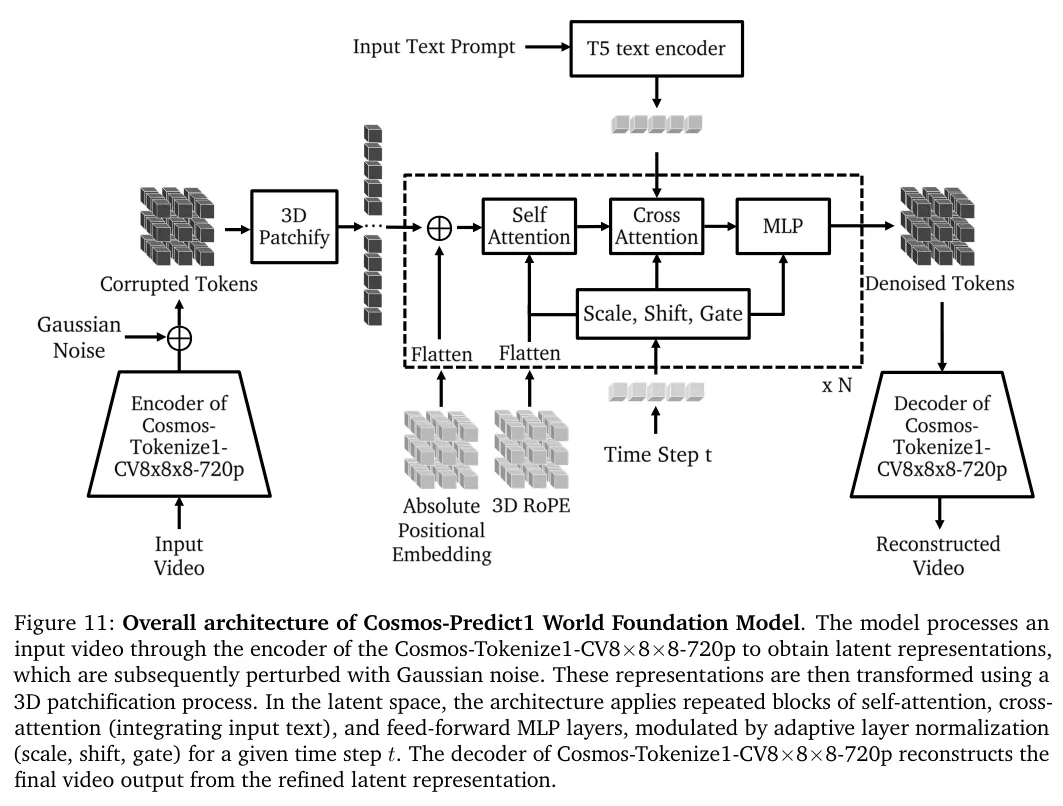
原文:"our denoiser network Dθ ... builds upon DiT (Peebles & Xie, 2023) ... applies repeated blocks of self-attention, cross-attention (integrating input text), and feed-forward MLP layers, modulated by adaptive layer normalization (scale, shift, gate) for a given time step t."
拆解:
- 3D patchification:把 latent 切成小立方体 (p_t=1, p_h=p_w=2) → 拉平成一维时空 token 序列,长度 T·H·W/(p_t·p_h·p_w)。
- 每个 block:self-attention(时空内部关系)+ cross-attention(把文本条件塞进来)+ MLP。
- adaLN(scale/shift/gate):把"当前噪声档 t / σ"调制进每层归一化——让网络知道现在噪声多大(对应 Ch1 里网络要吃 σ)。
- 用 Cosmos-Tokenize1-CV8×8×8-720p 的连续 latent。
Training Strategy §5.1.3
原文:"Joint image and video training ... interleaves batches of image and video data ... a domain-specific normalization scheme that aligns the latent distributions ... frame-wise and channel-wise standardization ... better approximate an isotropic Gaussian prior."
要点:① 图像+视频交替训(借海量图像数据);② latent 归一化(对齐图/视频分布、逐帧逐通道标准化 → 更接近各向同性高斯先验),带来"信噪比尺度不变"的训练稳定性。
5.2 · 自回归 WFM(Autoregressive-based)
Architecture:Transformer + 3D 位置编码 §5.2.1
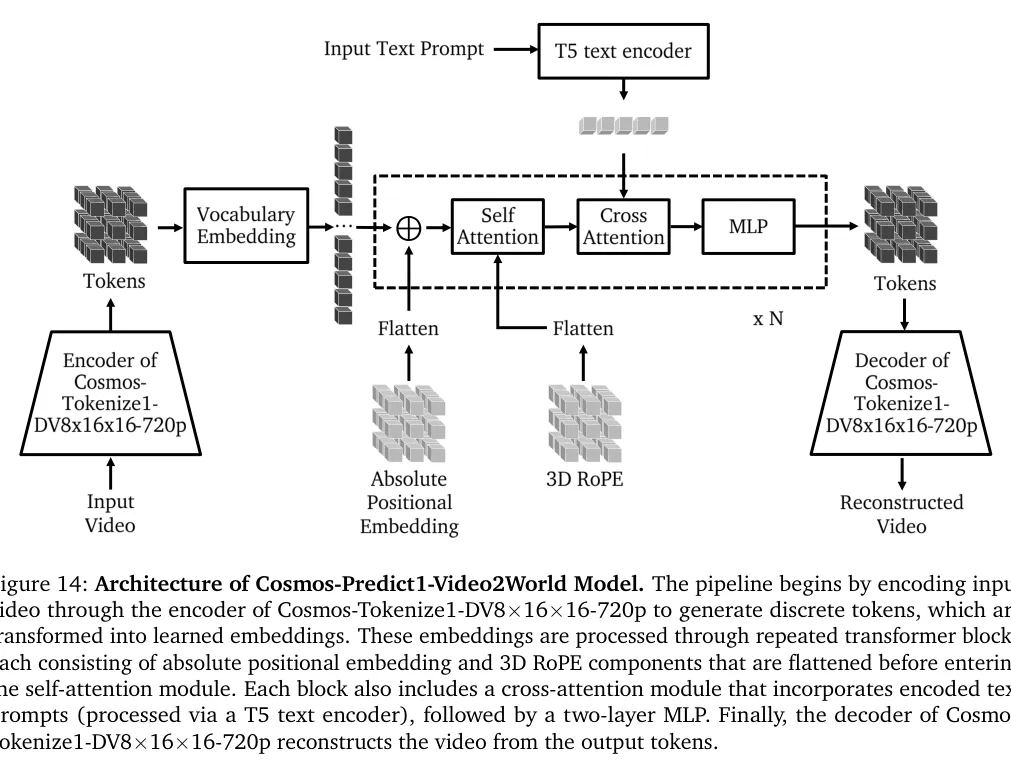
原文:"modifications to the standard transformer ... 1) 3D-aware positional embeddings, 2) cross-attention to enable textual inputs ... 3) QK-Normalization ... encoding input video through the encoder of Cosmos-Tokenize1-DV8×16×16 to generate discrete tokens ... 3D RoPE ... cross-attention module that incorporates encoded text prompts (processed via a T5 text encoder)."
拆解:像 GPT 一样逐 token 预测离散视频 token,但加了三样:3D RoPE + 3D 绝对位置编码(让 token 知道自己在时/高/宽的位置)、cross-attention 接 T5 文本(可控)、QK-Norm(稳训练)。用离散 DV8×16×16 tokenizer。
Diffusion Decoder:给离散 token"去糊" §5.2.5
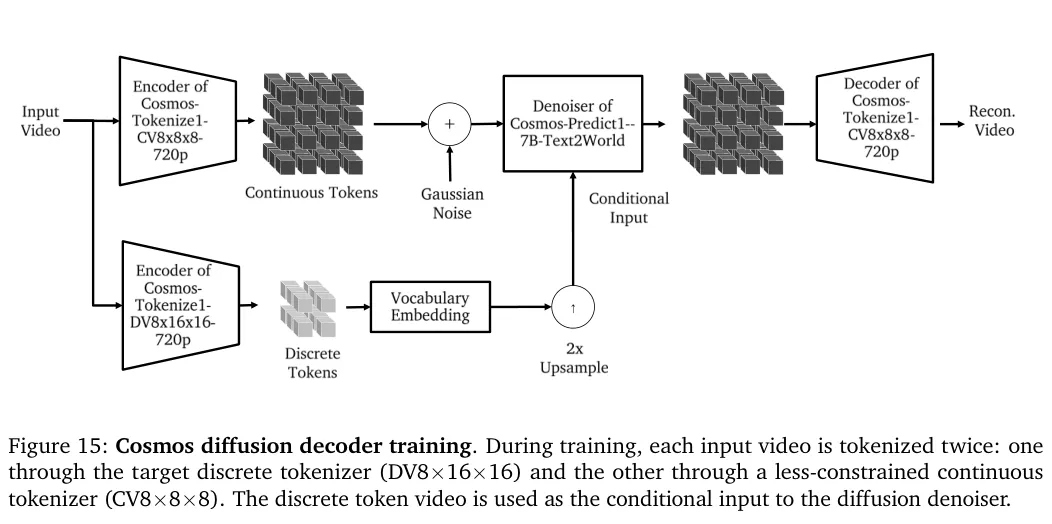
原文:"aggressive compression ... could lead to blurriness and visible artifacts ... especially in the autoregressive WFM ... where only a few integers ... We resort to the diffusion decoder ... by fine-tuning Cosmos-Predict1-7B-Text2Video."
这是重要的系统级细节(呼应 Ch4 的盲区):离散化压得狠 → 重建偏糊。Cosmos 把一个扩散模型微调成"解码器":训练时同一视频tokenize 两次(离散 DV8×16×16 当条件、连续 CV8×8×8 当目标),让扩散 decoder 把模糊的离散 token 精修成清晰视频。所以 AR 链路 = 自回归出 token + 扩散 decoder 精修两段式。
5.3 · 评估:3D 一致性 + 物理对齐 §5.3
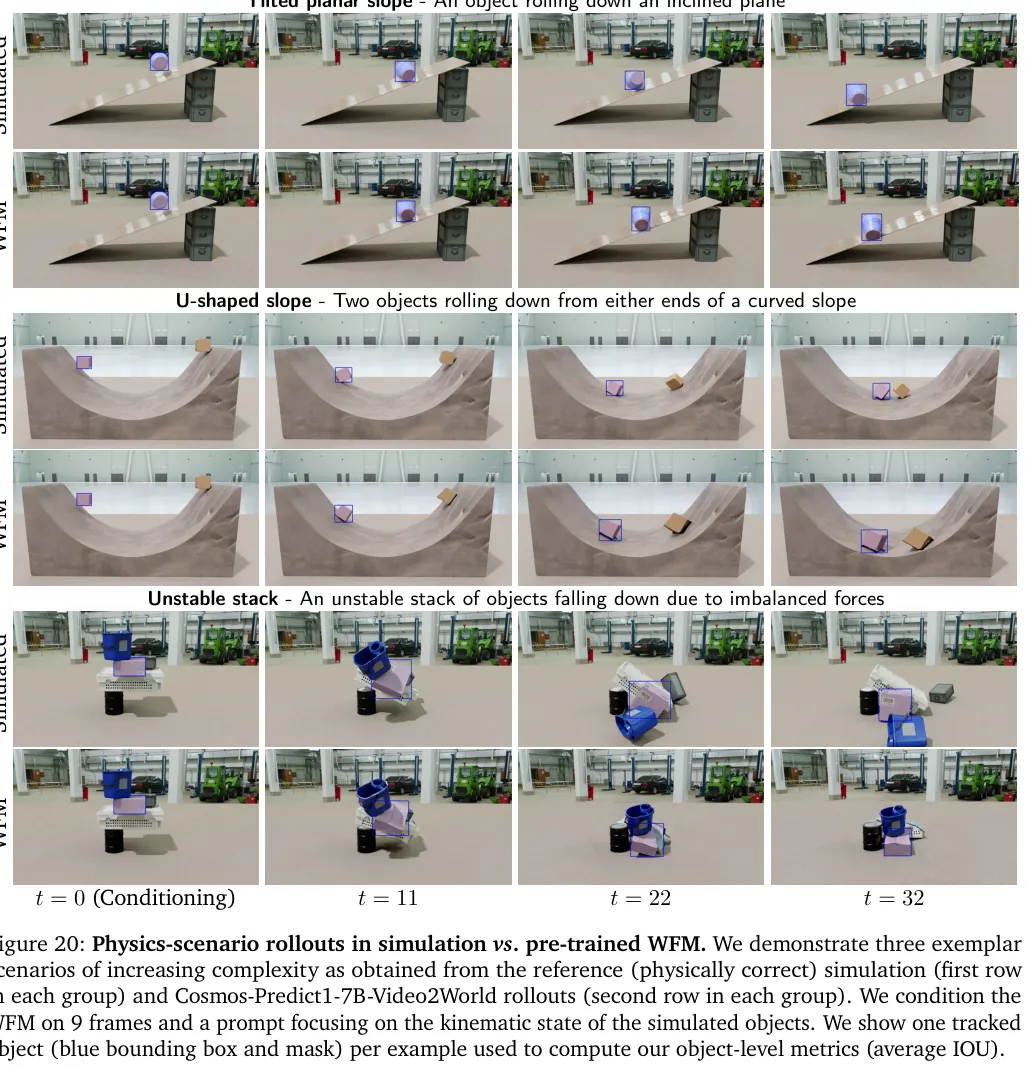
原文:"we evaluate our models on two aspects. First, ... the 3D consistency of the generated videos ... Second, ... the physics alignment ... how well the rendered dynamics adhere to the laws of physics."
| 维度 | 怎么测(原文) | 为什么重要 |
|---|---|---|
| 3D 一致性 | RealEstate10K 选 500 静态场景视频,用多视图几何工具测生成视频是否几何自洽 | 世界模型要模拟几何合理的 3D 世界,不能"穿帮" |
| 物理对齐 | 看生成动态是否符合物理定律(如运动、碰撞) | Physical AI 的根本要求 |
论文也坦承:"Evaluation of WFMs is a highly nontrivial task ... We leave a more comprehensive evaluation as future work." —— 呼应 Ch4 盲区:像素重建好 ≠ 世界模型强,3D/物理一致性才是关键且难测。
小结:两族 WFM 对照
| 扩散 WFM (§5.1) | 自回归 WFM (§5.2) | |
|---|---|---|
| 输入 token | 连续 latent (CV8×8×8) | 离散 token (DV8×16×16) |
| 骨架 | DiT(去噪) | Transformer(逐 token 预测) |
| 条件 | self+cross-attn(text)+adaLN(t) | 3D RoPE/APE + cross-attn(T5) + QK-Norm |
| 出图 | ODE/SDE 去噪 → 解码 | 逐 token + diffusion decoder 精修 |
| 特点 | 质量高 | 可流式/实时,但需 decoder 去糊 |
诚实边界:本章 formulation/架构/训练/评估均引自论文 §5 原文(标注小节);DiT/adaLN/RoPE/T5/QK-Norm 为通用组件术语。原图 fig11/14/15/20(按 figs.json 校准)配逐字英文 caption。具体超参、层数、λ(σ) 权重论文未全列,以官方
cosmos-predict1 源码为准。