DeepSeek-AI · Technical Report (arXiv:2606.19348, preview)
🏆 深度精读2026-04
DeepSeek-V4
Towards Highly Efficient Million-Token Context Intelligence
DeepSeek-AI ⋅ V4-Pro (1.6T / 49B activated) & V4-Flash (284B / 13B activated) ⋅ 1M context ⋅ MIT License
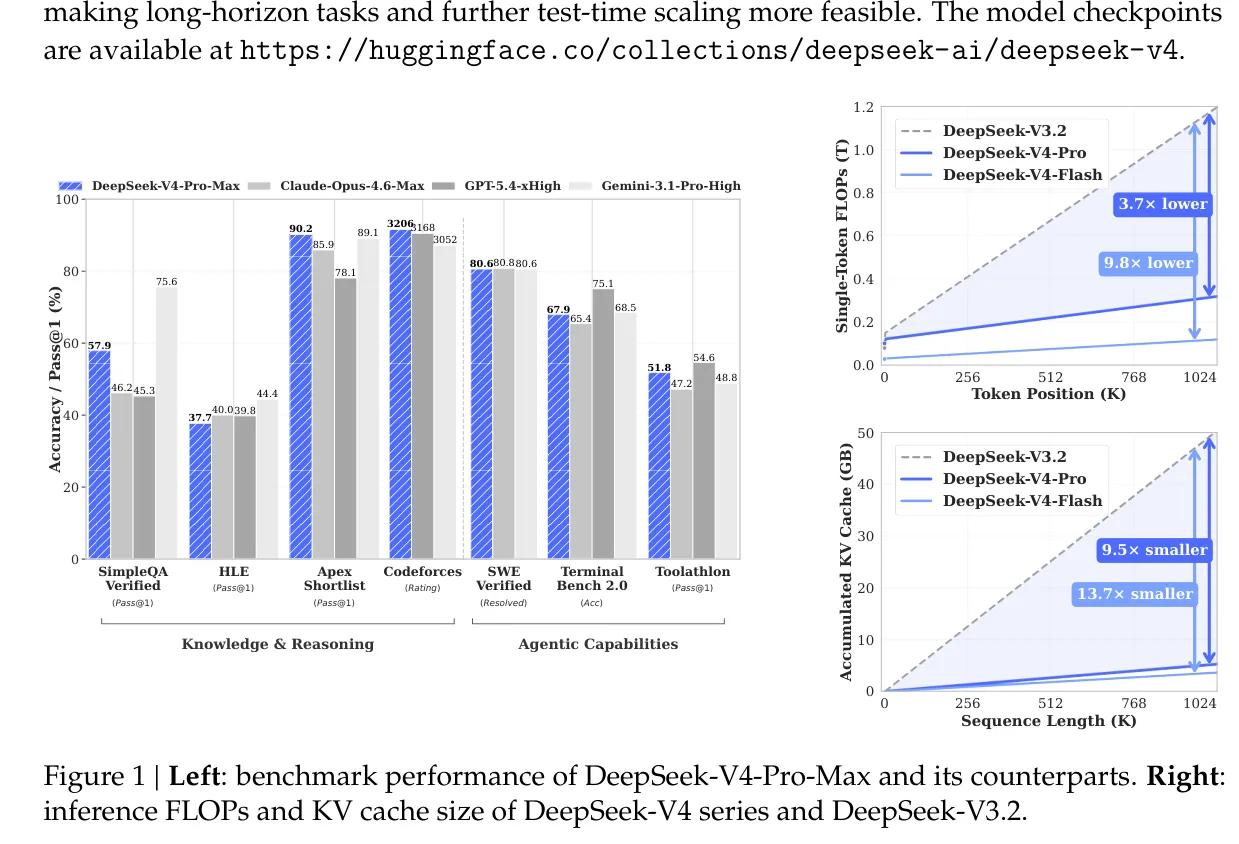
一句话:V4 的一切创新都围绕一个矛盾——vanilla attention 的 \(O(n^2)\) 复杂度卡死了「超长上下文 + test-time scaling + agent」这条路。它用混合注意力 CSA+HCA(压缩+稀疏)、mHC 残差稳定、Muon 优化器把 1M 上下文的成本压到 V3.2 的一小部分(Pro 27% FLOPs / 10% KV,Flash 10% / 7%),并在后训练用「先练领域专家 → 再多教师全词表 on-policy 蒸馏」取代了传统的统一混合 RL。作者坦承整体仍落后闭源 SOTA 约 3–6 个月。
摘要 Abstract(原文)
"We present a preview version of DeepSeek-V4 series, including two strong Mixture-of-Experts (MoE) language models — DeepSeek-V4-Pro with 1.6T parameters (49B activated) and DeepSeek-V4-Flash with 284B parameters (13B activated) — both supporting a context length of one million tokens. DeepSeek-V4 series incorporate several key upgrades in architecture and optimization: (1) a hybrid attention architecture that combines Compressed Sparse Attention (CSA) and Heavily Compressed Attention (HCA) to improve long-context efficiency; (2) Manifold-Constrained Hyper-Connections (mHC); (3) and the Muon optimizer for faster convergence and greater training stability. We pre-train both models on more than 32T diverse and high-quality tokens, followed by a comprehensive post-training pipeline that unlocks and further enhances their capabilities."
📝 全景导读(problem → solution → why)
灵魂一句
把「大模型继续 scale」的瓶颈重新定位到 注意力的二次复杂度 上——"this scaling paradigm is fundamentally constrained by the quadratic computational complexity of the vanilla attention mechanism ... a prohibitive bottleneck for ultra-long contexts"(§1)。V4 的每一个架构选择都是为拆掉这堵墙服务的。
problem · 要解决什么
test-time scaling(长思维链)与 agentic 长程任务都要吃超长上下文,但 vanilla attention 的 \(O(n^2)\) 计算 + 线性增长的 KV cache 让 1M 上下文在算力与显存上都不可承受。
solution · 给出的方案
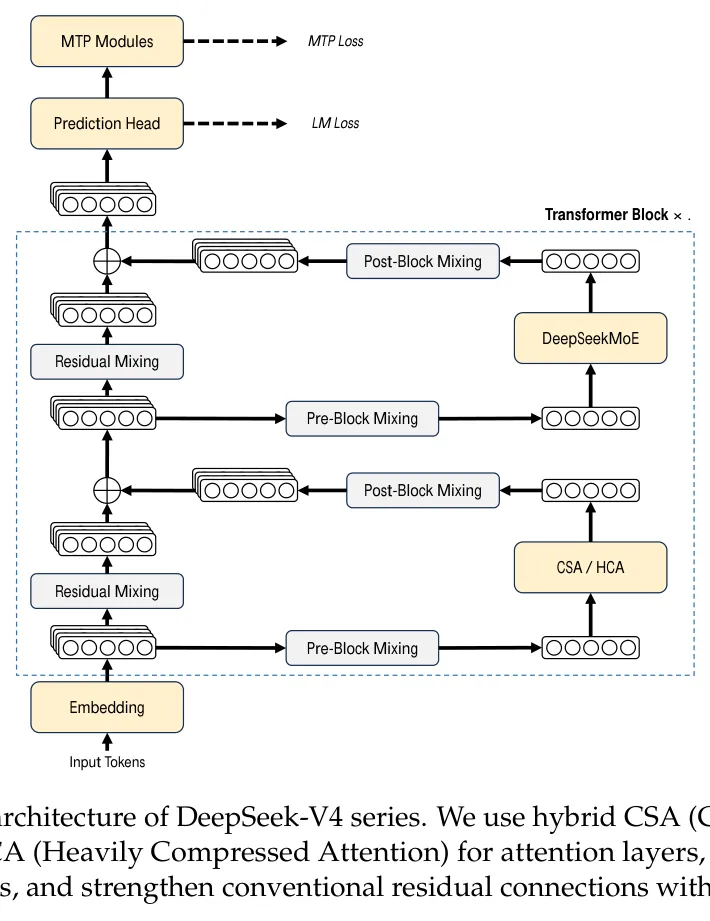
三大架构/优化升级:(1) Hybrid Attention(CSA + HCA) 压缩+稀疏降长上下文成本;(2) mHC(Manifold-Constrained Hyper-Connections) 稳住深层残差;(3) Muon 优化器 加速收敛、增强稳定。后训练则废弃统一混合 RL,改为「专家 SFT+GRPO → 多教师 OPD 蒸馏」。
why · 凭什么成立(效率硬数字)
1M 上下文下,V4-Pro 只需 V3.2 的 27% 单 token 推理 FLOPs、10% KV cache;V4-Flash 更低至 10% FLOPs、7% KV(§1/Abstract)。相对经典 BF16 GQA baseline,1M 场景 KV cache 可降到 ≈2%。Figure 1 右图换算成倍数更直观:FLOPs Pro 3.7× / Flash 9.8× 更低,KV cache Pro 9.5× / Flash 13.7× 更小。
两个模型规格
V4-Pro:1.6T 总 / 49B 激活,61 层,训 33T tokens。V4-Flash:284B 总 / 13B 激活,43 层,训 32T tokens。两者均原生 1M 上下文、MIT 开源;均提供 Non-think / Think High / Think Max 三档推理。
📚 背景:为什么「稀疏 / 压缩注意力」是主线(外部知识,非本文原文)
标准注意力每个 query 要看全部 key,计算和 KV cache 都随序列线性/二次膨胀。DeepSeek 自 V3.2 起走「可学习稀疏注意力(DSA/NSA 一脉)」路线:用一个轻量打分器只挑最相关的少量 KV 做精算。V4 把它升级成「压缩(HCA) + 压缩后再稀疏选(CSA)」的混合体。
§1 Introduction
Introduction 已把 method 的自然语言版讲清楚(problem→solution→why 见上「全景导读」)。此外它明确列出三类贡献:架构(CSA+HCA、mHC、Muon)、基础设施(EP 通算重叠、TileLang、batch-invariant/确定性 kernel、异构 KV cache 等)、后训练(专家培养 + on-policy 蒸馏)。
自评定位(很诚实):推理能力上 V4-Pro-Max "superior ... relative to GPT-5.2 and Gemini-3.0-Pro",但 "falls marginally short of GPT-5.4 and Gemini-3.1-Pro, suggesting a developmental trajectory that trails state-of-the-art frontier models by approximately 3 to 6 months"。
§2 Architecture
2.1 继承自 DeepSeek-V3 的设计
沿用 DeepSeekMoE(细粒度专家 + 共享专家)、MTP(多 token 预测)、aux-loss-free load balancing(用 bias 项做负载均衡,不加辅助损失)。注意:MLA 被替换掉了(换成 CSA/HCA),不属于「继承」。
2.2 Manifold-Constrained Hyper-Connections (mHC)
📚 背景:Hyper-Connections(外部知识)
HC 是残差连接的推广——把单一残差流扩成 \(n\) 条、用可学习矩阵混合,缓解 residual/表示塌缩。但混合矩阵不受约束时会放大信号、深层堆叠不稳。
本文创新:把残差映射矩阵约束到双随机矩阵流形(Birkhoff polytope),使其谱范数 \(\le 1\) → 非扩张(non-expansive) → 深层信号传播稳定。实现上用 Sinkhorn-Knopp 迭代(max 20 步)投影到双随机流形,expansion factor \(n_{hc}=4\)。工程开销仅约 6.7%(靠 recomputation + fused kernel 压下,见 §3.4)。
核心公式(据本地 PDF 还原,下标无丢失)
HC 残差更新(Eq.1)——把残差流从 \(\mathbb{R}^{d}\) 扩宽到 \(\mathbb{R}^{n_{hc}\times d}\):
\[ X_{l+1} = B_l X_l + C_l\,\mathcal{F}_l(A_l X_l) \]
manifold 约束(Eq.2)——把残差变换矩阵 \(B_l\) 约束到双随机矩阵流形(Birkhoff 多胞形),从而谱范数 \(\lVert B_l\rVert_2 \le 1\)(非扩张):
\[ B_l \in \mathcal{M} := \{\, M\in\mathbb{R}^{n\times n} \mid M\mathbf{1}_n=\mathbf{1}_n,\ \mathbf{1}_n^{\top}M=\mathbf{1}_n^{\top},\ M\ge 0 \,\} \]
用 Sinkhorn–Knopp 迭代(Eq.8,\(t_{\max}=20\),\(\mathcal{T}_r/\mathcal{T}_c\) 为行/列归一化)投影到该流形:
\[ M^{(0)}=\exp(\tilde{B}_l),\quad M^{(t)} = \mathcal{T}_r\!\big(\mathcal{T}_c(M^{(t-1)})\big),\quad B_l=M^{(t_{\max})} \]
变量:\(X_l\in\mathbb{R}^{n_{hc}\times d}\) 残差状态;\(A_l/B_l/C_l\) 输入/残差/输出映射(\(A_l=\sigma(\tilde A_l),\ C_l=2\sigma(\tilde C_l)\) 保正有界);\(\mathcal{F}_l\) 第 l 层(如 MoE);\(n_{hc}=4\)。
诚实边界:mHC 完整工程实现细节报告未展开(指向 Xie et al. 2026);上式已用本地 PDF 文本层 + 逐式渲染核对,仅 \(\mathcal{T}_r/\mathcal{T}_c\) 原文只给名称、未给逐元素展开。
2.3 Hybrid Attention:CSA + HCA(核心)
两种压缩注意力交错(interleaved) 堆叠,分工明确:
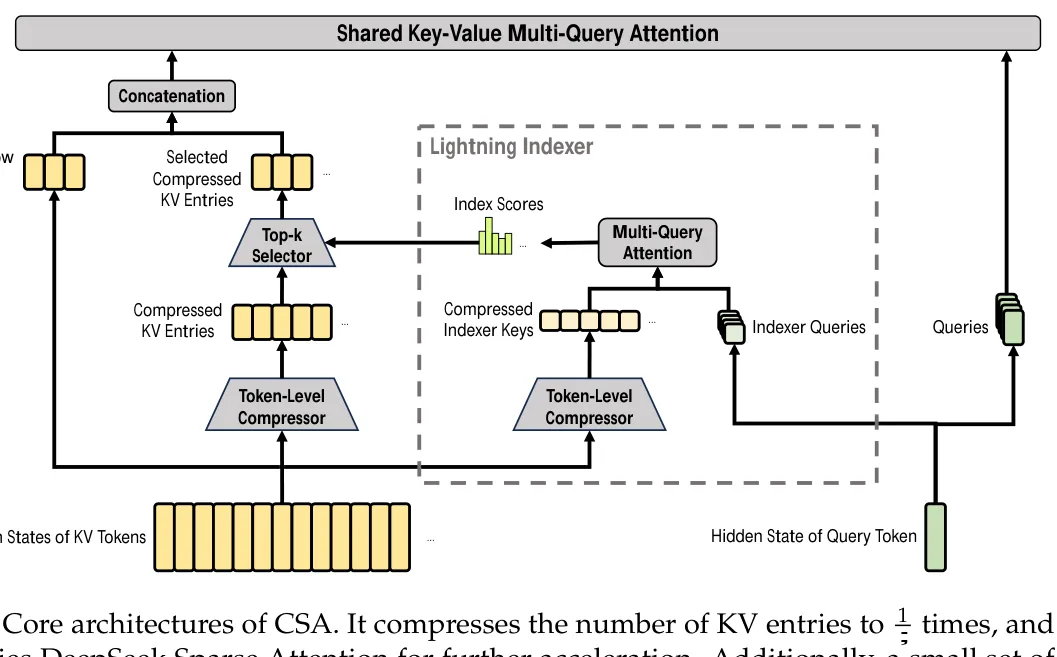
① Compressed Sparse Attention (CSA) — 管「选相关」:
- 先把每 \(\ell\) 个 token 的 KV 压成 1 条(compression rate \(\ell=4\),实际压 1/4);
- 用 lightning indexer(indexer query heads 64、head dim 128)算 index score;
- top-k 选出最相关的压缩 KV 条目(Flash top-k=512 / Pro=1024)做 MQA core attention。
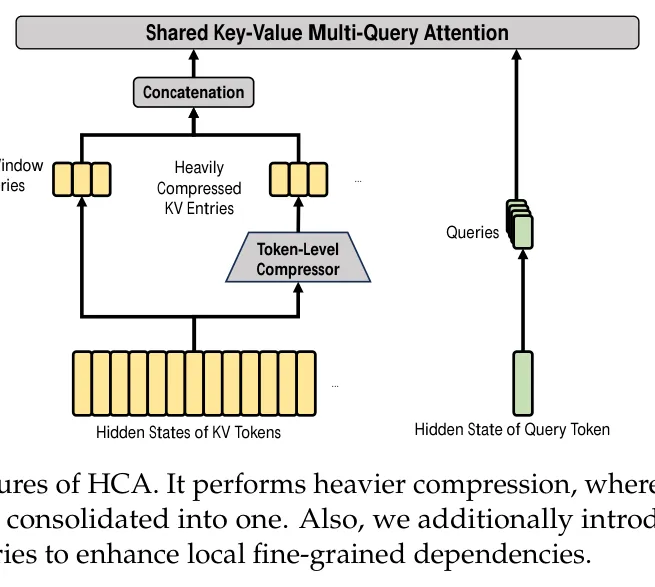
② Heavily Compressed Attention (HCA) — 管「极致压缩」:"aims for extreme compression by consolidating the KV cache of every ℓ′ (≫ℓ) tokens into a single entry",\(\ell'=128\),dense 不稀疏。
其他细节:core attention 用 shared-KV MQA(一份 KV 服务所有 query head);query head 很大,故做 grouped output projection(Flash 8 组 / Pro 16 组)降算力;partial-RoPE;每 query 额外接一条 sliding-window(w=128) 分支补局部依赖;带 attention sink(可学习 logit 让注意力和可不为 1)。
效率(2.3.4):1M 上下文下 KV cache ≈ 基线的 2%——这是「高效百万上下文」的硬支撑。CSA 管「从压缩序列里选相关」、HCA 管「把远处历史极致压扁」,二者互补。
CSA 关键公式(Eq.11–19,据本地 PDF)
① KV 压缩(Eq.12)——每 \(m\) 个 token 的 KV 用 softmax 权重加权合并成 1 条(相邻块重叠),序列长压到 \(1/m\):
\[ C^{\text{Comp}}_{i} = \sum_{j=mi}^{m(i+1)-1} S^{a}_{j}\odot C^{a}_{j} \;+\; \sum_{j=m(i-1)}^{mi-1} S^{b}_{j}\odot C^{b}_{j} \]
② Lightning indexer 打分(Eq.16)——query \(t\) 对压缩块 \(s\) 的相关性 = 多头 ReLU 内积加权和:
\[ I_{t,s} = \sum_{h=1}^{n^{I}_{h}} w^{I}_{t,h}\cdot \operatorname{ReLU}\!\big(q^{I}_{t,h}\cdot K^{\text{IComp}}_{s}\big) \]
③ top-k 稀疏选择(Eq.17)+ shared-KV MQA 核心注意力(Eq.19):
\[ \mathcal{C}^{\text{SprsComp}}_{t} = \big\{\, C^{\text{Comp}}_{s} \mid I_{t,s}\in \mathrm{Top\text{-}k}(I_{t,:}) \,\big\},\qquad o_{t,i} = \operatorname{CoreAttn}\!\big(q_{t,i},\ \mathcal{C}^{\text{SprsComp}}_{t},\ \mathcal{C}^{\text{SprsComp}}_{t}\big) \]
HCA 关键公式(Eq.22–26)
每 \(m'\!\gg\! m\) 个 token 合并成 1 条(不重叠、压缩更重),且 不做 top-k 稀疏,MQA 用全部压缩 KV:
\[ C^{\text{Comp}}_{i} = \sum_{j=m'i}^{m'(i+1)-1} S_{j}\odot C_{j},\qquad o_{t,i} = \operatorname{CoreAttn}\!\big(q_{t,i},\ C^{\text{Comp}},\ C^{\text{Comp}}\big) \]
Attention sink(Eq.27)——给每个头一个可学习 sink logit \(z'_h\) 加进 softmax 分母,允许该头注意力和不为 1:
\[ s_{h,i,j} = \frac{\exp(z_{h,i,j})}{\sum_{k}\exp(z_{h,i,k}) + \exp(z'_{h})} \]
2.4 Muon Optimizer
📚 背景:Muon(外部知识)
Muon 对隐藏层 2D 权重矩阵做 momentum+Nesterov 后,用 Newton–Schulz 迭代把更新量正交化,再按 \(\sqrt{\max(m,n)}\cdot\text{rescale}\) 缩放。
本文:用 hybrid Newton–Schulz(8+2 步);带来 "faster convergence and improved training stability",且免去 QK-Clip。仅用于大部分参数,embedding / prediction head / 所有 RMSNorm 仍用 AdamW(它们不是典型 2D 隐藏矩阵);update-RMS rescale=0.18 是为复用 AdamW 的学习率标度。
核心公式(Eq.28 + Algorithm 1,据本地 PDF)
Hybrid Newton–Schulz 正交化迭代——把更新矩阵近似正交化到 \(UV^{\top}\)(前 8 步 \((a,b,c)=(3.4445,-4.7750,2.0315)\) 快速收敛,后 2 步 \((2,-1.5,0.5)\) 把奇异值稳到 1):
\[ M_k = a\,M_{k-1} + b\,(M_{k-1}M_{k-1}^{\top})M_{k-1} + c\,(M_{k-1}M_{k-1}^{\top})^{2}M_{k-1} \]
单步更新(动量 + Nesterov + 正交化 + \(\sqrt{\max(n,m)}\) 缩放 + 解耦权重衰减):
\[ M_t = \mu M_{t-1} + G_t,\quad O_t = \operatorname{NS}(\mu M_t + G_t)\cdot\sqrt{\max(n,m)}\cdot\gamma,\quad W_t = W_{t-1}(1-\eta\lambda) - \eta\,O_t \]
§3 General Infrastructures(训练/推理基建)
这一章是 V4「工程即模型」哲学的集中体现——很多架构选择是和系统协同设计的。
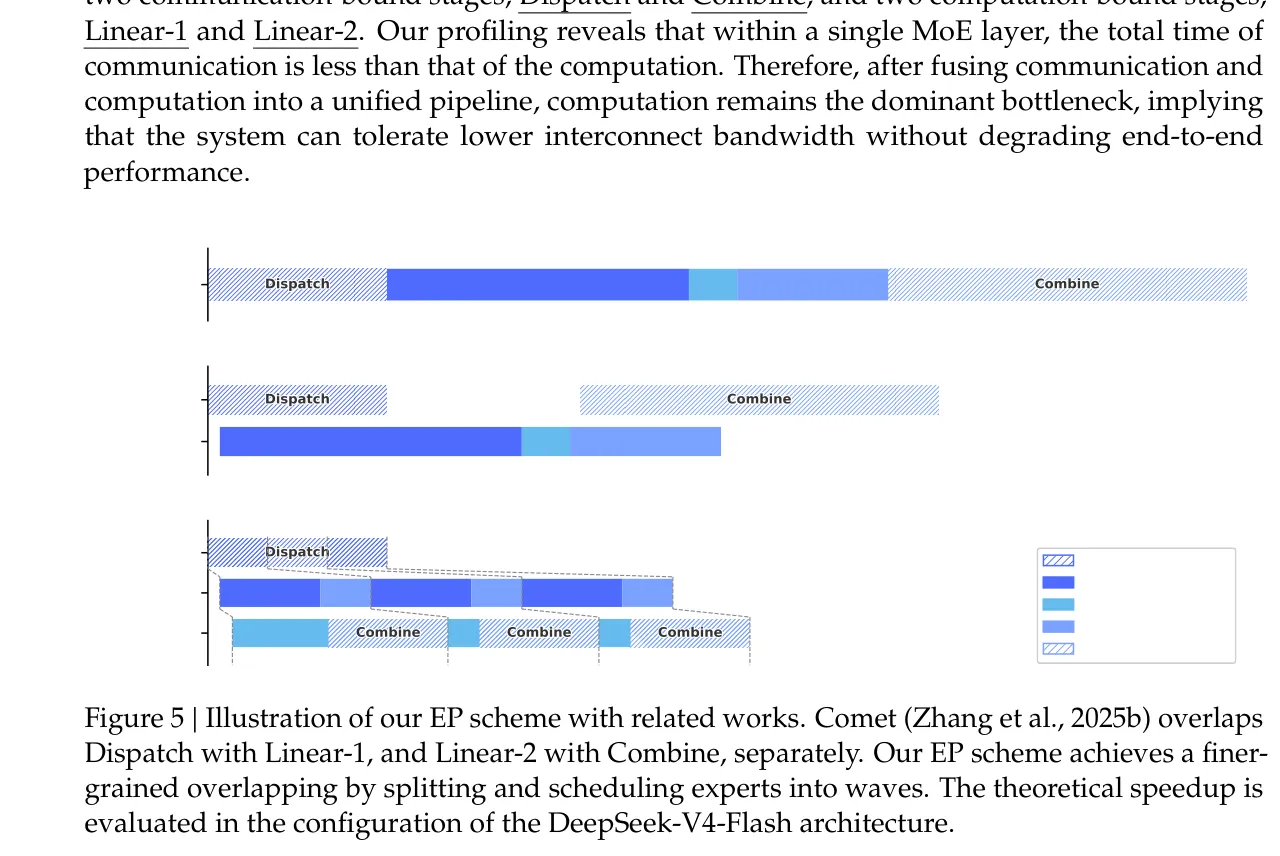
3.1 EP 细粒度通信-计算重叠:MoE 的 all-to-all 通信易暴露成瓶颈;V4 做细粒度算通重叠,实测 1.50–1.73× 加速(RL/延迟敏感场景峰值 1.96×,理论 1.42→1.92×),并开源了 MegaMoE。
3.2 TileLang 写 kernel:把 kernel 的 host 调用开销从数百 μs 压到 <1 μs,配合 Z3 SMT 求解器做 tile 配置,并支持逐位(bitwise)可复现。
3.3 Batch-Invariant / Deterministic Kernels(本章独门点):dual-kernel attention、用 DeepGEMM 替 cuBLAS(弃 split-k)、反向弃用 atomicAdd——保证 batch-invariance + 确定性,直击 RL 训练-推理数值失配(rollout 走推理引擎、更新走训练引擎,两者数值不一致会毒化 RL)。
3.4 训练框架:为 Muon 定制 hybrid ZeRO(梯度 BF16 通信、通信量减半,ZeRO padding <10%);mHC 低成本实现(recomputation+fused kernel,开销 6.7%);two-stage contextual parallelism(两阶段上下文并行,服务压缩注意力的长序列);autograd 的 tensor-level checkpointing(细粒度重算控制)。
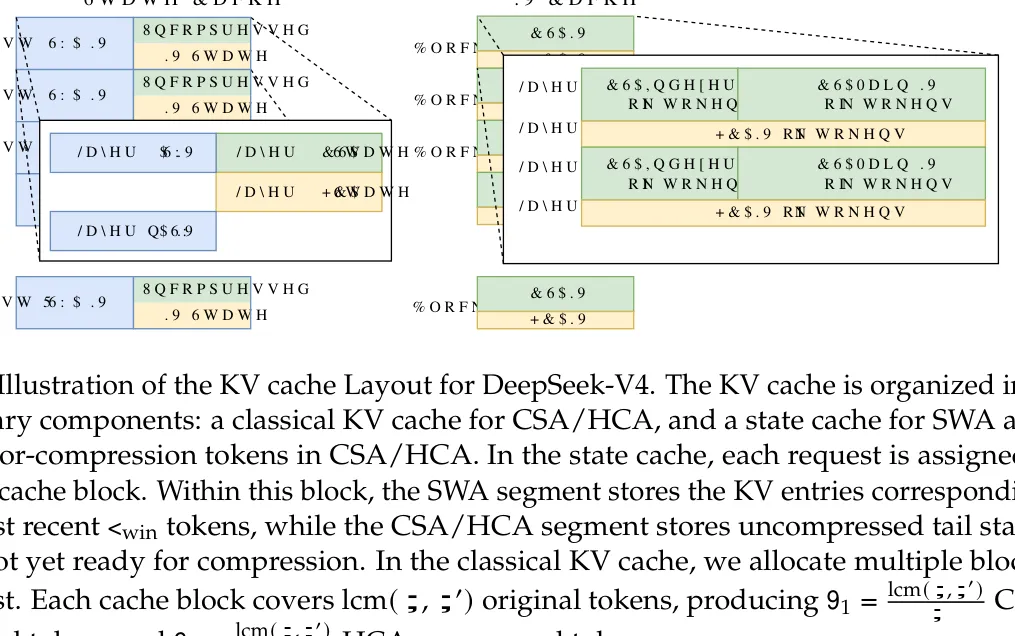
3.5 推理框架:异构 KV cache(CSA/HCA/SWA 三种 KV 布局不同)+ State Cache + 落盘 on-disk 共享前缀复用三档策略,支撑 1M 上下文的服务。
§4 Pre-Training
4.1 数据
语料 >32T tokens(数学/代码/网页/长文档等),在 V3 数据上做「更高质量、更长有效上下文」的增量。网页去污过滤 "batched auto-generated and templated content" 以 "mitigating the risk of model collapse";agentic 数据在 mid-training 阶段引入;关键差异是预训练用 sample-level attention masking(打包多文档到同序列时阻断跨文档串扰);沿用 128K 词表 + FIM。
4.2 模型配置对照表(Flash vs Pro)
| 超参 | V4-Flash | V4-Pro |
|---|---|---|
| 层数 / hidden dim | 43 / 4096 | 61 / 7168 |
| 前两层注意力 | 纯 Sliding Window | HCA |
| CSA 压缩率 / top-k | 4 / 512 | 4 / 1024 |
| HCA 压缩率 ℓ′ | 128 | 128 |
| query heads / head dim | 64 / 512 | 128 / 512 |
| query 压缩维 / 输出分组 | 1024 / 8 | 1536 / 16 |
| routed / shared experts | 256 / 1 | 384 / 1 |
| expert 中间维 / 每 token 激活 | 2048 / 6 | 3072 / 6 |
| 前 3 个 MoE 层 routing | Hash routing | Hash routing |
| MTP depth / mHC \(n_{hc}\) | 1 / 4 | 1 / 4 |
| 总参 / 激活参 | 284B / 13B | 1.6T / 49B |
前 3 个 MoE 层用无参确定性的 Hash routing 稳住训练早期(router 早期最易塌缩)。
4.3 训练配置与稳定性
优化器:主体 Muon + embedding/head/RMSNorm 用 AdamW。序列长度渐进:4K → 16K → 64K → 1M;先 dense attention warmup(Flash 前 1T tokens),到 64K 处引入稀疏,且先短暂「热身」CSA 的 lightning indexer 再全程稀疏训练(否则一上来就稀疏会选错 KV、训崩)。MTP loss weight 末期 0.3→0.1。
| 训练配置(§4.2.2) | V4-Flash | V4-Pro |
|---|---|---|
| 主体优化器 / 其余模块 | Muon / AdamW(embedding·head·RMSNorm) | 同 Flash |
| Muon momentum / wd / update-RMS rescale | 0.95 / 0.1 / 0.18 | 同 Flash |
| 训练 token 数 | 32T | 33T |
| max batch size (tokens) | 75.5M | 94.4M |
| peak LR / end LR (cosine) | 2.7×10⁻⁴ / 2.7×10⁻⁵ | 2.0×10⁻⁴ / 2.0×10⁻⁵ |
| 序列长度分阶段 | 4K → 16K → 64K → 1M | 4K → 16K → 64K → 1M |
| dense warmup / 稀疏引入点 | 前 1T tokens / seq=64K | 更长 dense 阶段 / seq=64K |
| bias update / balance loss(aux-free) | 0.001 / 0.0001 | 0.001 / 0.0001 |
| MTP loss weight | 0.3 → 0.1 | 0.3 → 0.1 |
稳定性两技巧(诊断:"spikes ... consistently tied to outliers in the MoE layers, and the routing mechanism itself appears to exacerbate ... these outliers"):
- Anticipatory Routing:解耦 backbone 与 router 的同步更新,routing indices 用历史参数预取预计算;额外开销压到 ~20% 且只在 loss spike 时自动触发。
- SwiGLU Clamping:线性分量钳到 [−10,10]、gate 上界 10,直接消 outlier,且不损性能。
诚实边界:作者明说这两个技巧的机理 "remains an open question"——有效但没完全搞懂为什么。
4.4 Base 模型评测(Table 1,节选)
| 维度 | Benchmark | V3.2-Base (37B/671B) | V4-Flash-Base (13B/284B) | V4-Pro-Base (49B/1.6T) |
|---|---|---|---|---|
| 知识 | MMLU-Pro | 65.5 | 68.3 | 73.5 |
| 知识 | FACTS Parametric | 27.1 | 33.9 | 62.6 |
| 知识 | Simple-QA verified | 28.3 | 30.1 | 55.2 |
| 知识 | MultiLoKo | 38.7 | 42.2 | 51.1 |
| 代码 | HumanEval | 62.8 | 69.5 | 76.8 |
| 数学 | MATH | 60.5 | 57.4 | 64.5 |
| 长文 | LongBench-V2 | 40.2 | 44.7 | 51.5 |
结论:Flash-Base 以更小参数打赢更大的 V3.2-Base(尤其世界知识/长上下文);Pro-Base 近乎全面碾压,知识密集型(FACTS 27→63、SimpleQA 28→55)提升最猛。
§5 Post-Training(本报告最大创新之一)
两阶段范式,整段替换 V3.2 的混合 RL。RL 没消失,而是被「下放」到第一阶段的每个专家内部;第二阶段的合并完全交给蒸馏。
Stage 1 · 领域专家(SFT → GRPO-RL)
数学/代码/agent/指令遵循等各自从 base 出发独立训(>10 个专家)。易验证任务用规则/测试用例打分;难验证任务弃用标量 RM,改用 生成式奖励模型 GRM——actor 兼任裁判,rubric 引导、直接对「评判行为」也做 RL,联合优化生成与评判,只需极少人工标注。RL 算法为 GRPO(超参沿用 R1/V3;报告未重推 GRPO 公式)。
Stage 2 · On-Policy Distillation (OPD)
把 10+ 专家蒸成一个学生。学生自采 rollout,按加权反向 KL 向「当前任务最相关专家」对齐:
\[ \mathcal{L}_{\text{OPD}}(\theta)=\sum_{i=1}^{N} w_i\, D_{\mathrm{KL}}\!\left(\pi_\theta \,\big\|\, \pi_{p_i}\right) \]
full-vocabulary logit 蒸馏:不像别的方法只对采样到的 token 打分(token-level 估计方差大、易不稳),V4 用完整词表(>100k)的 logit 分布算 reverse KL,更稠密更稳。工程避免爆显存:只缓存 teacher 最后一层 hidden state、训练时现场重构 logits + 按 teacher index 排序样本使单头驻留 + TileLang kernel 算 KL。
📚 为什么这么设计(相比 V3.2 混合 RL)
多领域目标同时 RL 容易互相打架/退化,权重合并也退化。先让专家各自练到最好,再用 logits 层面的蒸馏把能力融进统一参数空间,规避了混合 RL / 权重合并的退化。代价:full-vocab 蒸馏会把坏 teacher 的错误也精确编码进 student,专家数据质量即天花板。
配套设计
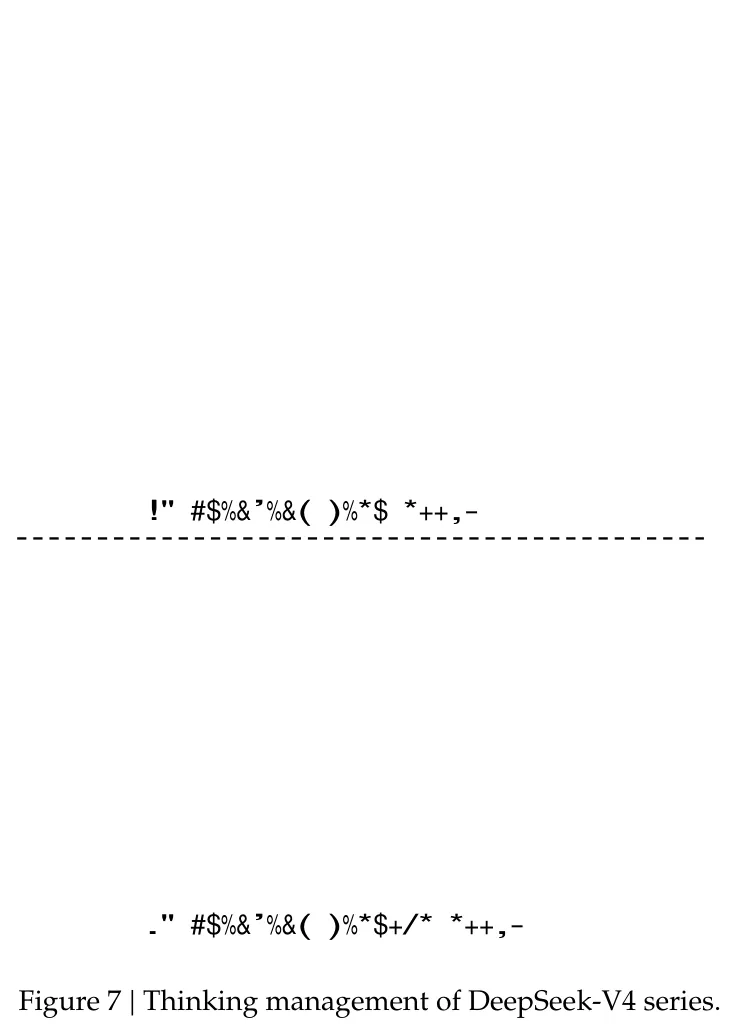
三档 reasoning effort(Non-think / Think High / Think Max,用
<think> 分隔;靠不同 length penalty + context window 训出);Interleaved Thinking(1M 上下文下工具调用全程保留推理痕迹、跨 user message 不丢);|DSML| XML 工具调用格式(比 JSON 更少转义/调用错误);FP4(MXFP4) QAT(MoE 权重 + CSA indexer QK path,FP4→FP8 无损反量化以复用 FP8 框架);token 粒度 WAL 的可抢占容错 rollout(论证「从头重生成会引入 length bias」);DSec 沙箱(Rust,单集群数十万并发,四种执行底座)。| 推理模式 (Table 2) | 定位 | 响应格式 | 评测 context |
|---|---|---|---|
| Non-think | 快速直觉,日常 / 低风险 | 无 <think>,仅 summary | 8K |
| Think High | 有意识分析、更慢更准,复杂中等风险 | <think>thinking</think> summary | 128K |
| Think Max | 推理推到极限、探索模型能力边界 | High + system prompt 注入指令 | 384K |
Think Max 注入指令(Table 3 原文节选):"Reasoning Effort: Absolute maximum with no shortcuts permitted. You MUST be very thorough ..."——要求彻底分解问题定位根因、对所有路径/边界/对抗场景压力测试、把被否决的假设也显式写出。
📊 全文评测汇总
Instruct 模型:Flash vs Pro × 三档推理(Table 7 节选)
| 维度 | Benchmark | Flash Non/High/Max | Pro Non/High/Max |
|---|---|---|---|
| 知识 | SimpleQA-Verified | 23.1 / 28.9 / 34.1 | 45.0 / 46.2 / 57.9 |
| 推理 | GPQA Diamond | 71.2 / 87.4 / 88.1 | 72.9 / 89.1 / 90.1 |
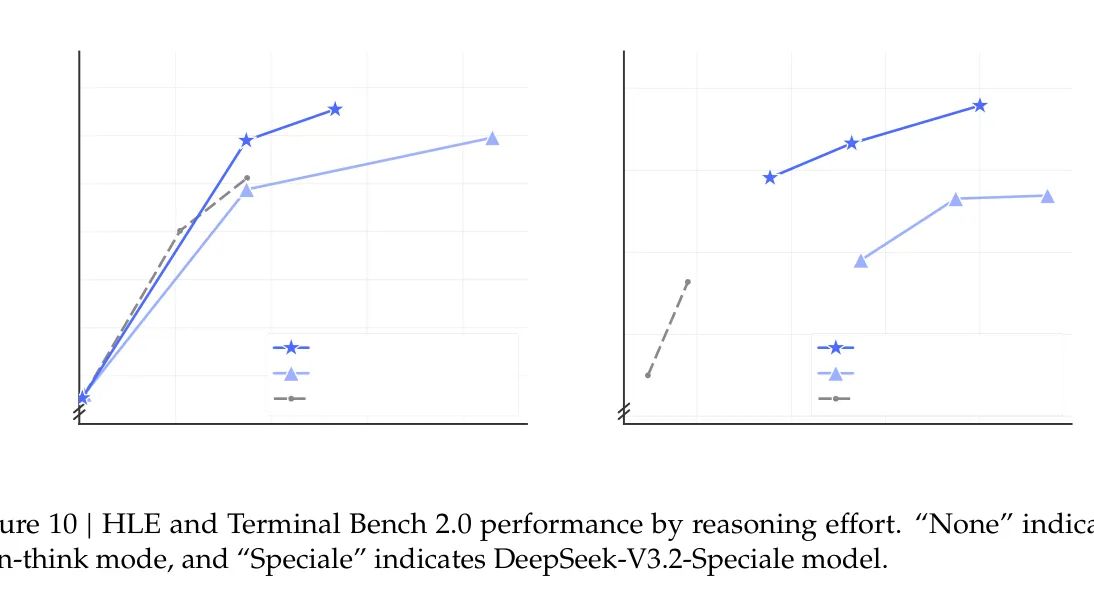
| 推理 | HLE | 8.1 / 29.4 / 34.8 | 7.7 / 34.5 / 37.7 |
| 代码 | LiveCodeBench | 55.2 / 88.4 / 91.6 | 56.8 / 89.8 / 93.5 |
| 代码 | Codeforces (Elo) | — / 2816 / 3052 | — / 2919 / 3206 |
| 数学 | HMMT 2026 Feb | 40.8 / 91.9 / 94.8 | 31.7 / 94.0 / 95.2 |
| 长文 | MRCR 1M | 37.5 / 76.9 / 78.7 | 44.7 / 83.3 / 83.5 |
| Agent | Terminal-Bench 2.0 | 49.1 / 56.6 / 56.9 | 59.1 / 63.3 / 67.9 |
| Agent | SWE Verified | 73.7 / 78.6 / 79.0 | 73.6 / 79.4 / 80.6 |
why(§5.3):"the Max mode, which employs longer contexts and reduced length penalties in RL, outperforms the High mode on the most challenging tasks." Non-think 在难题上崩塌(Apex:Pro 0.4→27.4→38.3),说明前沿数学/推理几乎完全依赖长思维链;Flash 与 Pro 差距主要在知识类,推理/代码给足 thinking budget 后 Flash 逼近 Pro。
vs 前沿模型(Table 6,可信部分节选)
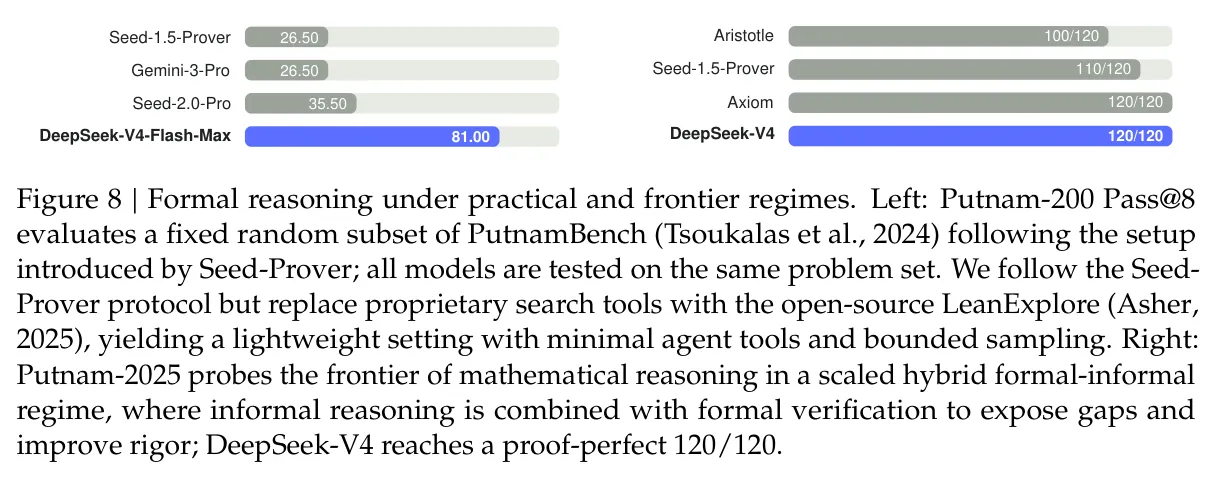
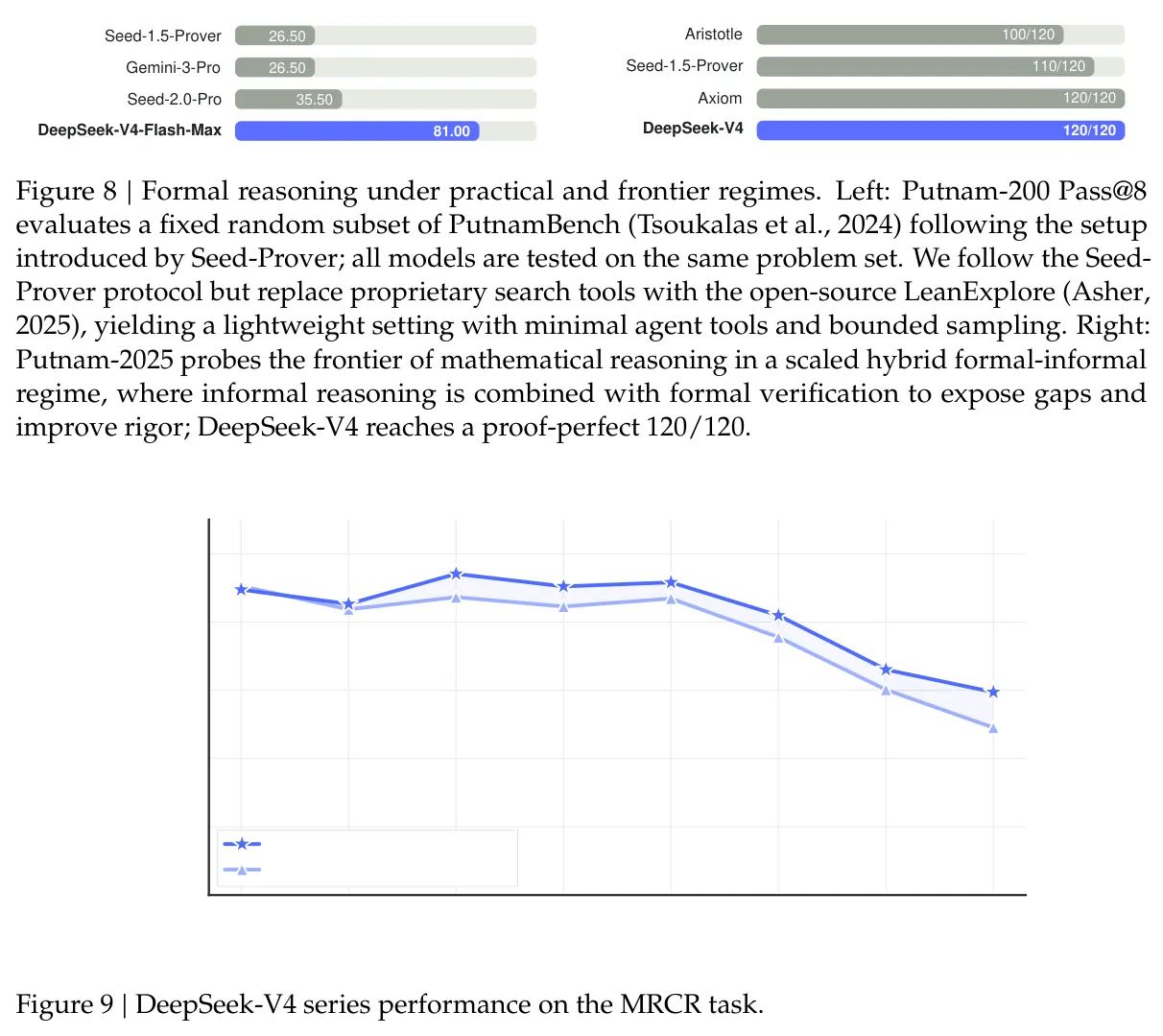
赢:Apex Shortlist(90.2)、Codeforces(3206,人类第 23)、LiveCodeBench(93.5)。负:SimpleQA-Verified(57.9 vs Gemini 75.6)、HLE、Terminal-Bench(GPT 75.1)、1M 长上下文(MRCR/CorpusQA 均落后 Claude Opus 4.6,但超过 Gemini-3.1-Pro)。形式化数学:Putnam-2025 DeepSeek-V4 = 120/120(proof-perfect)。
| Benchmark | Opus-4.6-Max | GPT-5.4-xHigh | Gemini-3.1-Pro | K2.6-Think | GLM-5.1-Think | DS-V4-Pro-Max |
|---|---|---|---|---|---|---|
| SimpleQA-Verified | 46.2 | 45.3 | 75.6 | 36.9 | 38.1 | 57.9 |
| HLE | 40.0 | 39.8 | 44.4 | 36.4 | 34.7 | 37.7 |
| Apex Shortlist | 85.9 | 78.1 | 89.1 | 75.5 | 72.4 | 90.2 |
| Codeforces (Elo) | — | 3168 | 3052 | — | — | 3206 |
| LiveCodeBench | 88.8 | — | 91.7 | 89.6 | — | 93.5 |
| Terminal-Bench 2.0 | 65.4 | 75.1 | 68.5 | 66.7 | 63.5 | 67.9 |
| SWE Verified | 80.8 | — | 80.6 | 80.2 | — | 80.6 |
| BrowseComp | 83.7 | 82.7 | 85.9 | 83.2 | 79.3 | 83.4 |
| GDPval-AA (Elo) | 1619 | 1674 | 1314 | 1482 | 1535 | 1554 |
| Toolathlon | 47.2 | 54.6 | 48.8 | 50.0 | 40.7 | 51.8 |
上表为已交叉核对的可信部分(Agentic 块 + Abstract 柱状图确认);知识/长文块因 OCR 行内错位未纳入。整体:DS-V4-Pro-Max 在 Apex Shortlist / Codeforces / LiveCodeBench 领先,SimpleQA / HLE 明显落后 Gemini-3.1-Pro,agent 类与闭源第一梯队接近但未超越。
诚实边界:Table 6 的知识/长文块在 arXiv→文本转换中出现「行内最优值错位」,竞品分数归属不确定处未硬编(DeepSeek 自身列已用 Table 7 交叉核对)。
真实场景
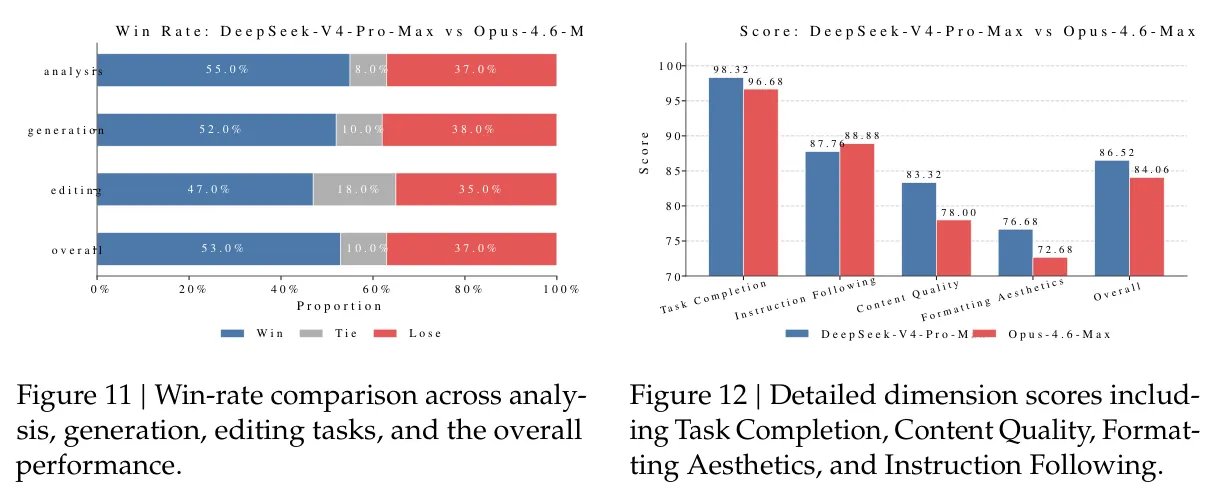
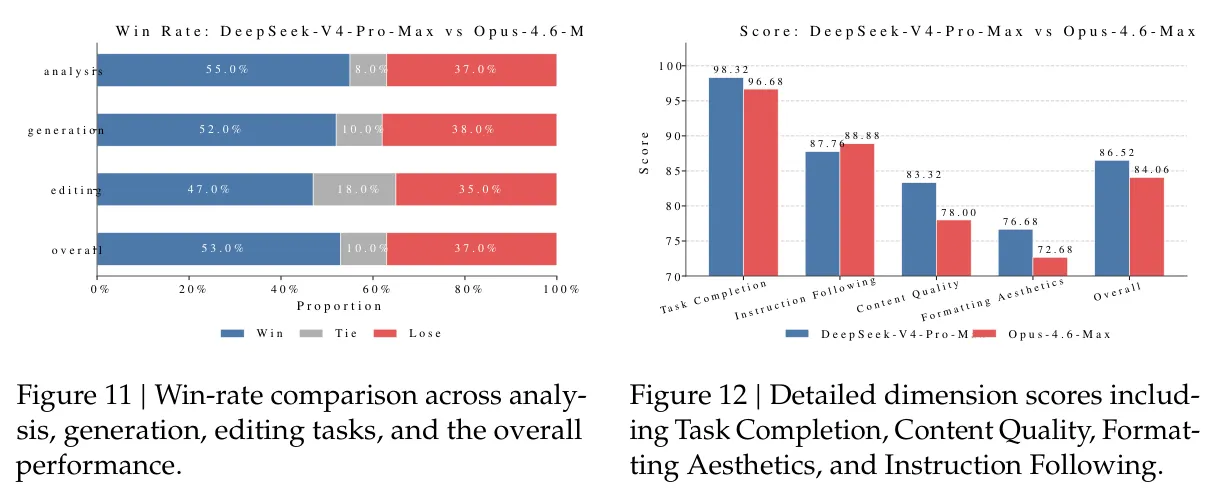
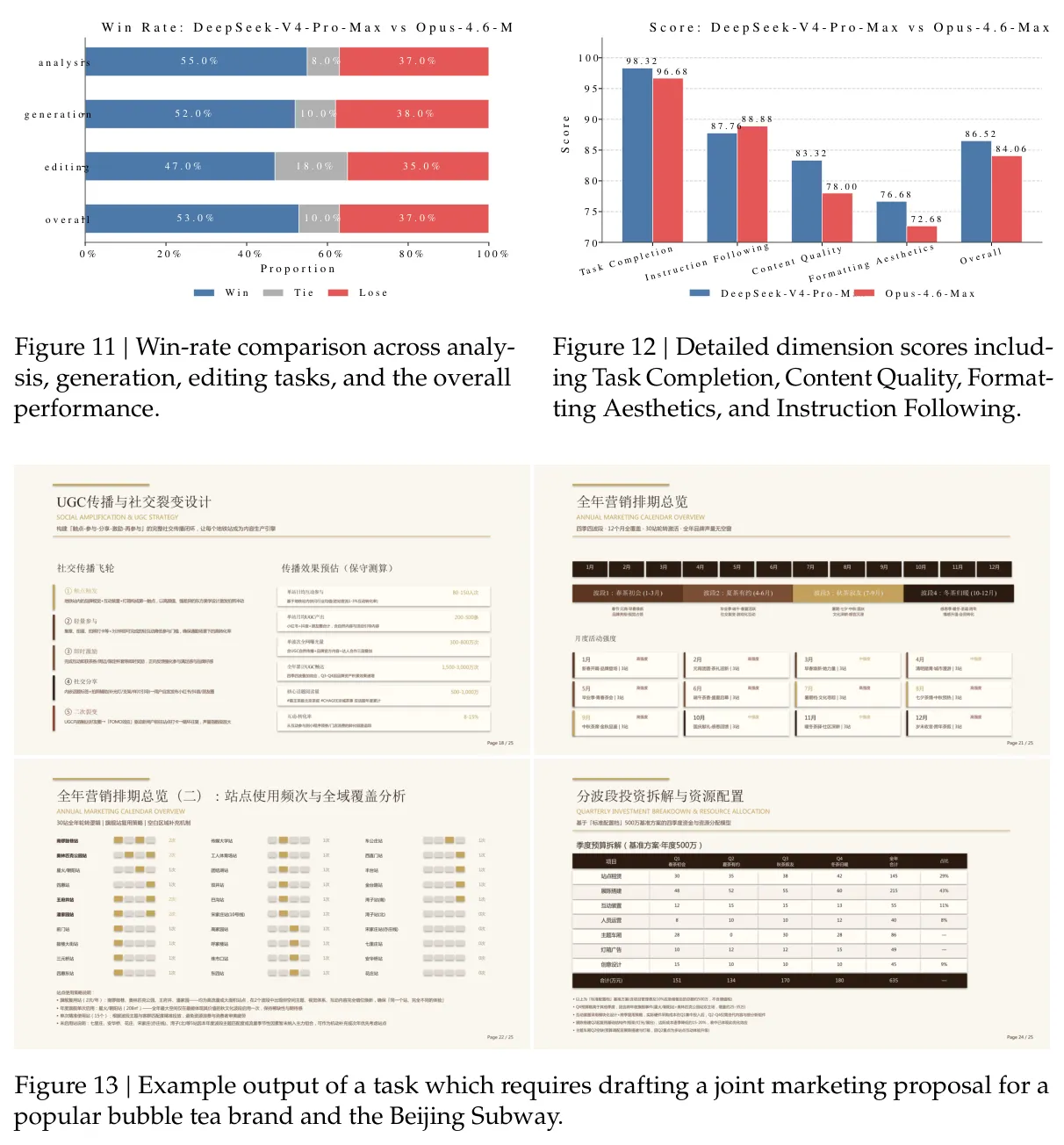
中文写作胜率显著超 Gemini-3.1-Pro;白领任务 vs Opus-4.6-Max non-loss rate 63%(弱在指令遵循与排版美观);R&D 代码 agent(30 内部真实任务)Pass=70,介于 Sonnet 4.5(47) 与 Opus 4.5(67/73) 之间,内部 85 名开发者中 52% 认为可作默认主力编码模型。
🎯 Conclusion + 诚实边界
贡献:"break the efficiency barrier of ultra-long-context processing";CSA+HCA 带来长序列效率的巨大飞跃,为 test-time scaling / long-horizon / online learning 铺路;Pro-Max "redefines the state-of-the-art for open models"。
作者坦承的局限:
- 架构过复杂:"we retained many preliminarily validated components and tricks, which ... made the architecture relatively complex" → 未来要蒸馏到最精简、更 elegant。
- 稳定性机理不明:Anticipatory Routing / SwiGLU Clamping 虽有效但 "their underlying principles remain insufficiently understood"。
- 整体落后闭源 SOTA 约 3–6 个月。
未来方向:新维度稀疏性(更稀疏的 embedding)、低延迟架构、long-horizon 多轮 agent、多模态、更好的数据合成。
本页整体诚实边界:底本为 arXiv HTML→文本,(1) Table 6 竞品分数有错位、未硬编;(2) §2.3/§3 多处公式下标/常数被提取吃掉,机制方向可信、精确形式待回查 PDF;(3) GRPO 内部推导、\(w_i\) 具体算法、GRM 损失、mid-training 细节报告本身未给。
📖 逐段精读 · 问答记录
随讨论持续累积「问题 + 讲解」。最后更新 2026-08-03。
Q1 · DeepSeek-V4 的 post-training 是怎么实现的?
答:两阶段范式(详见 §5)。Stage 1 按领域各自 SFT→GRPO-RL 练专家,易验证任务用规则/测试用例、难验证任务用「actor 兼裁判」的 GRM;Stage 2 用多教师(10+)on-policy 蒸馏,学生自采轨迹按加权 reverse KL \(\sum_i w_i D_{\mathrm{KL}}(\pi_\theta\|\pi_{p_i})\) 向最相关专家对齐,且坚持全词表 logit 蒸馏,工程上靠「缓存 teacher hidden state 现场重构 logits + 单头驻留」避免物化海量 logits。这整套取代了 V3.2 在统一模型上的混合 RL。
Q2 · 请详细阅读整份报告
答:已完成全文精读(§1–§5 + 评测 + 结论,见本页各区块)。主线是「用压缩+稀疏注意力打破 1M 上下文的效率墙」,配合 mHC/Muon 稳训练、专家蒸馏做后训练,工程上大量训练-推理协同设计(确定性 kernel、异构 KV cache、FP4 QAT)。
Q3 · 整理成 HTML 报告,先上线再精读
答:已生成本单页精读报告并经 PushGo 部署上线(personal_demo_files 站点);随后补入 15 张论文原图与 §2 架构核心公式,多次部署均 HEALTHY。
Q4 · 继续补
答:本轮补齐 §4.3 训练配置对照表、§5 reasoning effort 三档表 + Think Max 注入指令、评测 Table 6「vs 前沿模型」可信数值表,并更新问答记录。
🖼 论文原图(本地 PDF 抠取,caption 逐字原文未改写)
覆盖总览(Fig1)、架构(Fig2/3/4)、系统(Fig5/6)、后训练(Fig7) 与评测(Fig8/9/10) 关键图。
DeepSeek-V4 技术报告精读 · 由论文精读工作流生成 · 内容以 arXiv:2606.19348 原文为准