ICCV 2025 Finalist
MaskControl: Spatio-Temporal Control for Masked Motion Synthesis
Ekkasit Pinyoanuntapong · Muhammad Saleem · Korrawe Karunratanakul · Pu Wang · Hongfei Xue · Chen Chen · Chuan Guo · Junli Cao · Jian Ren · Sergey Tulyakov
摘要 Abstract
见上方 arXiv / CVF 链接。
📝 精读笔记
灵魂一句
第一个把 spatial 关节控制装进生成式 masked motion model(非 diffusion)的工作:不动 motion,而是直接操纵 token 分类器的 logits——训练期 Logits Regularizer(ControlNet 式可训练副本,把 logits 隐式拉向关节控制)+ 推理期 Logits Optimization(按目标函数梯度显式改 logits,零样本支持任意 objective)+ DES(用 Gumbel-Softmax + 码本期望把"采样/argmax 不可导"打通),同时拿到 SOTA 质量(FID 0.061,↓77%)与精度(平均误差 0.98cm vs TLControl 1.08)。
问题 & 动机
text-to-motion 里文本给语义、但给不了精确关节控制(pelvis/手的具体 (x,y,z))。已有可控模型三大痛点:① 质量 vs 精度难兼得——TLControl[51] 靠 test-time 优化精度高但生成质量差(FID 0.271),OmniControl[55] 控得动但精度/FID 不够;② sparse 与 dense 控制信号难同时支持(有的擅长稀疏 waypoint[GMD]、有的擅长逐帧 dense 轨迹[TLControl]);③ 主流用 motion-space diffusion,raw 数据冗余→算力开销大、生成慢。本文换赛道到 masked model 解决。
核心方法(三件套 + 关键公式)
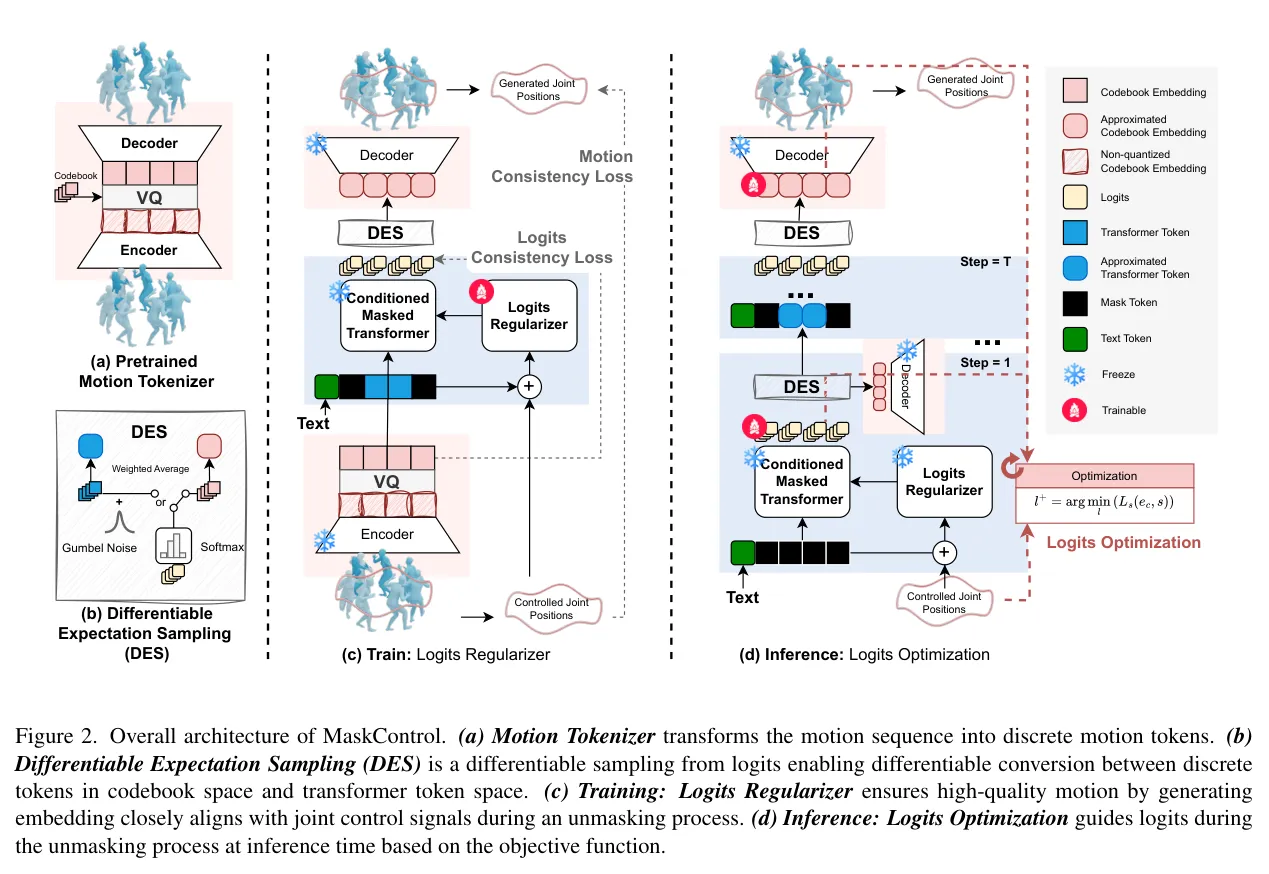
① Logits Regularizer(训练期·隐式):仿 ControlNet[59]——冻结预训练 masked transformer,旁挂一个可训练副本,逐层用 zero-init linear 连接(初始零影响);副本吃 text W + 关节信号 S(S 经 projection 直接加到 token 序列)。损失 = α·Logits Consistency(式4,对所有位置含未 mask 的 NLL)+ (1−α)·Motion Consistency(式3,把生成 token 解码回 3D 关节、和控制信号比 L2)。② Logits Optimization(推理期·显式):式7 l_{m+1}=l_m−η∇_l Ls 用梯度迭代改 logits 把生成关节怼向目标;Ls 可换任意 objective→零样本。③ DES:式9 Straight-Through Gumbel-Softmax 让采样可导;式10 E[X_recon]=Σ_k pθ(x_k)·c_k 用概率加权码本期望替 argmax,让"token↔嵌入"可微。
关键结果
HumanML3D(Tab.2,Train on Pelvis Only):FID 0.061(vs TLControl 0.271,↓77%)、R-Prec 0.809、Avg Err 0.98cm(TLControl 1.08)、Traj/Loc Err 双双 0.00;Train on All Joints:FID 0.083(↓68%)、Avg Err 0.72。上身编辑(Tab.3)免重训 FID 0.074 全面超 MDM/OmniControl/MMM/MotionLCM。零样本 objective(Tab.4)三个 HSI 任务 Constraint Error 全 0.000、超 ProgMoGen。消融(Tab.5):去 Regularizer→FID 最差(0.142)、去 Optimization→Avg Err 崩(40.41),二者互补。
亮点
① 换表示:从 diffusion-on-raw-motion 换到 masked discrete token,10 步内生成、又快又好;② 不动 motion 改 logits——控制施加在分类器分布而非连续运动空间,是本文最巧的视角;③ DES 是关键使能器:没有它,"控制信号梯度→离散 token"这条链断在 argmax/采样上;④ 统一框架覆盖 any-joint-any-frame / body-part timeline / zero-shot objective 三类任务。
疑问 / 待查
① 摘要写 "average error 0.91 vs 1.08",但 Tab.1/Tab.2 正文 Ours 均为 0.98——口径不一致,疑摘要笔误或跨设置平均(原文未明,需查附录);② Logits Optimization 每步要解码+反传 I 次,推理总耗时/步数原文正文未给明确数字(原文未写→需查附录);③ "10 步生成"是 masked model 通性,叠加 logits 迭代后的实际墙钟时间未在主表对比。
📖 逐段精读 · 笔记
从 Abstract 起逐段精读(批量精读初稿,供后续 review/深化)。基于 CVF 官方 PDF 全文。最后更新 2026-06-21。
① Abstract(摘要)逐句精读
原文逐句 + 中文指路:
1) "Recent advances in motion diffusion models have enabled spatially controllable text-to-motion generation. However, these models struggle to achieve high-precision control while maintaining high-quality motion generation." → 痛点:现有(扩散)可控动作模型精度与质量难兼得。
2) "we propose MaskControl, the first approach to introduce controllability to the generative masked motion model." → 首个给生成式 masked motion 模型加可控性的方法。
3) "Logits Regularizer implicitly perturbs logits at training time to align the distribution of motion tokens with the controlled joint positions, while regularizing the categorical token prediction to ensure high-fidelity generation." → 创新一:训练期隐式扰动 logits,对齐 token 分布与受控关节位置、并正则化保高保真。
4) "Logit Optimization explicitly optimizes the predicted logits during inference time, directly reshaping the token distribution that forces the generated motion to accurately align with the controlled joint positions." → 创新二:推理期显式优化 logits,重塑 token 分布逼控制目标。
5) "we introduce Differentiable Expectation Sampling (DES) to combat the non-differential distribution sampling process." → 创新三:DES 解决采样不可微。
6) "MaskControl outperforms state-of-the-art methods, achieving superior motion quality (FID decreases by 77%) and higher control precision (average error 0.91 vs. 1.08)." → 结果:FID 降 77%,平均误差 0.91 vs 1.08。
一句话抓 Abstract:第一次把"关节控制"引入生成式 masked motion 模型——不直接改动作,而是在token 分类器的 logits 上做文章:训练期用 ControlNet 式的 Logits Regularizer 隐式对齐控制信号,推理期用 Logit Optimization 显式梯度优化 logits,并用 DES(Gumbel-Softmax + 期望嵌入)打通"离散采样不可微",从而同时拿到高质量(FID↓77%)与高精度(avg err 0.98),还支持任意关节/帧、身体部位时间线、零样本目标控制。
② §1 Introduction · problem(可控动作生成的困境)
需求:文本语义丰富但 "often fall short in providing precise joint control over specific human joints, such as the pelvis and hands." 现有可控模型的四大难:
① 稀疏/稠密难兼顾:"some models excel at generating natural human movements that traverse sparse waypoints, while others are more effective at synthesizing motions that follow detailed trajectories",能同时支持两者的精度又不行。
② 质量差:可控模型 FID 远逊纯文本模型。
③ 慢:"most current methods utilize motion-space diffusion models… the redundancy in raw data introduces computational overhead, resulting in slower motion generation speeds."
④ SOTA TLControl 的取舍:"achieves high-precision control through test-time optimization with a simple feedforward transformer, but this comes at the cost of lower generation quality",且不能零样本适配任意目标函数。
③ §1 Introduction · 核心洞察 + 贡献
洞察:"masked models generate motion sequences by training a multi-category token classifier and subsequently sampling from the learned categorical distributions conditioned on input signals."——masked 模型本质是 token 分类器,那就直接操纵分类器的 logits 来对齐控制信号。
贡献:① 首个可控 masked motion 模型;② 两个组件——训练期 Logits Regularizer(隐式扰 logits 对齐关节)+ 推理期 Logits Optimization(显式优化 logits 减残差),外加 DES 解决离散 token 选择不可微;③ Logits Optimization 可零样本解未见控制任务;④ 在多任务上质量与精度均超 SOTA。
③b §2 Related Work · 三条技术脉络与本文定位
① 文生动作的演进:早期(Language2Pose/TEMOS/T2M/MotionCLIP)靠 KL/对比损失对齐文本与动作的潜分布,但 "the inherent discrepancy between the distribution of text and motion often results in suboptimal generation quality." 之后扩散模型成主流(在动作空间、VAE 潜空间或量化空间逐步去噪);另一支是 token-based——自回归 GPT(MotionGPT 等)与 masked motion modeling(MMM/MoMask/BAMM)。"While GPT models usually predict the next token from history tokens, masked motion models utilize the bidirectional context to decode the masked motion tokens." masked 模型质量/效率俱佳,但 "supporting spatial controllability in these models remains unexploited"——本文正是填补这一空白。
② 可控动作合成:控制模态很多(音乐、物体交互、传感器、场景、风格、目标到达等)。轨迹控制上 PriorMDM 微调 MDM 控末端执行器、GMD/Trace&Pace 在扩散过程里引导根关节、OmniControl 扩展到任意关节、MotionLCM 移到潜空间(都借 ControlNet)、DNO 在扩散噪声上做优化。"The existing frameworks for controllable motion generation predominantly rely on diffusion models; however, these models typically suffer from low-quality motion generation."
③ 本文差异:不走扩散,而是第一次在 masked motion 模型上做可控——通过操纵 token 分类器 logits,同时拿到高质量与高精度,且支持零样本任意目标。
📚 背景知识:VQVAE / Masked 生成模型 / ControlNet
① Motion VQVAE:把连续动作序列编码并量化成离散 token(码本里的码字),类似把动作"切成词"。
② Masked 生成模型(MaskGIT/MoMask):不同于 GPT 的"从左到右预测下一个 token",masked 模型用双向上下文一次并行预测一批被 [MASK] 的 token,再迭代地"揭开置信度最低的"重采样——"can generate motion sequences in as few as 10 steps",质量/效率俱佳。
③ ControlNet[59]:给预训练扩散模型加可控分支的经典做法——复制一份可训练副本、用零初始化连接层接回主干(初始无副作用),只训副本来注入新控制信号。MaskControl "demonstrate for the first time that similar design principle can be applied to introduce controllability to generative masked models."
④ §3.1 Preliminary(一)· Motion Tokenizer(公式1)
动作序列 \( P=[p_1,\dots,p_F] \)(每帧一个 3D 姿态)经编码器压成 \( z\in\mathbb{R}^{t\times d} \)(下采样率 \(F/L\)),再量化到码本 \( C=\{c_k\}_{k=1}^{K} \):最近码 \( \hat{z}=\arg\min_j\|z-c_j\|_2^2 \),得离散 token \( X=[x_1,\dots,x_L] \)。VQ 损失:\[ L_{VQ}=\|\operatorname{sg}(z)-c_j\|_2^2+\beta\|z-\operatorname{sg}(c_j)\|_2^2 \] \(\operatorname{sg}(\cdot)\) 是 stop-gradient,\(\beta\) 是 commitment 权重。这一步把"连续动作"变成"离散动作词",为 masked transformer 铺路。
⑤ §3.1 Preliminary(二)· Masked Transformer(公式2)
把 token 序列 \(X\) 用 [MASK] 腐蚀成 \(X_M\),连同文本嵌入 \(W\) 喂入参数为 \(\theta\) 的 text-conditioned masked transformer,重建概率 \( p_\theta(x_i\mid X_M,W) \) 由 token 分类器给出。目标=最小化被 mask token 的负对数似然:\[ \mathcal{L}_{mask}=-\mathbb{E}_{X\in\mathcal{D}}\Big[\sum_{\forall i\in[1,L]}\log p(x_i\mid X_{\overline{M}},W)\Big] \] 推理:"the transformer masks out the tokens with the least confidence and re-samples these tokens",掩码数 \(n_M\) 由随步数衰减的 masking schedule 控制——"Early steps use a large masking ratio due to high uncertainty"。
⑥ §3.2 Logits Regularizer(一)· 架构 + 关节信号
架构(ControlNet 式):"the Logits Regularizer is a trainable replica of the pre-trained masked motion model… Each Transformer layer in the original model is paired with a corresponding layer in the trainable copy, connected via a zero-initialized linear layer. This initialization ensures that the layers have no effect at the start of training." 文本 \(W\)(CLIP) 经 attention 影响 token,关节控制信号 \(S\) 经 projection 层直接加到 token 序列。
关节控制信号:\( S=[s_1,\dots,s_F],\ s_i\in\mathbb{R}^{j\times3} \),指定受控关节的 3D 坐标,未控关节置零。学条件分布 \( p_\theta(x_k\mid X,X_M,W,S) \)。"to guarantee the controllability… we extract the joint control signals from the generated motion sequence and directly optimize the consistency loss between input control signals and those extracted from the output."
⑦ §3.2 Logits Regularizer(二)· 两个损失(公式3-5)
Motion Consistency Loss(式3):衡量生成动作与输入关节信号的对齐:\[ L_s(e_c,s)=\frac{\sum_n\sum_j \sigma_{nj}\odot\|s_{nj}-R(D(e_c))\|}{\sum_n\sum_j \sigma_{nj}} \] \(\sigma_{nj}\) 是"帧 \(n\) 关节 \(j\) 是否有控制值"的二值掩码;解码器 \(D(\cdot)\) 把嵌入转成局部相对位置,\(R(\cdot)\) 再转成全局绝对位置(pelvis 全局位由历帧旋转平移累积、其他关节由相对 pelvis 累积)。
Logits Consistency Loss(式4):把式(2)扩展到所有位置(含未掩码)并加入 \(S\):\[ \mathcal{L}_{logits}=-\sum_{\forall i\in[1,L]}\log p(x_i\mid X_{\overline{M}},W,S) \] 总损失(式5):\[ \mathcal{L}=\alpha\mathcal{L}_{logits}+(1-\alpha)L_s(e_c,s) \]
⑧ §3.3 Logits Optimization(公式6-8)
目标:推理期进一步缩小生成动作与控制目标的差距,"does not require pretraining on specific tasks, allowing the model to handle arbitrary objective functions during inference, enabling new control tasks in a zero-shot manner."
做法:用 Logits Regularizer 得到的 logits 初始化,沿 motion consistency loss 的梯度迭代更新 logits:\[ l^{+}=\arg\min_{l}L_s(e_c,s),\qquad l_{m+1}=l_m-\eta\,\nabla_{l_m}L_s(l_m,s) \] 迭代 \(I\) 次(\(\eta\) 为步长)。最后一个 unmask 步还可直接优化码本嵌入:\[ e_{m+1}=e_m-\eta\,\nabla_{e_m}L_s(e_m,s) \] 零样本时把 \(L_s\) 换成任意目标函数即可。关键:优化的是 logits 而非动作本身——"perturbs the logits during the unmasking process, allowing the masked transformer to re-predict them",使结果仍贴近学到的分布、不至于不真实。
⑨ §3.4 Differentiable Expectation Sampling(公式9-10)
为什么需要:Logits Regularizer/Optimization 都要对"采样动作 token"求梯度,但分类采样本身不可微。两招破解:
① 可微采样(Straight-Through Gumbel-Softmax[19],式9):\[ p_\theta(x_k\mid X_{\overline{M}},W,S)=\frac{\exp((\ell_k+g_k)/\tau)}{\sum_{j=1}^{K}\exp((\ell_j+g_j)/\tau)} \] \(\tau\) 温度,\(g\) 是 Gumbel 噪声(\(g=-\log(-\log(u)),u\sim\text{Uniform}(0,1)\)),让从分类分布采样变可微。
② Token 期望(式10):原本取 \(\arg\max_k p_\theta\) 查码本嵌入,但 argmax 不可微。改用按重建概率加权平均码本近似连续 token:\[ \mathbb{E}[X_{recon}]=\sum_{k=1}^{K}p_\theta(x_k\mid X_{\overline{M}},W,S)\cdot c_k \] 即松弛量化约束,使梯度能从控制损失回传到 logits。
⑩ §4 三大应用
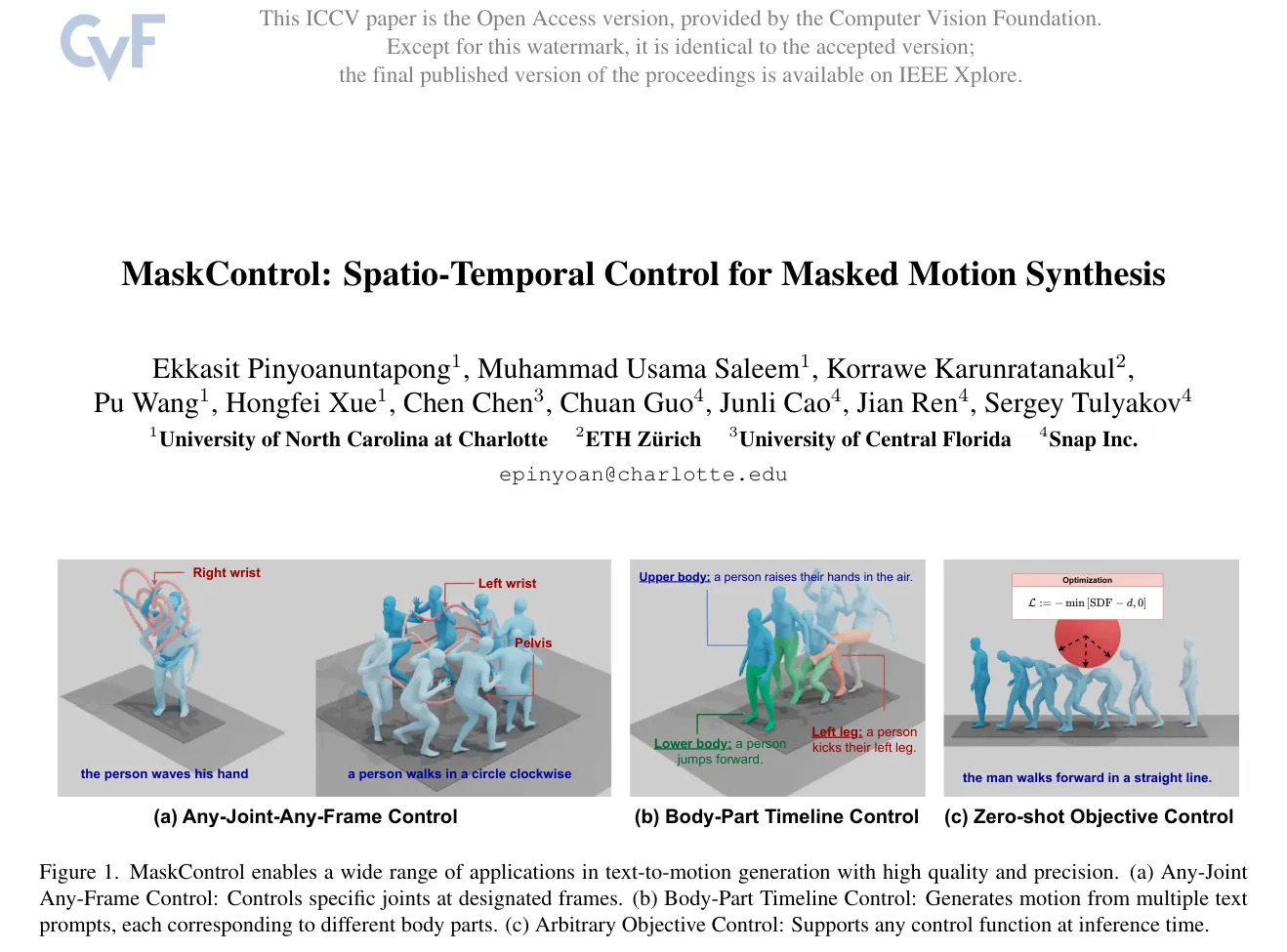
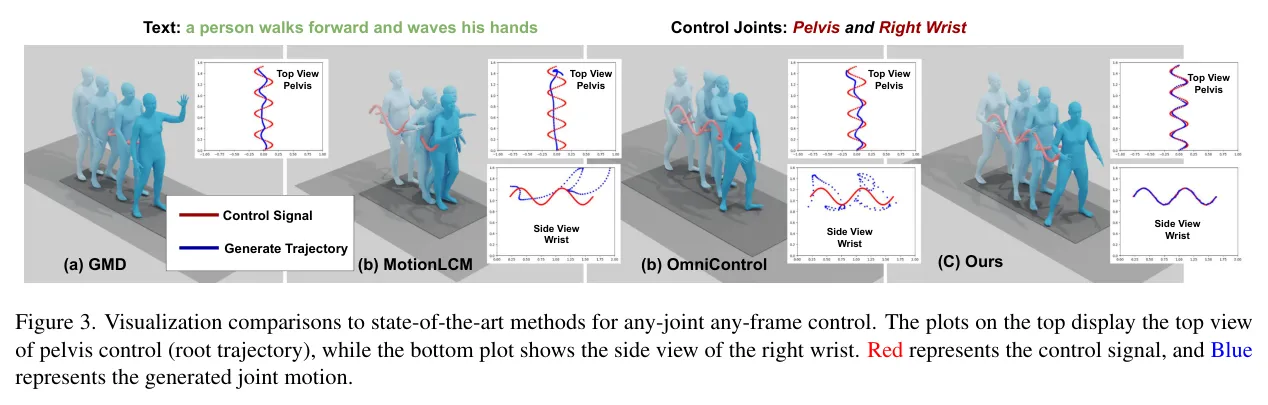
① Any-Joint-Any-Frame:训练损失本就为此设计,把关节控制信号直接施加到目标关节与帧的全局位置即可。
② Body-Part Timeline:多个 prompt 各管不同身体部位/时间段。"Initially, it generates motion without any body part control, then iteratively refines the motion by incorporating prompts conditioned on the specified body parts and timeline constraints from the prior generation."——先无控生成,再按部位/时间线逐步细化。
③ Zero-shot Objective:Logits Optimization 接受任意以关节/帧为输入的 loss(人-场景/人-物/自接触约束),推理期零样本适配。为防直接优化产生不真实动作,"Logits Optimization perturbs the logits during the unmasking process… ensures that the generated motion remains close to the learned distribution."
⑪ §5 实验设置 + 总览对比(Table 1)
数据:HumanML3D[15]——14,616 个动作序列、44,970 条文本描述、5,371 唯一词,源自 AMASS[34]+HumanAct12[13]。评测follow OmniControl[55](HumanML3D 质量 + GMD 轨迹误差)。Table 1 是各 base model 的总览对比:
| Method | FID↓ | Avg Err(cm)↓ | Base Model | Zero-shot |
|---|---|---|---|---|
| GMD [21] | 0.576 | 14.39 | Motion Diffusion | - |
| OmniControl [55] | 0.218 | 3.38 | Motion Diffusion | ✗ |
| MotionLCM [7] | 0.531 | 18.97 | Latent Diffusion | ✗ |
| TLControl [51] | 0.271 | 1.08 | Feed Forward | ✗ |
| Ours | 0.061 | 0.98 | Masked Model | ✓ |
本方法以 masked model 为底,FID 0.061(远低于次优 OmniControl 0.218)、平均误差 0.98cm(优于 TLControl 1.08),且唯一支持零样本目标控制。
⑫ §5.1 主结果表(Table 2 真实数值)
| Method | R-Prec↑ | FID↓ | Traj Err↓ | Loc Err↓ | Avg Err↓ |
|---|---|---|---|---|---|
| Real | 0.797 | 0.002 | 0.00 | 0.00 | 0.00 |
| — Train on Pelvis Only — | |||||
| GMD | 0.665 | 0.576 | 9.31 | 3.21 | 14.39 |
| OmniControl | 0.687 | 0.218 | 3.87 | 0.96 | 3.38 |
| TLControl | 0.779 | 0.271 | 0.00 | 0.00 | 1.08 |
| Ours (pelvis) | 0.809 | 0.061 | 0.00 | 0.00 | 0.98 |
| — Train on All Random Joints — | |||||
| OmniControl | 0.693 | 0.310 | 6.17 | 1.07 | 4.04 |
| TLControl | 0.782 | 0.256 | 0.00 | 0.00 | 1.11 |
| Ours (all) | 0.805 | 0.083 | 0.00 | 0.00 | 0.72 |
读法:仅控 pelvis 时,FID 由 TLControl 的 0.271→0.061(降 77%)、R-Precision 0.779→0.809,Trajectory/Location Error 双双归零、平均误差 0.91~0.98cm;控全关节时 FID 0.083(降 68%)、平均误差 0.72cm,全面超 OmniControl/TLControl。
⑬a §5.3-5.4 身体部位编辑 + 零样本目标控制
上身编辑(Table 3):用下身真值条件、按文本生成上身(follow MMM 协议),不重训用与 "Train on All Joints" 同一模型。结果 FID 0.074、R-Precision Top-3 0.804,全面超 MDM(FID 4.827, 多关节条件下崩)、OmniControl(FID 1.213, "performs poorly in this task")、MotionLCM(0.311),也优于需分别为上下身重训码本的 MMM(0.103)。说明本方法处理多关节信号鲁棒、且无需重训。
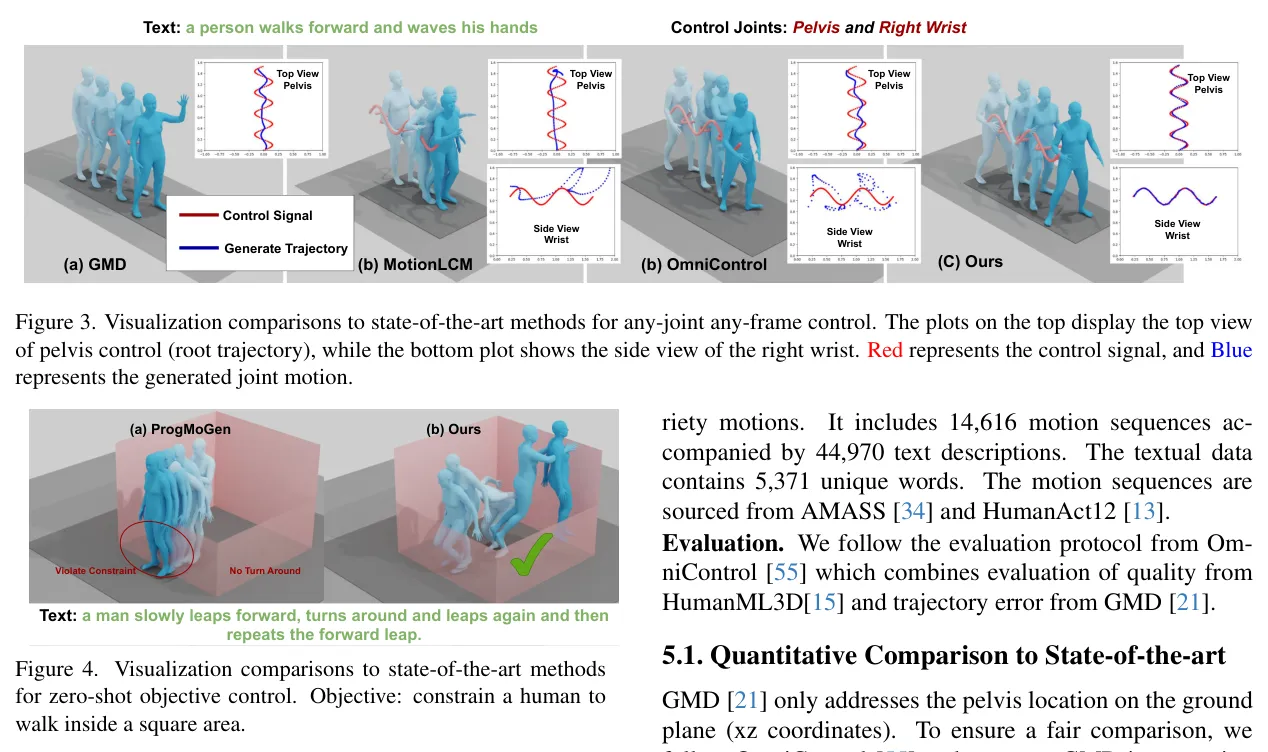
零样本目标控制(Table 4):用 ProgMoGen 的三项 Human-Scene Interaction 目标(Head Height Constraint / Avoiding Barrier / Walking Inside a Square)评测,MDM/MoMask 作无控基线。本方法在 HSI-1 上 Constraint Error 0.000、Unsucc. Rate 0.000、FID 0.246,优于 ProgMoGen(0.012/0.088/0.556);三项任务的约束误差均归零。"Max Acc. represents the maximum acceleration of joints which indicates the amount of joint jittering"——本方法抖动也更小。定性上(Fig.4)ProgMoGen "not only violates the constraint but also generates motion unrelated to the text, as it lacks any 'turns around' motion",而本方法既满足约束又忠实文本。
⑬ §6 消融实验(Table 5:组件 + 控制密度)
| 配置 | R-Prec↑ | FID↓ | Avg Err↓ |
|---|---|---|---|
| No Control | 0.807 | 0.095 | 63.18 |
| w/o Logits Regularizer | 0.795 | 0.142 | 2.18 |
| w/o Logits Optimization | 0.802 | 0.128 | 40.41 |
| Full model | 0.809 | 0.061 | 0.98 |
组件分析:去 Logits Regularizer ⇒ FID 最差(0.142)——它管生成质量;去 Logits Optimization ⇒ 平均误差暴增到 40.41——它管控制精度;两者互补,Full model 同时拿下最佳 FID(0.061) 与 Avg Err(0.98)。
控制密度:从 1 帧到 100% 帧,FID 0.077→0.054、R-Precision 0.804→0.814(控制越多质量越好),但平均误差反升(要精确命中的目标点更多)——"more joint control leads to higher error, as the model is required to target more specific points."
Q&A · 追问 why
Q1:为什么操纵 logits,而不是像扩散那样直接在动作空间引导?
因为 masked motion 模型的本质是token 分类器,生成=从 logits 决定的分类分布里采样。直接改 logits 就能在"模型自己认可的 token 分布"内部把概率质量推向"能满足关节约束"的 token——既精确(Logits Optimization 显式压残差),又不破坏生成先验(仍从分布采样)。对比动作空间扩散:raw 动作冗余、计算重、且引导易出不真实动作。消融显示这套设计让 FID 0.061 远优于扩散类。
Q2:Logits Regularizer(训练期)与 Logits Optimization(推理期)为什么都要、各管什么?
分工明确:Regularizer 在训练期隐式对齐控制信号、同时用 logits 一致性损失保住 token 预测质量(去掉它 FID 最差 0.142);Optimization 在推理期显式用梯度把 logits 进一步逼近控制目标(去掉它平均误差从 0.98 暴增到 40.41)。前者保质量、后者保精度,缺一不可——这正是"高质量+高精度"难题的解法。
Q3:DES 为什么是整个方法成立的前提?
因为两个组件都要对"采样出的动作 token"求梯度回传到 logits,而离散采样(argmax/分类采样)不可微,梯度会断。DES 用 Straight-Through Gumbel-Softmax 让采样可微(式9)、用"按概率加权平均码本"的期望嵌入替代 argmax(式10),松弛量化约束 ⇒ 控制损失的梯度才能流回 logits。没有 DES,Logits Regularizer/Optimization 都无法训练/优化。
📌 全文总结(≥3 takeaway)
problem:可控文生动作长期"精度与质量难兼得"——扩散类质量差/慢,SOTA TLControl 精度高但质量降且不能零样本适配任意目标。
method:首次给生成式 masked motion 模型加可控性,核心是操纵 token 分类器的 logits:训练期 Logits Regularizer(ControlNet 式可训副本+零初始化连接, 隐式对齐关节, 损失=Logits 一致性式4 + Motion 一致性式3);推理期 Logits Optimization(显式梯度优化 logits 式6-8, 零样本任意目标);并用 DES(Gumbel-Softmax 式9 + 期望嵌入式10)解决离散采样不可微。
experiment:HumanML3D 上 FID 0.061(较 TLControl 0.271 降 77%)、平均误差 0.98/0.72cm、轨迹/位置误差归零、R-Precision 0.809 全面 SOTA;消融证 Regularizer 保质量(去之 FID 0.142)、Optimization 保精度(去之 avg err 40.41)缺一不可;上身编辑 FID 0.074、零样本三项 HSI 约束误差均归零。
takeaway:① 把控制施加在token 分类器的 logits 上,是给离散生成模型加可控性的优雅范式——精确又不破坏生成先验;② 训练隐式 + 推理显式双管齐下,正好分别攻克"质量"与"精度"两个难点;③ DES(可微采样+期望嵌入)是让"梯度穿过离散 token"成为可能的关键使能技术,也使零样本任意目标控制可行。
局限[推测]:依赖预训练 masked motion 模型与 VQVAE 码本质量;推理期 Logits Optimization 迭代会增加耗时;控制密度越高平均误差越大(须命中更多目标点)。
🖼 论文原图(本地 PDF 截图,原文 caption 未改写)