CVPR 2026 Finalist
VGGT-Ω
Jianyuan Wang ⋅ Minghao Chen ⋅ Shangzhan Zhang ⋅ Nikita Karaev ⋅ Johannes Schönberger ⋅ Patrick Labatut ⋅ Piotr Bojanowski ⋅ David Novotny ⋅ Andrea Vedaldi ⋅ Christian Rupprecht
摘要 Abstract
We present VGGT-Ω, a feed-forward model for 3D reconstruction that substantially advances the state of the art in accuracy, efficiency, and capability for both static and dynamic scenes. Prior models such as VGGT have shown that feed-forward 3D reconstruction can already be competitive with traditional optimization-based methods. Here, we further demonstrate that the accuracy and robustness of these models scale predictably with model capacity and data size. To enable training 3D reconstruction models at an unprecedented scale, we introduce a high-quality data annotation pipeline that handles dynamic scenes, a self-supervised learning protocol, and architectural changes that greatly reduce memory requirements. We significantly simplify VGGT’s architecture by replacing multiple dense prediction heads with loss-driven multitask learning, removing unstable DPT blocks, and introducing more efficient global attention via scene tokens. These changes allow us to efficiently train VGGT-Ω with 20$\times$ more supervised data and 100$\times$ more unsupervised data than prior work, while requiring only 30% of VGGT’s memory and running 1.6$\times$ faster at inference. As a result, VGGT-Ω establishes a new state of the art for 3D reconstruction on both static and dynamic scenes across a wide range of benchmarks, e.g., improving the camera estimation accuracy by 77% on the Sintel dataset. Models and code will be publicly released.
📝 精读笔记
灵魂一句
VGGT 的"做大版"(Oxford VGG + Meta AI 同班人马):证明前馈 3D 重建的精度随模型(0.2B→10B)和数据(2K→2M 序列)规模可预测地、近 power-law 地上涨。靠三处架构改动把训练显存砍到 VGGT 的 ~30%(从而能吃下 15× 监督数据 + 海量无标注视频),加一条能处理动态场景的数据标注流水线。彩蛋发现:学到的 registers(scene tokens)不只是辅助、可被丢弃,而是携带全局信息、能即插即用提升 VLA、还能对齐语言——故主张"重建可作为空间理解的可扩展 proxy 任务"。Sintel 相机估计 AUC@3° 22.5→40.0(+77%),比 MegaSaM 快 50×。
问题 & 动机
前馈重建(VGGT[181]/DUSt3R[186])已能比肩甚至超传统 SfM,其 token 还被广泛当 geometry-aware 表示用——说明重建可作通用空间理解的 proxy 任务。但相比 LLM/视觉基础模型对"scale"研究透彻,3D 视觉里 scale 几乎没被探索。核心问题:前馈重建能否 scale up、scale 带来什么?瓶颈在 VGGT 太吃显存(DPT 高分辨率 conv 存激活 + 全局 attention 二次方开销)→ 无法把数据/模型做大。VGGT-Ω 就是先省显存、再 scale、并量化 scaling 规律。
核心方法(3 架构改动 + 数据流水线 + 自监督)
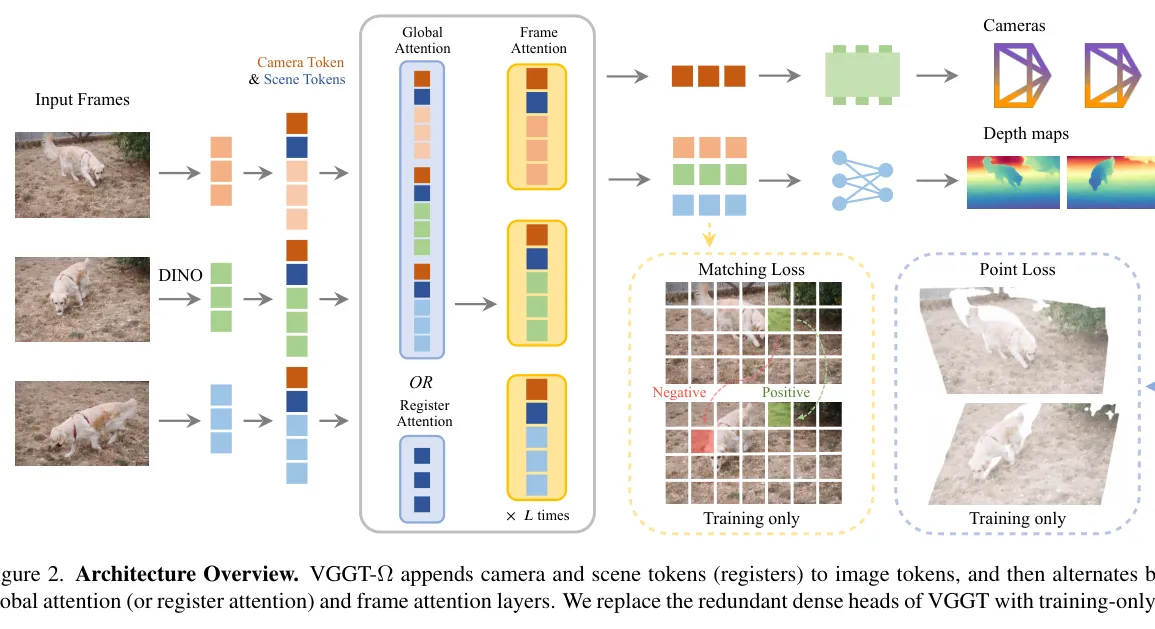
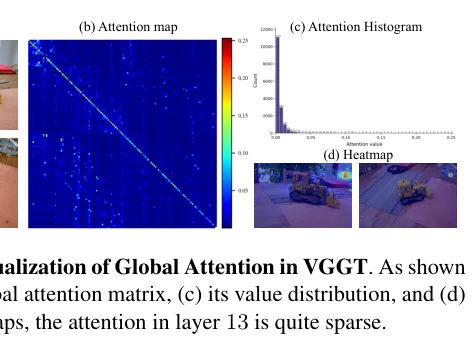
① Register Attention:每帧加 16 个 register(scene token);在 25% 的 global attention 层里把跨帧信息交换限制到只在 registers 之间(z′=attn_scene(z),只有 registers 参与跨帧 self-attn),再经 frame attention 把聚合信息分发回 image token——registers 成了多帧信息的 bottleneck。依据:global attention map 很稀疏(Fig 3)。替换 25% 无可测精度损失,省 ~23% FLOPs + 16% backbone 显存。② 轻量 depth head:DPT 高分辨率 conv 存激活极耗显存→把 1/4 分辨率以上的 block 换成 单 MLP(出 2u² 通道, u=4) + pixel-shuffle(重排成 depth+confidence 两通道),保留便宜的低分辨率 conv(避免 blocky artifact)。③ 单 dense head + 多任务 loss:VGGT 有多个 dense head(depth/point/track),Ω 只留一个 depth dense head + 一个 camera sparse head,但 point/matching 仍用 loss 监督(point 由 depth+camera unproject 推得)。三改动共省 70% 训练显存。数据:VLM 预筛(仅 10% 过)→Grounding DINO 去动态区→多匹配器 ensemble→VGGT 初始化+COLMAP BA→多视一致性+XGBoost/RF/CatBoost 几何分类器,从 40M 网络视频留 0.8M 高质(1/3 动态),合公开集共 4M 序列(>15× VGGT)。自监督:DINO 式 teacher-student(EMA),同帧不同增广+乱序,student 对齐 teacher 预测/特征、冻结 camera/depth head 防 collapse,吃 18M 无标注视频。
关键结果
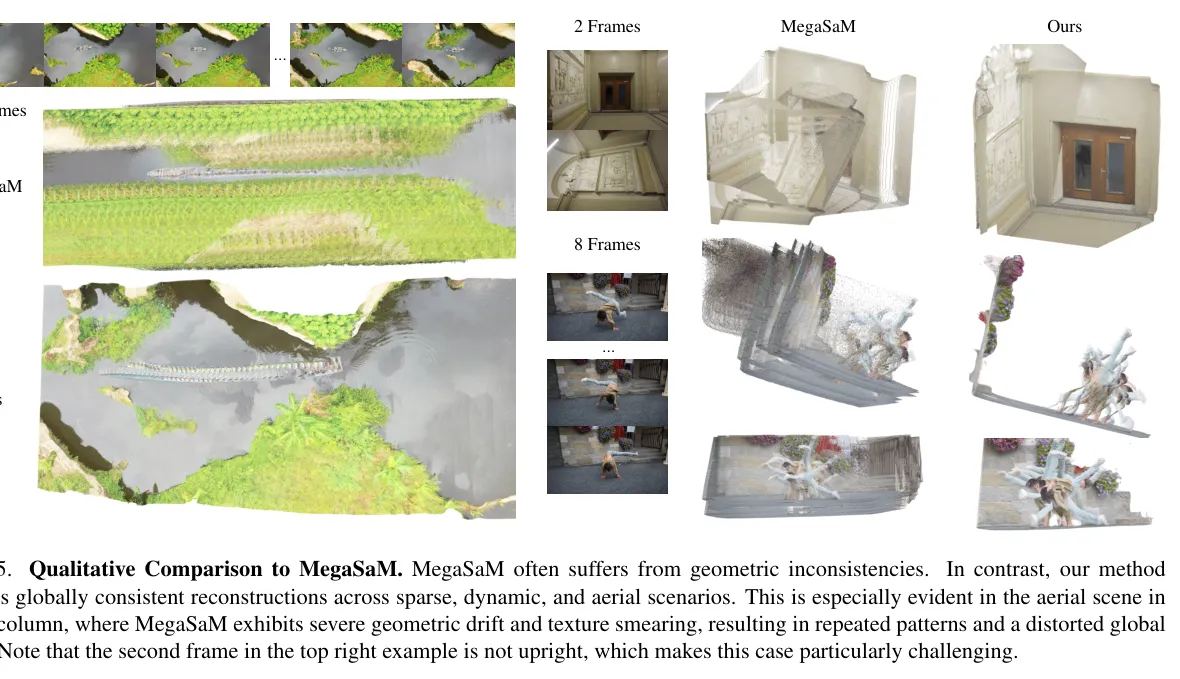
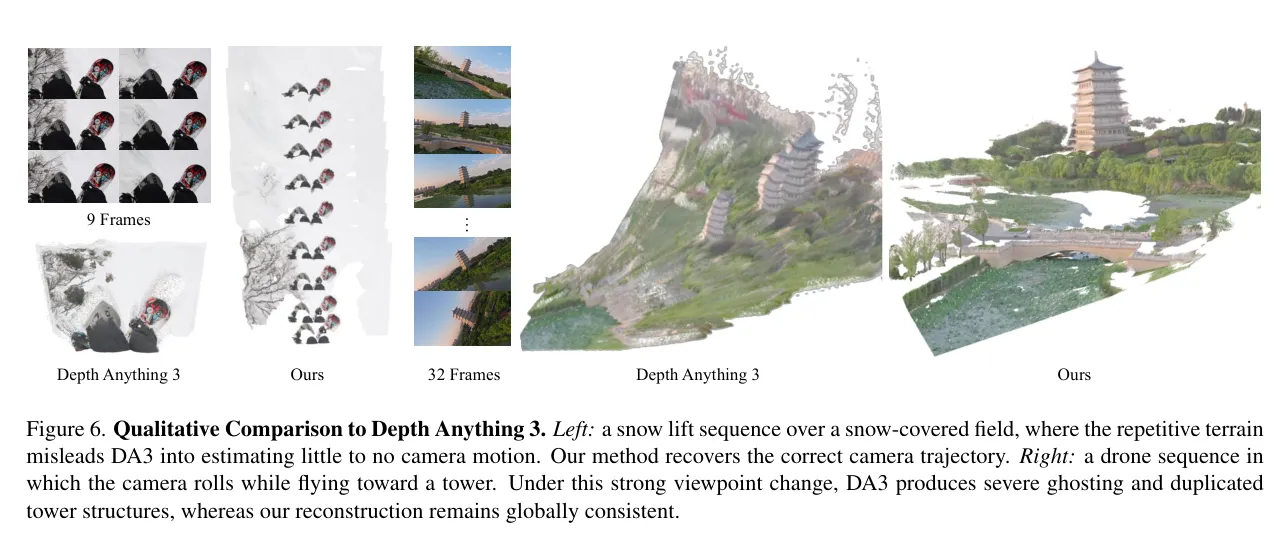
相机 pose(Table 1, AUC↑):Ours-10B 在 3 静态(7Scenes/NRGBD/ETH3D)+3 动态(DyCheck/Sintel/TUM-Dyn) 全面超 VGGT/PI3/DA3/MegaSaM——Sintel AUC@3° 22.5(MegaSaM)→40.0(+77%)、AUC@30° 58.3→79.1。深度(Table 2, δ1.25↑/AbsRel↓):Sintel δ1.25 86.1(DA3)→93.5、AbsRel 0.118→0.081。效率:训练显存 ~30% of VGGT、推理 1.6× faster、比 MegaSaM 快 50×、单 A100 可跑 >1000 帧(DA3 ~750 OOM)。registers 应用:LIBERO(VLA) 平均成功率 OpenVLA-OFT 97.1→98.5(+冻结 scene tokens);并能与语言 CLIP 式对齐。
亮点
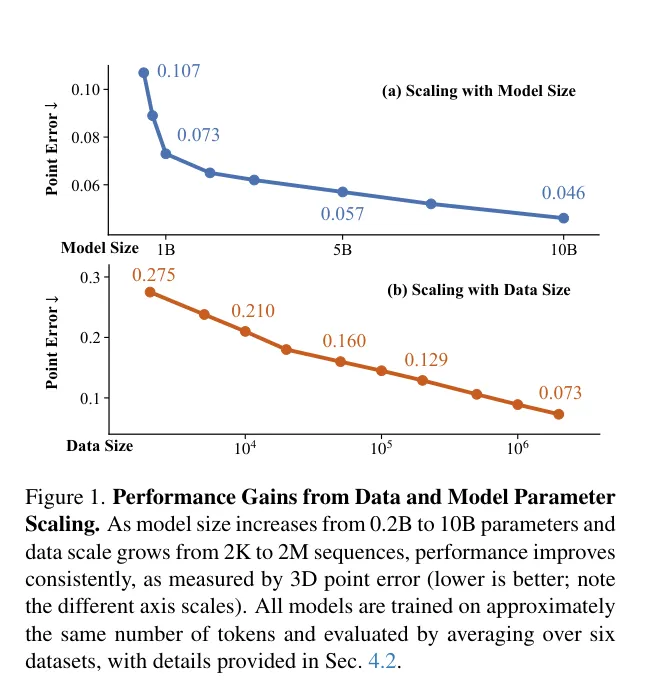
① 把"省显存"当 scaling 的前提:不是堆卡,而是先用 register attention + 轻量 head + 单 head 多任务把训练显存砍 70%,才腾出预算 scale 数据/模型——工程驱动的 scaling。② 量化 scaling law:Fig 1 model 0.2B→10B、data 2K→2M 都近 power-law 降 point error,给 3D 重建提供"做大确实有用"的实证。③ register 从"丢弃的辅助"翻身为"可复用的空间表示":language token 只读 registers、不看 image patch 也能对齐语言→证明 registers 真携带 scene-level 信息,支撑"重建即空间理解 proxy"的论点。
疑问 / 待查
① 大量关键细节(matching loss 正负对构造、depth loss 完整式、数据流水线各阈值)原文说"in the supplement"——正文未完整给出,需查补充材料。② "比 MegaSaM 快 50×" 与 register-only 变体"1000 帧 240→11.7s"是不同口径,引用时要分清(前者默认 Ω,后者激进全替换变体且精度更低)。③ 10B 模型训练用 128×96GB H100,社区复现门槛极高;公开的是否含 10B 权重需确认。④ href arXiv id 2605.15195(2026.05)为 future-dated preprint。
📖 逐段精读 · 笔记
批量精读初稿(基于本地 PDF 全文 139k 字符 / 28 页提取,正文约前 10 页)。最后更新 2026-06-21。
① Abstract(摘要)逐句精读
原文逐句 + 中文指路:
1) “Recent feed-forward reconstruction models, such as VGGT, have proven competitive with traditional optimization-based reconstructors while also providing geometry-aware features useful for other tasks.” → 出发点:前馈重建已比肩优化法,且其特征对别的任务有用。
2) “Here, we show that the quality of these models scales predictably with model and data size.” → 本文主命题:质量随模型/数据规模可预测地涨。
3) “we introduce architectural changes that improve training efficiency, a high-quality data annotation pipeline that supports dynamic scenes, and a self-supervised learning protocol.” → 三大支撑:省显存架构 + 动态数据标注 + 自监督。
4) “a single dense prediction head with multi-task supervision … removing the expensive high-resolution convolutional layers … register attention, which restricts inter-frame information exchange to these registers.” → 三处具体改动。
5) “uses only ∼30% of the GPU memory of its predecessor … 15× more supervised data than prior work.” → 省 70% 显存→吃 15× 数据。
6) “improving over the previous best camera estimation accuracy on Sintel by 77% … reconstruction can be a powerful and scalable proxy task for spatial understanding.” → 结果 + 升华。
一句话抓 Abstract:先把 VGGT 改瘦(省 70% 显存)→ 喂 15× 数据做大 → 证明前馈重建可 scale(Sintel +77%)→ 顺带发现 registers 是可复用的空间表示(助 VLA + 对齐语言)。
📚 背景①:VGGT 前作 + alternating-attention(理解全文必备)
VGGT(前作,CVPR 2025)=前馈 transformer,一次推理对多图联合出 camera/depth/point map/track,“first surpassed post-optimization methods (e.g., using bundle adjustment) while relying solely on feed-forward inference.” 关键机制 alternating-attention:交替 frame-wise self-attention(每帧独立、无 frame-index embedding → 可泛化任意帧数)与 global self-attention(跨所有帧所有 token,是多帧信息形成处,但 \(O(N^2)\) 贵)。两者皆 permutation equivariant。VGGT-Ω 就在它之上改三处 + scale。
📚 背景②:Registers / DPT+pixel-shuffle / Teacher-Student / 指标
Registers in ViTs(Darcet 2024 等):ViT 会自发用少数高范数 token 携带全局信息、“disrupt the spatial coherence of the patch features”;于是引入独立 register token 吸收之、保持 patch 一致性,通常推理时丢弃。本文反其道——证明 registers 有用、复用为 scene token。DPT=ViT 上的 dense prediction 头,末端高分辨率 conv 存激活极耗显存(FSDP/grad-ckpt 都消不掉)。pixel-shuffle=把通道 \(c\cdot r^2\) 重排成空间 \(r\times r\) 上采样,无 conv、省显存。Teacher-Student EMA(DINO 系):student 梯度更新,teacher 为其指数滑动平均;student 学匹配 teacher 在不同增广下的输出。指标:相机 AUC@τ°=相对 rot/trans 误差低于 τ 的图对比例曲线下面积(↑);深度 δ1.25=预测/真值比落在 [1/1.25,1.25] 的像素百分比(↑),AbsRel=平均绝对相对误差(↓);LIBERO=机器人操作 benchmark(Spatial/Object/Goal/Long),报成功率 SR。
② §1 Introduction — problem(为什么要研究 scale)
problem:前馈重建已能匹敌甚至超 SfM,且其 token 被广泛当 geometry-aware 表示用——“reconstruction can serve as a proxy task for learning representations useful for spatial understanding in general, with a foundational value.” 但 “compared to foundation models where the role of scale is well understood, this is less explored in 3D computer vision.” 于是核心问题:“whether feed-forward reconstruction models can be scaled up, and what benefits such scaling brings.” 真正卡点=VGGT 太吃显存(DPT 高分辨率 conv 存激活 + global attention 二次方开销),无法把数据/模型做大。
③ §1 Introduction — 三处改动 solution → why 闭环
solution(三改动逐字):(a) “in a subset of the global attention layers, information exchange among frames is restricted to the registers … forming a bottleneck for aggregating and redistributing multi-frame information”;(b) “replace the most memory-intensive convolutional layers in the dense predictors with a single MLP followed by a pixel shuffle operator”;(c) “still use multi-task losses, but to retain only a single dense head for depth prediction and a single sparse head for camera prediction.” 三者 “save 70% of GPU memory during training.” 再加 40M 视频标注流水线(留 0.8M)+ teacher-student 自监督(18M 无标注视频)。
why(为什么有效):① register attention 有效因 “global attention maps are typically sparse”(Fig 3 第 13 层极稀疏),少数 token 足以交换跨帧信息——替换 25% “incurs no measurable performance drop, while saving around 23% FLOPs and 16% memory in the backbone.” ② 省显存不是目的而是 scaling 的前提——腾预算把数据做到 4M(>15× VGGT)、模型做到 10B,才看得到 Fig 1 power-law。③ 只出 depth+camera 是为干净解耦相机与场景运动("静止相机拍跳舞的人"像素动但相机不动,ray map 会纠缠两者)。
📚 §2 Related Work — feed-forward 重建 + 4D 谱系定位
谱系:经典多视几何 → SfM 系统(COLMAP)→ 端到端可微 SfM → DUSt3R/MASt3R(直接从图出几何+相机,但仅处理图对、多视仍需后优化)→ VGGT(首个纯前馈超 BA)→ 大量 follow-up。降本路线:token merging / sparse attention / 描述符聚合 / test-time-training 层 / 因果缓存。本文与 PI3(去掉固定 reference view)、DA3 / Depth Anything 3(用 vanilla DINO 当 backbone,支持动态)最可比。4D/动态:MegaSaM(前馈深度 + 优化非刚重建,很有影响力)、MonST3R/D2USt3R(扩 DUSt3R 处理动态)、CUT3R/Point3R(增量重建)、D4RT(统一前馈 4D query)。
④ §3.1 问题形式化 + tokenization(映射 + 维度)
映射:\[ ((g_1,D_1),\dots,(g_N,D_N))=f(I_1,\dots,I_N) \] \(D_i\in\mathbb{R}^{H\times W}\) 是深度图,\(g_i=(q_i,t_i,f_i)\in\mathbb{R}^9\)=旋转四元数 \(q_i\in\mathbb{R}^4\) + 平移 \(t_i\in\mathbb{R}^3\) + 视场 \(f_i\in\mathbb{R}^2\)(principal point 设在图中心)。与 VGGT 区别:不直接预测 point map / track(仍用 loss 监督)。tokenization(§3.1.1):用 DINOv3-init ViT,\(z_i^F=\mathrm{DINO}(I_i)\in\mathbb{R}^{H'W'\times C}\)(\(H'=H/r,W'=W/r\),patch size \(r\));每帧再追加 1 个 camera token \(z_i^{cam}\) 与 16 个 register(scene token) \(z_i^{scene}\in\mathbb{R}^{16\times C}\),拼成 \(z\in\mathbb{R}^{N\times(H'W'+17)\times C}\)。token 有 reference/非 reference 两套可学参数。
⑤ §3.1.2 Register Attention(核心机制 + 公式)
global attention \(z'=\mathrm{attn}(z)\):所有帧所有 token 互看(多帧信息形成处,但 \(O(N^2)\) 贵)。frame attention \(z'=\mathrm{attn}_f(z)=(\mathrm{attn}(z_1),\dots,\mathrm{attn}(z_N))\):逐帧独立。register attention(替换 25% global 层):只有 registers 跨帧 self-attn \[ (z_1^{scene\prime},\dots,z_N^{scene\prime})=\mathrm{attn}(z_1^{scene},\dots,z_N^{scene}) \] 更新后的 registers 再在 frame attention 里把聚合的 scene 信息分发回 image token,于是 registers 成为多帧信息的 bottleneck。脚注:把全部 global 换成 register attn 可把 FLOPs 降到原来 6%,但精度大降——故默认只换 25%。
⑥ §3.1.3 Decoding(depth MLP+pixel-shuffle / camera 单次)
depth 头:DPT 末端高分辨率 conv 最耗显存——把高于 1/4 分辨率的 block 换成轻量上采样头:“a single MLP followed by a pixel-shuffle operator. The MLP outputs \(2u^2\) channels (u = 4), and the pixel-shuffle operator rearranges them from \((H'\times W', 2u^2)\) to \((uH')\times(uW')\times 2\)”,两通道=depth + confidence。试过纯 MLP 无 conv:benchmark 好但室外远景(天/山,深度无界)出 “blocky artifacts”,故保留便宜的低分辨率 conv。camera 头:对 \(\{(z_i^{cam},z_i^{scene})\}\) 跑轻量 transformer + 每个 camera token 过 MLP,单次预测(无 VGGT 的迭代 refine)。
⑦ §3.2 Training Losses(式1 + 四项全式)
总损失(式1):\[ \mathcal{L}=\lambda_{cam}\mathcal{L}_{cam}+\lambda_{depth}\mathcal{L}_{depth}+\lambda_{point}\mathcal{L}_{point}+\lambda_{match}\mathcal{L}_{match} \] 相机:\(\mathcal{L}_{cam}=\sum_{i=1}^N|\hat g_i-g_i|\),用 \(\ell_1\)(“more stable than the Huber loss used in VGGT”)。深度(aleatoric 不确定性 + 梯度一致 + 相对尺度):\[ \mathcal{L}_{depth}=\sum_i c_i^D\odot(1+D_i^{-1})\odot e_i + c_i^D\odot\nabla e_i - \alpha\sum_i\log c_i^D \] \(e_i=\hat D_i-D_i\)、\(c_i^D\) 为预测不确定性图。点:与 depth loss 同,仅残差换成 \(e_i=\pi^{-1}(\hat D_i,\hat g_i)-P_i\)(由 depth+camera unproject 推 point map)。匹配(拉近同 3D 位置正对、推开负对,加权 BCE):\[ \mathcal{L}_{match}=\mathbb{E}_{pos}[-\log\sigma(s)]+\mathbb{E}_{neg}[-\log(1-\sigma(s))] \] \(s\)=\(\ell_2\)-归一化 token 的 cosine 相似度。正负对构造 “provided in the supplement.”
⑧ §3.3 动态重建设计 — 为什么只出 depth+camera
动态重建需约束运动的统计先验;经典 non-rigid SfM 手工 low-rank/局部刚性约束脆弱。data-driven 模型可学更好先验,但输出表示决定相机运动与场景运动如何耦合。① point map 表示(DUSt3R)在动态需先分割动点(MonST3R)或加 dynamic point map。② depth + ray map(DA3):“ray maps add an expensive dense output and can entangle camera information with pixel-wise appearance changes. For example, a stationary camera observing a dancer has large motion but fixed camera parameters.” 故本文只出 depth + camera,不出 motion mask/ray map,把动态处理推给"数据先验"而非"显式输出"。
⑨ §3.4 自监督 teacher-student(EMA 防 collapse)
teacher/student 均从监督 VGGT-Ω 初始化;同一组帧喂两网络但加独立随机增广 + 帧重排(color jitter、blur、随机 90° 旋转、patch masking、随机换 reference 帧)。还原顺序后 student 用两路匹配 teacher:① \(\ell_2\) feature-matching(多层对齐 token);② camera/depth 回归 loss。为防 collapse,自监督期间冻结 camera/depth 头。teacher 按 EMA 更新:\[ \theta_T \leftarrow m\,\theta_T + (1-m)\,\theta_S \] “enforces invariance to appearance changes and frame order, enabling effective learning from millions of unlabeled videos.”(用了 18M 无标注视频)
⑩ §3.5 数据流水线(40M → 0.8M → 共 4M)
公开集:合 Aria/Co3Dv2/ScanNet/TartanAir/Waymo 等约 3M 序列(剔除 Kubric/PointOdyssey 因背景几何假)。新标注流水线("质量优先、激进拒绝"):① VLM 预筛——“classifies 50% of the clips as too difficult … 40% as reconstructible but potentially with low accuracy … remaining 10% go to the next stage”;② Grounding DINO 框出可动物体并从 matching/tracking/verification 排除;③ 多匹配器 ensemble(SIFT / SuperPoint+SuperGlue / ALIKED+LightGlue / VGGSfM Tracker);④ VGGT 初始化相机 + COLMAP 迭代 BA,启发式过滤(注册率 < 99.5% / FoV ∉ [30°,120°] / 畸变 > 0.1 丢弃);⑤ patch-MVS 出 dense depth;⑥ 多视一致性(有效深度像素 < 5% 丢);⑦ 监督几何过滤——手工特征(up-vector 一致/视差角/轨迹平滑)+ XGBoost/RF/CatBoost ensemble(500 静 + 500 动态人工标注训练)。最终从 40M 留 0.8M 高质(~200K 动态 + 600K 静态),合公开集共 4M(>15× VGGT)。
⑪ §4.1/4.2 实现 + 相机 pose(Table 1 真实数值,AUC%↑)
实现:4 档 200M/500M/1B/10B,blocks 12/12/24/16,hidden 384/768/1024/4096;DINOv3 init(不冻结);AdamW 240K iter(160K 监督 + 50K 自监督 + 30K 收尾监督),warmup 5% + cosine,peak lr 2e-4(sup)/1e-4(self);每 batch 帧数 \(U[1,24]\);aspect [0.33,1.33]、面积 ~512×512;128×96GB H100 + bf16 + grad-ckpt + FSDP;patch 16。
| Method | Sintel@3° | Sintel@30° | ETH3D@3° | ETH3D@30° | 7Scenes@3° | DyCheck@3° |
| MegaSaM(优化法) | 22.5 | 58.3 | 5.9 | 38.1 | 10.6 | 26.8 |
| VGGT | 15.0 | 50.0 | 18.8 | 62.1 | 10.9 | 21.0 |
| PI3 | 14.8 | 53.5 | 35.3 | 79.6 | 13.3 | 23.3 |
| DA3(Giant 1B) | 16.2 | 52.7 | 46.1 | 87.0 | 18.7 | 32.1 |
| Ours-1B | 35.3 | 73.0 | 49.8 | 88.5 | 29.6 | 38.4 |
| Ours-10B | 40.0 | 79.1 | 56.3 | 90.4 | 36.4 | 43.7 |
读表:3 静态(7Scenes/NRGBD/ETH3D)+ 3 动态(DyCheck/Sintel/TUM-Dyn)全面 SOTA。Sintel AUC@3° 22.5(MegaSaM)→40.0(+77%)、AUC@30° 58.3→79.1(+35%)。10B 一致优于 1B。
⑫ §4.2 深度(Table 2 真实数值)+ 效率(Fig 7)
| Method | Sintel δ1.25↑ | Sintel AbsRel↓ | ETH3D δ1.25↑ | 7Scenes δ1.25↑ |
| MegaSaM | 74.1 | 0.207 | 94.8 | 93.8 |
| VGGT | 79.2 | 0.189 | 97.4 | 91.9 |
| DA3 | 86.1 | 0.118 | 99.6 | 93.0 |
| Ours-1B | 89.5 | 0.097 | 99.8 | 94.6 |
| Ours-10B | 93.5 | 0.081 | 99.8 | 96.3 |
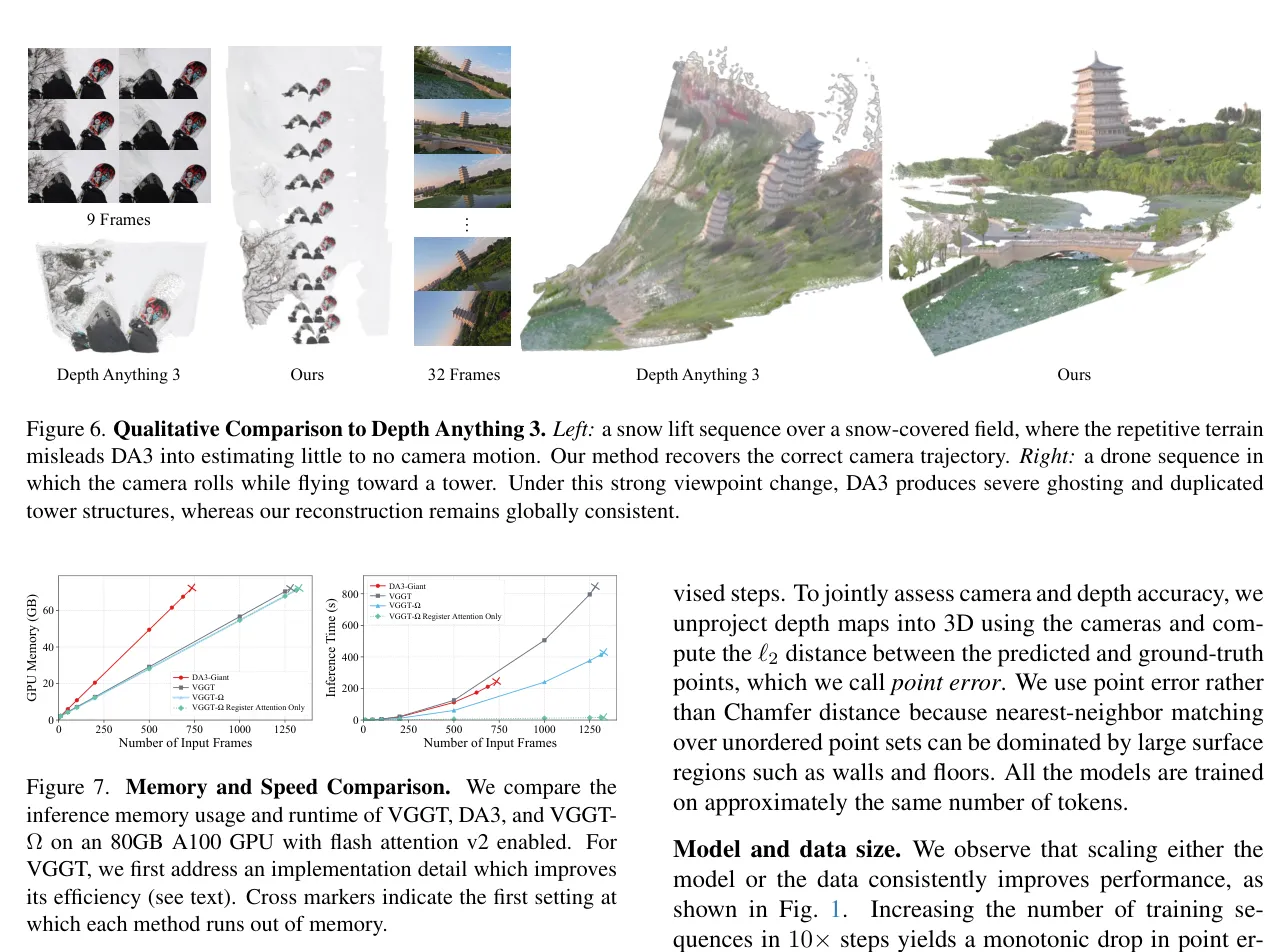
读表:Sintel δ1.25 86.1(DA3)→93.5、AbsRel 0.118→0.081;10B 全面优于 1B,“scaling up the reconstruction model directly benefits both camera and depth accuracy.” 效率(Fig 7,80GB A100 + flash-attn-v2):修正 VGGT(推理只需 4 层缓存而非全 24 层)后,VGGT 与 Ω 显存相近、均可跑 >1000 帧(DA3 ~750 OOM,VGGT/Ω ~1250);Ω 更快主因 DINOv3 patch16(少 ~25% token)+ 25% register attn(再 20–25% 提速),比 MegaSaM 快 50×。激进全 register 变体:1000 帧 240.2s→11.7s(精度降)。注意:去 global attention 的主要收益是速度而非显存——flash-attn 不显式物化注意力矩阵,峰值显存由帧数×token 数的激活主导,故显存随帧数近线性。
⑬ §4.3 消融 + scaling law(point error↓,真实数值)
消融用 1B/2M 序列、64 GPU、150k 监督步;point error=unproject 后预测点与真值点的 \(\ell_2\) 距离(不用 Chamfer,因其易被墙/地大面积主导)。
| 设置 | Point Error↓ | 结论 |
| 纯 global attention | 0.071 | 基准 |
| 替换 25% 为 register attn | 0.073 | 几乎无损、省 23% FLOPs |
| 去 point+match loss | 0.078 | 变差(多任务有用) |
| VGGT 多 dense head | 0.070 | 略好但难 scale |
| + 10% 自监督步 | 0.070 | 更好 + OOD 泛化 |
scaling(Fig 1):data 2K→2M(10× 步进):point error 0.275→0.210→0.160→0.129→0.073 单调降;model 0.2B→10B:0.107→0.073→0.057→0.046。“power laws might characterize scaling in this class of models.” 标注质量:流水线在 Sintel 匹配序列上 AUC@30° 96.4% / δ1.25 99.3%,远超 MegaSaM 62.1%/77.2%(刻意保守:“a smaller set of highly accurate pseudo ground truth is more beneficial … than a larger but noisier collection.”)。
⑭ §4.4 registers 应用(Table 3 LIBERO + 语言对齐)
VLA(Table 3,成功率%↑):冻结 Ω 抽 registers 拼进 OpenVLA-OFT:
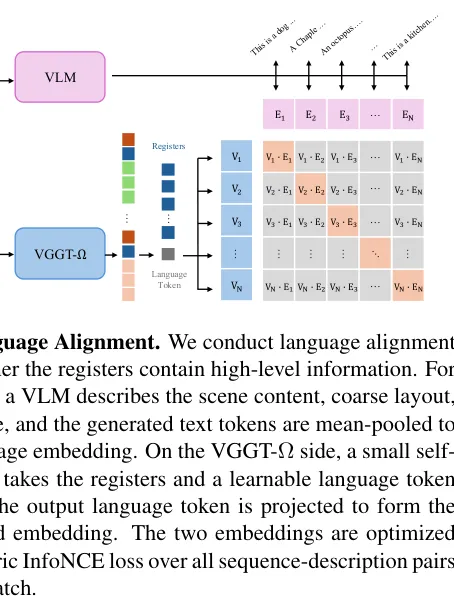
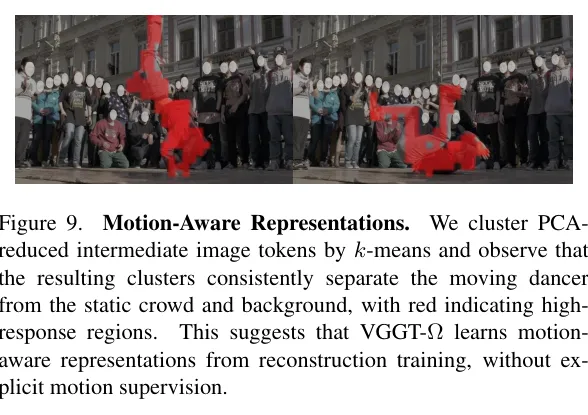
全任务提升,“the geometry-aware registers consistently improve performance across all LIBERO tasks.” 语言对齐(Fig 8):VLM 描述场景→text token mean-pool 成 language embedding;Ω 侧一个小 self-attn stack 吃 registers + 一个可学习 language token(只读 registers、从不看 image patch),用 symmetric InfoNCE 对齐。关键:对齐成功即证 registers 自身携带可与语言匹配的 scene-level 信息(无显式语义监督)。Fig 9 还显示 k-means 聚类自发分离 dancer 与静态背景——“learns motion-aware representations … without explicit motion supervision.”
| 方法 | Spatial | Object | Goal | Long | Avg |
| OpenVLA-OFT | 97.6 | 98.4 | 97.9 | 94.5 | 97.1 |
| + 冻结 scene tokens | 99.3 | 99.2 | 99.0 | 96.7 | 98.5 |
Q&A · 追问 why(三问)
Q1:register attention 为何能近乎无损替代 global attention? 因 global attention map 本就稀疏(Fig 3 第 13 层 attention 直方图/热图极稀疏),跨帧信息只需少量"枢纽"token。registers 充当枢纽:跨帧只在 16×N 个 register 间 self-attn 聚合,再经 frame attention 分发回 image token。消融 0.071→0.073 几乎不变、省 23% FLOPs。
Q2:为何不直接预测 point map/动态输出? point map 在动态需先分割动点;ray map 会纠缠相机与逐像素外观(静止相机拍 dancer:像素大动、相机不动)。只出 depth+camera 最干净,把动态推给"数据先验"。
Q3:为何说"重建是空间理解 proxy"被证明? ① VLA:冻结 registers 拼 OpenVLA-OFT,LIBERO 97.1→98.5;② 语言对齐:只读 registers 的 language token 仍能对齐文本。两者皆无显式语义监督,说明 registers 本身编码可迁移的高层空间信息。
⑮ 局限 / 我的疑问
① 大量关键细节(matching loss 正负对构造、loss 权重、数据各阈值)原文称 “in the supplement”,正文未完整给出 [需查补充材料]。② "比 MegaSaM 快 50×" 与 register-only 变体 "1000 帧 240→11.7s" 是不同口径(前者默认 Ω,后者激进全替换且精度更低),引用须分清 [推测:易混淆]。③ 10B 用 128×96GB H100 训练,社区复现门槛极高;公开是否含 10B 权重需确认。④ arXiv id 2605.15195(标注 14 May 2026)为 future-dated preprint。
📌 全文一页总结(problem → method → experiment → takeaway)
problem:前馈 3D 重建有基础模型潜力,但 scale 在 3D 视觉未被探索,且 VGGT 太吃显存无法做大。method:三处省显存改动(register attention 替 25% global / MLP+pixel-shuffle 替 DPT 高分辨率 conv / 单 depth head + 多任务 loss 式1,共省 70% 训练显存)+ 4M 序列数据流水线(>15× VGGT, 含动态)+ DINO 式 teacher-student 自监督(EMA, 18M 无标注视频);只预测 depth+camera 干净解耦动态。experiment:Sintel 相机 AUC@3° 22.5→40.0(+77%)、深度 δ1.25 86.1→93.5、AbsRel 0.118→0.081;6 benchmark 全面 SOTA;比 MegaSaM 快 50×、单 A100 跑 >1000 帧。Fig 1 证 model(0.2B→10B)/data(2K→2M) 双 scaling 近 power-law(point error 0.275→0.073)。registers 助 VLA(LIBERO 97.1→98.5)+ 对齐语言。takeaway(≥3):① scaling 的前提是先解决显存/效率——架构瘦身腾出预算,才看得到 power-law;② 重建可作空间理解的可扩展 proxy,其内部 registers 是免费、可复用的几何表示(VLA/语言);③ 动态场景宜"靠数据学先验、靠表示解耦"而非"堆显式输出";④ 工程细节(修正 VGGT 推理缓存、保留低分辨率 conv 避 blocky)对可 scale 同样关键。
🖼 论文原图(本地 PDF 截图,原文 caption 未改写)