CVPR 2026 Finalist
UnReflectAnything: RGB-Only Highlight Removal by Rendering Synthetic Specular Supervision
Alberto Rota ⋅ Mert Kiray ⋅ Mert Asim Karaoglu ⋅ Patrick Ruhkamp ⋅ Elena De Momi ⋅ Nassir Navab ⋅ Benjamin Busam
摘要 Abstract
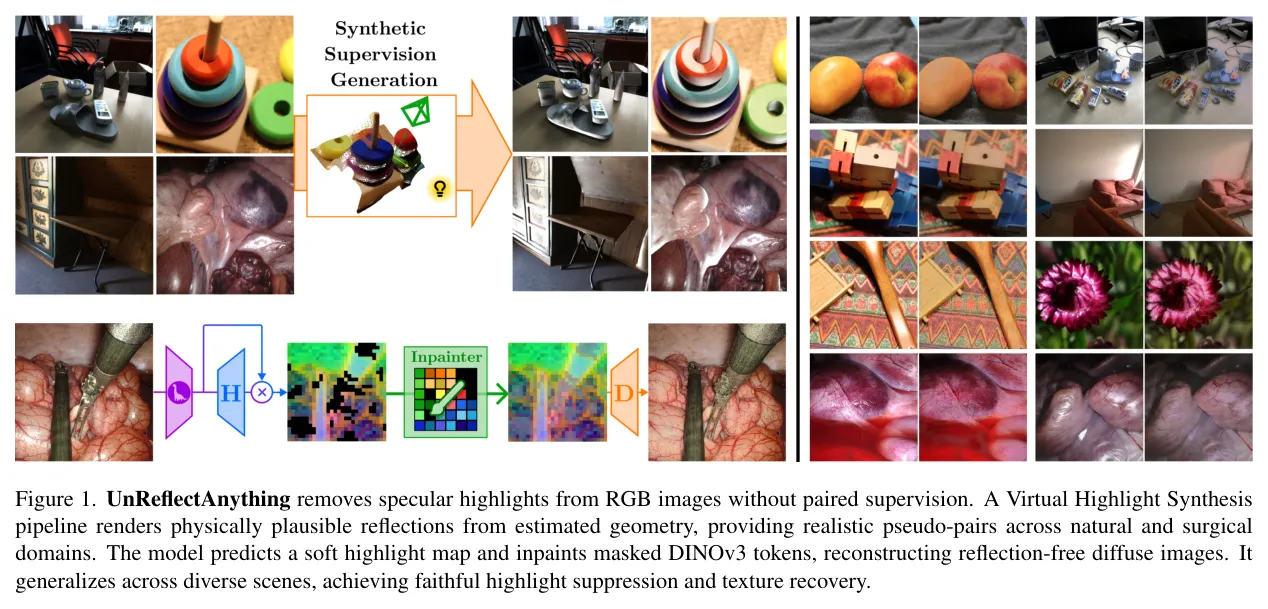
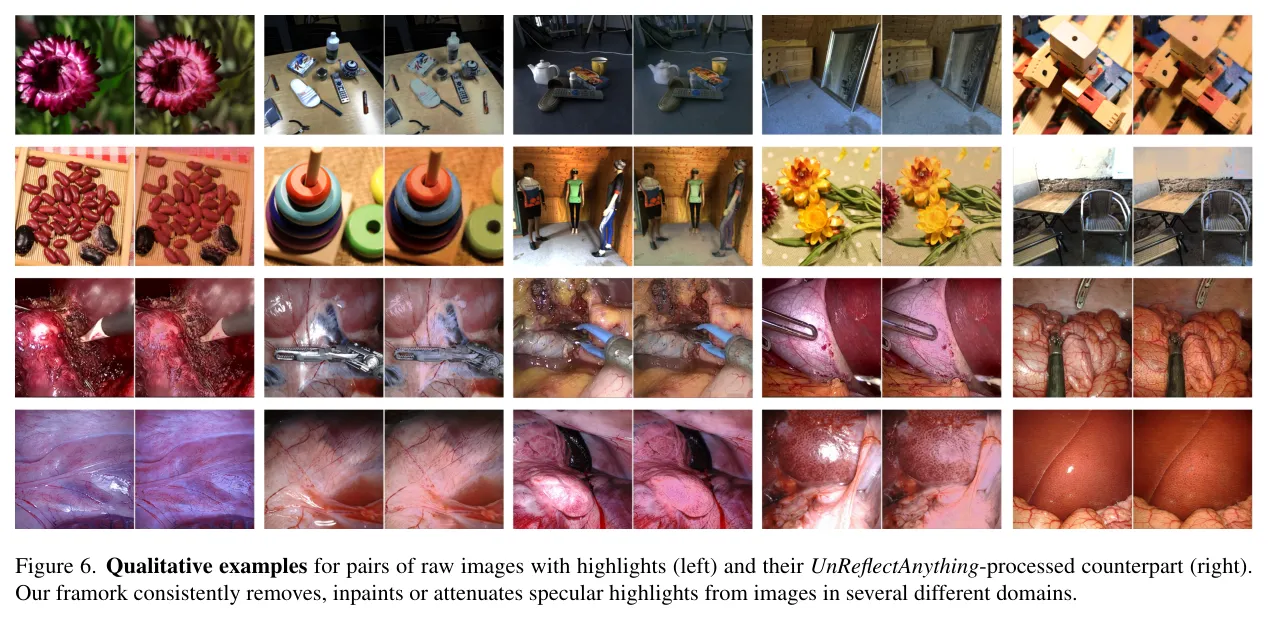
Specular highlights distort appearance, obscure texture, and hinder geometric reasoning in both natural and surgical imagery. We present UnReflectAnything, an RGB-only framework that removes highlights from a single image by predicting a highlight map together with a reflection-free diffuse reconstruction. The model uses a frozen vision transformer encoder to extract multi-scale features, a lightweight head to localize specular regions, and a token-level inpainting module that restores corrupted feature patches before producing the final diffuse image. To overcome the lack of paired supervision, we introduce a Virtual Highlight Synthesis pipeline that renders physically plausible specularities using monocular geometry, Fresnel-aware shading, and randomized lighting which enables training on arbitrary RGB images with correct geometric structure. UnReflectAnything generalizes across natural and surgical domains where non-Lambertian surfaces and non-uniform lighting create severe highlights and it achieves competitive performance with state-of-the-art results on several benchmarks.
📝 精读笔记
灵魂一句
RGB-only 单图去高光(去镜面反射),靠“自己造监督”解决无配对数据:用单目几何(深度+法线)在任意 RGB 图上物理渲染逼真高光(Schlick-Fresnel + Blinn-Phong + 随机光源)得到伪配对。模型=冻结 DINOv3 编码 → 轻量头预测软高光图 → token 空间 inpainting(在特征里补被高光污染的 patch) → DPT 解码出无反射 diffuse 图。在自然 + 外科(内窥镜)双域泛化,多个 benchmark SOTA,还能提升下游位姿估计。
问题 & 动机
镜面高光(saturated、view-dependent)遮纹理、坏几何推理,在分割/匹配/光度推断/深度/立体重建上都是杀手——尤其内窥镜(湿组织 + 强非均匀光)高光严重、影响临床决策。单图去高光本质 ill-posed(高光饱和、稀疏、与几何/材质/光照纠缠)。偏振相机能物理分离但要特殊硬件;经典法(color prior/ratio/dichromatic)在真实复杂材质下崩;深度学习受配对监督稀缺 + 合成→医学域漂移限制,常 over-smooth 或边界 hue 失真。
核心方法(造监督 + token inpainting)
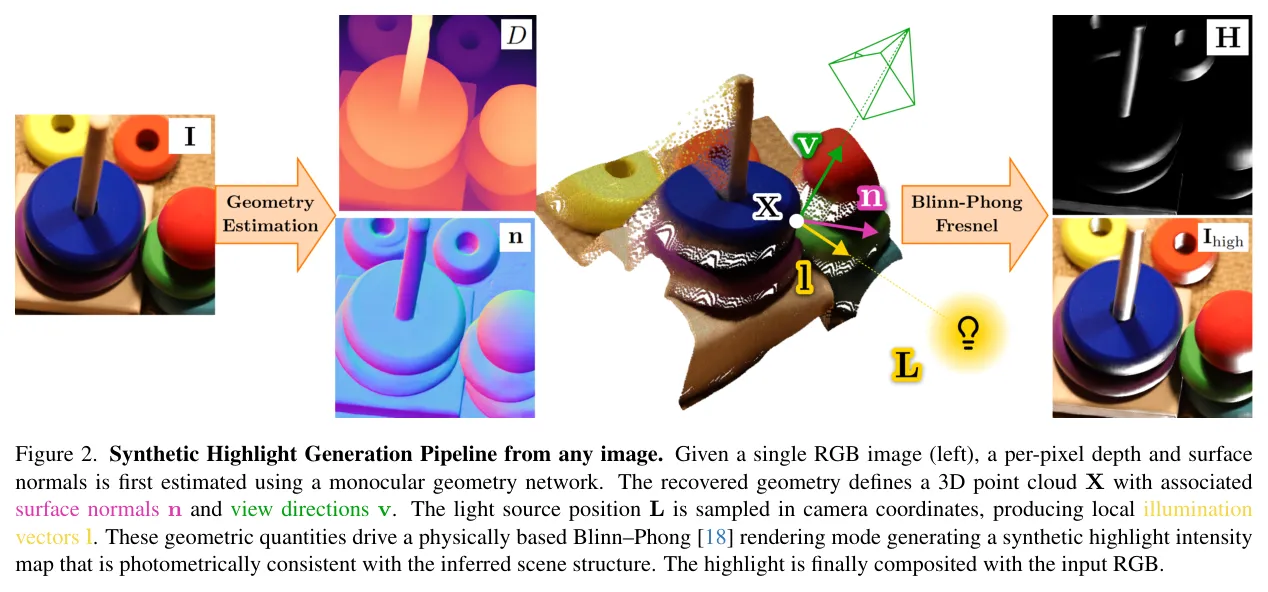
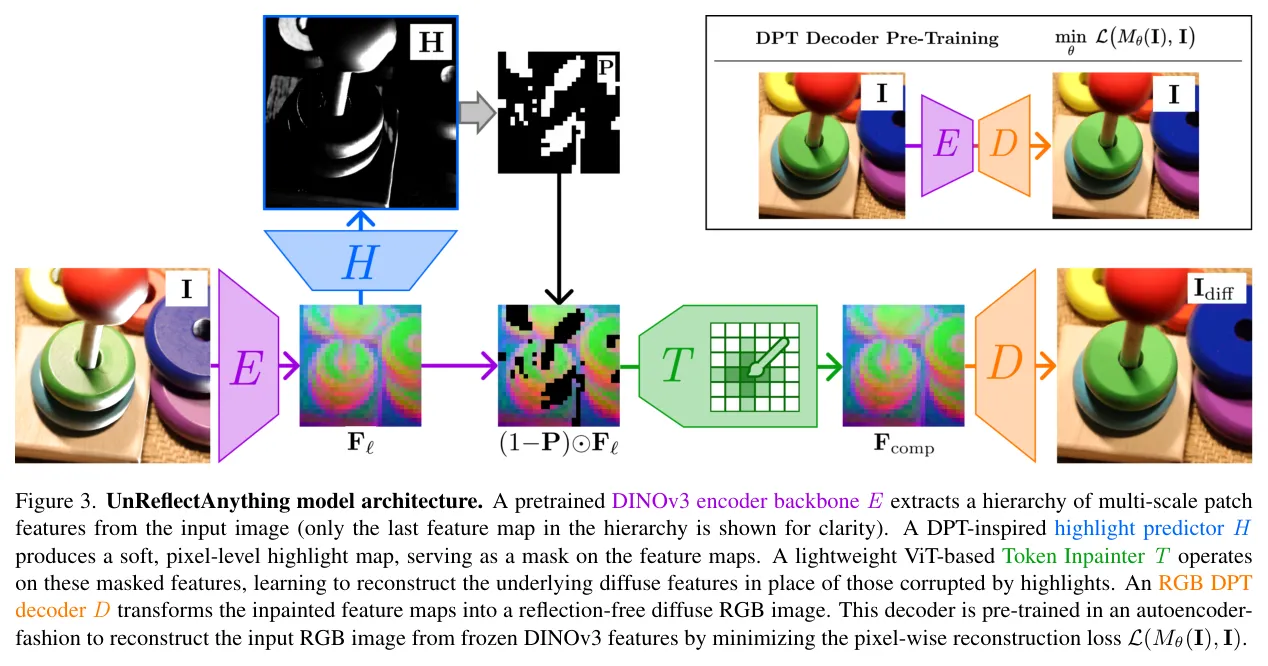
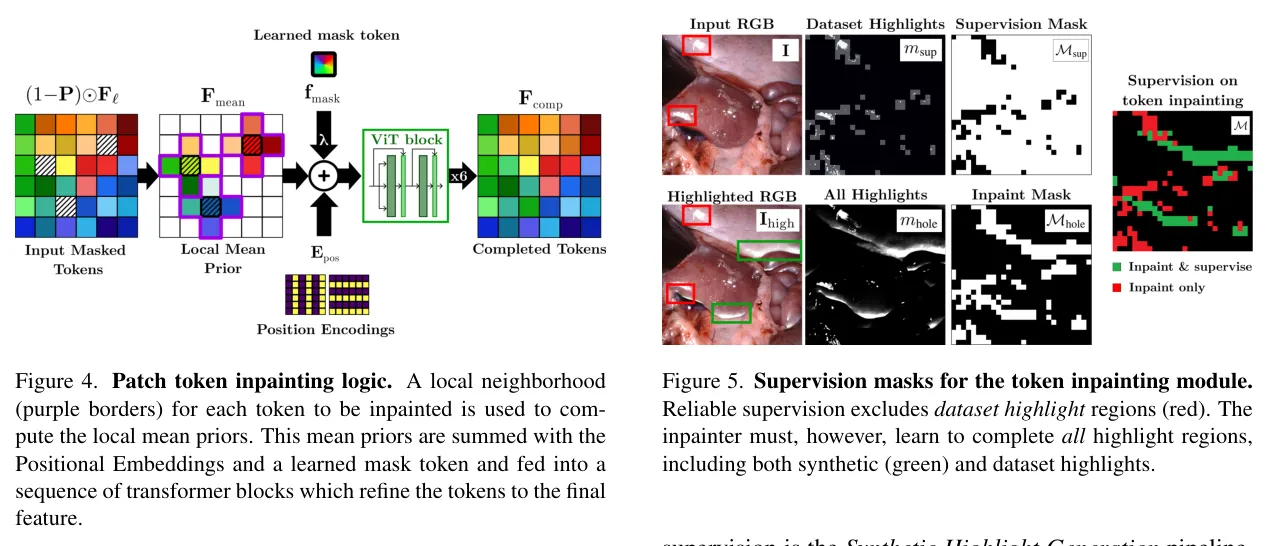
① Virtual Highlight Synthesis(关键):单目几何网络(MoGe-2)估深度/法线/内参 → 反投影到 3D 点云 → 相机系随机采点光源 → 用 Schlick-Fresnel + Blinn-Phong 渲染物理合理的高光强度图 → alpha 合成到原图。这样任意 RGB 图都能配出(干净图, 高光图)伪对。② 模型四件套:frozen DINOv3-L 多尺度特征 → DPT 式 highlight predictor 出软高光图(当 mask) → ViT 式 token inpainter(在特征空间补被 mask 的 patch) → DPT RGB decoder 出 diffuse 图。③ 处理“数据本身就有的真高光”:按亮度阈值检测、排除出监督(否则模型会把饱和白当 diffuse)。
关键公式
视/光方向 v=X/‖X‖, l=(L−X)/‖L−X‖(式1);半向量 h=(l+v)/‖l+v‖。Schlick-Fresnel:R=R0+(1−R0)(1−v·h)⁵(式2,R0=0.04)。Blinn-Phong 高光:H=K_H·R·(n·h)^S(式3,K_H 全局强度、S 光泽度,训练时 K_H/S/光源 L 从均匀分布随机采)。合成:I_high=(1−H)·I + H·(I+K_H·1₃)(式4)。token inpainting:seed F_seed=P⊙(λ·f_mask+(1−λ)·F_mean)+(1−P)⊙F+E_pos(式6),F_comp=P⊙ViT(F_seed)+(1−P)⊙F(式7);inpaint 损失 cosine+L1(式8)。
关键结果
有 diffuse GT(Tab.1):SSIM PSD 0.911/SHIQ 0.988/SSHR 0.971 多项最佳(结构保真最稳),MSEm 也低;但 PSNR 偏低(非高光区细节保留不如对手,作者诚实承认)。无 GT(Tab.2, LSR↓/NIQE↓):自然 3 集 + 外科 3 集的 LSR(高光抑制率)全部最低(如 Cholec80 0.002、SCRREAM 0.002),NIQE 也具竞争力。下游位姿(Tab.3):CroMo epipolar error 0.301 最低、StereoMIS 0.167 最低,外科域 inlier ratio 领先。
亮点
① 首个把“单目几何 + Fresnel 高光渲染 + 随机光照”结合来无配对造监督(自然 + 外科通吃);② 特征空间 inpainting(补 DINOv3 token 而非像素)→ 借全局语义恢复 diffuse,消融里换成 RGB 空间 inpainting SSIM 从 0.957 掉到 0.816;③ 显式排除“数据自带真高光”出监督(去掉它 MSEm 0.003→0.022,最伤);④ 去高光直接提升下游几何匹配/位姿。
疑问 / 待查
① PSNR 普遍不占优——MSEm 低但 PSNR 低,说明非高光区细节有损(作者归因缺 structure-aware prior,“less effective at preserving fine details in the non-highlighted regions”);② 高光检测靠亮度,会把亮天空/白色解剖结构误判成高光而错误 inpaint(supp 失败案例);③ 对透明/折射物及低梯度缓变高光处理差,seam 不连贯。
📖 逐段精读 · 笔记
① Abstract(摘要)— 逐句精讲
原文大意:镜面高光扭曲外观、遮蔽纹理、阻碍几何推理(自然图与外科图皆然)。提出 UnReflectAnything:一个 RGB-only 框架,单图去高光——同时预测一张高光图 + 一张无反射 diffuse 重建。模型用冻结的 ViT 编码器提多尺度特征、一个轻量头定位镜面区域、一个 token 级 inpainting 模块在产出最终 diffuse 图前修复被污染的特征 patch。为克服无配对监督,提出 Virtual Highlight Synthesis 管线:用单目几何 + Fresnel-aware shading + 随机光照渲染物理合理的高光,使任意带正确几何结构的 RGB 图都能用来训练。在自然 + 外科两域泛化,多个 benchmark 取得有竞争力/SOTA 结果。
逐句指路(verbatim 英文 + 中文):
1) “Specular highlights distort appearance, obscure texture, and hinder geometric reasoning in both natural and surgical imagery.” — 动机一句话:高光坏几何,外科尤甚。
2) “an RGB-only framework that removes highlights from a single image by predicting a highlight map together with a reflection-free diffuse reconstruction.” — 双输出:高光图 + diffuse 图,且纯 RGB(不要偏振硬件)。
3) “a frozen vision transformer encoder … a token-level inpainting module that restores corrupted feature patches before producing the final diffuse image.” — 架构核心:冻结 ViT + 特征空间 inpainting(不是像素空间)。
4) “To overcome the lack of paired supervision, we introduce a Virtual Highlight Synthesis pipeline that renders physically plausible specularities using monocular geometry, Fresnel-aware shading, and randomized lighting.” — 核心贡献:用渲染造监督,三要素=单目几何 / Fresnel 着色 / 随机光照。
5) “achieves competitive performance with state-of-the-art results on several benchmarks.” — 结论定调。
📚 背景知识①:镜面 vs 漫反射 / dichromatic / 为什么 ill-posed(外部补充)
物体反射光 = diffuse 漫反射(各向均匀、携带本征颜色与纹理)+ specular 镜面(像镜子、视角相关 view-dependent、常饱和发白)。二色反射模型 dichromatic reflection model(Shafer 1985)把观测拆成这两层。去高光 = 估出并去掉 specular、还原 diffuse。本质 ill-posed:原文 “the specular component is often saturated, spatially sparse, and entangled with scene geometry, material properties, and illumination.” —— 高光区像素被“烧”到饱和、信息丢失,且与几何/材质/光照纠缠,单图不可能逆出唯一解。偏振相机能物理分离 diffuse/specular,但 “their specialized hardware limits practicality in most consumer and surgical systems.”
📚 背景知识②:Blinn-Phong / Schlick-Fresnel / 半向量(理解式 1-4 必备)
都是图形学经典光照模型。半向量 half-vector \(h=\frac{l+v}{\lVert l+v\rVert}\) 是光方向 \(l\) 与视方向 \(v\) 的归一化中分线;Blinn-Phong 镜面项 \(\propto (n\cdot h)^S\),\(S\)(shininess/光泽度)越大高光越锐越小。Fresnel 效应=掠射角(大入射角)反射更强,Schlick 近似 \(R=R_0+(1-R_0)(1-v\cdot h)^5\) 是廉价算反射系数的常用公式,\(R_0\) 为正入射反射率。本文反其道而行:不是“去”高光的物理模型,而是用它们正向渲染出逼真高光去“污染”干净图,从而无配对地造出(干净图,高光图)伪配对。
📚 背景知识③:DINOv3 / DPT / MoGe-2 / 偏振对手
DINOv3(Siméoni et al. 2025)=自监督 ViT 大模型,本文当冻结编码器 \(E\) 提语义特征,并在其 token 上做 inpainting。DPT(Dense Prediction Transformer, Ranftl 2021)=把 ViT 特征解码成稠密图,本文的高光头 \(H\) 与 RGB 解码器 \(D\) 都是 DPT 式。MoGe-2(Wang et al. 2025)=单目几何大模型,估 metric 深度 + 法线 + 内参,提供渲染所需 3D 结构。偏振路线对手 PolarAnything (PA) / PolarFree (PF) 能借 DoLP/AoLP 分离 diffuse/specular,但需偏振输入;本文要的正是免偏振、纯 RGB。
② §1 Introduction — problem(动机闭环之“病”)
problem:高光遮内容、坏下游——原文 “corrupt downstream perception tasks such as segmentation, correspondence, and photometric inference.” 外科内窥镜里 “bodily fluids, moist tissue and strong non-uniform lighting introduce intense specularities that occlude anatomy, bias texture cues, and hinder navigation and decision-making.” 且 “visual ambiguity can carry clinical consequences.”(有临床后果)。单图去高光 “is fundamentally ill-posed.” 现有路线三条全有短板:① 偏振要专用硬件;② 经典法(color prior / color ratio / dichromatic)“often break down under real-world conditions involving complex materials or uncontrolled illumination.”;③ 深度学习受 “the scarcity of paired supervision and the domain shift between synthetic and medical imagery” 限,常 “over-smooth texture or introduce hue distortions near highlight boundaries.”
③ §1 Introduction — 三大贡献 solution → why 闭环
solution(原文三条贡献逐字):
• “Virtual highlight synthesis. We render realistic specularities from monocular geometry using Fresnel-aware shading and randomized lighting, enabling supervision without paired diffuse-only data.”
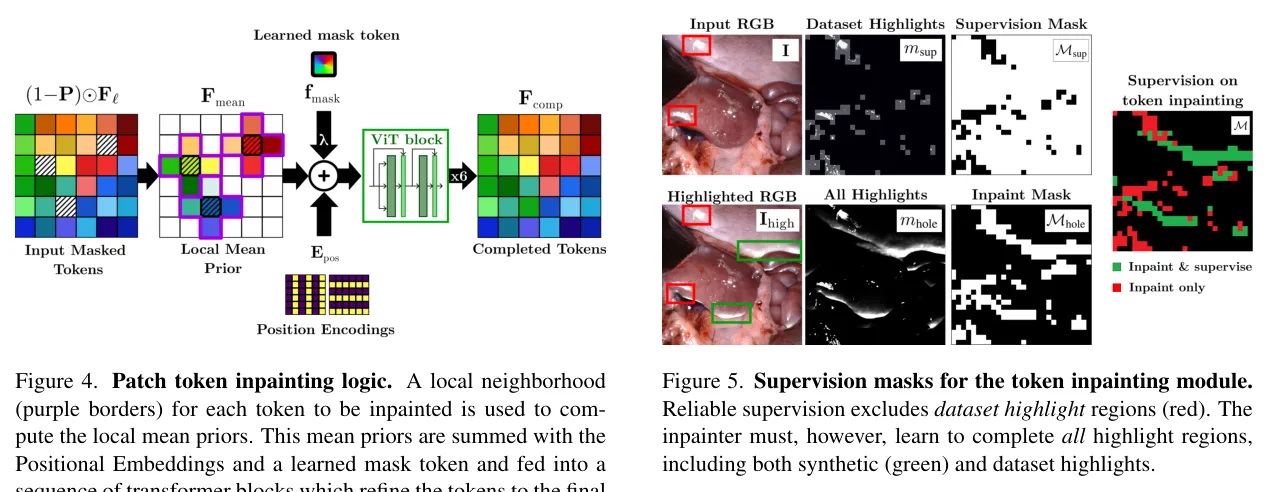
• “Token-space diffuse inpainting. A transformer inpainter reconstructs masked DINOv3 patch tokens directly in feature space, restoring diffuse appearance with global context.”
• “Hybrid geometry and pixel-level supervision. A unified training scheme couples synthetic highlight rendering with token- and image-space losses, enforcing seamless boundary consistency and cross-domain robustness.”
why(为什么“渲染造监督”成立、为什么在特征空间补):① 渲染合理性——只要单目几何(尤其法线)够准,按物理(Fresnel + Blinn-Phong)合成的高光就与真实场景结构光度一致 photometrically consistent,于是“干净原图”天然成为“合成高光图”的 diffuse GT;消融证实:把 MoGe-2 法线换成粗糙 depth-gradient 法线,MSEm 0.003→0.012 明显变差。② 特征空间 inpainting——高光区像素已饱和丢失,但 DINOv3 token 携带全局语义/上下文,在特征层补再解码比直接补像素更能恢复结构;消融:换成 RGB 空间 inpainting,SSIM 0.957→0.816(掉最多)。这两点正面回应“无 GT 怎么训、丢失信息怎么补”。
📚 §2 Related Work — 谱系定位
经典物理先验:Tan & Shen 用 color constancy / intensity ratio 拆 diffuse-specular;dichromatic 模型给出简化前提下的原理化公式;multi-flash、偏振相机能更显式分离但需特殊采集。学习法:HighlightNet 建首个大规模合成+真实联合检测/去除数据集;SpecularityNet 用 cross-polarization + 对抗训练;MG-CycleGAN 用软高光 mask + cycle-consistency 做无配对学习;DHAN-SHR 用 local-global 混合 transformer 不需显式 mask;StableDelight(受 StableNormal 启发)用扩散先验。外科专用:RPCA 分解、partial conv inpainting、Endo-STTN(时序 transformer 跨帧传纹理,但 “relies on binary highlight masks as explicit input queries, which are often unavailable in practice.”)。本文自我定位:“To our knowledge, UnReflectAnything is the first work to combine monocular geometry, Fresnel-aware specular rendering, and randomized lighting to generate physically plausible paired supervision for RGB-only highlight removal across both natural and surgical imagery.”
④ §3.1 Virtual Highlight Synthesis — 单目几何 + 视/光方向(式1)
机制:给定线性 RGB 图 \(I\in[0,1]^{H\times W\times 3}\),三步造高光:(i) 单视图推几何,(ii) 相机系采点光源,(iii) 渲一个带 Fresnel 调制的 Blinn-Phong 镜面瓣。单目几何用现成方法(MoGe-2)估 metric 深度 \(D\in\mathbb{R}_+^{H\times W}\)、法线 \(n\in\mathbb{R}^{H\times W\times3}\)、内参 \(K\in\mathbb{R}^{3\times3}\)。每个齐次像素 \(p=(u,v,1)^\top\) 反投影到相机系 3D 点 \[ X = D(p)\,K^{-1}p \] 点光源位置 \(L\in\mathbb{R}^3\) 在相机系 3D 采样。归一化的视方向与光方向(式1):\[ v=\frac{X}{\lVert X\rVert},\qquad l=\frac{L-X}{\lVert L-X\rVert} \]
⑤ §3.1 Specular Core — Fresnel(式2)/ Blinn-Phong(式3)/ 合成(式4)/ 数据自带高光
半向量 \(h=\frac{l+v}{\lVert l+v\rVert}\)。Schlick-Fresnel 反射系数(式2):\[ R=R_0+(1-R_0)(1-v\cdot h)^5 \] \(R_0\) 为正入射 Fresnel 反射率近似(实现取 \(R_0=0.04\))。Blinn-Phong 逐像素高光强度(式3):\[ H=K_H\,R\,(n\cdot h)^S \] \(K_H>0\) 控全局高光强度、\(S\) 量化表面光泽度;训练时 “KH, S and the light position L are sampled from empirically tuned uniform distributions”,以增加监督信号多样性。RGB 合成(式4,alpha 叠加):\[ I_{high}=(1-H)\,I + H\,(I+K_H\,\mathbf{1}_3) \] 关键工程细节——dataset highlights:原图 \(I\) 并非天然无高光(内窥镜尤甚),这些数据自带真高光按高亮度阈值 \(\tau_L\) 检测;“supervising these pixels would mislead the network into interpreting saturated highlight regions as diffuse ‘white’ surfaces”,故显式从监督中排除所有 dataset-highlight 像素。
⑥ §3.2 Architecture — E/H/T/D 四件套(式5)
模型 \(M\) 输入 \(I\),联合输出无反射 diffuse 图 \(I_{diff}\in[0,1]^{H\times W\times3}\) 与高光得分图 \(I_{high}\in[0,1]^{H\times W}\),即 \((I_{diff},I_{high})=M(I)\),形式化 \(I_{high}=H(E(I))\)、\(I_{diff}=D(T(E(I),I_{high}))\)。四组件:
• 编码器 \(E\)=冻结 DINOv3-Large,取四个深度的多尺度 patch token(式5):\[ F=\{F_1,F_2,F_3,F_4\}=E(I),\quad F_\ell\in\mathbb{R}^{N\times C} \] • 高光头 \(H\)=轻量 DPT 解码器,出单通道连续高光图 \(I_{high}\in[0,1]^{H\times W}\),“providing a guidance signal for subsequent token inpainting.”
• token inpainter \(T\)=在特征空间重建被高光污染的 token(详见⑦)。
• RGB 解码器 \(D\)=从补全后的多尺度 token 合成 diffuse 图。
⑦ §3.2 Patch-Token Diffuse Inpainting — seed 与合并(式6/式7)
patch mask \(P\in[0,1]^N\) 由 \(I_{high}\) 平均池化到 patch 分辨率再阈值化得到(逐层 \(\ell\) 独立,略去 \(\ell\))。待补 token 先换成可学 mask token \(f_{mask}\),再混入由可见邻居经 depthwise conv 算出的 local mean prior \(F_{mean}\),并加固定 2D 位置编码 \(E_{pos}\) 得 seed(式6):\[ F_{seed}=P\odot\big(\lambda f_{mask}+(1-\lambda)F_{mean}\big)+(1-P)\odot F+E_{pos} \] \(\lambda\) 为 local mean prior 系数(取 0.5)。seed 过六层 ViT 自注意(对可见+被 mask token 一起做),最终把补全与原可见 token 合并(式7):\[ F_{comp}=P\odot\mathrm{ViT}(F_{seed})+(1-P)\odot F \] 得到 “highlight-free features that preserve both spatial structure and semantic coherence”,再交 \(D\) 解码出 \(I_{diff}\)。
⑧ §3.3 Supervision — 双 mask + 特征损失(式8)+ 解码器 9/10/11/12
两 mask:监督 mask \(m_{sup}\)(GT 可信处=排除真高光)、hole mask \(m_{hole}\)(待补=合成∪真高光);下采到 patch 网格得 \(M_{sup},M_{hole}\)。高光头:\(L_H=w_{dice}L_{dice}+w_{L1}L_{L1}+w_{TV}L_{TV}\)。token inpainting:只在交集 \(M=M_{hole}\cap M_{sup}\)(被补且有可信 GT)上算,GT token 取合成前干净图 \(F^*_\ell=E(I)\),损失含 cosine + L1(式8):\[ L_{inp}=\frac{1}{|M|}\sum_{i\in M}\Big[\alpha\lVert F^*_i-F_i\rVert_1+(1-\alpha)\big(1-F^*_i F_i^\top\big)\Big] \] α=0.25。解码器两段:先 autoencoder 预训练(式9)\(L_{AE}=\lVert D(E(I))-I\rVert_1+(1-\mathrm{SSIM}(D(E(I)),I))\);再 fine-tune 加 seam 边界连续(式10)\(L_{seam}=\lVert(I_{diff}-I)\odot r\rVert_1+\lambda_g\lVert\nabla I_{diff}-\nabla I\rVert_1\)(\(r=\mathrm{dilate}(m_{hole})-m_{hole}\) 薄边界环)、抑制重现高光的 Charbonnier(式11)\(L_{spec}=\frac{1}{|m_{hl}|}\sum_{p\in m_{hl}}\sqrt{(B(p)-\tau)^2+\varepsilon^2}\)、RGB 重建(式12)\(L_{RGB}=\lVert I_{diff}-I^*_{diff}\rVert_1+(1-\mathrm{SSIM}(I_{diff},I^*_{diff}))\)(用 \(m_{sup}\) 排除真高光)。
⑨ §4 实验设置 + 超参(PDF 抄真值)
训练:1× NVIDIA A100 (80 GB),batch size 32,50 epochs,初始 lr \(5\times10^{-4}\)、每 10 epoch 线性衰减;几何用 MoGe-2,高光头/解码器用 DPT,inpainter 用 6 层 ViT。超参:\(R_0=0.04\)、亮度阈值 \(\tau_L=0.95\)、\(\lambda=0.5\)、α=0.25、解码器微调 mask 阈值 \(\tau_m=0.85\)、稳定项 \(\varepsilon=10^{-6}\)。loss 权重(Table 5):\(w_{dice}=0.2,\ w_{L1}=0.7,\ w_{TV}=0.1,\ w_{seam}=0.25,\ w_{spec}=0.25,\ w_{RGB}=0.5\)。数据:室内 SCRREAM / HouseCat6D、室外 CroMo、内窥镜 SCARED / Cholec80;按有无 diffuse GT 分两类评测——diffuse-referenced(PSD/SHIQ/SSHR 有配对 GT)与 non-referenced(其余,含全部外科集,“no publicly available surgical dataset provides paired reflection-free ground truth.”)。
⑩ §4.2 有 GT 评测 — Table 1 真实数值(MSEm↓/PSNR↑/SSIM↑)
| 方法 | PSD MSEm↓ | PSD PSNR↑ | PSD SSIM↑ | SHIQ SSIM↑ | SSHR SSIM↑ |
| DHAN-SHR | 0.006 | 24.863 | 0.868 | 0.982 | 0.971 |
| SpecularityNet | 0.007 | 23.675 | 0.839 | 0.961 | 0.952 |
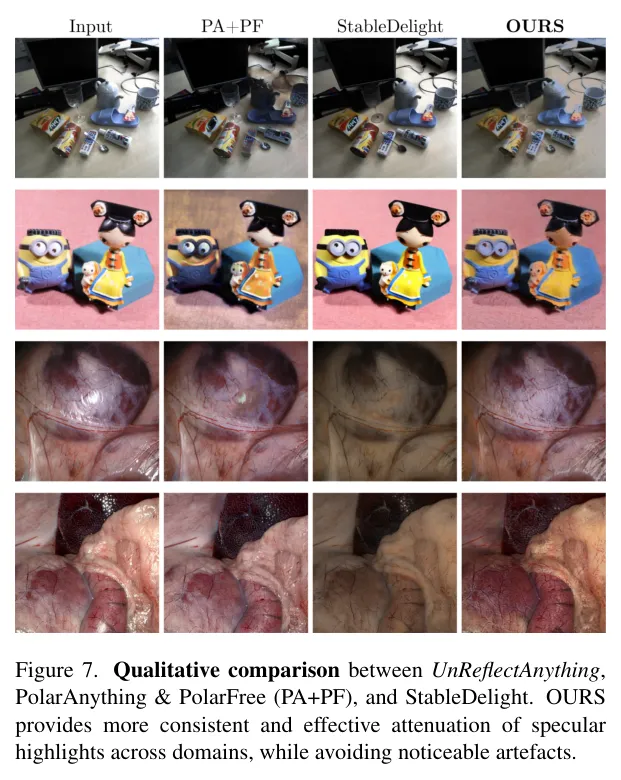
| StableDelight | 0.007 | 23.384 | 0.838 | 0.921 | 0.886 |
| PA+PF | 0.050 | 14.101 | 0.645 | 0.604 | 0.432 |
| OURS | 0.004 | 17.230 | 0.911 | 0.988 | 0.971 |
读表:结构保真 SSIM 多项第一/并列第一(PSD 0.911、SHIQ 0.988、SSHR 0.971),MSEm 也最低(PSD 0.004)。但 ⚠️ PSNR 偏低(PSD 17.230 vs DHAN-SHR 24.863)——作者诚实承认:“Our model attains lower MSEm but also lower PSNR, indicating it may be less effective at preserving fine details in the non-highlighted regions despite achieving lower global error.”
⑪ §4.3 无 GT 评测 — Table 2 真实数值(LSR / NIQE,越低越好)
| 方法 | CroMo LSR | SCRREAM LSR | Cholec80 LSR(外科) | SCARED LSR(外科) | StereoMIS LSR(外科) |
| DHAN-SHR | 0.063 | 0.073 | 0.115 | 0.114 | 0.077 |
| EndoSTTN | 0.028 | 0.039 | 0.021 | 0.020 | 0.052 |
| StableDelight | 0.176 | 0.270 | 0.316 | 0.262 | 0.278 |
| OURS | 0.012 | 0.002 | 0.002 | 0.011 | 0.022 |
读表:自然 + 外科全部数据集 LSR 最低(高光抑制最强),NIQE 也具竞争力(如 SCRREAM NIQE 0.056、CroMo 0.061 最低)。原文:“our approach systematically attains the lowest LSR across Cholec80, SCARED, and StereoMIS-Tracking … while remaining comparable to competing methods in terms of NIQE.”
⑫ §4.4 下游位姿 — Table 3 + Q&A:去高光真的帮几何吗?
设置:DISK 关键点 + LightGlue 匹配 + MAGSAC++ 估本质矩阵,指标=对称 epipolar error \(E_{ep}\)↓ 与 inlier ratio \(IR\)↑。真实数值:自然域 CroMo OURS \(E_{ep}=0.301\)(最低)/ IR 0.997;外科 StereoMIS-Tr OURS \(E_{ep}=0.167\)(最低)/ IR 1.000;Cholec80 OURS \(E_{ep}=0.355\) / IR 0.998(领先/并列领先 inlier)。
Q&A · 为什么去高光能改善位姿?高光是 view-dependent 的,在两视图里位置/亮度不一致,会制造假对应、干扰关键点定位。去掉它后关键点更稳、匹配更可靠。原文:“reducing specular contamination helps preserve keypoint localization under challenging clinical illumination, where reflections often interfere directly with geometric cues.” 外科域 “our model shows a more uniform advantage”,因为外科高光更强更广。
⑬ §C 消融 — Table 4 真实数值(MSEm↓/SSIM↑,PSD/SSHR/SHIQ 均值)
| 配置 | MSEm↓ | SSIM↑ |
| w/o MoGe-2(depth-gradient 法线) | 0.012 | 0.909 |
| w/o token inpainting(改 RGB 空间补) | 0.007 | 0.816 |
| w/o local mean prior | 0.004 | 0.911 |
| w/o decoder 预训练 | 0.006 | 0.873 |
| w/o dataset-highlight 排除 | 0.022 | 0.933 |
| Full(OURS) | 0.003 | 0.957 |
读表:① 去 token inpainting 改 RGB 空间补,SSIM 从 0.957 暴跌到 0.816(结构最伤)——证实“特征空间补”是核心。② 去 dataset-highlight 排除,MSEm 从 0.003 暴涨到 0.022(最伤误差)——证实“把饱和真高光当 GT 会带偏模型”。③ 去 MoGe-2 法线(用粗糙 depth-gradient),MSEm 0.003→0.012——证实“准法线→真高光”。原文:“inaccurate normals produce unrealistic synthetic highlights and weaken supervision … restoring corrupted features before decoding is essential for preserving structure.”
⑭ §4.5 Discussion / Limitations + 我的疑问
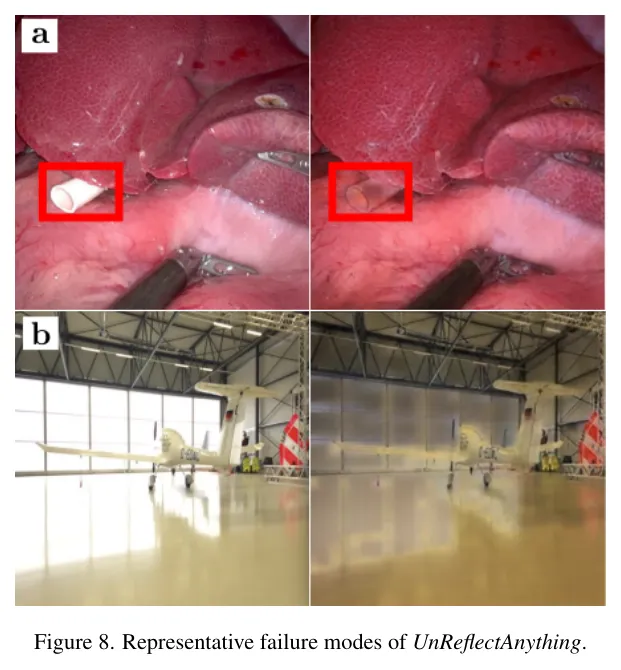
作者承认的局限:① “tends to struggle with transparent or refractive objects, where the distinction between diffuse and specular components is inherently ambiguous.”(透明/折射物难分)② 非高光区细节保留次优 “sub-optimal performance in retaining structure and resolution in the non-highlight regions”,建议加 structure-aware prior / edge constraint。③ 当前依赖亮度线索检测高光 “the current predictions rely predominantly on luminance cues”,会把亮天空/白色解剖结构误判成高光而错误 inpaint(supp Fig.8 失败案例)。④ “degraded reconstruction quality in cases of gradual, low-gradient highlights with smooth falloffs, where the inpainted seams may appear less coherent.”
我的疑问 [推测]:合成高光的 \(K_H,S\) 分布是“empirically tuned”,跨域(外科 vs 室外)是否需重调?论文未给跨域分布敏感性消融,存疑。
📌 全文一页总结(problem → method → experiment → takeaway)
problem:RGB 单图去镜面高光本质 ill-posed、缺配对监督、合成→医学域漂移、外科高光严重坏几何与临床决策。method:Virtual Highlight Synthesis(单目几何 MoGe-2 + Schlick-Fresnel 式2 + Blinn-Phong 式3 + 随机光照,alpha 合成式4,任意图造伪配对)+ 冻结 DINOv3 编码 + DPT 高光头 + token 空间 inpainting(式6/7 补污染特征)+ DPT 解码出 diffuse;混合 token/像素监督(式8-12)+ 显式排除数据自带真高光。experiment:有 GT 结构保真 SSIM 多项最佳(PSD 0.911 / SHIQ 0.988,但 PSNR 偏低 17.23);无 GT 自然+外科 LSR 全部最低(SCRREAM/Cholec80 0.002);下游位姿 CroMo \(E_{ep}\) 0.301、StereoMIS 0.167 最低。takeaway(≥3):① 物理渲染可无配对造高光监督,且能跨自然/外科泛化——只要单目几何准,干净图就是合成高光图的 diffuse GT。② 特征空间 inpainting 远胜像素空间(SSIM 0.957 vs 0.816):借 DINOv3 全局语义恢复被烧没的结构。③ 必须把“数据自带真高光”排除出监督(MSEm 0.022 vs 0.003),否则模型把饱和白当 diffuse。④ 去高光是“几何友好”预处理:直接提升关键点匹配与相对位姿。
🖼 论文原图(本地 PDF 截图,原文 caption 未改写)