CVPR 2026 Finalist
Towards Photorealistic and Efficient Bokeh Rendering via Diffusion Framework
Linxiao Shi ⋅ Siming Zheng ⋅ Zerong Wang ⋅ Hao Zhang ⋅ Jinwei Chen ⋅ Bo Li ⋅ Shifeng Chen ⋅ Peng-Tao Jiang
摘要 Abstract
Existing mobile devices are constrained by compact optical designs, such as small apertures, which make it difficult to produce natural, optically realistic bokeh effects. Although recent learning-based methods have shown promising results, they still struggle with photos captured under high digital zoom levels, which often suffer from reduced resolution and loss of fine details. A naive solution is to enhance image quality before applying bokeh rendering, yet this two-stage pipeline reduces efficiency and introduces unnecessary error accumulation. To overcome these limitations, we propose MagicBokeh, a unified diffusion-based framework designed for high-quality and efficient bokeh rendering. Through an alternative training strategy and a focus-aware masked attention mechanism, our method jointly optimizes bokeh rendering and super-resolution, substantially improving both controllability and visual fidelity. Furthermore, we introduce degradation-aware depth module to enable more accurate depth estimation from low-quality inputs. Experimental results demonstrate that MagicBokeh efficiently produces photorealistic bokeh effects, particularly on real-world low-resolution images, paving the way for future advancements in bokeh rendering. The code will be released publicly.
📝 精读笔记
灵魂一句
MagicBokeh=首个面向高倍数码变焦(LQ 输入)的统一单步扩散 bokeh 框架:把“超分(Real-ISR)”和“背景虚化(bokeh rendering)”塞进一个 SD 模型一次前向同时做,避开两阶段(先超分再虚化)的误差累积 + 双次推理低效。三件套:① alternative training(交替训 SR/bokeh 解耦冲突目标);② focus-aware mask attention(FAMA)(用 defocus map 把 self-attention 限制在前景/背景各自区域);③ degradation-aware depth(DA depth)(自蒸馏让 Depth Anything v2 在 LQ 图上也估准深度)。EBB400-LQ SOTA、单图 0.106s。
问题 & 动机
手机光学受限(小光圈)难出自然 bokeh;现有学习法都假设输入是 all-in-focus 的高质量图,碰到高倍数码变焦(分辨率降、噪声放大、边界糊)就崩。朴素 two-stage(先 Real-ISR 再 bokeh)两病:① 误差累积(超分输出不完美,虚化阶段进一步放大);② 低效(两次模型推理)。作者发现扩散模型(SD)既擅长细节生成、又自带 bokeh prior→ 干脆做统一扩散框架,质量+效率一起救。
核心方法(统一扩散 + 三补丁)
框架两部分:HQ feature extraction(LQ 不加噪直接喂,VAE encoder + 轻量 U-Net 注 LoRA,L2+LPIPS 监督) + controllable bokeh rendering(ControlNet 吃 defocus map 当结构条件)。① alternative training:先 SR 预训练打底;bokeh 阶段(冻 SD + HQ 特征提取,只训 ControlNet + bokeh LoRA)与 SR 阶段(defocus map 全 0 表 all-in-focus,只训 SR LoRA)循环交替,消除两任务冲突。② FAMA:用 defocus map 二值化出前景/背景 mask,注入 self-attention 让 ISR 专注对焦主体、bokeh 专注背景。③ DA depth:teacher(HQ)-student(degraded) 自特征蒸馏,LQ 图也估准 disparity。效率:U-Net block pruning(去 cross-attn + mid-stage + text encoder)。
关键公式
defocus map(模糊半径):r = K·|d − d_f|(式1),d=像素 disparity、d_f=用户指定对焦位置的 disparity、K=模糊强度、r=模糊半径。focus-aware mask attention:Attention = softmax((QK^T + M)/√d)·V(式2),掩码 M(x,y)=0 若同区域(mask=1)、否则 −∞(式3,把注意力限制在前景/背景各自内部;SR 阶段 M=0 复原全图)。损失:HQ 特征提取用 L2 + LPIPS。
关键结果
EBB400-LQ(Tab.1, vs 两阶段 SOTA):MagicBokeh PSNR 24.23/SSIM 0.8623/LPIPS 0.2786/DISTS 0.1600 全保真指标第一,单图 0.106s(vs Dr.Bokeh+ 2.99s、BokehDiff+ 0.92s,快约 9–28×)。真机用户研究(Fig.5):iPhone13Pro 5×–15× 变焦 50 图、50 人投票,MagicBokeh 71.7% 偏好率(碾压各两阶段组合)。DA depth(Tab.s1):degraded NYUv2 AbsRel 0.081→0.068、KITTI 0.123→0.105。
亮点
① 首个统一“超分 + 高倍变焦虚化”单步扩散;② 用交替训练 + 掩码注意力显式解耦两个冲突任务(否则联合训会让主体 ISR 退化);③ 复用扩散自带 bokeh prior,单步省时;④ 即顺手会 refocusing(把已虚化区重新对焦);⑤ K=0 时退化成纯 Real-ISR 也有竞争力(Tab.s2 DRealSR PSNR 28.99 最佳)。
疑问 / 待查
① 消融(Tab.2)各模块对 PSNR 几乎无影响(24.20~24.23)、主要提 no-reference 指标(CLIP-IQA/NIQE/MUSIQ)——说明改善偏“感知质量”而非像素保真,量化解释偏弱;② 对比 BokehDiff 某些 no-reference 指标更高,作者归因其“该虚的没虚”导致虚高分(“regions that should exhibit bokeh remain in focus”),属定性论证、未给定量证据;③ defocus map 的 K、对焦 d_f 由用户给,自动对焦决策不在本文范围。
📖 逐段精读 · 笔记
① Abstract(摘要)— 逐句精讲
原文大意:手机受紧凑光学设计(小光圈)限制,难产生自然、光学级真实的 bokeh(背景虚化)。基于学习的方法虽有进展,但在高数码变焦(high digital zoom)下拍的照片上仍吃力——这类图“suffer from reduced resolution and loss of fine details”(分辨率降、细节丢)。朴素做法是先增强画质再虚化,但“this two-stage pipeline reduces efficiency and introduces unnecessary error accumulation”(两阶段低效 + 误差累积)。本文提 MagicBokeh:“a unified diffusion-based framework designed for high-quality and efficient bokeh rendering”。靠 “an alternative training strategy and a focus-aware masked attention mechanism” 把 bokeh 与超分联合优化(jointly optimizes),提升可控性与保真;再加 “degradation-aware depth module to enable more accurate depth estimation from low-quality inputs”。
逐句拆解(5 句结构):
1) “small apertures … difficult to produce natural, optically realistic bokeh” → 硬件层动机:手机物理光圈太小,没有大光圈相机那种天然浅景深。
2) “struggle with photos captured under high digital zoom levels” → 具体痛点=高倍数码变焦把图劣化成 LQ。
3) “two-stage pipeline reduces efficiency and introduces unnecessary error accumulation” → 靶子=先 Real-ISR 再 bokeh 的两段式。
4) “jointly optimizes bokeh rendering and super-resolution” → 核心主张=统一联合。
5) 三大组件:alternative training + focus-aware masked attention + degradation-aware depth。结论 “particularly on real-world low-resolution images” 点明卖点在真实低分图。
📚 背景知识①(外部,非本文原文):bokeh / DoF / disparity / defocus map
bokeh(散景/背景虚化)=浅景深(depth-of-field, DoF)带来的美学效果:对焦平面清晰、前后景渐糊。disparity(视差)≈ 深度的倒数表示,越近视差越大。defocus map=逐像素“该虚多少”的图:本文用模糊半径 \(r=K\,|d-d_f|\) 算出——离用户指定对焦视差 \(d_f\) 越远的像素 \(r\) 越大、虚得越狠。defocus map 在本文当作 ControlNet 的结构条件来精确控制虚化强度与对焦面。对比相机原生 bokeh:相机靠大光圈物理成像,手机只能算法合成,所以 disparity / depth 的准确度直接决定虚化是否自然。
📚 背景知识②:Stable Diffusion / 单步扩散 / ControlNet / LoRA / VAE
Stable Diffusion(SD)=latent 扩散文生图模型,细节生成能力强,且本文观察到它“possess the bokeh prior”(自带虚化先验)。单步扩散 ISR(SinSR / OSEDiff / S3Diff)=把多步去噪压成一步前向,适合手机端实时。ControlNet=给扩散加结构条件控制的旁路网络(本文条件=defocus map)。LoRA(Low-Rank Adaptation)=低秩适配,只训极少参数微调大模型,本文借它分别注入 SR LoRA / bokeh LoRA 来在参数层面解耦两个任务。VAE encoder=把图编码进 latent 空间,本文只在第一个 ISR 阶段训练它。
📚 背景知识③:Real-ISR / Depth Anything v2 / Real-ESRGAN / EBB
Real-ISR(real-world image super-resolution)=真实世界图像超分,要修复未知退化(噪声/模糊/压缩)。Depth Anything v2=强单目深度大模型,本文当深度先验,但“its performance is still challenged by image quality degradation”——在 LQ 上深度估计快速退化,故需 DA depth 蒸馏修复。Real-ESRGAN degradation pipeline=合成“高质↔低质”训练对的标准退化管线,本文用它造 LQ-HQ 对、上采到 \(512\times512\)。EBB(Everything-is-Better Bokeh)数据集:本文从中取 400 对 + 手标对焦区,构造高变焦评测集 EBB400-LQ。
② §1 Introduction — problem(痛点)
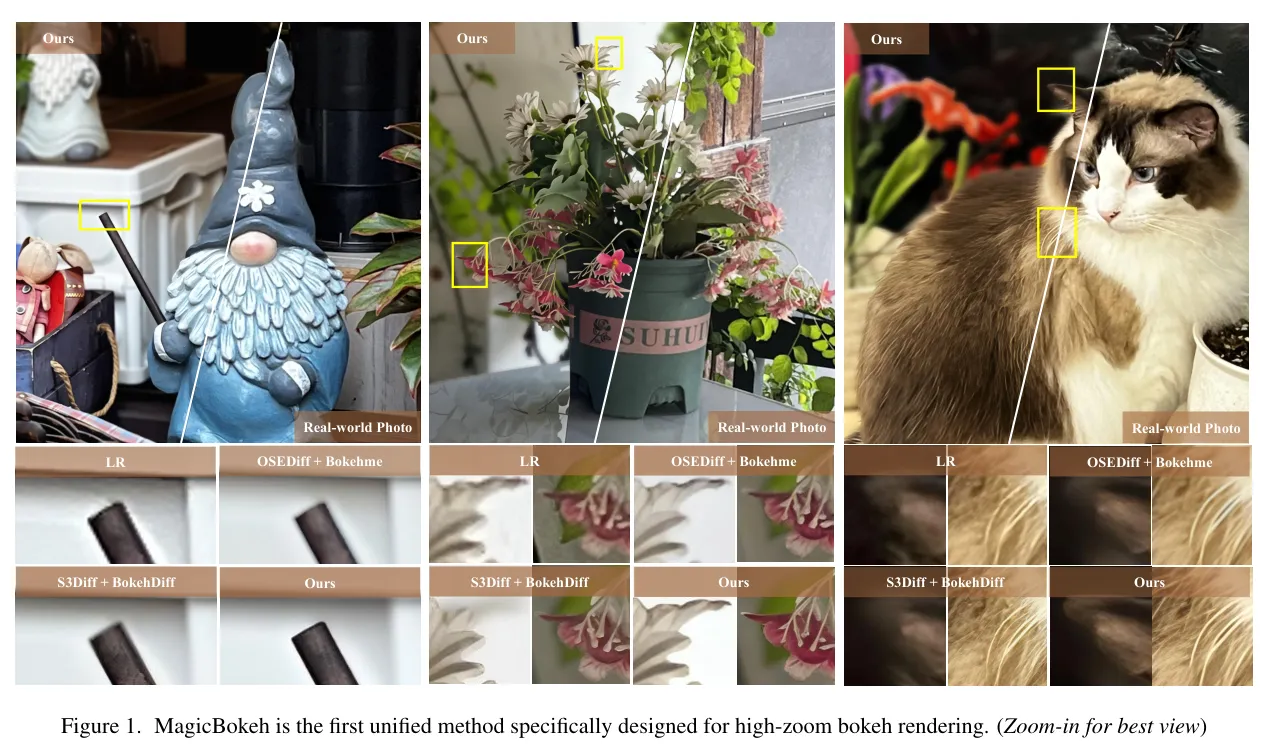
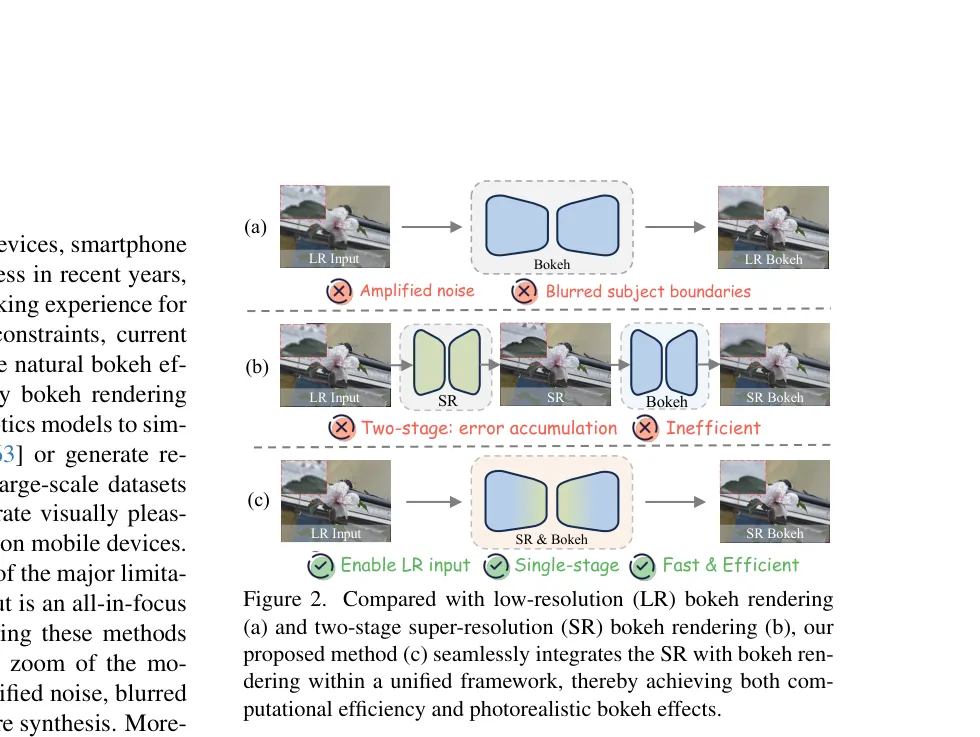
problem:手机硬件受限“often struggle to produce natural bokeh effects”。现有 bokeh 法(物理光学模拟 / 大数据学习)几乎都有一个共同前提缺陷——“they all assume that the input is an all-in-focus high-quality (HQ) image”。一旦输入是高倍数码变焦图,就“suffer from amplified noise, blurred subject boundaries, and unrealistic texture synthesis”(噪声放大、主体边界糊、纹理失真)。朴素 two-stage(先 Real-ISR 再 bokeh)有两病:① “since the output of the Real-ISR network is not always perfect, it may introduce error accumulation … further amplified during the subsequent bokeh rendering”(误差累积);② “requires two separate model inferences, which affects computational efficiency”(双推理低效)。
②b §1 — solution(why 用统一扩散)
solution:统一单步扩散 MagicBokeh——“a unified diffusion-based single-step framework”,一个模型同时做 ISR + bokeh。why diffusion:作者关键观察 “images produced by generative models often contain inherent bokeh information, indicating that these models possess the bokeh prior”——SD 本就懂虚化,复用其先验既省又好;这“motivates us to consider whether we can design a unified diffusion-based approach that improves both the quality and efficiency”。提速手段:“we compress the computationally intensive U-Net component in SD by block pruning”(去 cross-attention + mid-stage + text encoder)。
②c §1 — why 必须解耦 + 三大贡献
why(解耦的必要性,最关键):把两任务硬塞一个模型会“introduce conflicting optimization objectives between two tasks, leading to performance degradation during training”——主体要锐化清晰 vs 背景要模糊,目标天然冲突;加上样本不均衡会偏科。所以两招:① alternative training 在时间上把两任务分开训;② focus-aware mask attention 在空间上把 self-attention 限制在前景/背景各自内部。三大贡献(原文 bullet):(i) 单步框架同架构内同时做 Real-ISR 与 bokeh;(ii) alternative training + focus-aware mask attention + degradation-aware depth;(iii) “state-of-the-art (SOTA) quantitative and qualitative results on both synthetic and high-zoom real-world photographs”。
③ §2 Related Work — 经典 vs 学习式 bokeh + diffusion Real-ISR
经典渲染(Classical):早期用 ray tracing 出物理准确 bokeh,但“as the camera sampling space increased, the computational complexity increased exponentially”(慢)。DeepFocus 靠完美深度图渲染,但真实世界拿不到完美深度。Dr.Bokeh 用 inpainting 估遮挡区 RGBD、模拟球面透镜散射,“effectively reducing occlusion artifacts in boundary”,但 disparity 不准时仍有 “partial occlusion artifacts or color bleeding”。学习式(Learning-based):BokehMe(经典渲染器+神经修正)、MPIB(多平面图像 MPI 修遮挡)、EBokehNet(注入镜头属性控强度)、BokehDiff(diffusion + physics-inspired self-attention,本文主要对手)、AnytoBokeh(视频 one-step bokeh)。diffusion Real-ISR:SinSR(consistency 蒸馏确定性采样)、OSEDiff(variational score distillation 保真)、S3Diff(借 SD-Turbo 单步出 HQ)——本文把单步 Real-ISR 集成进 bokeh 管线。
④ §3.1 Framework — 总览 + Single-Step HQ Feature Extraction
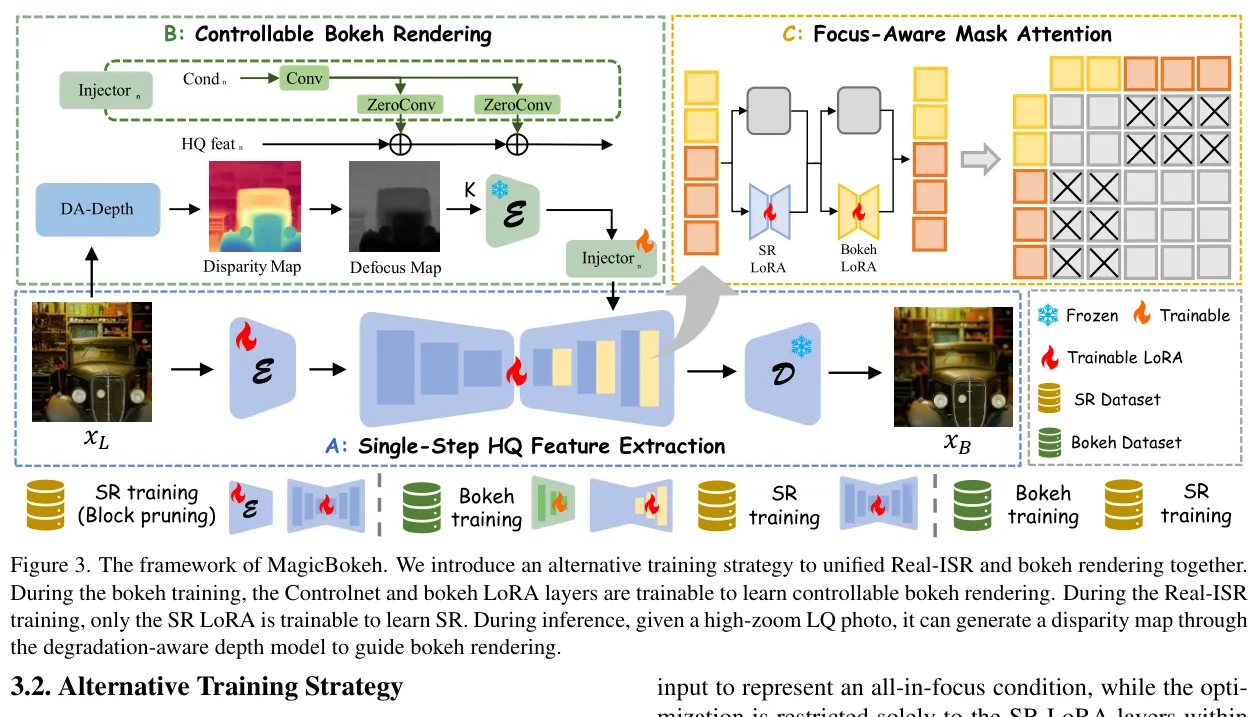
两大部件:“MagicBokeh consists of two main parts: HQ feature extraction and controllable bokeh rendering.” 前者从 LQ 图提 HQ 特征,后者管虚化。HQ 特征提取(关键设计):借 SinSR/OSEDiff 的观察——“directly using LQ images with little or no noise as input can substantially eliminate the uncertainty introduced by random noise sampling, while maximizing the retention of semantic content”。所以 LQ 不加噪直接喂;“we inject Low-Rank Adaptation (LoRA) into both the VAE encoder (only train in the first ISR training stage) and modified lightweight U-Net”,用 L2 loss + LPIPS loss 监督,恢复 HQ 特征提取能力。
④b §3.1 Controllable Bokeh Rendering + 式(1) defocus map
ControlNet 当条件控制:“ControlNet receives a defocus map as the structural condition.” 先从深度网络估 disparity map,再算 defocus map(逐像素模糊半径):
\[ r = K\,|d - d_f| \tag{1} \]
其中 \(d\)=该像素 disparity、\(d_f\)=用户指定对焦位置的 disparity、\(K\)=模糊强度(blur intensity)、\(r\)=该像素模糊半径。这样模型“can generate visually plausible bokeh with controllable depth-of-field (DoF), while preserving semantic consistency in the in-focus regions”。维度上:disparity / defocus map 与图同分辨率(测试时归一化到 0–1),作为 ControlNet 的单通道结构条件。
④c §3.2 Alternative Training Strategy(交替训练)
动机(现象):端到端联合训会“a notable performance degradation in the ISR of subject areas”(主体区超分退化),根因是 “conflicting optimization objectives” + 样本不均衡偏科。解法(循环交替):先 SR 预训练打底(“gives the network strong Real-ISR capability and a better starting point”);然后循环交替两阶段——bokeh 阶段:用 LQ all-in-focus 图 + defocus map 出 HQ bokeh,“the original diffusion model and pre-trained HQ feature extraction model are fixed, and training specifically targets the ControlNet and the bokeh LoRA layers”;Real-ISR 阶段:用 LQ-HQ 对,“a defocus map with all-zero values is used as input to represent an all-in-focus condition, while the optimization is restricted solely to the SR LoRA layers”。交替进行“effectively reduces intertask interference”。
④d §3.3 Focus-aware Mask Attention(FAMA)+ 式(2)(3)
动机:SD 的 self-attention 维系全局一致性,但直接注入 bokeh 条件会“results in degradation of the restoration quality for focused regions”。FAMA 用 defocus map 的对焦线索调制 self-attention:
\[ \mathrm{Attention}=\mathrm{softmax}\!\Big(\frac{QK^{\top}+M}{\sqrt{d}}\Big)\,V \tag{2} \]
掩码定义(同区放行、异区屏蔽):
\[ M(x,y)=\begin{cases}0 & \text{if } M(x,y)=1\\ -\infty & \text{otherwise}\end{cases} \tag{3} \]
其中 \(Q,K,V\) 是 self-attention 的 query/key/value,\(d\) 是注意力维度。\(M\) 由 defocus map 提主体信息后二值化(“with the same regions being 1 and different regions being 0”)再 resize 到注意力分辨率,让 self-attention 只在前景内部或背景内部交互——“the ISR component is guided to prioritize the focused subject area, while the bokeh rendering component is steered toward enhancing background bokeh effects”。注意 Real-ISR 阶段 “the attention mask M is set to 0 to restore the whole image”。
④e §3.4 Degradation-aware Depth(自特征蒸馏)
问题:“the accuracy of the depth estimation model deteriorates rapidly when applied to LQ images”,坏 disparity 直接拖垮虚化。方案=self-feature distillation:teacher 和 student 都用预训练 Depth Anything v2 (Large) 当 backbone;“both HQ images and simulated degraded images are respectively input into the teacher and student networks to extract features from encoder”,通过 特征蒸馏 \(L_f\) + 输出监督 \(L_{MSE}\) 让 student 在 LQ 上也产 HQ-like 特征。训练用 SA-1B 子集 200,000 样本 + Real-ESRGAN 造 LQ-HQ 对。
⑤ §4.1 实验设置(数据 / 指标 / 实现)
数据:HQ 特征提取训于 LSDIR + 10k FFHQ 人脸;bokeh GT 用自建 ray-tracing thin-lens 渲染器(类 MPIB/Dr.Bokeh,近 2k 背景图 + PhotoMatte85/RWP-636/AIM-500 前景,disparity 0–1、blur 参数 0–32);Real-ESRGAN 造 LQ-HQ、上采到 \(512\times512\)。指标:full-reference(PSNR、SSIM、LPIPS)+ reference 感知(DISTS、FID)+ no-reference(NIQE、MANIQA、MUSIQ、CLIP-IQA)。实现:基座 SD2.1,U-Net block pruning(去 cross-attention + mid-stage + text encoder,因 “text prompts … offer limited benefits and significant computational overhead”);LoRA 注入 VAE encoder + 轻量 U-Net;AdamW,ISR lr=5e-5、bokeh 阶段 lr=5e-5、Real-ISR 阶段 lr=5e-6;约 20 小时 / 4× NVIDIA L40。
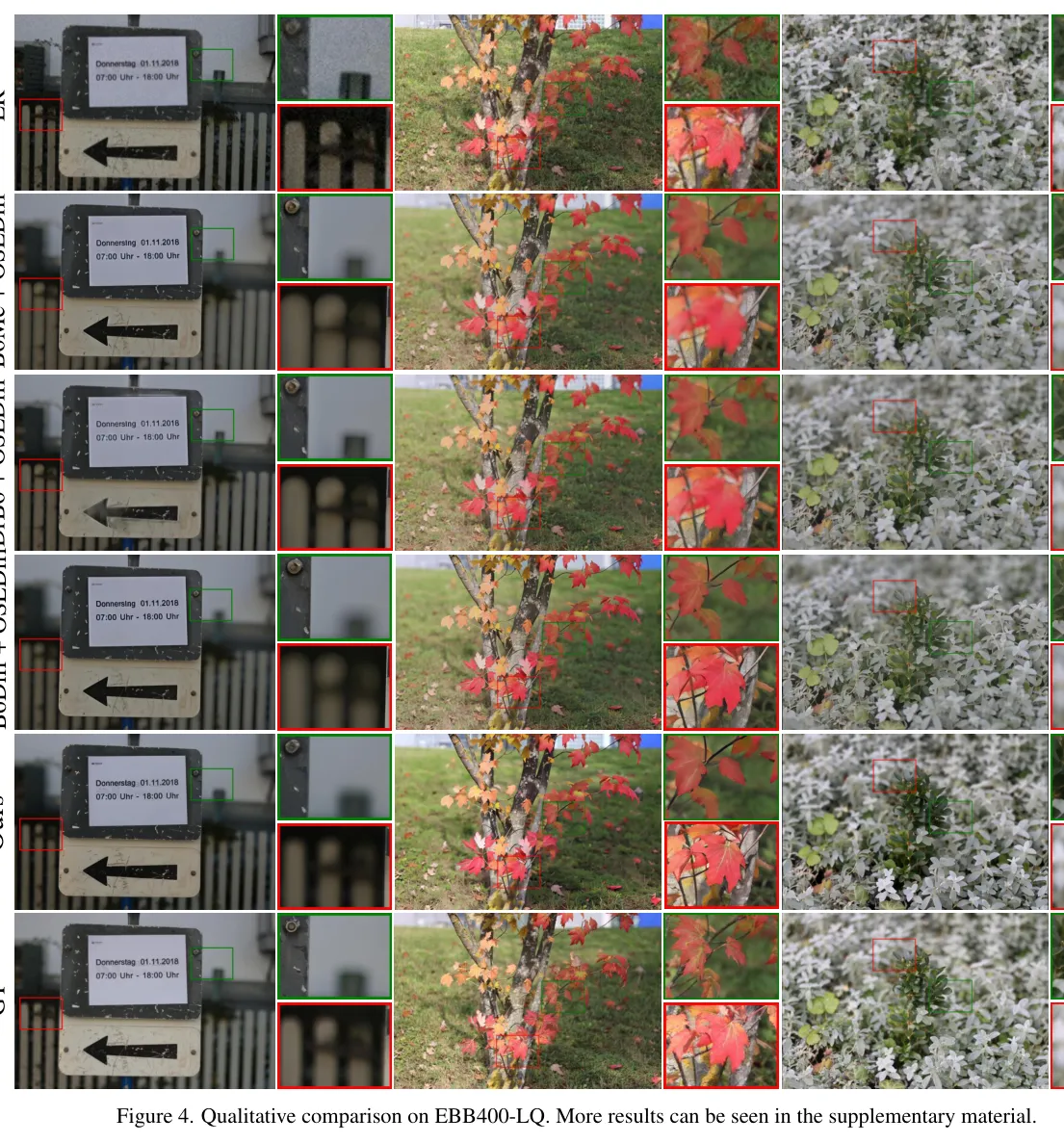
⑤b §4.2 EBB400-LQ 主结果(Tab.1 全表,真数字)
两阶段基线:ISR 用 OSEDiff(标 *)/ S3Diff(标 +),bokeh 用 BokehMe/Dr.Bokeh/BokehDiff。推理时间在 L40s、\(512\times512\) 输入下测:
| 方法 | PSNR↑ | SSIM↑ | LPIPS↓ | DISTS↓ | MUSIQ↑ | MANIQA↑ | FID↓ | Time(s)↓ |
| BokehMe* | 23.51 | 0.8459 | 0.3106 | 0.1666 | 57.70 | 0.4219 | 72.98 | 0.1648 |
| Dr.Bokeh* | 23.39 | 0.8488 | 0.3132 | 0.1677 | 52.40 | 0.3934 | 73.38 | 2.4021 |
| BokehDiff* | 23.65 | 0.8459 | 0.3049 | 0.1713 | 59.24 | 0.4251 | 72.65 | 0.3376 |
| BokehMe+ | 23.75 | 0.8388 | 0.3138 | 0.1606 | 57.54 | 0.4137 | 72.25 | 0.7510 |
| Dr.Bokeh+ | 23.67 | 0.8430 | 0.3134 | 0.1687 | 52.63 | 0.3876 | 73.10 | 2.9883 |
| BokehDiff+ | 23.83 | 0.8397 | 0.3071 | 0.1735 | 59.36 | 0.4259 | 72.54 | 0.9238 |
| MagicBokeh | 24.23 | 0.8623 | 0.2786 | 0.1600 | 58.83 | 0.4138 | 72.43 | 0.1062 |
读表:保真四项 PSNR/SSIM/LPIPS/DISTS 全第一,且最快 0.1062s(单步 + 单次推理,比 Dr.Bokeh+ 的 2.9883s 快约 28×、比 BokehDiff+ 的 0.9238s 快约 9×)。BokehDiff 的 MUSIQ(59.36)/MANIQA(0.4259)略高,作者解释“BokehDiff produces inaccurate focus distributions … regions that should exhibit bokeh remain in focus, leading to higher metric values. However, these gains do not reflect realistic bokeh effects.”(该虚的没虚→ no-reference 虚高分)。
⑤c §4.3 真机 User Study(Fig.5)
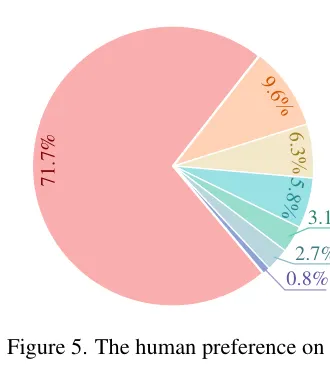
动机:“Synthetic degradation datasets fail to capture the complex artifacts in real-world photography, such as hybrid sensor circuit noise, motion blur from handheld shooting and lossy compression in digital zoom.” 设置:iPhone 13 Pro 采 50 张真实 LQ 图,覆盖人像/风景/室内外,变焦 5×–15×,平均分辨率 \(4032\times3024\);50 名不同背景参与者各选最佳。结果:MagicBokeh 71.7% 偏好率,碾压 OSEDiff/S3Diff × BoMe/Dr.Bo/BoDiff 各组合(最低组仅 0.8%、2.7%、3.1% 等个位数)。
⑤d §4.4 消融实验(Tab.2 全表,真数字)
EBB400-LQ 上逐模块消融(✓=启用):
| FAMA | Strategy | DA depth | PSNR↑ | LPIPS↓ | CLIP-IQA↑ | NIQE↓ | MUSIQ↑ | MANIQA↑ | FID↓ |
| ✗ | ✗ | ✗ | 24.21 | 0.2931 | 0.3743 | 6.0786 | 57.41 | 0.4038 | 73.25 |
| ✗ | ✓ | ✓ | 24.22 | 0.2798 | 0.4157 | 5.9068 | 58.10 | 0.4065 | 75.23 |
| ✓ | ✗ | ✓ | 24.20 | 0.2946 | 0.3781 | 5.7076 | 56.08 | 0.3956 | 73.04 |
| ✓ | ✓ | ✗ | 24.20 | 0.2784 | 0.4209 | 5.8035 | 58.80 | 0.4114 | 75.03 |
| ✓ | ✓ | ✓ | 24.23 | 0.2786 | 0.4229 | 5.6341 | 58.83 | 0.4138 | 72.43 |
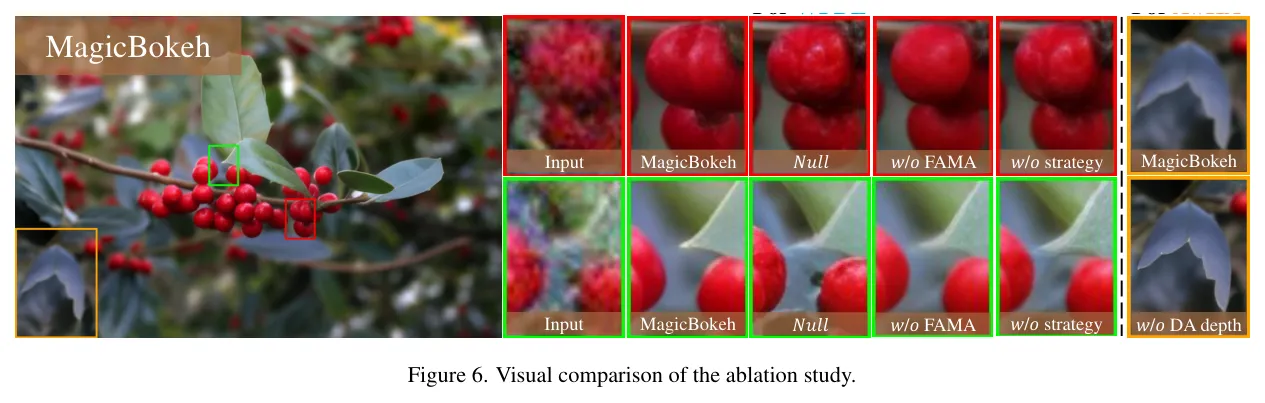
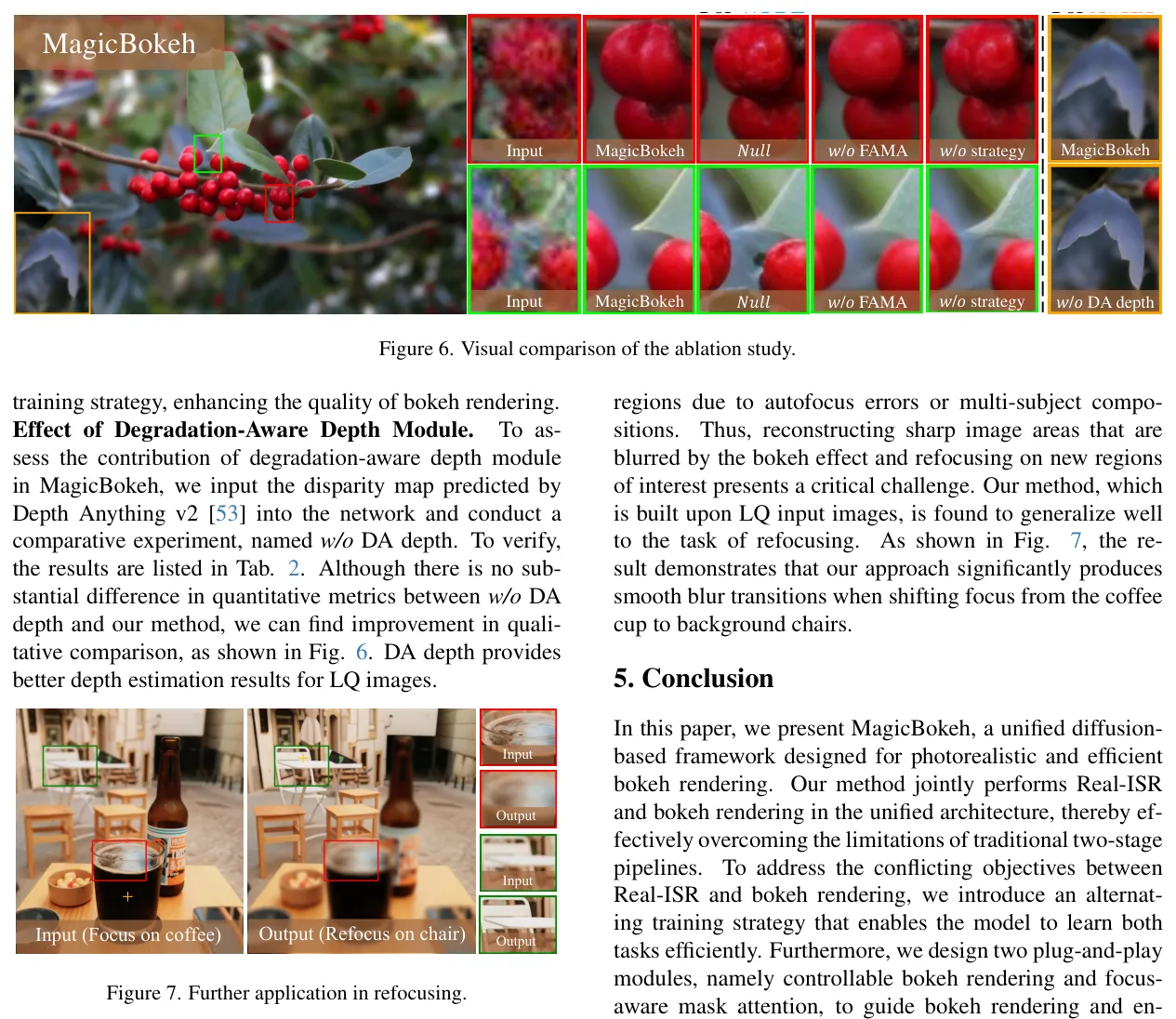
读表:PSNR 几乎不动(24.20~24.23),三模块主要拉升 no-reference 感知指标。去掉 alternative Strategy 掉得最狠(CLIP-IQA 0.4229→0.3781、MUSIQ 58.83→56.08、LPIPS 也变差到 0.2946)→ 解耦训练贡献最大。FAMA 主要改善 no-reference(“the full model and w/o FAMA seems minor differences in PSNR, the no-reference metrics show significant improvement”);DA depth 量化差异小、主要体现在定性(Fig.6)。
⑤e §4.5 Refocusing + 附录 DA depth(Tab.s1)+ Real-ISR(Tab.s2)
Refocusing(Fig.7):真实照片常因自动对焦错误/多主体而部分失焦,本文方法建立在 LQ 输入上,“generalize well to the task of refocusing”,能“produces smooth blur transitions when shifting focus from the coffee cup to background chairs”(把对焦从咖啡杯平滑迁到背景椅子)。DA depth(Tab.s1,退化场景):NYUv2 AbsRel 0.081→0.068、δ1 0.926→0.946;KITTI AbsRel 0.123→0.105、δ1 0.852→0.883——退化图上明显优于原始 Depth Anything v2,且 Clear 图几乎不掉。Real-ISR(Tab.s2,K=0 退化成纯超分):DRealSR PSNR 28.99(SinSR 28.35 / OSEDiff 27.91 / S3Diff 27.54,本文最佳);RealSR PSNR 26.14(仅次于 SinSR 26.32)——说明统一模型即便不为超分专门设计也有竞争力。
⑥ 疑问 / 存疑([推测] 已标注)
① 消融中三模块对 PSNR 几乎无影响(24.20~24.23),提升集中在 no-reference 感知指标——[推测] 改善偏“感知/美学”而非像素保真,论文未给像素层的强量化解释。② 对手 BokehDiff 某些 no-reference 指标更高,作者归因其“该虚的没虚”导致虚高分,属定性论证、未给定量证据(如失焦区误对焦比例)。③ defocus map 的 \(K\)、对焦视差 \(d_f\) 由用户给定,“automatic” 自动对焦决策不在本文范围。④ [推测] 训练时间 20h/4×L40 与端侧部署成本之间仍有 gap,论文未报手机端实测延迟(仅报 L40s 上 0.1062s)。
📌 全文一页总结(≥3 takeaway)
problem:高倍数码变焦 LQ 图做 bokeh——现有法假设 HQ all-in-focus 输入,朴素 two-stage(超分→虚化)误差累积 + 双推理低效。
method:统一单步扩散——HQ 特征提取(LQ 不加噪 + LoRA + L2/LPIPS)+ ControlNet(defocus map \(r=K|d-d_f|\) 条件);三补丁:alternative training(时间解耦 SR/bokeh)、focus-aware mask attention(式 2/3,空间把 self-attn 限前景/背景)、degradation-aware depth(自蒸馏让 DA v2 在 LQ 估准深度);U-Net block pruning 提速。
experiment:EBB400-LQ 保真四项全第一且最快 0.1062s;真机 50 图 71.7% 人选最佳;refocusing/纯超分(DRealSR PSNR 28.99)也强。
takeaways:① 超分与虚化可统一进一个扩散模型、复用其自带 bokeh prior,省一次推理;② 冲突目标靠“一时(交替训)一空(掩码注意力)”双解耦,是本文最核心的可迁移思想;③ LQ 下深度会退化、必须专门蒸馏修复,否则坏 disparity 直接拖垮虚化质量。
🖼 论文原图(本地 PDF 截图,原文 caption 未改写)