CVPR 2026 Finalist
Thinking with Drafts: Speculative Temporal Reasoning for Efficient Long Video Understanding
Pengfei Hu ⋅ Meng Cao ⋅ Yingyao Wang ⋅ Yi Wang ⋅ Jiahua Dong ⋅ Jun Song ⋅ Cheng Yu ⋅ Bo Zheng ⋅ Xiaodan Liang
摘要 Abstract
Long video understanding is essential for human-like intelligence, enabling coherent perception and reasoning over extended temporal contexts. While the emerging thinking-with-frames paradigm—which alternates between global temporal reasoning and local frame examination—has advanced the reasoning capabilities of video multi-modal large language models (MLLMs), it suffers from a significant efficiency bottleneck due to the progressively growing and redundant multi-modal context. To address this, we propose SpecTemp, a reinforcement learning-based Speculative Temporal reasoning framework that decouples temporal perception from reasoning via a cooperative dual-model design. In SpecTemp, a lightweight draft MLLM rapidly explores and proposes salient frames from densely sampled temporal regions, while a powerful target MLLM focuses on temporal reasoning and verifies the draft’s proposals, iteratively refining its attention until convergence. This design mirrors the collaborative pathways of the human brain, balancing efficiency with accuracy. To support training, we construct the SpecTemp-80K dataset, featuring synchronized dual-level annotations for coarse evidence spans and fine-grained frame-level evidence. Experiments across multiple video understanding benchmarks demonstrate that SpecTemp not only maintains competitive accuracy but also significantly accelerates inference compared with existing thinking-with-frames methods.
📝 精读笔记
灵魂一句
把“speculative decoding(草稿模型猜、目标模型验)”的思路搬到长视频时序推理:用一个轻量 Draft MLLM(3B) 在密集采样的时序区域里快速“探”出最关键的稀疏帧,交给强大的 Target MLLM(7B) 做时序推理 + 验证,迭代到收敛。把“感知(选帧)”与“推理”解耦,避开 thinking-with-frames 范式里上下文越滚越长、视觉 token 高度冗余的效率瓶颈。配 SpecTemp-80K(双层标注) + SFT→GRPO 两阶段训练,8 个 benchmark 上精度持平/更高,长视频推理提速 19–23%。
问题 & 动机
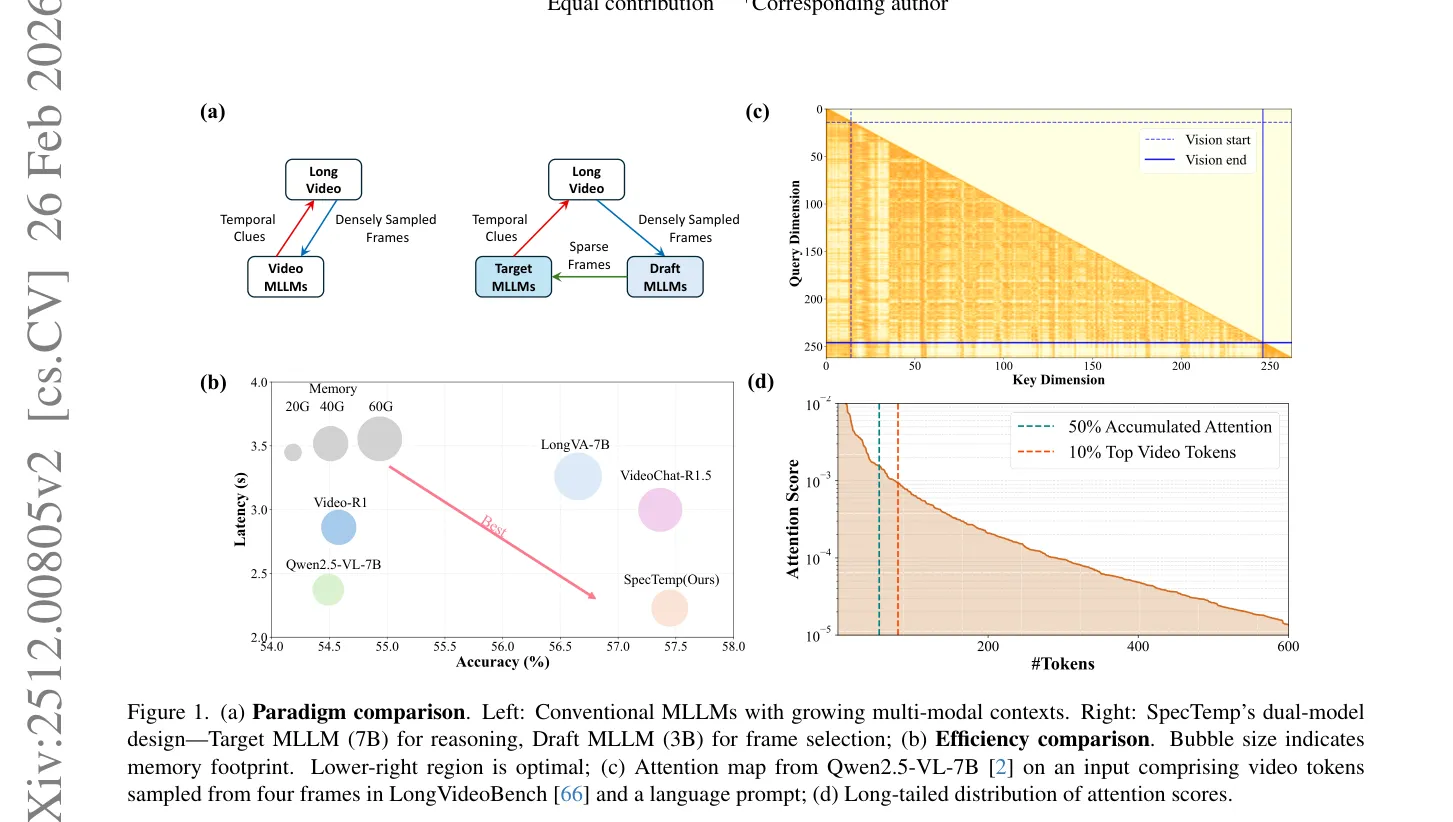
thinking-with-frames(在全局时序推理与局部看帧间交替)虽强了视频 MLLM 推理,但上下文渐进膨胀 + 视觉冗余→ 效率瓶颈。作者用 Qwen2.5-VL-7B 的 attention 量化证明:① 语言 token 只 attend 一小撮视频 token(清晰的模态边界);② 视觉 token 注意力呈长尾,“more than 90% of the visual tokens have attention scores below 10⁻³”——绝大多数视觉 token 对推理几乎没贡献。受 speculative decoding(draft 猜 + target 验,又快又不掉精度)启发,把耗时的“dense frame zoom-in”外包给小模型。
核心方法(dual-model + 迭代 speculate-verify)
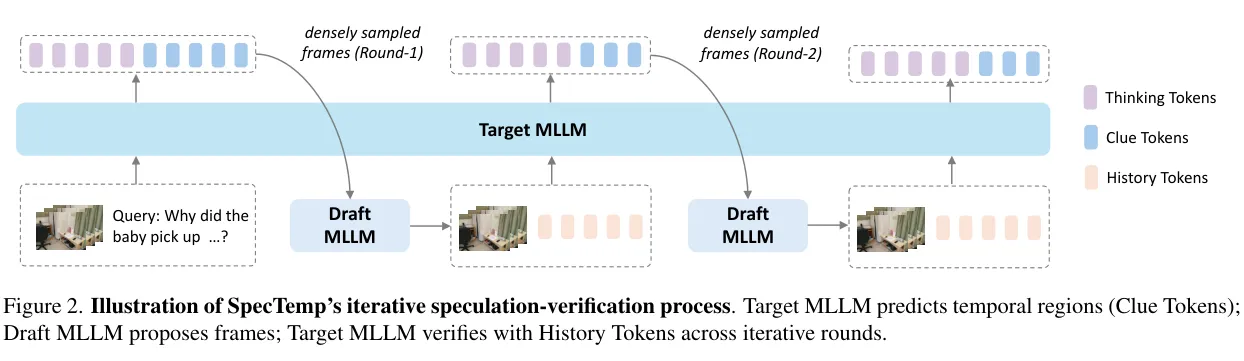
① Init:均匀采 K 帧 → Target 初推理,出 reasoning trace T0 + 时序 RoI R0 + (若够)直接答 Wa(T0 与 Wa 互斥:够就答、不够就吐 segment 触发取帧)。② Speculation:在 R_{t−1} 内 dense 采样(1fps) → Draft 据当前轮 trace T_{t−1} 选出 2 张最有信息量的稀疏帧 V^s_t。③ Verification:Target 用历代全部 trace T_{<t} 验证这些帧、决定收敛或再迭代。Tmax=3。整体像人脑“快感知通路(lemniscal) + 慢认知通路(extralemniscal)”分工。计算不对称 |π_draft|≪|π_target| 是提速关键。
关键公式
联合似然:∏_{≤Tmax} π_target(W^a, V^d | W^q, V^s) · π_draft(V^s | V^d)(式2,V^d=target 指定区域的密集帧、V^s=draft 选的稀疏帧)。三步:T0,V^d_0,Wa=π_target(W^q,V^s_0)(式3);V^s_t=π_draft(V^d_t; T_{t−1})(式4);(T_t,V^d_t,Wa)=π_target(V^s_t; T_{<t})(式5)。奖励:Target R=R_format+R_answer+R_IoU(式7,IoU=预测证据段 vs GT 时序段);Draft R=R_format+R_visual(式9),其中 R_visual=Sim_CLIP(q,f_i) − max_{f_j∈F_prev} Sim_CLIP(f_i,f_j)(式8,前项=与问题相关、后项=惩罚与已选帧冗余)。RL 用 GRPO(式6)。
关键结果
短视频(Tab.1):13.7 帧即全面超 Qwen2.5-VL-7B(16 帧)且 latency 2.1→1.8s;47.6 帧时与 VideoChat-R1.5 精度持平、快 19%。长视频(Tab.2):14.5 帧 vs Qwen 16 帧,Video-Holmes +12.0、MLVU +8.0、Video-MME +6.4,latency 4.1→3.7s;58.1 帧时超 VideoChat-R1.5(45.1/60.6/52.3/63.4)且快 23%。协作消融(Tab.4):7B+3B(57.5/2.3s/Eff 25.0) > 纯 7B(54.1/3.1s) > 纯 3B(40.3/1.7s)——精度效率双赢。
亮点
① 首次把 reasoning-level speculative 范式落到长视频(把 frame zoom-in 外包给 draft);② 双奖励分工(Target 管 IoU 时序定位、Draft 管 CLIP 视觉增益去冗余);③ SpecTemp-80K 用 GPT-4o 合成多轮 speculate-verify 轨迹(含 <think>/<segment>/<frame>/<answer> token);④ early-termination(实际平均迭代 0.9–3.7 < Tmax);⑤ V-NIAH 在 2000 帧仍 >80% 检索准确。
疑问 / 待查
① 消融(Tab.6)显示 Tmax>3 在 Video-Holmes 反而掉点(过多迭代引入冗余帧、损推理连贯)——最优迭代数与任务相关;② Draft 每轮固定选 2 帧是否对“多线索散落”问题(如 Video-Holmes)够用,原文未深究上限;③ 训练要同时调两模型 + GRPO 采多条轨迹,训练开销大(作者在 limitations 自承),PEFT 等高效训练留待后续。
📖 逐段精读 · 笔记
深化精读(本地 PDF 全文 PyMuPDF 提取,正文 8 页 + supplementary 共 19 页,~72K 字符,含全部 Table 真实数值/Eq.1-9/Alg.1/prompt 模板)。最后更新 2026-06-23。verbatim 英文引用 + 中文指路,存疑标 [推测]。arXiv:2512.00805v2(MBZUAI + Alibaba)。
① Abstract(摘要)— 逐句精讲
原文逐句:
1) “While the emerging thinking-with-frames paradigm—which alternates between global temporal reasoning and local frame examination—has advanced the reasoning capabilities of video MLLMs, it suffers from a significant efficiency bottleneck due to the progressively growing and redundant multi-modal context.” —— thinking-with-frames 强但多模态上下文越滚越长、冗余 → 效率瓶颈。
2) “SpecTemp, a reinforcement learning-based Speculative Temporal reasoning framework that decouples temporal perception from reasoning via a cooperative dual-model design.” —— RL 的投机式时序推理,双模型协作解耦感知与推理。
3) “a lightweight draft MLLM rapidly explores and proposes salient frames from densely sampled temporal regions, while a powerful target MLLM focuses on temporal reasoning and verifies the draft’s proposals, iteratively refining its attention until convergence.” —— 轻量 draft 提帧、强 target 推理+验证、迭代到收敛。
4) “This design mirrors the collaborative pathways of the human brain.” —— 类比人脑皮层协作。
5) 数据 SpecTemp-80K “synchronized dual-level annotations for coarse evidence spans and fine-grained frame-level evidence.”
一句话抓 Abstract:把“投机解码”思想搬到长视频——3B draft 在密采区快速提稀疏关键帧、7B target 专注时序推理并验证,迭代到收敛;解耦感知/推理大幅提速(长视频 19-23%),精度不降反升。
📚 背景知识(外部,非本文原文)
① Thinking-with-frames:视频 MLLM 不一次性吃整段,而是交替“从长片段抽时序线索定位关键区”与“在该区密采帧细看”,迭代聚焦——强但上下文越滚越长。
② Speculative decoding(投机解码):用小 draft 模型快速猜多 token、强 target 模型并行验证,加速 LLM 解码且不掉精度。本文把它从token 级升到推理级 + 时序感知级。
③ Speculative Thinking [74]:让小模型生成大部分推理、把难段交给强模型——本文据此扩展到长视频的“帧 zoom-in”委派给 draft。
④ RLVR / GRPO [51]:可验证奖励的 RL;GRPO(DeepSeek 系)用组内相对优势优化,无需 critic。本文 RFT 用 GRPO 联合优化双模型。
⑤ MLLM / Qwen2.5-VL [2]:多模态大模型;本文 target 7B、draft 3B 均由 Qwen2.5-VL 初始化。
⑥ 长尾注意力(Fig.1d,本文观察):“more than 90% of the visual tokens have attention scores below 10⁻³” —— 90%+ 视觉 token 注意力极低,即高视觉冗余,这是动机。
⑦ 对比基线:VideoChat-R1.5 [71](thinking-with-frames SOTA)、Video-R1、Qwen2.5-VL-7B、LongVA、InternVL3、VideoChat-Flash。
② §1 Introduction — problem(效率瓶颈 + 长尾冗余)
瓶颈(原文):“Existing methods progressively maintain extensive multi-modal sequences that include both high-level reasoning traces and densely sampled visual tokens, which substantially hinders inference efficiency.”
两个证据:① Fig.1(c) “a clear modality boundary where language tokens selectively attend to only a small subset of video tokens, revealing the high visual redundancy.”(语言 token 只关注极少视觉 token);② Fig.1(d) “a clear long-tailed distribution ... more than 90% of the visual tokens have attention scores below 10⁻³, indicating that these tokens contribute minimally to reasoning and answer generation.”(90%+ 视觉 token 几乎无贡献)。
两个证据:① Fig.1(c) “a clear modality boundary where language tokens selectively attend to only a small subset of video tokens, revealing the high visual redundancy.”(语言 token 只关注极少视觉 token);② Fig.1(d) “a clear long-tailed distribution ... more than 90% of the visual tokens have attention scores below 10⁻³, indicating that these tokens contribute minimally to reasoning and answer generation.”(90%+ 视觉 token 几乎无贡献)。
③ §1 — solution(投机式双模型闭环)
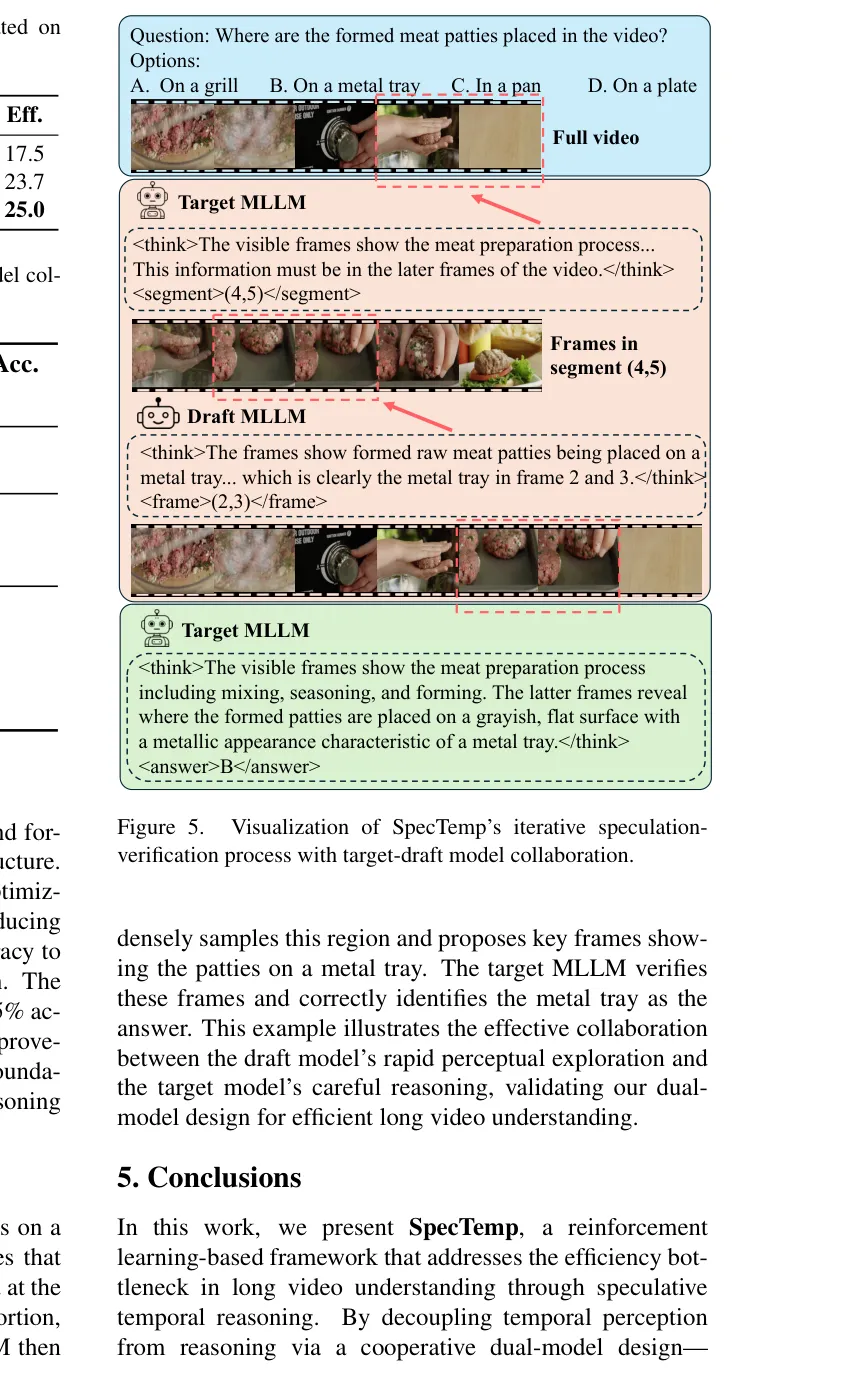
原文 workflow:“we first uniformly sample video frames and feed them into the target MLLM, which performs initial temporal reasoning and predicts temporal clues that require further attention. A lightweight draft model then conducts dense sampling within the predicted temporal regions to explore fine-grained temporal cues, while producing a compact set of sparse representative frames returned to the target model. The target model then verifies the proposed frames, decides whether sufficient information has been gathered, or iteratively triggers another round ... until convergence.” —— target 均匀采样初推→预测需关注时序区→draft 在该区密采并回传稀疏代表帧→target 验证→够了出答案/否则再迭代。
类脑(原文):“a fast perceptual subsystem (akin to the lemniscal pathway) rapidly explores ... a slower cognitive module (i.e., the extralemniscal pathway) validates and integrates.”
类脑(原文):“a fast perceptual subsystem (akin to the lemniscal pathway) rapidly explores ... a slower cognitive module (i.e., the extralemniscal pathway) validates and integrates.”
④ §1 — 三大贡献
① Speculative Visual Reasoning (SpecTemp):分层 test-time scaling,把投机推理融入迭代视频感知,实现不同容量模型间的语义级近似与验证;② Collaborative Sampling Mechanism:dense-sparse 协作采样——小模型投机局部细节、大模型动态验证并精化全局时空焦点;③ Empirical:精度与 VideoChat-R1.5 相当或更优,推理延迟降约 20%,利于实时多模态推理。
⑤ §2 Related Work — 三方向定位
Long video understanding:token 压缩/关键帧选择(高压缩比丢细节)、扩 context window(不解根本算力问题)、agent 法(需定制+复杂后处理)——“an effective and scalable framework ... remains elusive.”
Thinking with frames:自适应 zoom-in + 文本/视觉交织推理,强但 “the sampled tokens from predicted temporal cues remain numerous, and the resulting visual representations are often highly redundant.”
Speculative decoding:多为 token 级(Medusa/EAGLE/self-speculative);近期转向 reasoning-level(Speculative Thinking [74])。本文:“we extend the reasoning-level speculative strategy to long video understanding, where the time-consuming frame zoom-in process ... is delegated to a small draft model.”
⑥ §3.1 形式化(Eq.1-2 + Alg.1)
Vanilla MLLM(Eq.1):\[ \pi(W^a|W^q,V)=\prod_{i=1}^n\pi(W^a_i|W^a_{SpecTemp(Eq.2):\[ \prod_{\le T_{max}}\pi_{target}(W^a,V^d|W^q,V^s)\cdot\pi_{draft}(V^s|V^d) \] \( V^d \)=target 预测区内密采帧(如 1fps),\( V^s \)=draft 选的稀疏关键帧(如 2 帧),\( T_{max} \)=最大迭代数;计算不对称 \( |\pi_{draft}|\ll|\pi_{target}| \)。
Alg.1:均匀采样 \( F^{(0)} \)→target 出 (T0, R0, Wa),有答案则早停;否则循环:在 RoI \( R_{t-1} \) 密采 → draft \( M_D(F^{dense}_t|T_{t-1}) \)(仅用当前迭代历史)→ target \( M_T(F^{draft}_t|W^q,T_{
Alg.1:均匀采样 \( F^{(0)} \)→target 出 (T0, R0, Wa),有答案则早停;否则循环:在 RoI \( R_{t-1} \) 密采 → draft \( M_D(F^{dense}_t|T_{t-1}) \)(仅用当前迭代历史)→ target \( M_T(F^{draft}_t|W^q,T_{
⑦ §3.2 投机式时序推理(Eq.3-5)
Initialization(Eq.3):\( T_0,V^d_0,W^a=\pi_{target}(W^q,V^s_0) \),\( T_0 \)=初始推理 trace,\( V^d_0 \)=需细看区的密采帧。关键:\( T_0 \) 与 \( W^a \) 互斥——“when the target model determines that sufficient temporal evidence is available, it directly outputs the answer; otherwise, it predicts a temporal evidence region.”
Speculation(Eq.4):\( V^s_t=\pi_{draft}(V^d_t;T_{t-1}),\ t\in[1,T_{max}] \),draft 据当前迭代 reasoning trace 选最有信息的稀疏帧。
Verification(Eq.5):\( (T_t,V^d_t,W^a)=\pi_{target}(V^s_t;T_{累积推理 trace。
Speculation(Eq.4):\( V^s_t=\pi_{draft}(V^d_t;T_{t-1}),\ t\in[1,T_{max}] \),draft 据当前迭代 reasoning trace 选最有信息的稀疏帧。
Verification(Eq.5):\( (T_t,V^d_t,W^a)=\pi_{target}(V^s_t;T_{
⑧ §3.3 策略优化(GRPO,Eq.6)
两阶段:cold-start SFT(分别建 target 高层验证 + draft 细粒度选帧能力)→ RFT(GRPO [51] 把 keyframe 投机与回答生成建成统一策略学习)。
目标(Eq.6,省略 clip):\[ J=\mathbb{E}\Big[\frac{1}{G}\sum_{i=1}^G \frac{\pi_{target}(W^a_i,V^d|W^q,V^s)\pi_{draft}(V^s|V^d)}{\pi_{target}^{old}\,\pi_{draft}^{old}}A_i-\beta\,D_{KL}(\pi_{target}\pi_{draft}\|\pi_{target}^{ref}\pi_{draft}^{ref})\Big] \] \( A_i \)=组奖励算出的 advantage,\( \beta \)=KL 惩罚(supp 设 0.04)。
目标(Eq.6,省略 clip):\[ J=\mathbb{E}\Big[\frac{1}{G}\sum_{i=1}^G \frac{\pi_{target}(W^a_i,V^d|W^q,V^s)\pi_{draft}(V^s|V^d)}{\pi_{target}^{old}\,\pi_{draft}^{old}}A_i-\beta\,D_{KL}(\pi_{target}\pi_{draft}\|\pi_{target}^{ref}\pi_{draft}^{ref})\Big] \] \( A_i \)=组奖励算出的 advantage,\( \beta \)=KL 惩罚(supp 设 0.04)。
⑨ §3.3 Reward 设计(Eq.7-9)
Target(Eq.7):\( R_{target}=R^{target}_{format}+R_{answer}+R_{IoU} \)——format(<think>/<segment>/<answer> 结构)、answer(对错)、IoU(预测证据段 vs GT 时序区的 Intersection-over-Union,评时序定位质量)。
Draft(Eq.8-9):\( R_{draft}=R^{draft}_{format}+R_{visual} \),其中视觉信息增益 \[ R_{visual}=Sim_{CLIP}(q,f_i)-\max_{f_j\in F_{prev}}Sim_{CLIP}(f_i,f_j) \] 第一项奖与问题相关的帧,第二项罚与已选帧冗余——鼓励选信息量大且多样的帧。
Draft(Eq.8-9):\( R_{draft}=R^{draft}_{format}+R_{visual} \),其中视觉信息增益 \[ R_{visual}=Sim_{CLIP}(q,f_i)-\max_{f_j\in F_{prev}}Sim_{CLIP}(f_i,f_j) \] 第一项奖与问题相关的帧,第二项罚与已选帧冗余——鼓励选信息量大且多样的帧。
⑩ §3.4 SpecTemp-80K 数据构建
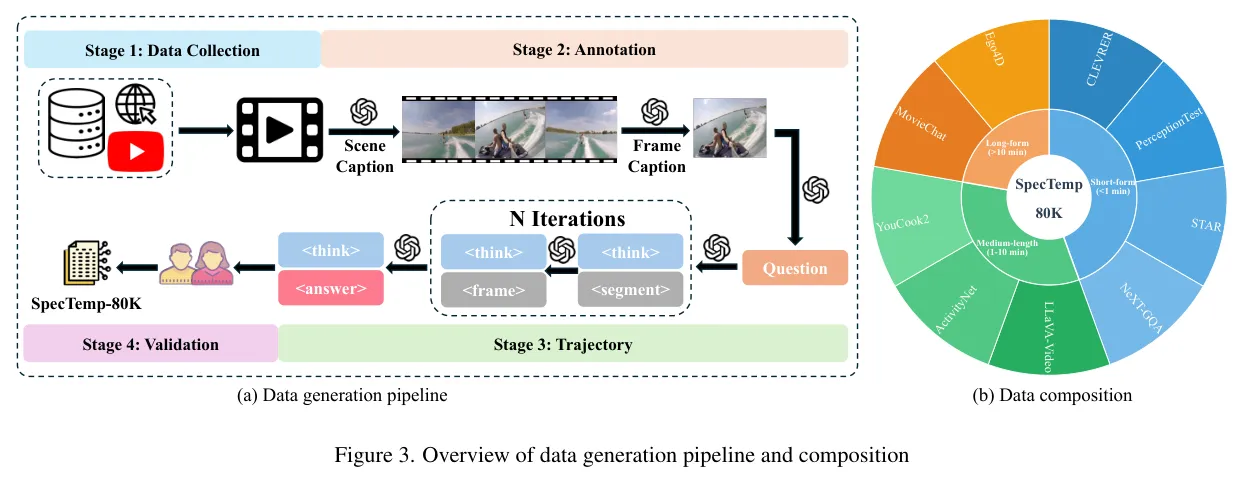
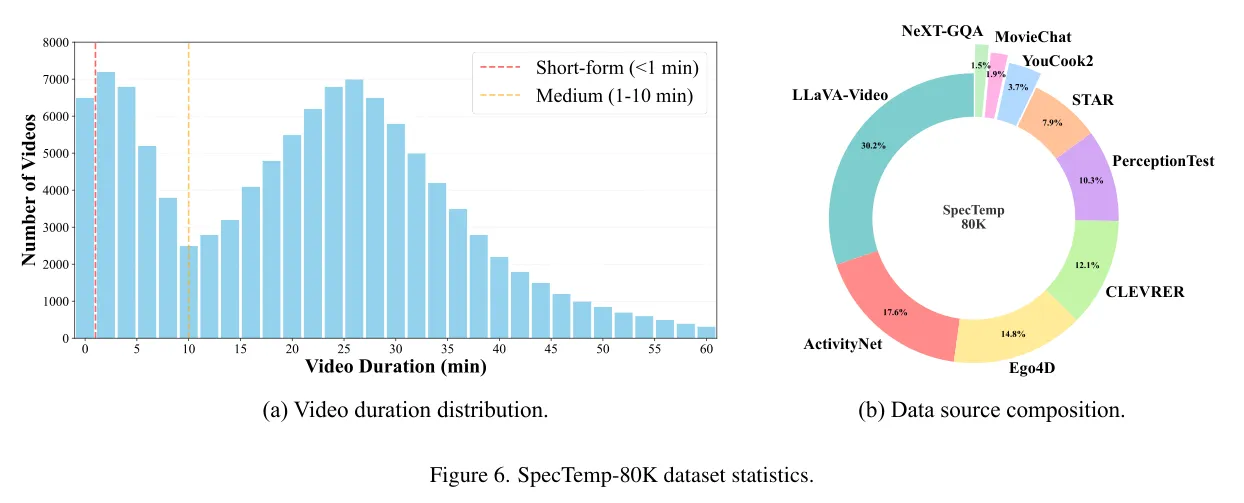
四阶段(Fig.3):data collection → annotation → trajectory generation → validation。80,142 个 video-QA 三元组、9 源。三时长档:short(<1min:CLEVRER/PerceptionTest/STAR/NeXT-GQA,32.4%)、medium(1-10min:LLaVA-Video/ActivityNet/YouCook2,51.8%)、long(>10min:MovieChat/Ego4D,15.8%);主源 LLaVA-Video 30.2%/ActivityNet 17.6%/Ego4D 14.8%。
标注(GPT-4o):scene-level caption(整体叙事/关键事件,供 target)+ frame-level caption(细粒度,供 draft)——“synchronized dual-level annotations”。轨迹:GPT-4o 合成多轮 speculation-verification 轨迹,含 <think>/<segment>/<frame>/<answer> token。验证:人工抽检过滤错误时序证据/不一致选帧。
标注(GPT-4o):scene-level caption(整体叙事/关键事件,供 target)+ frame-level caption(细粒度,供 draft)——“synchronized dual-level annotations”。轨迹:GPT-4o 合成多轮 speculation-verification 轨迹,含 <think>/<segment>/<frame>/<answer> token。验证:人工抽检过滤错误时序证据/不一致选帧。
⑪ §4.1 实现细节
模型:target 7B + draft 3B,均从 Qwen2.5-VL 初始化。target 初始化均匀采 10 帧;draft 在预测区密采 1fps、每轮选 2 代表帧;\( T_{max}=3 \)。
训练(supp 6.1):SFT 2 epoch lr 1e-6 → RFT(GRPO) 1 epoch lr 1e-6,\( \beta=0.04 \);16×H100,batch 32(SFT)/16(RFT)。
评测配置:对 16 帧基线用 “10 init + up to 3 iters of 2 frames”;对 64 帧基线用 “32 init + up to 4 iters of 8 frames”。8 个 benchmark(短:TempCompass/MVBench/MMVU/VSI-Bench;长:Video-Holmes/LongVideoBench/MLVU/Video-MME),报 accuracy + 每样本平均延迟(batch=1)。
⑫ §4.2 主结果(Table 1/2 真实数值)
Table 1 短视频(acc / 平均帧数 / latency):
| 模型 | TempComp | MVBench | MMVU | VSI | Lat |
| Qwen2.5-VL-7B(16f) | 72.2 | 64.1 | 65.7 | 34.3 | 2.1s |
| SpecTemp(13.7f) | 75.3 | 68.7 | 67.8 | 37.4 | 1.8s |
| VideoChat-R1.5(64f) | 77.3 | 70.6 | 70.1 | 39.4 | 5.8s |
| SpecTemp(47.6f) | 77.2 | 69.3 | 70.4 | 39.7 | 4.7s(19% 快) |
每项较 Qwen2.5-VL-7B +2~4.6,且帧更少、更快。
Table 2 长视频(acc / latency):
| 模型 | V-Holmes | LongVB | MLVU | Video-MME | Lat |
| Qwen2.5-VL-7B(16f) | 35.0 | 54.5 | 40.6 | 56.0 | 4.1s |
| SpecTemp(14.5f) | 47.0(+12.0) | 57.5 | 48.6(+8.0) | 62.4 | 3.7s |
| VideoChat-R1.5(64f) | 45.1 | 60.6 | 52.3 | 63.4 | 11.5s |
| SpecTemp(58.1f) | 47.8 | 61.4 | 50.9 | 64.1 | 8.9s(23% 快) |
长视频增益更大(Video-Holmes +12.0、MLVU +8.0),印证“识别相关时序段对长视频的精度+效率都关键”。
⑬ §4.3 消融(Table 3/4/5 + latency 分解)
Table 3 选帧策略(4 bench):Uniform(16) baseline → Target+Uniform +1.2%(证时序定位)→ Target+CLIP +2.5% → Ours(Target+Draft) 14.1 帧最佳,证“训练专用 draft 优于启发式 CLIP”。
Table 4 模型协作(LongVideoBench,Eff=Acc/Lat):Large only(7B) 54.1%/3.1s/17.5;Small only(3B) 40.3%/1.7s/23.7;Ours(L+S) 57.5%/2.3s/25.0——双模型精度和延迟同时优于纯 7B。
Table 5 训练策略:Baseline 54.5% acc/40.6% format → target SFT 55.3%/95.2% → +target RL 56.3% → +draft SFT 98.7% format → 全 SFT+RL 57.5%/99.5%(+3.0% over baseline)。
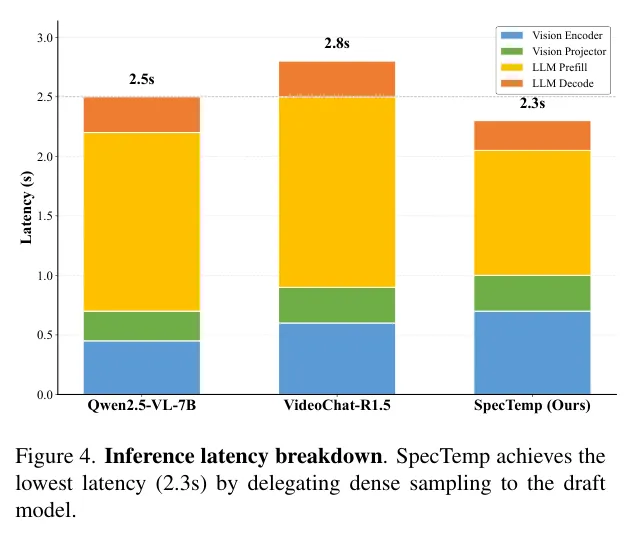
Fig.4 延迟分解:“LLM prefill dominates total inference time.” VideoChat-R1.5 2.8s(上下文滚大)、Qwen2.5-VL-7B 2.5s、SpecTemp 2.3s(dense 探索卸给 3B draft,只回传 salient 帧给 7B)。
⑭ supp 消融(Tmax / reward / 帧分配 / V-NIAH)
supp Table 6 最大迭代 \( T_{max} \):1→3 稳升(LongVB 54.7→57.5、V-Holmes 42.8→47.0),\( T_{max}=3 \) 最佳;超过 3 边际递减甚至降(\( T_{max}=5 \) V-Holmes 46.2)。实际平均迭代 0.9-3.7 < \( T_{max} \),证有效早停。
supp Table 7 reward:SFT baseline 53.1/42.1;单 \( R_{IoU} \) +2.7/+3.4(贡献更大,“accurate temporal localization is the primary bottleneck”);单 \( R_{visual} \) +1.5/+2.6;两者合 57.5/47.0(+4.4/+4.9)互补。
supp Table 8 帧分配(Init+Per-Iter×Max-Iter):16 预算 10+2×3(ours)57.5/47.0/1.8s 最佳;64 预算 32+8×4(ours)61.4/47.8/4.7s。激进早采(4+4×3)缺全局上下文、保守晚采(13+1×3)缺细粒度,本文均衡最优。
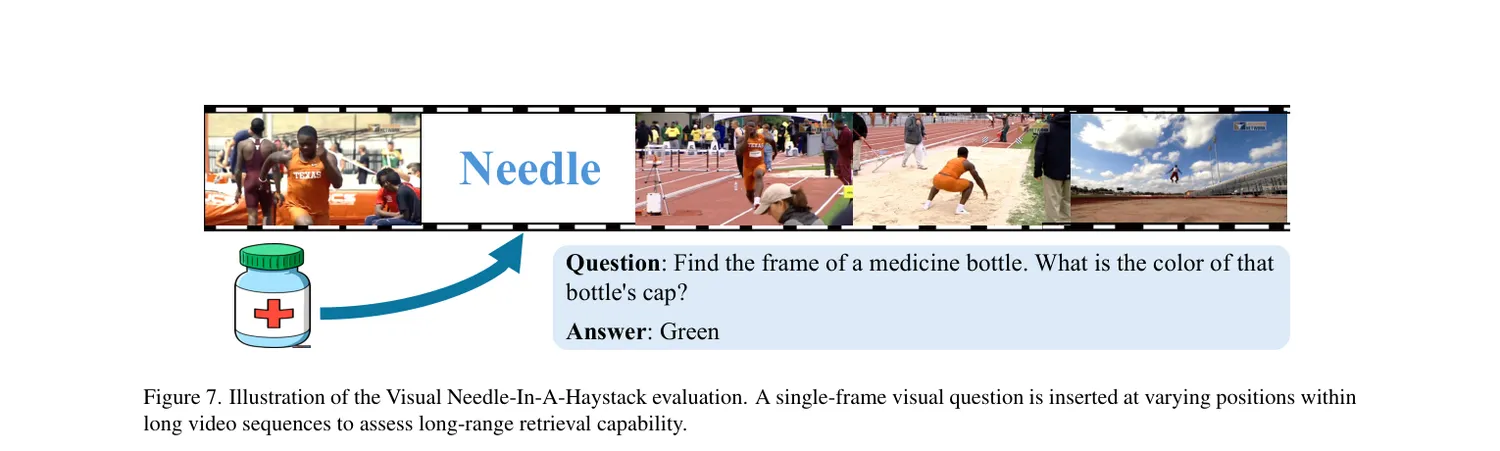
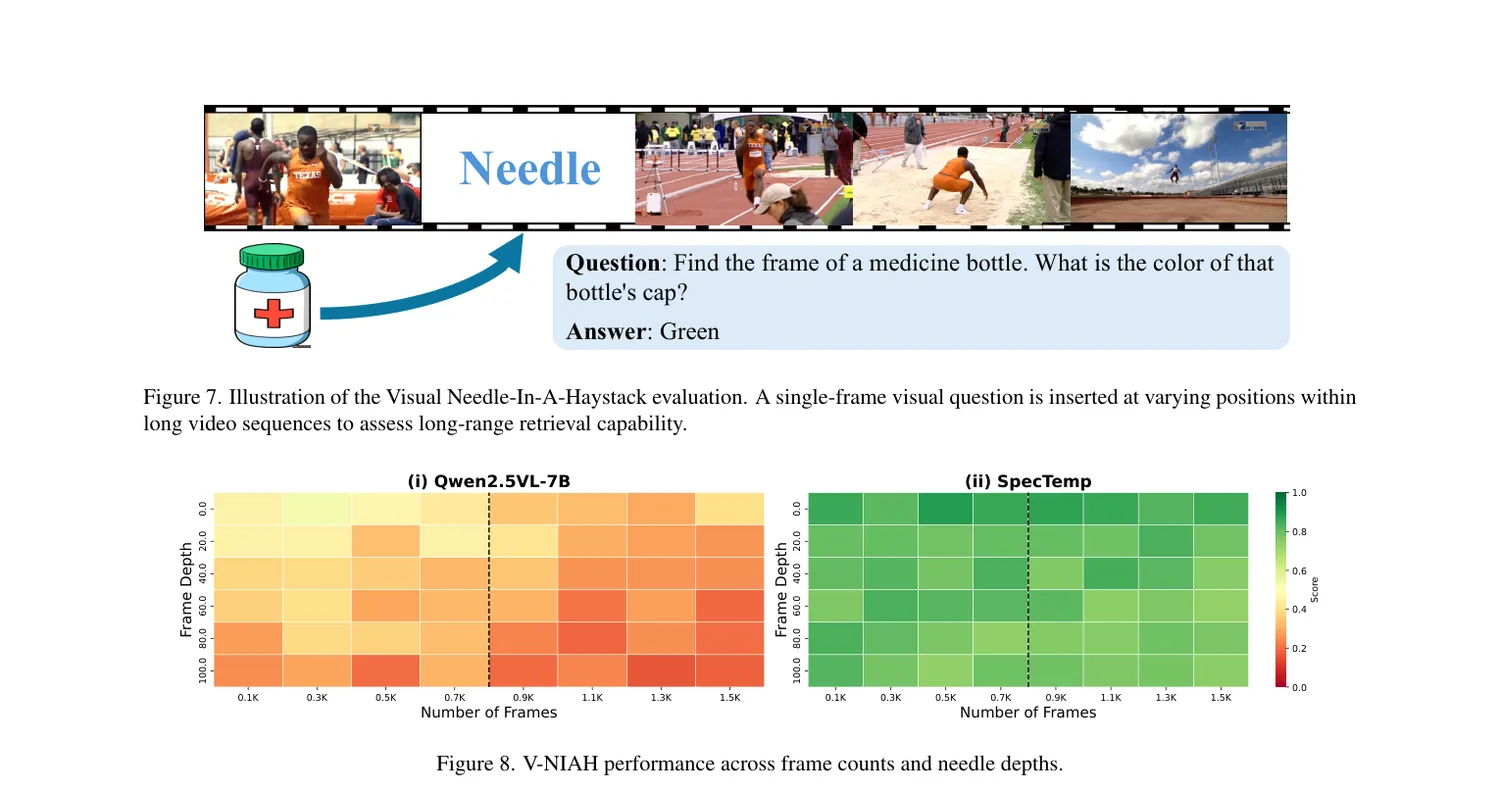
V-NIAH(supp 6.2):hour-long 视频插反常识 needle,SpecTemp 在 ≤2000 帧仍保 >80% 准确率,且 7B+3B 优于纯 7B。
⑭b supp prompt 模板 + case study(1/2/3 轮迭代)
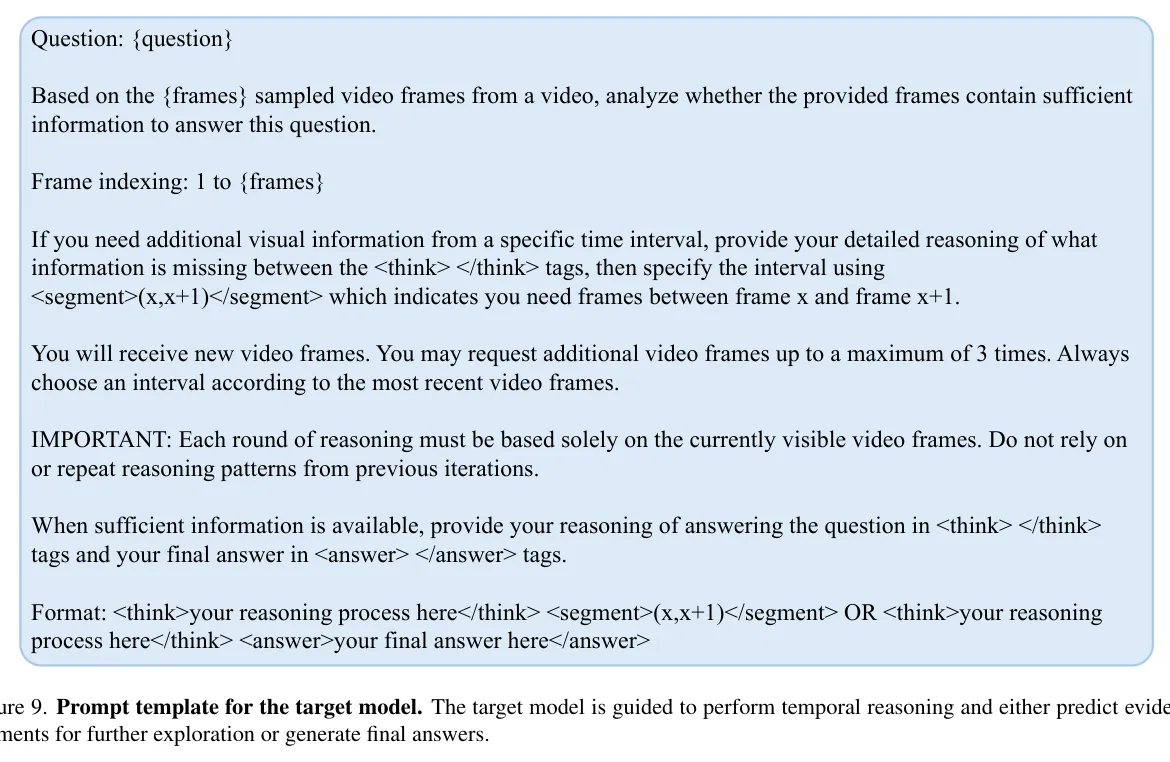
Target prompt(supp Fig.9):给定 question + 已采帧,判断是否足以回答;若缺信息,在 <think></think> 说明缺什么、再用 <segment>(x,x+1)</segment> 指定需要的帧区间(最多请求 3 次);够了则 <think>...</think> + <answer>...</answer>。强约束:“Each round of reasoning must be based solely on the currently visible video frames.”
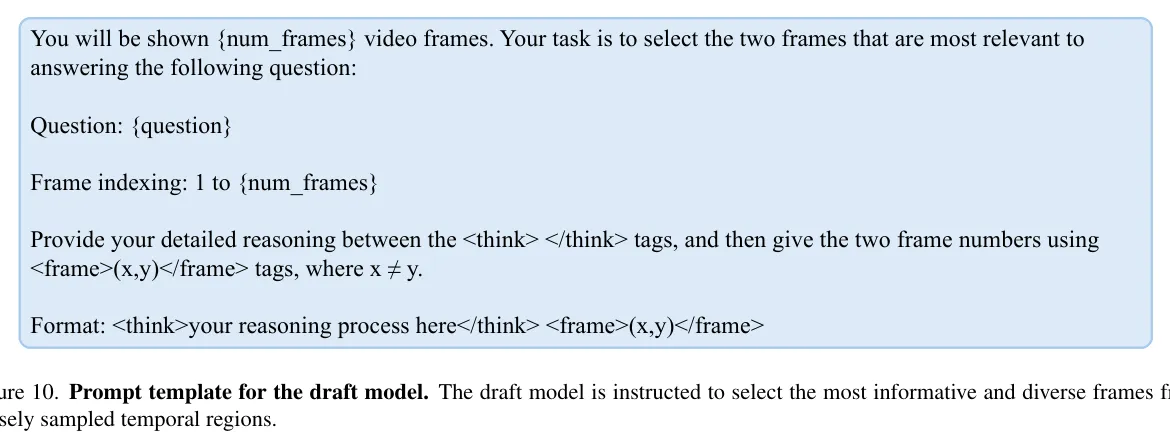
Draft prompt(supp Fig.10):从 {num_frames} 帧中选最相关的两帧,<think> 推理后用 <frame>(x,y)</frame>(x≠y)输出。
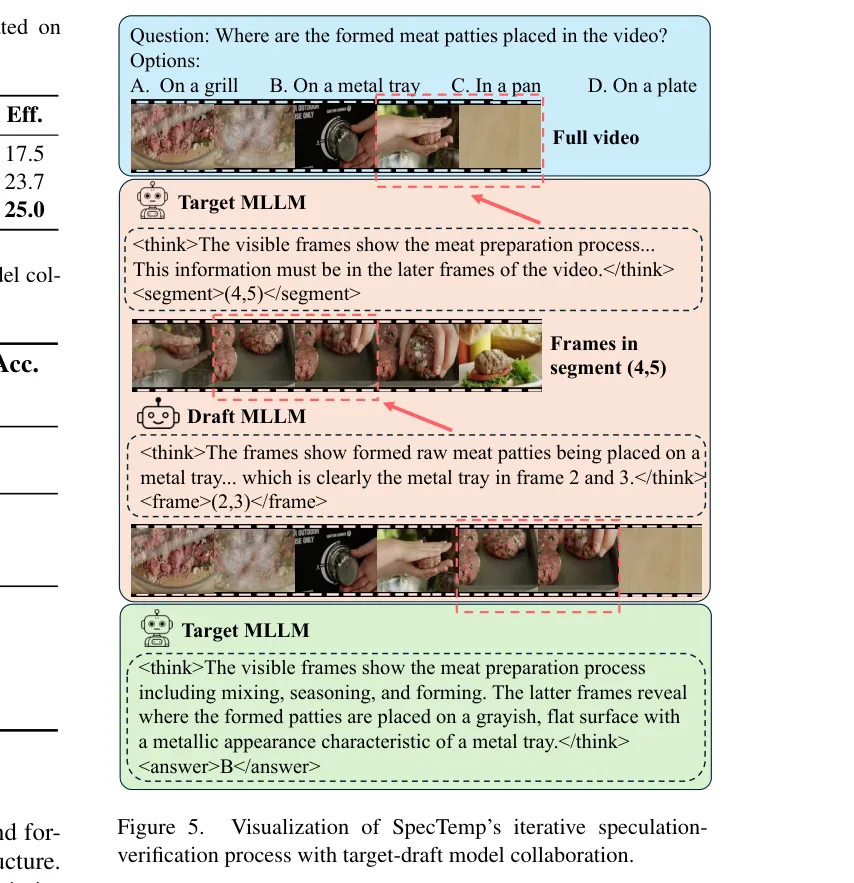
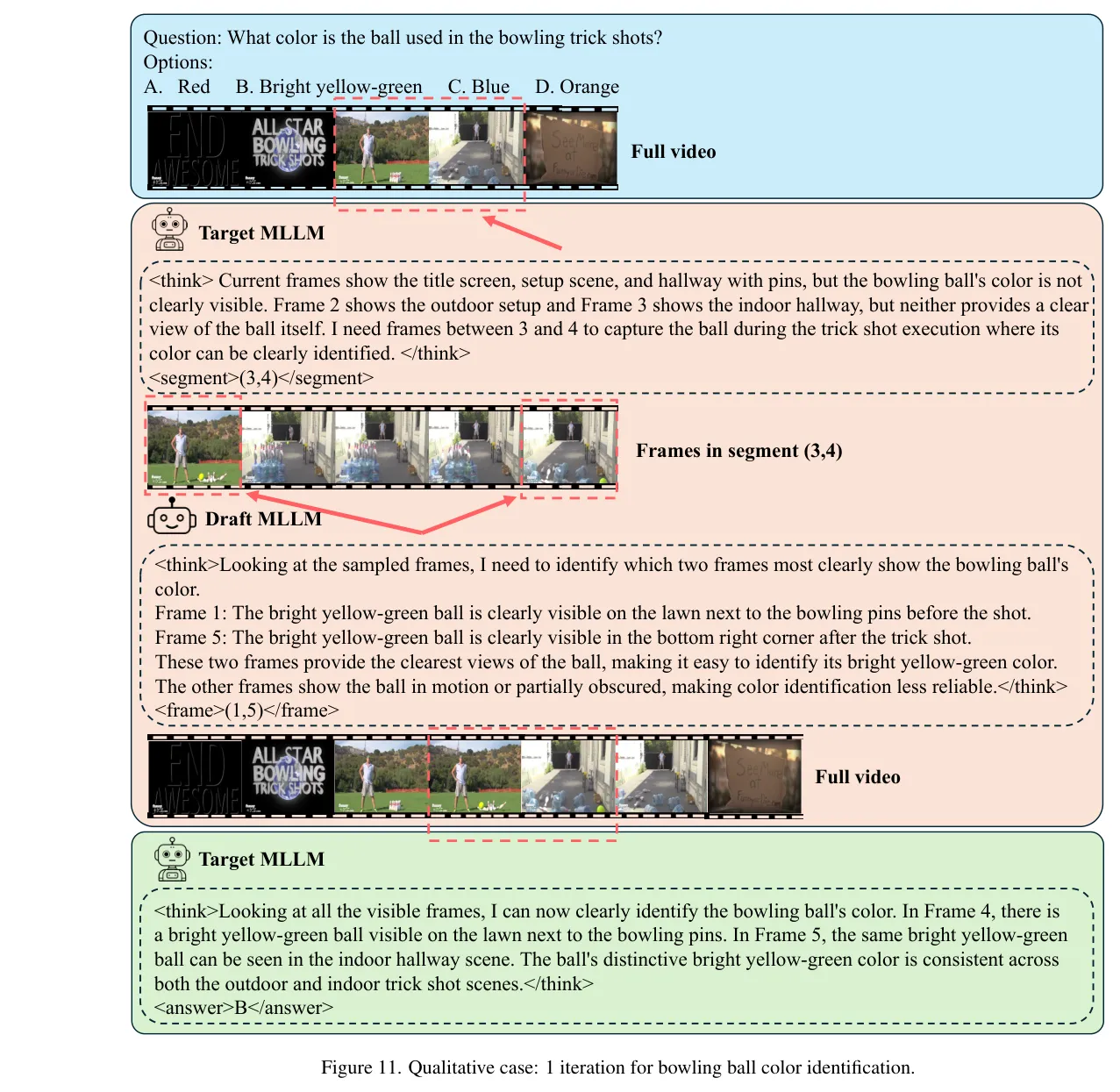
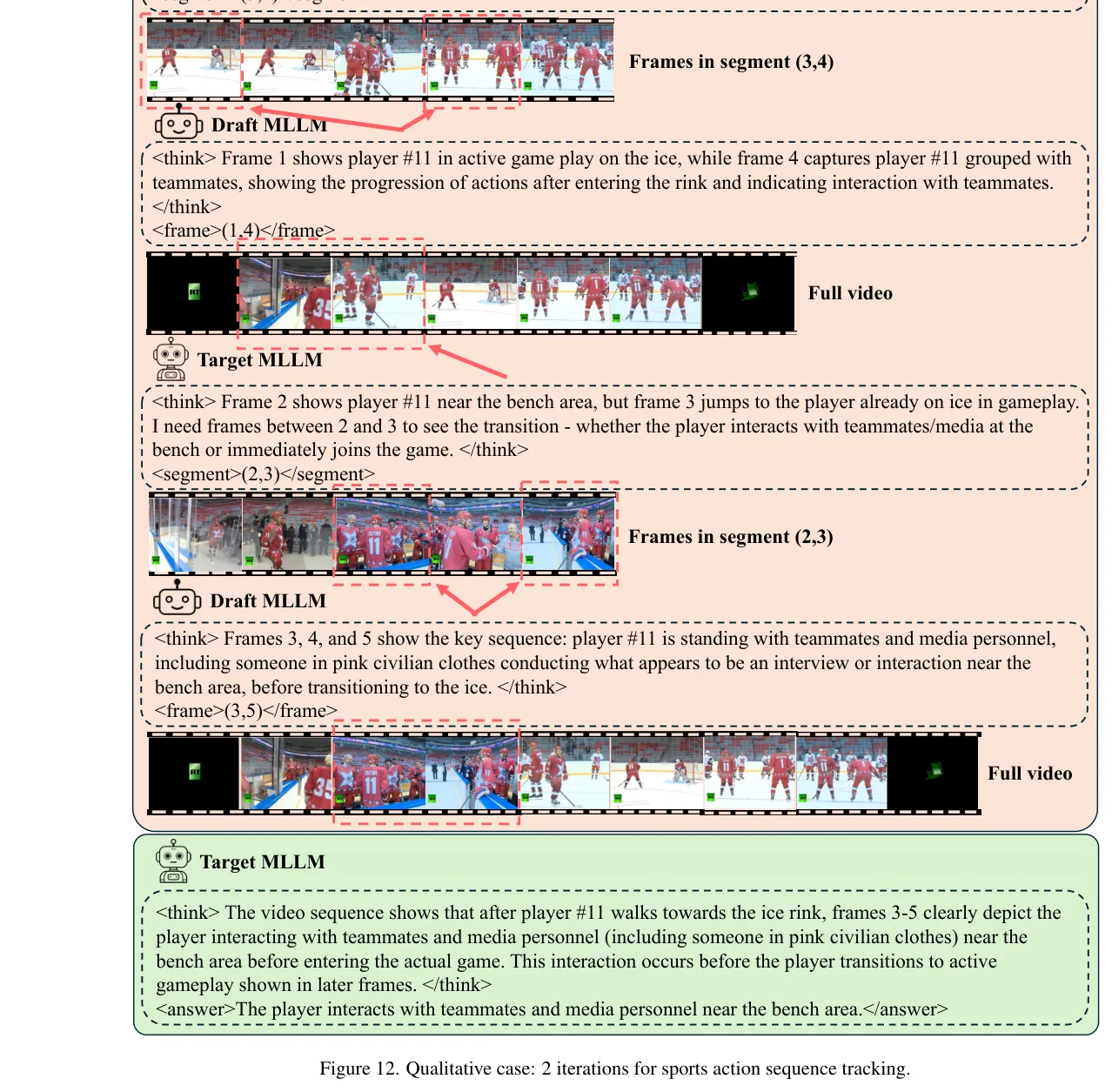
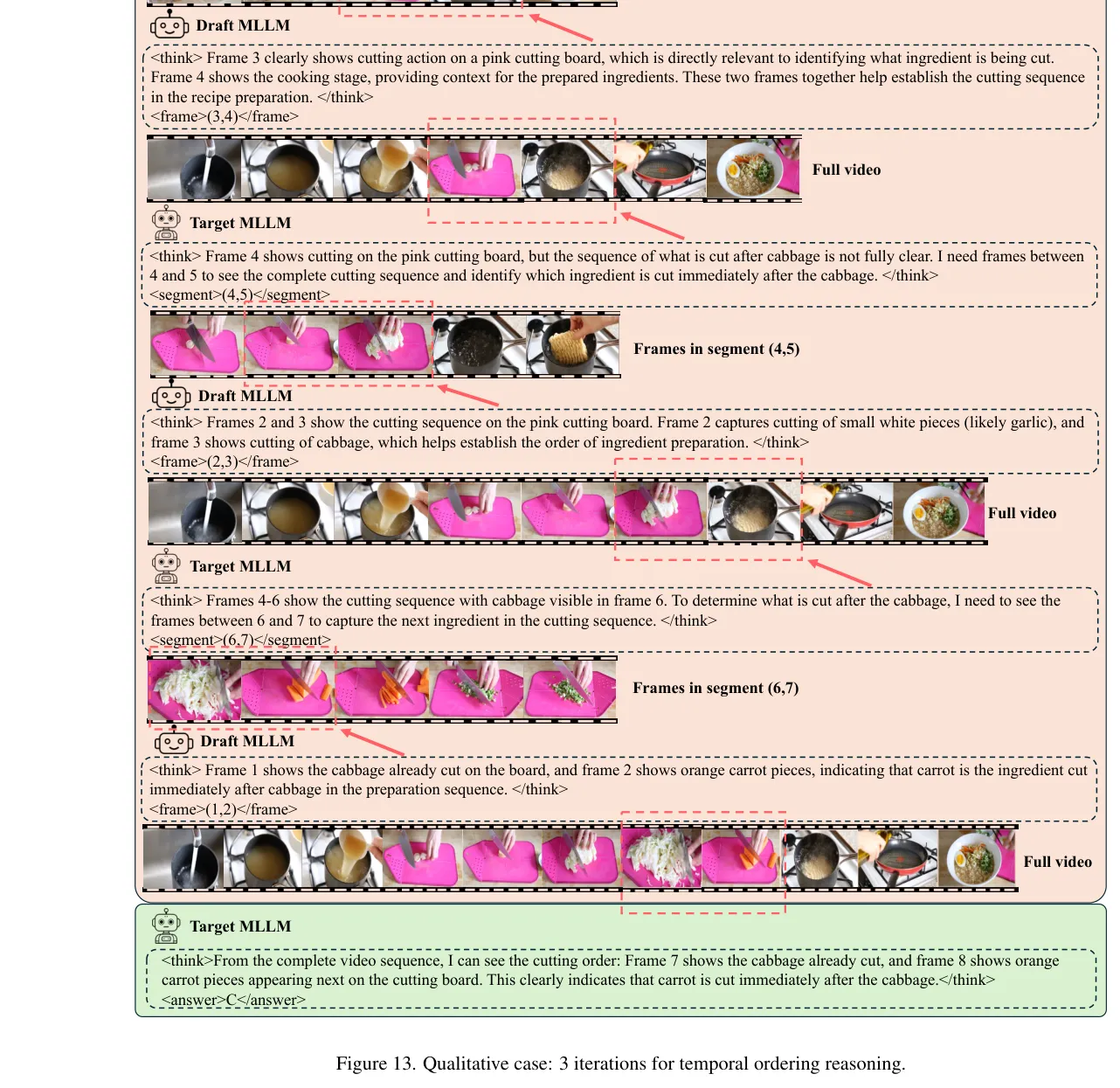
Case study(正文 Fig.5 + supp Fig.11-13):① 1 轮(保龄球颜色):target 判断需后段→draft 在 segment 内选 frame(1,5) 清晰展示亮黄绿球→target 答 B;② 2 轮(11 号球员入场后发生什么):target 连续预测 segment(3,4)/(2,3)、draft 选 frame,最终答“与队友/媒体在替补席互动”;③ 3 轮(卷心菜之后切什么):经 segment(3,4)→(4,5)→(6,7) 多轮 zoom-in,draft 选 frame(2,3)/(1,2) 锁定胡萝卜→答 C。体现 draft 快速感知探索 + target 谨慎推理验证的协作。
⑮ 亮点 / 创新点
① 把投机解码升维到“推理级 + 时序感知级”:3B draft 投机选帧、7B target 推理验证,解耦感知与推理,破 thinking-with-frames 的上下文膨胀;② 非对称双模型(\( |\pi_{draft}|\ll|\pi_{target}| \)):dense 探索的重活卸给小模型、只把 salient 帧喂大模型,直击 LLM prefill 这个真瓶颈(2.8s→2.3s);③ 专用 reward:target 用 IoU 奖时序定位、draft 用 CLIP 相关-冗余奖选帧,GRPO 统一联合优化;④ SpecTemp-80K 双层标注(scene span + frame evidence)+ GPT-4o 合成多轮轨迹;⑤ 精度效率双赢:长视频 +12/+8 同时快 19-23%,且支持 2000 帧 V-NIAH。
⑯ 疑问 / 边界 / 局限(原文 §6.4 + 推断)
① 训练计算开销大(原文):“requires training two separate MLLMs and performing joint reinforcement learning ... The RL stage is particularly resource-intensive, requiring generation of multiple trajectory samples per training example.”(双模型 + 联合 RL + 每样本多轨迹采样);② 超长视频泛化未验(原文):“performance on videos exceeding 2-3 hours has not been extensively evaluated ... the number of potential temporal segments grows dramatically.”(>2-3 小时未充分评,建议层级推理/记忆机制);③ [推测] draft 选帧依赖 CLIP 相似度,对细粒度/反直觉内容可能漏选(V-NIAH 特意用 counterfactual needle 应对);④ [推测] \( T_{max} \) 超 3 反降,说明过度迭代引入冗余帧损推理连贯性,迭代数需调;⑤ 单一 GT 评测对“多关键帧组合”可能不充分。
📌 全文一页总结(≥3 takeaway)
problem→method→experiment→takeaway:
problem:thinking-with-frames 长视频推理强但多模态上下文越滚越长、90%+ 视觉 token 注意力<10⁻³(高冗余)→ 效率瓶颈。
method:① 投机式双模型——7B target 初推+预测时序区+验证,3B draft 在密采区选稀疏关键帧,迭代到收敛(Eq.1-5,Alg.1,\( T_{max}=3 \));② SFT+GRPO 两阶段,target 用 format/answer/IoU 奖、draft 用 format/CLIP 相关-冗余奖(Eq.6-9);③ SpecTemp-80K 双层标注 + GPT-4o 多轮轨迹。
experiment:8 benchmark;短视频用 13.7 帧超 Qwen2.5-VL-7B 各 +2~4.6 且更快,长视频 Video-Holmes +12.0/MLVU +8.0、延迟降 19-23%;消融证 draft>CLIP、L+S 协作精度延迟双优、IoU 奖贡献最大、10+2×3 帧分配最优、2000 帧 V-NIAH >80%。
takeaway 1:投机解码可从 token 级升到“推理+时序感知级”——把耗时的帧 zoom-in 委派给小 draft、大 target 只验证,直击 LLM prefill 瓶颈。
takeaway 2:解耦感知与推理让 3B+7B 协作同时优于纯 7B 的精度与延迟(Eff 25.0 vs 17.5),是 test-time scaling 的高效路径。
takeaway 3:时序定位(IoU 奖)是长视频的主瓶颈,配合 draft 的相关-冗余选帧奖,能在更少帧下提精度;迭代需早停、\( T_{max} \) 适中(3)。
边界:训练开销大、>2-3h 超长视频未验、依赖 CLIP 选帧、过度迭代损连贯。
🖼 论文原图(本地 PDF 截图,原文 caption 未改写)