CVPR 2026 Finalist
The SA-FARI Dataset: Segment Anything in Footage of Animals for Recognition and Identification
Dante Wasmuht ⋅ Otto Brookes ⋅ Maximilian Schall ⋅ Pablo Palencia ⋅ Christopher Beirne ⋅ Tilo Burghardt ⋅ Majid Mirmehdi ⋅ Hjalmar Kühl ⋅ Mimi Arandjelovic ⋅ Sam Pottie ⋅ Peter Bermant ⋅ Brandon Asheim ⋅ Yi Jin Toh ⋅ Adam Elzinga ⋅ Jason Allan Holmberg ⋅ Andrew Whitworth ⋅ Eleanor Flatt ⋅ Laura Gustafson ⋅ Chaitanya Ryali ⋅ Yuan-Ting Hu ⋅ Baishan Guo ⋅ Andrew Westbury ⋅ Kate Saenko ⋅ Dídac Surís
摘要 Abstract
Automated video analysis is critical for wildlife conservation. A foundational task in this domain is multi-animal tracking (MAT), which underpins applications such as individual re-identification and behavior recognition. However, existing datasets are limited in scale, constrained to a few species, or lack sufficient temporal and geographical diversity -- leaving no suitable benchmark for training general-purpose MAT models applicable across wild animal populations. To address this, we introduce SA-FARI, the largest open-source MAT dataset for wild animals. It comprises 11,609 camera trap videos collected over approximately 10 years (2014-2024) from 741 locations across 4 continents, spanning 99 species categories. Each video is exhaustively annotated culminating in $\sim$46 hours of densely annotated footage containing 16,224 masklet identities and 942,702 individual bounding boxes, segmentation masks, and species labels. Alongside the task-specific annotations, we publish anonymized camera trap locations for each video. Finally, we present comprehensive benchmarks on SA-FARI using state-of-the-art vision-language models for detection and tracking, including SAM 3, evaluated with both species-specific and generic animal prompts. We also compare against vision-only methods developed specifically for wildlife analysis. SA-FARI is the first large-scale dataset to combine high species diversity, multi-region coverage, and high-quality spatio-temporal annotations, offering a new foundation for advancing generalizable multi-animal tracking in the wild. The dataset is available at [ANONYMIZED]
📝 精读笔记
灵魂一句
迄今最大的野生动物多目标追踪(MAT)开源数据集:11,609 段相机陷阱视频(2014–2024 约 10 年)、741 个采样点、横跨 4 大洲、99 个物种类别,~46 小时密集标注,16,224 条 masklet 身份 + 942,702 个 bbox/分割掩码/物种标签,且首次大规模提供人工核验的时空分割掩码(经 SAM 3 data engine + 人工校正)。配 SAM 3 等 VLM 的检测/追踪 benchmark:在 SA-FARI 上微调让 SAM 3 比基线涨 20+ 点 HOTA(cgF1 +32.9)。
问题 & 动机
生物多样性正以空前速度衰退,保护亟需自动化视频分析(物种/个体/行为),而相机陷阱(CT)产生的数据量早已超过人工处理能力。MAT(multi-animal tracking)是个体 re-ID、行为识别的底层前置,但现有数据集四大短板:① MAT 专用集(AnimalTrack/GMOT/TAO)规模太小(<1h)、无生态传感器footage;② 较大的也只覆盖 ≤5 物种、≤10h;③ UAV 野外集多为单地点、地理/时间跨度窄;④ 多数只给 bbox,分割掩码常是自动生成、未人工后处理。→ 缺一个能训“通用 MAT 模型”的 benchmark。
核心方法(数据集构建,非算法)
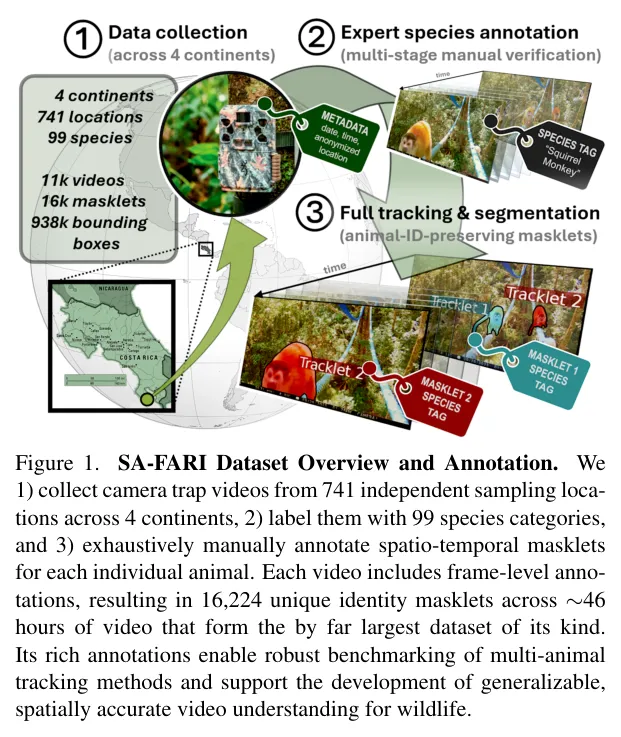
① 数据采集:4 大洲(中非/南美/中美/南欧)、7 家保护机构、741 独立采样点;多品牌 CT,离地 0.3–2m(另 2,790 段哥斯达黎加树冠 arboreal CT 离地 8–24m);运动触发、夜间 IR 闪光;分辨率 320×194~2688×1234、10–60 FPS(多 30)、时长 0.5–90s(多 15s);含音频(本文未用)。② 物种标注:本地专家给俗名→2–4 名标注者独立确认;附拉丁名 + 完整分类阶元(界门纲目科属种)。③ 分割标注(SAM 3 data engine, 6fps):SAM 3 自动 pseudo-标注全部 video-species 对 → 按 IoU 去重 → 人工核验(查可见性 + 第二标注者用 online SAM 2 在环修正 + exhaustivity 检查);bbox 由 mask 自动导出。
关键口径 / 评测指标(无核心算法公式)
规模(Tab.2):总 11,609 视频 / 2,747 min / 99 物种 / 16,224 masklet / 942,702 标注 / 741 站点;train 10,776、test 833,train/test 相机点零重叠。物种构成:67.7% 哺乳类、27% 鸟类、4% 爬行、1% 两栖;top-3=蜘蛛猴/领西貒/刺豚鼠;均 1.4 masklet/视频(最多 14)。“challenging” 判据:masklet 平均相邻帧 IoU <0.7(动得多) 或 遮挡次数 ≥2。评测指标:cgF1(classification-gated F1)、pHOTA(phrase-based HOTA,HOTA=√(DetA·AssA) 的开放词表版,分 Total/Det/Ass)、TETA(Track Every Thing Accuracy)、IDF1、HOTA。负样本增广:每个 video-species 对配 1 个同组 hard-negative + 1 个跨组 easy-negative(共 29 组)。
关键结果
物种特定 prompt(Tab.3, cgF1/pHOTA/TETA):SAM 3(14.0/48.5/39.6) > LLMDet+SAM3-TR(2.6/41.3/30.4) > GLEE(−0.2/7.5/22.0);加 SA-FARI 训 SAM3(SA-FARI) 39.0/63.1/52.1,微调 SAM3 FT(SA-FARI) 46.9/68.1/58.7(vs 原 SAM3 +32.9 cgF1 / +19.6 pHOTA / +19.1 TETA,≈3× 提升)。物种无关 “animal” query(Tab.4):SAM3(SA-FARI) IDF1 71.1 / HOTA 64.4,超次优 +23.9 IDF1 / +18.9 HOTA。子集(Tab.5):大 mask 比小 mask pHOTA +29.2;challenging 追踪更难(pHOTA-Ass −9.3)。
亮点
① 规模/多样性碾压前作(5× 标注时长、2× 物种数);② 唯一大规模人工核验时空分割掩码的野生 MAT 集;③ 与 SAM 3 data engine 深度绑定(自动 + human-in-the-loop);④ 精心的 site-disjoint 划分 + long-tail open-world(部分物种只在 test,如 Saki monkey);⑤ 含匿名地理位置、音频等可扩展模态。
疑问 / 待查
① 摘要数据集地址被匿名化([ANONYMIZED]),正文给的是 conservationxlabs.com/SA-FARI——以发布版为准;② SAM 3 本身的 PCS 评测协议细节与训练数据靠引用 SAM 3 论文[12],需查该文;③ 标注 6fps、视频原生最高 60fps,时间分辨率折损对快速运动 masklet 的影响原文未量化。
📖 逐段精读 · 笔记
① Abstract(摘要)— 逐句精讲
原文骨架(verbatim):"Automated video analysis is critical for wildlife conservation. A foundational task in this domain is multi-animal tracking (MAT), which underpins applications such as individual re-identification and behavior recognition." 痛点:"existing datasets are limited in scale, constrained to a few species, or lack sufficient temporal and geographical diversity – leaving no suitable benchmark for training general-purpose MAT models." 方案:"we introduce SA-FARI, the largest open-source MAT dataset for wild animals."
规模逐项(verbatim):"It comprises 11,609 camera trap videos collected over approximately 10 years (2014-2024) from 741 locations across 4 continents, spanning 99 species categories." 标注量:"∼46 hours of densely annotated footage containing 16,224 masklet identities and 942,702 individual bounding boxes, segmentation masks, and species labels." 收尾定位:"SA-FARI is the first large-scale dataset to combine high species diversity, multi-region coverage, and high-quality spatio-temporal annotations." benchmark 用 SAM 3,分 "species-specific and generic animal prompts" 两套设置。
📚 背景知识 A:camera trap / MAT / tracklet vs masklet
camera trap(CT,相机陷阱):野外布设的运动触发相机,是生态学主力 in-situ 传感器;原文动机 "the growing amount of data collected by in-situ sensors – such as camera traps (CTs) – which now vastly exceed the processing capacity of human experts"。MAT(multi-animal tracking)= multi-object tracking(MOT) 在动物域的特例。本文术语约定(verbatim):"we use 'tracklet' to refer to both bounding box or mask sequences … 'Masklets' refer specifically to tracklets that contain mask information, i.e., sequences where each element is a segmentation mask rather than just a bounding box." → 一个 masklet ≈ 一只被持续追踪的动物个体。
📚 背景知识 B:SAM 2 / SAM 3 / data engine
SAM 2=对图像/视频做 promptable 分割 + memory-based 追踪。SAM 3(本文既用其 data engine 标注、又作 benchmark 模型) 原文定义:"extends the Segment Anything Model 2 (SAM 2) to support open-vocabulary, text-based promptable segmentation and tracking. It can segment and track all instances of a user-specified concept across images and videos, using a DETR-style detector and a SAM 2-style memory-based tracker with a shared vision-language backbone." SAM 3 "is trained on a large, diverse dataset … annotated with millions of unique concept phrases, collected via a human- and AI-in-the-loop pipeline." SA-FARI 的掩码即由 SAM 3 data engine 自动初标 + 人工修。
📚 背景知识 C:追踪/分割指标(HOTA 家族,含公式)
HOTA(Higher Order Tracking Accuracy) 把性能拆成检测准确 DetA 与关联准确 AssA:\[ \mathrm{HOTA}=\sqrt{\mathrm{DetA}\cdot\mathrm{AssA}} \] pHOTA(phrase-based HOTA):"Each video–noun phrase pair is treated as a unique sample, enabling class-agnostic evaluation",分 Total/Det/Ass。TETA(Track Every Thing Accuracy):"consists of three parts: a localization score, an association score, and a classification score"。cgF1(classification-gated F1):"combines localization quality (positive micro F1, pmF1) and classification ability (image-level Matthews correlation coefficient, IL MCC)",记 \( \mathrm{cgF1}\sim \mathrm{pmF1}\times \mathrm{IL\text{-}MCC} \),为大标签空间设计、补 AP 之短。IDF1=身份保持准确度(平衡 precision/recall 并惩罚 identity switch)。
② §1 Introduction — problem → solution → why 闭环
problem:生物多样性以 "orders of magnitude faster than at any time in the last tens of millions of years" 的速度衰退;MAT 是 re-ID/行为识别的前置(提供时空动物表征,且 "help to prevent shortcut learning of spurious background cues, which are known to hinder out-of-distribution (OOD) generalisation")。但现有集四短板:(i) MAT 专用集 "lack scale (less than one hour of annotated footage)" 且无生态传感器 footage;(ii) 较大集 "focus on a small number of species – no more than 5 … no more than 10 hours";(iii) UAV 野外集 "generally collected from a single location … narrow geographic range and short temporal window";(iv) "most datasets provide localisation only via bounding boxes … often generated automatically without manual post-processing, leaving annotation quality uncertain."
solution + why:SA-FARI 把多机构 11,609 段 CT 视频合成一个大公开集,穷尽标注 bbox/mask/物种/个体 masklet。原文量化优势:"This is 5× greater in total annotated duration and 2× broader in species diversity than any existing MAT dataset to date." 且 "the only large-scale dataset to include high-quality manually annotated segmentation masks for wild multi-animal tracking." why 分割掩码重要:掩码(coat pattern/body shape/pose)利于细粒度个体/物种/行为区分、抑制背景 shortcut、利 OOD 泛化——这是“做大”之外的质量护城河。
③ Contribution(verbatim)
原文:"We present SA-FARI, by far the largest open-source MAT dataset for wild animals … 11,609 camera trap videos collected over 10 years from 741 locations across 4 continents." 关键 benchmark 结论一句:"Our results show that training on SA-FARI leads to over 20-point gains in HOTA metrics, underscoring the value of our large-scale, diverse annotations."
④ §2 Related Work — 三类既有数据集 & 其局限
(1) MAT benchmark:AnimalTrack[53]=58 段 YouTube、10 物种、1,927 tracklet;GMOT[2]=16 段、3 物种;TAO[17]=429 段、51 类、均 2 动物/视频,BURST[1] 在 TAO 上加掩码。共病:"these datasets lack in-situ footage from ecological sensors, and therefore do not capture animals in natural environments." (2) Wild MAT(多 UAV):BuckTales[34]=12 段黑羚 UAV(单 lekking 点)、BaboonLand[18]=18 段狒狒、KABR[26]=~10h 斑马/长颈鹿 UAV、WildLive[16]=22 段 drone 且掩码自动生成。共病:"limited to a narrow geographic and temporal scope … rely heavily on automated annotations without manual correction." (3) 行为/Re-ID 附带 MAT:LoTE[30]=28k 图 11 物种、MammAlps[20]=6K tracklet 5 物种(>90% 是鹿)、PanAf500[8]=500 段黑猩猩/大猩猩 CT、CCR[4]=>5k 脸+12k 身体轨迹。
⑤ §3 数据采集(Data Collection)
4 大洲(Central Africa / South America / Mesoamerica / Southern Europe)、7 家保护机构、741 独立采样点;多品牌 CT(Browning/Bushnell/Reconyx/…) "usually 0.3m to 2m from the ground",另 "2,790 videos from Costa Rica were recorded by cameras set up in tree crowns (arboreal camera traps) between 8 and 24m";运动触发、夜间 IR flash "invisible to the species of interest";分辨率 320×194~2688×1234、10–60 FPS(多 30)、时长 0.5–90s(多 15s);跨度约 10 年(2014-2024);"All videos within the dataset contain at least one animal";含音频但本文未用。
⑥ §3 物种标注(Species Annotation)
本地团队专家给俗名(如 fox)→"2-4 independent annotators then confirmed the common name";同视频多物种在时空 tracklet 标注时按个体赋独立俗名消歧。附拉丁名(如 Vulpes vulpes) + 完整分类阶元 "Kingdom: Animalia - Phylum: Chordata - Class: Mammalia - Order: Carnivora - Family: Canidae - Genus: Vulpes - Species: Vulpes vulpes",至少到 family、通常到 species。每段附日期时间戳 + 匿名采样点字符串。
⑦ §3 分割掩码标注(SAM 3 data engine, 6fps)
自动阶段:"SAM 3 is used to pseudo-annotate all video-species category pairs, generating initial masks … These masklets are then deduplicated based on their Intersection over Union (IoU)"(掩码重叠 \( \mathrm{IoU}=\frac{|A\cap B|}{|A\cup B|} \) 去冗余)。人工阶段:第一标注者查可见性(排除过糊/难辨,如混在 flock 中);第二标注者 "using online SAM 2 in the loop to improve or add masklets";最后 exhaustivity 检查确保所有 masklet 都标了。bbox 不人工标:"they are trivially derived from the segmentation masks by computing their spatial limits."
⑧ §3 划分 / 负样本增广 / test 子集
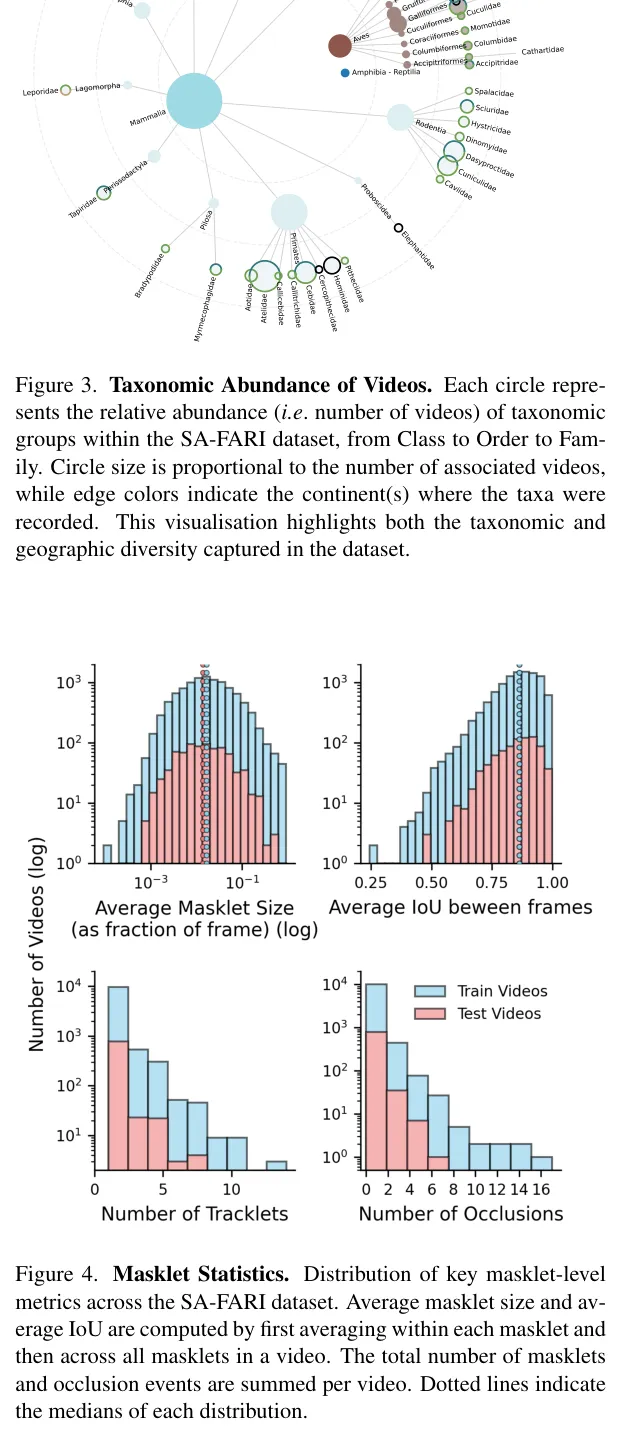
train/test 划分:test ≤1,000 视频、最大化物种多样性,且 "ensuring that all videos from the same camera trap are assigned to the same split"(站点零泄漏);按相机“物种类别/视频”比贪心选点。负样本增广:物种归 29 组,每个 video-species 对配 1 个同组 hard-negative + 1 个跨组 easy-negative(都确保不在该视频)——靠 exhaustive 标注才可行。test 五子集:challenging(106)/night(598)/multi-masklet(136)/large-masklet(211)/small-masklet(212)。challenging 判据:"the average inter-frame IoU of the masklet being < 0.7" 或 "the number of occlusions is ≥2";large/small 子集按平均 masklet size 的 \(>75\%\) / \(<25\%\) 分位,size \(\in[0,1]\) 为帧级 mask 占图比的平均。
⑨ §3 数据统计(Tab.2,PDF 真数)
| split | 视频 | 时长(min) | 物种 | masklet | 标注数 | 站点 |
| Train | 10,776 | 2,545 | 91 | 15,141 | 880,361 | 650 |
| Test | 833 | 202 | 83 | 1,083 | 62,341 | 91 |
| Total | 11,609 | 2,747 | 99 | 16,224 | 942,702 | 741 |
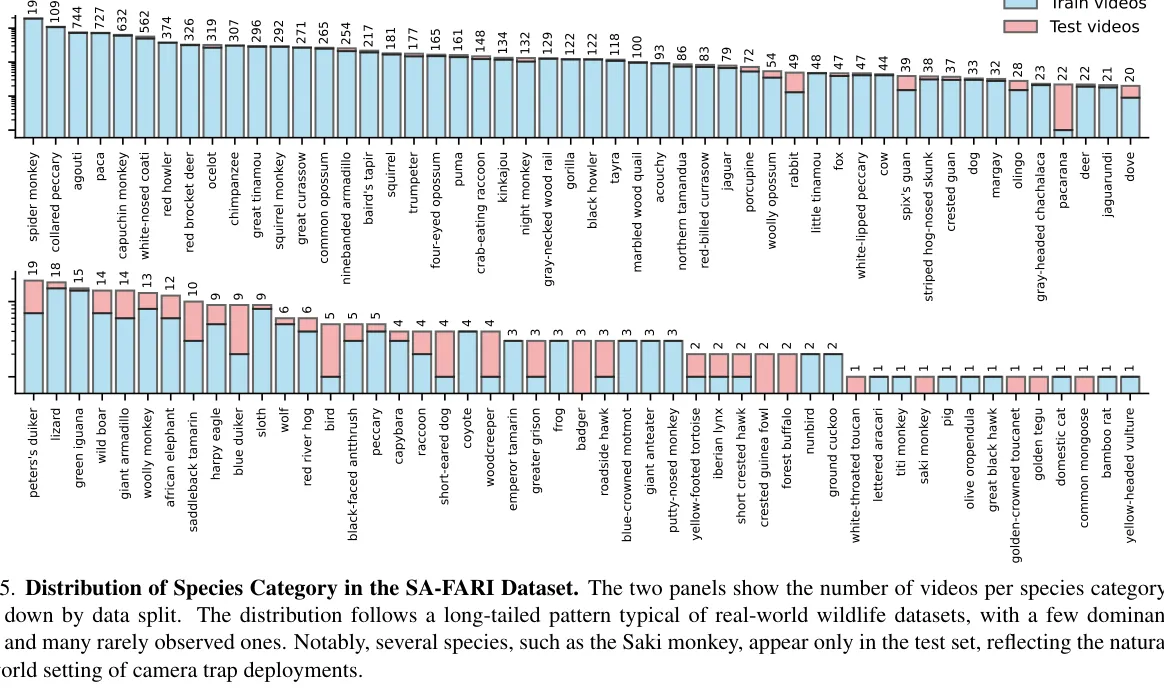
物种构成:"67 (67.7%) … belong to the Mammalia class … 27 (27%) … Aves … 4 (4.0%) … Reptilia … 1 (1.0%) … Amphibia";top-3 物种=spider monkeys / collared peccaries / agoutis;均 1.4 masklet/视频,22.7% 视频 ≥2 masklet,最多 14;masklet/视频最多的是 red river hogs(6.7)。长尾分布,部分物种(如 Saki monkey)只出现在 test,体现 open-world。
📊 数据集可视化统计(Fig.2 / Fig.3 / Fig.4)
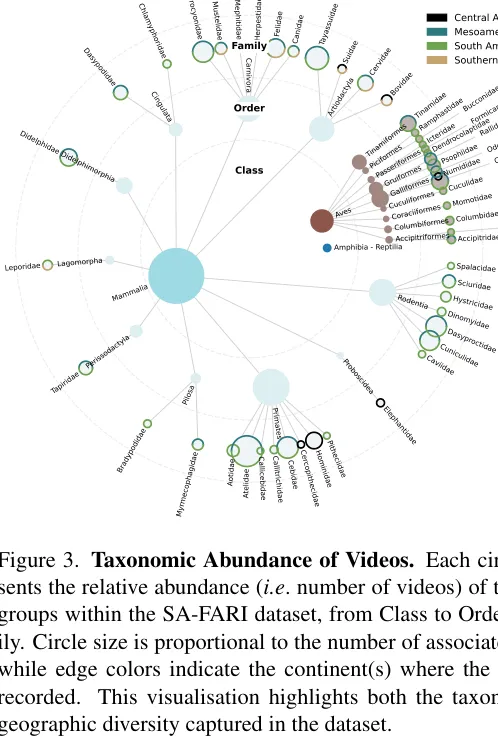
Fig.2 难例场景(verbatim caption):"The dataset captures a wide range of challenging scenarios, including: multiple animals in the same scene, occlusions between animals or with other scene elements, animals reappearing after leaving the frame, unconventional or partial views, small animals, nighttime conditions, and camouflaged animals." 这些正是野外 MAT 的核心难点(重现、遮挡、伪装、夜间)。Fig.3 分类丰度:从 Class→Order→Family 的圆圈图,圆大小 ∝ 视频数、边色标洲,凸显 "both the taxonomic and geographic diversity"。Fig.4 masklet 统计:展示 average masklet size、average inter-frame IoU(运动度)、masklet 数、occlusion 数四个分布,"Average masklet size and average IoU are computed by first averaging within each masklet and then across all masklets in a video." 地理集中度:"A minimum of 165 (22.3%) recording locations provided 90% of the data."
⑩ §2 数据集横向对比(Tab.1,节选 PDF 真数)
| 数据集 | 站点 | 物种 | 视频 | 时长(h) | tracklet | seg |
| AnimalTrack | — | 10 | 58 | 0.23 | 2k | ✗ |
| TAO/BURST | — | 51 | 429 | 3.60 | 1k | ✗/✓ |
| KABR(UAV) | 1 | 3 | 742 | 10.00 | — | ✗ |
| MammAlps(CT) | 3 | 5 | 2,384 | 14.50 | 6k | ✗ |
| PanAf500(CT) | 12 | 2 | 500 | 2.10 | 1.5k | ✗ |
| SA-FARI | 741 | 99 | 11,609 | 45.78 | 16k | ✓ |
SA-FARI 在站点(741)、物种(99)、视频(11,609)、时长(45.78h)、tracklet(16k) 全面碾压,且唯一提供 dense、人工核验的分割掩码。
⑪ §4 Benchmark — 两套设置
(1) 物种特定 prompt:VLM 收物种名,按 SAM 3 的 video promptable concept segmentation(PCS) 协议定位+追踪该物种全部实例。三模型:GLEE[51](开放词表检测追踪)、LLMDet[19](仅检测,外接追踪器)、SAM 3。SAM 3 再加两配置:参训(SA-FARI 按比例混入) 与显式微调,记 SAM 3 / SAM 3 (SA-FARI) / SAM 3 FT (SA-FARI)。(2) 物种无关:物种名换通用 query "animal",对比 SAM3(SA-FARI) vs MegaDetector(MD)+ByteTrack/OCSort/BoostSort++。注意 "SAM 3 models trained on SA-FARI were not exposed to the 'animal' query during training; this prompt is used only at inference time."
⑫ §4 物种特定 prompt 结果(Tab.3,PDF 真数)
| 方法 | cgF1↑ | pHOTA↑ | TETA↑ |
| 1 GLEE | -0.2 | 7.5 | 22.0 |
| 2 LLMDet + SAM 3 TR | 2.6 | 41.3 | 30.4 |
| 3 SAM 3 | 14.0 | 48.5 | 39.6 |
| 4 SAM 3 (SA-FARI 参训) | 39.0 | 63.1 | 52.1 |
| 5 SAM 3 FT (SA-FARI) | 46.9 | 68.1 | 58.7 |
读表(verbatim):SAM 3 比次优 LLMDet "by +11.4 cgF1 and +7.2 pHOTA";微调后 "outperforms its counterpart (row 3) by +32.9, +19.6, and +19.1 on cgF1, pHOTA, and TETA"(≈3× 基线),原文称 "exhibiting the value of domain-specific data on the performance of SOTA models."
⑬ §4 物种无关结果 + 子集分析(Tab.4 / Tab.5)
Tab.4(IDF1/HOTA):SAM3(SA-FARI) IDF1 71.1 / HOTA 64.4(Det 50.0 / 总 83.7),原文 "surpassing the closest competing models on IDF1 and HOTA by +23.9 … and +18.9"(对比 MD+BoostSort++ IDF1 47.2、MD+OCSort HOTA 45.5)。Tab.5 子集(pHOTA):large mask 81.4 vs small mask 52.2("+29.2 greater than small ones on the pHOTA metric",小目标最难);challenging 相比 All "-4.1 pHOTA-Det … -9.3 pHOTA-Ass"(遮挡+运动主要伤“关联”);multi-animal 67.8 ≈ All 68.1(因常伴大 mask 抵消);night 66.0 vs All 68.1(略低但接近)。
⑭ §5 Conclusion + 局限/扩展
结论:SA-FARI 以 "over 11,000 camera trap videos from over 700 sampling sites … 99 species categories and sightings spanning a decade" 提供空前规模,且首次大规模人工核验时空分割掩码(16k+ masklet)。关键发现:"even SOTA models perform poorly in this domain without large-scale, richly annotated collections like SA-FARI",微调 SAM 3 实现 "a three-fold improvement over its baseline"。扩展方向(verbatim):"The integrated audio streams present a compelling opportunity for future multi-modal model development that leverage vocalizations to enhance detection, species classification and tracking robustness in the wild." 另建议 "Future data integration should prioritize additional ecoregions to capture a wider array of species and mitigate geographic bias." 即加 body pose / depth / 自然语言描述等模态,补更多生态区减地理偏置。
⑮ 疑问 / 局限 [推测]
① arXiv 版摘要数据集地址被匿名([ANONYMIZED]),正文/项目页给 conservationxlabs.com/SA-FARI——以发布版为准;② SAM 3 的 PCS 协议、训练数据、cgF1/pHOTA 精确算法靠引用 SAM 3 论文[12],需查原文;③ 标注仅 6fps 而视频原生最高 60fps,时间下采样对快速运动/短暂出现 masklet 的影响未量化[推测];④ benchmark 强绑 SAM 3 生态(既当标注器又当被测模型),可能存在自指偏置[推测];⑤ 地理/物种长尾极重(29 类占 90%),尾部物种评测样本稀少、指标方差大[推测]。
📌 全文一页总结(≥3 takeaway)
problem:野生动物 MAT 缺一个大规模、多物种、多地点、含人工核验分割掩码的 benchmark,训不出通用 MAT 模型。method(数据集):合并 4 大洲 741 点的 11,609 段相机陷阱视频,穷尽标注 99 物种 / 16,224 masklet / 942,702 个 bbox+mask;SAM 3 data engine 自动初标 + online SAM 2 人工在环核验;site-disjoint 划分 + hard/easy 负样本增广 + 5 个难度子集。experiment:微调 SAM 3 后 cgF1/pHOTA/TETA = 46.9/68.1/58.7,比原 SAM3 +32.9/+19.6/+19.1(≈3×);通用 “animal” query 也以 IDF1 71.1/HOTA 64.4 大幅领先 MegaDetector+经典追踪器。
takeaway:① 规模 + 多样性 + 人工掩码质量是训“跨种群通用”野生 MAT 的三件套,缺一不可;② 即便 SAM 3 这类 SOTA VLM 在野外也需域内数据微调才好用(domain-specific data 价值被实测确认);③ 小目标 / 遮挡运动是最大难点(small mask 比 large 低 29.2 pHOTA、challenging 关联 −9.3),为后续数据采集与建模指明方向;④ 数据集预留 音频 / pose / depth 等模态,是后续多模态野保模型的接口。
🖼 论文原图(本地 PDF 截图,原文 caption 未改写)