CVPR 2026 Finalist
Texvent: Asynchronous Event Data Simulation via Text Prompt
Ruofei Wang ⋅ Peiqi Duan ⋅ Ka Chun Cheung ⋅ Simon See ⋅ Boxin Shi ⋅ Renjie Wan
摘要 Abstract
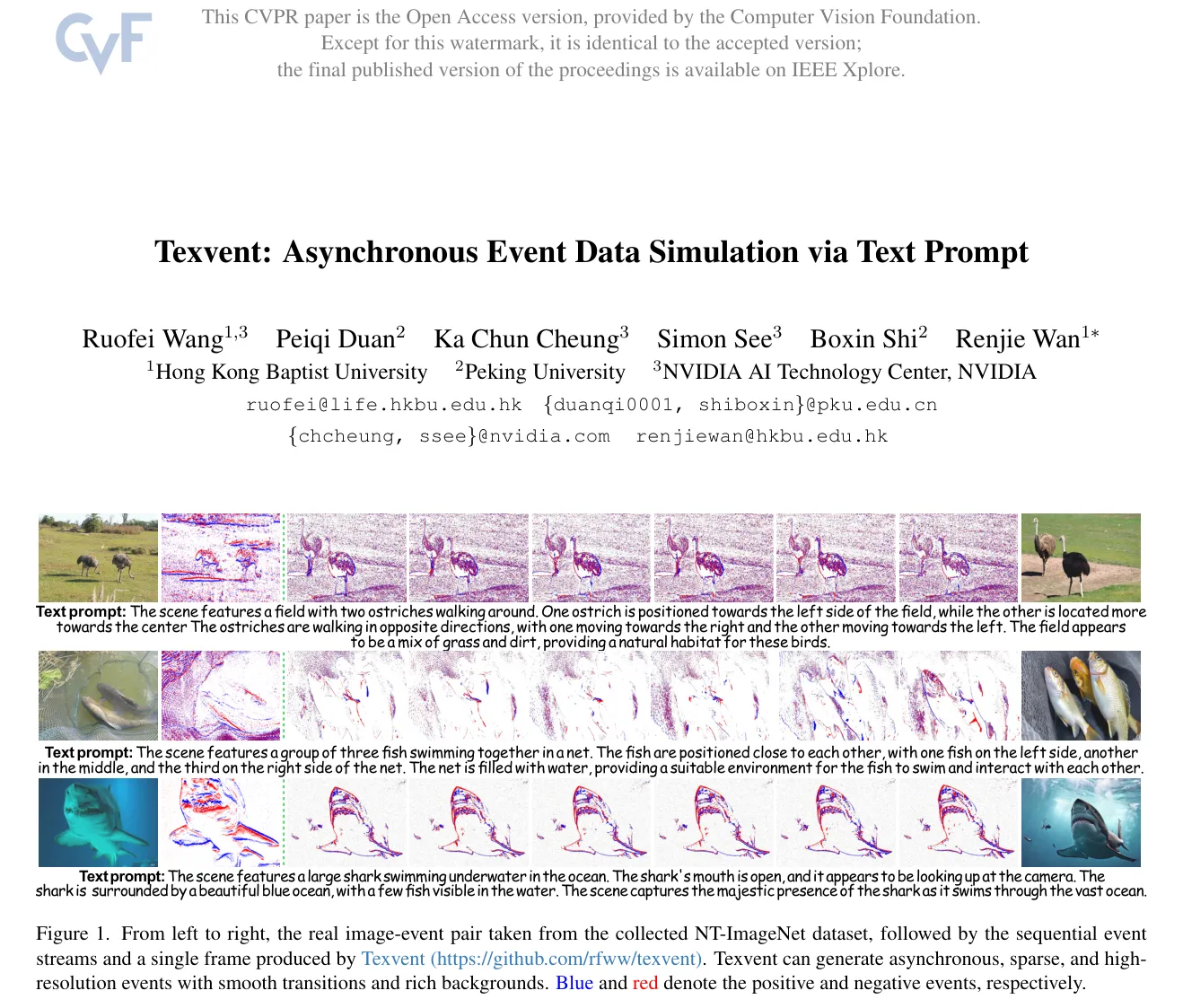
Current event simulation methods focus on employing videos to synthesize new event data, suffering from costly video capture and limited scalability across viewpoints, motions, and lighting. To this end, we propose a Text-to-event simulation framework (Texvent) that can directly generate asynchronous event data from simple text prompts. Texvent first renders prompt-driven videos via multimodal large language models and subsequently applies a new physical simulator to generate event streams. Specifically, an adaptive brightness-aware frame interpolation approach is proposed to enhance the temporal resolution of the rendered videos. A balanced logarithmic intensity comparison strategy and a cache–based voltage refreshment mechanism are introduced into the simulator to generate event data.To narrow the sim-to-real gap, we also introduce background activity noise injection and dense time stamp reconstruction operations. Extensive experiments demonstrate Texvent’s superior computational efficiency and its ability to generate more realistic event data than existing simulators.
📝 精读笔记
灵魂一句
训练-free 的“文本→事件相机数据”仿真:一句 text prompt → MLLM 视频生成器(默认 Cosmos-7B)出视频 → 一个新的物理 event simulator 出异步事件流。两大新模块:① brightness-aware 帧插值(按亮度变化决定插几帧,没变化就不插→省掉冗余光流、提效率);② simulator 内的 balanced logarithmic intensity comparison(平衡 α) + cache-based voltage refreshment(亮度缓存)(修高/低光激活不公平 + 防参考亮度频繁刷新丢事件)。再加 BA 噪声注入 + dense 时间戳重建缩 sim-to-real gap。EQS 最高、速度第二快,还放出 NT-ImageNet(5000 text-event 对)。
问题 & 动机
事件相机(bio-inspired,低延迟/低功耗/高动态范围)好,但大规模事件数据集难采集→需要 event simulation。主流是 video-to-event:要 costly 视频采集、跨视角/运动/光照 scalability 差。已有 text-to-event[37]要训 diffusion+autoencoder、需大量 text-event 对、还是 gesture-specific。最朴素方案“视频生成器 + 现成 video-to-event simulator 级联”有两病:① 低效(帧插值里冗余双向光流估计);② 低保真(没建模真实采集 vs 仿真的差异)。本文要一个 training-free、通用、又快又真的 T2E。
核心方法(两阶段 + 三补丁)
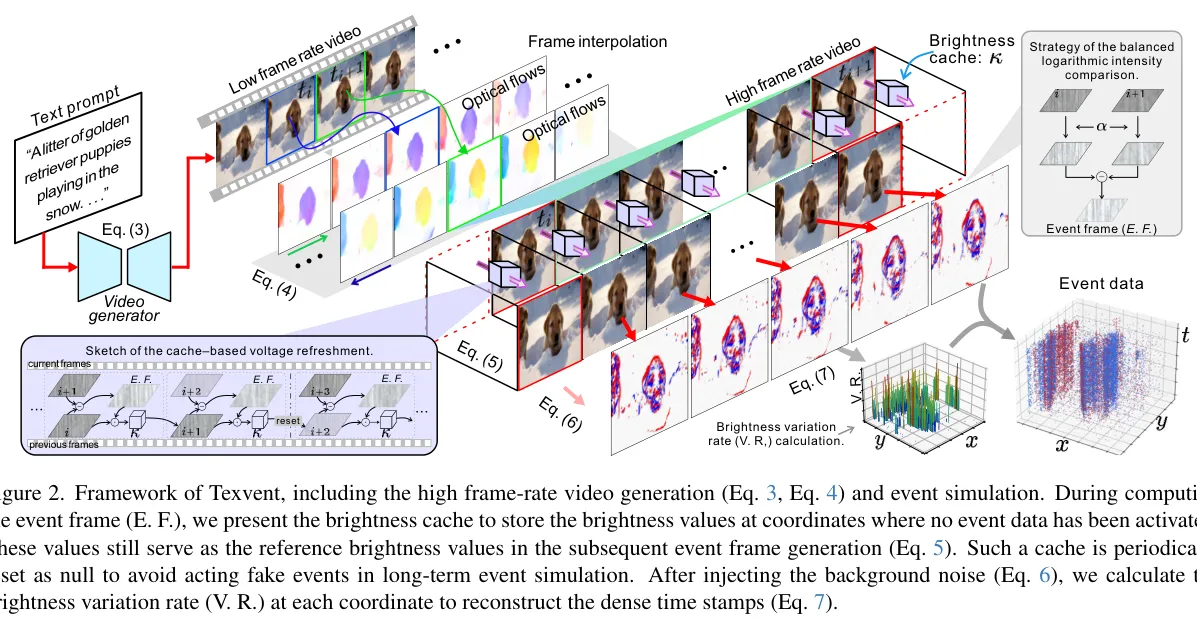
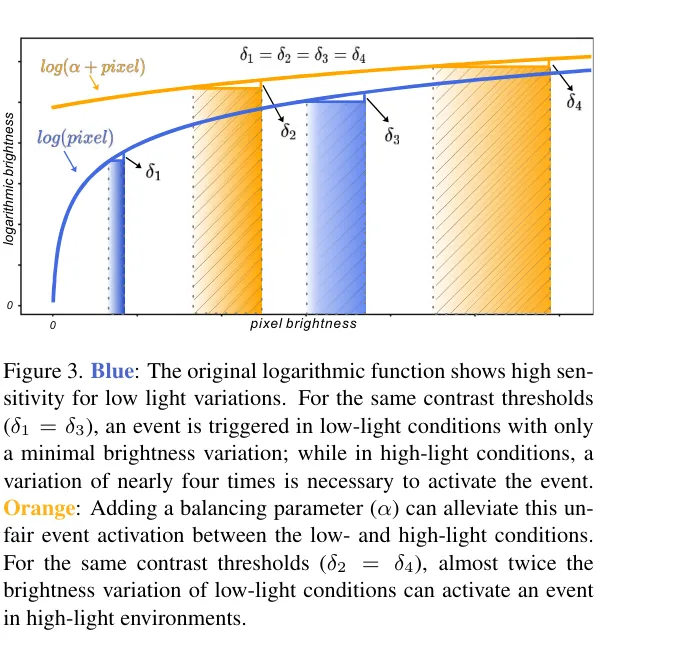
阶段一 高帧率视频:text→MLLM 出低帧率视频 → brightness-aware 插值:帧间插值数 K_i 由两帧亮度差决定(式4),亮度变化 > δ 才用 RIFE 插 K_i 帧、< δ(不触发事件)就不插→省算力。阶段二 事件仿真:① balanced log 比较:原 log 函数对低光过敏(同阈值低光微变就触发、高光要 ~4× 变化),加平衡参数 α 拉平高/低光激活公平;② brightness cache κ:拿当前帧跟“校准帧”比(而非相邻帧),只在真激活事件的像素更新参考亮度(对齐事件相机电路的电压更新)、缓存周期性 reset 防长时假事件;③ 噪声 + 时间戳:自适应往低光背景注 Poisson BA 噪声、按亮度变化率重建 µs 级 dense 时间戳。
关键公式
事件触发:|L(x_i,t_i)−L(x_i,t_i−Δt)| ≥ δ(式1,L=log 亮度,δ=对比阈值,极性 p∈{−1,+1})。插值帧数:K_i = max(|L(I_{ti})−L(I_{ti+1})|) mod δ(式4)。事件帧生成(平衡 α + 缓存 κ):L(α+I^j)−L(α+κ⋄I^{j−1}) > δ(式5,⋄=亮度更新)。噪声:E = E·(1−M) + M·Poisson(λ1·λ2)(式6,M 锁定低光&背景区)。时间戳:t_{xi}=γ·(t_{i+1}−t_i)·(1−(ΔL_{xi}−min ΔL)/(max ΔL−min ΔL))+t_i(式7,亮度变化越大、激活越早)。
关键结果
video-to-event(Tab.1, ECD/DSEC):事件帧 MSE 0.045(最好)、LPIPS 0.339(最好)、SSIM 0.488(次优);重建图 SSIM 0.472、LPIPS 0.296 均最好。text-to-event(Tab.2, NT-ImageNet):EQS 0.8851(最高)(SENPI 0.8824 次之),单帧对耗时 0.0653s(第二快)(SENPI 0.0573s 最快;VID2E/V2E ~2.1s 慢在光流)。下游(Tab.3):仅加 5% Texvent 数据,HyperE2VID 重建 PSNR +6.16%、LPIPS −31.6%。
亮点
① 全程 training-free,simulator 是 plug-and-play(可换不同视频生成器/接真实相机);② brightness-aware 插值用“亮度变化”代替“双向光流”定插帧数→显著提速;③ 两个物理洞察补丁(α 平衡高/低光、cache 防丢事件)各自有消融支撑(去 cache EQS 掉 4.01%);④ 新 benchmark NT-ImageNet(5000 text-event 对)。
疑问 / 待查
① 式2 摘要称 EQS 比 SENPI 高“2.7%”,但 Tab.2 数值 0.8851 vs 0.8824 实际仅 ~0.3%——该 2.7% 口径原文未明说(可能对另一基线或另一统计);② 式4 的“mod δ”量纲/取整细节正文未细说;③ α、σ、λ1/λ2、γ 等超参具体取值需查 Supplementary(正文只给定性)。
📖 逐段精读 · 笔记
① Abstract(摘要)— 逐句精讲
原文骨架(verbatim):"Current event simulation methods focus on employing videos to synthesize new event data, suffering from costly video capture and limited scalability across viewpoints, motions, and lighting." → 靶子:主流 event simulation 是 video-to-event,受制于昂贵视频采集 + 跨视角/运动/光照扩展性差。"we propose a Text-to-event simulation framework (Texvent) that can directly generate asynchronous event data from simple text prompts." → 卖点:直接「文本→异步事件」。
方法两阶段(verbatim):"Texvent first renders prompt-driven videos via multimodal large language models and subsequently applies a new physical simulator to generate event streams." 即 MLLM 渲视频 → 新物理 simulator 出事件流。三个组件:"an adaptive brightness-aware frame interpolation approach"(效率补丁)、"A balanced logarithmic intensity comparison strategy and a cache–based voltage refreshment mechanism"(保真两补丁)。再加 "background activity noise injection and dense time stamp reconstruction operations" 缩 sim-to-real gap。结论句:"Extensive experiments demonstrate Texvent's superior computational efficiency and its generation ability."
📚 背景知识 A:事件相机(DVS) 工作原理(外部,非本文,理解前提)
普通相机按固定帧率拍完整图;事件相机(event camera / dynamic vision sensor, DVS, bio-inspired) 每个像素独立、异步地只在「log 亮度变化超过对比阈值 \(\delta\)」时吐一个事件 \(e_i=(x_i,t_i,p_i)\):坐标 \(x_i=(x_i,y_i)\)、微秒级时间戳 \(t_i\)、极性 \(p_i\in\{-1,+1\}\)(变亮 +1 / 变暗 −1)。三大优势 = 低延迟(µs)、低功耗、高动态范围(对数响应)。本文要在没有真实相机的前提下「伪造」这种数据,即 "generate synthetic event data, eliminating the need for a physical event camera"。
📚 背景知识 B:video-to-event 仿真谱系 + 为何 log 函数不公平
仿真谱系(本文 Related Work 梳理):"ESIM [38] is the first event camera simulator, which employs an adaptive sampling strategy to interpolate frames" → VID2E[11] 沿用 ESIM 仿真器但 "adopting the optical flow between pairs of video frames to interpolate intermediate samples"(靠光流插帧,慢)→ V2E[19] 加 "temporal noise, leak events, and pixel threshold mismatch" 更真 → V2CE[54] 用 "local dynamic-aware timestamp inference" 让事件时间分布正常 → DVS-Voltmeter[29] 把电压变化 "modeling the voltage variation as a Brownian motion with drift"。它们都需要视频且插帧多靠光流。
log 不公平(Fig.3):log 曲线低亮度处斜率大、高亮度处斜率平。"For the same contrast thresholds, an event is triggered in low-light conditions with only a minimal brightness variation; while in high-light conditions, a variation of nearly four times is necessary to activate the event." 普通相机动态范围低、高光细节本就少 → 高光物体几乎仿不出事件。加平衡参数 \(\alpha\) 后 "almost twice the brightness variation of low-light conditions can activate an event in high-light environments"(图3 橙线,约 2× 即可)。另外 EQS(Event Quality Score, CVPRW2025)= latent 空间距离衡量「仿真事件流 vs 真实事件流」的真实度,是本文 text-to-event 主指标;RIFE=实时中间流插帧法;BA noise=电路受温度影响的背景误触发事件。
② §1 Introduction — problem → solution → why 闭环
problem:事件相机优势大但 "the difficulties in large event dataset collection limit the event-based exploration" → 需 simulation;现有 video-to-event 受 "costly video capture and limited scalability" 所限;已有 T2E[37] 用 diffusion + autoencoder 做 gesture-specific 仿真,但 "training such specialized models still requires a large corpus of text-event pairs",不通用。naive 级联(视频生成器 + 现成 video-to-event simulator) 有两病:"1) low efficiency, due to the redundant bidirectional optical flow estimation during the frame interpolation … 2) low fidelity, stemming from incomplete modeling of the discrepancies between the real event data capture and event data simulation."
solution + why:training-free Texvent = 高帧率视频生成(brightness-aware 插值省光流) + 高效事件仿真(balanced log \(\alpha\) + brightness cache \(\kappa\))。why:① 治 low efficiency → 用亮度变化而非光流定插帧数,亮度没变(不触发事件)就不插帧;② 治 low fidelity → 两个贴合事件相机物理的补丁(高/低光激活公平、参考亮度只在激活时更新),再补 BA 噪声 + dense µs 时间戳。原文一句概括目标:"A training-free T2E method with general simulation ability is highly desirable, as it can reduce expensive data collection and facilitate rapid adaptation to diverse event domains."
③ 三个贡献(verbatim contributions)
原文 main contributions:
1) "We propose a novel T2E framework (Texvent) that overcomes the challenges of event dataset collection, enabling effective support for event-based downstream tasks."
2) "We present the balanced logarithmic intensity comparison strategy and the cache–based voltage refreshment mechanism to avoid potential event data corruption."
3) "We introduce NT-ImageNet, a new text-event pair dataset comprising 5000 pairs, specifically curated for evaluating text-to-event simulation."
📚 背景知识 C:§2 Related Work — MLLM 视频生成 & 事件仿真定位
视频生成(§2.1):近年 MLLM 在 text-to-video(T2V) 大成功——Sora[1]、Cosmos[2]、Wan[45]、VideoPoet[25]、video diffusion[17] 等。原文回顾:"VDM [17] is the first T2V model that extends image diffusion models to video generation via employing a U-Net to model temporal details.";Make-A-Video[44] "decomposes video generation into text-image modeling and motion perception";VideodirectorGPT[28] "leverages the large language model to generate structured plans" 引导长视频。但 "Training all these models shows a high computational cost",故本文主张「最大化复用现成 T2V 模型、扩展到事件域」而非另训。事件仿真(§2.2):分 image-to-event(需真实相机拍带微小运动的图,硬件门槛高,如 N-Caltech101 / CIFAR10-DVS / N-ImageNet) 与 video-to-event(无需相机,ESIM/VID2E/V2E/V2CE/DVS-Voltmeter)。原文点出 T2E 已有工作 Ott et al.[37] 的痛点:"It requires not only labeling the text prompt for each event sample but also converting the event stream into event frames to train the autoencoder." → 故本文 "propose harnessing the power of MLLMs to simulate event data, enabling open-world event simulation."
④ §3.1 问题形式化 — 公式 (1)(2)
事件触发条件(式1):\[ |L(x_i,t_i)-L(x_i,t_i-\Delta t)| \ge \delta \] \(L(\cdot)\)= log 亮度(模拟人眼视网膜),\(\delta\)= 对比阈值,\(\Delta t\)= 传感器最小时间分辨率,极性 \(p_i\in\{-1,+1\}\)(\(>+\delta\) 为正、\(<-\delta\) 为负)。T2E 形式化(式2):\[ E=F(T),\quad E=\{e_i\}_{i=1}^{n} \] \(E\)= 生成事件集(\(n\) 个),\(F(\cdot)\)= T2E 函数,\(T\)= 文本。两条设计原则(verbatim):"1) Efficiency: … without introducing perceptible latency for end users. 2) Fidelity: The simulated events must maintain statistical consistency with real data."
⑤ §3.2.1 高帧率视频 + brightness-aware 插值 — 公式 (3)(4)
视频生成(式3):文本 → 编码 → 解码出图像序列 \(I_{t\{1:N\}}\in\mathbb{R}^{N\times H\times W\times 3}\):\[ I_{t\{1:N\}}=D\big(E(T;\theta_e);\theta_d\big) \] \(D(\cdot;\theta_d)\)= 图像解码器、\(E(\cdot;\theta_e)\)= 文本编码器,\(N,H,W\)= 帧数/高/宽。MLLM 视频时间分辨率低于事件相机,故需插帧。brightness-aware 插值(式4):两连续帧间插帧数 \[ K_i=\max\big(|L(I_{t_i})-L(I_{t_{i+1}})|\big)\ \mathrm{mod}\ \delta \] 亮度变化明显才用 RIFE[20] 等间隔插 \(K_i\) 帧;变化 \(<\delta\) 说明 "no events are activated. Therefore, we don't need to interpolate these two video frames, thereby increasing the efficiency." 对照 ESIM/VID2E/V2E 靠双向光流约束「相邻插值帧位移 ≤1 像素」,光照混乱时极慢。
⑥ §3.2.2 事件帧生成 — balanced log \(\alpha\) + brightness cache \(\kappa\)(公式 5)
核心式(5):\[ \prod_{i\in\{0:N-1\}}\prod_{j\in\{1:K_i\}}\Big[L\big(\alpha+I^{j}_{(t_i,t_{i+1})}\big)-L\big(\alpha+\kappa\diamond I^{j-1}_{(t_i,t_{i+1})}\big)\Big]>\delta \] \(\alpha\)= 平衡参数,\(\kappa\)= 亮度缓存,\(\diamond\)= 亮度更新操作。两设计:
• balanced log(\(\alpha\)):解决 log 对低光过敏(Fig.3)。把输入整体抬高 \(\alpha\) 再取 log,拉平高/低光激活公平,又 "retaining the property of biological retinas"。
• brightness cache(\(\kappa\)):不用相邻两帧直接算差,而 "compare the current frame with a calibrated frame";\(\kappa\) 缓存「尚未激活事件处」的过去亮度作参考,"we only modify the reference brightness at a pixel where an event is activated, consistent with the voltage updating of the event camera circuit"。缓存周期 reset("periodically reset as null to avoid acting fake events in long-term event simulation") 防长时假事件。
⑦ §3.2.2 噪声注入 — 公式 (6)
BA 噪声(式6):\[ E=E\cdot(1-M)+M\cdot \mathrm{Poisson}(\lambda_1\lambda_2) \] 掩码 \(M=(I_{t_{i+1}}<\sigma)\cdot(\Delta L<\delta)\) 锁定低光(\(I_{t_{i+1}}<\sigma\)) + 背景(\(\Delta L<\delta\)) 区,其中 \(\Delta L=|L(\alpha+I_{t_{i+1}})-L(\alpha+\kappa\diamond I_{t_i})|\)。\(\lambda_1\)= 像素噪声激活概率、\(\lambda_2\)= 按 fill factor 适配不同 sensor。动机(verbatim):"For injection position, we suggest an adaptive injection strategy that prioritizes adding noise to the low-light background regions, as lower brightness makes noise activation easier." 相比 VID2E 用「随机对比阈值」注噪可能 "disregarding real events",本文 Poisson + 掩码更不易误删真事件。
⑧ §3.2.2 dense 时间戳重建 — 公式 (7)
时间戳(式7):\[ t_{x_i}=\gamma\times(t_{i+1}-t_i)\Big(1-\frac{\Delta^{x_i}_{L}-\min(\Delta L)}{\max(\Delta L)-\min(\Delta L)}\Big)+t_i \] 假设(verbatim):"the larger the brightness change in a fixed time bin, the earlier the event data is activated." \(\Delta L\)= 绝对亮度差,\(\gamma\)= 缩放参数把时间戳拉到 µs 级。最终 \(e=\{x_i,t_i,p_i\}\),串成事件流即完成「文本→事件」仿真。
⑨ §3.3 实现细节
默认视频生成器 Cosmos-1.0-Diffusion-7B-Text2World,另测过 Wan / CogVideoX / Open-Sora(FPS 分别 24/16/16/24)。单卡 NVIDIA H100。"We set the accumulation time to 1/FPS to aggregate individual events into an event stream." 深度图用 E2Depth[16]、warped event 用 Contrast Maximization Framework[43]。全程 training-free,simulator 是 "plug-and-play module that can be easily compatible with different video generation models and real standard cameras."
⑩ §4.1 实验设置
数据:video-to-event 用 ECD[33] 与 DSEC[12];text-to-event 用自建 NT-ImageNet(事件取自 N-ImageNet[24] validation、图取自 ImageNet[42]、文本用 LLaVA-v1.5-13B 配 prompt "Caption the image in detail." 生成)。baseline:VID2E/V2E/V2CE/DVS-Voltmeter/SENPI([37] 因 "a lack of official implementations" 未纳入)。三层评测:frame-level(重建图 PSNR/SSIM/LPIPS/MSE)、point-level(EQS)、application-level(下游 recognition / reconstruction / depth)。
⑪ §4.2 video-to-event 主结果(Tab.1,事件帧 E.F. / 重建图 R.I.,PDF 真数)
| 方法 | E.F. MSE↓ | E.F. SSIM↑ | E.F. LPIPS↓ | R.I. SSIM↑ | R.I. LPIPS↓ |
| VID2E | 0.116 | 0.430 | 0.406 | 0.387 | 0.381 |
| V2E | 0.142 | 0.299 | 0.603 | 0.420 | 0.422 |
| V2CE | 0.082 | 0.552 | 0.383 | 0.392 | 0.451 |
| DVS-Voltmeter | 0.276 | 0.085 | 0.972 | 0.149 | 0.354 |
| SENPI | 0.186 | 0.095 | 0.820 | 0.251 | 0.561 |
| Texvent | 0.045 | 0.488 | 0.339 | 0.472 | 0.296 |
读表(verbatim):"our method achieves the best MSE (0.045) and competitive SSIM (0.488), while maintaining the lowest LPIPS score by 0.339";重建图 "the highest SSIM (0.472) and the best LPIPS (0.296)"。唯一被 DVS-Voltmeter 在 R.I. MSE(0.096 vs 0.116) 略胜,原文承认 "slightly better than our simulator by 0.02"。事件帧 SSIM 0.488 次于 V2CE 的 0.552。
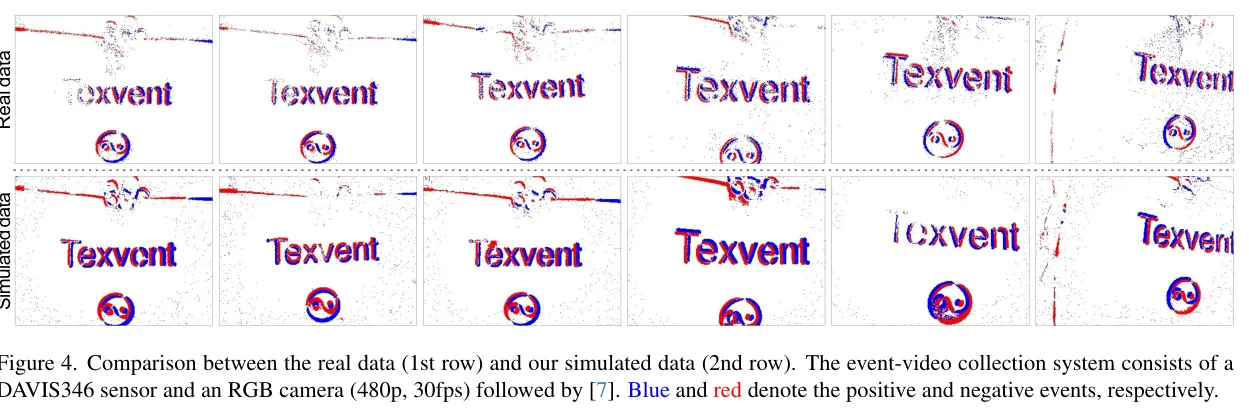
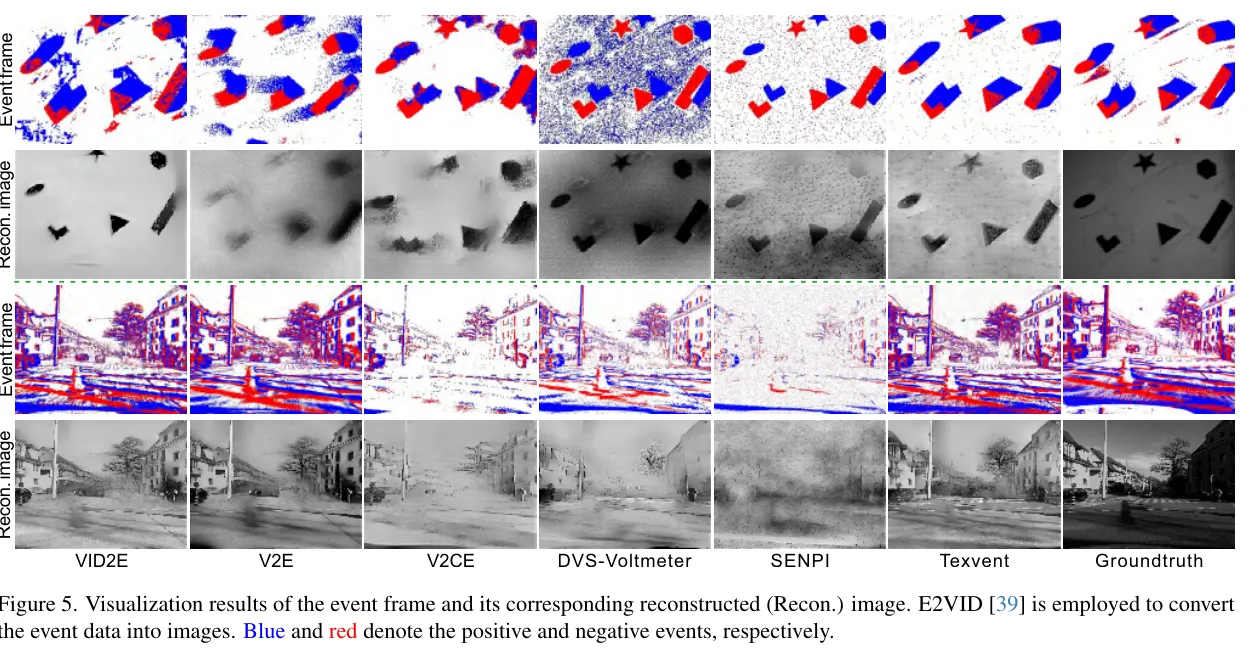
定性对比(Fig.5):原文逐家点评 baseline 缺陷——"VID2E and V2E generate relatively sparse events with noticeable gaps in the event distribution. V2CE produces events in a low temporal resolution that leads to some events being lost in the motion parts … DVS-Voltmeter shows scattered noise-like patterns that corrupt natural event distributions." 而 Texvent "produces event patterns that more closely resemble the ground truth, with balanced density and clear object boundaries." 真实相机验证(Fig.4):作者搭了 "a dual-camera system (DAVIS346 sensor + RGB camera)",把 RGB footage 直接喂 simulator,仿真事件 "closely matched the temporal dynamics and spatial distribution characteristics of the real event data",证明 plug-and-play 接真实相机也成立。
⑫ §4.3 text-to-event + 效率(Tab.2,EQS / 单帧对耗时)
| 方法 | EQS↑ | Time(s)↓ |
| VID2E | 0.8597 | 2.1228 |
| V2E | 0.8138 | 2.1652 |
| V2CE | 0.8642 | 0.0950 |
| DVS-Voltmeter | 0.8573 | 0.6919 |
| SENPI | 0.8824 | 0.0573 |
| Texvent | 0.8851 | 0.0653 |
EQS 最高 0.8851,速度第二(0.0653s,仅次 SENPI 0.0573s)。VID2E/V2E 慢 ~30× 因 "repetitive optical flow estimation during frame interpolation"。⚠️ 原文称 "better than the SENPI [13] by 2.7%",但数值 0.8851/0.8824 ≈ +0.3%——该 2.7% 口径正文未明说[推测:可能对另一统计或子集]。
⑬ §4.4 下游 image reconstruction(Tab.3,仅 5% 增广)
| 方法 | 增广 | PSNR↑ | SSIM↑ | LPIPS↓ | MSE↓ |
| E2VID | ✗ | 22.1127 | 0.5897 | 0.3104 | 0.0070 |
| E2VID | ✓ | 22.8475 | 0.6320 | 0.2791 | 0.0063 |
| HyperE2VID | ✗ | 21.9488 | 0.5973 | 0.2421 | 0.0077 |
| HyperE2VID | ✓ | 23.3000 | 0.6624 | 0.1656 | 0.0061 |
| ETNet | ✗ | 21.1987 | 0.5629 | 0.2013 | 0.0087 |
| ETNet | ✓ | 21.3771 | 0.5630 | 0.2112 | 0.0084 |
仅加 5% Texvent 数据,HyperE2VID 提升最大:"The improvement percentages are 6.16%, 10.9%, 31.6% and 20.9%"(PSNR / SSIM / LPIPS / MSE)。原文结论:"even a small increase in training data can lead to substantial improvements in image reconstruction quality."
⑭ §5 消融 / Discussion(balancing \(\alpha\) + brightness cache \(\kappa\))
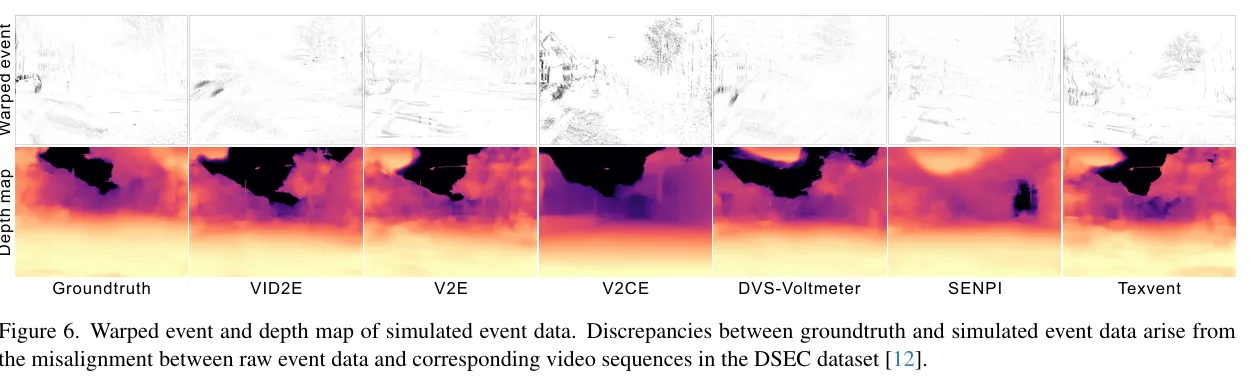
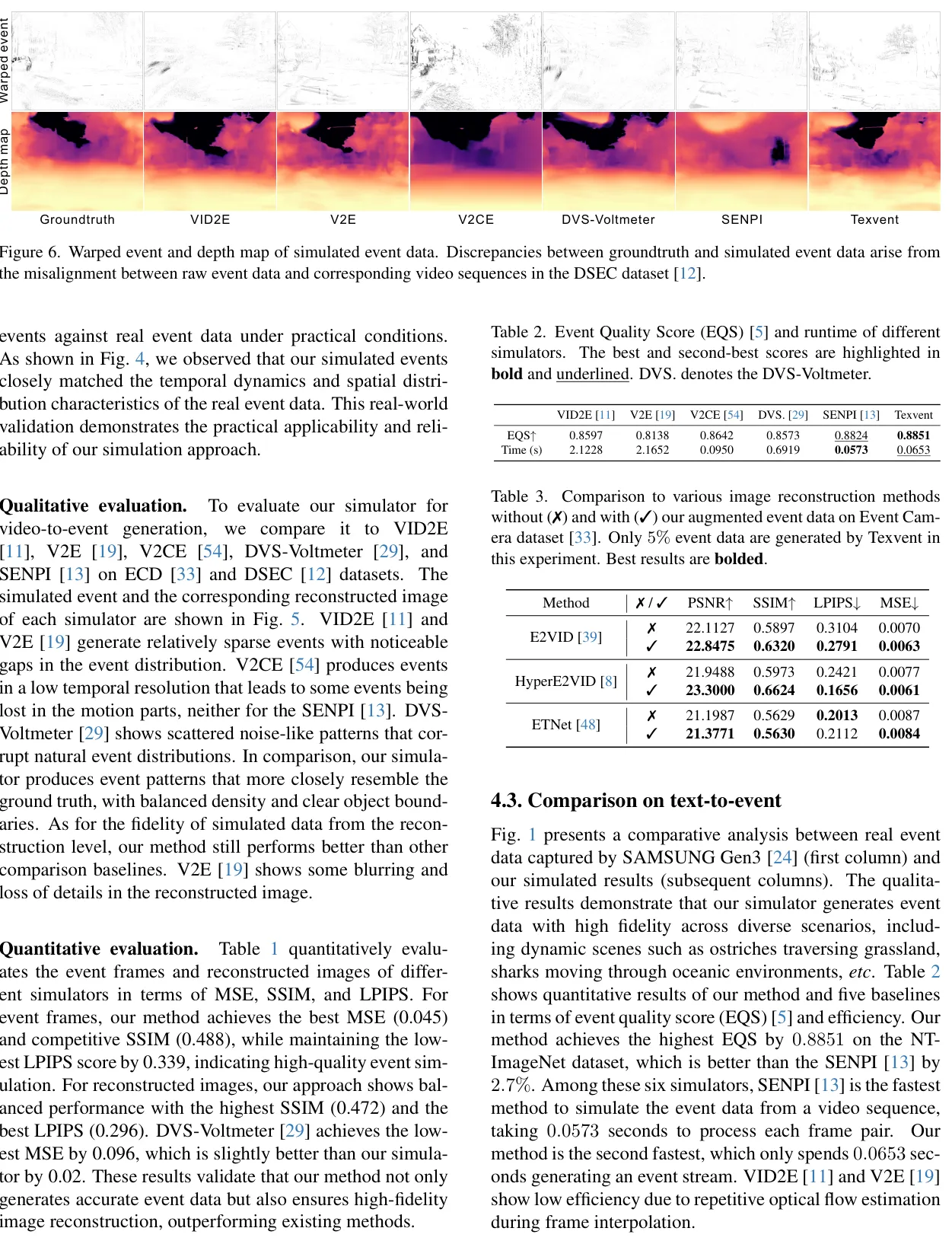
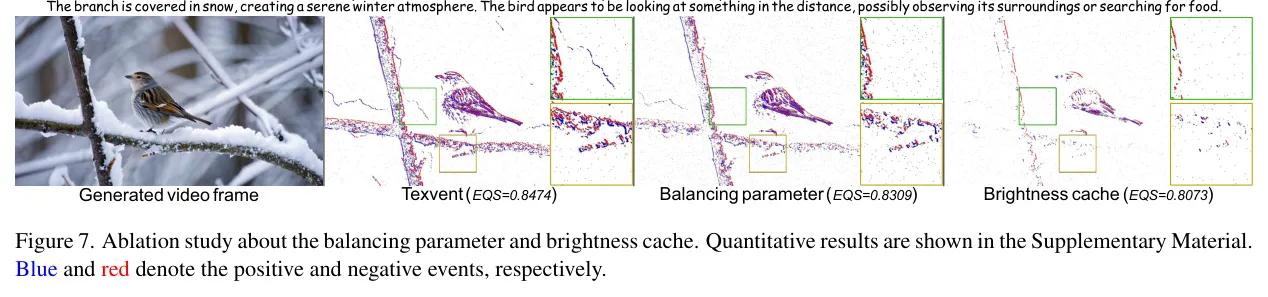
Fig.7 消融(EQS):full 0.8474 → 去 balancing \(\alpha\) 降到 0.8309(原文:"The EQS is decreased from 0.8474 to 0.8309")→ 去 brightness cache 降到 0.8073,原文:"resulting in a substantial EQS drop of 4.01%, showcasing the importance of our brightness cache." 故 cache 是防丢事件的关键(掉最多)。depth/warped-event(Fig.6):Texvent "The warped events are the cleanest and most sharply aligned, with minimal ghosting",深度图近远分离最清晰。
⑮ 疑问 / 局限 [推测]
① 摘要/正文「比 SENPI 高 2.7%」与 Tab.2 数值(0.8851 vs 0.8824 ≈ +0.3%)对不上,口径原文未交代;② 式4「\(\max(\cdot)\ \mathrm{mod}\ \delta\)」的取整/量纲细节正文未细说[推测];③ \(\alpha,\sigma,\lambda_1,\lambda_2,\gamma\) 等超参具体取值需查 Supplementary(正文只给定性);④ 依赖 MLLM 视频生成器质量,T2V 失真会直接传导到事件流[推测];⑤ 真实性评测主要靠 EQS 单指标,缺更多下游任务级 sim-to-real 验证。
📌 全文一页总结(≥3 takeaway)
problem:事件数据难采,video-to-event 贵且扩展差,已有 T2E 要训练、不通用;朴素级联又低效(光流)低保真。method:training-free 两阶段——MLLM 出视频 + brightness-aware 插值(亮度定插帧数、省双向光流);物理 simulator 三补丁(balanced log \(\alpha\) 平衡高/低光、brightness cache \(\kappa\) 防丢事件、Poisson BA 噪声 + dense µs 时间戳)。experiment:video-to-event 事件帧 MSE 0.045/LPIPS 0.339 最好;text-to-event EQS 最高 0.8851、速度第二(0.065s);5% 增广让 HyperE2VID PSNR +6.16%、LPIPS −31.6%;去 cache EQS 掉 4.01%。
takeaway:① 用 MLLM 把「文本→事件」打通、完全免训练,降低事件数据采集成本;② 把事件相机物理特性显式建进 simulator(log 响应不公平→\(\alpha\) 平衡、参考电压只在激活时更新→cache)才能高保真,这是 fidelity 的关键洞察;③ 用亮度变化代替光流定插帧数是效率主因(慢方法卡在反复光流);④ 仿真数据可作低成本增广源,小比例(5%)即显著提升下游重建。
🖼 论文原图(本地 PDF 截图,原文 caption 未改写)