CVPR 2026 Finalist
SocialNav: Training Human-Inspired Foundation Model for Socially-Aware Embodied Navigation
Ziyi Chen ⋅ Yingnan Guo ⋅ Zedong Chu ⋅ Minghua Luo ⋅ Yanfen Shen ⋅ Mingchao Sun ⋅ Junjun Hu ⋅ Shichao Xie ⋅ Yang Kuan ⋅ Pei Shi ⋅ Zhining Gu ⋅ Lu Liu ⋅ Honglin Han ⋅ Xiaolong Wu ⋅ Mu Xu ⋅ Yu Zhang
摘要 Abstract
Embodied navigation that adheres to social norms remains an open research challenge. Our SocialNav is a foundational model for socially-aware navigation with a hierarchical "brain-action" architecture, capable of understanding high-level social norms and generating low-level, socially compliant trajectories. To enable such dual capabilities, we construct the SocNav Dataset, a large-scale collection of 7 million samples, comprising (1) a Cognitive Activation Dataset providing social reasoning signals such as chain-of-thought explanations and social traversability prediction, and (2) an Expert Trajectories Pyramid aggregating diverse navigation demonstrations from internet videos, simulated environments, and real-world robots. A multi-stage training pipeline is proposed to gradually inject and refine navigation intelligence: we first inject general navigation skills and social norms understanding into the model via imitation learning, and then refine such skills through a deliberately designed Socially-Aware FlowExploration GRPO (SAFE-GRPO), the first flow-based reinforcement learning framework for embodied navigation that explicitly rewards socially compliant behaviors. SocialNav achieves +38% success rate and +46% social compliance rate compared to the state-of-the-art method, demonstrating strong gains in both navigation performance and social compliance. Data and code will be made publicly available.
📝 精读笔记
灵魂一句
把“懂社会规范”和“走出合规轨迹”拆成 hierarchical brain-action 两层:Brain(VLM, Qwen2.5-VL-3B)做高层语义推理→出 CoT 解释 + 社会可通行区 polygon;Action Expert(conditional flow-matching DiT)吃 Brain 的 last-layer 语义特征 Z_VLM→生成 socially-compliant 轨迹。配 7M SocNav 数据集(internet video + sim + real robot 三层金字塔 + 认知激活数据),三阶段训练(IL 预训练 → 真机 SFT → SAFE-GRPO 强化)。SAFE-GRPO 是首个 flow-based RL for embodied navigation。比 SOTA(CityWalker) +38% SR、+46% social compliance。
问题 & 动机
现有导航(GNM/ViNT/NoMaD/CityWalker)只盯 shortest-path + 避障,忽略 social compliance(乱穿马路 jaywalking、踩草坪、闯绿化带/禁区)。原文:“most existing approaches focus primarily on shortest-path planning and collision avoidance, while overlooking the social compliance essential to real-world deployment”。更深一层:即使示范数据隐含 social prior,纯 behavior cloning 学不到规范行为的因果结构——“behavior cloning fails to capture the causal structure underlying normative conduct”→ 需要 RL 让 agent internalize 规范背后的原则、而非表面模仿。
核心方法(brain-action + 三阶段)
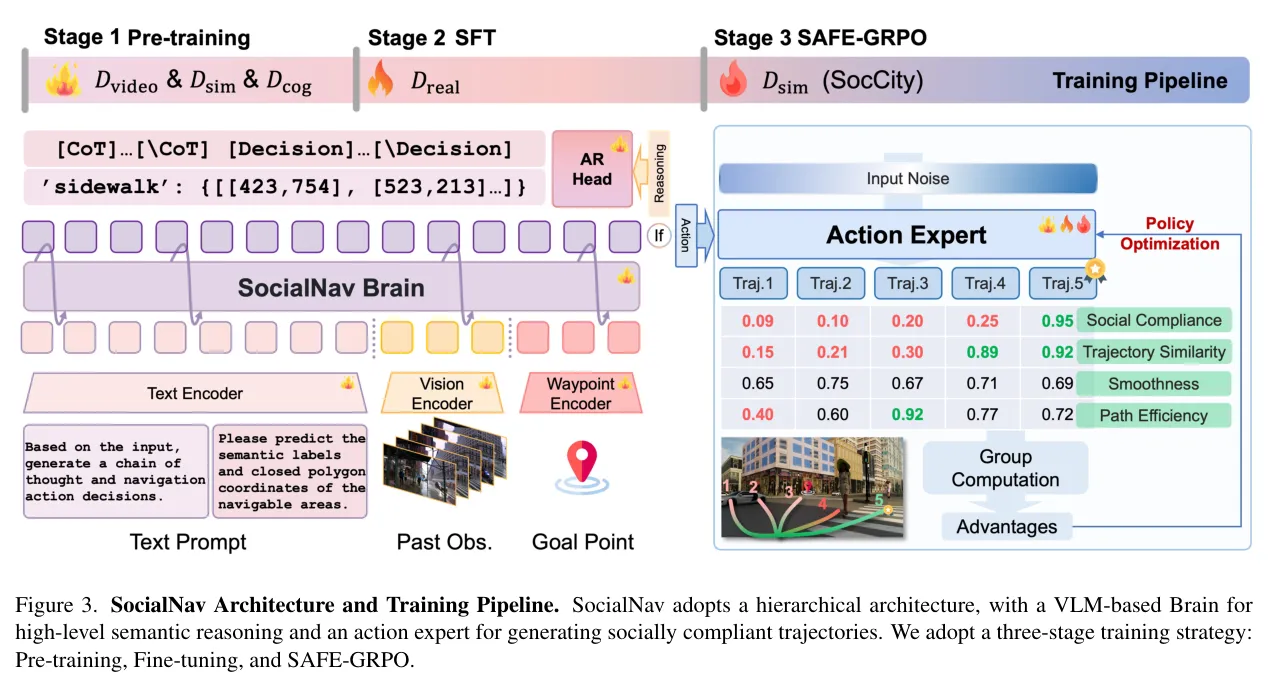
① Brain Module:VLM(Qwen2.5-VL-3B),autoregressive 文本推理,出 3 类可解释输出——socially traversable regions(polygon)、CoT reasoning、VQA。② Action Expert:conditional flow matching(DiT, L=12 / H=12 / D=1536, 去噪 K=5 步),A_{t+1:t+m}=π_flow(x_t,t; Z_VLM),Z_VLM=π_VLM(O,P,g)。③ 三阶段:Stage1 预训练(D_video+D_sim+D_cog, 全模型 e2e) → Stage2 SFT(D_real 真机, 冻结 VLM 只训 action expert, 缩 sim-to-real) → Stage3 SAFE-GRPO(SocCity, 只训 action expert)。
关键公式(SAFE-GRPO:ODE→SDE + 奖励)
把 flow policy 的确定性 ODE 转成 SDE 注入探索:dx_t = v_flow(x_t,t;Z_VLM)·dt + σ_t·dw_t(式4),σ_t 控探索幅度,随机性只在 flow integration、Z_VLM 语义条件全程固定(controlled + semantically grounded exploration)。总奖励 R = R_social + λ_expert·R_expert + λ_smooth·R_smooth + λ_eff·R_eff(式5)。R_social(主奖励)来自 occupancy map M_occ 的 Distance Transform:R_social=β·σ((d_pred−d_gt)/α),α=0.5, β=2.0(式11),鼓励轨迹保持 ≥ expert 的障碍 clearance(d 为路径平均 clearance)。
关键结果
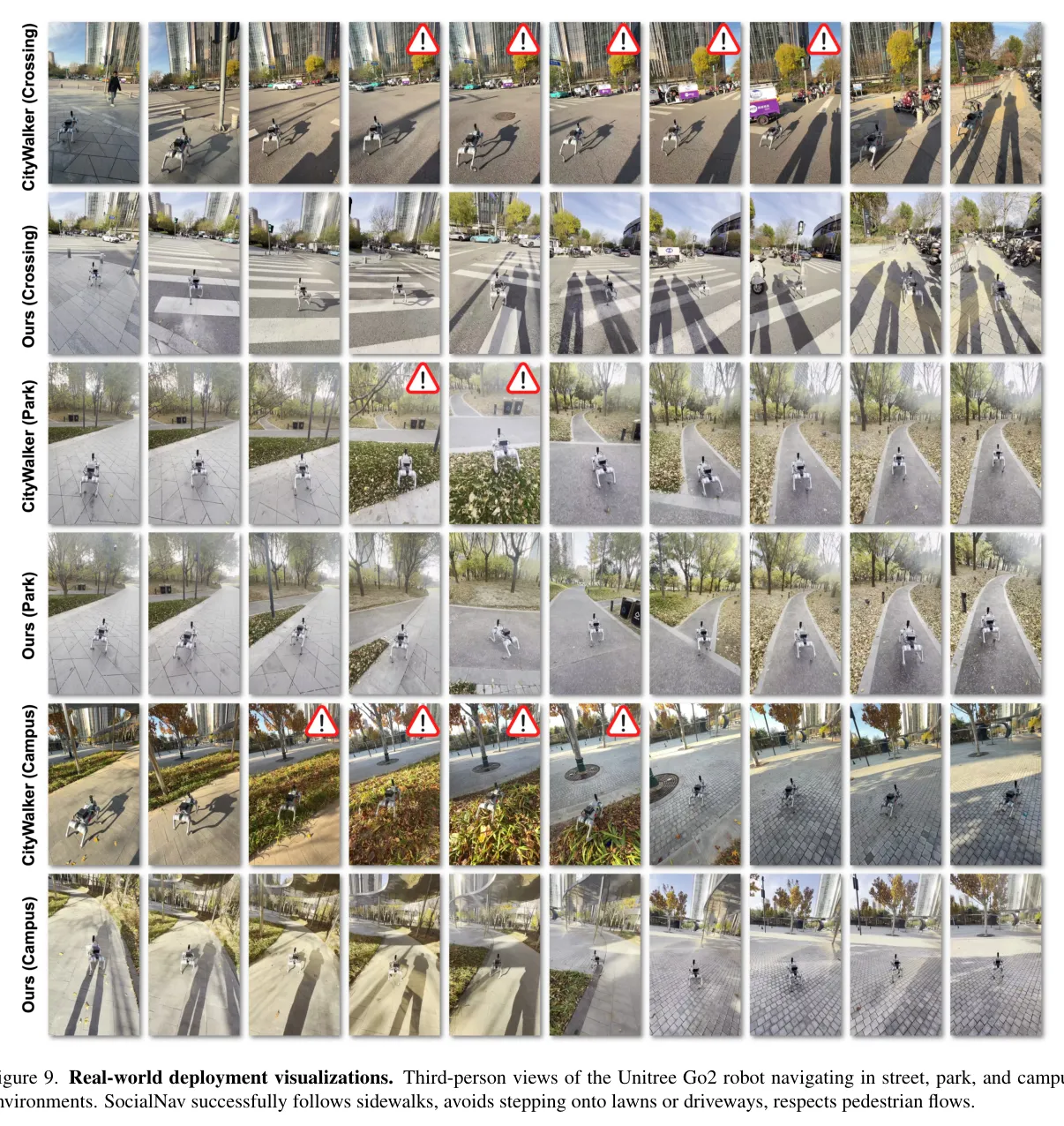
闭环 SocNav Bench(Tab.2):SocialNav(Full) SR 86.1/RC 91.2/SPL 77.4/DCR 82.5/TCR 82.9 vs CityWalker 47.8/64.7/44.7/36.1/36.6 → +38.3 SR、DCR/TCR 翻倍多。开环 CityWalker Bench(Tab.1, MAOE↓):Mean 10.2 / All 7.8,全场景最低(CityWalker 15.2/11.5)。真机(Tab.3):85.0 avg SR vs CityWalker 62.5,street crossing 18/20,>5Hz(A10)。
亮点
① SAFE-GRPO 首个 flow-based navigation RL,把 ODE→SDE 做受控探索;② D_cog 是 RL 的前提(Tab.4 No.5 vs No.6)——没有认知先验直接上 RL 反而掉 social compliance(DCR −1.7),有 D_cog 才达最佳;③ 7M 多源数据金字塔(2M video + 1.7M sim + 340K real) + SocCity/SocialGS 自建 3DGS 场景 + Isaac Sim 闭环 benchmark。
疑问 / 待查
① 式5 的 λ_expert/λ_smooth/λ_eff 顶层权重主文未给数值(只给了各子奖励内部超参 wd=0.7/wθ=0.3 等);② GRPO 的 group 大小 / advantage 归一化细节正文略,需查 appendix 与 Flow-GRPO 原作;③ Action Expert 的 conditioning 用 VLM last-layer feature,是否对 VLM 回传梯度——Stage1 全 e2e、Stage2/3 冻结 VLM(Tab.6)。
📖 逐段精读 · 笔记
深化精读(本地 PDF 全文 PyMuPDF 提取,正文 11 页 + supplementary 共 19 页,~69K 字符,含全部 Table 真实数值/Eq.1-16/三阶段超参/reward 设计)。最后更新 2026-06-23。verbatim 英文引用 + 中文指路,存疑标 [推测]。arXiv:2511.21135v2(Amap, Alibaba)。
① Abstract(摘要)— 逐句精讲
原文逐句:
1) “Embodied navigation that adheres to social norms remains an open research challenge.” —— 遵守社会规范的具身导航仍是开放难题。
2) “SocialNav is a foundational model for socially-aware navigation with a hierarchical ”brain-action” architecture, capable of understanding high-level social norms and generating low-level, socially compliant trajectories.” —— 分层“脑-动作”架构,既懂高层社会规范又出低层合规轨迹。
3) 数据:“SocNav Dataset, a large-scale collection of 7 million samples”,含 (1) Cognitive Activation Dataset(CoT 解释 + social traversability 预测)和 (2) Expert Trajectories Pyramid(聚合 internet videos / 仿真 / 真机轨迹)。
4) 训练:先 imitation learning 注入通用导航 + 社会规范理解,再用 “Socially-Aware Flow Exploration GRPO (SAFE-GRPO), the first flow-based reinforcement learning framework for embodied navigation that explicitly rewards socially compliant behaviors” 精化。
5) 结果:“+38% success rate and +46% social compliance rate compared to the state-of-the-art method”。
一句话抓 Abstract:VLM 当“脑”理解社会规范、flow matching 当“动作专家”出轨迹,靠 7M 认知+轨迹数据 IL 打底、再用首个面向导航的 flow-based RL(SAFE-GRPO)做社会规范对齐,SR +38%、社会合规 +46%。
📚 背景知识(外部,非本文原文)
① Point-goal navigation:给 2D 目标点 g,用历史观测 + 位置预测未来动作序列(非语言指令导航)。
② Flow matching [21]:学速度场把噪声沿 ODE 流到数据分布,能建多峰动作分布;VLA 模型(π0/π0.5)常用它做动作生成,但多停在 behavior cloning。
③ GRPO / Flow-GRPO [23]:GRPO(DeepSeek 系)= group-relative policy optimization,组内相对优势做 RL;Flow-GRPO 把 flow 的确定性 ODE 转成随机 SDE 注入探索,做在线 RL 对齐人类偏好。本文 SAFE-GRPO 据此扩展到导航 + 社会奖励。
④ 3DGS [18]:3D Gaussian Splatting,实时高保真渲染;本文用它重建大规模社会场景。
⑤ Isaac Sim [27]:NVIDIA 物理仿真;本文把 3DGS 场景转 mesh 导入做碰撞反馈。
⑥ π3 [47] / MoGe [44]:前者做密集 3D 重建(permutation-equivariant),后者做单目 metric 几何估计;本文用它们把网络视频转成带尺度的伪轨迹。
⑦ VLA(vision-language-action):把感知-语言-动作统一的机器人模型;本文“脑-动作”是其层级化变体——VLM 推理与 flow 动作解耦但语义相连。
⑧ 对比基线:GNM [34]/ViNT [35]/NoMaD [40](端到端学习导航)、CityWalker [24](web 视频学城市导航,本文主对比)。
② §1 Introduction — problem(问题)
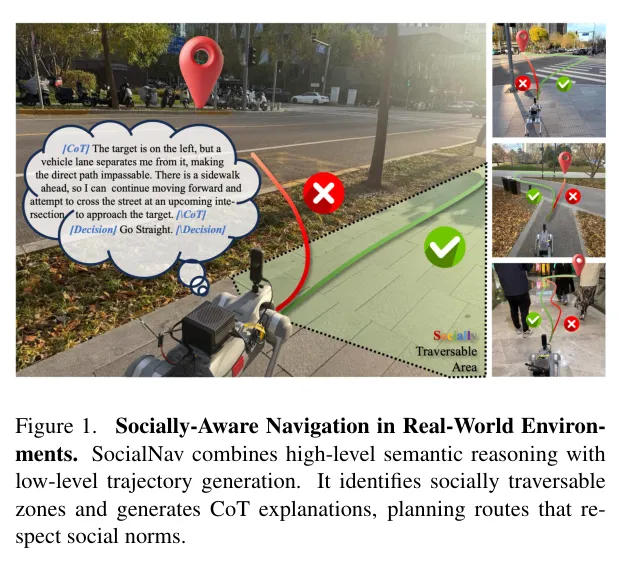
核心痛点(原文):“most existing approaches focus primarily on shortest-path planning and collision avoidance, while overlooking the social compliance essential to real-world deployment (e.g., a robotic guide dog).” —— 现有法只顾最短路 + 避障,忽略社会合规。
后果(原文):“trajectories that appear optimal from a geometric or efficiency perspective may still lead to socially disruptive or inappropriate behaviors, such as jaywalking and traversing restricted zones (e.g., landscaped lawns).” —— 几何最优却社会失当(乱穿马路、踏草坪)。
更深层(原文):“behavior cloning fails to capture the causal structure underlying normative conduct.” —— 即便示范里隐含社会先验,纯 BC 也学不到规范背后的因果结构。
③ §1 — solution(brain-action 闭环)
原文:“SocialNav consists of two core components: (1) the Brain Module, built upon a vision-language model (VLM), which encodes rich social navigation priors and is capable of generating interpretable chain-of-thought (CoT) explanations or explicitly predicting socially traversable regions; and (2) the Action Expert, based on conditional flow matching, which translates the semantic priors provided by the Brain Module into robot-executable trajectories that adhere to social norms.” —— 脑(VLM 出 CoT / 可通行区域)→ 动作专家(flow matching 把语义先验翻成可执行合规轨迹)。
数据 + RL 解法:建 7M 的 SocNav Dataset(CAD 认知 + ETP 轨迹),再用 SAFE-GRPO “enables agents to internalize the underlying principles governing social conventions, rather than merely mimicking surface-level actions”(内化规范而非表面模仿)。
④ §1 — why(为何脑-动作 + RL)+ 三大贡献
why(原文):“Without explicit comprehension of scene semantics and walkable areas, conventional RL agents struggle to formulate or discover socially-compliant behaviors solely from inefficient exploration and sparse rewards.” —— 没有“脑”提供的语义/可行区先验,普通 RL 靠低效探索 + 稀疏奖励学不出社会合规;故 SAFE-GRPO 的探索是 “controlled and semantically grounded”。
三大贡献:① SocialNav 基础模型(层级 brain-action,统一高层规范理解 + 合规轨迹生成);② SAFE-GRPO(首个面向具身导航的 flow-based RL,靠 norm-aware reward shaping 强制社会合规);③ SocNav Dataset & Benchmark(大规模认知-动作数据 + Isaac Sim/3DGS 高保真评测平台)。开/闭环 + 真机均超 SOTA。
⑤ §2 Related Work — 定位
Visual navigation:从 SLAM → 端到端(GNM/ViNT/NoMaD);扩语料用网络视频(CityWalker/MBRA)或仿真造规则合规轨迹;VLM 增强语义,但 “still struggle with high-level reasoning and alignment with human values in socially complex scenarios.”
Social nav & 偏好对齐:从手工 cost → VLM 推理,但 “VLM reasoning is often disconnected from low-level action generation.”(推理与动作脱节);flow matching 在 VLA 里建多峰动作但 “typically limited to behavior cloning”;纯 IL “lacks the causal understanding needed to robustly adapt to novel or dynamic social situations.” GRPO / Flow-GRPO 启发本文用生成模型 + 在线 RL 做偏好对齐。
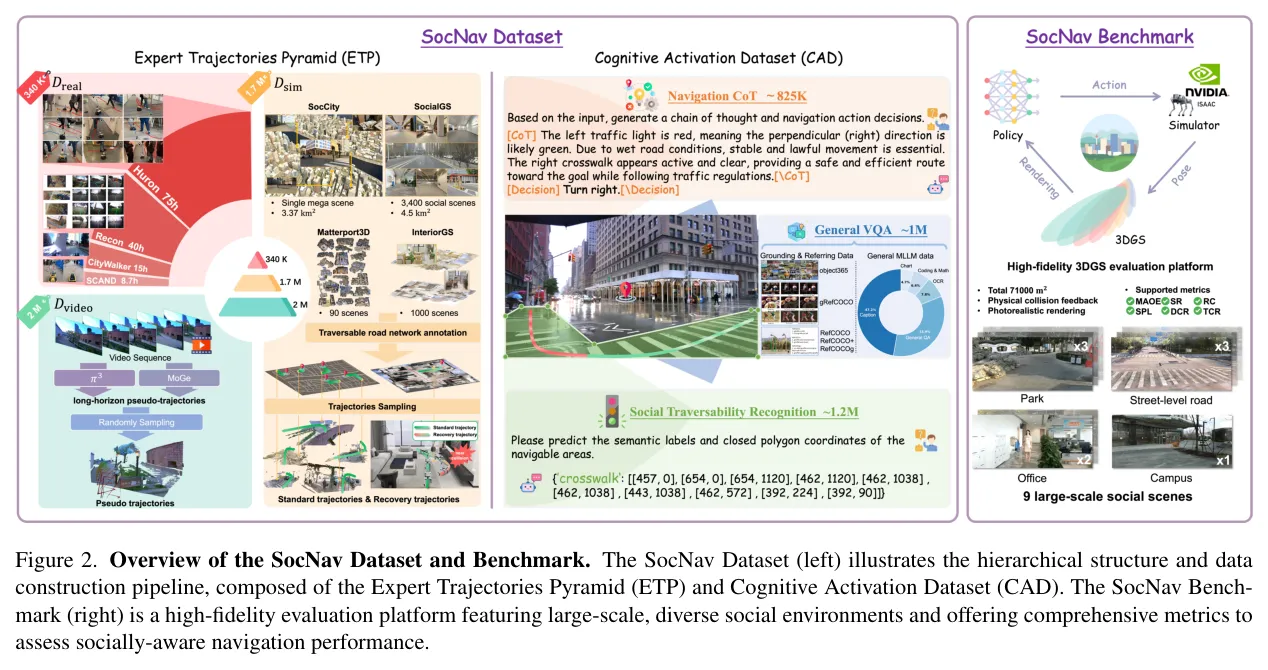
⑥ §3.1 SocNav Dataset — Expert Trajectories Pyramid(三层)
ETP(学运动先验,三层金字塔):
• \( D_{video} \)(2.0M 伪轨迹,基础层):从海量城市探索视频提取,经 (1) π3 [47] 密集 3D 重建 →(2) MoGe [44] metric scale 对齐 →(3) 沿重建路径采样 point-goal 伪轨迹,覆盖全球城市/天气/建筑风格。
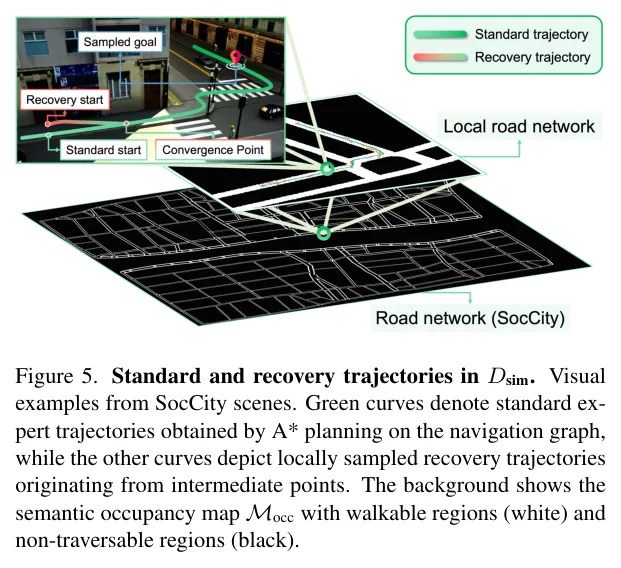
• \( D_{sim} \)(1.7M,中间层):4,490+ 高保真 3D 场景 + 大规模动态城市。两大自建:SocialGS(3,400 真实场景,4.5 km²,3DGS 重建,含商场/街道/办公)、SocCity(3.37 km² 动态城市,Isaac Sim 含车辆/行人)。轨迹在人工标注的可通行路网上生成,含标准导航 + recovery(近碰撞)场景。
• \( D_{real} \)(340K,顶层):真机轨迹(SCAND/Huron/Recon/CityWalker 遥操作),提供 ground-truth metric 精度、传感器一致性,用于 SFT 闭 sim-to-real gap。
⑦ §3.1 SocNav Dataset — Cognitive Activation Dataset(认知激活)
CAD(\( D_{cog} \),培养超越几何路径的空间认知):
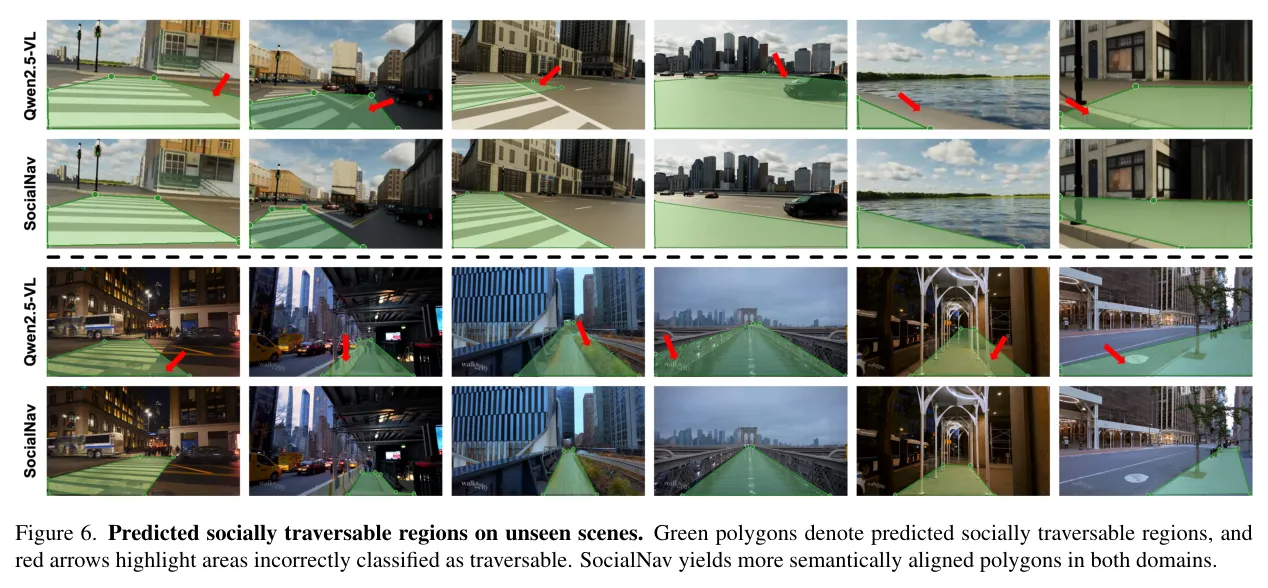
• Social Traversability Recognition:1.2M 样本,人工在第一人称图上对 “socially traversable regions(人行道/斑马线/公园小径)” 标多边形,教模型区分物理可行 vs 社会可行。
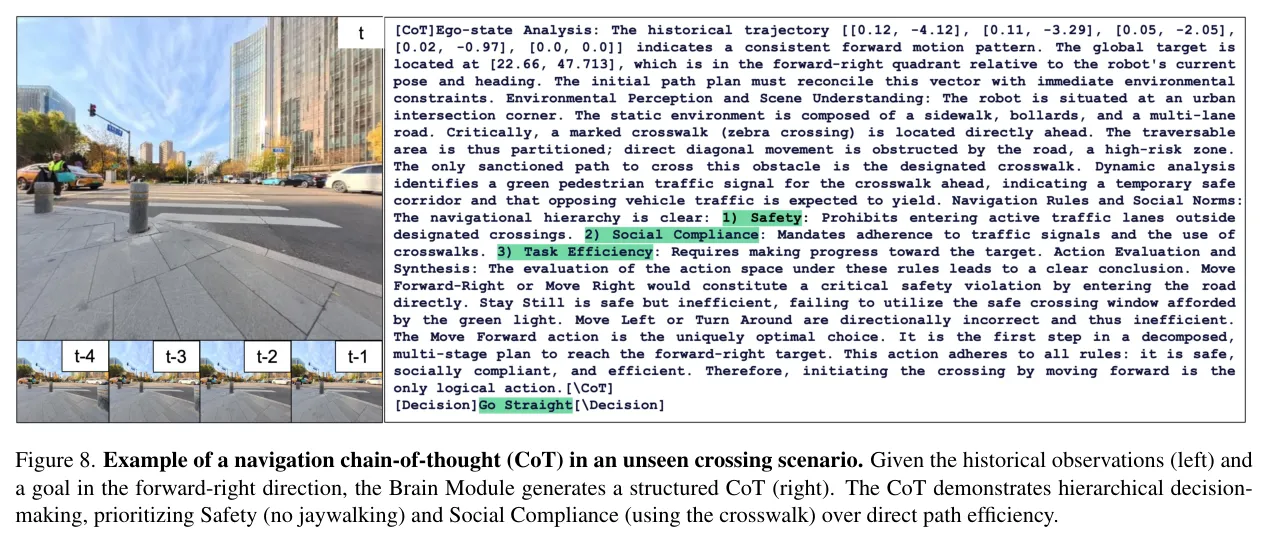
• Navigation CoT:825K 样本,用 Qwen2.5VL-72B 生成“逐步文字推理”教显式推理。
• General VQA:1M 样本(来自 COCO/Objects365 等),保通用世界知识、推理空间关系。
原文:ETP + CAD “unifying scale, realism, and cognition within a single, coherent data framework.”
⑧ §3.2 SocNav Benchmark
原文:“a unique blend of realism by combining the physics simulation of Isaac Sim with the photorealistic rendering of 3DGS.” 9 个新采集 3DGS 场景,共 73K m²:3 parks / 3 street-level roads / 2 offices / 1 campus。统一用 Unitree Go2 机器人 + 一致 locomotion policy;每个 3DGS 场景转 mesh 导入 Isaac Sim 做精确碰撞;随机引入 digital humans 模拟动态碰撞。每场景在 20m 和 100m 各采 10 个 start-goal 对 = 20 评测 case/场景。所有评测环境训练时未见(unseen)。
⑨ §4.1-4.2 问题定义 + brain-action 架构(Eq.1-3)
问题(Eq.1):history-conditioned point-goal nav,每步收最近单目观测 \( O_{t-n:t} \) + 2D 位置 \( P_{t-n:t} \) + 目标 \( g\in\mathbb{R}^2 \),学策略 \[ A_{t+1:t+m}=\pi_\theta(O_{t-n:t},P_{t-n:t},g) \] 默认 \( n=5,m=5 \)。
Brain Module \( \pi_{VLM} \):自回归文本推理,出 3 类可解释输出——socially traversable regions(多边形)/ CoT 推理 / VQA。
Action Expert(Eq.2-3):conditional flow matching,条件于 VLM 末层特征 \[ A_{t+1:t+m}=\pi_{flow}(x_t,t;Z_{VLM}),\quad Z_{VLM}=\pi_{VLM}(O_{t-n:t},P_{t-n:t},g) \] 原文:“decoupling high-level reasoning from low-level control while preserving a strong semantic connection between them.”(解耦但语义相连)
⑩ §4.3 三阶段训练(IL + SAFE-GRPO,Eq.4-5)
Stage 1 预训练(通用导航):在 ETP(\( D_{video}+D_{sim} \))+ \( D_{cog} \) 上端到端训,激活 VLM 导航能力 + 训 flow 预测 waypoint。
Stage 2 微调(真机):在 \( D_{real} \) 上微调,冻结 VLM,只优化 action expert,保语义/社会推理同时适配真实动态与尺度(sim-to-real)。
Stage 3 SAFE-GRPO(社会规范对齐):在 SocCity(\( D_{sim} \))上 RL。把 flow 的确定 ODE 转 SDE \[ dx_t=v_{flow}(x_t,t;Z_{VLM})dt+\sigma_t dw_t \] \( \sigma_t \) 控探索幅度;关键:randomness 只在 flow 积分时引入,VLM 的语义条件 \( Z_{VLM} \) 全程固定。奖励 \[ R=R_{social}+\lambda_{expert}R_{expert}+\lambda_{smooth}R_{smooth}+\lambda_{eff}R_{eff} \] \( R_{social} \) 为主,来自语义 occupancy map \( M_{occ} \),鼓励与不可通行区保持安全 clearance。
⑪ §5.1 评测指标(Eq.6-10)
MAOE(开环):Maximum Average Orientation Error,对每步预测取与 GT 动作的角度差 \( \theta_{ik}=\arccos(\langle\hat a,a\rangle/(\|\hat a\|\|a\|)) \),再对未来步取 max 后平均,强调最坏朝向失配。
SR:“reaching within 3 meters of the goal with fewer than three collisions”(3m 内且 <3 次碰撞)。
RC:route completion;SPL:success weighted by path length。
DCR(距离合规率,Eq.6/10):\[ DCR=\frac{d_{compliant}}{d_{actual}}\ (s=1),\ 0\ (otherwise) \] 成功时在社会可通行区行进的距离占比;TCR 同理换成时间。两者仅对成功 episode 计、再平均。
⑫ §5.3-5.5 主结果(Table 1/2/3 真实数值)
Table 1 开环 CityWalker(MAOE↓):
| 方法 | Mean | All |
| GNM | 16.2 | 12.1 |
| ViNT | 16.5 | 12.6 |
| NoMaD | 19.1 | 12.1 |
| CityWalker | 15.2 | 11.5 |
| SocialNav(Full) | 10.2 | 7.8 |
每个场景(Turn/Crossing/...)均最低,Turn/Crossing 提升最大(需社会布局理解)。
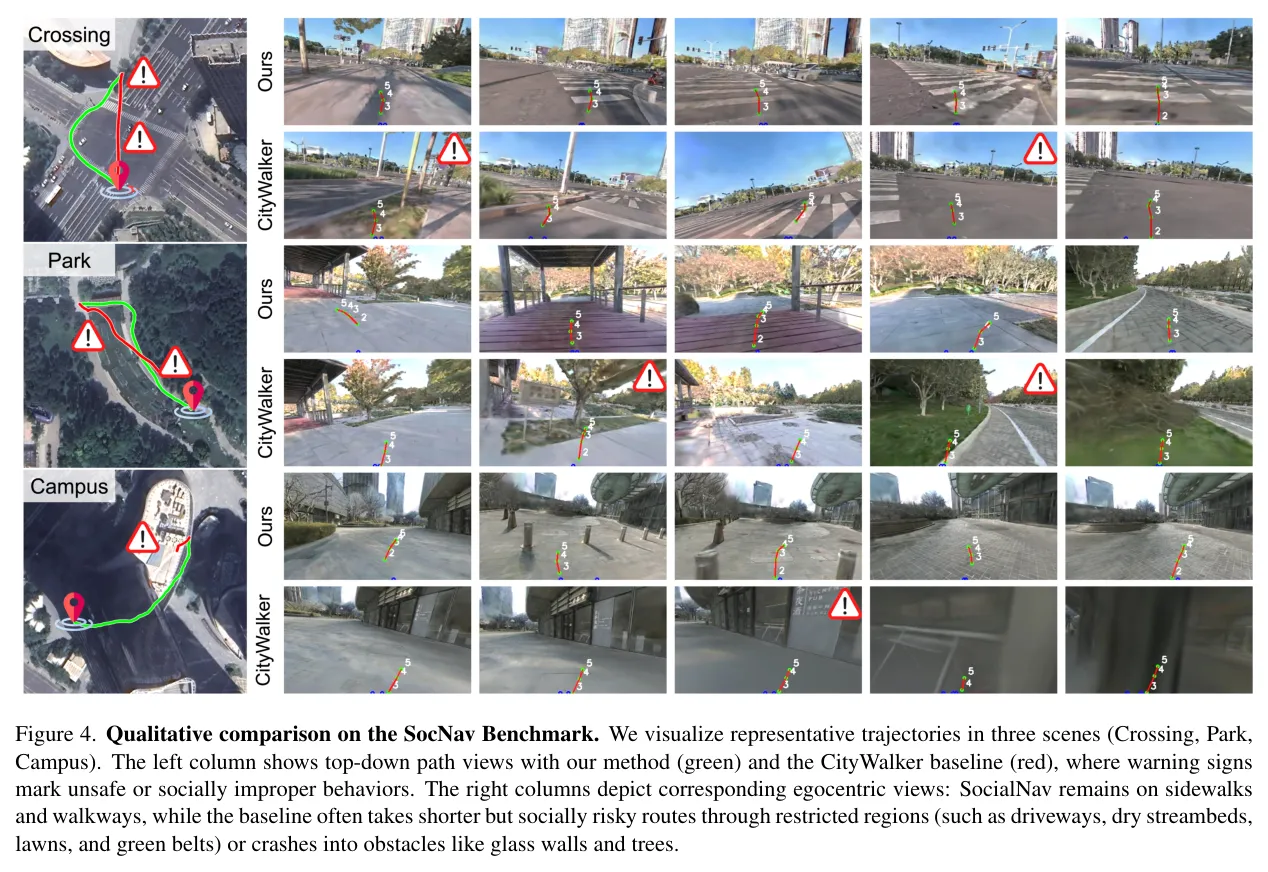
Table 2 闭环 SocNav(SR/RC/SPL/DCR/TCR):SocialNav(Full) 86.1 / 91.2 / 77.4 / 82.5 / 82.9,vs CityWalker 47.8/64.7/44.7/36.1/36.6 —— SR +38.3、RC +26.5、SPL +32.7;DCR/TCR 均超 CityWalker 两倍以上(+46.4/+46.3)。SocialNav*(仅 \( D_{real} \) IL)65.0/78.4/62.3/58.0/56.7 已超所有基线,证架构本身强。
Table 3 真机(Unitree Go2 + A10 GPU,>5Hz):SocialNav street 18/20、office park 16/20、mall 17/20,平均 SR 85.0,vs CityWalker 62.5、NoMaD 50.0。
⑬ §5.6 消融全表(Table 4 数据/阶段 + reward 消融)
Table 4(逐步加数据/阶段;SR / DCR / TCR):
| No. | 配置 | SR | DCR | TCR |
| 1 | SocialNav*(Dreal,IL) | 65.0 | 58.0 | 56.7 |
| 2 | +Dvideo | 76.7 | 62.9 | 64.6 |
| 3 | +Dsim | 82.2 | 69.8 | 68.2 |
| 4 | +Dcog(IL 全) | 84.4 | 78.2 | 78.4 |
| 5 | +RL(无 Dcog) | 80.0 | 68.1 | 66.9 |
| 6 | +RL(全数据) | 86.1 | 82.5 | 82.9 |
关键洞见:① +Dvideo SR +11.7;② +Dsim 加 recovery 轨迹 SR +5.5(鲁棒性);③ +Dcog 社会合规大涨(DCR +8.4/TCR +10.2)——认知知识是内化社会规则的关键;④ No.5 vs No.3/No.6:无 \( D_{cog} \) 直接上 RL 反而比纯 IL 还差(DCR −1.7/TCR −1.3)——RL 缺“脑”知识无法对齐社会规范;⑤ SAFE-GRPO(No.6 vs No.4)DCR 78.2→82.5、SR 84.4→86.1;⑥ SPL 79.4→77.4 微降——“socially compliant behaviors are often less geometrically direct”,刻意取人类化而非最短路。
supp Table 8 reward 消融:w/o \( R_{social} \) DCR 仅 61.4/TCR 62.1 vs Full 82.5/82.9 —— \( R_{social} \) 对社会合规至关重要。
⑭ supp B SAFE-GRPO reward 设计 + 模型超参
模型(supp Table 5):Brain=Qwen2.5-VL-3B(36 层/hidden 2048/MLP 11008/16(2) KV heads/SiLU+RMSNorm);Action Expert=Diffusion Transformer \( L=12,H=12,D=1536 \),action dim 2/chunk 5,flow-matching K=5 步去噪。
训练(supp Table 6-7):Pre-train 3 epoch / 96 H20 / batch 192 / lr 5e-5(全模块训);Finetune 32 H20 / batch 256 / lr 1e-5(只 action expert);SAFE-GRPO 16 H20 / rollout batch 128 / lr 5e-7。AdamW(β 0.9/0.95)、wd 0.1、cosine、BF16、Flash-Attn2。
Reward 细节(supp Eq.11-16):\( R_{social}=\beta\sigma((\bar d_{pred}-\bar d_{gt})/\alpha) \)(α=0.5,β=2.0,基于 \( M_{occ} \) 的 Distance Transform 平均 clearance);\( R_{expert}=w_d r_{dist}+w_\theta r_{dir} \)(\( w_d=0.7,w_\theta=0.3,\tau_d=1.0 \));\( R_{smooth}=\exp(-std/\alpha_s) \)(αs=0.8,惩罚步长方差);\( R_{eff}=\beta_l\sigma(\cdot) \)(αl=5.0,βl=2.0,比净位移)。recovery 轨迹:5cm 步插值 + 高斯扰动 \( \epsilon\sim N(0,(0.01m)^2) \) 治 covariate shift。
⑭b supp 定性:traversability 预测 + CoT 决策层级
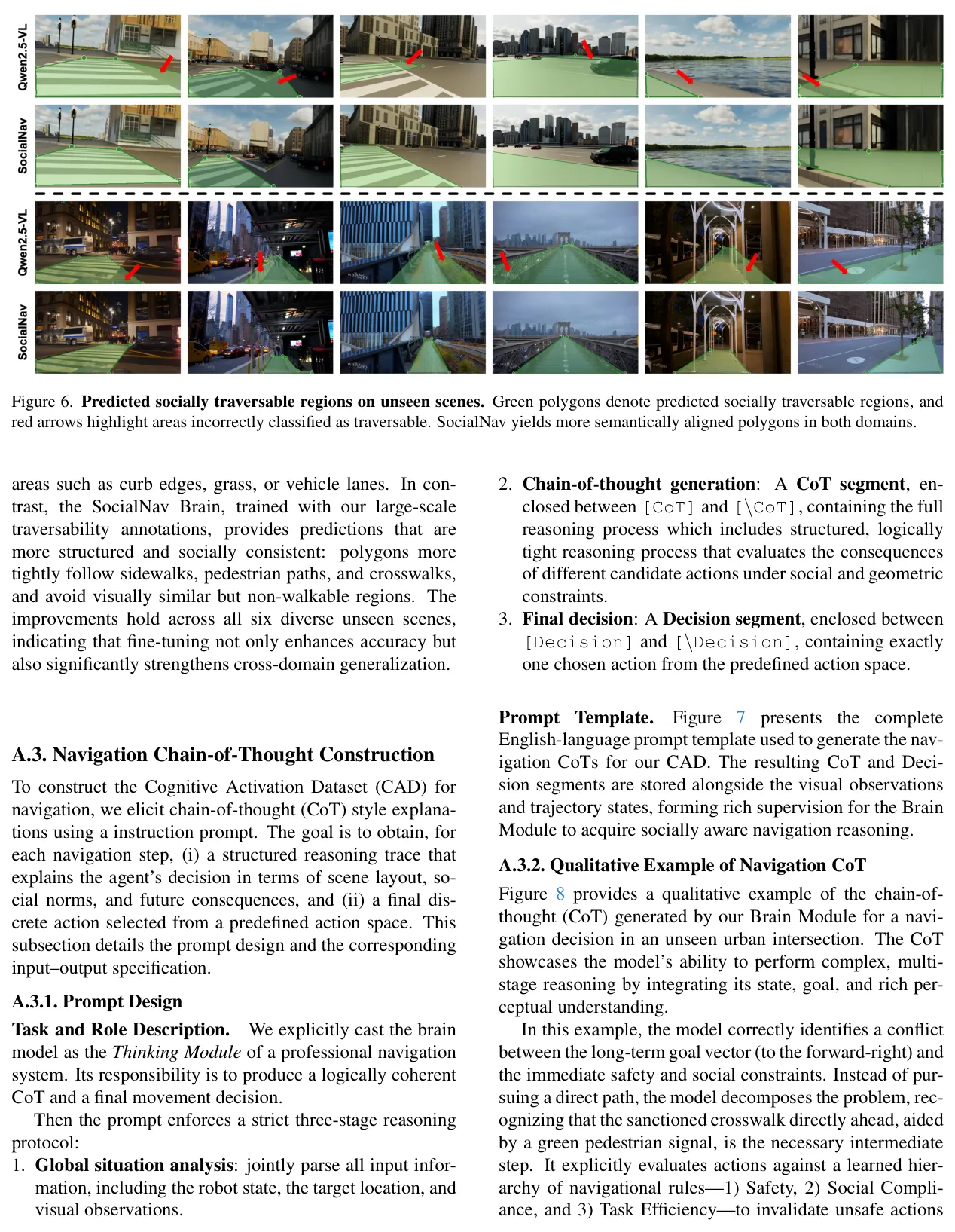
Social traversability 预测(supp A.2.3):在 6 个 unseen 场景上对比,base Qwen2.5-VL-3B 的多边形 “coarse, spatially misaligned, or leak into socially invalid areas such as curb edges, grass, or vehicle lanes”(粗糙/错位/漏进路缘、草地、车道);而经大规模 traversability 标注微调的 SocialNav Brain “polygons more tightly follow sidewalks, pedestrian paths, and crosswalks, and avoid visually similar but non-walkable regions”,且 6 个场景一致——“fine-tuning not only enhances accuracy but also significantly strengthens cross-domain generalization.”
Navigation CoT 决策层级(supp A.3):prompt 强制三步——Global situation analysis → CoT 生成([CoT]...[\CoT])→ Final decision([Decision]...[\Decision],从 7 个候选动作 Go Straight/Stay Still/Move Backward/Forward-Left/Forward-Right/Left/Right 选 1)。示例中模型在“目标在前右、但前方斑马线 + 绿灯”冲突下,按学到的规则层级 1)Safety 2)Social Compliance 3)Task Efficiency 否决 Move Forward-Right(不安全/jaywalking)与 Stay Still(低效),最终选 Go Straight 走斑马线——“not a simple reactive choice but the output of a deliberate plan”。
行人模型(supp A.4.2):行人在社会可通行区内边界 50-100cm 生成、密度 ≤6 人/100m,速度截断正态(均值 1.0 m/s、std 0.2),且不主动避让机器人,逼机器人主动适应。
⑮ 亮点 / 创新点
① 层级 brain-action:VLM“脑”出可解释 CoT/可通行多边形,flow“动作专家”出合规轨迹,解耦控制但语义相连,破“推理与动作脱节”;② SAFE-GRPO——首个面向具身导航的 flow-based RL,ODE→SDE 受控探索 + norm-aware 奖励,内化社会规范而非表面模仿;③ 7M SocNav 数据:ETP 三层(视频伪轨迹 2M + 仿真 1.7M + 真机 340K)+ CAD 认知(traversability 1.2M + CoT 825K + VQA 1M),统一 scale/realism/cognition;④ SocNav Bench:3DGS×Isaac Sim 高保真闭环 + DCR/TCR 社会合规新指标;⑤ 实证“认知先验是 RL 对齐社会规范的前提”(无 Dcog 的 RL 反而掉点)。
⑯ 疑问 / 边界 / 局限(原文 §6 + 推断)
① RL 范围有限(原文):“our reinforcement learning paradigm could be extended beyond semantic traversability to capture a broader range of context-dependent human conventions.”(仅语义可通行,未覆盖更广的情境化人类惯例);② 奖励手工(原文):“the current reward formulation relies on hand-crafted rules; integrating vision-language models to deliver richer, more adaptive reward signals” 是未来方向。③ [推测] social traversability 多边形标注靠人工 + VLM 过滤,标注口径(哪算“社会可通行”)影响上限;④ [推测] 真机仅 3 环境 × 20 trial,规模有限;⑤ SPL 因社会合规而微降,是合规 vs 最短路的固有取舍,非纯增益。
📌 全文一页总结(≥3 takeaway)
problem→method→experiment→takeaway:
problem:具身导航只顾最短路+避障、忽略社会合规(乱穿马路/踏草坪),且纯行为克隆学不到规范背后的因果。
method:① 层级 brain-action——VLM(Qwen2.5-VL-3B) 出 CoT/可通行多边形,flow matching(DiT) 出合规轨迹(Eq.1-3);② 7M SocNav 数据(ETP 三层轨迹 + CAD 认知);③ 三阶段训练(预训练→真机微调→SAFE-GRPO),SAFE-GRPO 把 flow ODE 转 SDE 做受控探索 + 社会奖励(Eq.4-5)。
experiment:开环 MAOE 10.2(最低),闭环 SR 86.1(+38.3)、DCR 82.5/TCR 82.9(超 CityWalker 两倍),真机平均 SR 85.0;消融证 Dcog 对社会合规与 RL 对齐都关键。
takeaway 1:“脑-动作”解耦让 VLM 的高层社会语义有效引导低层 flow 轨迹生成,兼得可解释性与合规性。
takeaway 2:flow-based RL(SAFE-GRPO)用 norm-aware 奖励能把社会规范从“表面模仿”推进到“内化原则”,但必须有认知先验(Dcog)托底,否则 RL 反而掉点。
takeaway 3:社会合规与最短路是取舍(SPL 微降换 DCR/TCR 翻倍),真实部署应优先人类化行为;高保真 3DGS×Isaac Sim 闭环 + DCR/TCR 指标为该取舍提供了可量化评测。
边界:RL 仅覆盖语义可通行、奖励手工、真机规模有限。
🖼 论文原图(本地 PDF 截图,原文 caption 未改写)