CVPR 2026 Finalist
SoccerMaster: A Vision Foundation Model for Soccer Understanding
Haolin Yang ⋅ Jiayuan Rao ⋅ Haoning Wu ⋅ Weidi Xie
摘要 Abstract
Soccer understanding has recently garnered growing research interest due to its domain-specific complexity and unique challenges.However, prior works typically rely on task-specific expert models, which are resource-intensive and hinder a holistic view of the game.This paper aims to propose a unified framework that enables a single model to handle diverse soccer visual understanding tasks, spanning both fine-grained perception (e.g., athlete detection) and semantic reasoning (e.g., event classification).Concretely, we make the following contributions in this paper:(i) we present **SoccerMaster**, the first soccer-specific vision foundation model that unifies comprehensive understanding tasks within a single framework via **supervised multi-task pretraining**;(ii) we consolidate multiple existing soccer video datasets and develop an automated data curation pipeline, termed as **SoccerFactory**, to produce scalable multi-task training annotations;and (iii) we conduct extensive experiments demonstrating that SoccerMaster consistently outperforms task-specific expert models across diverse downstream tasks, underscoring its breadth and superiority.The data, code, and model will be publicly available to the research community.
📝 精读笔记
灵魂一句
第一个「足球专用」视觉基础模型,用监督式 multi-task 预训练把足球理解的两类任务——细粒度空间感知(球员检测/球衣号/裁判角色/球场配准/相机标定/MOT)与高层语义推理(事件分类/视频-文本对齐/解说生成)——统一进单个模型。配套 SoccerFactory(自动数据标注流水线,从转播视频造大规模空间标注)。在所有预训练任务上超通用 VFM(SigLIP2/DINOv3)与足球专用 MatchVision,轻量微调即下游 SOTA。
问题 & 动机
原文:足球理解存在 spatial perception ↔ semantic reasoning 的 dichotomy。当前主流靠 fragmented task-specific expert model(费资源、无全局观);近期想用 vision-language alignment 统一但 “neglect dense spatial objectives during pretraining”——能说「发生了什么」却说不清「在哪/是谁」。且缺主相机视角的大规模 dense 空间标注。
核心方法 + 关键结构
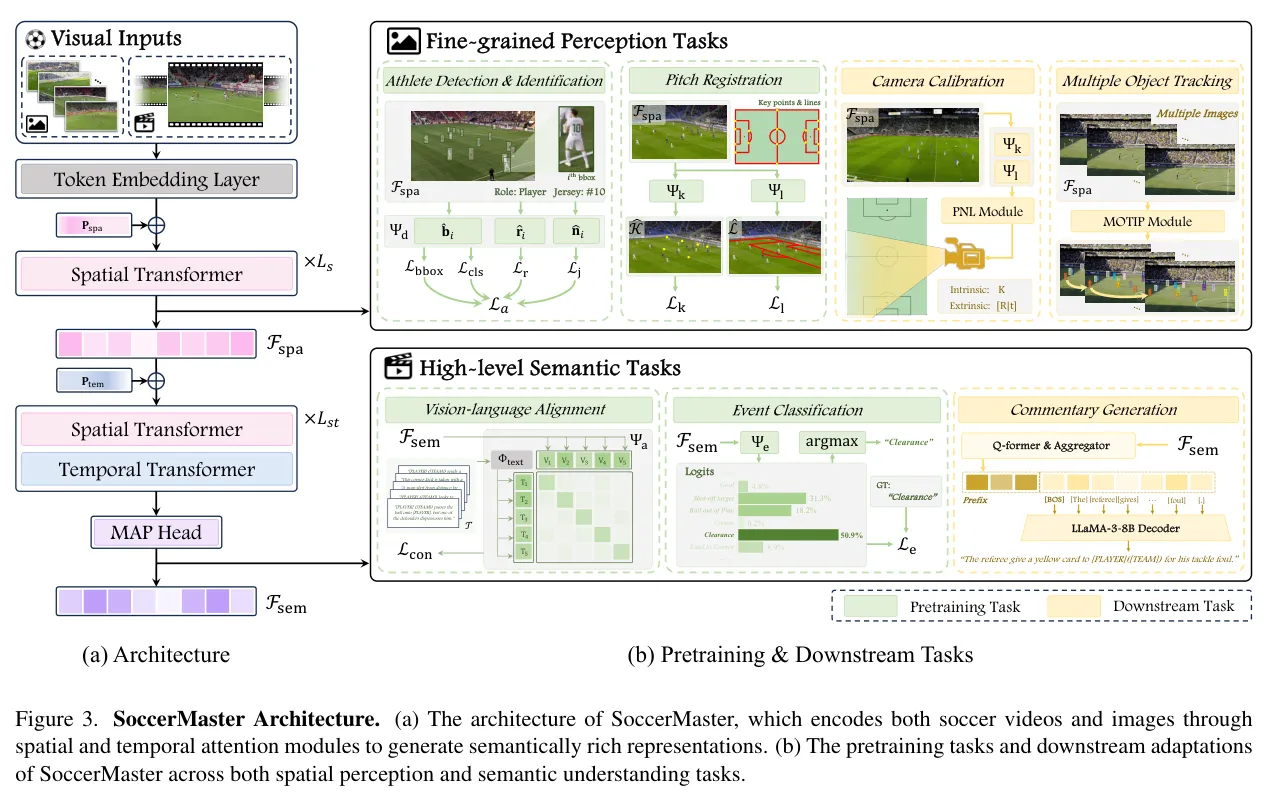
① 视觉编码器(§5.2):ViT + TimeSformer 式。前 Ls=16 层纯空间 attention(逐帧)→空间特征 Fspa(保细粒度);后 Lst=8 层时空 attention(交替 temporal+spatial)→MAP 注意力池化→语义特征 Fsem。d=1024, T=30 帧, 512², 从 siglip2-large 初始化。
② 多任务预训练头(§5.3):athlete detection Ψd(Deformable-DETR decoder,La=λ·(cls+bbox+role+jersey focal))、pitch registration Ψk/Ψl(heatmap+PixelShuffle, MSE)、event cls Ψe(2 层 transformer+avgpool+CE)、VL alignment Ψa(avgpool Fsem 与 SigLIP2 text encoder 对齐, SigLIP 对比 loss);Ltotal=λa·La+λk·Lk+λl·Ll+λe·Le+λcon·Lcon(Eq.14)。
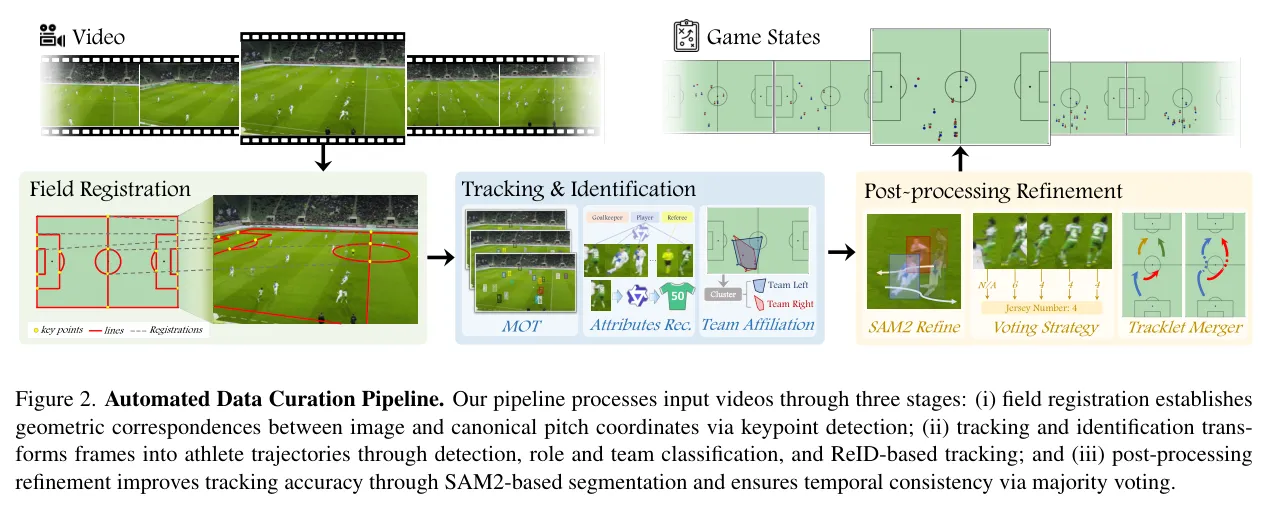
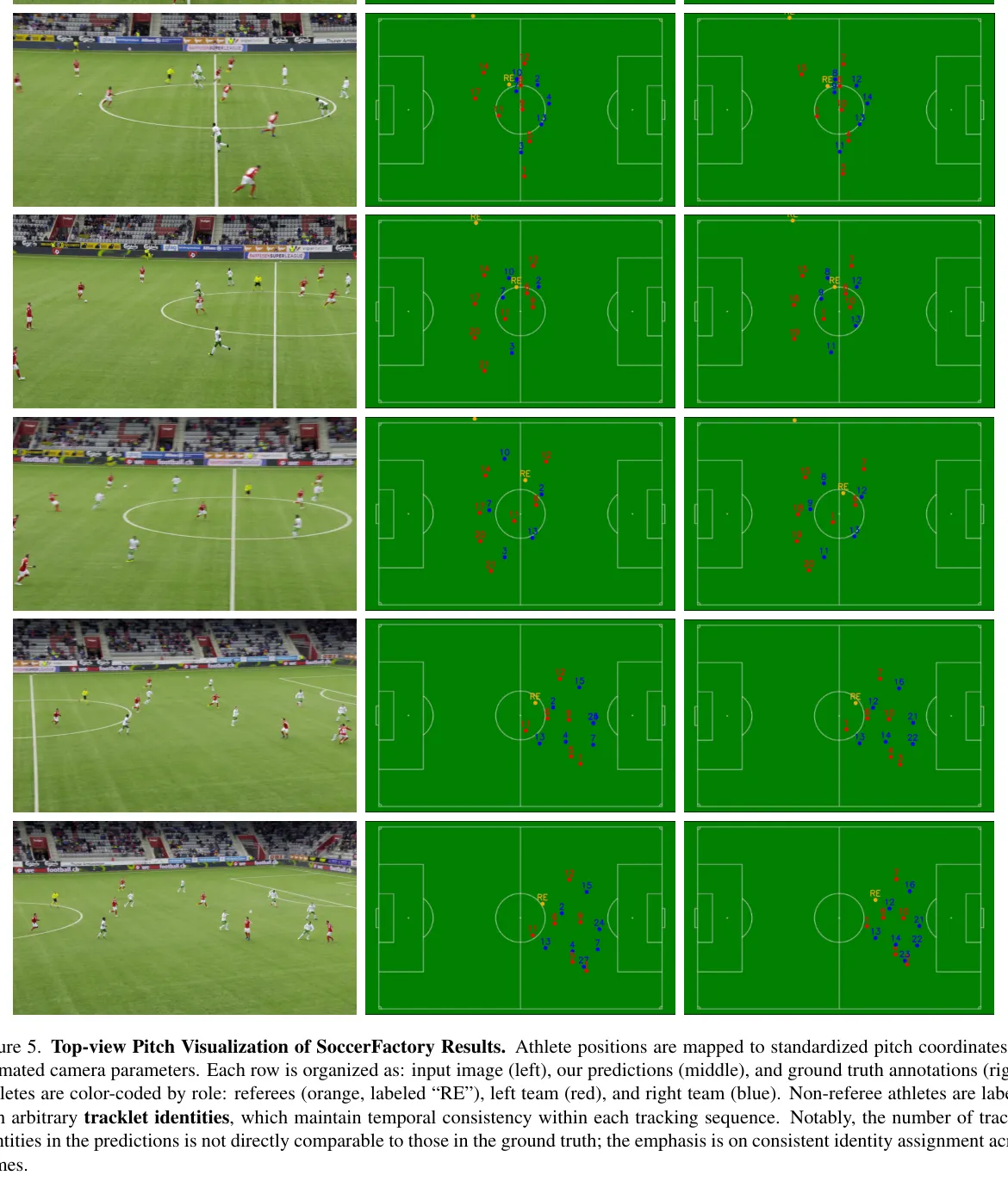
③ SoccerFactory(§4):field registration(keypoint/line→PnL→相机参数→投影 canonical pitch 精化标注) + tracking&id(YOLOv8 检测→StrongSORT+PRTReID 跟踪→Qwen2.5-VL 认 role/jersey→legibility 滤+team 聚类) + post-processing(SAM2 补漏/纠 ID switch + majority voting + tracklet 合并)。
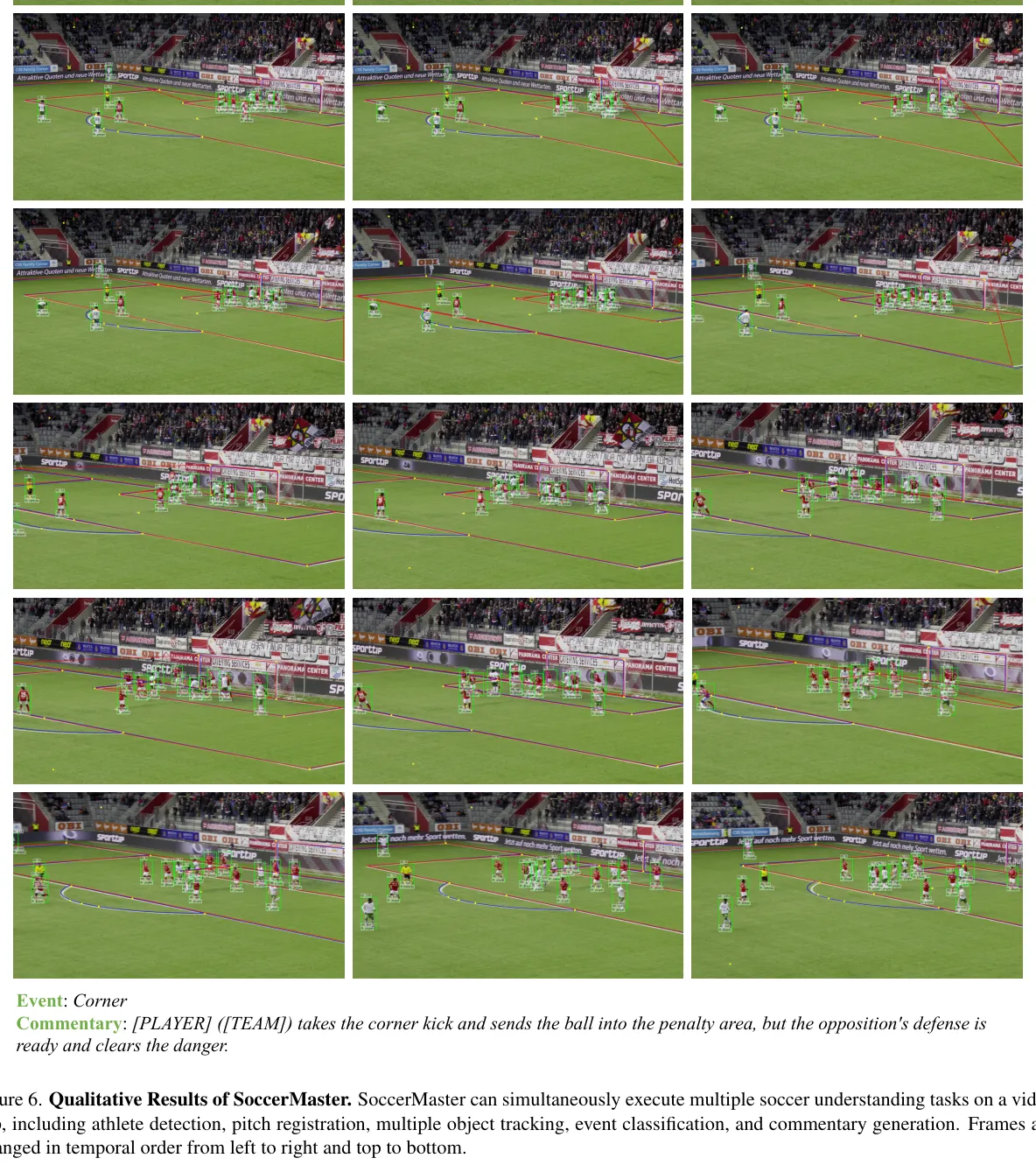
④ 下游(§5.4):commentary(Q-Former+Llama-3-8B)、camera calibration(PnL on 检测的 keypoint/line)、MOT(MOTIP,关联当分类)。
关键结果
预训练任务(Table 3,baseline 冻结编码器+训头 / Ours 直接评):athlete detection AP@50 91.5 vs SigLIP2 72.3/DINOv3 70.2/MatchVision 51.9,mAP +17.5;event cls 77.2 vs 65.3(+11.9);VL 对齐 top-1 39.0 vs SigLIP2 3.4(域差巨大)。下游:camera calib 微调 FS 75.8 vs PnlCalib 67.6(+8.2@SN22);MOT 端到端 HOTA 59.1/DetA 65.2(最佳)/MOTA 81.6;commentary BLEU@1 31.3/CIDEr 38.6 最佳。SoccerFactory 质量 GS-HOTA 64.1 > 挑战赛冠军 KIST-GSR 61.5。
亮点
① 第一个足球 VFM,把空间感知与语义推理「在预训练里联合」,破「会说不会指」的脱节;② SoccerFactory 全自动从转播造 dense 空间标注(质量超人工挑战赛冠军),省昂贵人工;③ 一个 backbone 微调即覆盖检测/跟踪/标定/事件/解说多任务;④ 消融(Table 12):足够容量下 multi-task ≈ single-task 单项性能、但额外得通用表示,VL 对齐还涨。
疑问 / 边界
① 限制(原文):jersey number 当 101 类分类、null 占绝大多数(类不均衡)、且与检测联合(非高分裁剪)→号码识别弱;② goalkeeper 常被误判为 player(样本少+守门服颜色方差大、缺关系推理);③ 仅做球员+球场,不含 ball detection/tracking;④ 训练成本高(16×H800 ~9 天);⑤ 多任务消融用 compact 变体时 athlete detection 反降(容量受限)——结论依赖「足够容量」前提。
📖 逐段精读 · 笔记
批量精读初稿(本地 PDF 全文 PyMuPDF 提取,~96K 字符,含 supplementary 数据/超参/全表/limitations)。最后更新 2026-06-21。
深化精读(本地 PDF 全文 PyMuPDF 提取,正文 13 页 + supplementary 共 24 页,~95K 字符,含全部 Table 真实数值/Eq.3-14/训练超参)。最后更新 2026-06-23。verbatim 英文引用 + 中文指路,存疑标 [推测]。arXiv:2512.11016v2。
① Abstract(摘要)— 逐句精讲
原文逐句:
1) “Unlike prior works that typically rely on isolated, task-specific expert models, this work aims to propose a unified model to handle diverse soccer visual understanding tasks” —— 反对“一任务一专家模型”的碎片化范式,目标单一统一模型。
2) “ranging from fine-grained perception (e.g., athlete detection and identification) to high-level semantic reasoning (e.g., event classification)” —— 任务谱跨细粒度感知 ↔ 高层语义推理。
3) 贡献三件套:(i) “SoccerMaster, the first soccer-specific vision foundation model that unifies diverse tasks within a single framework via supervised multi-task pretraining”;(ii) “an automated data curation pipeline, SoccerFactory, to generate scalable spatial annotations”;(iii) “SoccerMaster consistently outperforms task-specific expert models across diverse downstream tasks”。
4) “The data, code, and model will be publicly available.”
一句话抓 Abstract:首个足球专用视觉基础模型,靠有监督多任务预训练把检测/识别/注册/事件/对齐统一到一个视觉编码器;并配套 SoccerFactory 自动标注管线解决密集空间标签稀缺,下游简单微调即超各路专家模型。
📚 背景知识(外部,非本文原文)
① Vision Foundation Model(VFM):大规模预训练学通用视觉表征(CLIP/DINOv2/v3/SigLIP),再迁移到下游。本文把这套搬进足球视频这个高动态垂域。
② SoccerNet 系列 [10,11,13,20-22]:足球理解的基准基石,覆盖 action spotting、camera calibration、tracking、re-id、jersey 识别、game state reconstruction(GSR)等;但标注 “predominantly tailored for distinct, decoupled tasks”(各任务解耦)。
③ Deformable DETR [90]:用 learnable query + 注意力做端到端检测,本文检测头复用其 decoder。
④ TimeSformer [5]:把时空注意力拆成“先时间后空间”交替,省算力地建视频时序。
⑤ SigLIP 2 [65] / SigLIP loss [86]:sigmoid 对比损失的视觉-语言编码器;本文 backbone 用 siglip2-large 初始化,对齐头用 SigLIP loss。
⑥ PnLCalib [25]:用 points + lines 优化做球场注册→相机标定,本文注册头与标定下游都基于它。
⑦ GS-HOTA / HOTA:多目标跟踪综合指标(检测 DetA × 关联 AssA 的几何均衡);GSR 任务加“游戏状态”维度成 GS-HOTA。
⑧ MatchVision / UniSoccer [57]:前作足球视频统一模型,但偏语义、忽略密集空间目标(本文的主要对比对象)。
② §1 Introduction — problem(核心矛盾)
核心二分(原文):“A central dichotomy in soccer understanding lies between spatial perception and semantic reasoning.” 前者要 “fine-grained geometric precision”(检测/跟踪/jersey/标定),后者要 “high-level abstraction”(action spotting/事件/犯规/解说)。
现状之痛(原文):“Current paradigms predominantly rely on fragmented, task-specific expert models ... in isolation.” 即便有统一尝试 [UniSoccer],“they often neglect dense spatial objectives during pretraining. This omission results in models that can describe what is happening but struggle to pinpoint where or who is involved” —— 能说“发生了什么”却定位不了“在哪/是谁”,空间感知与语义推理脱节。
③ §1 — solution(统一框架闭环)
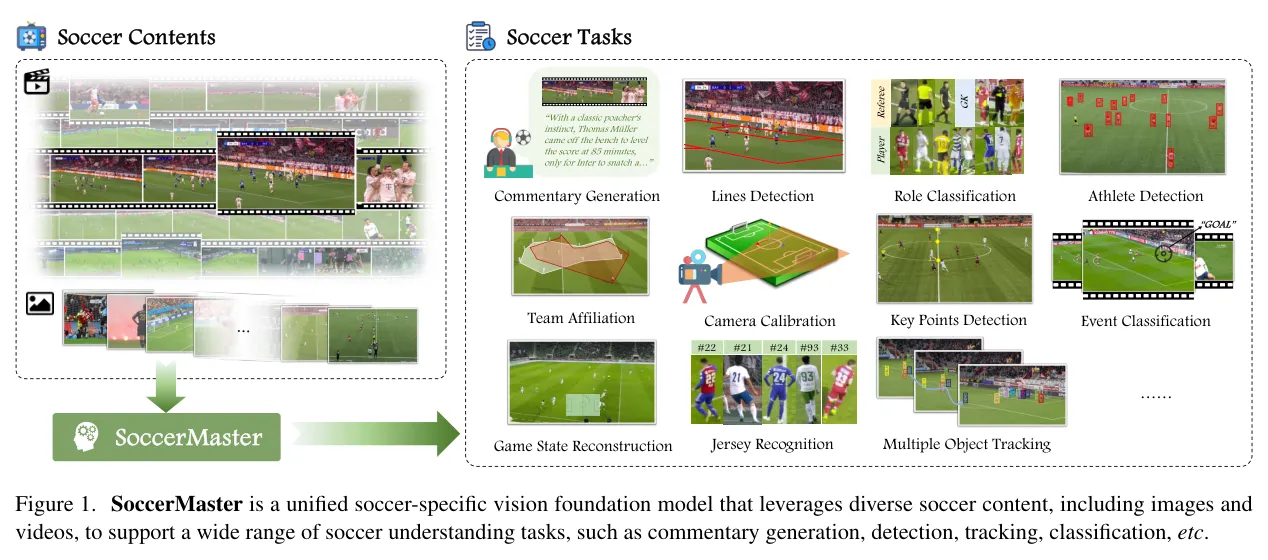
原文:“SoccerMaster, the first soccer-specific vision foundation model that unifies fine-grained spatial perception and high-level semantic representations within a single framework ... learn holistic representations through multi-task learning. By simultaneously optimizing for (i) athlete detection and identification, (ii) pitch registration, (iii) event classification, and (iv) vision-language alignment, we enforce a shared representation that captures both the geometry of the pitch and the semantics of the game.”
数据侧解法:“To address the scarcity of dense spatial labels, we develop SoccerFactory, an automated data curation pipeline capable of generating high-quality annotations from broadcast footage at scale.” 兼顾 breadth(事件/联赛/机位多样)与 depth(密集空间标签 + 时序精确语义)。
④ §1 — why(为何统一)+ 四大贡献
why(原文结果支撑):“SoccerMaster substantially outperforms both general-purpose vision foundation models (e.g., SigLIP 2, DINOv3) and soccer-specific models (MatchVision) across all pretraining tasks with direct evaluation. Moreover, with only lightweight task-specific fine-tuning, our model establishes state-of-the-art or competitive results on downstream applications” —— 证明学到了 “universal, transferable representations”。
四大贡献:(i) 首个足球专用 VFM,做统一 backbone;(ii) 有监督多任务预训练策略,联合优化细粒度空间感知 + 高层语义推理,学多粒度表征;(iii) SoccerFactory 自动从转播视频造大规模空间标注;(iv) 充分评测,简单微调即 SOTA / 有竞争力。
⑤ §2 Related Work — 定位
VFM 视频垂域:VFM 已在 captioning/3D/医学/机器人/自驾铺开,但 “their exploration in video domains, especially in highly dynamic and professional sports visual understanding, remains relatively nascent.”
Soccer datasets:SoccerNet 是 “the indispensable cornerstone”,但 “there remains a noticeable scarcity of large-scale datasets that provide dense, spatial annotations specifically from the main-camera perspective” —— 主机位密集空间标注稀缺,正是 SoccerFactory 的动机。
Soccer understanding:早期一任务一模型 “inevitably increases the exploration cost”;近期 MLLM 尝试 [56] “only focus on semantic-level tasks such as question-answering” —— 仍未打通空间+语义。
⑥ §3 任务定义(7 个任务 · 4 预训练 + 3 下游)
视频 \( V=\{I_1,...,I_T\} \),\( I_t\in\mathbb{R}^{H\times W\times 3} \)。
预训练任务:(i) Athlete det&id:每帧检测 \( a_i=(b_i;r_i;n_i) \),bbox \( b_i=(x,y,w,h) \)、role \( r_i\in\{goalkeeper,player,referee\} \)、jersey \( n_i\in\mathbb{N} \)(GK/ref 或遮挡时 \( n_i=null \))。(ii) Pitch registration:出 keypoints \( K_t \)(Eq.1,含坐标+类型)与 lines \( L_t \)(Eq.2,两无序端点+线型),类型集遵循 PnLCalib [25]。(iii) Event classification:预测 \( e\in\mathbb{E} \),\( \mathbb{E} \)=SoccerReplay-1988 的 24 类(goal/corner/yellow card…)。(iv) Vision-language alignment:视频语义特征与 SigLIP 2 文本特征在共享空间高相似度。
下游任务:(v) commentary generation(生成解说 \( \hat T \));(vi) camera calibration(估内参 \( K\in\mathbb{R}^{3\times3} \) + 外参 \( [R|t] \),以 pitch 注册为中间表示);(vii) MOT(在检测上加唯一 \( id_i \) 维持轨迹)。
⑦ §4.1 SoccerFactory 数据管线(3 阶段)
原文:“transform raw broadcast footage into structured annotations”,三阶段:
① Field registration:keypoint/line 检测器 → PnL module [25] 估相机参数 → 用 canonical pitch 投影回来精修关键点/线当训练标注。
② Tracking & identification:YOLOv8 [67](足球数据微调)检测 player/GK/referee → StrongSORT [15] + PRTReID [45] ReID 跟踪 → 每个 bbox 用 Qwen2.5-VL [1] 识别 role/jersey(再过 legibility classifier [30] 过滤)→ team affiliation 靠 tracklet 平均 ReID 嵌入 + pitch 坐标聚类。
③ Post-processing refinement:SAM2 [58] 分割补漏检/纠 ID switch;jersey/role 跨 tracklet majority voting 保时序一致;按 ReID + jersey 一致性合并短 tracklet。
产物:bbox+role+team+jersey、keypoints/lines、相机参数、pitch 坐标轨迹。
⑧ §4.2/§4.3 数据质量 + 组成
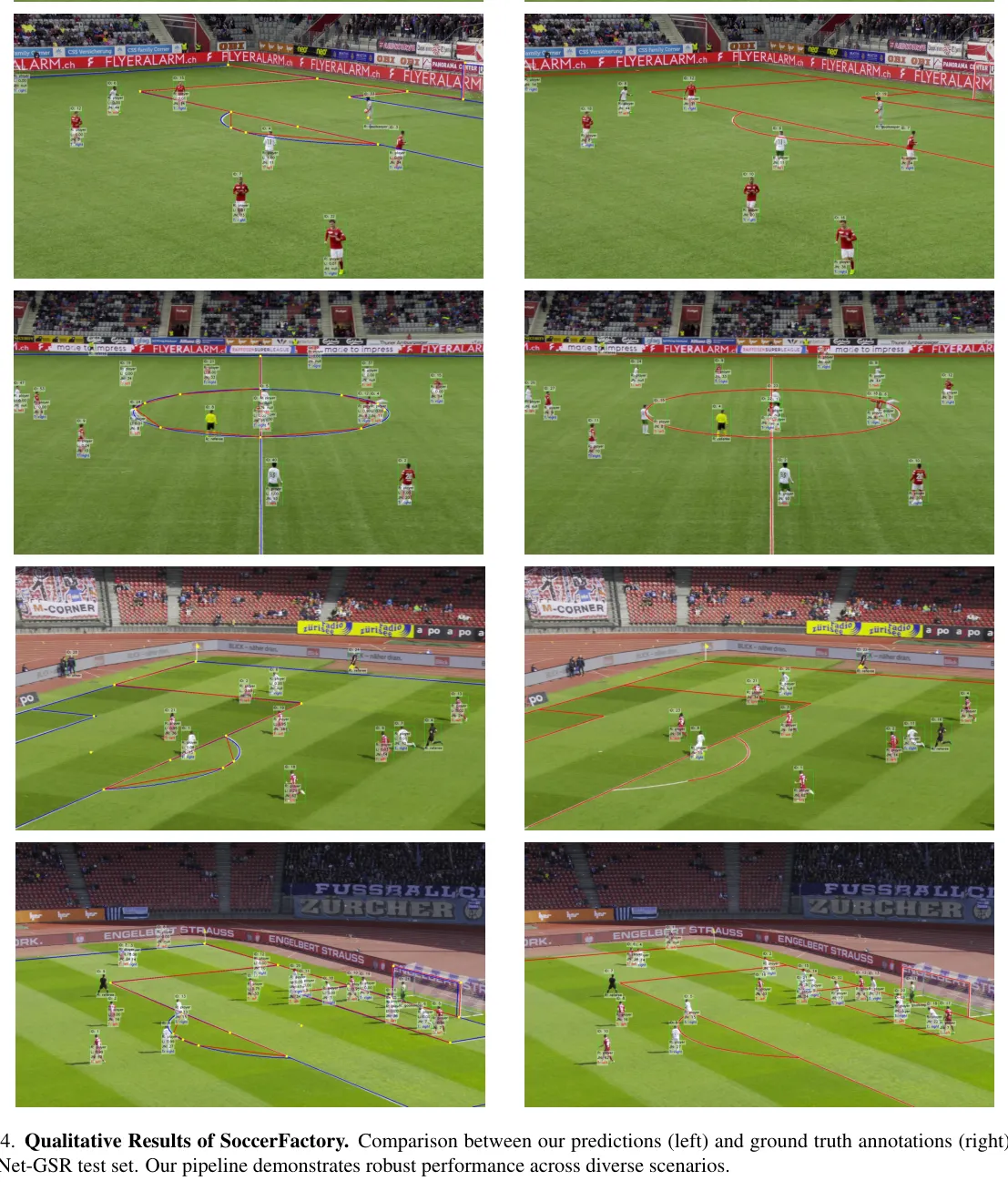
质量(Table 1,SoccerNet-GSR Challenge 测试集):SoccerFactory GS-HOTA 64.1 / GS-DetA 51.5 / GS-AssA 79.9,超挑战赛冠军 KIST-GSR(61.5/48.5/78.0)、Metrica-Sports(58.2)、Playbox&MIXI(58.1)—— “offering a practical alternative to expensive manual labeling”。
组成(Table 2):共 ~7.45M 帧 / 248.3K 视频段(2.75M 空间感知 + 4.71M 语义推理,语义任务 1FPS 采样)。来源:SoccerNet-GSR 42.8K + SoccerFactory-generated 2.7M(空间);SoccerNet-v2 1.6M + MatchTime 7.1K + SoccerReplay-1988 3.1M(语义)。空间数据来自 SoccerNet-v2 中 500 场主机位 clip(排除 replay/特写/其他机位)。
⑨ §5.2 视觉编码器架构(Eq.3-8)
整体(Eq.3-4):\( F=\{F_{spa},F_{sem}\}=\Phi_{enc}(V) \);所有任务输出 \( \{A,\{id_i\},K,L,\mathbf{K},R,t,e,\hat T\}=\Psi_{out}(F) \)。
结构:ViT [14] + TimeSformer-like [5],共 \( (L_s+L_{st}) \) 层。前 \( L_s \) 层只做空间注意力,最后 \( L_{st} \) 层做时空注意力(省算力)。三阶段:
(1) Token embedding:每帧切 N patch → d 维 + 空间位置嵌入 \( P_{spa} \),得 \( z^{(0)}\in\mathbb{R}^{T\times N\times d} \)。
(2) Spatial encoding(Eq.6):\( z^{(l+1)}_{t,i}=\text{SpatialAttn}(z^{(l)}_{t,i},\{z^{(l)}_{t,j}\}_{j=1}^N) \),帧内注意力、帧间无交换;输出 \( F_{spa}=z^{(L_s)} \) 保细粒度空间。
(3) Spatiotemporal(Eq.7-8):加时间位置嵌入 \( P_{tem} \),交替 \( \text{TemporalAttn}(z,\{z_{t',i}\}_{t'=1}^T) \)(同空间位、跨帧)与 SpatialAttn;末层经 MAP head(attention pooling) 得 \( F_{sem}=\text{MAP}(z^{(L_s+L_{st})})\in\mathbb{R}^{T\times d} \)。
⑩ §5.3 多任务预训练 heads + loss(Eq.9-14)
检测头 \( \Psi_d \)(Eq.9-10):Deformable DETR decoder-like,learnable query 与 \( F_{spa} \) 注意力 → 3 个线性头出 \( \hat b_i/\hat r_i/\hat n_i \);\( \mathcal{L}_a=\lambda_{cls}\mathcal{L}_{cls}+\lambda_{bbox}\mathcal{L}_{bbox}+\lambda_r\mathcal{L}_r+\lambda_j\mathcal{L}_j \)(role/jersey 用 focal loss [37])。
注册头 \( \{\Psi_k,\Psi_l\} \)(Eq.11):承 PnLCalib heatmap 法,CNN + PixelShuffle [61] 渐进上采样出 keypoint/line heatmap,MSE loss \( \mathcal{L}_k,\mathcal{L}_l \)。
事件头 \( \Psi_e \)(Eq.12):两层 transformer encoder + 时间平均池化 + 线性分类,\( \hat e=\Psi_e(F_{sem}) \),交叉熵 \( \mathcal{L}_e \)。
对齐头 \( \Psi_a \)(Eq.13):\( s=\Psi_a(F_{sem},\Phi_{text}(T)) \),SigLIP loss \( \mathcal{L}_{con} \) 对比学习。
总损失(Eq.14):\( \mathcal{L}_{total}=\lambda_a\mathcal{L}_a+\lambda_k\mathcal{L}_k+\lambda_l\mathcal{L}_l+\lambda_e\mathcal{L}_e+\lambda_{con}\mathcal{L}_{con} \)(权重见 supp Table 10:\( \lambda_{con}=4.0 \) 最大)。
⑪ §5.4 下游适配(3 任务)
Commentary:Q-Former [34] 对 \( F_{sem} \) 时序聚合 → 线性投到 Llama-3-8B [24] 嵌入空间当 prefix,自回归生成解说。
Camera calibration:基于注册头的 keypoints/lines,用 PnL refinement [25] 估内/外参。
MOT:承 MOTIP [19],把关联当分类:从检测头 DETR decoder 取 object 特征 + ID dictionary 的 learnable ID 嵌入拼成历史轨迹当 in-context prompt,ID decoder(transformer)对当前帧每个检测预测一致 ID。
⑫ §6.1/§6.2 实现 + 预训练任务结果(Table 3)
实现:\( L_s=16 \) 空间块 + \( L_{st}=8 \) 时空块,\( d=1024 \),\( T=30 \) 帧、512×512、patch 16×16,初始化 siglip2-large-patch16-512;预训练 16× H800、~9 天 float32、20 epoch、AdamW、grad clip 0.1。评测协议:baseline 冻结 encoder 只训轻量头,SoccerMaster 直接评(已预训练过这些任务)。
Table 3(frozen encoder + trainable head;Ours 直接评):
| Encoder | AP@50 | mAP | event acc | align top-1 |
| SigLIP 2(+data) | 72.3 | 32.0 | 49.8 | 3.4 |
| DINOv3(+data) | 70.2 | 28.0 | 51.8 | — |
| MatchVision | 51.9 | 17.0 | 65.3 | 4.0 |
| Ours | 91.5 | 49.5 | 77.2 | 39.0 |
原文:det&id +17.5% mAP、event +11.9% acc;alignment top-1 39.0 碾压(SigLIP2 仅 3.4,“severe domain gaps”;DINOv3 无文本编码器;MatchVision 4.0)。role 99.1 / jn 79.7 / keypoint acc 95.3 / line acc 95.7 也均最佳。
⑫b §B 训练细节(supp Table 9-11)
分层学习率(Table 9):backbone temporal-agnostic 5.0×10⁻⁵、temporal-related(zero-init 的时间注意力 + 时间位置嵌入)1.0×10⁻⁴、各 head 1.0×10⁻⁴,唯独 Line Detection Head 1.0×10⁻³(最大,因从零学)。原文:backbone 从 SigLIP 2 初始化、“zero-initialized temporal attention layers and temporal positional embeddings to enable temporal modeling while preserving the pretrained spatial features”。
多任务 loss 权重(Table 10):检测子项 \( \lambda_{cls}=2.0,\lambda_{bbox}=5.0,\lambda_r=2.0,\lambda_j=1.0 \);任务级 \( \lambda_a=\lambda_k=\lambda_l=\lambda_e=1.0 \),\( \lambda_{con}=4.0 \)(对齐权重最高)。原文为稳训练 “apply gradient normalization and clipping independently to the backbone and each task-specific head ... clipping the gradient norm to a maximum of 0.1”,防单任务主导。
数据增强(Table 11):几何(Random Affine 旋转 ±10°/平移 ±10%/缩放 [0.9,1.1]/shear ±5°、Random Perspective 0.3、Random Crop [0.6,1.0]、Horizontal Flip 0.5)+ 光度(Color Jitter brightness/contrast/saturation 0.4、hue 0.2、Gaussian Noise σ=0.02、Gaussian Blur)。采样:空间任务 25 FPS 取 30 连续帧,语义任务 1 FPS 单样本居中于事件时刻。
⑬ §6.2 下游结果(Table 4/5/6 真实数值)
Camera calibration(Table 4,@512×512):SN22-test-center:Ours* zero-shot FS 70.1 > PnlCalib 67.6;Ours† fine-tuned FS 75.8(+8.2)。SN23-test:Ours* 44.8(< PnlCalib 51.8,更难的非主机位),Ours† 56.2(+4.4)。注:PnlCalib 在原生 960×540 上 FS 78.6/60.9。
MOT(Table 5,SoccerNet-tracking):Ours+MOTIP HOTA 59.1 / DetA 65.2(best) / AssA 53.9(2nd)/ MOTA 81.6(best) / IDF1 74.6(best),且是唯一端到端方法(无独立检测器/ReID/后处理多阶段)。
Commentary(Table 6,SN-Caption-test-align):Ours BLEU@1 31.3 / BLEU@4 8.9 / CIDEr 38.6(均 best),超 MatchVision(30.9/8.7/35.7,CIDEr +2.9);METEOR 26.2 / ROUGE-L 26.6 略低于 MatchVision 但远超 SigLIP2。
⑭ §6.3/§D 消融全表(Table 7 / Table 12)
Table 7(SoccerFactory 数据增益;compact 变体 224×224/Ls=8/Lst=4):加管线生成数据后 athlete det +4.3 AP@50(82.0 vs 77.7)、+7.3 mAP(37.5 vs 30.2),其余任务稳定或微升 —— 证自动标注 “reliable and scalable”。
Table 12(多任务 vs 单任务;compact 变体):多任务把 alignment top-1 32.6→36.8(互补语义信号),但 athlete det 退化 AP@50 88.3→82.0 / mAP 43.8→37.5 —— 原文归因 “limited capacity of the compact variant”。关键反证:full-scale 单任务 vs 多任务仅 −0.3 AP@50 / −0.5 mAP(jn +0.8/role +0.1),证明容量够时多任务≈单任务且额外学到可迁移表征。
⑮ 亮点 / 创新点
① 首个足球专用 VFM,一个视觉编码器同时吃细粒度空间感知(检测/注册)与高层语义(事件/对齐),破“能说不能指”脱节;② SoccerFactory 自动标注管线(YOLOv8+StrongSORT+PRTReID+Qwen2.5-VL+SAM2+majority voting+tracklet merge),GS-HOTA 64.1 超人工标注挑战赛冠军,规模化造密集空间标签;③ ViT + TimeSformer 双特征 \( F_{spa}/F_{sem} \) 分层供检测/语义,前 16 层空间、后 8 层时空省算力;④ 下游轻量微调即 SOTA(标定 +8.2FS、MOT 端到端、解说 CIDEr +2.9);⑤ 实证“容量够时多任务不掉点还涨可迁移性”。
⑯ 疑问 / 边界 / 局限(原文 §F)
① Jersey number recognition:建模为 101 类(0-99 + null),“the null class dominates ... severe class imbalance”,且联合检测单次前向不如两阶段裁高分辨率 crop 准;② Goalkeeper classification:GK 样本少 + 球衣颜色跨联赛方差大,“difficult without relational reasoning that compares uniform colors across all detected athletes”(缺关系推理);③ 空间感知范围有限:“focuses exclusively on athlete detection and pitch registration, without considering ball detection and tracking”(不含球检测/跟踪)。[推测] compact 变体多任务掉点提醒:多任务收益强依赖模型容量,小模型慎用全任务联合。
未来:更强 tracking + 更严时序一致约束、引入 audio commentary / player statistics 等辅助模态、继续 scale 数据。
📌 全文一页总结(≥3 takeaway)
problem→method→experiment→takeaway:
problem:足球理解被“空间感知 vs 语义推理”二分割裂,碎片化专家模型成本高,统一模型又常忽略密集空间目标(能说不能指),且主机位密集空间标注稀缺。
method:① SoccerMaster——ViT+TimeSformer 视觉编码器(\( L_s=16 \) 空间 + \( L_{st}=8 \) 时空),出 \( F_{spa}/F_{sem} \) 双特征,5 个轻量头有监督多任务联合预训练(Eq.9-14);② SoccerFactory——自动标注管线造 2.7M 帧密集空间标签,凑成 7.45M 帧统一预训练集;③ 下游 commentary/calibration/MOT 轻量适配。
experiment:预训练任务全面超 SigLIP2/DINOv3/MatchVision(mAP +17.5、event +11.9、align top-1 39.0 vs ≤4);下游标定 +8.2FS、MOT 端到端 best DetA/MOTA/IDF1、解说 CIDEr +2.9;GSR 标注质量 GS-HOTA 64.1 超挑战赛冠军。
takeaway 1:有监督多任务预训练能把空间几何 + 语义统一进单一 backbone,且容量够时不牺牲单任务性能。
takeaway 2:自动数据管线(检测+跟踪+VLM 识别+SAM2 精修+投票合并)可规模化产出超人工的密集空间标注,是垂域 VFM 的关键供给。
takeaway 3:共享表征可迁移——一次预训练,下游只需轻量头微调即达 SOTA,大幅降低足球 AI 的工程开销。
边界:jersey 类别失衡、GK 误判、无球检测、小模型多任务掉点。
🖼 论文原图(本地 PDF 截图,原文 caption 未改写)