CVPR 2026 Finalist
Rethinking Dataset Distillation: Hard Truths about Soft Labels
Priyam Dey ⋅ Aditya Sahdev ⋅ Sunny Bhati ⋅ Konda Reddy Mopuri ⋅ R. Venkatesh Babu
摘要 Abstract
Despite the perceived success of large-scale dataset distillation (DD) methods, recent evidence \cite{qin2024a} finds that simple random image baselines perform on-par with state-of-the-art DD methods like SRe2L \cite{yin2024squeezerecoverrelabeldataset} due to the use of soft labels during downstream model training. This is in contrast with the findings in coreset literature, where high-quality coresets consistently outperform random subsets in the hard-label (HL) setting. To understand this discrepancy, we perform a detailed scalability analysis to examine the role of data quality under different label regimes, ranging from abundant soft labels (termed as SL+KD regime) to fixed soft labels (SL) and hard labels (HL). Our analysis reveals that high-quality coresets fail to convincingly outperform the random baseline in both SL and SL+KD regimes. In the SL+KD setting, performance further approaches near-optimal levels relative to the full dataset, regardless of subset size or quality, for a given compute budget. This performance saturation calls into question the widespread practice of using soft labels for model evaluation, where unlike the HL setting, subset quality has negligible influence. A subsequent systematic evaluation of five large-scale and four small-scale DD methods in the HL setting reveals that only RDED \cite{sun2024diversityrealismdistilleddataset} reliably outperforms random baselines on ImageNet-1K, but can still lag behind strong coreset methods due to its over-reliance on easy sample patches. Based on this, we introduce CAD-Prune, a compute-aware pruning metric that efficiently identifies samples of optimal difficulty for a given compute budget, and use it to develop CA2D, a compute-aligned DD method, outperforming current DD methods on ImageNet-1K at various IPC settings. Together, our findings uncover many insights into current DD research and establish useful tools to advance data-efficient learning for both coresets and DD.
📝 精读笔记
灵魂一句
一篇「打假/反思」论文:大规模 dataset distillation(DD) 的「成功」主要是 soft label(知识蒸馏) 的功劳,不是蒸馏出的数据质量。在 soft-label 评测下,数据的质量与大小几乎不影响性能——性能由 compute 决定且很快饱和到接近全量;只有 hard-label(HL) 下数据质量才真正起作用。据此提 DCS(零成本诊断指标,证明 trajectory-matching DD 不 scale) 和 CAD-Prune/CA2D(compute-aware,HL 下 SOTA)。
问题 & 动机
原文:Qin et al.[27] 发现 “simple random image baselines perform on-par with state-of-the-art DD methods like SRe2L ... due to the use of soft labels”。这与 coreset 文献矛盾(HL 下高质量 coreset 一贯超随机子集)。核心问题:“How does data quality, size and compute interplay ... under the SL+KD regime?”——soft label 到底把数据质量的作用稀释了多少?
三种 label regime(关键概念,先分清)
① HL(hard label):one-hot 标签 + 交叉熵。② SL(fixed soft label):teacher 给每图一个 soft label,训 student 时冻结。③ SL+KD:teacher 给每个 augmented image 一个 soft label(每图多个,cutmix 增强),等价于 knowledge distillation——大规模 DD(SRe2L 系)默认用这个评测。
核心方法 + 关键公式
① EL2N-SL(Def.1):把 EL2N importance 推广到 soft-label(KL loss):EL2N-SL(x)=(1/T)·E‖p(w_t,x) − q(w_t,x)‖₂(q=teacher soft 分布,T=温度)。
② DCS(Distillation Correlation Score):DCS(φ)=ρ({ℓ_Dtest(θ*_Sj)}, {L_distill(Sj,D)})(ρ=Spearman 秩相关)。把蒸馏 loss 与 downstream 泛化误差跨多个子集做相关——泛化误差只算一次可复用,零成本评估蒸馏目标好坏。
③ CAD-Prune:U_k(x)=连续 J 个 epoch 分数的标准差(uncertainty);CAD(x)=末端窗口 W 内 U_k 的均值(W=2, J=6@IN1K);关键=用 compute-aligned checkpoint(同 LR schedule)取「在该 budget 下还在被学」的样本。
④ CA2D:用 CAD-Prune 选合适难度样本 → RDED 式 crop/select/stitch patch 构 distilled set。
关键结果
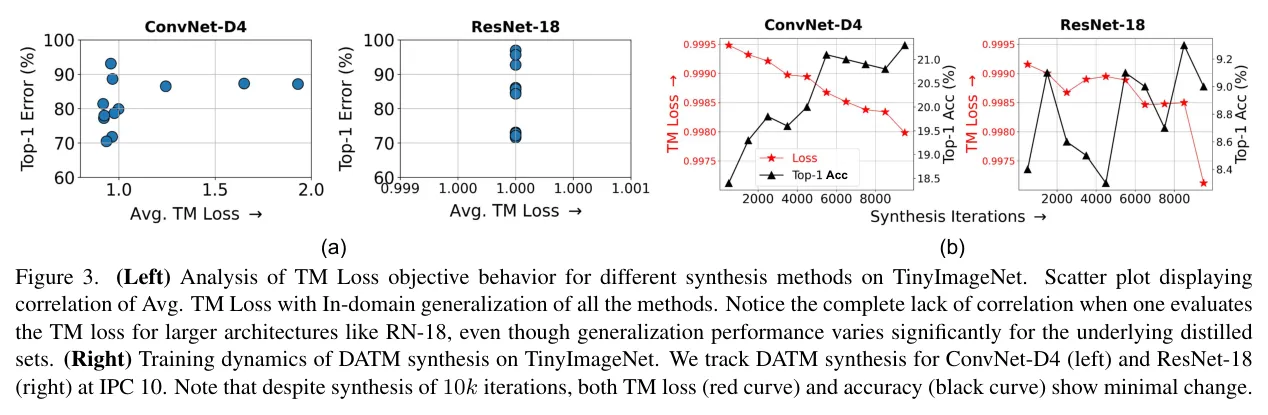
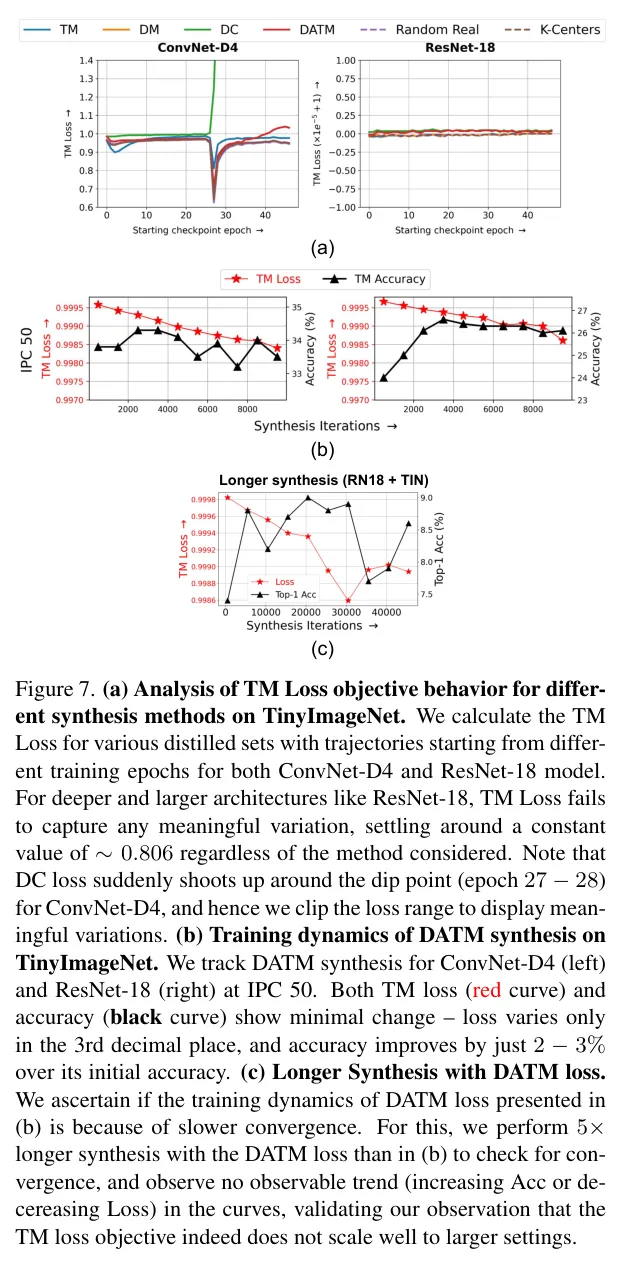
Table 1(IN1K, ResNet-18) 是杀手锏——HL 下差距大(IPC50:RDED 38.49 / EL2N-Best 38.06 / Random 28.52 / EL2N-Hard 7.00),到 SL+KD 全部塌缩(IPC50:SRe2L 52.58 / RDED 54.42 / Random 58.10 / EL2N-Best 59.16,random 甚至反超 DD!全量 62.50)。提出方法 HL 下:CA2D IPC50 41.72 vs RDED 38.49;CAD-Prune IPC50 40.21 vs EL2N-Best 38.44。DCS:TM loss 在 RN-18 上恒≈0.999(TinyIN≈0.806)、与泛化零相关,10k→50k 合成迭代 loss/acc 几乎不变。
亮点
① 直接挑战领域共识、给可操作建议:“we recommend eschewing ... the SL+KD setting for assessing DD methods”;② DCS 不用真合成+训练就能筛 distillation 目标(零成本诊断 + 可复用查找表);③ CAD-Prune 用「compute-aligned checkpoint + uncertainty 窗口」解决「固定难度分数跨 IPC 不泛化」,2–4× 省算力。
疑问 / 边界
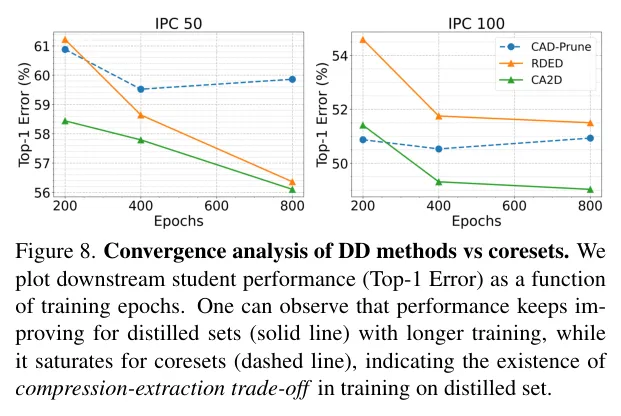
① “regardless of quality” 有边界(原文脚注 3):仍须属真实图像分布、IPC 须 > 极小值;② 主要限图像分类,多模态/其他任务未验(原文 future work);③ scaling law 拟合(附录C):SL+KD 下 random 与 EL2N 的 b≈0.05 几乎一致、HL 下 b 显著不同——量化了「soft label 抹平数据效用」;④ compression-extraction trade-off(附录H.3):distilled set 比 coreset 慢 ≥2× 才能榨干信息。
📖 逐段精读 · 笔记
批量精读初稿(本地 PDF 全文 PyMuPDF 提取,~96K 字符,含附录公式/全表)。最后更新 2026-06-21。
① Abstract(摘要)逐句精讲
原句①(打假):“recent evidence finds that simple random image baselines perform on-par with state-of-the-art DD methods like SRe2L due to the use of soft labels during downstream model training.”
指路:random 子集 ≈ SOTA DD(SRe2L),根因是下游训练用了 soft label,而非蒸馏出的图像质量。
原句②(矛盾):“This is in contrast with the findings in coreset literature, where high-quality coresets consistently outperform random subsets in the hard-label (HL) setting.”
指路:coreset 文献里高质量子集在 HL 下一贯赢随机——两边结论冲突,逼出本文的核心追问。
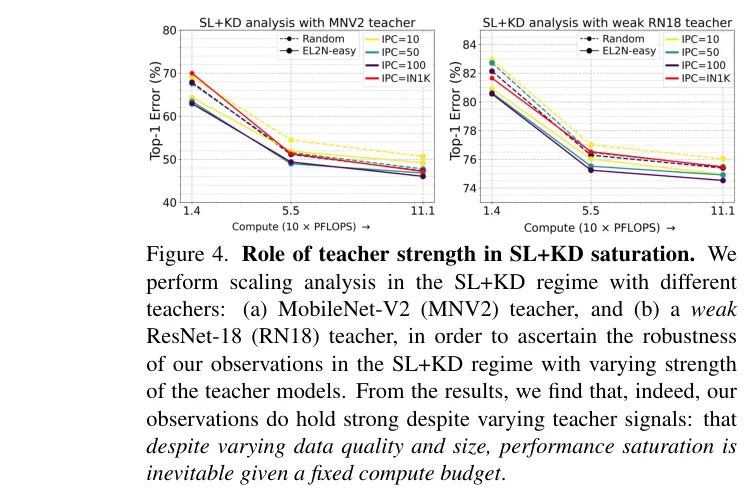
原句③(发现):“high-quality coresets fail to convincingly outperform the random baseline in both SL and SL+KD regimes … performance further approaches near-optimal levels relative to the full dataset, regardless of subset size or quality, for a given compute budget. This performance saturation calls into question the widespread practice of using soft labels for model evaluation.”
指路:soft-label 评测下质量/大小几乎无影响、性能由 compute 决定并饱和到近全量——质疑用 soft label 评 DD 这件事本身。
原句④(工具):“only RDED reliably outperforms random baselines on ImageNet-1K, but can still lag behind strong coreset methods due to its over-reliance on easy sample patches … we introduce CAD-Prune … CA2D … outperforming current DD methods on ImageNet-1K at various IPC settings.”
指路:HL 下只有 RDED 真超随机但仍输强 coreset(偏好 easy patch);据此提 CAD-Prune + CA2D 在 HL 拿 SOTA。
📚 背景知识(外部,非本文原创)
① Dataset Distillation (DD) / IPC:把大数据集 \( \mathcal{D} \) 合成成极小集 \( \mathcal{S} \)(每类 IPC=images-per-class 张),让在 \( \mathcal{S} \) 上训的模型逼近在 \( \mathcal{D} \) 上训的性能。② Coreset selection:不合成、直接从真实数据挑信息子集;与 DD 同属 data-efficient learning,但传统只在 HL 评测。③ KD / soft label:teacher 带温度 \( T \) 的 softmax 概率分布,比 one-hot 含更多类间关系;student 用 KL 散度对齐。
④ SRe2L [38]:大规模 DD 奠基框架,把昂贵的合成步骤与 student 训练 decouple,后续 DWA/D4M/Minimax 多基于它。⑤ RDED [34]:从同类多张真实图里裁“最自信”的 patch 拼成合成图(真实 patch 重组)。⑥ TM [2] / DATM [14]:小规模 DD——TM 用 trajectory matching 对齐真实/合成数据上的训练参数轨迹;DATM 加匹配区间约束并联合优化 soft label。⑦ EL2N / GraNd [26]:coreset 难度分,估样本对训练的影响(详见下方公式)。
② §1 Introduction:problem → solution → why 闭环
problem:DD 靠 SRe2L 框架 scale 到 IN1K,但 Qin et al. 揭穿“the primary factor behind the success … stems from the use of these soft labels instead of the synthesized images”;之后新 DD 仍 “struggle to convincingly beat the random subset baseline except in very low data budget regimes”。核心追问(原文):“How does data quality, size and compute interplay in shaping performance behavior under the SL+KD regime?”
solution(分三 regime 系统分析):(a) SL+KD——“performance is largely insensitive to dataset quality or size and is instead governed by compute, approaching the near-optimal full-dataset accuracy”;(b) SL——“dataset size still matters, but subset quality does not hold influence beyond very small IPC values”,根因 “tight clustering of difficulty scores during SL training”;(c) HL——RDED / TM / DATM 确实超随机,但与最好 coreset “mixed results”。
why(soft label 为何抹平质量):大量 teacher 监督把 student 直接拉向 teacher 的全量性能,子集自身的“难度差异”被冲淡——“increasing the amount of soft-label supervision during student training drives all methods (coresets and DD) toward the teacher’s full-dataset performance regardless of their underlying quality.”
③ 三种 label regime 的精确定义(先分清)
HL(hard label):one-hot 标签 + 交叉熵。SL(fixed soft label):teacher 在原数据上给每图一个 soft label,student 训练时冻结(one soft label per image)。SL+KD:teacher 给每个 augmented image(cutmix 增强)一个 soft label(每图多个),等价 knowledge distillation——大规模 DD(SRe2L 系)默认用这个评测。原文点出文献的不公:大规模 DD 报 SL+KD、小规模 DD 报 HL 或 SL、coreset 只报 HL,导致 “highly varying model performances reported in the literature”。
④ §2 形式化设定 + 核心假设
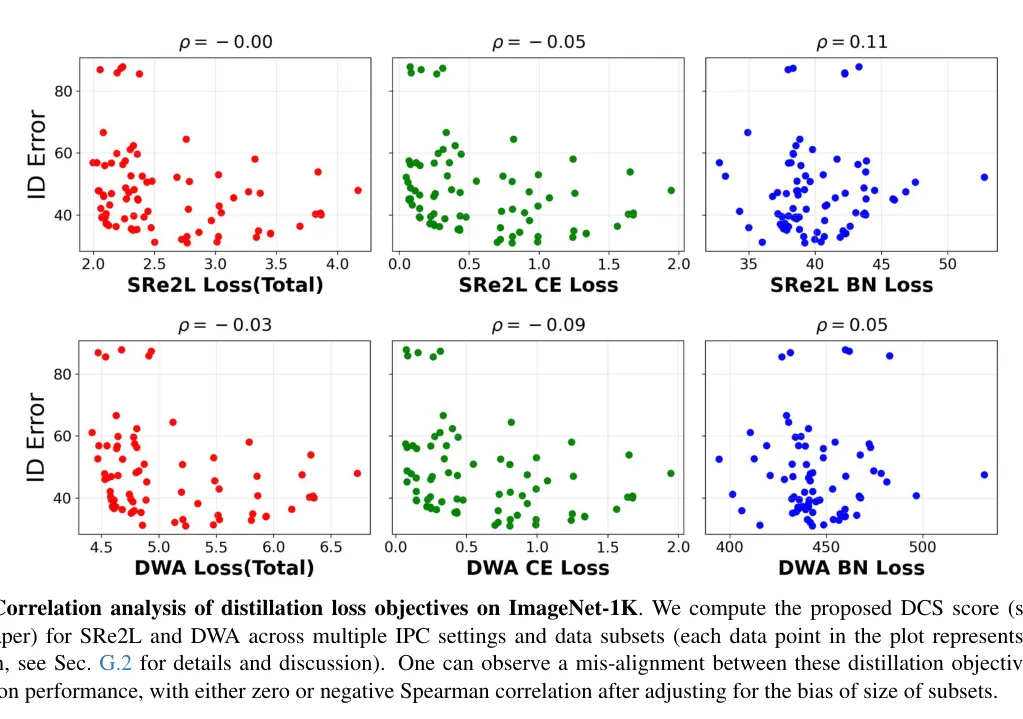
DD 目标:给定大数据集 \( \mathcal{D}_{train} \),合成紧凑集使下游测试损失最小:\[ \mathcal{S}^*=\arg\min_{\mathcal{S}}\ \ell_{\mathcal{D}_{test}}(\theta_{\mathcal{S}}),\qquad \theta_{\mathcal{S}}^*=\arg\min_{\theta}\ \ell_{\mathcal{S}}(\theta) \] 各方法用代理蒸馏目标 \( \mathcal{L}_{\mathrm{distill}}(\mathcal{S},\mathcal{D}) \) 指导合成。隐含假设(原文):“Minimization of \( \mathcal{L}_{\mathrm{distill}} \) should yield a synthetic set \( \hat{\mathcal{S}}^* \) that … lead to good downstream generalization on a test set \( \mathcal{D}_{test} \).” 本文核心就是质疑:在 soft-label 评测下这个假设还能不能区分好坏数据。
⑤ §3.1 SL+KD 分析:scalability + Pareto + saturation
实验设置:用 EL2N 在 IN1K 上造 IPC 10–700 的子集,保留分数 fraction \( f \) 从 100%(=random)降到 20%(造 easy/hard 子集),在 2–50 epoch 全量等效 compute 下训 ResNet-18。结果:HL 下 “improving performance requires jointly scaling dataset size (IPC), its quality and compute”;SL+KD 下 “performance is primarily dictated by compute, while remaining largely unaffected by dataset size or quality”,且所有子集都 near-optimal 到全量红线(IPC=IN1K)。
Pareto(Fig 1b):HL 有清晰 frontier(低 IPC 偏 easy 样本、高 IPC 偏 hard);SL+KD “no such pareto-frontier exists: beyond the minimum IPC of 10, the performance of all subsets, regardless of difficulty or size, remains largely invariant.” 结论建议(原文):“we recommend eschewing from use of the SL+KD setting for assessing DD methods.” 脚注边界:“regardless of quality 不代表任意集(如高斯噪声)也行——仍须属真实图像分布”。
⑥ §3.2 SL 分析 + EL2N-SL 公式(Definition 1)
原 EL2N(HL,外部):\( \mathrm{EL2N}(x)=\mathbb{E}\,\lVert p(w_t,x)-y\rVert_2 \)(\( p \)=softmax 输出、\( y \)=one-hot、期望取训练中权重 \( w_t \)),假设 hard label + 交叉熵。本文推广到 SL(KL loss 下,Def.1):\[ \mathrm{EL2N\text{-}SL}(x)=\frac{1}{T}\,\mathbb{E}\,\lVert p(w_t,x)-q(w_t,x)\rVert_2 \] \( q \)=teacher 给的目标概率分布、\( T \)=softmax 温度(附录 D 给推导)。
结果:SL 下 EL2N-SL 分数 “tightly clustered, indicating that most samples contribute similarly to the learning process”(难度同质化)→质量影响小;小规模 DD 把“学到的 soft label”换成 teacher soft label 后优势消失——“while DATM outperforms K-centers by ∼8% in the HL setting, it fails to do so in the SL setting.”
⑦ §3.3 HL 设定 + 小规模 DD 结果(Table 2 全表)
Table 2(TinyImageNet, ConvNet-D4,HL | SL,IPC 10/50,PDF 原值):
| 方法 | HL@10 | HL@50 | SL@10 | SL@50 |
| DM | 13.51 | 22.76 | 16.12 | 36.58 |
| DC | 12.83 | 12.66 | 7.23 | 10.18 |
| TM | 20.11 | 28.16 | 26.11 | 36.43 |
| DATM | 19.26 | 29.51 | 28.43 | 37.39 |
| Random Real | 6.88 | 18.62 | 26.07 | 36.87 |
| K-centers | 11.38 | 22.02 | 27.11 | 37.45 |
→ HL 下 DATM(29.51)/TM(28.16) 明显超 K-centers(22.02);切到 SL 全部塌缩到 ~36–37、DATM(37.39)≈K-centers(37.45),DD 的优势消失。
⑧ §4 DCS:零成本诊断蒸馏目标好坏
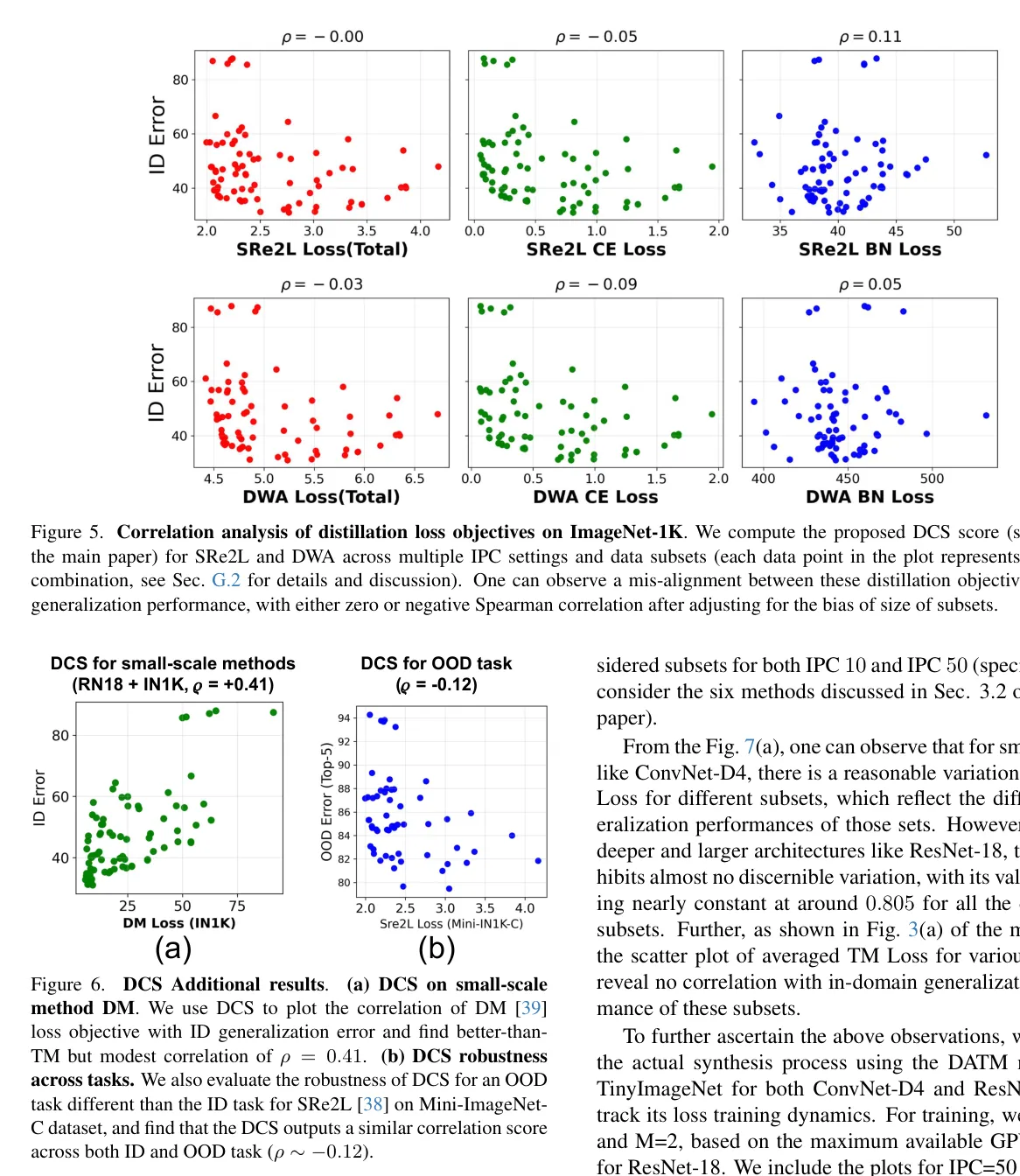
动机:既然 DD 想用 \( \mathcal{L}_{\mathrm{distill}} \) 逼近 \( \mathcal{S}^* \),那就直接评“这个目标和下游泛化对不对齐”。定义(Spearman 秩相关 \( \rho \)):\[ \mathrm{DCS}(\phi)=\rho\!\left(\{\ell_{\mathcal{D}_{test}}(\theta^*_{\mathcal{S}_j})\}_{j=1}^{m},\ \{\mathcal{L}_{\mathrm{distill}}(\mathcal{S}_j,\mathcal{D})\}_{j=1}^{m}\right) \] 先在 \( m \) 个子集(coreset 或 distilled)各训 student 得泛化误差(只算一次、当查找表复用),再对任意(现有/未来)蒸馏目标算其 loss 与该误差的相关——“mitigate the compute-intensive process of generating distilled sets”,绕开合成 + 下游训练两步。
⑨ §4.1 DCS 实证:trajectory-matching 不 scale
TM 目标在大模型上失灵:“no correlation between the TM surrogate loss and generalization when using a larger architecture such as RN-18 … their TM surrogate loss remains unchanged at approximately 0.999”,而不同子集的 RN-18 性能差异很大;ConvNet-D4 上 TM loss 才有合理变化。DATM 合成动态:“despite 10k synthesis iterations, one can hardly observe any significant change in both loss and accuracy when using RN-18 for synthesis.” 结论:TM 类目标 “fails to capture meaningful variations between subsets”,无法 scale 到大模型/大数据(补充材料里 DM 目标 \( \rho=0.41 \),比 TM 好但仍弱)。
⑩ §5 提出方法:CAD-Prune 公式 + CA2D
动机:固定难度分(EL2N-Hard/Dyn-Unc)跨 IPC 不泛化(低 IPC 喜 easy、高 IPC 喜 hard);Lee & Chung 的 sliding-window 准但 “requires multiple full training runs for each candidate window”(贵)。CAD-Prune(compute-aware):用与下游同 compute budget、同 LR schedule 训全量,取末端窗口的 uncertainty——逐 epoch 不确定度(连续 \( J \) 个 epoch 分数的标准差):\[ U_k(x)=\sqrt{\frac{\sum_{j=0}^{J-1}\big[\,\mathbb{S}(y\mid x,\theta^{k+j})-\bar{\mathbb{S}}\,\big]^2}{J-1}},\quad \bar{\mathbb{S}}=\tfrac{1}{J}\sum_{j=0}^{J-1}\mathbb{S}(y\mid x,\theta^{k+j}) \] 再对末端宽度 \( W \) 的窗口取均值:\[ \mathrm{CAD}(x)=\frac{\sum_{k=K-J-W}^{K-J-1}U_k(x)}{W},\qquad W=2,\ J=6\ (\text{IN1K}) \]
CA2D:用 CAD-Prune 选出对该 compute budget“合适难度”的样本,再按 RDED 式 “crop, select, and stitch patches” 构造 distilled set(Compute-Aware Dataset Distillation)。关键洞察(原文):必须用 compute-matched run 才能 “replicate which samples remain learnable at that stage”,用早期 checkpoint 不行——会漏掉只在低学习率阶段才学到的样本。
⑪ §3 实验主表(Table 1 全表,IN1K / ResNet-18,PDF 原值)
IPC 50,HL | SL | SL+KD(看“HL 有差距 → SL+KD 塌缩”):
| 方法 | HL | SL | SL+KD |
| SRe2L (DD) | 9.79 | 27.64 | 52.58 |
| DWA (DD) | 8.26 | 28.42 | 53.25 |
| D4M (DD) | 21.56 | 44.33 | 58.08 |
| Minimax (DD) | 19.62 | 40.30 | 57.77 |
| RDED (DD) | 38.49 | 38.78 | 54.42 |
| Random Real | 28.52 | 48.49 | 58.10 |
| GraphCut | 31.88 | 45.50 | 59.22 |
| Dyn-Unc | 33.03 | 45.54 | 58.22 |
| EL2N-Hard | 7.00 | 44.12 | 58.16 |
| EL2N-Best | 38.06 | 48.76 | 59.16 |
| Full Dataset | 62.50 | 62.50 | 62.50 |
→ HL 下 EL2N-Hard(7.00) vs EL2N-Best(38.06) 差 31 分;SL+KD 下全部挤进 52–59,Random(58.10) 反超所有 DD,逼近全量 62.50。
headline 行的 IPC 10 / 100(HL | SL | SL+KD):SRe2L 2.82·14.89 | 14.14·37.33 | 30.94·61.38;RDED 14.34·44.36 | 19.27·44.91 | 32.10·58.61;Random 5.10·40.89 | 19.96·55.65 | 28.82·62.87;EL2N-Best 10.33·47.18 | 22.82·56.05 | 33.62·63.32。读数:SL+KD 列里 IPC100 各法都贴近全量 65.91,质量/方法差异被抹平。
⑫ §5 提出方法结果(Table 3 全表,IN1K / HL)
| 方法 | IPC 10 | IPC 50 | IPC 100 |
| EL2N-Best (coreset) | 10.53 | 38.44 | 47.76 |
| CAD-Prune (ours) | 12.57 | 40.21 | 47.40 |
| RDED (DD) | 14.34 | 38.49 | 44.36 |
| CA2D (ours) | 15.25 | 41.72 | 46.32 |
→ CAD-Prune 在 IPC 10/50 超 sliding-window 的 EL2N-Best(12.57/40.21 vs 10.53/38.44),IPC100 基本持平;CA2D 在三档全超 RDED。效率:“for IPC 100 coreset selection, this delivers 2–4× compute savings” —— 单次 compute-matched run 即得 budget-optimal 分数,无需为每个窗口重训。
⑬ 失败/边界/Limitations/Future work
边界(原文脚注):“regardless of quality” 不含任意集——仍须属真实图像分布;size 在 IPC>极小值(如 IPC 10)后才无额外增益。compression-extraction trade-off(Fig 8):distilled set 随训练更久持续提升、coreset 早饱和——意味着 distilled set 要更长训练才能榨干信息。Limitations / Future work:“in model-stealing scenarios, a small dataset with repeated supervision could achieve near-optimal performance”(安全隐患);研究限图像分类,多模态/分类外任务待探;“expressing non-optimizable DD objectives for evaluation under DCS requires care and is an open problem”。
📌 全文总结(problem→method→experiment→takeaway,≥3 条硬结论)
problem:大规模 DD 的“胜过随机”可能是 soft label 的假象——数据质量在 soft-label 评测下还重不重要?method:① 跨 HL/SL/SL+KD 的 scalability + Pareto + scaling-law 系统分析;② EL2N-SL(soft-label 版难度分)解释 SL 下质量失效;③ DCS(蒸馏目标 vs 泛化误差的 Spearman 相关,零成本诊断);④ CAD-Prune(compute-aligned uncertainty 窗口)+ CA2D(RDED 式 patch)。
takeaway 1:SL+KD 下数据质量/大小几乎不影响、性能由 compute 决定并饱和到近全量(Random 在 IPC50 达 58.10 反超所有 DD),故 “recommend eschewing the SL+KD setting for assessing DD methods”。
takeaway 2:DCS 证明 trajectory-matching(TM/DATM)目标不 scale 到 RN-18(loss 恒≈0.999、与泛化零相关),是个不用真合成就能筛目标的诊断器。
takeaway 3:HL 下质量仍是主因——CAD-Prune / CA2D 用 compute-aware 选样在 IN1K 各 IPC 超 EL2N-Best / RDED,并省 2–4× 算力。对本仓库的启示:评数据效率方法务必控住 label regime 与 compute(同 LR schedule 的 compute-matched run),否则“涨点”可能只是 soft-label/算力假象——这是做数据精简/蒸馏类实验的硬约束。
🖼 论文原图(本地 PDF 截图,原文 caption 未改写)