CVPR 2026 Finalist
Residual Primitive Fitting of 3D Shapes with SuperFrusta
Aditya Ganeshan ⋅ Matheus Gadelha ⋅ Thibault Groueix ⋅ Zhiqin Chen ⋅ Siddhartha Chaudhuri ⋅ Vladimir G. Kim ⋅ Wang Yifan ⋅ Daniel Ritchie
摘要 Abstract
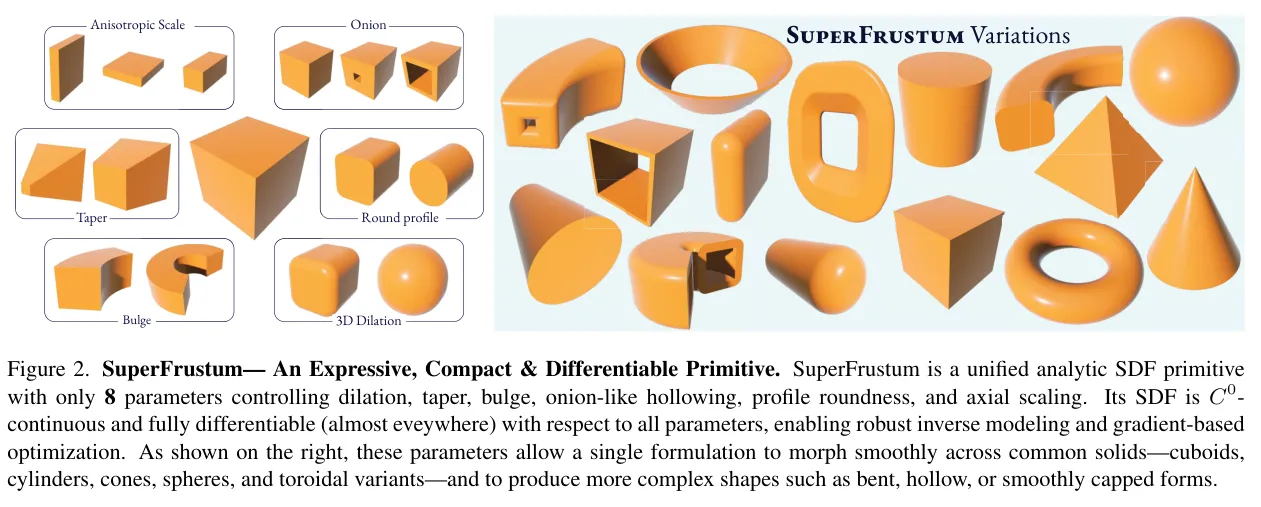
We introduce a framework for converting 3D shapes into compact and editable assemblies of analytic primitives, directly addressing the persistent trade-off between reconstruction fidelity and parsimony. Our approach combines two key contributions: a novel primitive, termed SuperFrustum, and an iterative inference algorithm, Residual Primitive Fitting (ResFit). SuperFrustum is a analytical primitive that is simultaneously (1) expressive, being able to express various common solids such as cylinders, spheres, cones & their tapered and bent forms, (2) editable, being compactly parameterized with 8 parameters, and (3) optimizable, with a sign distance field differentiable w.r.t. its parameters almost everywhere. ResFit is an unsupervised procedure that interleaves global shape analysis with local optimization, iteratively fitting primitives to the unexplained residual of a shape to discover a parsimonious yet accurate decompositions for each input shape. On diverse 3D benchmarks, our method achieves state-of-the-art results, improving IoU by over 9 points while using nearly half as many primitives as prior work. The resulting assemblies bridge the gap between dense 3D data and human-controllable design, producing high-fidelity and editable shape programs.
📝 精读笔记
灵魂一句
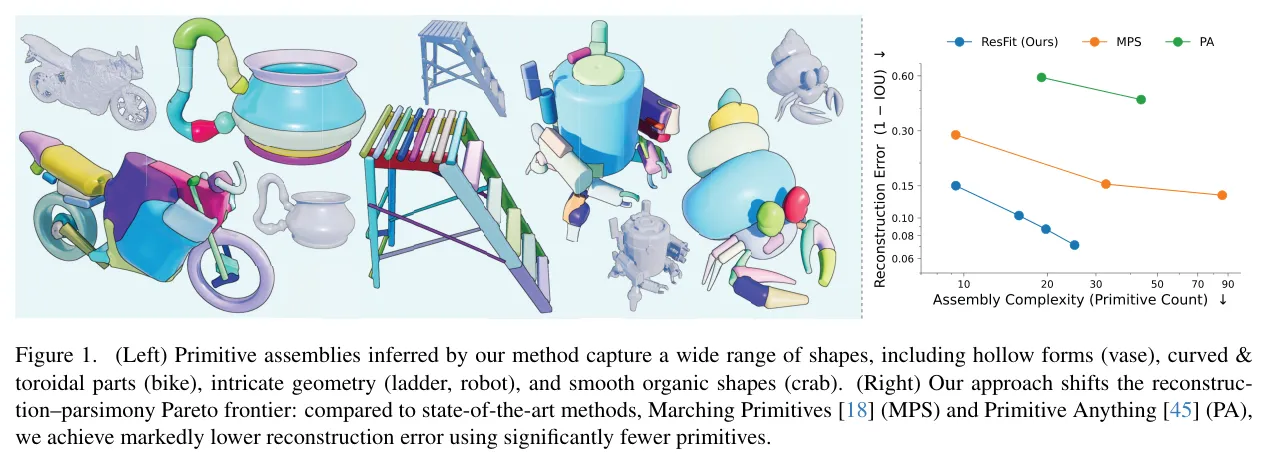
把任意 3D 形状拆成「又准又少」的可编辑解析 primitive 拼装。两大件:① SuperFrustum——单个解析 SDF primitive,仅 8 参数却同时 expressive(能 morph 成 cuboid/cylinder/cone/sphere/torus 及其 taper/bend/hollow 变体)、editable、optimizable(几乎处处可导);② ResFit——无监督迭代拟合,全局形状分解(MSD「先剥最厚部分」)↔局部梯度优化交替,每轮只对「还没解释的 residual」补 primitive。结果:IoU 比 SOTA +6~9 分、primitive 数≈砍半。
问题 & 动机
原文 “a fundamental trade-off between reconstruction fidelity and program parsimony”。3D 生成的资产 “structurally unorganized”,难做 animation/rigging/editing。primitive 表示要准就堆 “dense, redundant assemblies of overlapping primitives”、要少就 “fail to capture fine geometric details or curved structures”。两根因:① 常用家族(cuboid/superquadric/ellipsoid)表达力弱→要很多个;② 推理本身——先定完整分割的方法 brittle(“segmentation errors propagate directly to the final assembly”),从头优化一大堆 primitive 要面对 “highly non-convex loss landscape”。
核心方法 + 关键公式
总目标(Occam):z*=argmax O(x,z),O(x,z)=R(x,E(z)) − α|z|(R=重建精度,|z|=primitive 数,α=10⁻³ 权衡)。
① SuperFrustum:SF(p)=f(p;θ),θ=(s,r,d,t,b,o);assembly 用递归 smooth union F_{k+1}=U(F_k, g_{k+1}; β_k)。
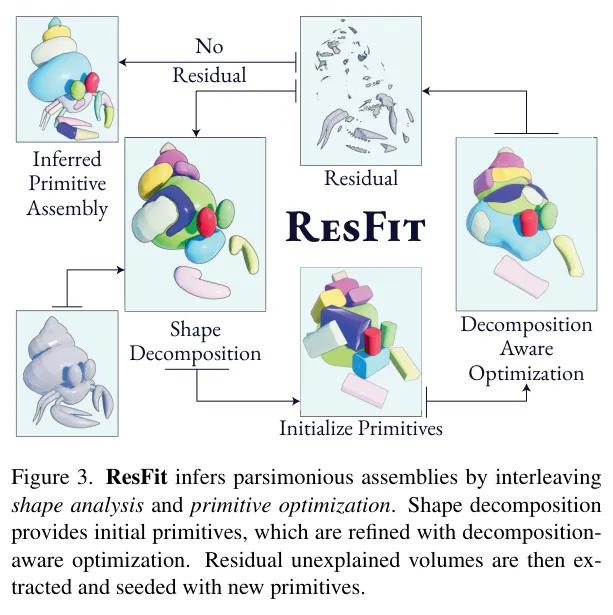
② ResFit:analysis(MSD 分解 residual 出 seed)↔optimization(调参 max O)交替,到 O 饱和或预算 K 停。
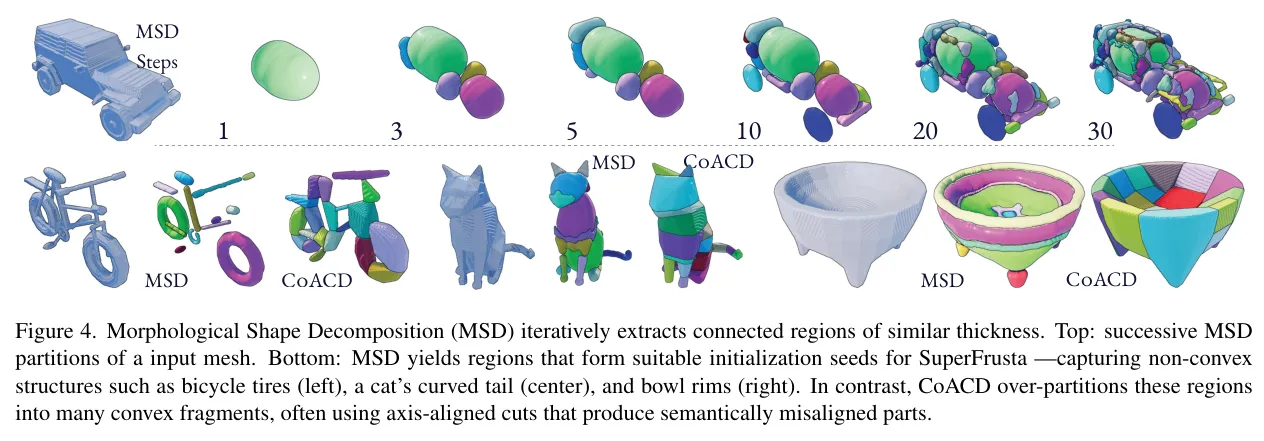
③ MSD:Γ_k⊆{p | f(p)≤τ} 且连通,τ 取使 Vol(Γ_k) 达体积比 κ 的最小值,dilate 回 R_k=Γ_k⊕B_|τ|,更新 residual f_{k+1}=f_k\R_k。
④ loss:L_total=L_rec+λ_count·L_count+λ_qual·L_qual——L_rec=curvature 加权 occupancy MSE、L_count=Σq_i(Gumbel-Softmax existence)、L_qual=overlap+union 一致性;末尾 discrete pruning 贪心删(改善 O 才删)。
关键结果
3DGen-Prim:Ours IoU 88.74 vs MPS 82.67(+6.1)、#Prims 23.98 vs 42.96(≈半)、Overlap 0.210 vs 0.684(>3× 降);Toys4K:IoU 89.92 vs 80.60(+9.3)。消融:ResFit+MSD 89.86 > Single-shot+MSD 87.95 > ResFit+CoACD 88.02;SuperFrustum+SmoothUnion 88.37 > Cuboid 82.33 > Superquadric 76.50。
亮点
① 灵感来自 Shadertoy/Demoscene 社区为「最小描述长度」做的 analytic SDF(paniq / Inigo Quilez),被改造来做 inverse modeling;② analysis↔optimization 双向互 inform,同时破「分割先行 brittle」与「从头优化 non-convex」两难;③ 顺带做 4 应用:textured deployable asset / CSG program / image-to-primitive / 语义分割细化。
疑问 / 边界
① 慢:full 10-round 652.6s/shape,原文承认 “not yet optimized for speed”;② 限制(原文 conclusion):“restricted by its purely additive composition; shapes requiring subtractive operations remain challenging”;③ SuperFrustum 的 SDF 完整闭式公式正文未给(“provided in the supplementary”)——原文未写正文、需查 supplementary。
📖 逐段精读 · 笔记
批量精读初稿(本地 PDF 全文 PyMuPDF 提取,~46K 字符)。最后更新 2026-06-21。
① Abstract(摘要)逐句精讲
原句①(任务):“a framework for converting 3D shapes into compact and editable assemblies of analytic primitives, directly addressing the persistent trade-off between reconstruction fidelity and parsimony.”
精讲:把任意 3D 形状转成"少而准"的解析基元装配体,正面解决"重建精度 vs 简洁性"这对长期矛盾。
原句②(两大贡献):“a novel primitive, termed SuperFrustum, and an iterative fitting algorithm, Residual Primitive Fitting (ResFit).” SuperFrustum 三性合一:“(1) expressive … (2) editable, being compactly parameterized with 8 parameters, and (3) optimizable, with a sign distance field differentiable w.r.t. its parameters almost everywhere.”
原句③(ResFit 是什么):“an unsupervised procedure that interleaves global shape analysis with local optimization, iteratively fitting primitives to the unexplained residual of a shape to discover a parsimonious yet accurate decompositions for each input shape.”
精讲:注意 “unsupervised” + “for each input shape”——它不是训练一个网络去预测,而是对每个形状单独做无监督优化,因此天然不受训练分布限制(这正是它能泛化到 novel/复杂物体、而学习式方法做不到的根因)。
原句④(成绩+愿景):“improving IoU by over 9 points while using nearly half as many primitives as prior work. The resulting assemblies bridge the gap between dense 3D data and human-controllable design, producing high-fidelity and editable shape programs.”
精讲:同时更准 + 更省(推动 fidelity-parsimony Pareto 前沿),且产出的是"人可控编辑"的 shape program,而非一堆不可解释的稠密表示。
📚 背景知识(外部,非本文原创;读懂本文必备)
① 基元装配 / shape abstraction(外部):用一组可解释的解析"零件"(cuboid/cylinder/sphere/superquadric)拼出复杂形状,得到可编辑、结构化的资产,契合认知科学 “humans perceive objects as compositions of simpler forms”(Biederman 1987 recognition-by-components)。
② Superquadrics / SDF / CSG(外部):Superquadric=用指数参数化的隐式曲面族(Barr 1981),表达力强但不可精确还原 cube/cone 且难编辑;SDF(signed distance field)=每点到表面的有符号距离,零等值面即表面,可微则可梯度优化;CSG=用并/交/差组合基本体的实体造型树。
③ Shadertoy / Demoscene 解析基元(本文灵感源):图形社区为"最小描述长度+实时渲染"造出可在单一函数式里平滑 morph 的统一解析基元(Quilez 的 SDF 库、paniq 的 sdsuperprim)。原文:“These formulations were developed to minimize scene-description size … not for inverse modeling … We find that, when carefully adapted, these formulations are exceptionally well-suited for inverse modeling.”
④ ACD / CoACD / MSD(分解方法):ACD(Approximate Convex Decomposition)把形状切成近似凸块;CoACD=collision-aware 的树搜索版;MSD(Morphological Shape Decomposition, Pitas 1990)=形态学"先剥最厚部分"。本文选 MSD 是因为它能产出非凸区域、且对残差噪声鲁棒。
② §1 Introduction(problem → solution → why 闭环)
problem:3D 生成虽强但输出 “structurally unorganized”,难做动画/绑定/编辑;基元化能给结构。但推理基元装配有根本矛盾:“Approaches that prioritize high fidelity often yield dense, redundant assemblies of overlapping primitives … methods that enforce parsimony may fail to capture fine geometric details or curved structures.”
归因两因素:① 基元族(cuboid/superquadric/ellipsoid)表达力不足→需大量实例;② 推理流程有缺陷——先承诺完整分割的方法 “any initial segmentation errors propagate directly to the final assembly”(脆),从头优化一大堆基元的方法要 “navigate a highly non-convex loss landscape”。
solution + why:“marries a highly expressive primitive with a robust inference strategy.” SuperFrustum 补齐"表达力/可编辑/可优化"三者常缺其一的空白;ResFit “tightly interleaves global shape analysis with local primitive optimization”,让自顶向下分析与自底向上基元表示互相纠错,从而既紧凑又高保真。
③ §2 Related Work(三类基元推理定位本文)
① Shape-analysis-driven:按曲率/厚度/凸性把形状分区再拟合基元——“brittle across diverse shapes and sensitive to tuning … the decomposition is fixed and independent of what the primitives can represent.” ② Optimization-driven:直接调基元参数最小化重建误差——“effective on small assemblies, they often require many primitives for high fidelity.” ③ Learned:神经网络预测参数/部件布局,“generalize poorly to novel or complex objects.” 本文 = analysis 与 optimization 双向耦合,让分解适配基元表达力。
④ §3 任务定义与目标函数(式1-2,Occam's razor)
给定 3D 形状 \(x\),推一段程序 \(z\)(一串基元 \(\{f_{\theta_i}\}_{i=1}^{|z|}\) 经组合算子执行成闭合曲面 \(E(z)\))。目标(式1-2): \[ z^* = \arg\max_z O(x,z),\quad O(x,z) = R(x, E(z)) - \alpha|z| \] \(R\)=重建精度,\(|z|\)=程序复杂度(基元数),\(\alpha\) 控精度↔简洁权衡。“Maximizing O thus favors concise programs that explain the geometry with a small set of expressive parts.”(α=10⁻³)
⑤ §3.1 ResFit 迭代框架(analysis↔optimization 交替)
动机:“a disconnect between the geometric analysis (top-down) and the primitive representation (bottom-up)”。流程交替两阶段:分析阶段把当前残差体分解成区域,给新基元播种;优化阶段调参最大化 \(O\),分离"已解释"与"残差"。循环到 \(O\) 饱和或达迭代预算 \(K\)。
双向纠错设计:防过参数化——每轮只播种少量基元 + soft 正则惩罚冗余 + hard pruning 删降质部件;防欠参数化——基元按局部支撑优化、每轮重优化整个装配体,“This enables self-correction as new parts are added.”
为何这能打破两难:纯优化式方法从头同时调"一大锅基元(soup)",要在高度非凸的重建 loss 里硬搜,极易陷入纠缠的劣解;纯分析式方法又先把分割钉死,与基元能表达什么脱节。ResFit 把"提全局结构"与"调局部参数"两信号交替喂给彼此,相当于每轮都用最新残差几何重新指导下一批基元该放哪、放几个,从而既不冗余堆叠也不漏掉未解释区域。
⑥ §3.2 SuperFrustum 基元(式3-4,表达力/可编辑/可优化三合一)
表格对比(Table,三性):Superquadrics ✗表达✓编辑✓优化、Algebraic Surf ✓✗✓、Multi-type(PA) ✓✓✗、SuperFrusta ✓✓✓。
定义(式3):SuperFrustum 是某 SDF 的零等值面 \( SF(p) = f(p;\theta),\ \theta=(s,r,d,t,b,o) \),仅 8 个标量直观控制 anisotropic scale \(s\)、profile rounding \(r\)、dilation \(d\)、taper \(t\)、bulge \(b\)、onion/shell thickness \(o\)。SDF “piecewise-C1 … differentiable almost everywhere”,可平滑 morph 出 cuboid/cylinder/cone/torus 及弯曲、空心、平滑封口等形态。
装配体组合(式4):每个实例有位姿 \((R_i,t_i)\) 与形参 \(\theta_i\),给出 \( g_i(p)=f(R_i^\top(p-t_i);\theta_i) \);再用 smooth union 递归合成 \[ F_1(p)=g_1(p),\quad F_{k+1}(p)=U\!\big(F_k(p), g_{k+1}(p); \beta_k\big) \] \(\beta_k\) 控混合锐度,最终曲面=\(F\) 的零等值面。
⑦ §3.3 MSD 初始化(式5-6,"先剥最厚")
MSD 每步找最厚的近匀厚连通区做种子。每轮 \(k\) 找经半径 \(|\tau|\) 腐蚀仍存活的最厚内部连通分量 \(\Gamma_k\): \[ \Gamma_k \subseteq \{p\in\Omega \mid f(p)\le\tau\},\quad \Gamma_k\ \text{is a cc} \] 阈值 \(\tau\le0\) 取使 \(\mathrm{Vol}(\Gamma_k)\) 达体积比 \(\kappa\) 的最小值;再膨胀回原半径 \(R_k=\Gamma_k\oplus B_{|\tau|}\),并从形状中减去更新残差: \[ f_{k+1}(p) = f_k(p)\setminus R_k,\quad f_1\equiv f \] 选 MSD 而非 ACD 的两理由(原文):① “ACD's convexity constraint over-partitions non-convex structures that a single SuperFrustum can model”(如弯曲/空心件);② MSD “substantially more robust to the noisy surface artifacts” —— 正适合迭代残差体。每个分解体用 PCA 初始化 SuperFrustum 位姿/尺度(cylindricity score 选 canonical 方向)。
⑧ §3.4 Decomposition-Aware Optimization(式7-8,三项损失+剪枝)
① 重建(式7):监督占据场 \( \hat{o}(p)=\sigma(-\beta F(p)) \) 对齐 GT 占据 \(o(p)\),按主曲率加权强调薄/高曲率结构: \[ w(p)=1+\sigma(\kappa(p)),\quad L_{rec}=\frac{1}{|M|}\sum_{p\in M} w(p)\big(\hat{o}(p)-o(p)\big)^2 \] 只在空间掩码 \(M=\{p\mid F(p)<\tau\}\) 内算。② 简洁(parsimony):每基元配 Gumbel-Softmax 存在变量 \(q_i\in(0,1)\),调制 SDF \(f_i^*(p)=q_i f_i(p)+(1-q_i)\),损失 \(L_{count}=\sum_i q_i\)。③ 质量:\(L_{qual}=L_{overlap}+L_{union}\)——前者惩罚多基元重叠覆盖,后者惩罚"被 smooth union 占据但任何单基元都没占"的过度混合。
总损失(式8): \( L_{total}=L_{rec}+\lambda_{count}L_{count}+\lambda_{qual}L_{qual} \)(\(\lambda_{count}=10^{-3},\lambda_{qual}=10^{-2}\))。剪枝:可微优化收敛后,对体积/贡献微小的基元试删,“deletions are greedily accepted if they improve the primary objective O.”
⑨ §4 实验设置(数据/指标/基线)
数据:① 3DGen-Prim 不公开,用 3DGen-Bench 的 510 prompts + Hunyuan3D-2.1 重建;② Toys4K 用最远点采样选 500 个几何多样形状。指标:重建——voxel IoU(128³)、CD、EMD(2048 点)、BiSurfIoU(双向近表面 IoU);程序质量——\(|z|\)(#Prims)、Overlap Ratio、IntraPrim(基元内 PartField 特征方差,↓越纯)、InterPrim(基元特征质心最近邻距离,↑越有区分)。基线:Primitive Anything (PA,学习式,预测 cuboid/cylinder/ellipsoid) 及其 TTO 变体;Marching Primitives (MPS,superquadric 优化式,128 体素)。
指标深入(为何要 BiSurfIoU / IntraPrim / InterPrim):voxel IoU(128³) 只看体积重合、对薄壳/曲面不敏感,故引入 BiSurfIoU——“the mean of IoU scores from near-surface points sampled on both the target and reconstructed shapes, with the latter surface extracted via dual contouring of the SDF”,更能反映表面保真。语义指标基于 PartField 特征:把目标面上的点关联到最近基元后,IntraPrim=基元内特征方差(越低=单个基元语义越纯,不会一个基元横跨多语义部件),InterPrim=基元特征质心间最近邻距离(越高=不同基元对应不同语义部件,分得开),两者按 size-weighted 平均。
⑩ 主表 Table 1(真实数值,Gold=最佳)
3DGen-Prim:Ours IoU 88.74 / BiSurfIoU 80.19 / CD 0.168 / EMD 0.073 / #Prims 23.98 / Overlap 0.210;MPS 82.67 / 71.53 / 0.884 / 0.093 / 42.96 / 0.684;PA(TTO) 53.73 / 37.90 / 0.742 / 0.131 / 64.87 / 0.493;PA 34.62 / 30.56 / 7.588 / 0.119 / 19.81 / 0.402。
Toys4K:Ours 89.92 / 85.66 / 0.154 / 0.067 / 23.67 / 0.208;MPS 80.60 / 72.75 / 1.147 / 0.086 / 30.62 / 0.588。
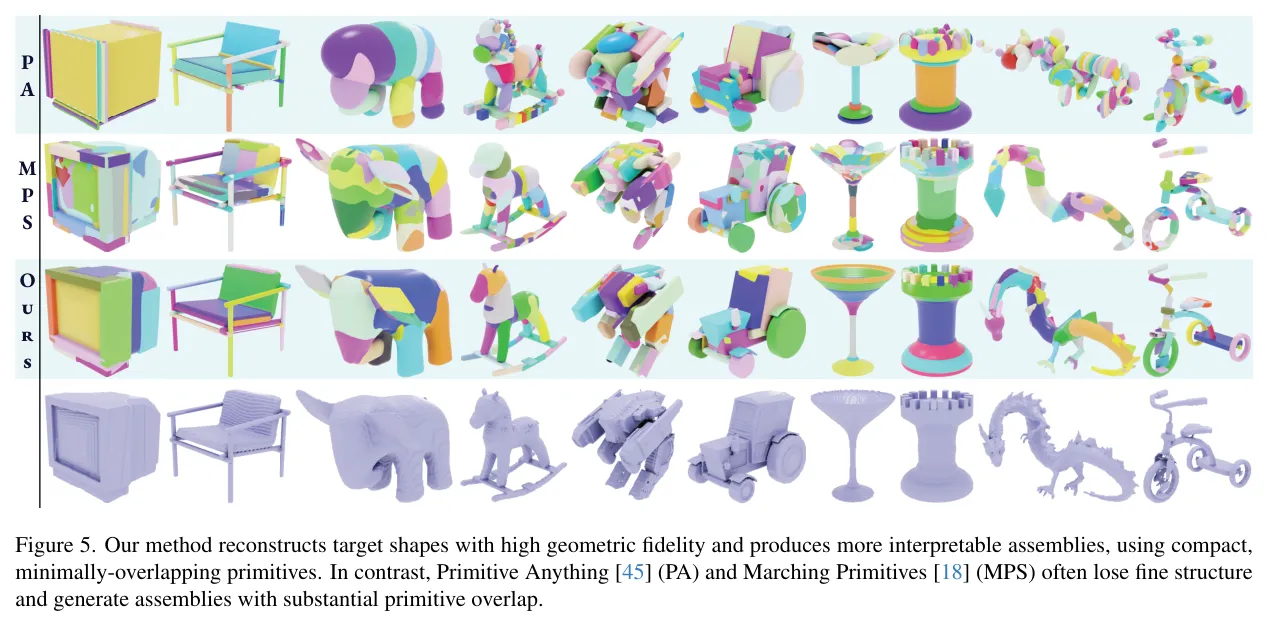
结论:IoU 比 prior 高 +6.1(3DGen-Prim)/ +9.3(Toys4K),基元数约为 MPS 一半,体积重叠降 3× 以上,且 IntraPrim 最低 / InterPrim 居前(语义更纯、部件更可分)。
⑪ 消融 Table 2 + Table 3(基元族 & 拟合策略)
基元族(Table 2,IoU/CD/#Prims/Overlap):Cuboid 82.33 / 0.129 / 20.49 / 0.298;SQ(superquadric) 76.50 / 0.523 / 18.17 / 0.286;SP(superprimitive,无 taper/bend) 86.66 / 0.134 / 21.36 / 0.291;SF(no union) 87.15 / 0.173 / 18.68 / 0.257;SF + smooth union 88.37 / 0.147 / 21.46 / 0.199。证明 taper/bend 自由度与 smooth union 都关键;SQ 因轴向错配易陷局部最优(MPS 靠不可微的周期性 axis-flip 缓解,本文受控对比里不用)。
拟合策略(Table 3):Single+CoACD 86.56 / 0.368 / 26.67 / 0.226;Single+MSD 87.95 / 0.337 / 28.17 / 0.236;ResFit+CoACD 88.02 / 0.290 / 24.18 / 0.214;ResFit+MSD 89.86 / 0.157 / 23.46 / 0.207。结论:迭代 ResFit > single-shot(后者对初始分割敏感、无法把容量重分配给未解释区域);MSD > CoACD(非凸分区给曲/空/分叉几何更好的初始化)。
⑫ Timing + CSG 推理(Table 4)
时间(Toys4K):full 10 轮 ResFit 652.6s/shape;但 2 轮变体 184.1s 即达 86.54 IoU / 仅 15.54 基元,匹配甚至略超 MPS@256³(86.30 IoU,194.6s)却用 5× 更少基元。PA 58.3s、MPS@128³ 37.9s 更快但质量低。作者注:“ResFit is not yet optimized for speed; dedicated CUDA kernels … may reduce runtime.” —— 这说明当前瓶颈在工程实现而非算法本质:2 轮就能打平 MPS@256³ 的精度且基元数仅约 1/5,意味着大部分质量在前两轮就拿到了,后续 8 轮主要在打磨细节与剪枝,给"按质量预算自适应早停"留了清晰的提速空间。
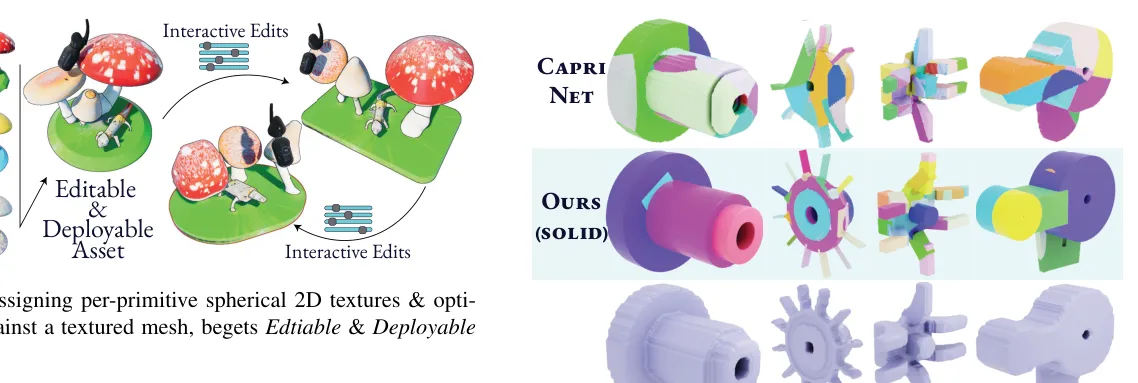
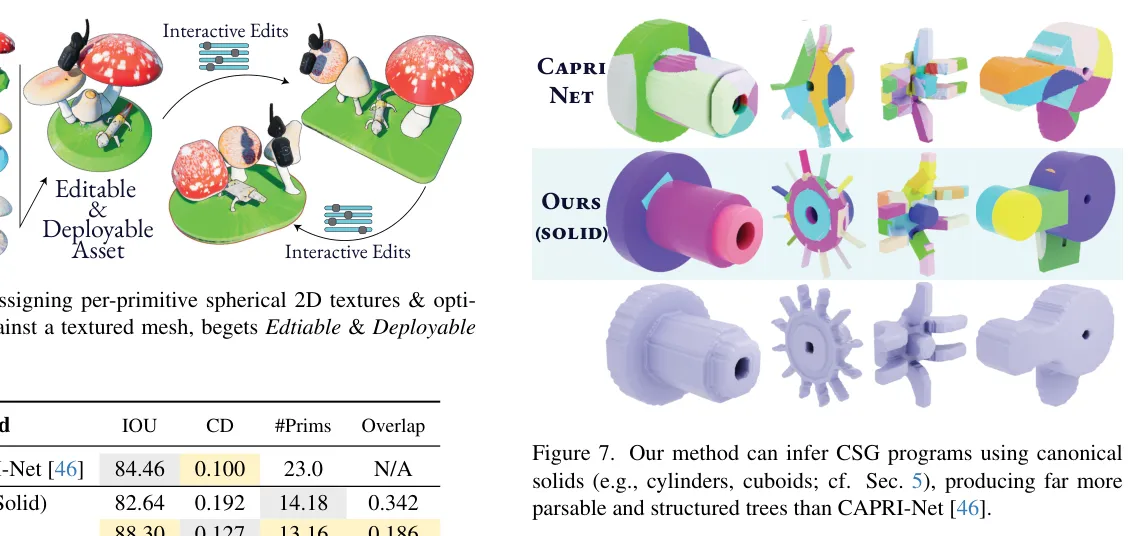
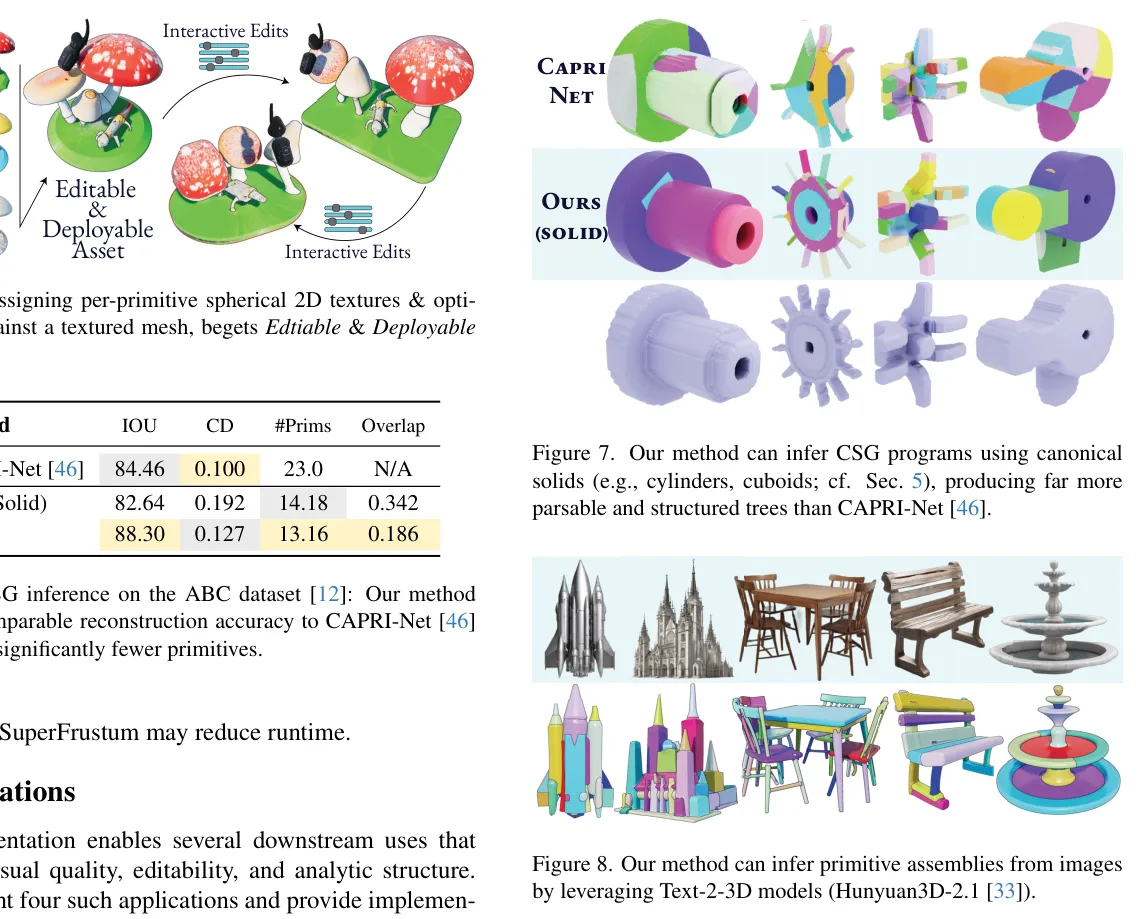
CSG 程序(Table 4,ABC 100 样本):把 SuperFrustum 参数约束为 cuboid/cylinder/cone/sphere 的重心插值(onion 算子天然含"减去"形态),得离散 CSG。CAPRI-Net 84.46 / 0.100 / 23.0;Ours(Solid) 82.64 / 0.192 / 14.18;Ours 88.30 / 0.127 / 13.16——精度与 CAPRI-Net 相当但基元数约 2/3,树更可解析。
⑬ §5 应用(四类下游)
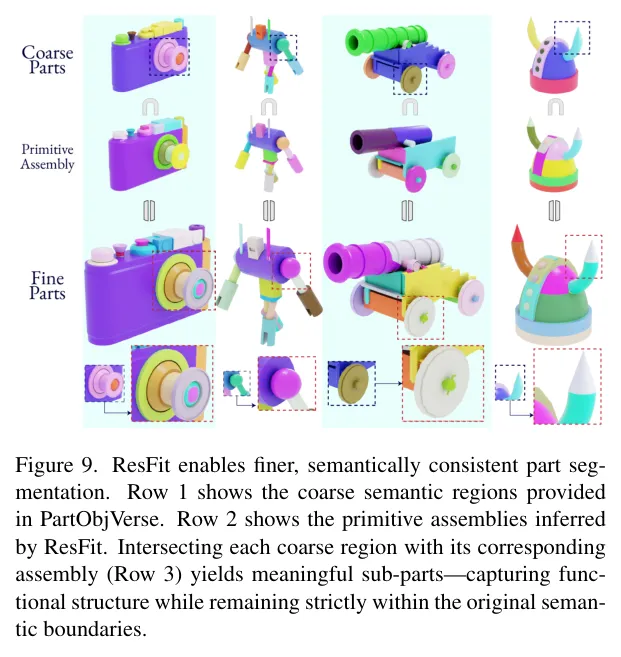
① 可编辑/可部署资产:每基元配局部 2D 球面纹理对着 textured mesh 优化,可直接 sphere-trace 部署且保持可编辑;② CSG 程序推理(见⑫);③ Image-to-primitive:接 Hunyuan3D-2.1 从图生 3D 再 ResFit;④ 语义分割增强:把 PartObjVerse 粗标签与基元装配体求交,“subdivide large parts into functionally meaningful subcomponents without drifting outside their semantic boundaries”,为开放世界部件分割提供解析先验。
⑭ 关键追问(why these choices)+ 局限
Q:为什么 IoU 大涨却基元更少? 单个 SuperFrustum 能表达 cuboid/cone 的弯曲/锥化/空心变体,一个顶过去好几个 superquadric/cuboid;ResFit 又把容量按残差精准分配并剪冗余。Q:为什么用 occupancy + 曲率加权而非纯 CD? CD 主导时易牺牲薄/高曲率结构;曲率权 \(w(p)=1+\sigma(\kappa(p))\) 让优化盯住细节。局限(§6):“restricted by its purely additive composition; shapes requiring subtractive operations remain challenging.” 未来:tree-of-shapes 分解、更丰富 CSG/交互编辑。
⑮ 深入:SuperFrustum 为何适合 inverse modeling
① 与 superquadric 的本质差异:superquadric 用指数参数化,轴向一旦与目标几何错配就极易陷入糟糕的局部最优(原文:“SQs are particularly susceptible to poor local minima when their axes misalign with the target geometry”),MPS 这类方法只能靠不可微的周期性 axis-flipping 等启发式硬救;而 SuperFrustum 的 SDF “differentiable almost everywhere”,可纯梯度优化,无需这些 hack——这是它"可优化(optimizable)"那一栏打✓的关键。
② taper/bulge/bend/onion 自由度为何重要:消融 Table 2 里去掉 taper/bend 的 SuperPrimitive(SP) 从 SF 的 87.15 IoU 掉到 86.66,cuboid 掉到 82.33、superquadric 更掉到 76.50——说明"锥化+弯曲+鼓胀+空心"这几个自由度正是单基元能吃下曲面/非匀厚结构的来源,让一个 SuperFrustum 顶替过去要好几个简单基元才能拼出的弯管、空心碗沿、锥形腿等。onion(空心/壳)算子还顺带在纯加法框架里"偷渡"出了减法形态,使 CSG 推理无需显式 subtraction 算子。
③ smooth union 的取舍:消融显示 SF+smooth union 把 Overlap 从 0.257 压到 0.199(同时 IoU 88.37)——平滑并集让相邻基元用"融合"而非"相交堆叠"来形成连续体,既减重叠又更接近人类对"一个连续零件"的认知;代价是 \(L_{union}\) 必须约束过度混合,否则会糊成一团失去可编辑性,这正是 \(L_{qual}=L_{overlap}+L_{union}\) 两项要同时存在的原因。
📌 全文总结(≥3 条 takeaway)
Takeaway 1(基元设计):SuperFrustum 把 Shadertoy/Demoscene 为"最小描述长度+实时渲染"造的统一解析 SDF 反过来用于 inverse modeling——8 参数同时满足表达力/可编辑/可优化,是"用对工具"而非"造大网络"的胜利。
Takeaway 2(推理范式):ResFit 的 analysis↔optimization 双向交替 + 在残差上迭代,破解了"先分割后拟合(脆)"与"从头优化一大堆(非凸)"的两难,self-correction 让欠/过参数化都能纠回,是把 top-down 与 bottom-up 信号耦合的范式样本。
Takeaway 3(成绩与边界):跨 3DGen-Prim/Toys4K,IoU +6~9 点、基元数减半、重叠降 3×,并能产出可编辑资产 / 结构化 CSG / 细粒度分割,整体把 fidelity-parsimony Pareto 前沿外推。但纯加法组合是硬伤——需要"挖洞/相减"的形状仍难,且 full 版 652.6s/shape 偏慢(未做 CUDA 优化)。
定性印证(Fig 5):原文 “Our assemblies exhibit higher geometric fidelity and are more interpretable, using a compact set of non-overlapping, semantically aligned primitives. In contrast, baseline reconstructions can show lower fidelity on complex structures and tend to produce assemblies with greater primitive overlap.” —— 数值优势(IoU↑、Overlap↓、IntraPrim↓)在可视化上对应"零件更少、更不重叠、更像人会怎么拆这个物体"。这也解释了为什么作者反复强调"editable":只有当装配体里每个基元都对应一个语义清晰、互不打架的部件时,下游的交互编辑/绑定/换纹理才真正可用。
一句话定位:本文不是又训了一个更大的网络,而是用"对的解析基元(SuperFrustum)+ 对的迭代推理(ResFit)"这条 optimization-as-inference 路线,在无监督、逐形状的设定下同时拿下精度、简洁与可编辑——对追"可控、可编辑 3D 资产"的工业管线(动画/绑定/CAD/游戏)是直接可用的一块拼图。
🖼 论文原图(本地 PDF 截图,原文 caption 未改写)