CVPR 2026 Finalist
RefAV: Towards Planning-Centric Scenario Mining
Cainan Davidson ⋅ Deva Ramanan ⋅ Neehar Peri
摘要 Abstract
Autonomous Vehicles (AVs) collect and pseudo-label terabytes of multi-modal data localized to HD maps during normal fleet testing. However, identifying interesting and safety-critical scenarios from uncurated driving logs remains a significant challenge. Traditional scenario mining techniques are error-prone and prohibitively time-consuming, often relying on hand-crafted structured queries. In this work, we revisit spatio-temporal scenario mining through the lens of recent vision-language models (VLMs) to detect whether a described scenario occurs in a driving log and, if so, precisely localize it in both time and space. To address this problem, we introduce RefAV, a large-scale dataset of $10,000$ diverse natural language queries that describe complex multi-agent interactions relevant to motion planning derived from $1000$ driving logs in the Argoverse 2 Sensor dataset. We evaluate several referential multi-object trackers and present an empirical analysis of our baselines. Notably, we find that naively repurposing off-the-shelf VLMs yields poor performance, suggesting that scenario mining presents unique challenges. Lastly, we discuss our recently held competition and share insights from the community.
📝 精读笔记
灵魂一句
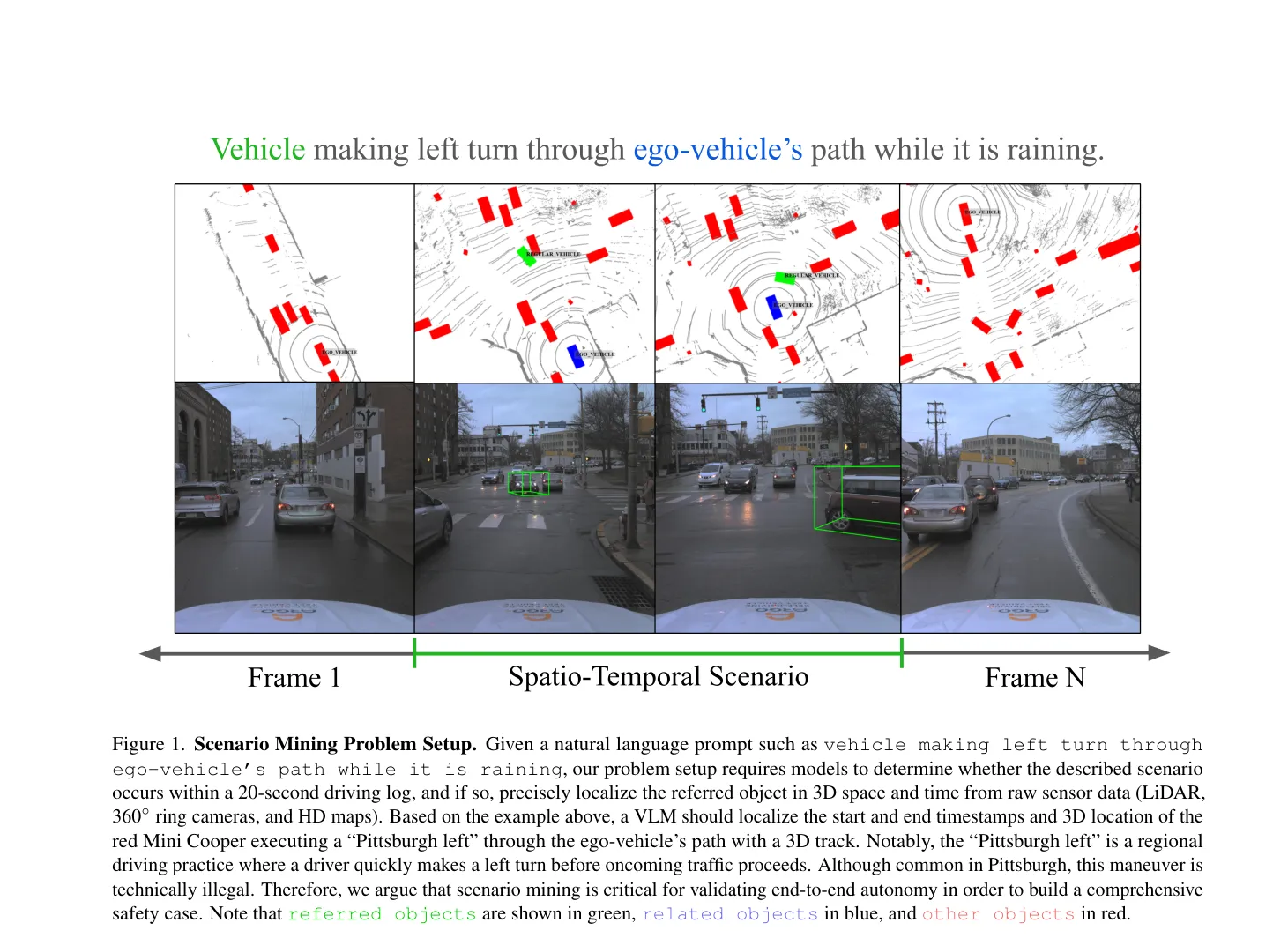
CMU(Deva Ramanan 组):第一个面向自动驾驶的时空场景挖掘(spatio-temporal scenario mining)数据集 + 基准 + 方法。给一句自然语言(如"下雨天有车从 ego 车前方抢左转"),要判断这条 20 秒驾驶 log 里到底有没有发生,若有则用 3D track 在时间和空间上精确定位所有相关物体。基于 Argoverse 2 造了 1 万条 NL query(描述与运动规划相关的复杂多智能体交互)。核心发现:直接拿现成 VLM 来做效果很差;提出 RefProg(程序合成式引用追踪)——让 LLM 把复杂语言拆成原子函数组合的 Python 程序、在现成 3D track 上执行过滤。原文定位:“detect whether a described scenario occurs in a driving log and, if so, precisely localize it in both time and space”。
问题 & 动机
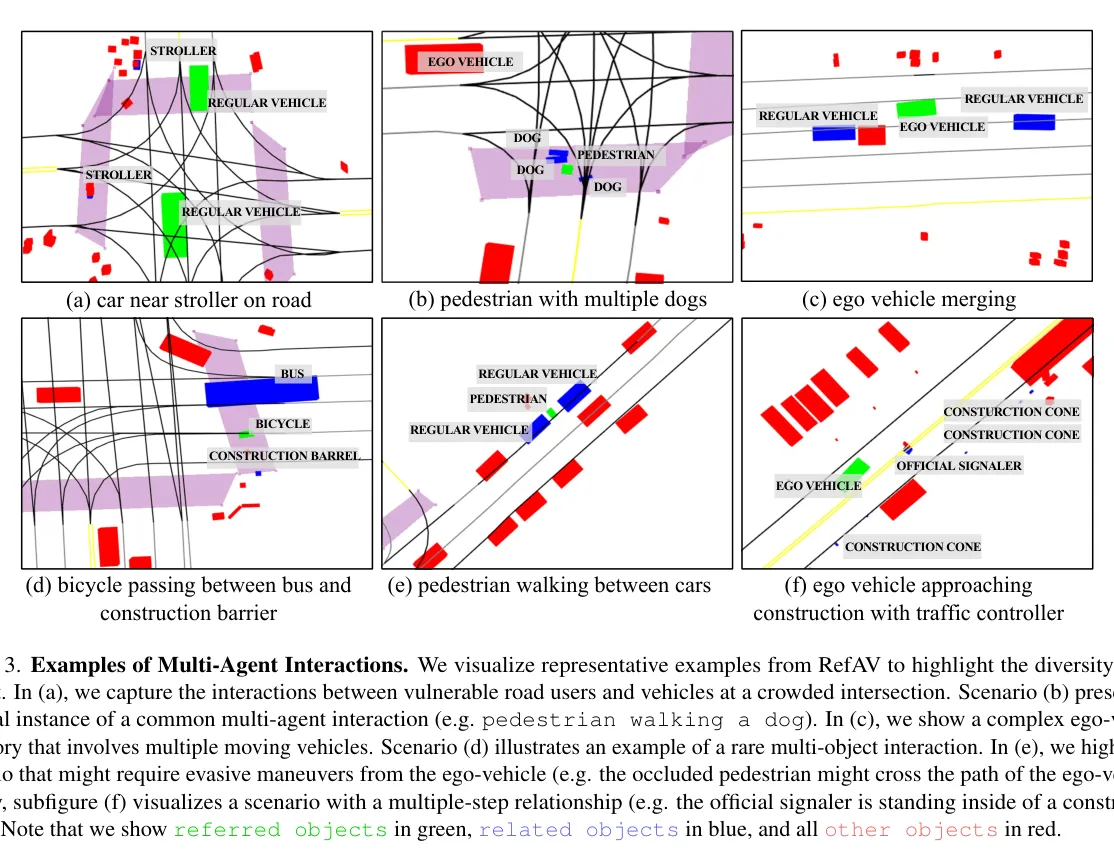
AV 车队每天 pseudo-label TB 级多模态数据,但从未筛选的 log 里找到"有趣/安全攸关"的场景=大海捞针;传统做法靠手写结构化 query,易错且极耗时。本文用 VLM + 自然语言来做。关键:场景挖掘≠已有任务:① 与 RMOT(引用多目标追踪)不同——RMOT 保证被引用物体存在,场景挖掘不保证(含负样本 prompt);② 与多模态 VQA 不同——要输出 3D track 而非文字;③ 与 VLM 运动规划不同——要推理 非 ego 车之间的交互而非预测 ego 轨迹。一句话:要从原始传感器(RGB+LiDAR+HD 地图)判断"场景是否发生 + 在哪 + 何时"。
核心方法(数据集构建 + RefProg)
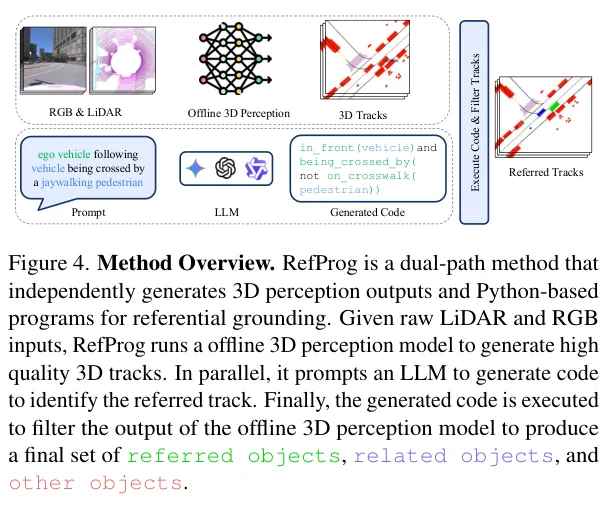
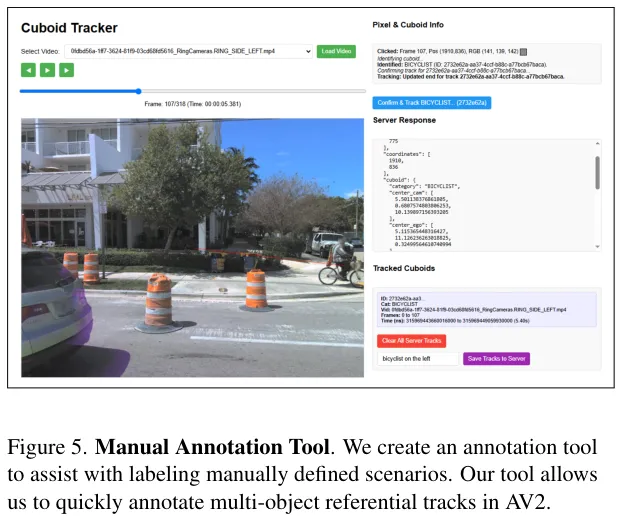
① 数据集(§3.1):基于 Argoverse 2 Sensor(1000 个 15–20s log、7 环视相机+2 LiDAR、HD 地图、30 类、10Hz track——比 nuScenes 2Hz 更细粒度,利于抓运动;track 裁到 50m 因远距 3D 感知还不行)。仿 nuPlan 的 80 个规划场景,定义 28 个原子函数(物体状态/关系[基于场景图]/布尔逻辑:moving、accelerating、turning、changing_lanes、heading_toward、in_same_lane、near、on_intersection、scenario_and/or/not 等)。LLM 程序化生成:给 Claude 3.7 Sonnet API+示例→生成"程序+对应 NL 描述"→在 1000 log 的 GT track 上执行得 >50K 真阳匹配→采样 8000 真阳(最大化多样性)+2000 真阴。成功率 70%,再人工核验 200 小时(每条 ~3min)。② RefProg 方法(§3.2,Fig4):双路——一路跑离线 3D 感知出高质量 track,一路让 LLM 按 query 生成 Python 代码(用原子函数 API + SigLIPv2 视觉工具),执行代码过滤 track→分成 referred/related/other 三类。注意:RefProg 的代码不经人工核验直接执行(区别于数据集生成时的人工修正)。
关键结果
• 现成 VLM 很拉,RefProg 大幅领先(Table2,HOTA-Temporal↑):无语言全标 referred 13.3 → Filter by Class 19.2 → Image-Embedding 17.2 → ReferGPT 20.2 → LLM 当黑盒 37.2 → RefProg 50.1(+13.8%);用 GT track 时 RefProg 达 64.8。
• CVPR 2025 挑战赛:8 队参赛、4 队超最佳基线,冠军 Zeekr UMCV 53.4(+3.3%),所有获胜方案都基于 RefProg。
• LLM 消融(Table3):Claude 3.7 Sonnet HOTA-Temporal 最高 50.1;Claude 3.5 Sonnet 程序失败率最低 0.5%(99.5% 可运行)vs Qwen-2.5-7B 18.1%。
• 跨数据集泛化(Table4):RefProg 零样本上 nuPrompt(StreamPETR)AMOTA 0.321,反超在该域训练过的 PromptTrack 0.259——原子函数是通用运动基元。
亮点
① 把"场景挖掘"定义成一个干净的新任务(含负样本 prompt、要 3D track 时空定位、10Hz 抓动态),并指出它和 RMOT/VQA/规划的本质区别;② 程序合成绕开 VLM 的弱项——VLM 直接做组合推理+运动理解很差,但让它"写程序调原子函数"就强(把语义理解和几何定位解耦);③ 原子函数可跨数据集复用(nuPrompt 零样本超 SOTA);④ 双向用 LLM 很巧:生成数据集时"由代码反推 NL"(更容易、且人工修正),推理时"由 NL 生成代码"。
疑问 / 待核
① HOTA-Temporal 绝对值仍低(最佳 50.1,GT track 上限也才 64.8)——说明任务远未解决,且强受限于现成 3D 感知/track 质量(论文 Limitations:jittery track→短时运动分类错)。② RefProg 受 API 表达力限制:涉及天气/光照等原子函数覆盖不到的 prompt 就失败,"不断加原子函数"不可扩展。③ 数据集生成靠 LLM+人工核验,两类系统性错误(边界 case 误纳、referred/related 反转)即便核验仍可能残留;AV2 规模相对工业级数据仍小。④ arXiv v3(2025-12)题为 RefAV,含 CVPR2025 挑战赛复盘,与早期版本相比 baseline 换成了 GPT-5/SigLIP2 等更新模型。
📖 逐段精读 · 笔记
批量精读初稿(基于本地 PDF 全文 118.9K 字符 / 28 页提取,正文+核心表,跳过参考文献)。原文英文原句 + 中文指路,追问 why、给数值表、外部概念标“外部非本文”、原文未写处标“原文未写/需查”。
① Abstract(摘要)逐句精讲
原句①(痛点):“Autonomous Vehicles (AVs) collect and pseudo-label terabytes of multi-modal data localized to HD maps … identifying interesting and safety-critical scenarios from uncurated driving logs remains a significant challenge. Traditional scenario mining techniques are error-prone and prohibitively time-consuming, often relying on hand-crafted structured queries.”
指路:车队每天 pseudo-label TB 级多模态数据(已对齐到 HD 地图),但从未筛选 log 里捞安全攸关场景是大海捞针;传统手写结构化 query 又慢又错。
原句②(任务定义):“we revisit spatio-temporal scenario mining through the lens of recent vision-language models (VLMs) to detect whether a described scenario occurs in a driving log and, if so, precisely localize it in both time and space.”
指路:任务双要素——是否发生(允许不发生=负样本) + 时间与空间上精确定位(输出 3D track)。
原句③(数据+核心发现):“we introduce RefAV, a large-scale dataset of 10,000 diverse natural language queries that describe complex multi-agent interactions relevant to motion planning derived from 1000 driving logs in the Argoverse 2 Sensor dataset … naively repurposing off-the-shelf VLMs yields poor performance, suggesting that scenario mining presents unique challenges.”
指路:1 万条 NL query / AV2 1000 个 log;直接拿现成 VLM 来做效果很差是全文最关键的实证结论。最后还复盘了 CVPR 2025 挑战赛(“we discuss our recently held competition”)。
📚 背景知识(外部,非本文原创,帮助看懂正文)
① 三个近邻任务(本文要刻意区分):RMOT(referential multi-object tracking,Refer-KITTI/nuPrompt)=按语言找物体并跨帧关联,但默认被引用物体一定存在;多模态 VQA=带 LiDAR 的视觉问答,输出文字;VLM 运动规划=按高层语言指令预测 ego 未来 waypoint。场景挖掘三者都不是。
② Argoverse 2 / nuScenes / nuPlan:AV2 Sensor=1000 个 15–20s log、7 环视相机+2 LiDAR+HD 地图、30 类、10Hz track 标注;nuScenes 仅 2Hz、类少、无 HD 地图(故本文选 AV2);nuPlan 提出 80 个“规划相关场景”,本文借它当 query 模板。
③ 程序合成(program synthesis,本文方法的思想源头):VisProg / ViperGPT 让 LLM 生成可执行代码、调用 CLIP/GLIP/MiDaS/OwlViT 等工具做视觉推理;但它们多是单帧,本文把这套搬到视频时序的多智能体交互。
④ HOTA(外部,本文评测基石):HOTA=把检测、关联、定位统一平衡的追踪指标,比 MOTA 更贴近人眼判断。本文派生两个变体(详见⑨)。另用 Balanced Accuracy 抗正负样本不平衡。
② §1 Introduction:problem → solution → why 闭环
problem:“identifying interesting and safety-critical scenarios from uncurated real-world driving logs is akin to finding a ‘needle in a haystack’ due to the scale of data.” 用 “Pittsburgh left”(抢左转,匹兹堡常见但 “technically illegal”)当招牌例子:这类罕见但安全攸关的机动,正是端到端自驾 safety case 必须挖出来验证的。
why 不同于近邻任务(原文逐条):“unlike RMOT, scenario mining does not guarantee that referred objects exist”;“we require that methods output 3D tracks instead of text-based answers”;“scenario mining methods can reason over the full driving log to identify interactions between non-ego vehicles”。三句话精确切割出新任务边界。
solution(RefProg):“we propose Referential Tracking by Program Synthesis (RefProg), a modular approach that combines off-the-shelf 3D tracks with LLMs … use an LLM to break down complex referential expressions into simpler compositional actions … synthesize a program that composes these atomic actions … execute the generated program to filter off-the-shelf tracks.” 关键洞察:find all cars accelerating while changing lanes 可拆成 cars + accelerating + changing_lanes 的组合。
三大贡献(原文 Contributions):① 提出 RefAV 数据集评测 VLM 的 3D 场景理解+时空定位;② 大量实验揭示现有方法局限、证明程序合成有效;③ 复盘 CVPR 2025(与 Workshop on Autonomous Driving 合办)挑战赛结果。
③ §3.1 数据集构建机制:28 个原子函数 + LLM 程序化生成
为何选 AV2(原文):“prior datasets like nuScenes only annotate ground-truth tracks at a lower temporal resolution (e.g. 2Hz vs. 10Hz), making it more difficult to extract fine-grained motion”;KITTI/Waymo “only label a limited number of categories … and do not have HD maps”。track 裁到 50m:“current 3D perception models struggle with long-range detection … the community is not ready to address spatio-temporal scenario mining at range.”
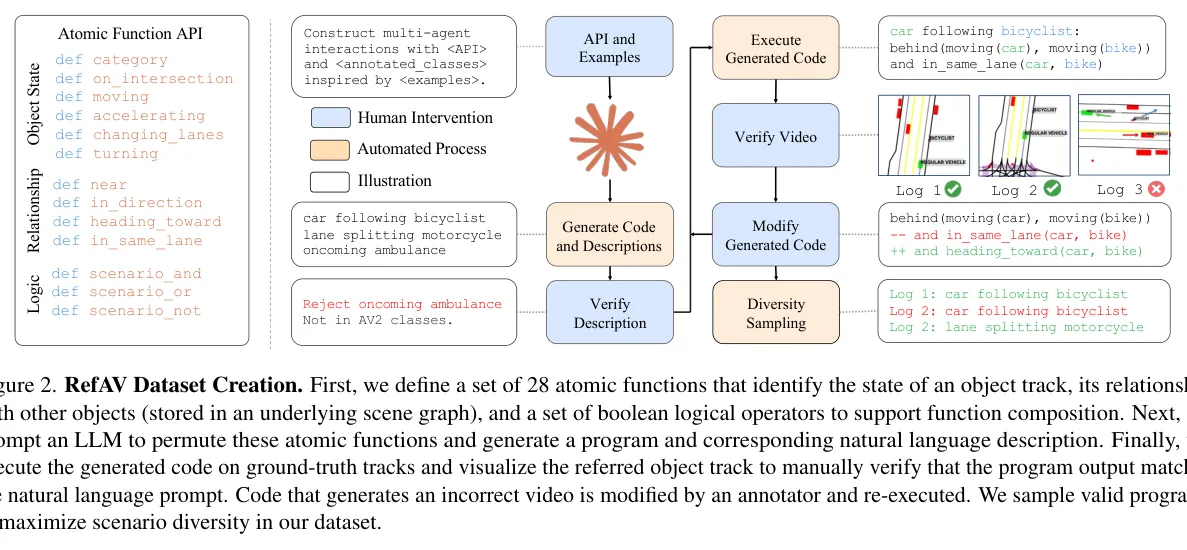
原子函数 API(Fig 2 左,28 个,分三组):对象状态
car following bicyclist ⇒ behind(moving(car), moving(bike)) and in_same_lane(car, bike)
moving / accelerating / turning / changing_lanes;关系(基于底层 scene graph)near / in_direction / heading_toward / in_same_lane / on_intersection;逻辑算子 scenario_and / scenario_or / scenario_not;外加 category 选类。组合式伪代码示例(原文 Fig):car following bicyclist ⇒ behind(moving(car), moving(bike)) and in_same_lane(car, bike)
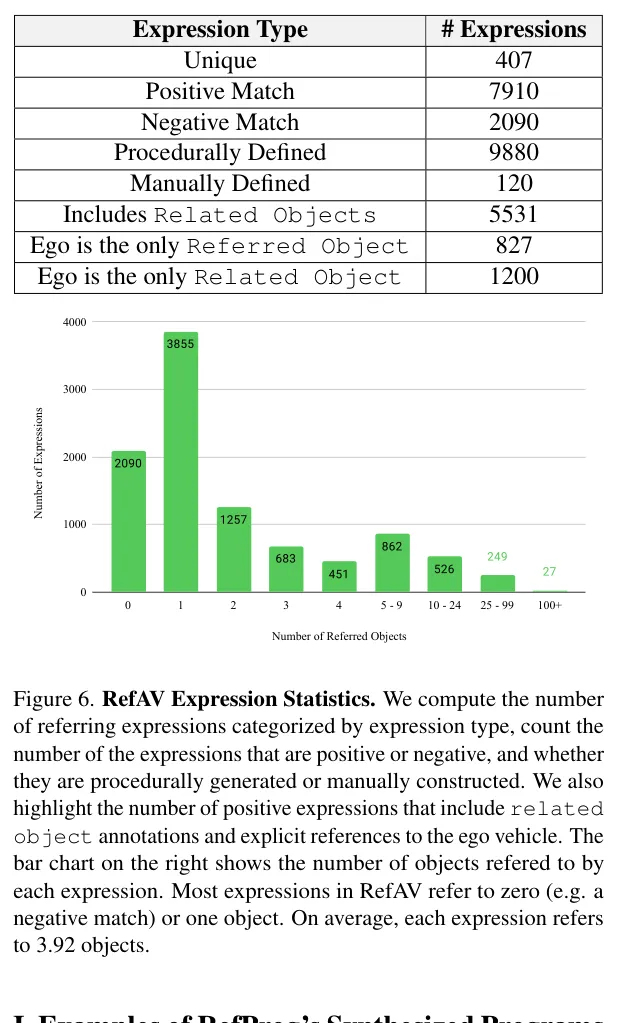
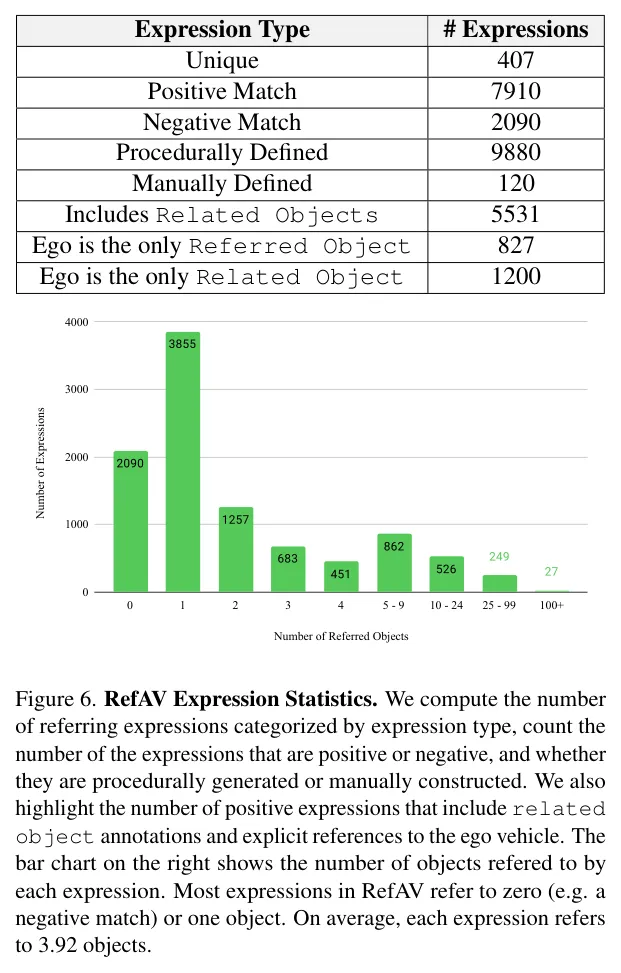
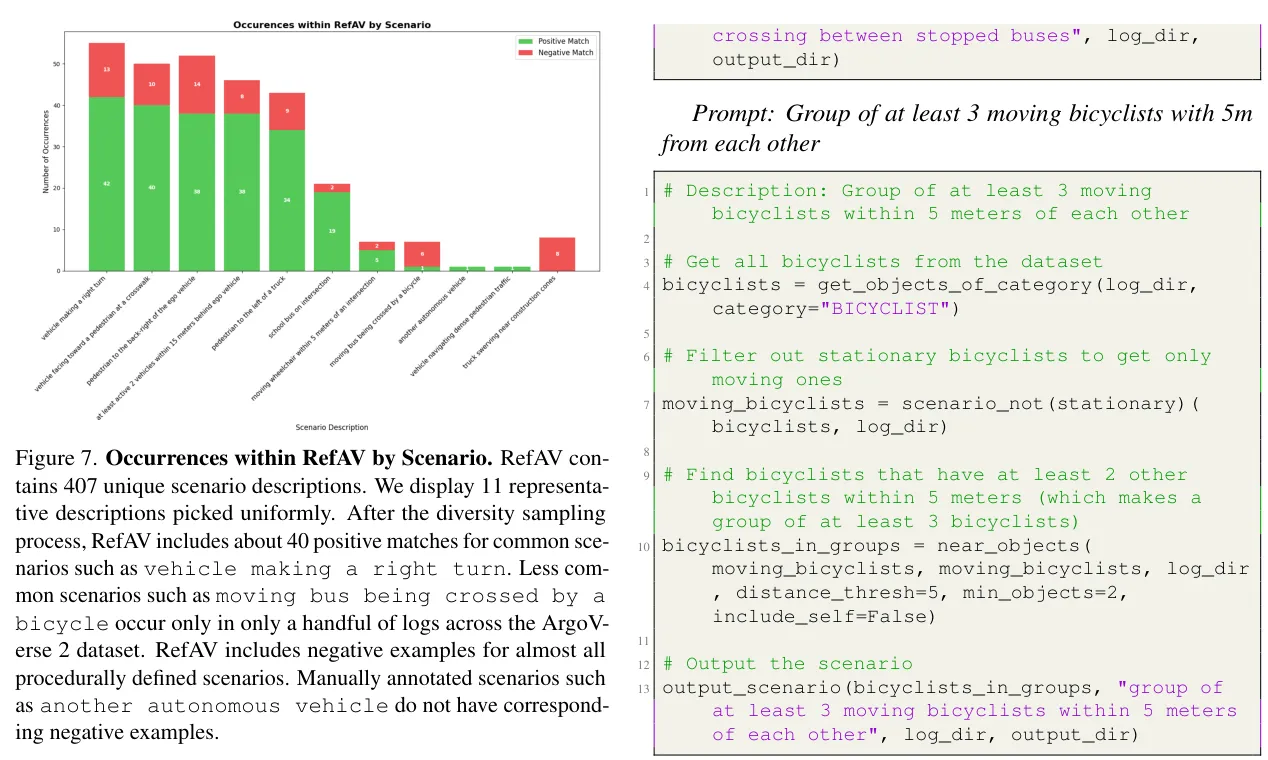
生成流程(原文):给 LLM(Claude 3.7 Sonnet)完整 API listing + 真实组合的 in-context 示例 → 让它 “permute these atomic functions and generate a program and corresponding natural language description” → 在 1000 个 log 的 GT track 上执行得 >50K 真阳匹配 → 采样 8,000 真阳(最大化场景多样性)+随机采 2,000 真阴。自动流水线平均成功率 70%。
④ §3.1 人工核验:两类系统性误差(200 小时)
误差①(边界 case under/over-specification):“the LLM often defines the prototypical case … but misses or incorrectly includes edge cases.” 例:car following a bicyclist 的生成代码把反向行驶(opposite directions)的 false positive 也纳入了。
误差②(referred/related 反转):“LLMs often reverse the relationship of referred and related objects.” 例:bicycles in front of the car 被写成了 car behind the bicycles。人工看视频改代码重跑,每条 ≈3 分钟,合计 200 小时。另人工标注 val/test 的天气(clear/cloudy/rain/snow/fog)与光照(daylight/dusk-dawn/night),用于全工况 safety case。
⑤ 数据集统计(Table 1 全表,verbatim 数字)
表头:Base Data · Task · View · Anno.Freq · #Expressions · #Frames · Neg.Prompts。
• Talk2Car:nuScenes · Detection · Front · 12k · 9k · ✗
• nuScenes-QA:nuScenes · VQA · 360° · 2Hz · 460k · 34k · ✓
• DriveLM:nuScenes · VQA · 360° · 2Hz · 443k · 5k · ✗
• OmniDrive:nuScenes · VQA · 360° · 2Hz · 200k · 34k · ✗
• Refer-KITTI:KITTI · RMOT · Front · 2Hz · 818 · 7k · ✗
• nuGrounding:nuScenes · RMOT · 360° · 2Hz · 2.2M · 34k · ✗
• nuPrompt:nuScenes · RMOT · 360° · 2Hz · 407k · 34k · ✗
• RefAV:Argoverse 2 · RMOT & Scenario Mining · 360° · 10Hz · 10k expr · 155k frames · Neg ✓。原文:RefAV 不比别人 query 多,但“focus on capturing diverse multi-agent interactions”,且“one of only two datasets to support negative prompts”。
⑥ §3.2 五个零样本基线逐一拆解
① Filter by Referred Class(盲基线):“does not explicitly reason about multi-agent interactions”——用 LLM 解析出被引用类,只留该类 track。② ReferGPT:把每条 track 的 3D box 投到 2D 取 crop(同一时刻取面积最大那个相机视角)→ VLM 生 caption(GPT-5-mini)→ 与 prompt 算文本余弦相似(SigLIP2 文本嵌入);相似度超阈值占 track 长度 >50% 才算 referred。
③ Image-Embedding Similarity:直接用 CLIP 图像特征 vs prompt 文本嵌入算逐帧余弦相似(>50% 帧超阈值算 referred)。④ LLM API as a Black Box:把地图+city2ego 变换+现成 track 喂 GPT-5(OpenAI Responses API),直接吐出 referred 物体 CSV——“analyzing the thinking traces of GPT-5 shows that it writes code from scratch to parse the input files”(黑盒自己在 CoT 里写代码)。⑤ RefProg:见下。
⑦ RefProg 机制(§3.2,Fig 4,双路 + 与数据集生成器的两点区别)
双路(dual-path):一路对原始 LiDAR/RGB 跑 offline 3D 感知出高质量 track;一路让 LLM 按 query 生成调原子函数 API 的 Python 代码(并可调 SigLIPv2 视觉工具取视觉属性)→ 执行代码过滤 track → 分成
referred / related / other 三类。本质是把“语义理解”交给 LLM 写程序、把“几何定位”交给现成 3D track,解耦。与生成器的两点区别(原文):① 方向相反——RefProg “generates code based on the referential query”,而生成器 “synthesizes the referential query based on the generated code”;论文判断生成器更易,因为 “there are many valid natural language prompts to describe a generated program, but significantly fewer valid programs corresponding to each natural language prompt”。② RefProg 的代码 “executed without verification”(不经人工核验直接跑),生成器的代码则被人工大改。
⑧ 评测指标:HOTA-Temporal / HOTA-Track / Balanced Accuracy
HOTA-Temporal:“only considering the referred timestamps within a track as true positives”——只把被引用动作真正发生的那些时间戳算 TP(对 car turning right,只有正在右转的帧算对)。HOTA-Track:同上但 “does not penalize methods for incorrectly predicting the start and end of a referred action”(不罚动作起止时刻预测错,把整条 referred track 的时间戳都当 TP)。两者只对 referred 类报,related/other 在附录。Balanced Accuracy:分 log-level 与 timestamp-level 两个分类指标;“used over … F1 due to the imbalance of positive and negative prompts”。
⑨ §4 主实验全表(Table 2,HOTA / HOTA-Temporal↑ / HOTA-Track↑ / LogBal↑ / TSBal↑,PDF 原值)
• 无语言全标 referred(GT track):100.0 / 13.3 / 20.5 / 50.0 / 50.0
• Filter by Class:GT 100.0 / 21.4 / 33.9 / 52.9 / 57.2 ;LE3DE2E 74.4 / 19.2 / 30.0 / 53.4 / 55.0
• Image-Embedding:GT 100.0 / 24.6 / 28.3 / 54.7 / 57.0 ;LE3DE2E 74.4 / 17.2 / 24.4 / 51.1 / 51.1 ;ReVoxelDet 63.1 / 17.1 / 21.2 ;TransFusion 63.6 / 16.0 / 18.2
• ReferGPT(LE3DE2E):74.4 / 20.2 / 30.8 / 57.0 / 57.1
• LLM Black Box(LE3DE2E):74.4 / 37.2 / 39.2 / 58.4 / 62.3
• RefProg:GT 100.0 / 64.8 / 68.7 / 81.1 / 80.7 ;LE3DE2E 74.4 / 50.1 / 51.1 / 71.8 / 74.6 ;ReVoxelDet 63.1 / 43.9 / 45.1 ;TransFusion 63.6 / 48.1 / 46.6 ;Valeo4Cast 69.2 / 41.7 / 44.1。
读数:RefProg(LE3DE2E) 比 LLM 黑盒 +13.8% HOTA-Temporal(50.1 vs 37.2,原文确认);用 GT track 上限才 64.8——感知/track 质量是天花板。有趣细节:Filter by Class 用预测 track(19.2)几乎不输 GT(21.4),因 “Le3DE2E has exceptionally high tracking accuracy for REGULAR VEHICLE, which dominates the AV2 dataset”;Image-Embedding 用预测 track(17.2)反低于 Filter by Class(19.2),因 “CLIP being much more sensitive to the predicted 3D location”。
⑩ §4 LLM 消融全表(Table 3,Failure Rate↓ / HOTA-T↑ / HOTA-Track↑ / LogBal / TSBal)
• Qwen-2.5-7B-Instruct:18.1 / 31.6 / 34.4 / 62.1 / 62.0
• gemini-2.0-flash:2.6 / 45.2 / 46.6 / 72.1 / 74.6
• gemini-2.5-flash-preview-04-17:15.4 / 47.8 / 47.6 / 71.0 / 73.8
• claude-3.5-sonnet-20241022:0.5(最低失败率,即 99.5% 程序可运行)/ 46.1 / 47.5 / 71.8 / 71.8
• claude-3.7-sonnet-20250219:2.9 / 50.1(最高 HOTA-T)/ 51.1 / 71.8 / 74.6。
读数:Failure Rate=生成程序运行抛异常的比例;Gemini-2.5/Qwen 常 “try to generate full programs using invalid import statements” 导致高失败率。Claude 3.7 因 “explicitly tuned for code generation and instruction following” 综合最好。
⑪ §4 跨数据集泛化全表(Table 4,nuPrompt 零样本,AMOTA↑/AMOTP↓/Recall↑/MOTA↑)
• CenterPoint(DETR3D) 0.079 / 1.820 / 0.196 / 0.093 ;CenterPoint(PETR) 0.178 / 1.650 / 0.291 / 0.197
• DQTrack(DETR3D/Stereo/PETRv2) 0.186 / 0.198 / 0.234 …
• ADA-Track(PETR) 0.249 / 1.538 / 0.353 / 0.270
• PromptTrack(DETR3D) 0.202 ;PromptTrack(PETR) 0.259 / 1.513 / 0.366 / 0.280
• RefProg(StreamPETR) 0.321 / 1.238 / 0.504 / 0.329。
读数:RefProg 零样本反超在 nuPrompt 训练过的 PromptTrack(0.259)、ADA-Track(0.249)。适配仅 “swap out the AV2 class list for the nuScenes class list and remove atomic functions that require an HD map”,且 “zero modifications to our atomic action definitions”——证明原子函数是通用运动基元。
⑫ 失败分析 + Limitations + CVPR 2025 挑战赛
失败分析:Image-Embedding/ReferGPT 差,因 2D crop “lacks the context required to understand multi-agent interactions … does not contain information about past or future frames”(缺时序上下文);RefProg 在 “API listing is not expressive enough”(天气/光照类 prompt)时失败,“although one can always add new atomic actions, this strategy is not scalable”(堆原子函数不可扩展)。Limitations:数据集质量受 AV2 GT 感知标注限制(“jittery tracks can lead to poor motion classification over short horizons”);AV2 相对工业级数据仍小。
挑战赛(CVPR 2025):8 队参赛、4 队超最佳基线,前三(HOTA-Temporal):Zeekr UMCV 53.4(LogBal 66.3 / TSBal 76.6)、Mi3 UCM 52.4、ZXH 52.1;冠军超基线 +3.3%,且 “All winning submissions to our challenge build upon RefProg”(所有获胜方案都基于 RefProg)。
⑬ §2 Related Works:本文在文献里的坐标
引用接地与追踪谱系:早期 RefCOCO/RefCOCO+/RefCOCOg 普及单帧 referential grounding;Refer-KITTI “formalizes the problem of 2D referential multi-object tracking (RMOT)”,ReferKITTI-v2 用 LLM 扩展 prompt 多样性,LaMOT 把 4 个追踪数据集 1,660 个序列合成统一 RMOT 基准。方法分两支:两阶段(先 track 再按语言过滤,如 iKUN、ReferGPT 用 CLIP 分数+模糊匹配过滤现成 3D track)与端到端(JointNLT 统一接地与追踪、MMTrack 把追踪重构成 token 生成、ReferFormer 用语言条件 object query)。nuPrompt 把 2D 引用追踪扩到 3D(RGB 输入)。RefAV 的差异:“RefAV addresses 3D multi-modal referential tracking and dynamic scene understanding”——多模态(RGB+LiDAR+HD 地图)、3D、动态交互、含负样本,是本文区别于上述所有工作的卖点。
VLM/程序合成谱系:LLaVA、BLIP-2、Qwen2.5-VL 等泛化强,但 “state-of-the-art models still struggle with spatial reasoning and grounding”;SpatialRGPT/SpatialVLM 用单目深度伪标签补 3D 推理;VisProg/ViperGPT 让 LLM 生成可执行代码调 OwlViT/CLIP/MiDaS/GLIP,但 “primarily focus on single-frame reasoning”。本文明确 “take inspiration from existing methods and apply similar program synthesis-based approaches for spatio-temporal scenario mining”——即把单帧程序合成升级到视频时序多智能体。
📌 全文总结(problem→data→method→experiment→takeaway,≥3 条硬结论)
problem:从未筛选 AV 驾驶 log 里用自然语言挖“安全攸关场景”——大海捞针;且这是个区别于 RMOT/VQA/规划的新任务(含负样本、要 3D track 时空定位、推理非 ego 交互)。data:RefAV=基于 Argoverse 2(10Hz/HD 地图/30 类)的 1 万条 query(8k 真阳+2k 真阴、155k 帧),28 原子函数+Claude 3.7 程序化生成+200h 人工核验,带天气/光照与负样本。method:RefProg=LLM 把 query 合成成调原子函数的 Python 程序,在现成 3D track 上执行过滤出 referred/related/other(语义理解与几何定位解耦)。
takeaway 1:“naively repurposing off-the-shelf VLMs yields poor performance”——直接用 VLM/引用追踪基线 HOTA-Temporal 仅 13–37,而 RefProg 达 50.1(+13.8%),挑战赛冠军 53.4 且全基于它。程序合成绕开了 VLM 在组合推理+运动理解上的弱项。
takeaway 2:原子函数是可跨数据集复用的通用运动基元——nuPrompt 零样本(0.321 AMOTA)反超训练方法。
takeaway 3:任务远未解决——GT track 上限也才 64.8 HOTA-T,瓶颈在现成 3D 感知/track 质量与原子函数 API 表达力(堆函数不可扩展)。这与本仓库 BEV/3D 感知/追踪方向直接相关(论文本身领域,非强行类比):上游 track 质量直接决定下游场景挖掘上限。
🖼 论文原图(本地 PDF 截图,原文 caption 未改写)