CVPR 2026 Finalist
ProPhy: Progressive Physical Alignment for Dynamic World Simulation
Zijun Wang ⋅ Panwen Hu ⋅ Jing Wang ⋅ Terry Jingchen Zhang ⋅ Yuhao Cheng ⋅ Long Chen ⋅ Yiqiang Yan ⋅ Zutao Jiang ⋅ Hanhui Li ⋅ Xiaodan Liang
摘要 Abstract
Recent advances in video generation have shown remarkable potential for constructing world simulators. However, current models still struggle to produce physically consistent results, particularly when handling large-scale or complex dynamics. This limitation arises primarily because existing approaches respond isotropically to physical prompts and neglect the fine-grained alignment between generated content and localized physical cues. To address these challenges, we propose ProPhy, a Progressive Physical Alignment Framework that enables explicit physics-aware conditioning and anisotropic generation. ProPhy employs a two-stage Mixture-of-Physics-Experts (MoPE) mechanism for discriminative physical prior extraction, where Semantic Experts infer semantic-level physical principles from textual descriptions, and Refinement Experts capture token-level physical dynamics. This mechanism allows the model to learn fine-grained, physics-aware video representations that better reflect underlying physical laws. Furthermore, we introduce a physical alignment strategy that transfers the physical reasoning capabilities of vision-language models (VLMs) into the Refinement Experts, facilitating a more accurate representation of dynamic physical phenomena. Extensive experiments on physics-aware video generation benchmarks demonstrate that ProPhy produces more realistic, dynamic, and physically coherent results than existing state-of-the-art methods.
📝 精读笔记
灵魂一句
中山大学×鹏城实验室×MBZUAI 等:给"文生视频世界模拟器"加一条 物理分支,用两阶段 Mixture-of-Physics-Experts(MoPE)——Semantic Expert(视频级,从文字推物理原理)→ Refinement Expert(token 级,捕局部物理动力学)——把物理先验逐步注入到对应空间区域,实现"各处响应各自物理规律"的各向异性(anisotropic)生成。关键招:把 VLM(Qwen2.5-VL-32B)的物理定位能力蒸馏进 Refinement Expert。在 VideoPhy2 上 CogVideoX 的 Joint 物理通过率 +19.7%。原文:“a Progressive Physical Alignment Framework that enables explicit physics-aware conditioning and anisotropic generation”。
问题 & 动机
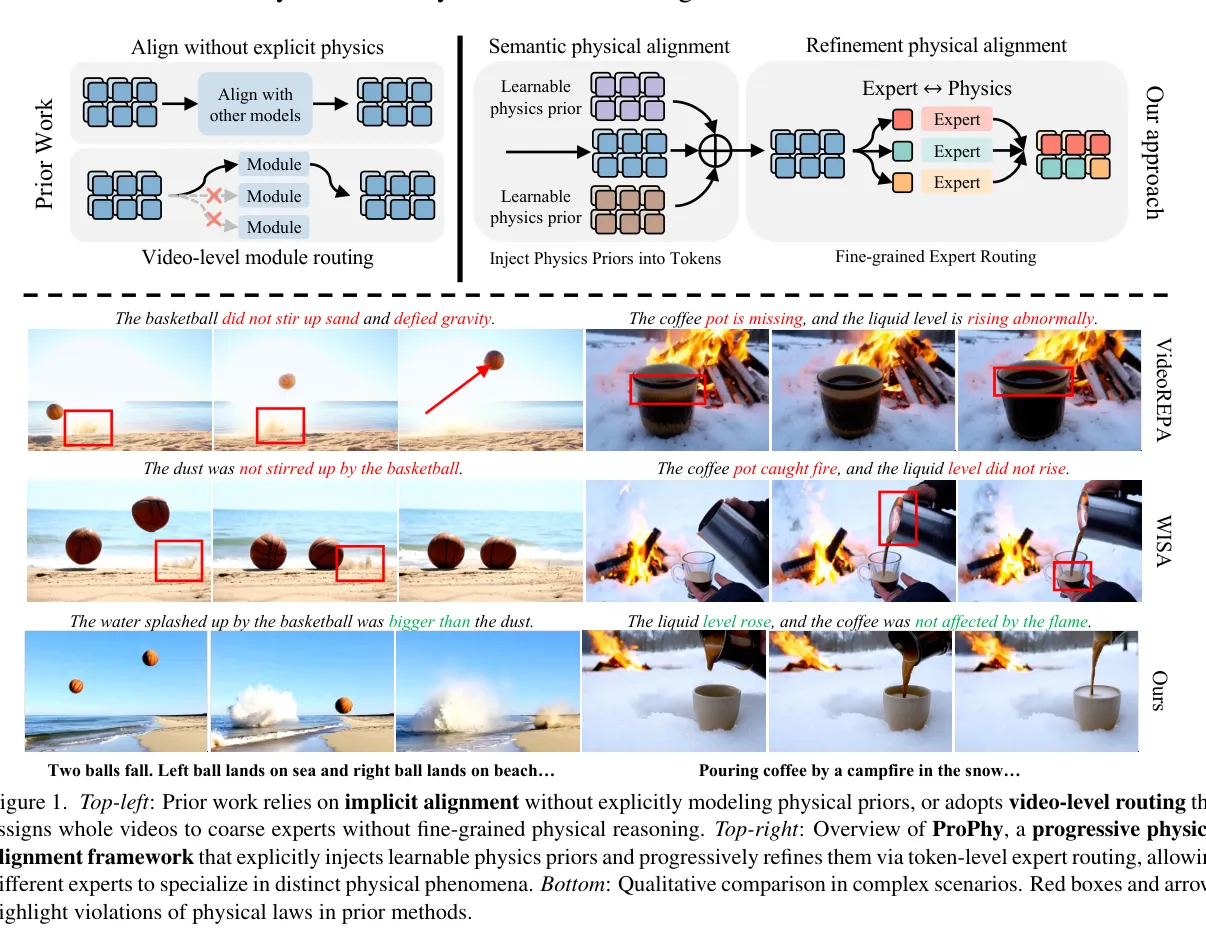
视频生成视觉很真但物理不一致(尤其大尺度/复杂动力学),当不了真正的 world simulator。根因两条:① 各向同性响应物理 prompt——现有法多在训练时"内化"物理先验、推理时没有显式物理引导(VideoREPA 蒸馏、PhysMaster/PISA 强化学习),复杂场景就违反物理;② 缺细粒度对齐——即便 WISA 用了 MoPE 显式引导,也是全局级,多个物理现象共存或局部发生时抓不住(如篮球溅水 vs 扬尘是不同区域不同物理)。故定义两个必须攻克的挑战:(a) Explicit physical guidance(让不同物理定律的表示更可判别)、(b) Fine-grained physical alignment(让不同空间区域准确响应局部物理线索)。
核心方法(两阶段 MoPE + 关键公式)
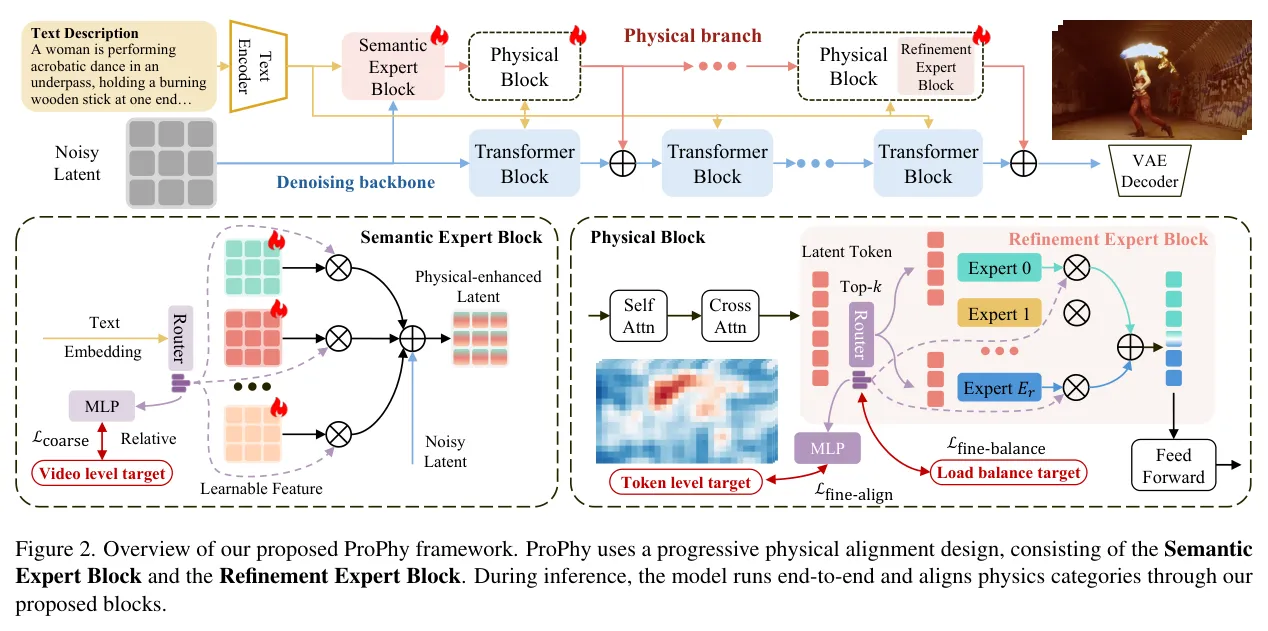
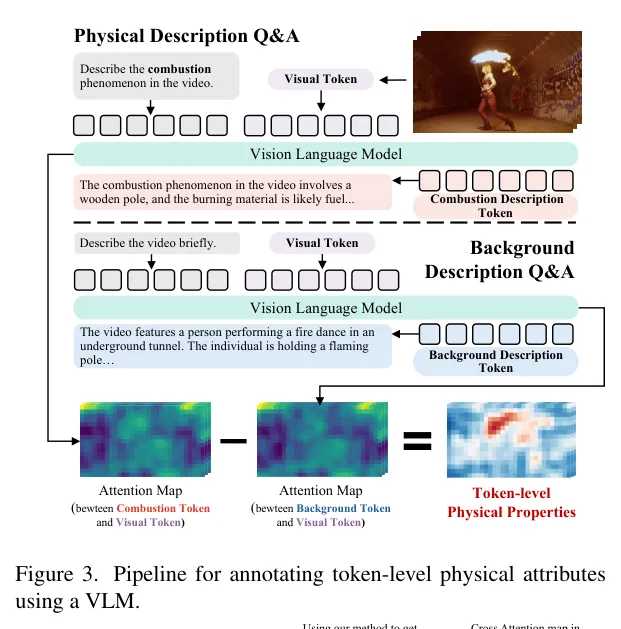
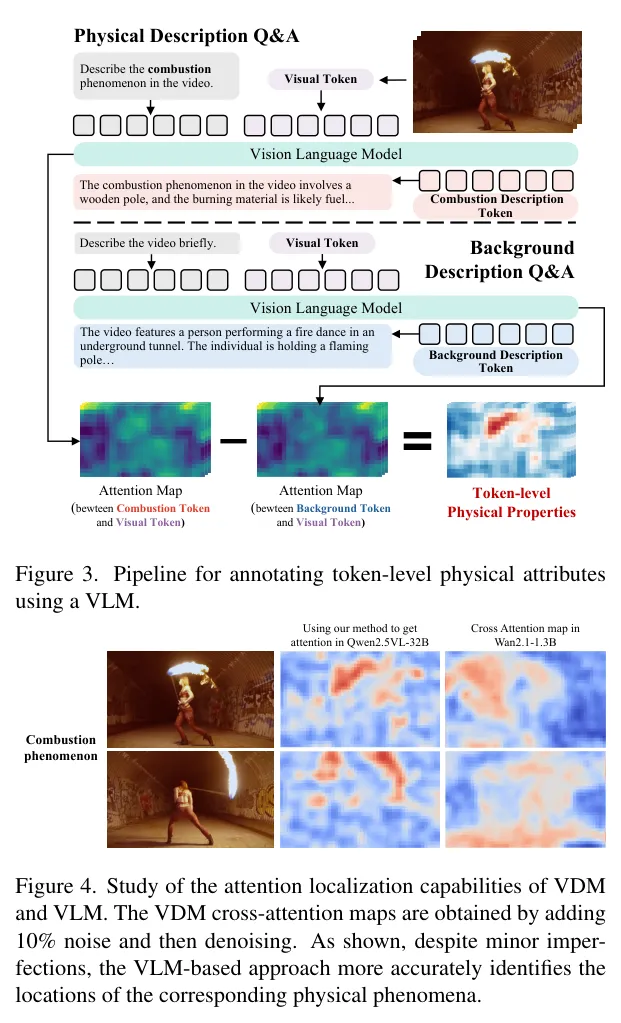
建在 latent 视频扩散 backbone(WAN2.1-1.3B / CogVideoX-5B)上,加 Physical Branch=SEB + 多个 Physical Block(PB,复制 backbone block 权重初始化、输出顺序注入 latent、渐进累积物理信息)+ REB。① SEB(视频级):E_s 个可学习物理 basis map B_e∈ℝ^(N×C)(与 latent 同形),semantic router 从文本给归一化权重 ρ_p,物理增强 latent X̃ = X + Σ_e ρ_e^p·B_e(式1);用连续加权(非标准 top-k)防小 batch 下 mode collapse。② REB(token 级):每个 token 由 refinement router 选 top-k 专家(线性层),x̃′ = Σ_{i∈argtopk ρ_r} ρ_r^i·e_θ^i(x̃)(式2)。③ 两个对齐目标:语义对齐 L_coarse=Σ_{i<j}‖P_s^{i,j}−Q_s^{i,j}‖²(式4)(同物理类别的视频 routing 权重相似,标签来自 WISA-80K 类别向量);细粒度对齐 L_fine-align=Σ_{M=1}‖P′_r−Q_r‖²(式5)(用 VLM 对"物理现象问句↔视频 token"的注意力图减背景图,得 token 级目标 Q_r)。总损失 L=L_diffusion+λ1·L_coarse+λ2·L_fine-align+λ3·L_fine-balance(式6),λ1=0.1/λ2=0.02/λ3=0.01。
关键结果
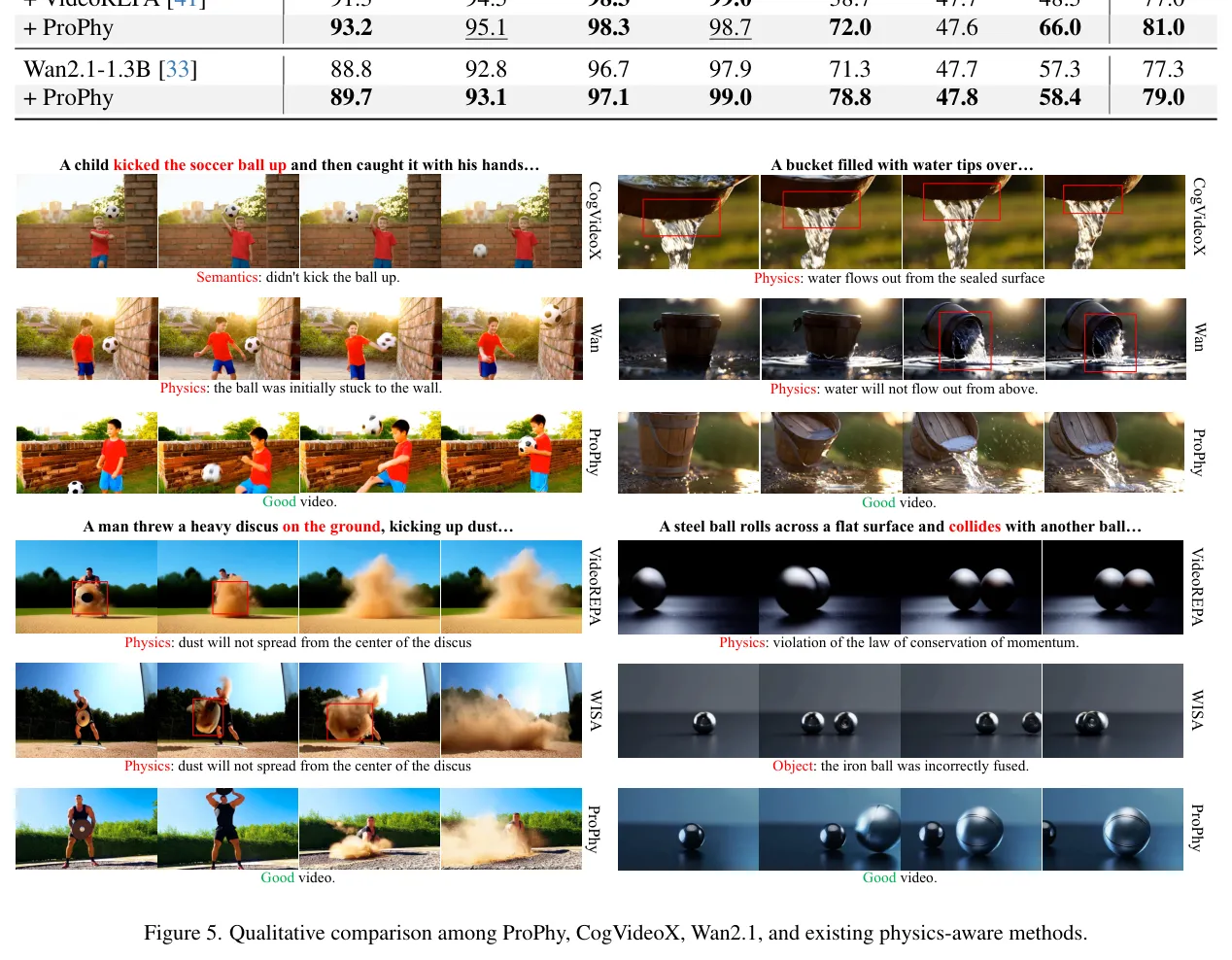
• VideoPhy2(PC 物理常识 / SA 语义符合 / Joint 联合通过,≥4 分算过):CogVideoX-5B Joint 22.3→26.7(+19.7%)、PC 67.2→72.5、SA 29.0→32.2;Wan2.1-1.3B Joint 24.8→26.5。对比 VideoREPA 虽把 PC 拉到 72.5 但 SA 暴跌到 24.2、Joint 仅 22.0(顾此失彼),ProPhy PC/SA 双高。HARD 子集 Wan Joint 5.6→7.2。
• VBench 质量:最大增益在 Dynamic Degree——CogVideoX 46.8→72.0、Quality Score 76.8→81.0(VideoREPA 反而把 Dynamic 拉到 38.7)。
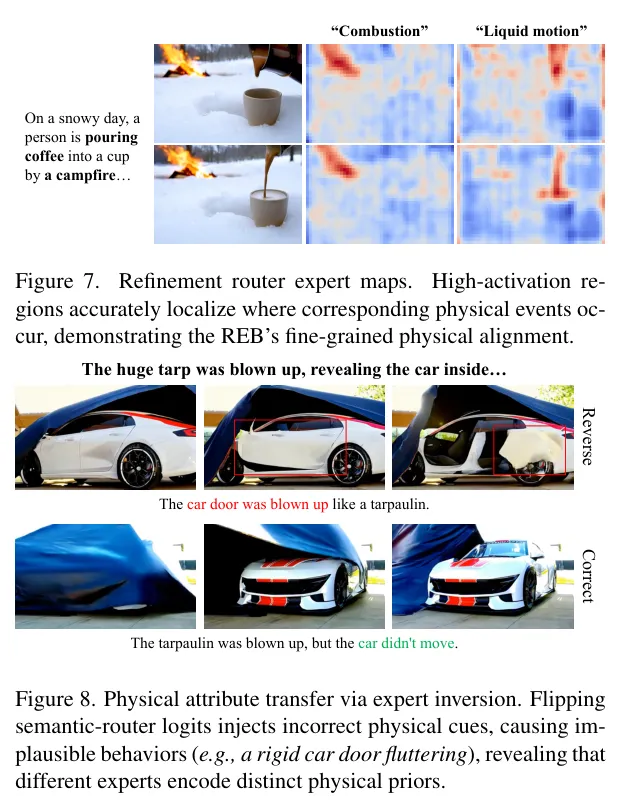
• 专家可解释:SEB router 相关物理类(燃烧↔爆炸)Pearson r=0.86/0.97、无关类(爆炸↔折射)r=0.02/0.21;翻转 router logits 注入错误物理→刚性车门像布一样飘(证明各专家编码不同物理先验)。
亮点
① 把"物理引导"从全局级推进到 token 级各向异性——同一视频里不同区域走不同物理专家(铲球扬尘只在触地时触发、铁球碰撞守动量);② 用 VLM 的注意力做空间物理监督是巧招(生成模型自己定位物理现象弱、VLM 强,Fig4 实证),减背景图去噪声;③ 即插即用(两个 backbone 同套 λ 无需调参)、消融干净(Table3/4 逐项验证 PB>LoRA、SEB+REB 都涨、相对距离损失优于 BCE)。
疑问 / 待核
① HARD 子集 Joint 绝对值很低(最高仅 7.2/100),复杂物理仍远未解决,"+19.7%"是相对小基数的提升。② 监督信号依赖 VLM 注意力图,噪声大(论文 Limitations 自承"region-level 只抓粗表面 pattern"),且物理类别是离散标注、非真正物理方程——未来才考虑接入 governing PDE。③ 训练只用 WISA-80K 采样 20K 视频,是否泛化到 WISA 分布外的物理现象原文未验。④ 关键公式细节:式5 的 P′_r 由 ρ_r 经 MLP 从 E_r 升维到 E_attn(同时缓解直接对齐的 training conflict),但 E_s/E_r/E_attn 具体取值正文未给(在 Supplementary)。
📖 逐段精读 · 笔记
批量精读初稿(基于本地 PDF 全文 45.5K 字符 / 10 页提取)。原文英文原句 + 中文指路,追问 why、给数值表、外部概念标“外部非本文”、原文未写处标“原文未写/需查”。
① Abstract(摘要)— 逐句精讲
立靶(病根):原文 "current models still struggle to produce physically consistent results, particularly when handling large-scale or complex dynamics. This limitation arises primarily because existing approaches respond isotropically to physical prompts and neglect the fine-grained alignment between generated content and localized physical cues."
指路:视频生成"看着真、物理假",尤其大尺度/复杂动力学。两条根因——① 各向同性(isotropically)响应物理 prompt(整段视频用同一套物理响应);② 忽视"生成内容 ↔ 局部物理线索"的细粒度对齐。
解法(贡献句):原文 "we propose ProPhy, a Progressive Physical Alignment Framework that enables explicit physics-aware conditioning and anisotropic generation. ProPhy employs a two-stage Mixture-of-Physics-Experts mechanism … where Semantic Experts infer semantic-level physical principles from textual descriptions, and Refinement Experts capture token-level physical dynamics."
指路:两阶段 MoPE(Mixture-of-Physics-Experts)——Semantic Expert(视频级,文字→物理原理)+ Refinement Expert(token 级动力学),实现显式物理条件 + 各向异性(anisotropic)生成。
核心 trick:原文 "a physical alignment strategy that transfers the physical reasoning capabilities of vision-language models into the Refinement Experts."
指路:把 VLM(Qwen2.5-VL-32B)的物理推理/空间定位能力蒸馏进 Refinement Expert,这是全文最巧的一招(生成模型自己定位物理弱、判别式 VLM 强)。结果声称 "more realistic, dynamic, and physically coherent results than existing state-of-the-art methods."
📚 背景知识(外部,非本文原创,便于理解)
① World Simulator / 视频扩散(外部):Sora/Cosmos/Genie 想用大规模视频数据训出"会模拟物理世界"的生成模型;但 [Kang2024,物理定律视角] 指出 "Increasing model size or dataset scale alone does not enable generators to learn the physical laws"——单纯堆数据/规模学不会物理。backbone 用 latent video diffusion(VAE 把视频压成 latent + DiT 去噪),ProPhy 建在 Wan2.1-1.3B 与 CogVideoX-5B 上。
② MoE / MoPE(外部):Mixture-of-Experts(Shazeer 2017)——多个专家子网 + router 按输入选 top-k 激活;难点是小 batch 下的 mode collapse(只激活少数专家),靠 load-balancing loss 缓解。MoPE = 把"专家"对应到"物理现象/定律"。WISA[35] 是前作(视频级 MoPE),本文升级为两阶段 + token 级。
③ 前作物理增强法(外部,本文要超越的):VideoREPA[41](蒸馏基础模型的帧间关系)、PhysMaster[10]/PISA[16](RL + 奖励建模)、PhysHPO[5](层级偏好对齐)、WISA[35](从 prompt 识别物理类别 + MoPE)、PhysGen/PhysMotion(物理仿真 MPM 渲染,需预定义动力学参数、泛化差)、NewtonGen[39](Neural Newtonian Dynamics)。
④ 评测基准(外部):VideoPhy2[2]——action-centric 物理常识评测,PC(physical commonsense)+ SA(semantic adherence)各打 1–5 分,"we treat scores of 4 or higher as PC = 1 or SA = 1",Joint = PC 与 SA 都过才记 1(主指标);600 prompts + 180 hard。VBench[9]——7 维质量(含 Dynamic Degree 动态程度),Quality Score 是 7 维加权。
② §1 Introduction — problem → solution → why 闭环
problem(递进批评):原文 "these approaches primarily rely on internalizing physical priors during training, lacking explicit physical guidance during inference. This often leads to generations that deviate from fundamental physical laws in complex scenarios." 对 WISA 的精准批评:"WISA's guidance is largely global-level; it struggles to capture fine-grained processes when multiple physical phenomena coexist or occur within localized regions."
两个必须攻克的挑战(原文定义):"(a) Explicit physical guidance, which enables the representations of different physical laws to become more discriminative … and (b) Fine-grained physical alignment, which allows different spatial regions within a video to respond accurately to localized physical cues."
solution(Intro 即给出):原文 "we introduce a two-stage MoPE mechanism … which mainly consists of a Semantic Expert Block and a Refinement Expert Block. … The Semantic Expert Block first infers physics-specific priors directly from textual prompts, which are subsequently fused with visual features and further processed by the Refinement Expert Block to learn token-wise physical priors."
why VLM(关键洞察):原文 "vision-language models (VLMs) exhibit a more detailed and reliable localization of physical phenomena compared to generative models … our strategy aligns the spatial distributions predicted by the physics experts with those inferred from the VLMs."——生成模型自己定位物理弱、判别式 VLM 强(Fig4 用 Qwen2.5VL-32B vs Wan2.1 cross-attn 实证)。三条贡献:两阶段 MoPE / 细粒度物理对齐策略 / 多 backbone 验证通用性。
③ §2 Related Work — 三类物理增强法的坐标
本文把已有工作分三类并逐一指出短板:① Physics simulation(PhysGen/PhysMotion 用 MPM 先预测动力学再渲染)——原文 "these methods require predefined dynamics parameters and explicit physical rules, limiting their generalization to diverse, unconstrained scenarios." ② Learning-based(VideoREPA 用帧间视觉特征关系引导扩散)。③ External physics priors(PhyT2V 用 LLM 迭代改 prompt、WISA 构造结构化物理表示、NewtonGen 用 NND)。
总批评(本文立足点):原文 "existing methods … largely operate at the sample level. However, different physical phenomena within a scene often appear at distinct spatial locations. Sample-level guidance therefore lacks fine-grained alignment with localized physical cues, dispersing physical awareness and failing to focus on critical areas."——这正是 ProPhy 用 token 级各向异性对齐要补的洞。
③ §3.1 Method — 整体框架(Physical Branch 旁挂设计)
结构:backbone(Wan/CogVideoX)把初始噪声 \( X_T \) 去噪为干净视频 \( X_0 \);并行挂一条 Physical Branch = SEB + 多个 Physical Block (PB) + REB(REB 接在最后一个 PB 上)。原文 "each PB adopts the same architecture as its corresponding transformer block and is initialized with its weights. The PB outputs are sequentially injected into the video latent, allowing the model to accumulate physical information in a progressive manner."
指路:PB 复制对应 transformer block 的结构与权重初始化(保留预训练语义/渲染能力),输出顺序注入 latent → "progressive(渐进)"累积物理信息;PB 数量按 backbone 深度与显存定(细节在 Supplementary)。
③ §3.2 SEB — 视频级语义专家(式1)
机制:定义 \( E_s \) 个可学习物理 basis map \( B_e \in \mathbb{R}^{N \times C} \),与 latent \( X_t \in \mathbb{R}^{N\times C} \) 同形;token 数 \( N = (F/r_f)\times(H/r_s)\times(W/r_s) \)(\(F,H,W\) 为视频长/高/宽,\(r_f,r_s\) 为时空下采样率,\(C\) 为 latent 维度)。semantic router 从文本 embedding \(y\) 出归一化权重 \( \rho_p \in \mathbb{R}^{E_p} \),物理增强 latent:
\[ \tilde{X} = X + \sum_{e=1}^{E_s} \rho_e^{p}\, B_e \tag{1} \]why 连续加权而非标准 top-k:原文 "small batch sizes will make the standard top-k MoE prone to mode collapse, where only a few experts are repeatedly activated. To address this, we adopt the continuous weighted formulation." 即用全专家连续加权避免 mode collapse;\( \tilde X \) 作为后续细化的全局物理先验。
③ §3.2 REB — token 级细化专家(式2)
机制:每个 token \( \tilde{x} \in \mathbb{R}^{C} \),refinement router 出 \( \rho_r \in \mathbb{R}^{E_r} \)(该 token 物理定律的概率分布),选 top-k 专家(每个专家是线性层 \( e_\theta^i \)):
\[ \tilde{x}' = \sum_{i \in \arg\text{top}k\,\rho_r} \rho_r^{i}\, e_\theta^{i}(\tilde{x}) \tag{2} \]why 这里用标准 MoE:原文 "Because the number of tokens is large and the proposed fine-grained alignment strategy … is applied, the risk of mode collapse is considerably reduced in this stage. We therefore adopt a standard MoE strategy."——token 多 + 有细粒度监督,mode collapse 风险低。
③ §3.3 两个对齐目标 + 总损失(式3–6)
语义对齐(视频级,式3–4):用 WISA-80K 每视频物理类别向量 \( q_s \in \mathbb{R}^{E_{wisa}} \)。batch 内算 routing 权重余弦相似矩阵,再与标签矩阵 \( Q_s \) 对齐:
\[ P_s^{i,j} = \frac{\rho_s^{(i)} \cdot \rho_s^{(j)}}{\lVert \rho_s^{(i)} \rVert\,\lVert \rho_s^{(j)} \rVert} \tag{3} \qquad \mathcal{L}_{coarse} = \sum_{1 \le i \lt j \le B} \lVert P_s^{i,j} - Q_s^{i,j} \rVert^2 \tag{4} \]效果:原文 "samples within a batch that belong to the same physical category tend to share similar routing weights, whereas samples from different categories exhibit more divergent routing distributions."
细粒度对齐(token 级,式5,核心):VLM 标注流程(Fig3)——问 VLM "Describe the combustion phenomenon in the video",取视频 token 当 key、相关文本 token 当 query,拿注意力分数定位现象;再用泛化短问句(generic prompt)得背景注意力图,现象图减背景图得 token 级目标 \( Q_r \in \mathbb{R}^{N \times E_{attn}} \)(去噪 + 锐化高注意区)。mask \( M \):只标该视频可能有的物理类别(marked=1),并 \( M = M \wedge \text{sign}(Q_r) \) 丢掉负值区。
\[ \mathcal{L}_{fine\text{-}align} = \sum_{M^{i,e}=1} \lVert P_r'^{\,i,e} - Q_r^{i,e} \rVert^2 \tag{5} \]\( P_r' \) 由 \( \rho_r \) 经 MLP 从 \( E_r \) 升维到 \( E_{attn} \);原文 "Beyond dimension matching, this MLP also reduces the training conflict that arises when alignment signals are applied directly." 再加 load-balance \( \mathcal{L}_{fine\text{-}balance} \),总损失:
\[ \mathcal{L} = \mathcal{L}_{diffusion} + \lambda_1 \mathcal{L}_{coarse} + \lambda_2 \mathcal{L}_{fine\text{-}align} + \lambda_3 \mathcal{L}_{fine\text{-}balance} \tag{6} \]固定系数 \( \lambda_1{=}0.1,\ \lambda_2{=}0.02,\ \lambda_3{=}0.01 \),原文 "This configuration works reliably across both backbones without additional tuning."
④ §4.1 实验设置(可复现)
训练:从 WISA-80K 随机采 20K 视频训练 Wan2.1-1.3B 与 CogVideoX-5B;Qwen2.5-VL-32B 取 token 级物理标注;\( \lambda \) 同上。评测:VideoPhy2(600 prompts + 180 hard,PC/SA/Joint),并在 VBench 同 600 prompts 上测质量。"This joint rate is the primary metric for assessing the physical plausibility of generated videos."
④ §4.2 主结果 — VideoPhy2(Table 1,真实数值)
PC/SA/Joint(↑,越高越好),ALL=全 600,HARD=180 难子集:
读表:CogVideoX Joint 22.3→26.7 = +19.7%(摘要数字出处)。对比 VideoREPA:虽把 PC 拉到 72.5,但 SA 暴跌到 24.2、Joint 仅 22.0(顾此失彼);ProPhy PC 同为 72.5 而 SA/Joint 双高。HARD 子集绝对值仍很低(Joint 最高 7.2/100)。
| Method | ALL PC | SA | Joint | HARD PC | SA | Joint |
| HunyuanVideo | 64.2 | 19.2 | 24.7 | 52.2 | 7.2 | 5.0 |
| Cosmos | 54.6 | 26.2 | 22.6 | 40.0 | 5.1 | 4.0 |
| Cosmos-Predict2.5 | 61.3 | 27.7 | 23.1 | 50.6 | 8.3 | 5.6 |
| Wan2.1-14B | 60.5 | 29.0 | 24.7 | 45.6 | 8.3 | 3.9 |
| Wan2.1-1.3B | 57.8 | 30.0 | 24.8 | 36.7 | 11.7 | 5.6 |
| + ProPhy | 65.0 | 32.0 | 26.5 | 48.9 | 12.2 | 7.2 |
| CogVideoX-5B | 67.2 | 29.0 | 22.3 | 51.1 | 9.6 | 5.0 |
| + WISA | 69.1 | 31.5 | 25.8 | 51.7 | 11.1 | 5.0 |
| + VideoREPA | 72.5 | 24.2 | 22.0 | 52.2 | 7.8 | 5.6 |
| + ProPhy | 72.5 | 32.2 | 26.7 | 52.8 | 11.7 | 6.1 |
④ §4.2 VBench 质量(Table 2,真实数值)
7 维质量 + Quality Score(↑),加粗为相对各自 base 的最佳:
读表:最大增益在 Dynamic Degree——CogVideoX 46.8→72.0(VideoREPA 反降到 38.7),Quality 76.8→81.0。原文 "Our improvements are most notable in the Dynamic Degree dimension." 证明渐进物理对齐增强动态物理行为且不牺牲画质。
| Method | Subj. | Bg. | Temp. | Motion | Dyn.Deg | Aesth. | Imag. | Quality |
| CogVideoX-5B | 92.9 | 95.6 | 97.9 | 98.7 | 46.8 | 48.2 | 51.1 | 76.8 |
| + WISA | 91.7 | 94.9 | 98.1 | 98.3 | 49.7 | 49.4 | 54.4 | 78.8 |
| + VideoREPA | 91.3 | 94.5 | 98.3 | 99.0 | 38.7 | 47.7 | 48.5 | 77.0 |
| + ProPhy | 93.2 | 95.1 | 98.3 | 98.7 | 72.0 | 47.6 | 66.0 | 81.0 |
| Wan2.1-1.3B | 88.8 | 92.8 | 96.7 | 97.9 | 71.3 | 47.7 | 57.3 | 77.3 |
| + ProPhy | 89.7 | 93.1 | 97.1 | 99.0 | 78.8 | 47.8 | 58.4 | 79.0 |
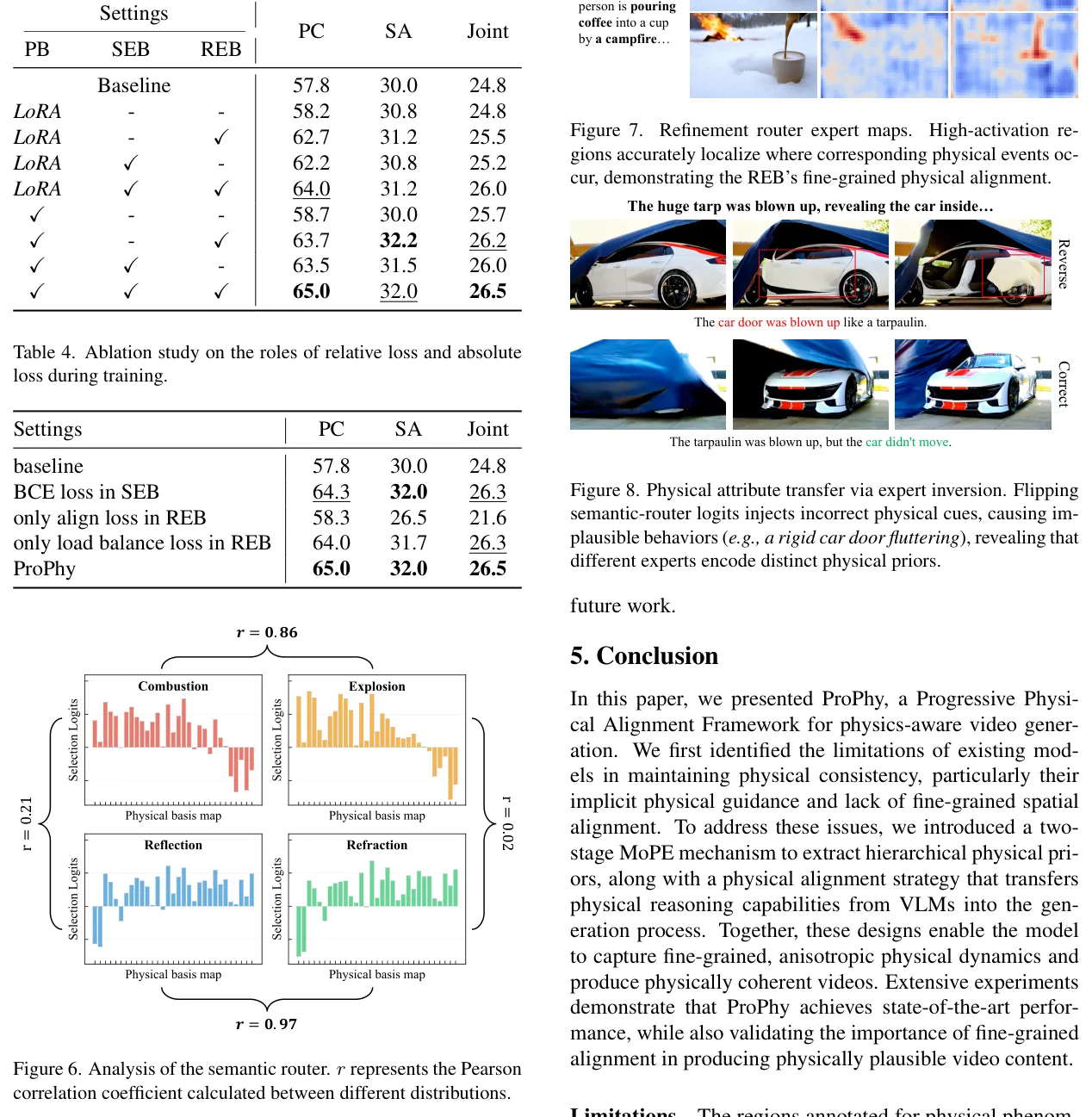
④ §4.4 消融全表(Table 3:模块;Table 4:损失)
Table 3(Wan2.1-1.3B,PB/SEB/REB 逐项;PC/SA/Joint):
结论:原文 "the Physical Branch provides larger gains than plain LoRA … incorporating both the SEB and the REB further improves physical commonsense and semantic adherence."
| PB | SEB | REB | PC | SA | Joint |
| Baseline | 57.8 | 30.0 | 24.8 | ||
| LoRA | - | - | 58.2 | 30.8 | 24.8 |
| LoRA | - | ✓ | 62.7 | 31.2 | 25.5 |
| LoRA | ✓ | - | 62.2 | 30.8 | 25.2 |
| LoRA | ✓ | ✓ | 64.0 | 31.2 | 26.0 |
| ✓ | - | - | 58.7 | 30.0 | 25.7 |
| ✓ | - | ✓ | 63.7 | 32.2 | 26.2 |
| ✓ | ✓ | - | 63.5 | 31.5 | 26.0 |
| ✓ | ✓ | ✓ | 65.0 | 32.0 | 26.5 |
Table 4(损失消融):baseline 57.8/30.0/24.8;BCE loss in SEB 64.3/32.0/26.3(SA 升但 PC/Joint 弱→相对距离损失更有效);only align loss in REB 58.3/26.5/21.6(明显退化);only load balance loss in REB 64.0/31.7/26.3(缺细粒度线索 PC 降);ProPhy 全组合 65.0/32.0/26.5 最佳。原文 "using only the absolute alignment loss causes clear degradation, while using only the load-balance loss improves SA but reduces PC due to missing fine-grained cues."
④ §4.5 专家学到了什么(可解释性)
SEB(Fig6):相关物理类(combustion ↔ explosion)Pearson r=0.86 / 0.97(高)、无关类(explosion vs. refraction)r=0.02 / 0.21(低)→ 原文 "the SEB learns coherent physical semantics."
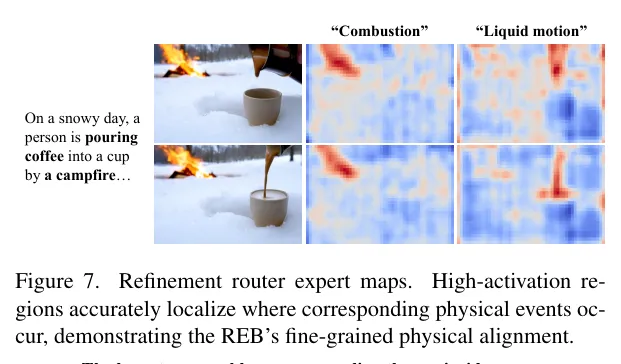
REB(Fig7):"regions with high activation reliably align with where corresponding physical events occur"(雪地倒咖啡:"Combustion"/"Liquid motion" 分别点亮火焰与液面)。
专家反转(Fig8):手动给物体指派错误专家 → 刚性车门像 tarpaulin 一样飘动,证明 "individual experts indeed capture distinct physical priors … physically-grounded and possess the potential for more explicit attribute control."
⑤ 疑问 / 边界 / 待核([推测] 已标注)
① HARD 子集 Joint 绝对值极低(最高仅 7.2/100),复杂物理远未解决,"+19.7%"是小基数上的相对提升。
② 监督依赖 VLM 注意力图,噪声大——Limitations 自承 "The regions annotated for physical phenomena inevitably contain noise, and simple region-level physical categorization captures only coarse surface patterns.";物理类别是离散标注、非真正物理方程,未来才想接入 governing PDE。
③ 训练仅用 WISA-80K 采样 20K 视频,对 WISA 分布外现象的泛化原文未验 [推测受限]。
④ \( E_s/E_r/E_{attn} \) 与 PB 数量等具体取值正文未给,全在 Supplementary [需查]。
⑤ Table 1 中 HunyuanVideo 的 ALL Joint(24.7) > SA(19.2) 反常,疑为原表/抽取排版问题 [推测]。
📌 全文总结(problem→method→experiment→takeaway)
problem:视频生成视觉真但物理假;现有物理增强法要么推理时无显式引导、要么 MoPE 只到全局级,抓不住"多物理现象共存于不同局部区域"。
method:视频扩散 backbone 旁挂 Physical Branch——两阶段 MoPE(SEB 视频级 basis map 加权式1 + REB token 级 top-k 专家式2),用 WISA 类别做语义对齐(式4)+ VLM 注意力图做 token 级细粒度对齐(式5),实现各向异性物理注入;总损失式6。
experiment:VideoPhy2 上 CogVideoX Joint 22.3→26.7(+19.7%)、PC/SA 双高(不像 VideoREPA 顾此失彼);VBench Dynamic Degree 大涨(46.8→72.0);消融证 Physical Branch > LoRA、两个对齐损失缺一不可;专家可解释。
takeaway 1:把"物理引导"从视频级推进到 token 级各向异性是关键——同一视频不同区域走不同物理专家(铲球扬尘只在触地触发、铁球碰撞守动量)。
takeaway 2:用判别式 VLM 的空间物理定位当老师、蒸馏进生成式 MoE 专家是有效且新颖的监督来源(Fig4 实证 VLM 定位优于 VDM cross-attn),减背景图去噪声是工程巧思。
takeaway 3:方法即插即用(两 backbone 同套 \( \lambda \) 无需调参)、消融干净;但边界明确——region 级只抓粗 pattern、HARD 物理仍低分、监督有噪,接入物理微分方程是下一步。原文收尾:"these designs enable the model to capture fine-grained, anisotropic physical dynamics and produce physically coherent videos."
🖼 论文原图(本地 PDF 截图,原文 caption 未改写)