CVPR 2026 Finalist
PixelDiT: Pixel Diffusion Transformers for Image Generation
Yongsheng Yu ⋅ Wei Xiong ⋅ Weili Nie ⋅ Yichen Sheng ⋅ Shiqiu Liu ⋅ Jiebo Luo
摘要 Abstract
Latent-space modeling has been the standard for Diffusion Transformers (DiTs). However, it relies on a two-stage pipeline where the pretrained autoencoder introduces lossy reconstruction, leading to error accumulation while hindering joint optimization. To address these issues, we propose PixelDiT, a single-stage, end-to-end model that eliminates the need for the autoencoder and learns the diffusion process directly in the pixel space. PixelDiT adopts a fully transformer-based architecture shaped by a dual-level design: a patch-level DiT that captures global semantics and a pixel-level DiT that refines texture details, enabling efficient training of a pixel-space diffusion model while preserving fine details. PixelDiT achieves 1.61 FID on ImageNet 256 and 2.21 FID on ImageNet 512, surpassing existing pixel generative models by a large margin. We further extend PixelDiT to text-to-image generation and pretrain it at the $1024^{2}$ resolution in pixel space. It achieves 0.74 on GenEval and 83.5 on DPG-bench, approaching the best latent diffusion models.
📝 精读笔记
灵魂一句
NVIDIA×Rochester:把扩散直接搬回像素空间、彻底扔掉 VAE 的单阶段端到端 Diffusion Transformer。核心是 dual-level 结构——一条 patch-level DiT 管全局语义、一条 pixel-level DiT(PiT)管纹理细节;靠 pixel-wise AdaLN(每个像素一套调制参数)+ pixel token compaction(注意力前把 p² 像素压成 1 token、注意力后还原)让"逐像素建模"既可行又省算力。ImageNet256 gFID 1.61、ImageNet512 1.81,并扩到 1024² 文生图(GenEval 0.74 / DPG 83.5,1.3B),逼近最强 latent diffusion。原文定位:“a single-stage, end-to-end model that eliminates the need for the autoencoder and learns the diffusion process directly in the pixel space”。
问题 & 动机
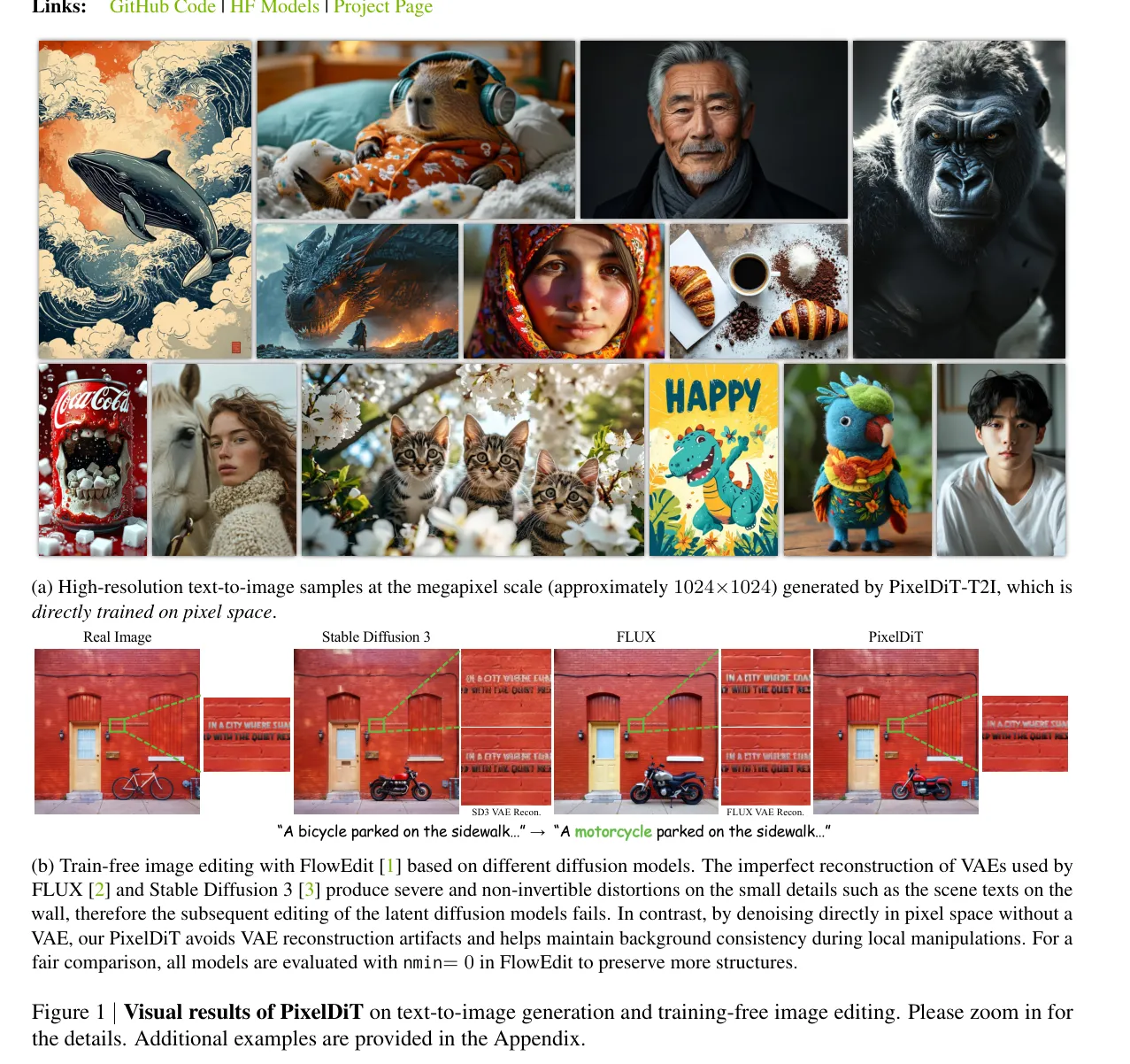
主流 LDM 是两阶段(先训 VAE 压成 latent、再训 DiT)。两大结构性硬伤:① VAE 重建目标与下游生成目标只部分对齐,latent 有分布漂移(纹理被抹平 / 色偏),DiT 还得去补偿;② VAE 是有损压缩,高频细节被砍掉,封顶了采样保真度——Fig 1b 里 FLUX/SD3 的 VAE 连墙上的场景文字都重建糊了,导致编辑失败。回到像素空间能绕开这些,但贵:激进 patchify(省算力)会削弱逐像素建模;逼近逐像素粒度(保细节)又让全局注意力吃超长序列、O(N²) 爆炸。原文把核心难点提炼成 “pixel modeling”:“capturing dense, per-pixel interactions and high-frequency details”——缺一个高效的逐像素建模机制。
核心方法(dual-level 三件套)
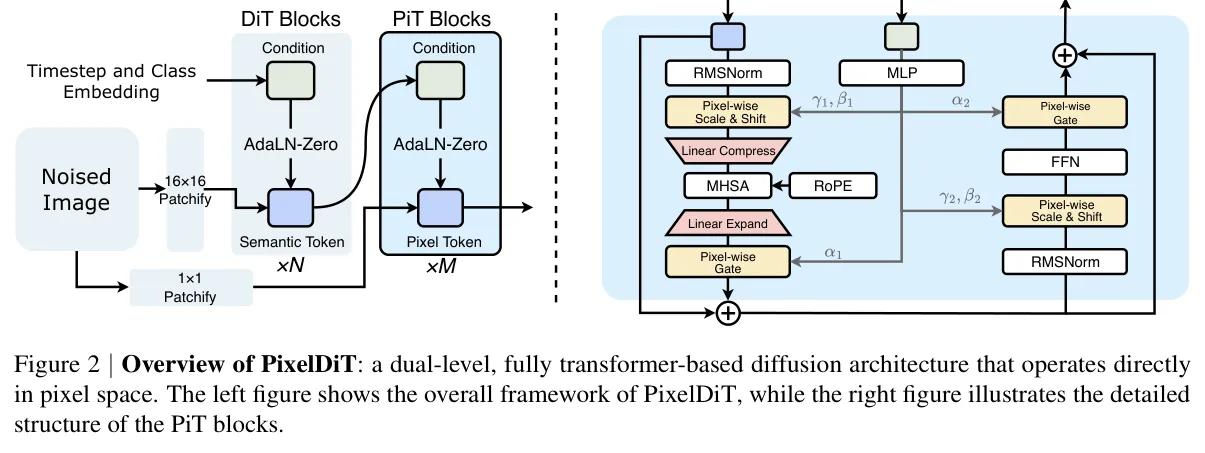
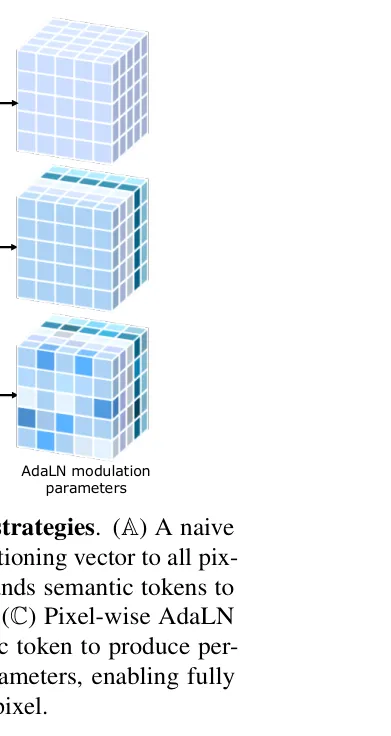
① Dual-level 架构:patch-level 用大 patch(p=16)走短序列长程注意力抓全局布局/内容(N 层 augmented DiT,RMSNorm+2D RoPE),输出 semantic token s_N;pixel-level 用 M 层 PiT block、极小隐藏维 D_pix=16 ≪ D 做逐像素细化。② Pixel-wise AdaLN(式7):把每个 patch 的语义条件 s_cond 经线性 Φ: ℝ^D→ℝ^(p²·6D_pix) 展开成 p² 套 AdaLN 参数 (β1,γ1,α1,β2,γ2,α2),每个像素一套(对比 Fig3B patch-wise 全 p² 共享一套、Fig3A 全局一套)。③ Pixel Token Compaction:全局注意力前用学得的 𝒞: ℝ^(p²×D_pix)→ℝ^D 把 p² 像素压成 1 个 patch token、注意力后用 ℰ 还原——序列从 H×W 降到 L=(H/p)(W/p),p²-fold 缩短、注意力代价 p⁴-fold 下降(p=16→256× 缩短);靠残差+学得 expansion 保高频,不像 VAE 那样永久有损。训练目标 = Rectified Flow 速度匹配 ℒ_diff=𝔼‖f_θ(x_t,t,y)−v_t‖² + λ_repa·ℒ_repa(向冻结 DINOv2 特征对齐,λ=0.5)。
关键结果
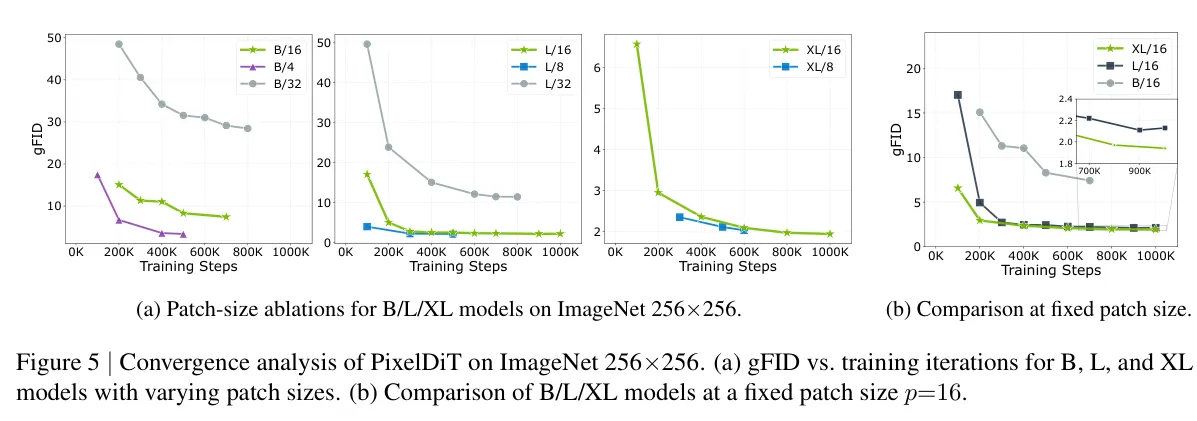
• ImageNet 256(XL,797M,320ep):gFID 1.61、IS 292.7、recall 0.64,碾压像素类 PixelFlow-XL(1.98)/PixNerd-XL(1.93)/EPG-XXL(1.81)/JiT-G(1.82);仅 80ep 已 2.36(收敛快)。
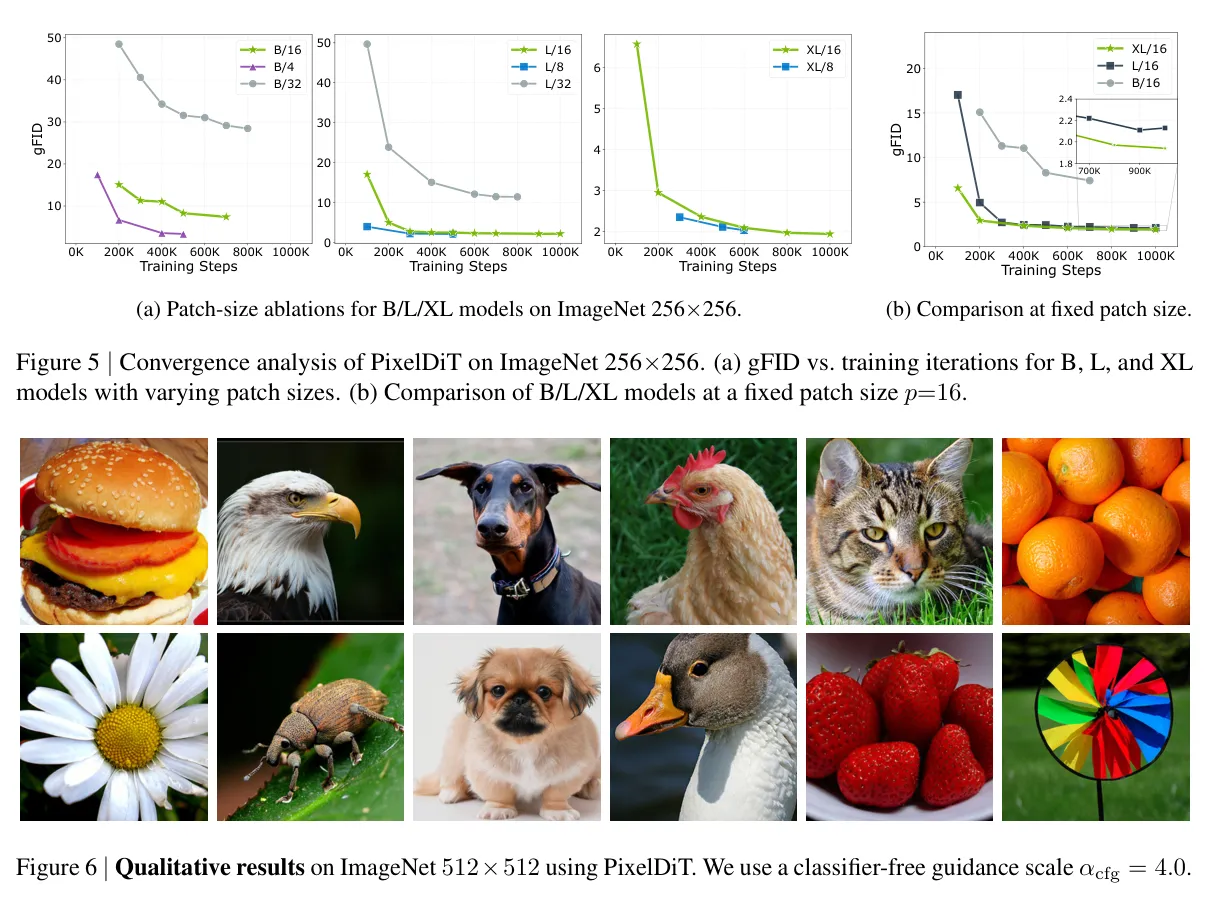
• ImageNet 512:gFID 1.81、recall 0.67(像素类最高),甚至超 latent 的 REPA(2.08)。
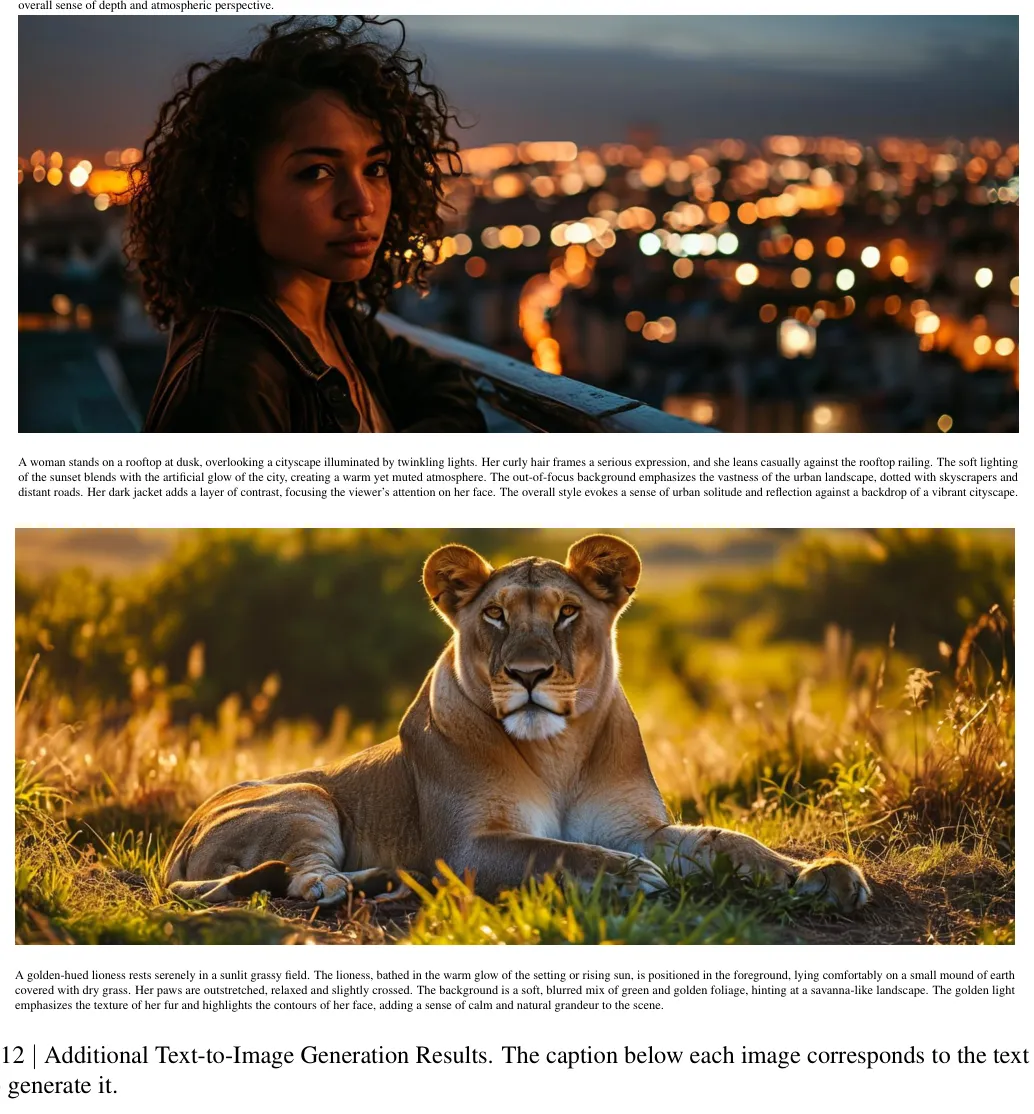
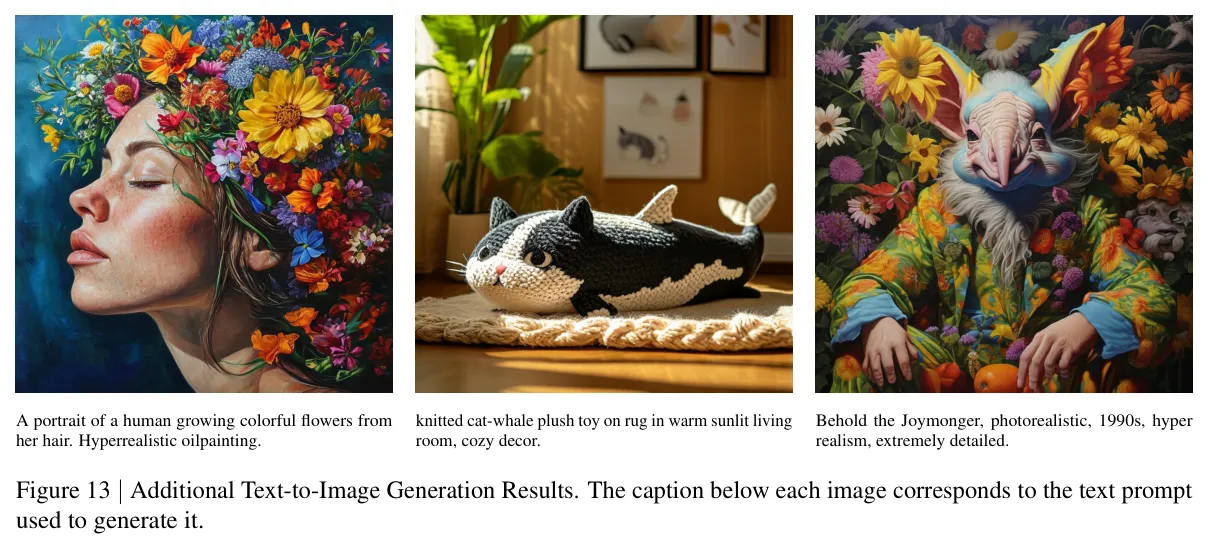
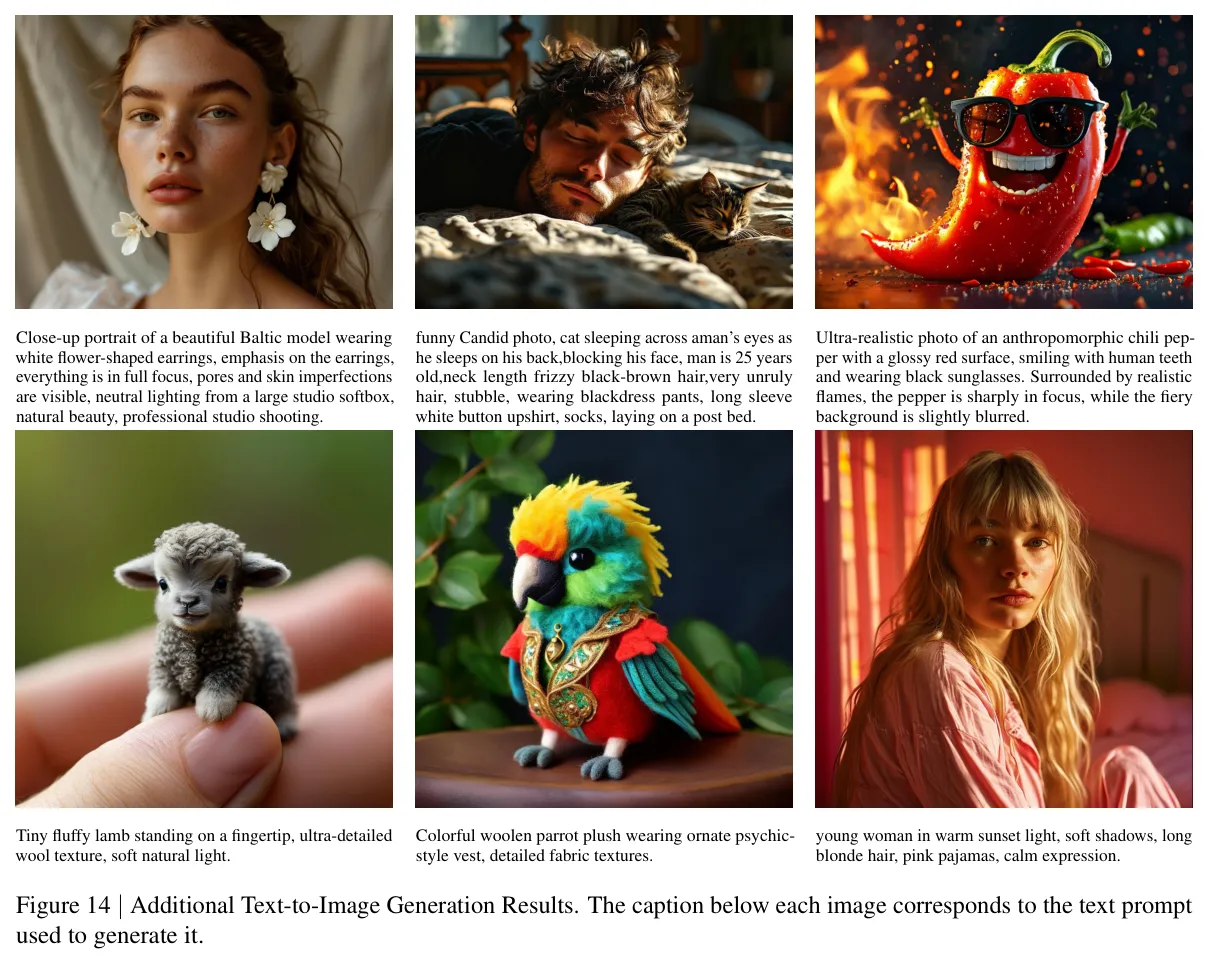
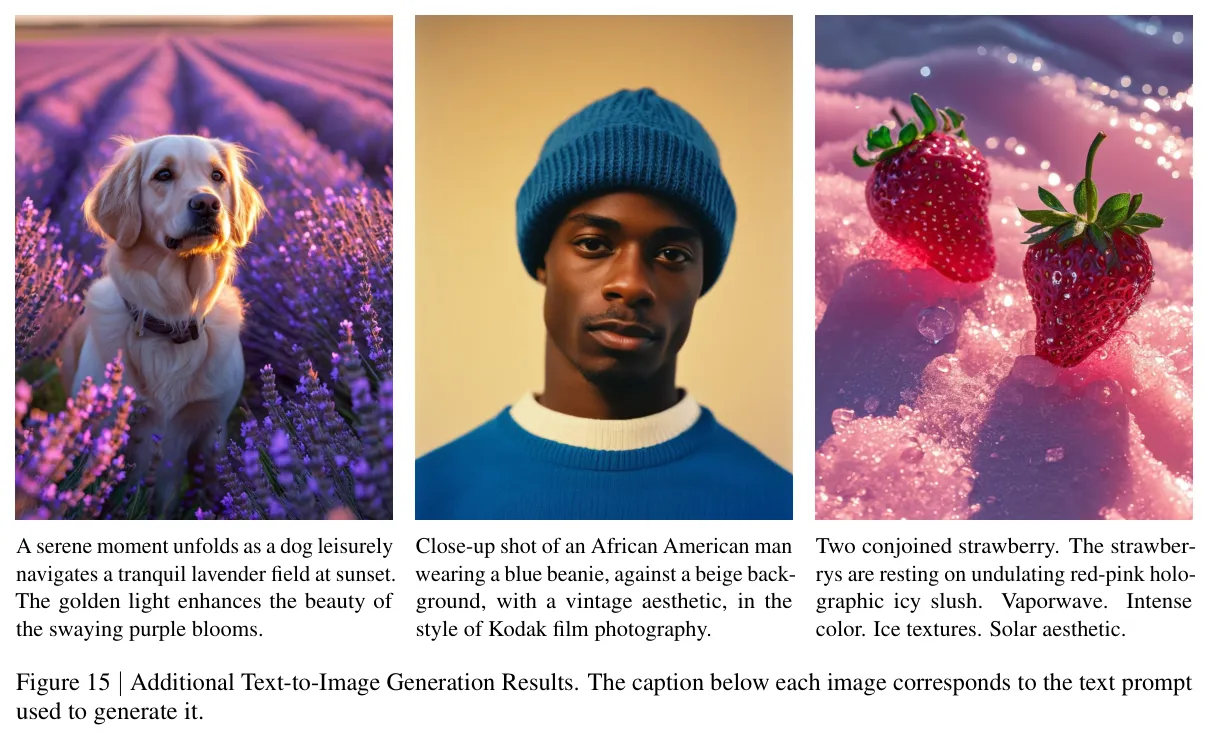
• 文生图 1024²(1.3B):GenEval 0.74 / DPG 83.5,逼近 FLUX-dev(12B, 0.67/84.0);512² 为 0.78/83.7。
• 算力:311 GFLOPs 拿到 1.61 FID(Table15),vs PixelFlow-XL 5818、远低于多数像素模型、接近 latent(238–292)。
• 编辑:背景 MSE 0.001522 vs FLUX 0.009105(6× 更低)、SSIM 0.8628 最高。
亮点
① 实证"单阶段像素扩散能追平 latent",把无 VAE 路线做到 SOTA;② 消融极干净(Table5:Vanilla 9.84→+RoPE/RMSNorm 8.53→+compaction 3.50→+pixel-wise AdaLN 2.36/1.61),逐项证明每个组件必要;③ Appendix G 诚实列失败尝试(DCT 因式分解 AdaLN、Haar 小波、cross-attn 条件、prefix token、ED bottleneck 全没赢过简单设计),对后人很有价值。
疑问 / 待核
① 本页摘要写 ImageNet512=2.21,但 PDF v2 正文/Table2=1.81——Table18 显示 2.21 是"320+40ep finetune"的中间值、1.81 是"320+530ep"的最终值,属版本/checkpoint 差异(本页摘要疑取了旧数)。② 用 velocity prediction 但论文自承"易 loss spike"(尤其深网/长训),x-prediction 能缓解却没更好——像素扩散的训练稳定性仍是 open challenge(Limitations 明写)。③ D_pix=16 为何够?论文扫了 4–128,16 足矣、更大不成比例涨显存(原文给了结论、未给完整机理)。
📖 逐段精读 · 笔记
批量精读初稿(基于本地 PDF 全文 85.8K 字符 / 25 页提取)。原文英文原句 + 中文指路,追问 why、给数值表、外部概念标“外部非本文”、原文未写处标“原文未写/需查”。
① Abstract(摘要)— 逐句精讲
立靶:原文 "Latent-space modeling has been the standard for Diffusion Transformers (DiTs). However, it relies on a two-stage pipeline where the pretrained autoencoder introduces lossy reconstruction, leading to error accumulation while hindering joint optimization." —— latent 扩散是 DiT 的标准做法,但它是两阶段(先训 VAE、再训扩散);预训练 autoencoder 的有损重建→误差累积 + 妨碍联合优化。这是全文要拔掉的钉子。
解法:原文 "we propose PixelDiT, a single-stage, end-to-end model that eliminates the need for the autoencoder and learns the diffusion process directly in the pixel space." —— 单阶段、端到端、无 autoencoder,直接在像素空间学扩散。
架构关键词:原文 "a dual-level design: a patch-level DiT that captures global semantics and a pixel-level DiT that refines texture details, enabling efficient training of a pixel-space diffusion model while preserving fine details." —— dual-level:patch 级抓全局语义、pixel 级修纹理细节,兼顾"高效"与"保细节"(全文 selling point)。
硬指标:原文 "achieves 1.61 FID on ImageNet 256 and 1.81 FID on ImageNet 512, surpassing existing pixel generative models … pretrain it at the 1024² resolution … achieves 0.74 on GenEval and 83.5 on DPG-bench, approaching the best latent diffusion models." —— 256→1.61、512→1.81、1024² 文生图 GenEval 0.74 / DPG 83.5。注意:本页顶部摘要写 512=2.21(旧版数),PDF v2 已更新为 1.81,差异见下文 Table 18 解释。一句话抓 Abstract:把扩散搬回像素空间、扔掉 VAE,用 dual-level + 高效逐像素建模做到追平 latent diffusion。
📚 背景知识(外部,非本文原创——理解 PixelDiT 必备)
① DiT / AdaLN-Zero(Peebles & Xie 2023):Diffusion Transformer 把图像切 patch 当 token、纯 Transformer 做扩散 backbone;条件(timestep/class)经小 MLP 算出 LayerNorm 的 scale \(\gamma\)/shift \(\beta\)/gate \(\alpha\) 注入,即 AdaLN;AdaLN-Zero 让 gate 初始化 0→残差初为恒等、稳训练。本文沿用并把 LayerNorm 换 RMSNorm、加 2D RoPE。
② Latent Diffusion / VAE(Rombach 2022):先训 VAE 把 image 压成低分辨率 latent、扩散只在 latent 跑、生成完 decode 回像素——省算力但受 VAE 重建上限封顶。本文要取代的正是这个范式。
③ Rectified Flow / flow matching(Liu 2023):直线插值 \(x_t=(1-t)x_0+t\,x_1\)(\(x_0\) 噪声/\(x_1\) 数据),网络回归速度 \(v=x_1-x_0\);推理沿 ODE 少步积分。本文训练用速度匹配 loss(式8)。
④ REPA(Yu 2025):Representation Alignment——训扩散时加辅助 loss,把中间层特征对齐到冻结 DINOv2 语义特征,大幅加速收敛/稳训练。本文 \(\lambda_{repa}=0.5\);消融显示去掉 REPA 直接发散。
⑤ MM-DiT(SD3 / Esser 2024)+ 评测:多模态 DiT block,图像流与文本流各自 QKV、在 joint self-attention 融合;本文文生图版接在 patch 通路、文本编码器用冻结 Gemma-2。评测:gFID/sFID 越低越好、IS/Precision/Recall 越高越好;GenEval 看对象/计数/颜色/位置组合正确率、DPG-Bench 看密集 prompt 语义对齐。
② §1 Introduction — problem → 现有不足 → solution → why 闭环
problem(两层结构性硬伤):原文 "First, LDMs couple diffusion to a separately pretrained autoencoder whose reconstruction objective is only partially aligned with the downstream generative objective. Second, the autoencoder introduces a lossy reconstruction that can remove high-frequency details and cap sample fidelity"——即目标错配 + 有损封顶。Fig 1b 展示 FLUX/SD3 的 VAE 连墙上场景文字都重建糊了,导致编辑失败。
现有像素方法的两难(why 它们不行):原文 "One line of work adopts aggressive patchification to keep attention affordable, but this significantly weakens per-pixel token modeling"(激进 patchify 省算力但削弱逐像素建模);另一派 "pushes toward near-pixel granularity … but the global attention must process very long token sequences with quadratic complexity"(逼近逐像素则注意力 \(O(N^2)\) 爆炸)。结论:"the obstacle … is the lack of an efficient pixel modeling mechanism that can model both global semantics and per-pixel updates."
solution(Intro 即给出,不推迟到 Method):"PixelDiT decouples image semantics from per-pixel learning with a dual-level architecture"——patch 级走短序列长程注意力抓全局、pixel 级做逐像素细化;两把钥匙 (i) pixel-wise AdaLN(用语义 token 调制每个像素 token),(ii) pixel token compaction(全注意力前压缩、之后还原)。
why it works:把语义推理放到低分辨率 patch grid("most semantic reasoning to occur on the low-resolution grid")→ 减轻 pixel 通路负担、加速收敛;pixel-wise AdaLN 让每像素更新与全局上下文对齐;token compaction 让全局注意力序列可控。四点贡献原文自列:single-stage 无 AE / efficient pixel modeling 是 key / pixel-wise AdaLN+compaction / 类条件与文生图都强。
Q&A · "pixel modeling"到底难在哪?
定义:原文 "By pixel modeling, we refer to the mechanism of capturing dense, per-pixel interactions and high-frequency details, which is distinct from the semantic structural generation typically handled by coarse patch tokens." 即"逐像素的密集交互 + 高频细节建模",区别于粗 patch token 负责的语义结构。难点本质:它对纹理保真至关重要但算力昂贵——直接对 \(H\times W\) 个像素 token 做全局注意力是 \(O(N^2)\) 显存、\(O(N^2 D)\) FLOPs,256² 下就到 82,247 GFLOPs(Table 6,直接 OOM)。所以全文的工程核心就是"既要逐像素、又要算得起"。
③ §3.1 Dual-level 架构 · patch-level 公式(eq1–5)
patch 通路(输入→维度):输入 \(x\in\mathbb{R}^{B\times C\times H\times W}\)→非重叠 \(p\times p\) patch→\(x_{patch}\in\mathbb{R}^{B\times L\times(p^2 C)}\),\(L=\frac{H}{p}\frac{W}{p}\);线性投到隐藏维 \(D\)(式1–2) \[ s_0=W_{patch}\,x_{patch},\qquad c=\mathrm{SiLU}(W_t t+W_y y+b)\in\mathbb{R}^{B\times1\times D} \] 全局条件 \(c\) 来自 timestep \(t\) + class \(y\)。
augmented DiT block(式3–5): \[ \tilde s_i=\mathrm{RMSNorm}(s_i) \] \[ s_i=s_i+\alpha_1(c)\odot\mathrm{Attn}\big(\gamma_1(c)\odot\tilde s_i+\beta_1(c);\ \mathrm{RoPE}\big) \] \[ s_{i+1}=s_i+\alpha_2(c)\odot\mathrm{MLP}\big(\gamma_2(c)\odot\mathrm{RMSNorm}(s_i)+\beta_2(c)\big) \] AdaLN 参数 \((\alpha,\gamma,\beta)\) 由 \(c\) 算出后广播到全部 \(L\) 个 patch token(即 patch 级 token-independent,与后面 pixel-wise 形成对比)。\(N\) 层后得语义 token \(s_N\in\mathbb{R}^{B\times L\times D}\),定义 pixel 通路条件 \(s_{cond}:=s_N+t\)。
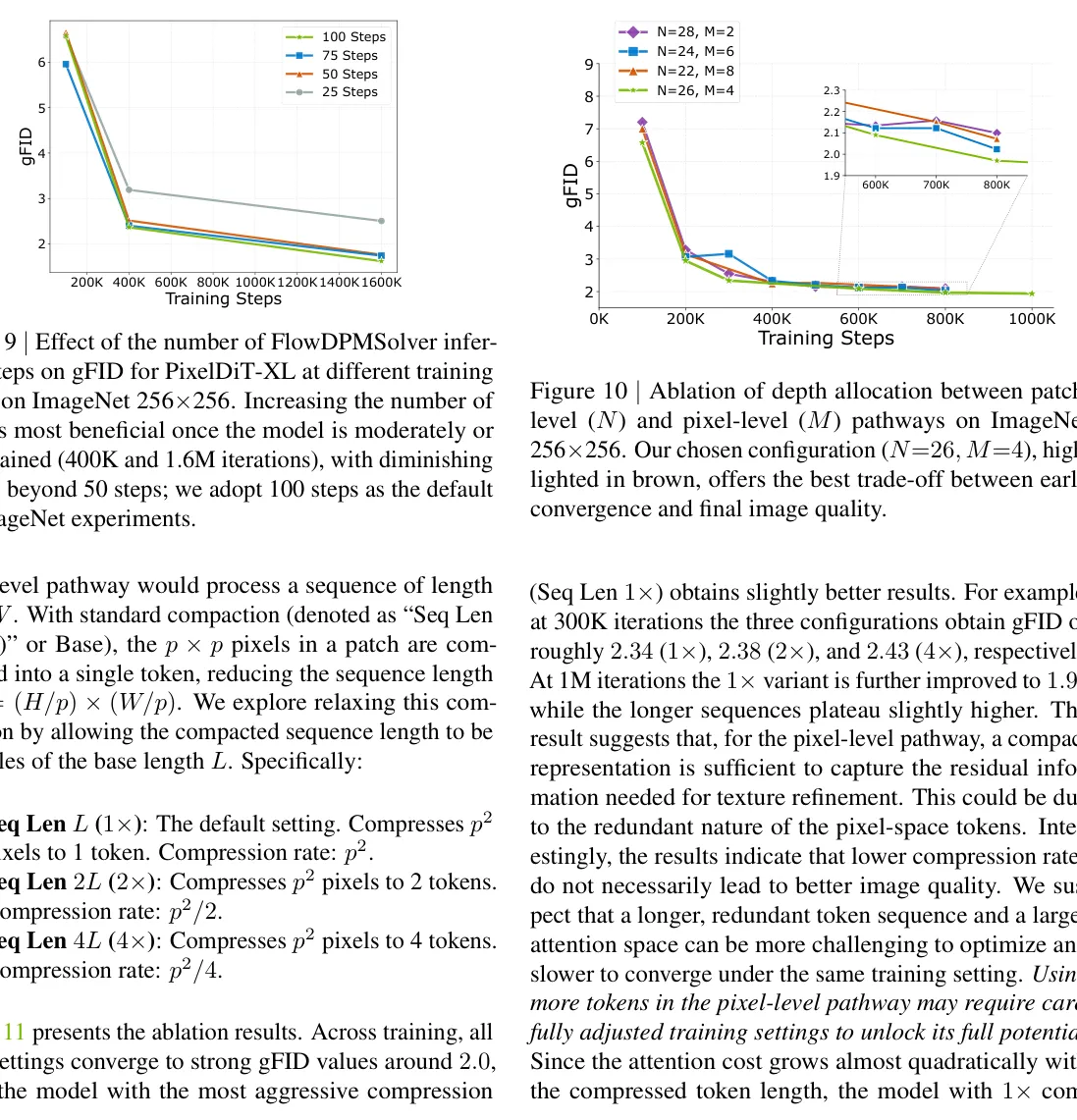
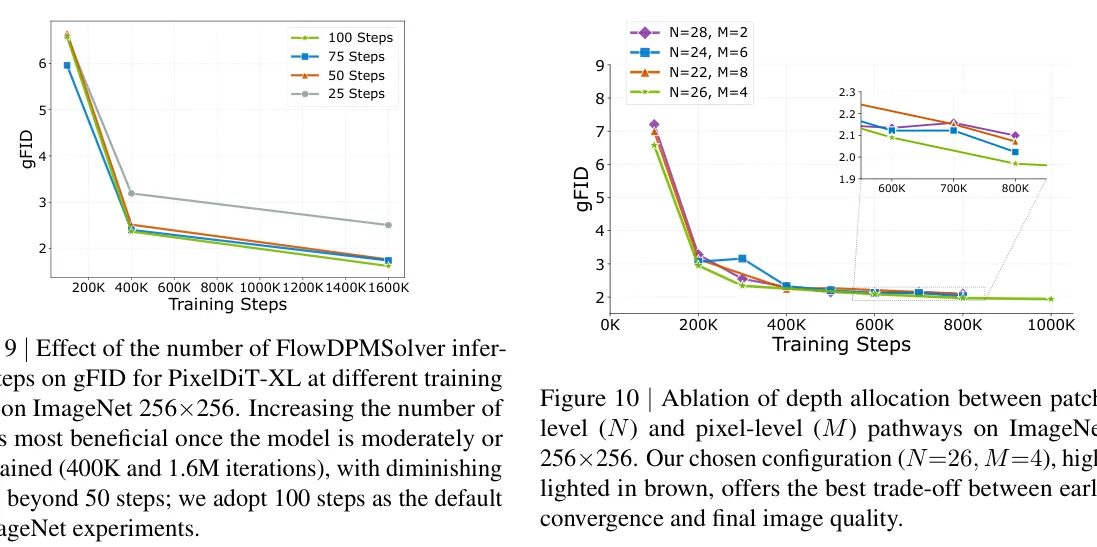
设计取舍:patch 通路只处理 patch token 抓全局,故可用大 patch \(p\) 缩短序列、加速推理而不丢细节;pixel 通路用极小隐藏维 \(D_{pix}\ll D\)(如 \(D_{pix}=16\)),保证逐像素计算高效。默认配置 \(N=26,\ M=4\)(Fig 10 消融最优)。
④ §3.2 Pixel-wise AdaLN · 每像素一套调制(eq6–7)
pixel 嵌入(式6):每像素一个 token \[ X\in\mathbb{R}^{B\times C\times H\times W}\ \xrightarrow{\text{reshape+linear}}\ \mathbb{R}^{B\times H\times W\times D_{pix}} \] 再 reshape 成 \((B\cdot L)\times p^2\times D_{pix}\)(每个 patch 内 \(p^2\) 个像素 token)。
关键式7(pixel-wise AdaLN):用线性投影 \(\Phi:\mathbb{R}^{D}\to\mathbb{R}^{p^2\cdot 6D_{pix}}\) 把每个 patch 的语义条件 \(s_{cond}\) 展成 \(p^2\) 套 AdaLN 参数 \[ \Theta=\Phi(s_{cond})\in\mathbb{R}^{(B\cdot L)\times p^2\times 6D_{pix}} \] 再把末维切 6 组得 \((\beta_1,\gamma_1,\alpha_1,\beta_2,\gamma_2,\alpha_2)\)——每个像素独立调制。对比 Fig 3B patch-wise(\(p^2\) 像素共享一套、抓不到逐像素变化)、Fig 3A naive(全局一套)。这是 PixelDiT"逐像素对齐全局上下文"的核心机制。
Q&A · 为什么 patch 通路用"全局广播"AdaLN,pixel 通路却要"逐像素"AdaLN?
对比:patch 通路的 AdaLN 参数由全局条件 \(c\) 算出后广播到全部 \(L\) 个 patch token(token-independent),因为 patch 级处理的是"全局语义结构",同一套调制足矣。pixel 通路若也共享一套(Fig 3B patch-wise)就抓不到同一 patch 内 \(p^2\) 个像素之间的细微差异——而细微差异正是纹理高频所在。所以 pixel 级必须 Fig 3C 的 pixel-wise:用 \(\Phi\) 把 \(s_{cond}\) 展成 \(p^2\) 套参数、每像素独立(式7)。一句话:语义可粗(共享调制),纹理必细(逐像素调制),这正是 dual-level 在"调制粒度"上的体现。
⑤ §3.2 Pixel Token Compaction · 让全局注意力算得起
做法:注意力前用学得线性 \(\mathcal{C}:\mathbb{R}^{p^2\times D_{pix}}\to\mathbb{R}^{D}\) 把 1 个 patch 内 \(p^2\) 像素压成 1 个 patch token,注意力后用 \(\mathcal{E}:\mathbb{R}^{D}\to\mathbb{R}^{p^2\times D_{pix}}\) 还原。序列从 \(H\times W\) 降到 \(L\),\(p^2\)-fold 缩短(\(p=16\to256\times\)),注意力总代价 \(p^4\)-fold 下降。原文:\(O(N^2)\) 显存与 \(O(N^2 D)\) FLOPs,256² 下达 82,247 GFLOPs(Table 6),compaction 后才可训。
Q&A · token compaction 跟 VAE 压缩有何本质不同?
关键区别:原文 "Unlike the lossy bottleneck in VAEs, this mechanism only compresses the representation momentarily for the attention operation … high-frequency information is preserved through residual connections and learned expansion layers." VAE 是永久有损瓶颈(高频被砍掉再也回不来);而 compaction 只在注意力这一步临时压缩,靠残差连接 + 学得 expansion 把高频带回,是可逆/无永久损失的。这正是 PixelDiT 能"既省算力又保细节"、避开 VAE 伪影的根因。
⑥ §3.3 文生图 + §3.4 训练目标(Rectified Flow + REPA)
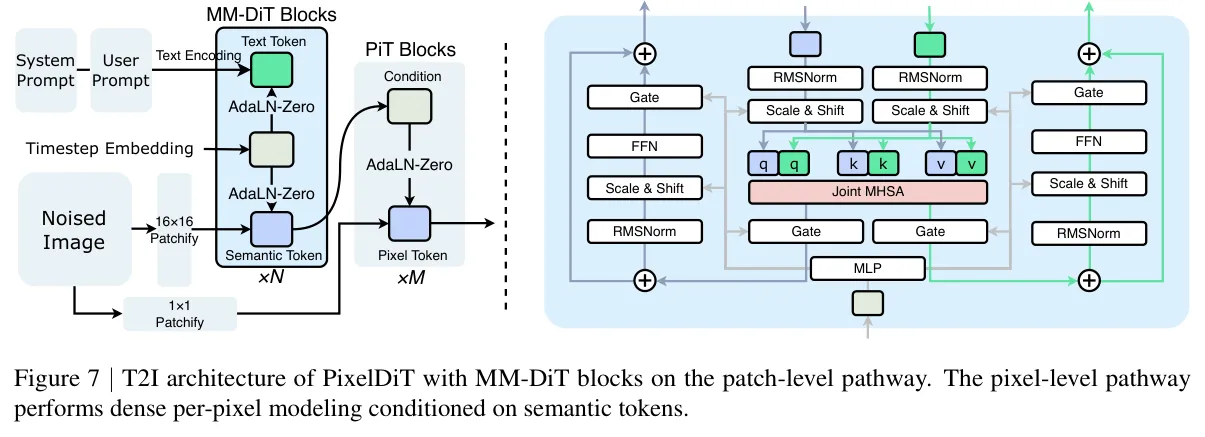
文生图(§3.3):patch 通路换 MM-DiT block 融合冻结 Gemma-2 文本特征 \(y\in\mathbb{R}^{B\times L_{txt}\times D_{txt}}\)、pixel 通路不变(文本只经 semantic token 间接进 pixel 流,不直接路由 text token 进像素流)。
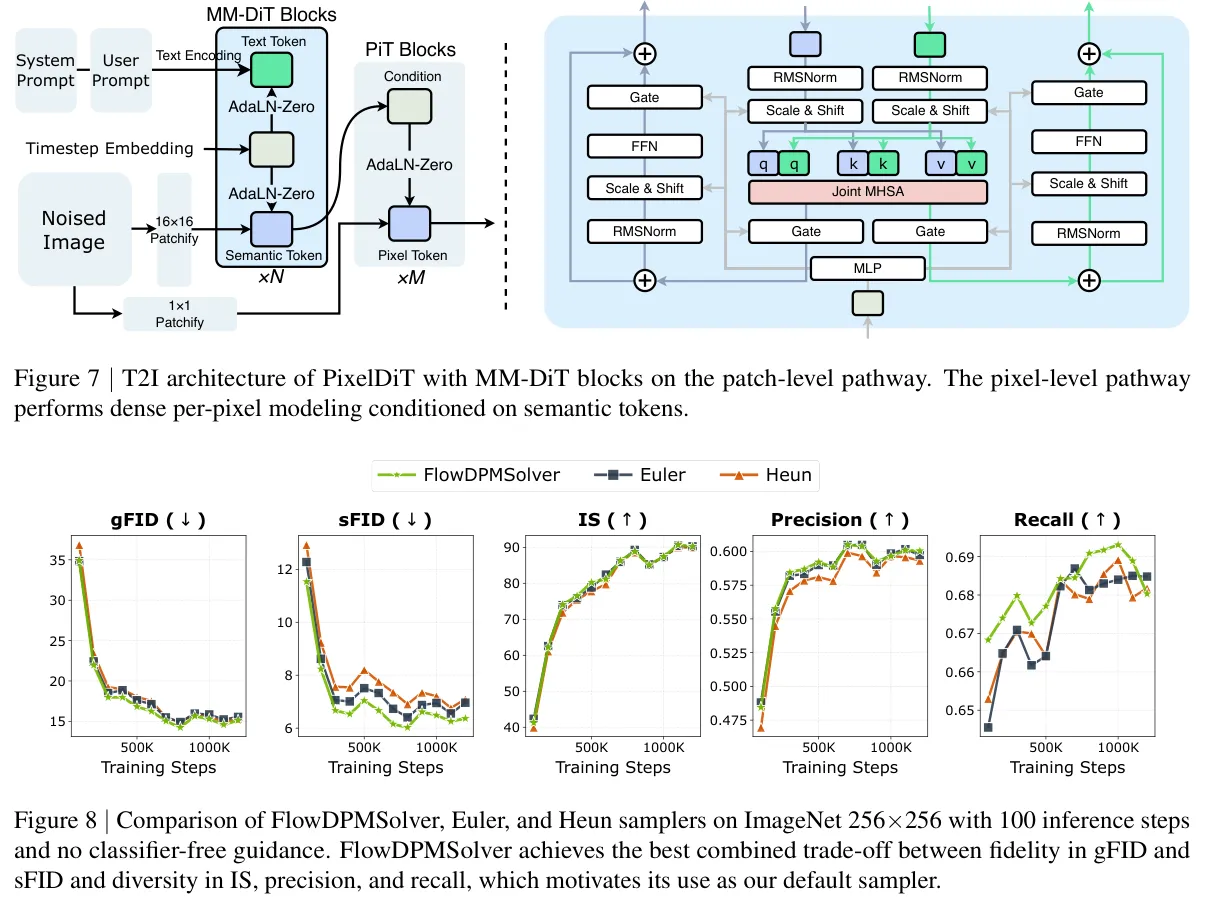
训练目标(式8):Rectified Flow 速度匹配 + REPA 对齐 \[ \mathcal{L}_{diff}=\mathbb{E}_{t,x,\epsilon}\big\lVert f_\theta(x_t,t,y)-v_t\big\rVert^2,\qquad \mathcal{L}=\mathcal{L}_{diff}+\lambda_{repa}\,\mathcal{L}_{repa} \] \(\lambda_{repa}=0.5\),向冻结 DINOv2 特征对齐。采样器默认 FlowDPMSolver(ImageNet 100 步、文生图 25 步,Fig 8 证其在 fidelity/diversity 间权衡最优)。配置:XL = \(N{=}26/M{=}4/D_{pix}{=}16\)/797M;T2I = 1.3B,512² 预训→1024² finetune。
⑦ §4 实验 · SOTA 对比(真实数值,gFID↓/IS↑/Recall↑)
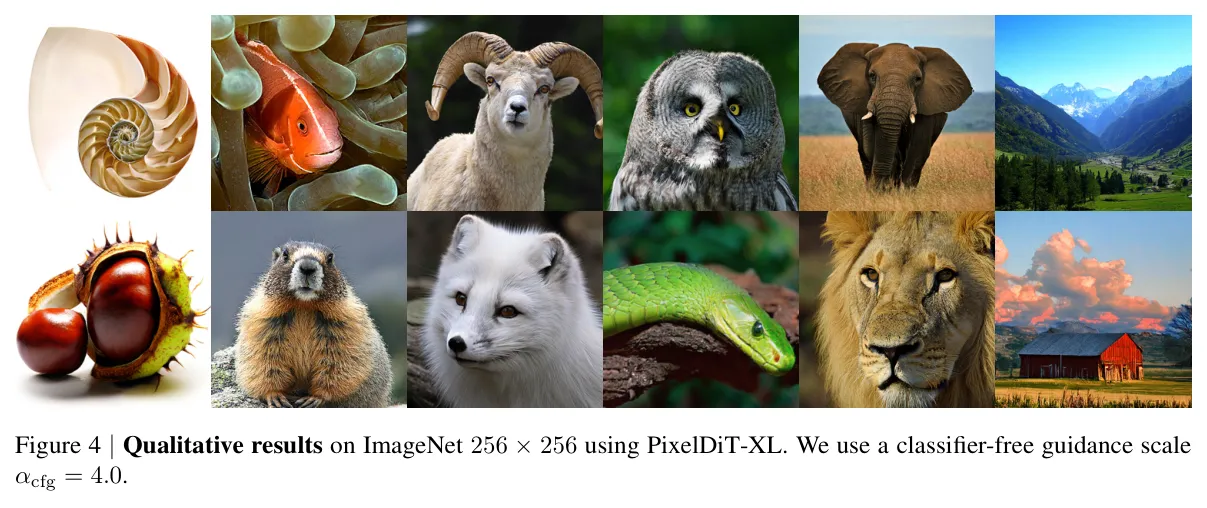
ImageNet 256(Table 1,XL 797M):PixelDiT-XL 320ep gFID 1.61 / sFID 4.68 / IS 292.7 / recall 0.64;80ep 已 2.36(收敛快)。碾压像素类:PixelFlow-XL 1.98、PixNerd-XL 1.93、EPG-XXL/16 1.81、JiT-G(2B) 1.82、Simple Diffusion 2.44、FractalMAR-H 6.15。vs latent 类 DDT-XL 1.26 / RAE-XL 1.13(仍有差距但已很近)/ REPA 1.42。
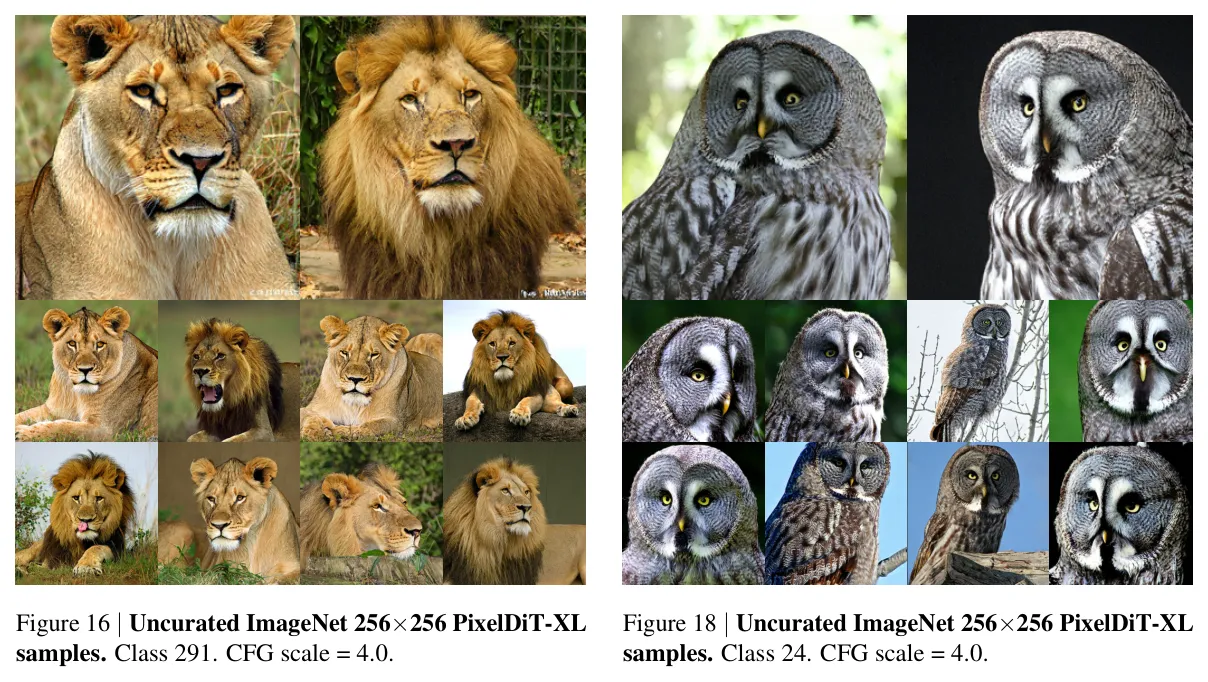
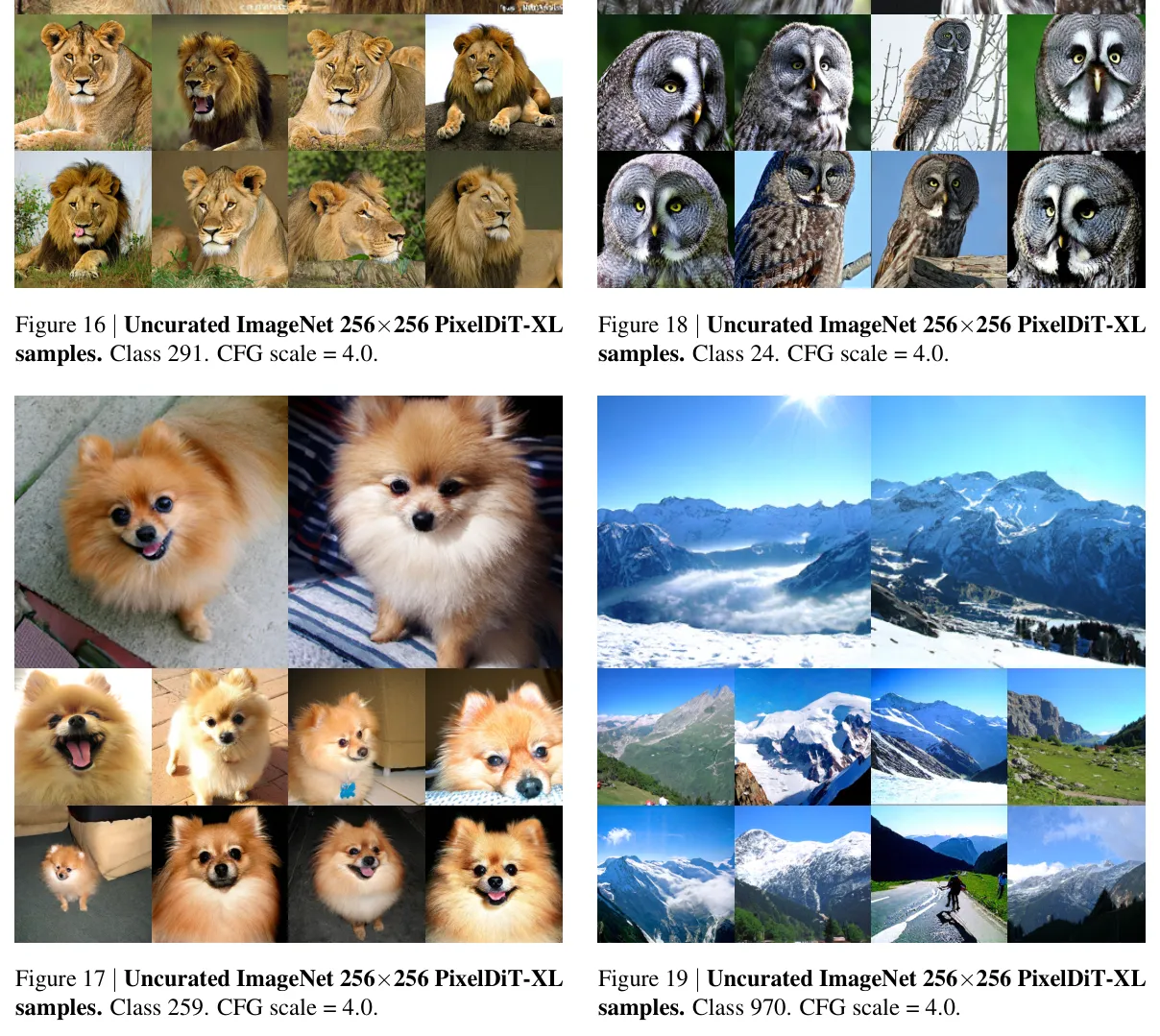
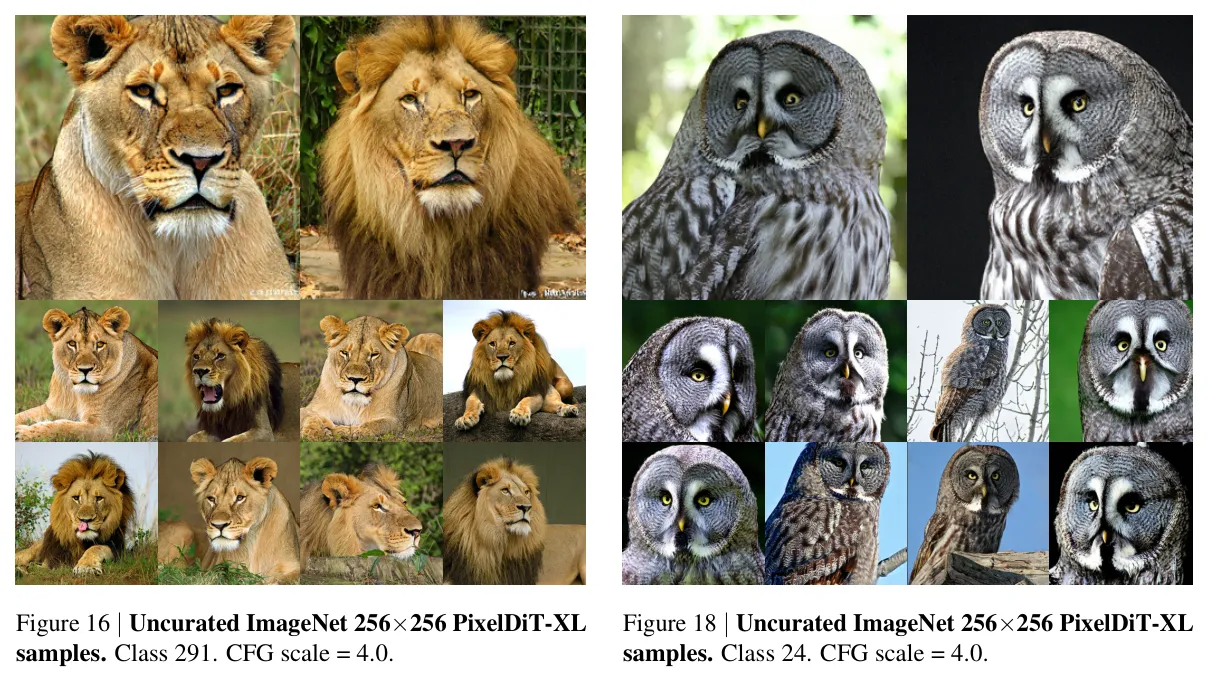
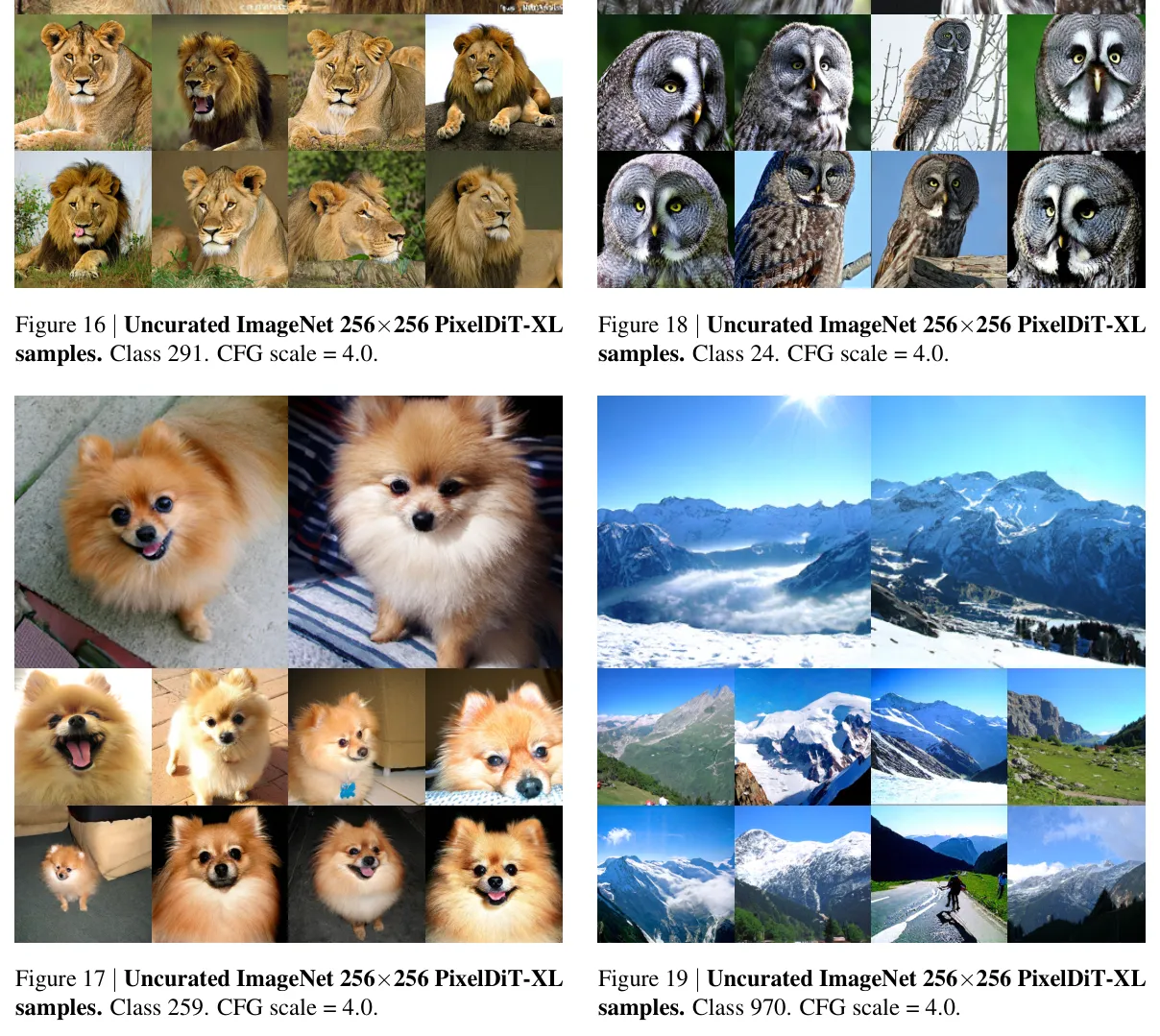
ImageNet 512 + 文生图:512 正文 gFID 1.81(像素类最高,超 latent REPA 2.08)。1024² PixelDiT-T2I(1.3B) GenEval 0.74 / DPG 83.5,超 SDXL/Hunyuan-DiT/DALL·E3、逼近 FLUX-dev(12B);512² 0.78/83.7 胜 PixNerd/PixelFlow。算力(Table 15):311 GFLOPs 拿 1.61 FID,远省于 PixelFlow-XL 等几百~几千 GFLOPs 的像素模型,接近 latent 的 240–290。
⑧ §4.5 消融全表 — 每项"验证了什么"
组件消融(Table 5,256,每加一件涨多少):Vanilla DiT/16 9.84 → +RoPE,RMSNorm 8.53 → +Dual-level(无 compaction) = OOM(全局注意力随像素数二次爆显存)→ +Pixel Token Compaction 3.50(同 80ep,质量大跳)→ +Pixel-wise AdaLN 2.36(80ep)/ 1.61(320ep)。验证:compaction 让方案可行、pixel-wise AdaLN 进一步提质,二者是从 9.84 到 1.61 的两大台阶。
compaction 算力(Table 6):No Pixel Token Compaction = 82,247 GFLOPs → OOM(vs 完整 ~311 GFLOPs,差约 264×);No Pixel-Pathway Attention(只留 AdaLN+MLP)虽更省但"consistently inferior"(80→160ep 一直更差)。验证:compact 后的全局注意力对"局部更新对齐全局"是必要的,不能砍。
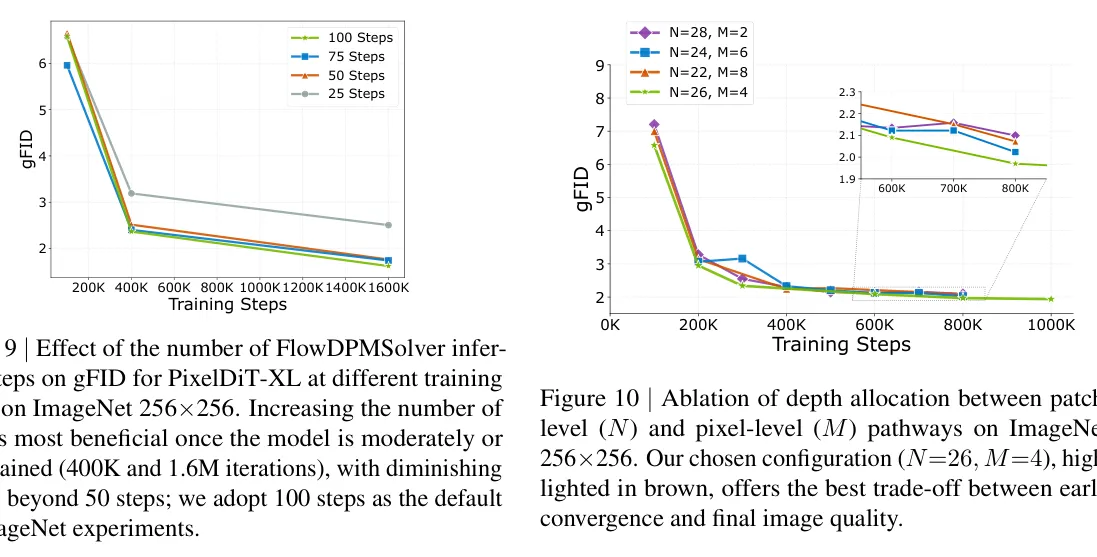
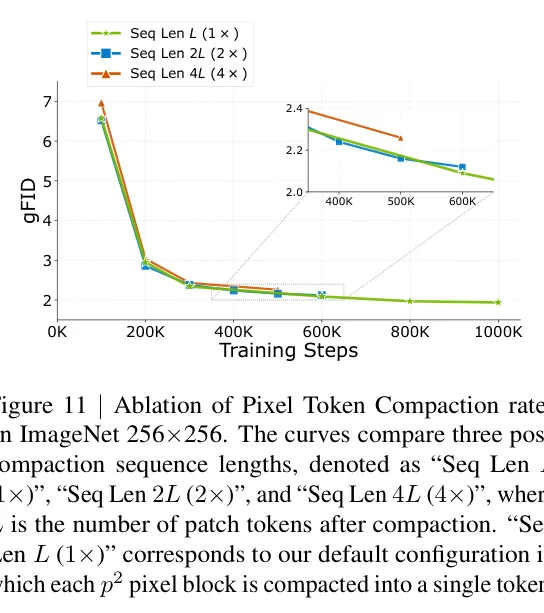
REPA 必要性(Table 11):w/ REPA 160ep 1.97 / IS 299.4;w/o REPA 6.58 / IS 165.9(去掉直接发散)。PTC rate(Fig 11):1×(\(p^2\to\)1 token)反而略优于 2×/4×(推测更长冗余序列更难优化)。depth(Fig 10):\(N{=}26,M{=}4\) 优于 \(N{=}22,M{=}8\) 等。采样器(Fig 8):FlowDPMSolver 综合最佳。
Q&A · 本页摘要 512=2.21、PDF 正文=1.81,到底哪个对?
解谜(Table 18 / v2 更新):ImageNet-512 是从 320ep 的 256 ckpt finetune 而来——短 finetune("320+40ep")= 2.21,充分 finetune("320+530ep")= 1.81。即 2.21 是中间 checkpoint 值、1.81 是终值;PDF v2 摘要已统一为 1.81,而本页顶部摘要疑取了旧版数字。诚实结论:两个数都"真实存在",只是对应不同训练时长,最终代表数应取 1.81。
⑨ 诚实加分项 · 失败尝试与 Limitations(Appendix G)
失败尝试(对后人有价值):作者诚实列出没赢过简单设计的尝试——x-prediction(直接预测干净图 \(\hat x\),\(\hat v=(\hat x-x_t)/\max(\sigma(t),\epsilon),\ \epsilon=0.05\))"can effectively mitigate loss spikes" 但 "did not outperform direct velocity prediction" 且要额外调参;以及 Encoder–Decoder bottleneck 等架构变体也未胜出。Limitations:原文承认 "training pixel-space diffusion models with velocity prediction is prone to loss spikes, particularly for deeper architectures and during long training runs"——稳定性仍是 open challenge;复杂建筑/人手等细节仍吃力。
⑩ §4 图像编辑 · 无 VAE 的核心红利(Table 14)
为什么无 VAE 对编辑特别重要:latent 扩散做 train-free 编辑(如 FlowEdit)要先把图 encode 进 latent、改完再 decode;VAE 的有损往返会把 bounding box 外的背景也改坏(Fig 1b:墙上场景文字被 FLUX/SD3 的 VAE 重建糊掉,编辑随之失败)。PixelDiT 在像素空间直接去噪,没有 encode/decode 往返,背景天然保持。
定量(FlowEdit 281 个样本,用 SAM3 取编辑框、只算框外背景区):背景 MSE:PixelDiT 0.001522 vs FLUX 0.009105(6.0× 更低)、vs SD3 也更优;背景 SSIM:PixelDiT 0.8628 > FLUX 0.8254(最高)。原文:"with 6.0× lower MSE"。验证:"像素空间无 VAE"不是口号,而是带来可量化的编辑/背景保持优势——这是 PixelDiT 区别于 latent 路线的实际落地价值。
Q&A · pixel 通路隐藏维 \(D_{pix}=16\) 为何这么小还够用?
机理:原文 "the pixel-level pathway operates with a reduced hidden dimension \(D_{pix}\ll D\) (e.g., \(D_{pix}=16\)), ensuring that dense per-pixel computations remain highly efficient." 因为语义重活已被 patch 通路(隐藏维 \(D\))干完,pixel 通路只负责"在已有语义骨架上修高频纹理细节",所需表达能力小,故 \(D_{pix}\) 可极小——这正是 dual-level 解耦的红利:把"贵但低维"的逐像素计算和"高维但短序列"的语义计算分开,各取所需。[推测] 具体 \(D_{pix}\) 维度扫描见 Appendix,本页未逐一列出其曲线,但默认 16 是作者给出的高效配置。
📌 全文一页总结(problem → method → experiment → takeaway)
problem:主流 latent diffusion 两阶段 VAE 有损、目标错配、封顶保真且编辑掉细节;纯像素扩散又因 \(O(N^2)\) 注意力太贵、缺高效"逐像素建模"机制。
method:单阶段无 VAE 的 dual-level Transformer:patch-level DiT 抓全局(大 patch、短序列、RMSNorm+RoPE+AdaLN+REPA,式1–5);pixel-level PiT 做细节,靠 pixel-wise AdaLN(每像素一套调制,式6–7)+ pixel token compaction(压→注意力→还原,\(p^2\)-fold 缩序列、\(p^4\)-fold 降算力,且非永久有损)。Rectified Flow 速度匹配 + REPA(式8)训练。
experiment:ImageNet256 1.61 / 512 1.81(均超像素类、512 超 latent REPA),1024² 文生图 0.74/83.5 逼近 FLUX;311 GFLOPs 高性价比;编辑背景 MSE 0.001522 vs FLUX 0.009105(6.0× 更优)。消融证 compaction(否则 82,247 GFLOPs/OOM)、pixel-wise AdaLN(2.36→优于 patch-wise)、REPA(否则发散 6.58)三者缺一不可。
takeaway(≥3 条):① "高效逐像素建模是实用像素扩散的钥匙"——把逐像素做高效(dual-level + AdaLN + compaction),单阶段像素扩散能在类条件与文生图上追平 latent;② 无 VAE 天然规避重建伪影,对图像编辑/背景保持优势显著(6× 更低 MSE);③ 临时压缩+残差还原 ≠ VAE 永久有损,这是兼顾省算力与保细节的关键洞见。
适用边界 / 诚实标注:1.3B 文生图对复杂建筑/人手仍吃力;velocity prediction 易 loss spike,训练稳定性是 open challenge(Limitations 承认);\(D_{pix}=16\) 为何够论文给了扫描结论但未给完整机理;512 的 2.21 vs 1.81 属 checkpoint 差异(见 Q&A)。
🖼 论文原图(本地 PDF 截图,原文 caption 未改写)