CVPR 2026 Finalist
Molmo2: Open Weights and Data for Vision-Language Models with Video Understanding and Grounding
Christopher Clark ⋅ Jieyu Zhang ⋅ Zixian Ma ⋅ Jae Sung Park ⋅ Rohun Tripathi ⋅ Sangho Lee ⋅ Reza Salehi ⋅ Jason Ren ⋅ Chris Dongjoo Kim ⋅ Yinuo Yang ⋅ Vincent Shao ⋅ Yue Yang ⋅ Weikai Huang ⋅ Ziqi Gao ⋅ Taira Anderson ⋅ Jianrui Zhang ⋅ Jitesh Jain ⋅ George Stoica ⋅ Ali Farhadi ⋅ Ranjay Krishna
摘要 Abstract
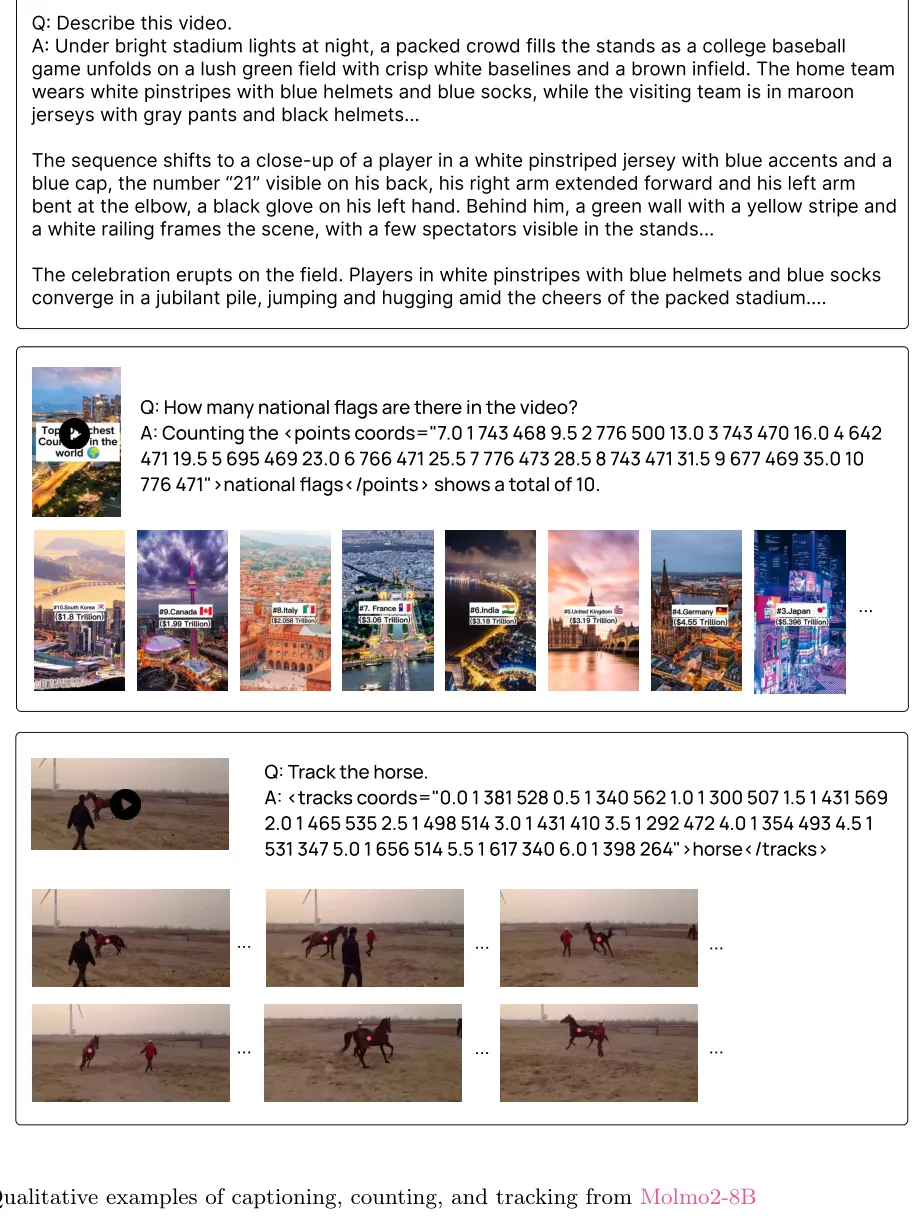
Today’s strongest video-language models (VLMs) remain proprietary.The strongest open-weight models either rely on synthetic data from proprietary VLMs, effectively distilling from them, or do not disclose their training data or recipe.As a result, the open-source community lacks the foundations needed to improve on the state-of-the-art video (and image) language models.Crucially, many downstream applications require more than just high-level video understanding; they require grounding—either by pointing or by tracking in pixels. Even proprietary models lack this capability.We present Molmo2, a new family of VLMs that are state-of-the-art amongst open-source models and demonstrate exceptional new capabilities in point-driven grounding in single image, multi-image, and video tasks.Our key contribution is a collection of 7 new video datasets and 2 multi-image datasets, including a dataset of highly detailed video captions for pre-training, a free-form video Q&A dataset for fine-tuning, a new object tracking dataset with complex queries, and an innovative new video pointing dataset, all collected without the use of closed VLMs.We also present a training recipe for this data utilizing an efficient packing and message-tree encoding scheme and show bi-directional attention on vision tokens and a novel token-weight strategy improve performance. Our best-in-class 8B model outperforms others in the class of open weight and data models on short videos, counting, and captioning, and is competitive on long-videos. On video-grounding Molmo2 outperforms larger proprietary models, including 32.9% (Molmo2) vs 17% (Gemini 2.5 Pro) on video pointing.
📝 精读笔记
灵魂一句
第一个权重+数据+代码全开、且训练数据完全不蒸馏闭源模型的 SoTA 视频-语言模型家族 Molmo2,把图像 VLM 里的 2D pointing 接地(grounding)扩到时间维度:不仅能在帧里指物,还能"指出某动作发生的时刻+位置(video pointing)""持续追踪一个物体(video tracking)"。核心贡献是 9 个全新数据集(无闭源蒸馏)+ 一套训练配方(packing / message-tree / 视觉 token 双向注意力 / token 加权)。8B 在 video grounding 上反超更大的闭源模型(video pointing F1 38.4 vs Gemini 3 Pro 20.0)。
问题 & 动机
三个硬伤:① 最强视频 VLM 全是闭源(权重/数据/配方都不公开);② 现有最强 open-weight 模型要么蒸馏闭源模型的合成数据(等于偷师)、要么不公开数据与配方 → 开源社区没有"可改进 SoTA"的地基;③ 一个被普遍忽视的能力是 grounding——很多下游应用(机器人、视频检索、安防)需要"指/追踪到像素",连闭源模型都做不好视频 grounding。本文要做"全开 + 把 grounding 带进视频"。
核心方法(+关键公式)
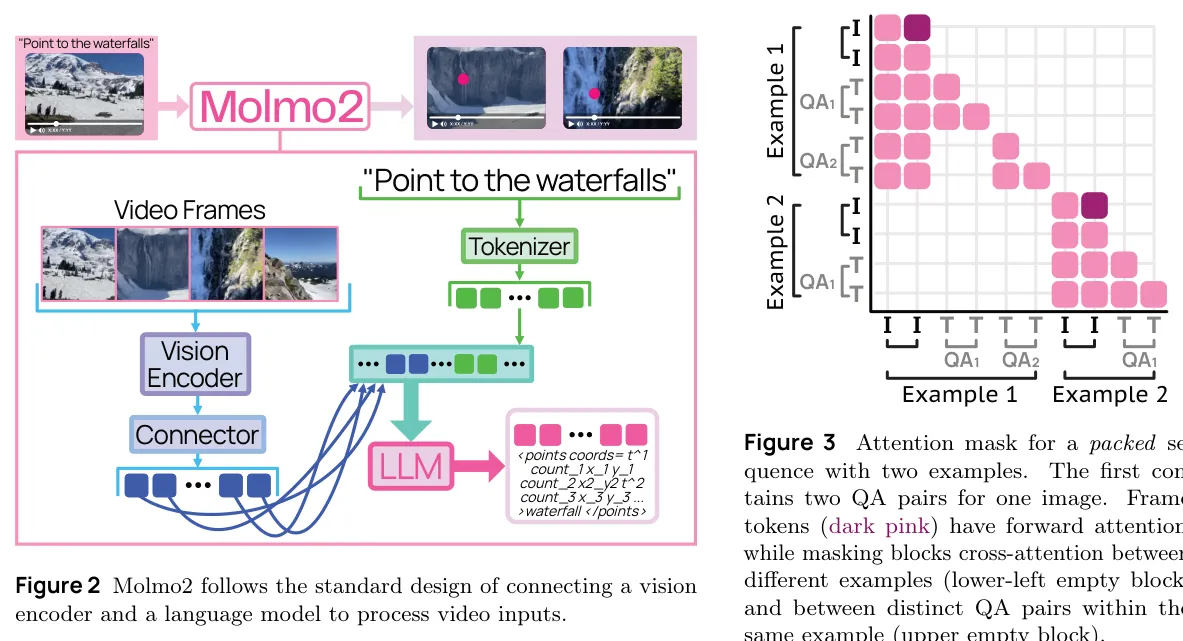
架构沿用标准 ViT + connector + LLM(图像/视频帧切 crop → ViT patch 特征 → attention pooling → MLP 投影成 visual token → 喂 LLM)。三阶段训练:① 图像 caption+pointing 预训练 → ② 图/视频/多图联合 SFT → ③ 短暂 long-context SFT(序列 36864、F=384 帧、context parallel 8 卡 + Ulysses attention)。四个训练创新:(a) token 加权 w=0.1(caption)/0.2(pointing)/否则 1/√n(n=答案 token 数),防长 caption 主导 loss;(b) 视觉 token 双向注意力(让不同帧/图的 image token 互相 forward-attend);(c) packing(3.8 例/16348 token,15× 训练效率);(d) message-tree(一个视觉输入 + 多标注分支,自定义 attention mask 防分支互相 attend)。点坐标用纯文本格式:归一化 x,y + 时间戳(视频)/图索引(多图) + 每个物体唯一整数 ID(支持 tracking/counting)。counting 的 close acc:correct ⟺ |pred−gt| ≤ Δ,Δ=1+⌊0.05×gt⌋。
关键结果
三个模型:Molmo2-4B / 8B(基于 Qwen3)+ Molmo2-O-7B(基于全开 OLMo)。① 视频理解(Table 2):8B 在 open-weight+open-data 类里短视频/counting/captioning 取得 SoTA,long video 略逊(作者归因缺 open 长视频数据+算力);② video grounding(Table 3)是杀手锏:BURST-VideoCount Acc 60.8(8B) vs Qwen3-VL-8B 42.0;Molmo2-VideoPoint F1 38.4(8B) vs Gemini 3 Pro 20.0 / Qwen3-VL-8B 1.5 / GPT-5 4.1——反超闭源大模型一个数量级;video tracking 56.2 vs 41.1 J&F、video counting 35.5 vs 29.6。
亮点
① "全开 + 无蒸馏"是定位性贡献(数据全自建,方法可被社区复现/改进);② 把图像 pointing 范式时间化,且 grounding 反超闭源——证明"专门收集 grounding 数据"比"更大模型"更有效;③ dense video caption 平均 924 词/视频(vs LLaVA-Video 547、ShareGPT4Video 280),是迄今最密;④ 工程:packing+message-tree 15× 效率,使 58 页规模训练可行。
疑问
① token 加权 0.1/0.2/1/√n 是手调启发式,未做系数 sweep,是否最优存疑;② video pointing F1 绝对值仍只有 38.4——video grounding 远未解决,离实用有距离;③ long video 落后于 Qwen3-VL,是数据/算力 bottleneck 还是架构上限?作者倾向前者但未给充分证据;④ 原文未写/需查:F1 对 SAM2 mask 的匹配阈值、Elo 的 Bradley-Terry 拟合细节都在 appendix。
📖 逐段精读 · 笔记
批量精读初稿(本地 PDF 全文提取 ~186K 字符 / 58 页)。最后更新 2026-06-21。
① Abstract(摘要)— 逐句精讲
痛点(原文):“Today’s strongest video-language models (VLMs) remain proprietary. The strongest open-weight models either rely on synthetic data from proprietary VLMs, effectively distilling from them, or do not disclose their training data or recipe.”——最强 VLM 都闭源;开源的要么从闭源 VLM 蒸馏、要么不公开数据/配方,社区缺“地基”。
缺失能力:“many downstream applications require more than just high-level video understanding; they require grounding—either by pointing or by tracking in pixels. Even proprietary models lack this capability.”——下游需要像素级 grounding(指点 / 追踪),连闭源模型都做不好。
贡献(逐句指路):① “Molmo2, a new family of VLMs that are state-of-the-art among open-source models” 且在 single/multi-image/video 上有 “point-driven grounding”;② “a collection of 7 new video datasets and 2 multi-image datasets … all collected without the use of closed VLMs.”(9 个新数据集、全程不用闭源 VLM);③ 训练配方含 “efficient packing and message-tree encoding scheme … bi-directional attention on vision tokens and a novel token-weight strategy improves performance.”。
结论性数字(原文):“Our best-in-class 8B model outperforms others … on short videos, counting, and captioning, and is competitive on long-videos. On video-grounding Molmo2 significantly outperforms … Qwen3-VL (35.5 vs 29.6 accuracy on video counting) and surpasses proprietary models like Gemini 3 Pro on some tasks (38.4 vs 20.0 F1 on video pointing and 56.2 vs 41.1 J&F on video tracking).”。一句话抓 Abstract:第一个权重/数据/代码全开、零蒸馏的 SOTA 视频 VLM,把 image 的 pointing 范式扩到时空(video pointing + tracking),靠 9 个自建数据集 + 高效训练配方在 grounding 上反超 Gemini 3 Pro。
📚 背景①(外部知识):VLM / grounding / open-weight vs open-data / 蒸馏
VLM(vision-language model)=接受图像/视频 + 文本、输出文本(或坐标)的多模态大模型。grounding(接地)=把语言落到像素:image 里是 pointing(输出点坐标,Molmo 首创范式),本文扩到 video 的 pointing(时空:哪一刻、哪个位置)与 tracking(持续输出物体轨迹点)。open-weight ≠ open-data:很多“开源”模型只放权重,不放数据/配方,或数据是从 GPT-4/Gemini 蒸馏来的(有版权/偏置/不可复现问题)。Molmo2 强调 “all our data is constructed without distilling from proprietary models.”——这是它区别于 Qwen3-VL/InternVL 等 open-weight 的根本卖点。
📚 背景②:ViT+connector+LLM 架构范式 / 评测指标(J&F / HOTA / Elo / F1)
架构范式:预训练 ViT(视觉编码器,本文用 SigLIP 2 系)→ connector(把视觉特征对齐进 LLM 输入空间)→ LLM(Molmo2 用 Qwen3 / OLMo)。指标:J&F(Jaccard + F-measure,VOS 分割质量)、HOTA(含 association 的追踪精度,看 ID 关联对不对)、F1(点是否落在 GT mask 内)、Elo(Bradley-Terry)(人类两两偏好排名)、close accuracy(计数 \(|pred-gt|\le\Delta,\ \Delta=1+\lfloor0.05\times gt\rfloor\),奖励“接近正确”)。
② §1 Introduction — problem → solution → why 闭环
problem:视频无处不在(手机/家庭摄像头/自动驾驶/工业传感),但最强 video-language 模型 “remain proprietary, with closed weights, data, and training recipes.”,且普遍缺 grounding——无法回答 “How many times does the robot grasp the red block?”(每次抓取在时空里打点)或 “When did the cup fall off the table?”(返回杯子轨迹)。
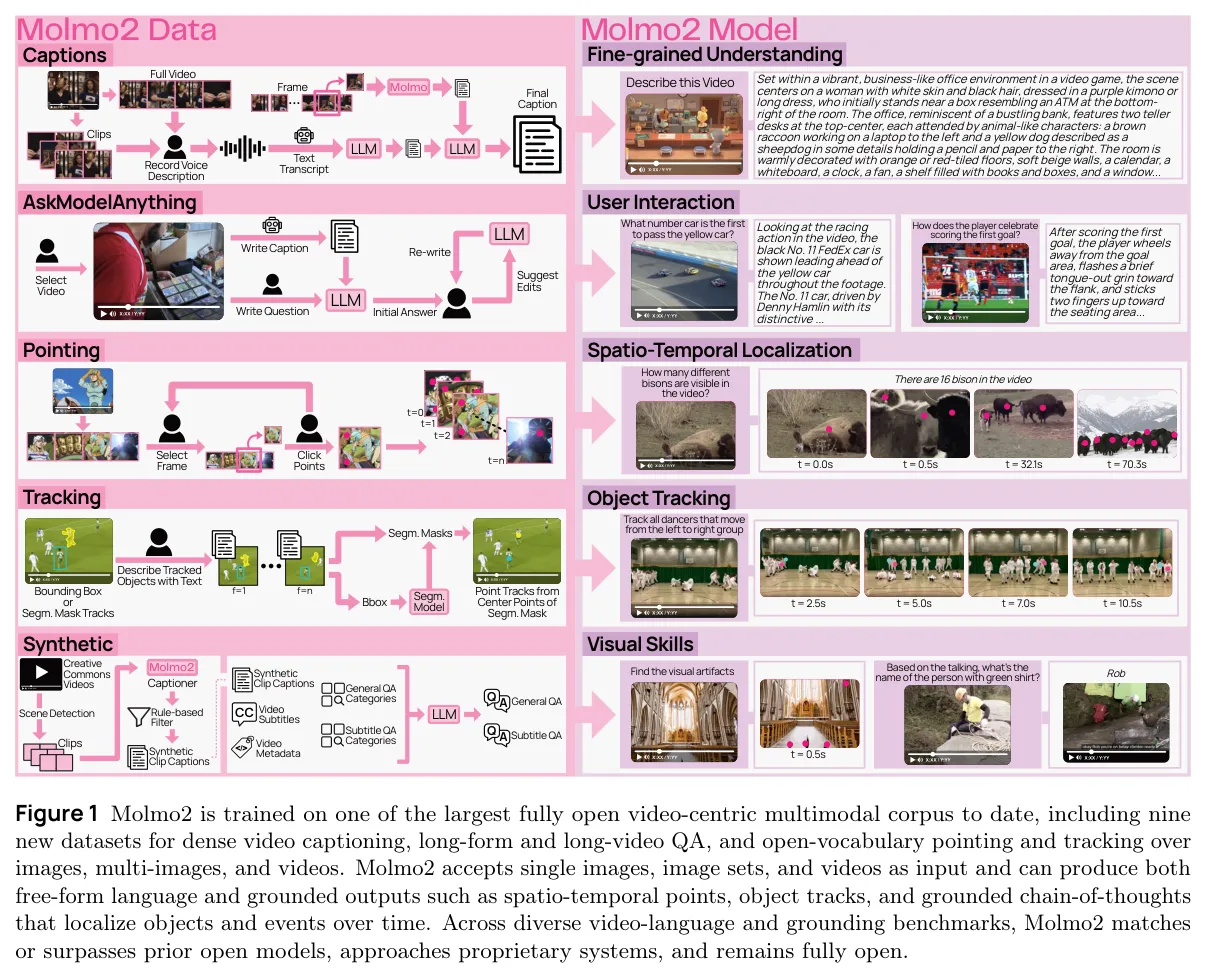
solution(Intro 自包含):发布 Molmo2(全开 VLM),支持单图/多图/视频并把 grounding 带进视频。核心是 9 个新数据集:(1) 两个开放词表 video pointing+tracking(520k 实例);(2) dense video captioning(104k 视频,比任何前作都长更详);(3) 两个 long-form QA(212k,人工答、不蒸馏);(4) 两个 long-video QA(约 1.3M,针对开源模型在超长视频上的弱点);(5) 两个 multi-image 数据集。三阶段训练 + 多项训练创新(token weighting / packing / message tree / bi-directional attention)。
why(关键主张):“all our data is constructed without distilling from proprietary models.”——为透明可复现,宁可自己造数据。grounding 把 “2D pointing paradigm … into the temporal domain”,模型既能在帧里指点、也能定位动作发生时刻、还能跨视频持续追踪。发布 4B/8B(Qwen3)+ 7B(OLMo)三版以证明纯开放 LLM 也能做到。
③ §2 数据 — 9 个新数据集(逐个关键数字)
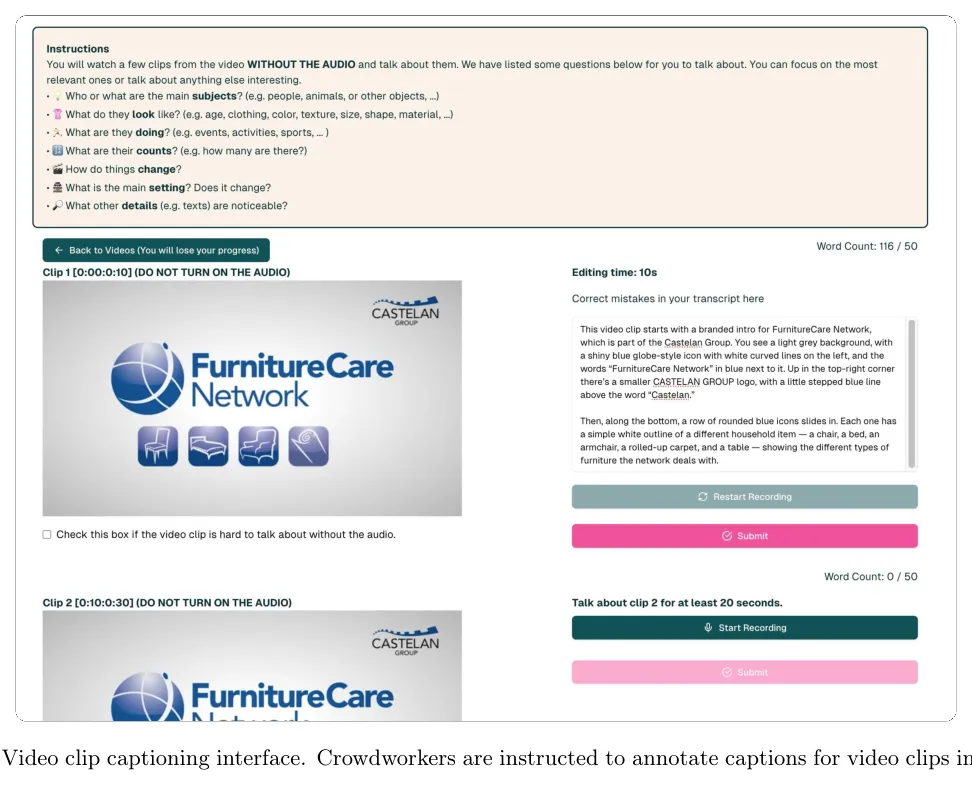
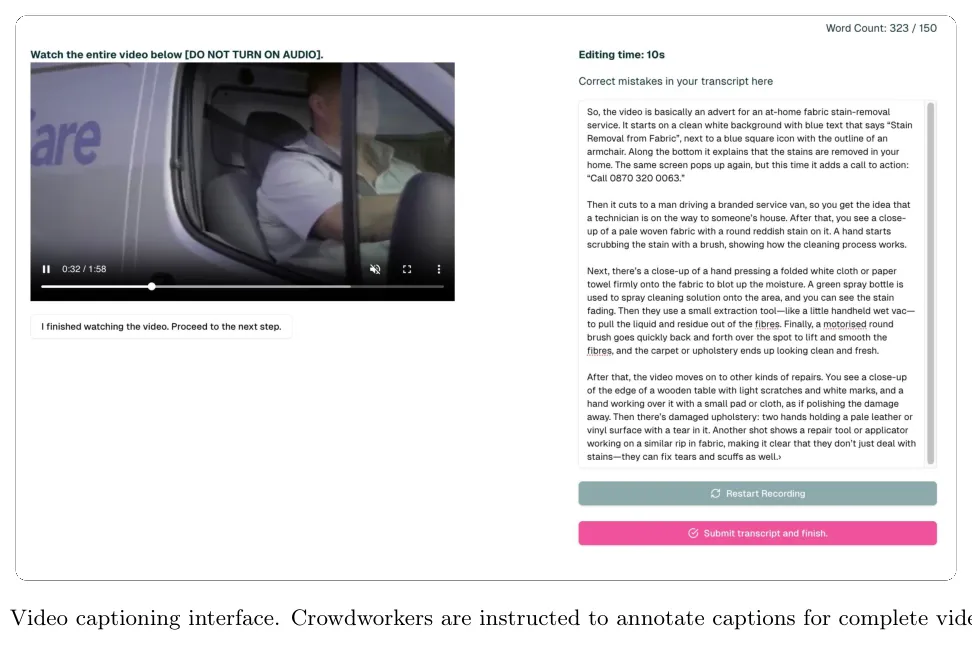
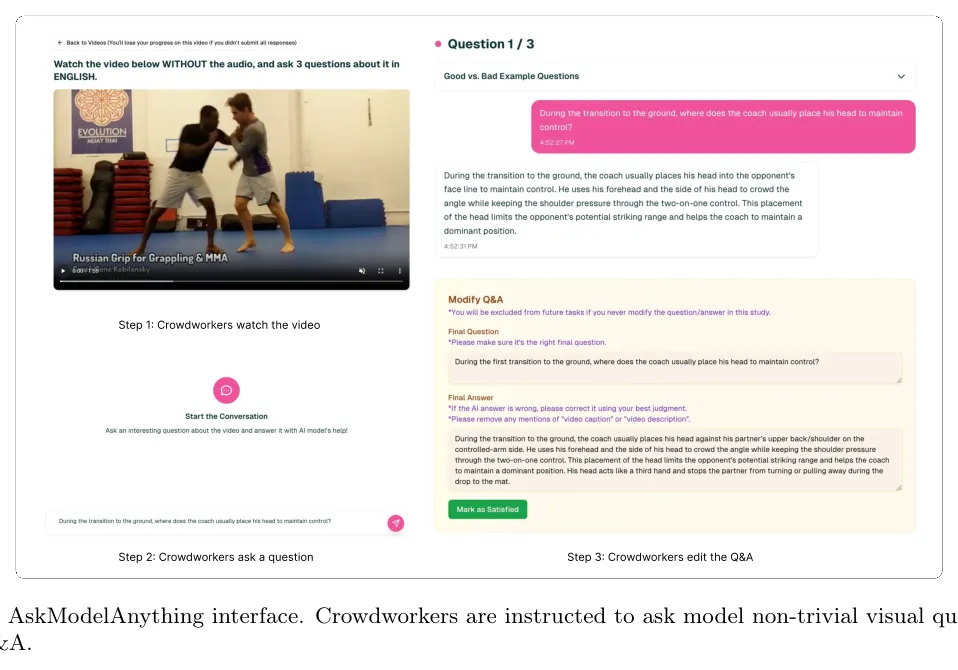
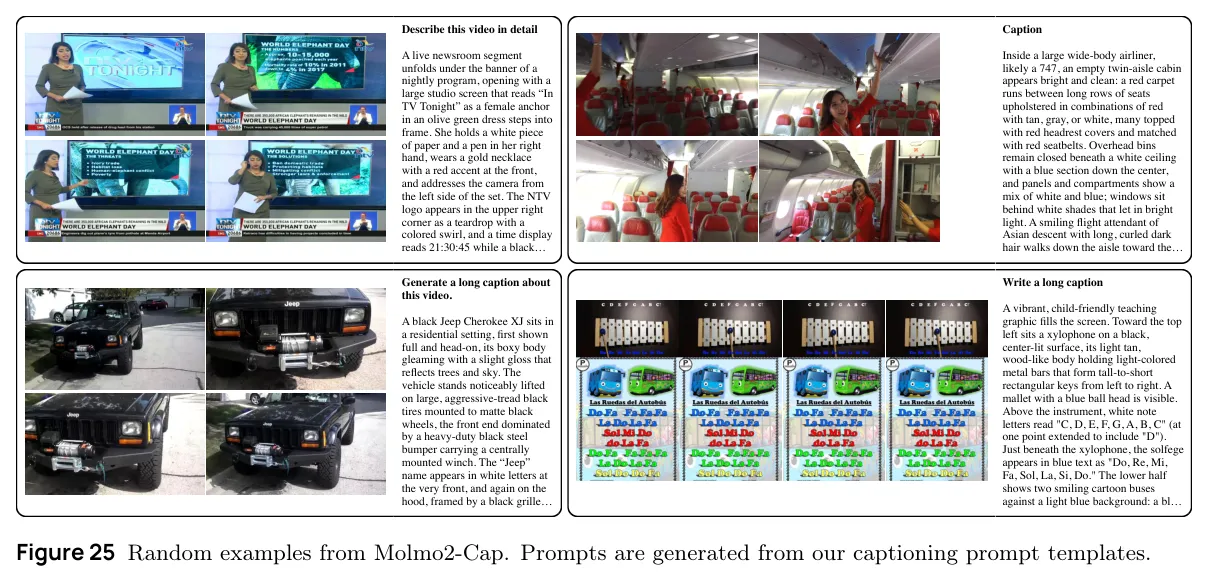
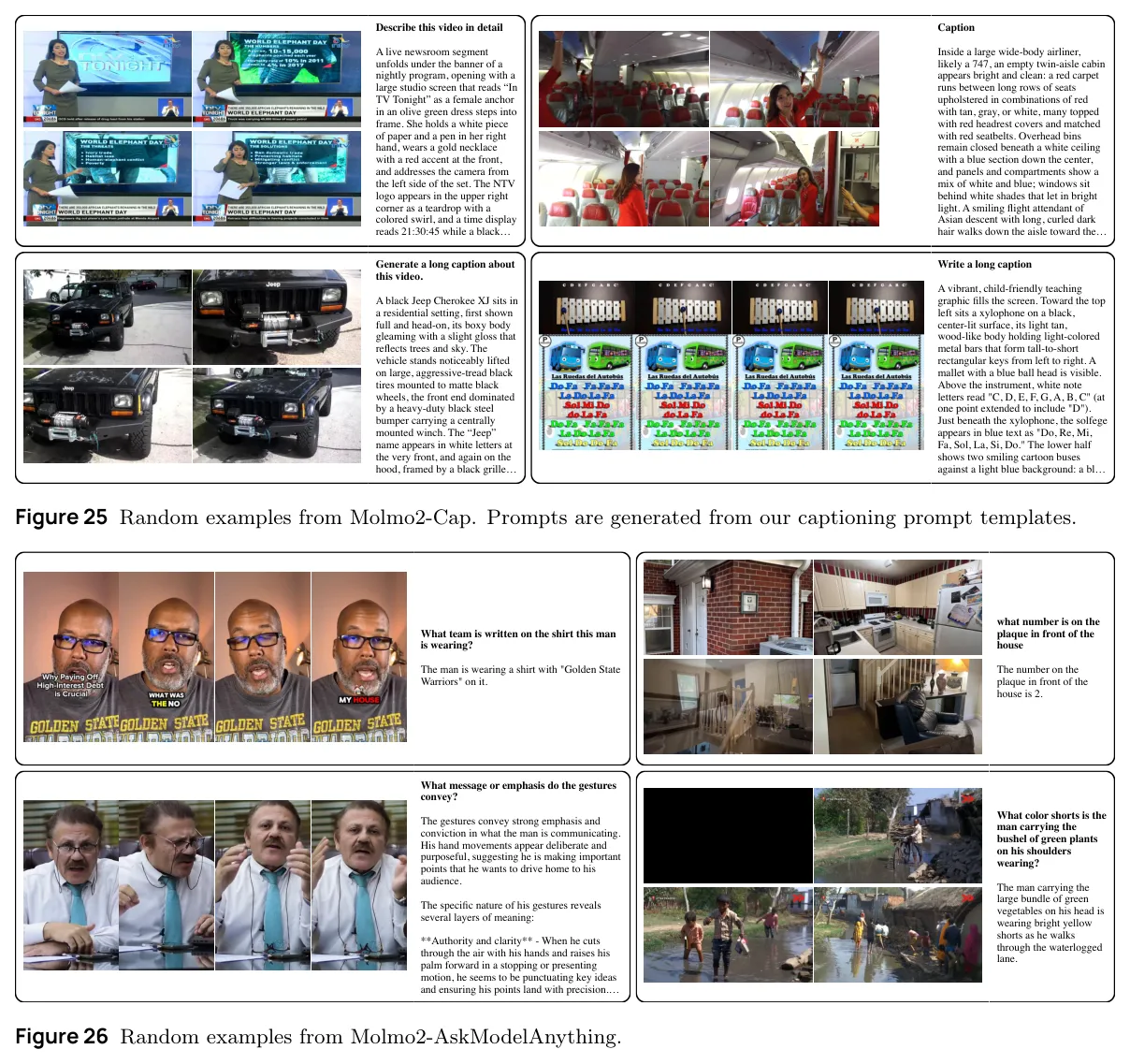
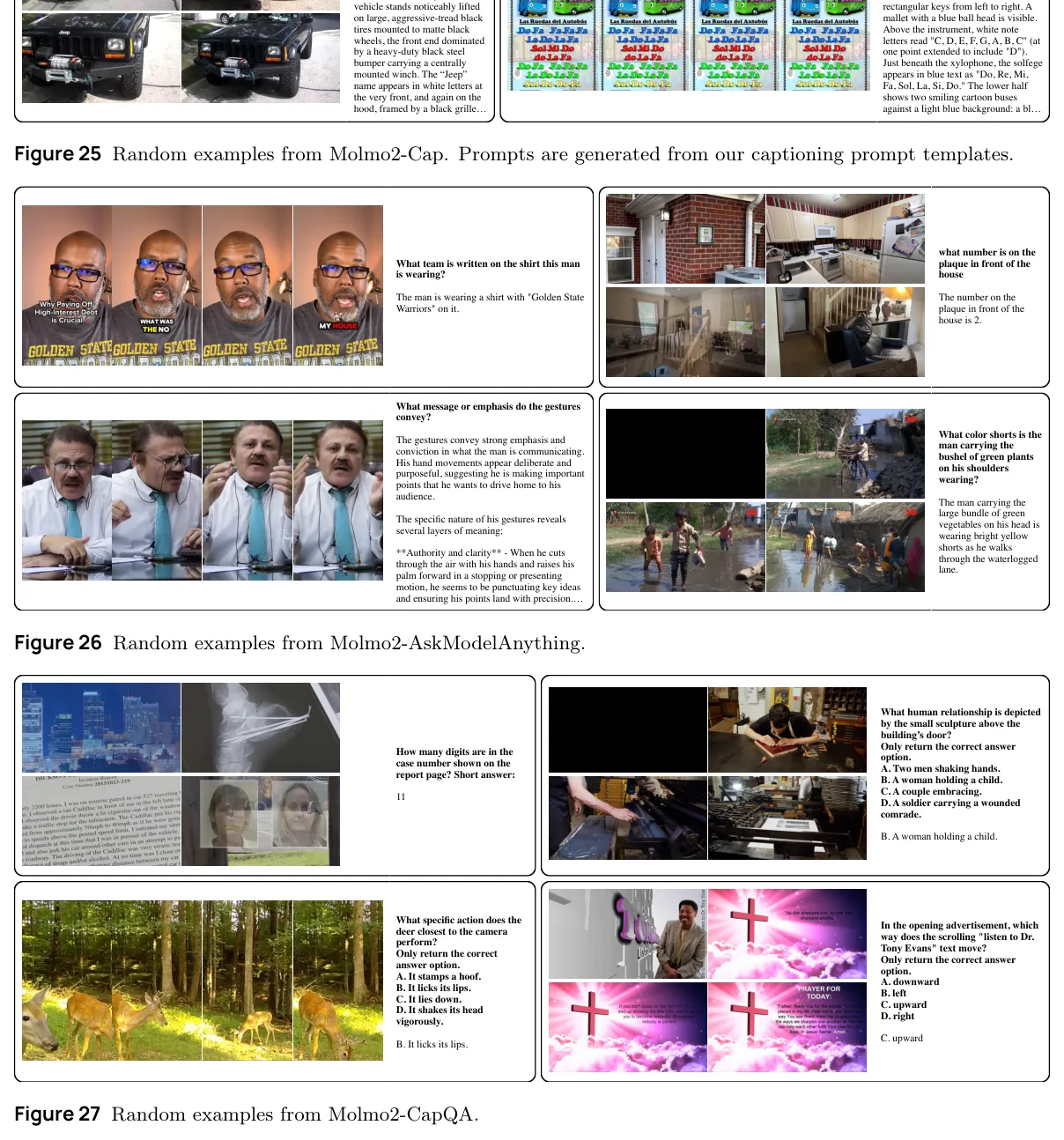
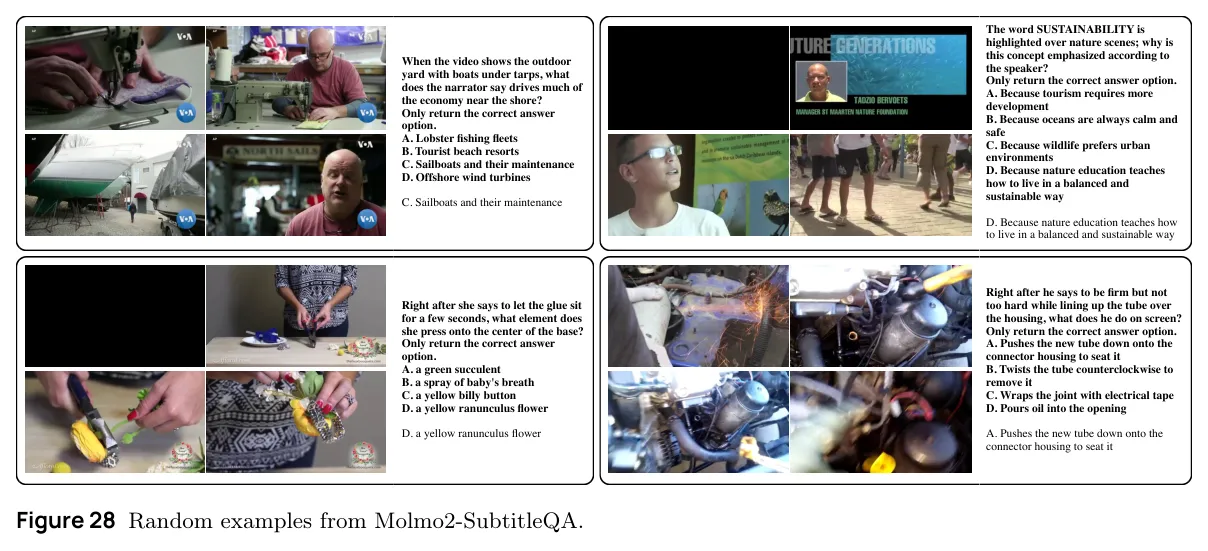
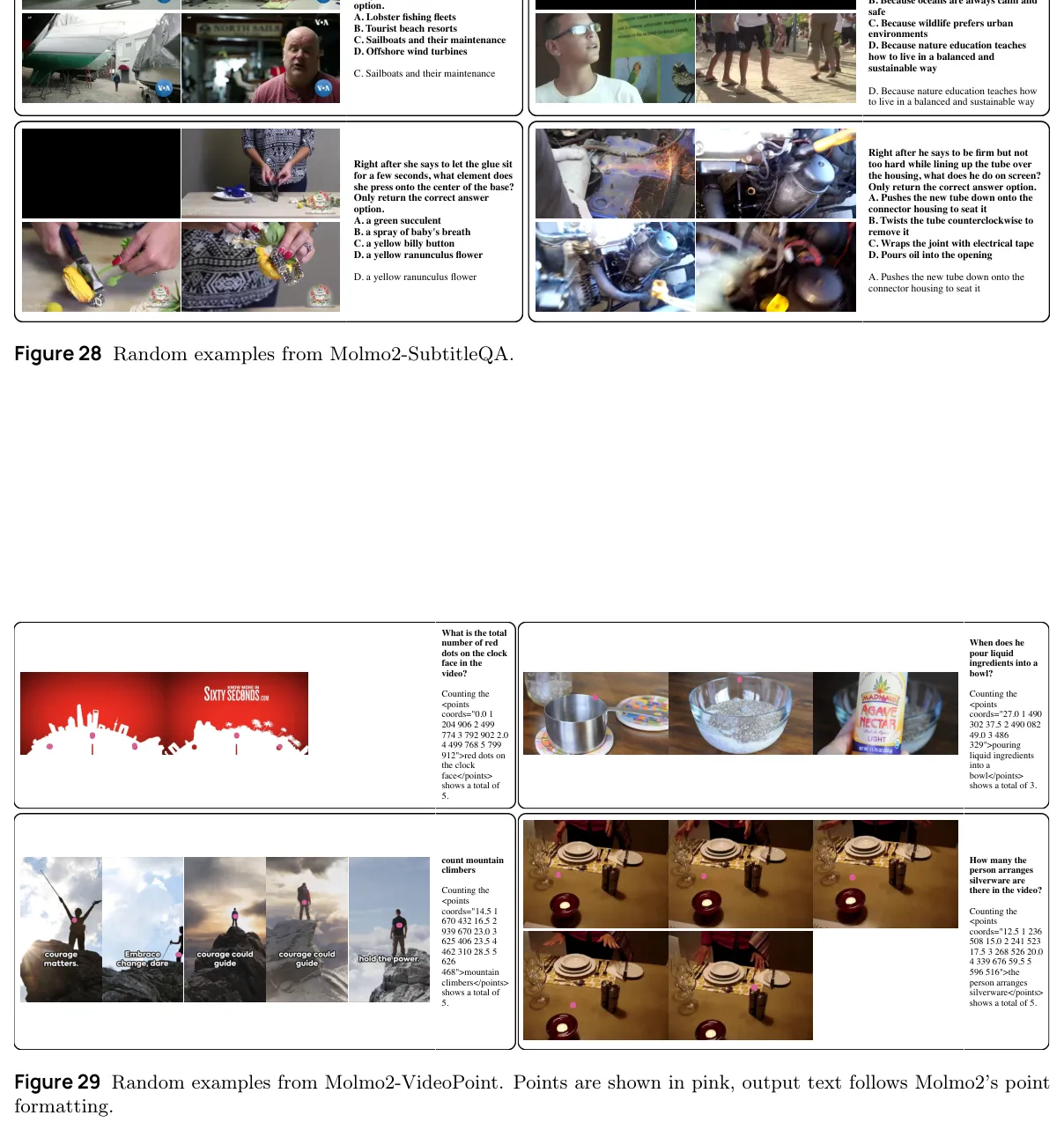
1) Molmo2-Cap(人工):104k 视频级 + 431k clip 级 dense caption,平均 924 词/视频(对比 Video Localized Narratives 75、RCap/RDCap 89/100、ShareGPT4Video 280、LLaVA-Video-178K 547,是“densest video caption dataset to date”)。2) Molmo2-AskModelAnything(人工):140k 人写 video QA,按 caption 聚成 31 类均匀采样;初答用 Claude Sonnet 4.5(条件于早期 Molmo2 caption)、人工迭代精修,LLM filter 去掉 counting/非英文/不匹配。3) Molmo2-CapQA(合成):1M QA(200k 视频 × 5)。4) Molmo2-SubtitleQA(合成):300k QA(100k 视频 × 3),需同时推理视觉+字幕。
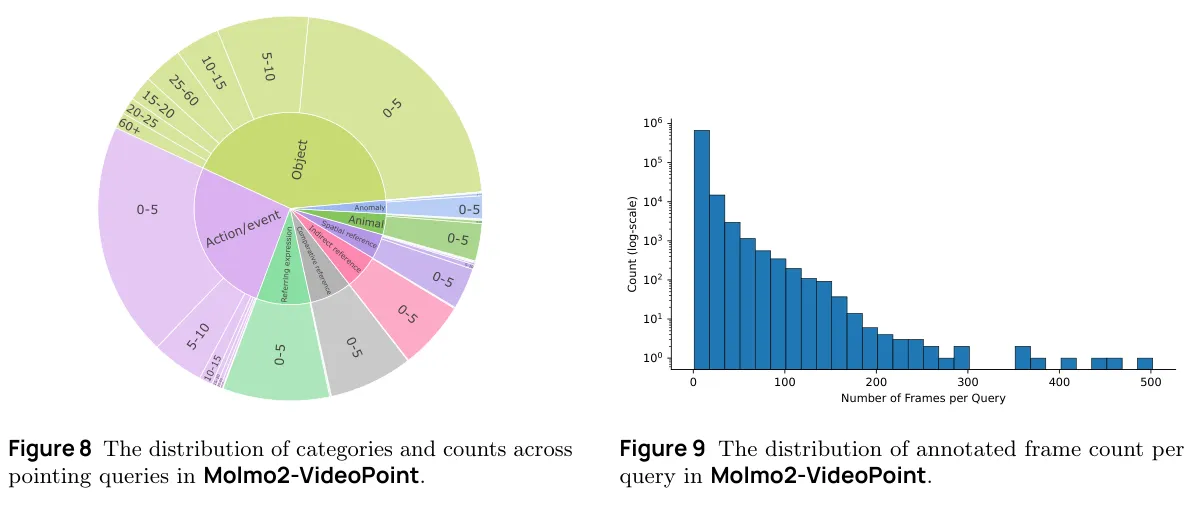
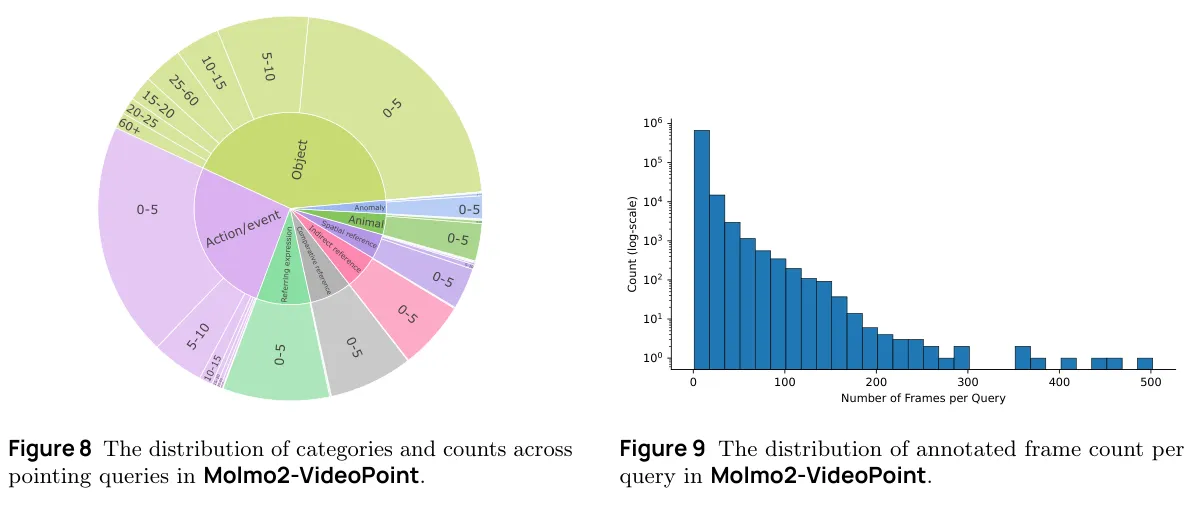
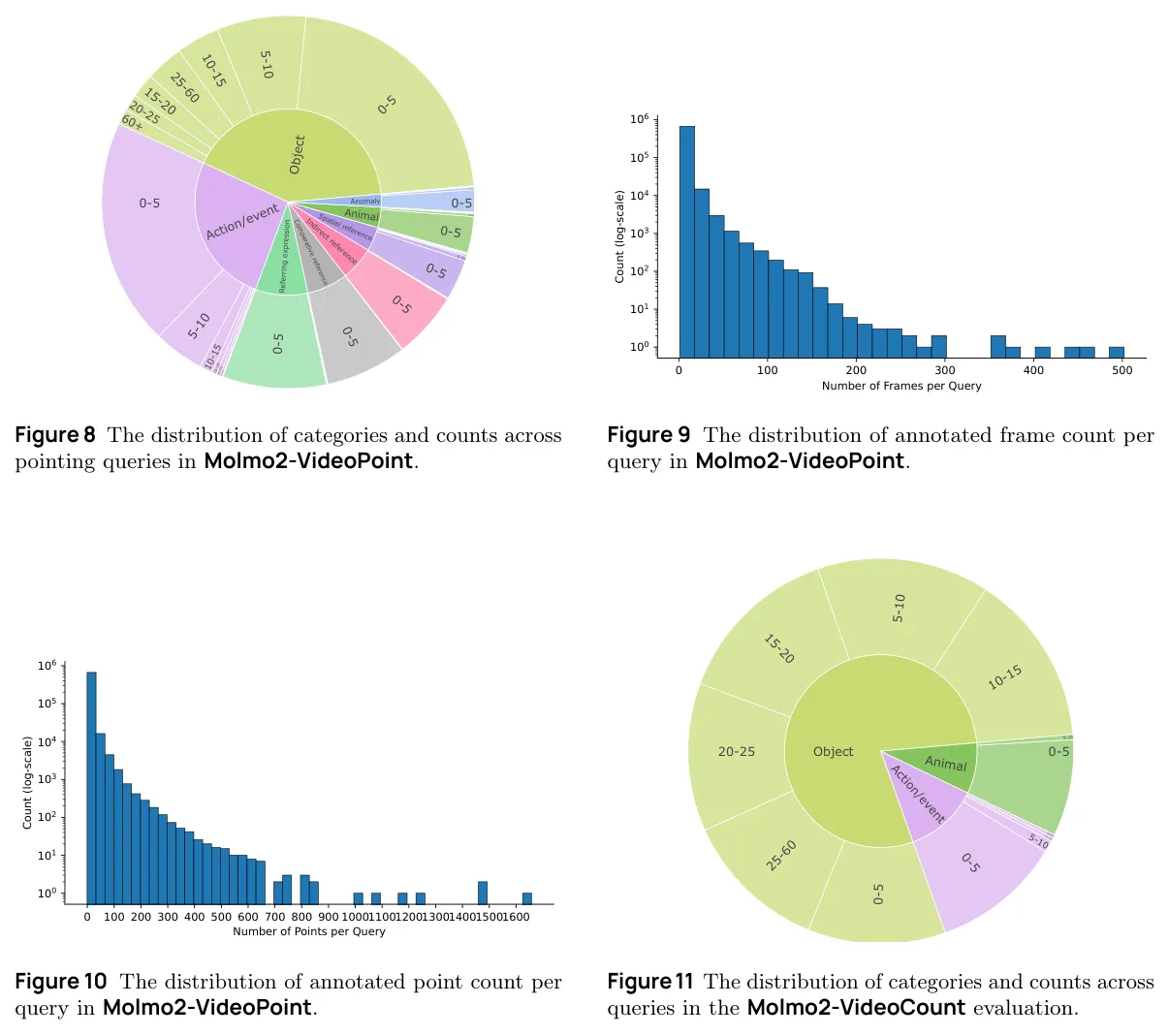
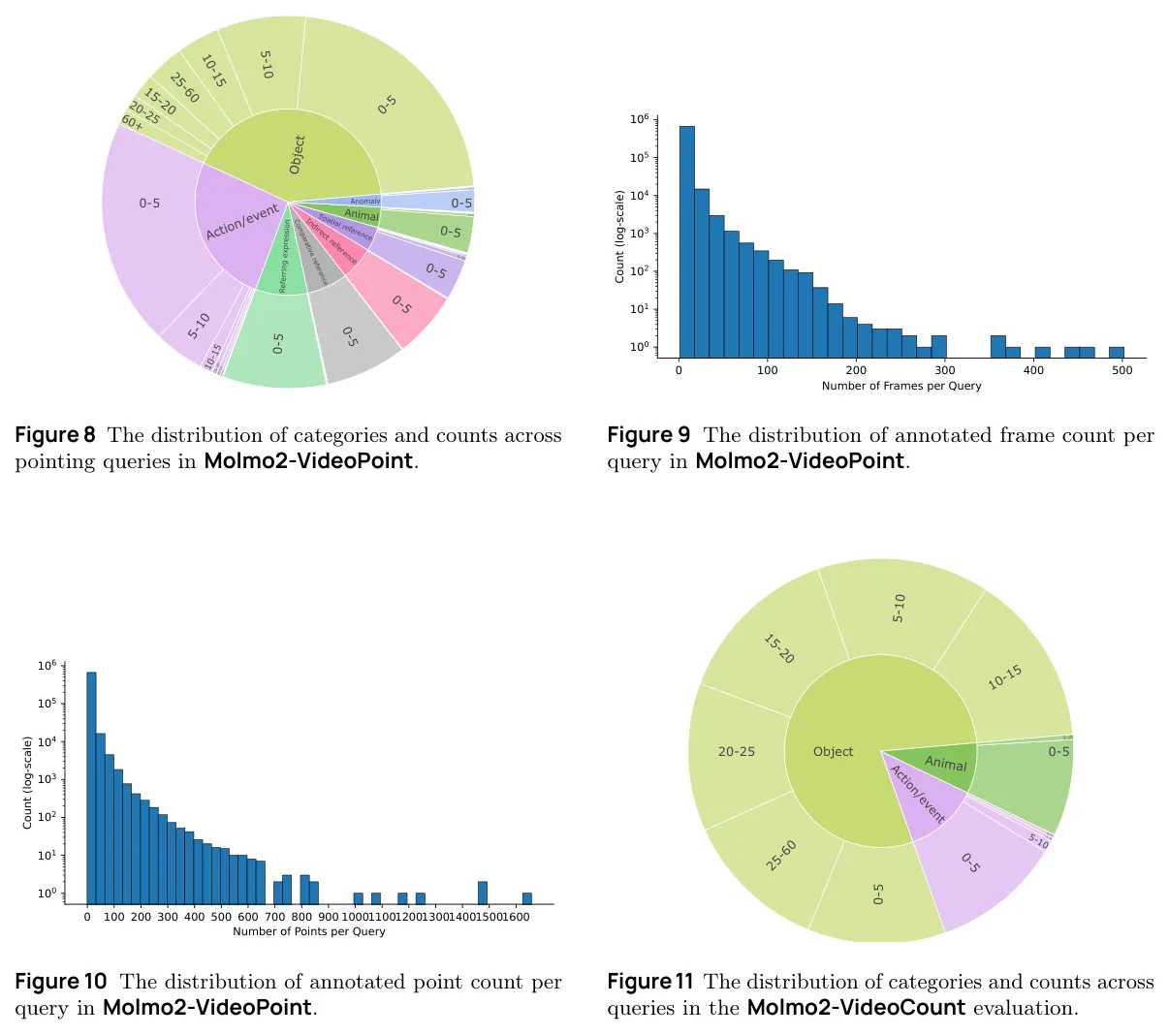
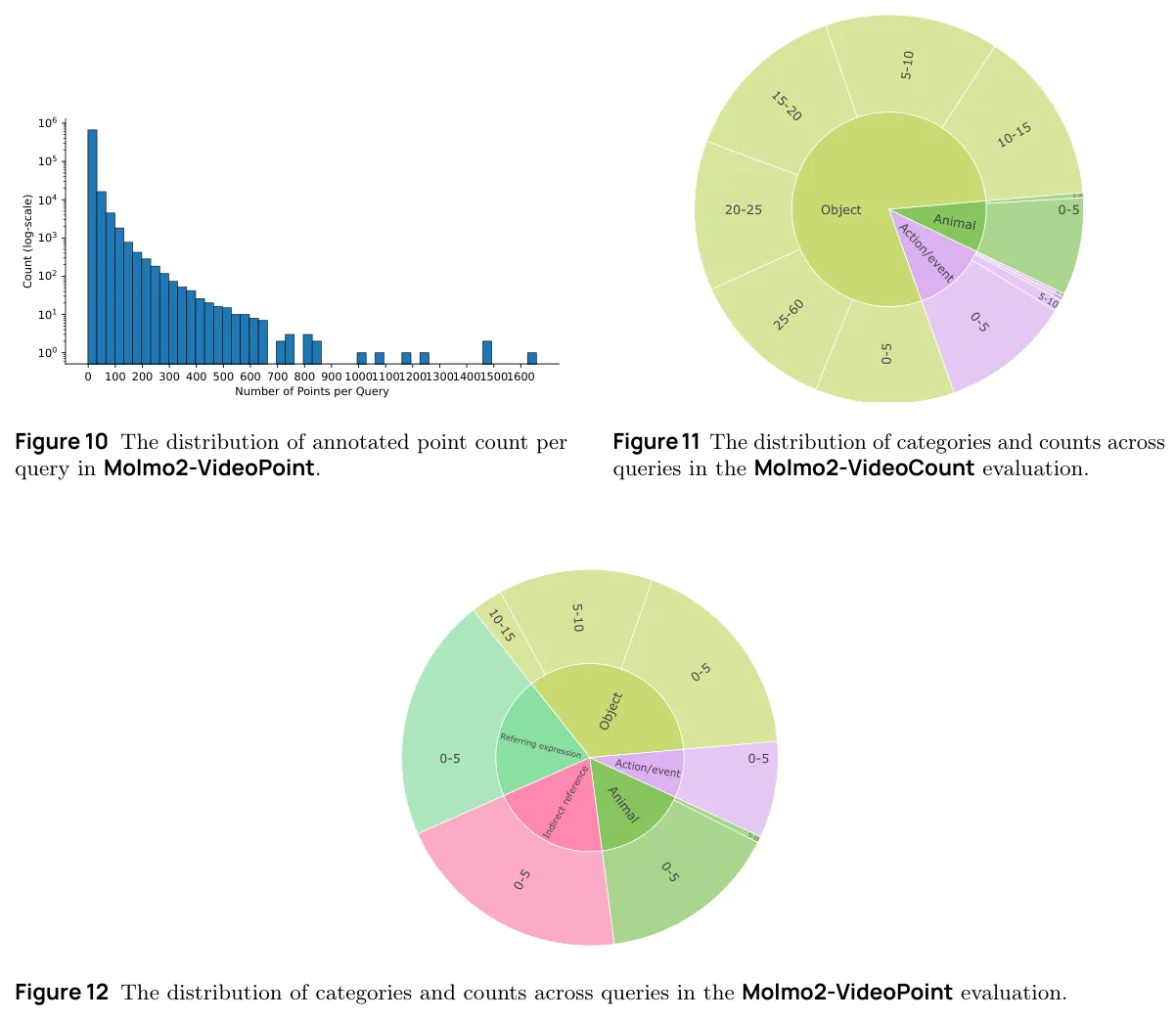
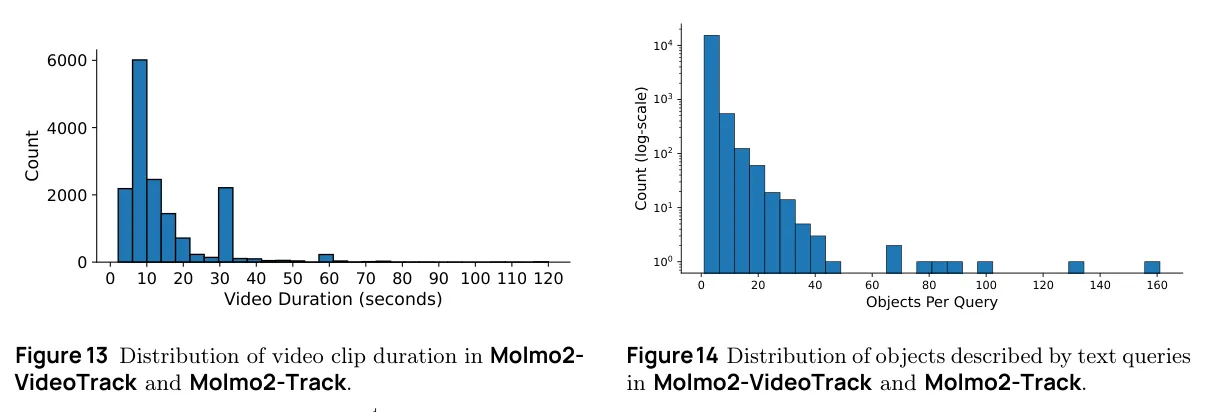
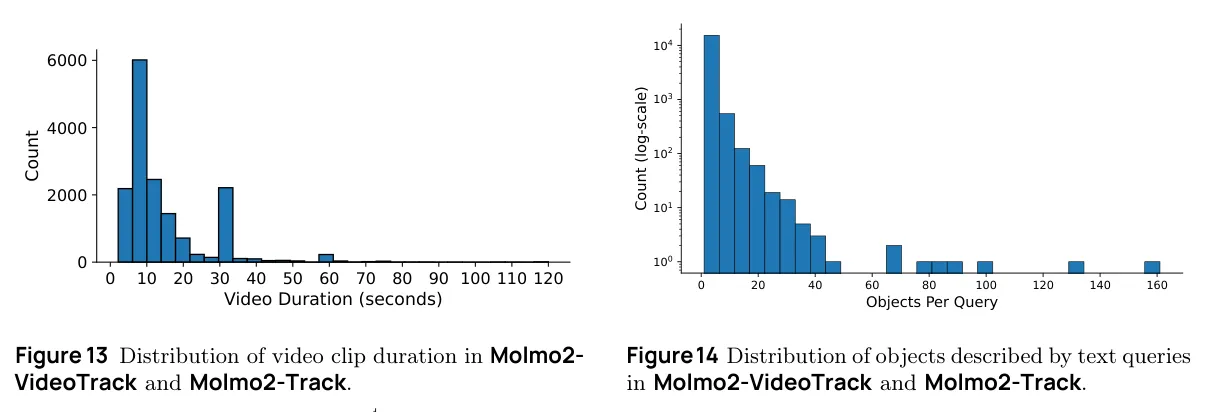
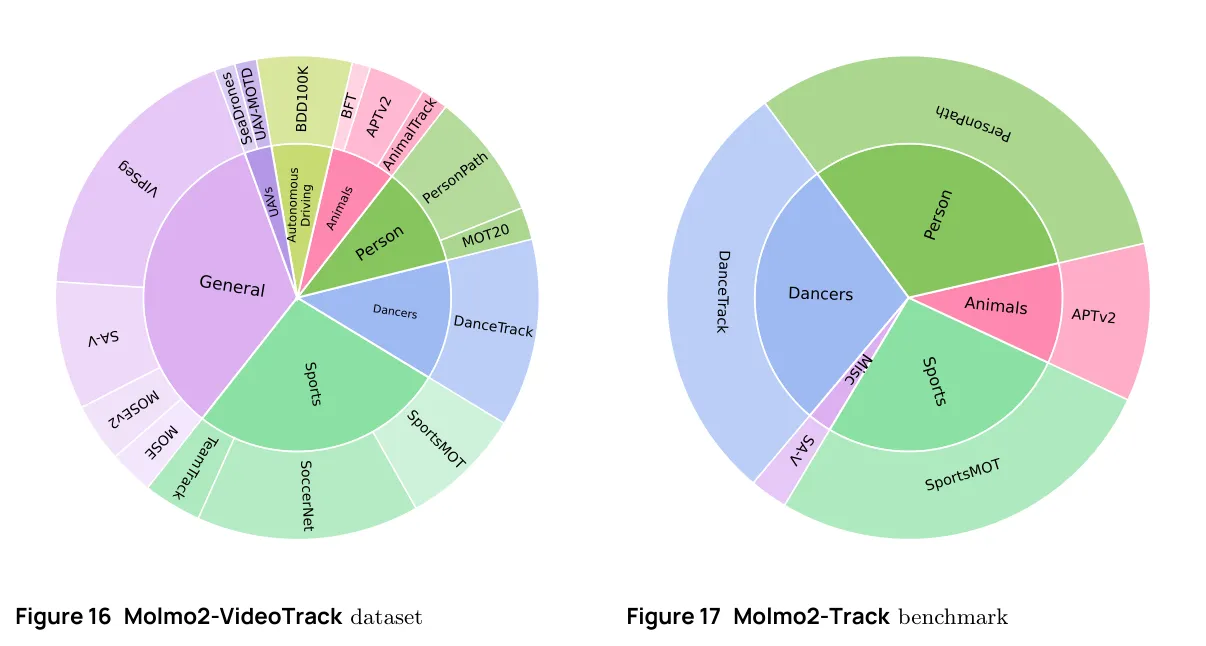
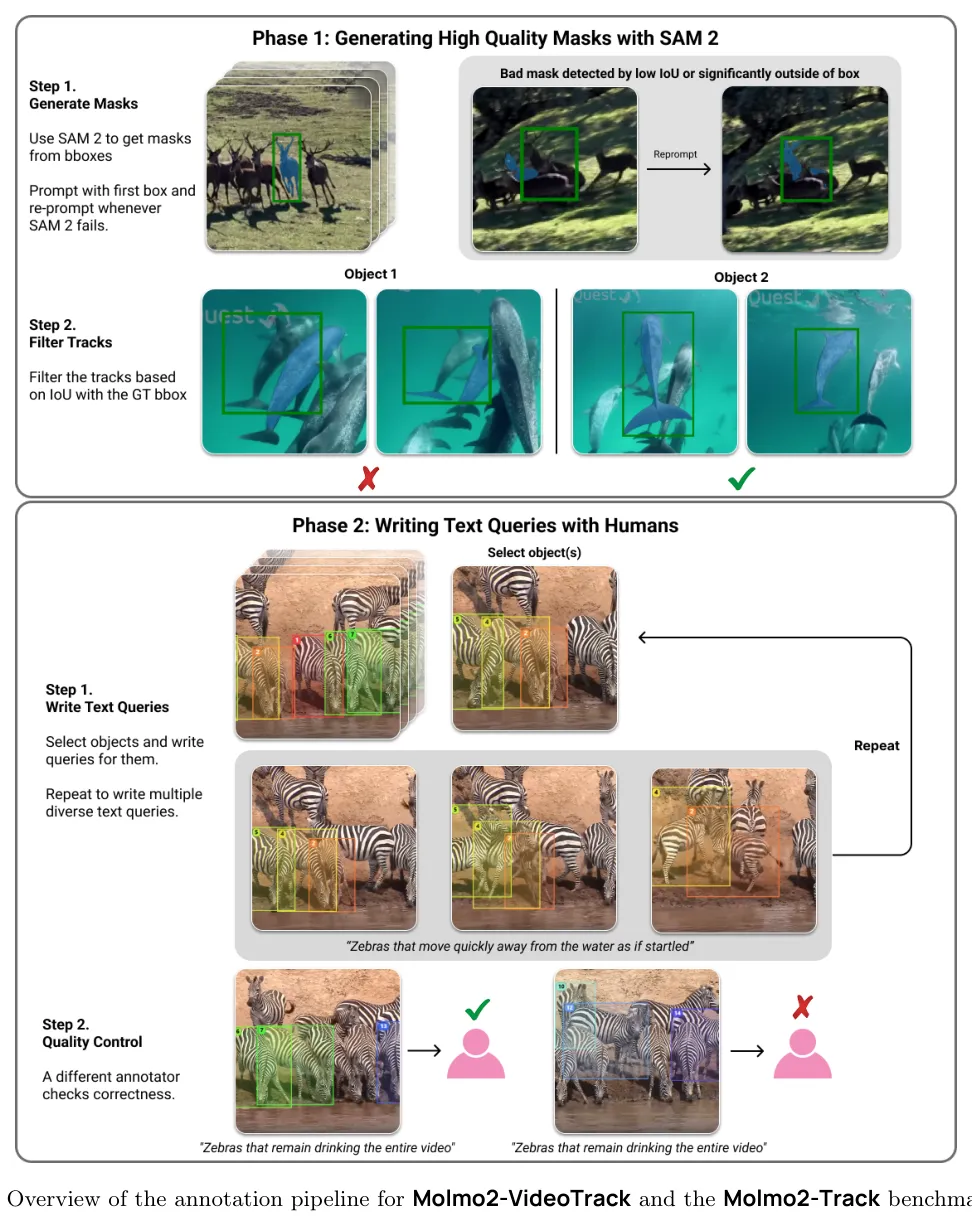
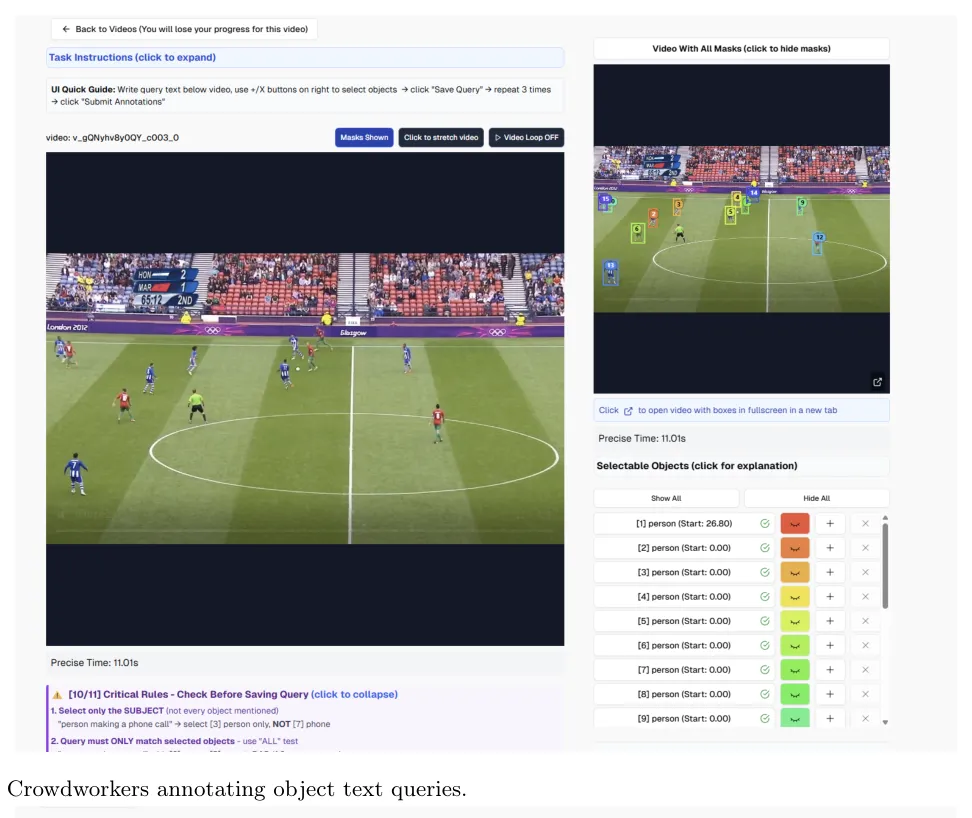
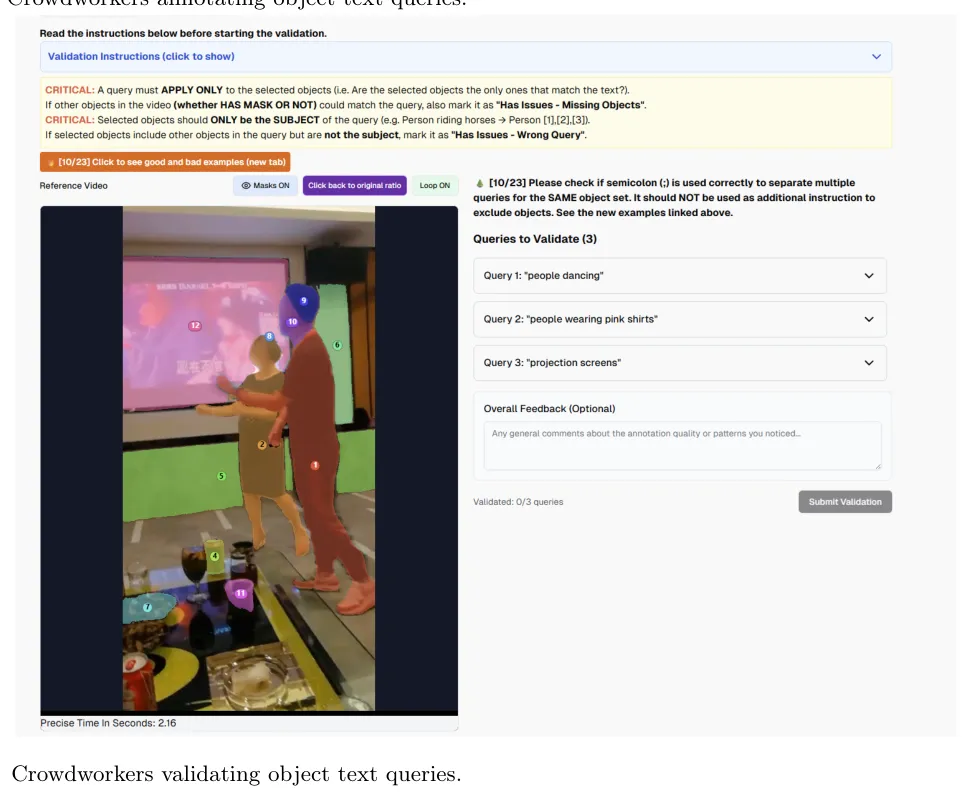
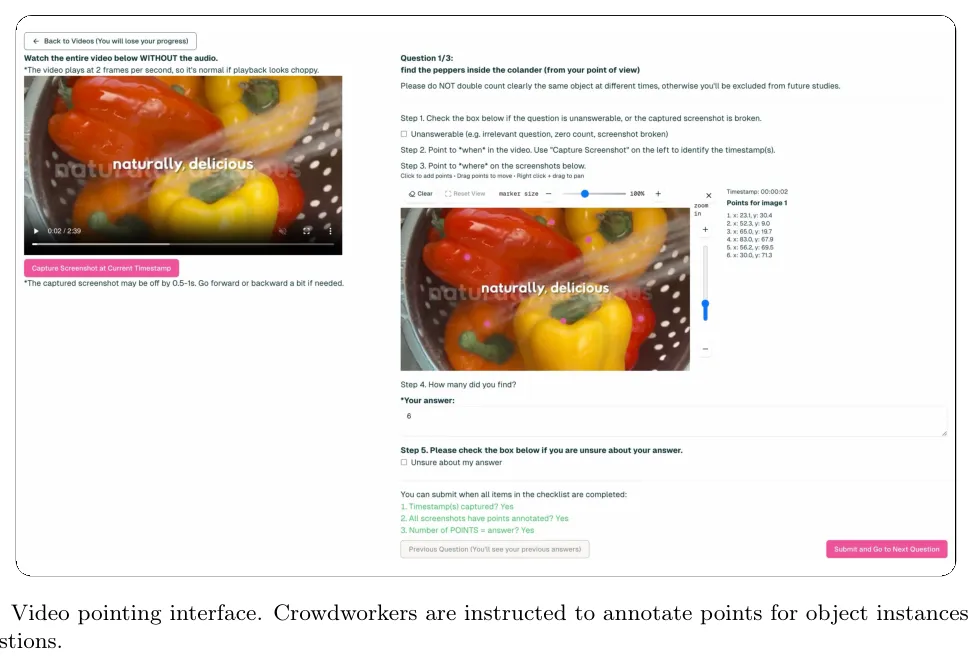
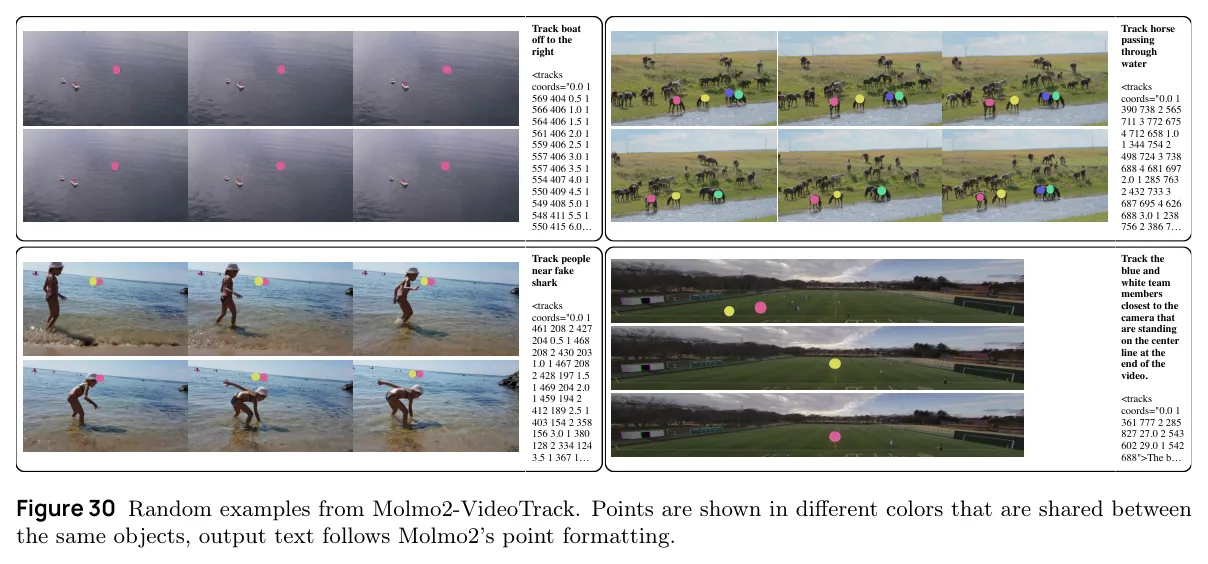
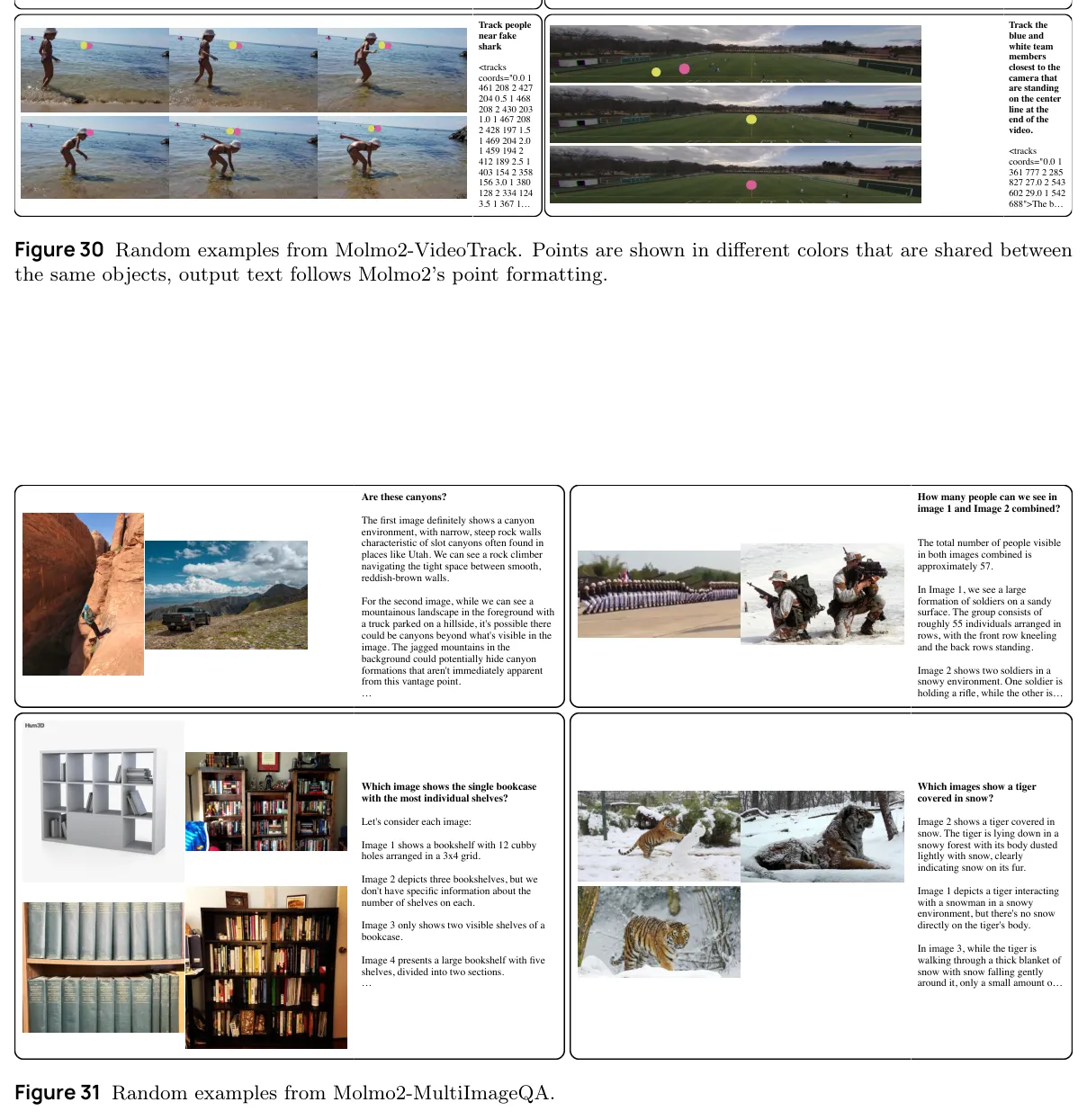
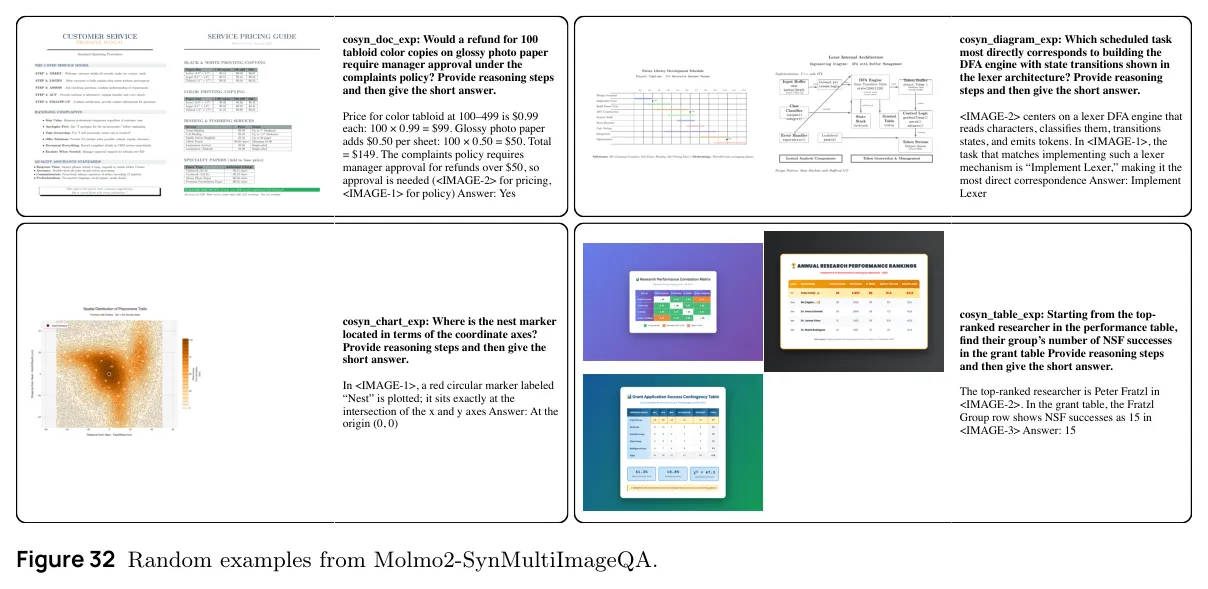
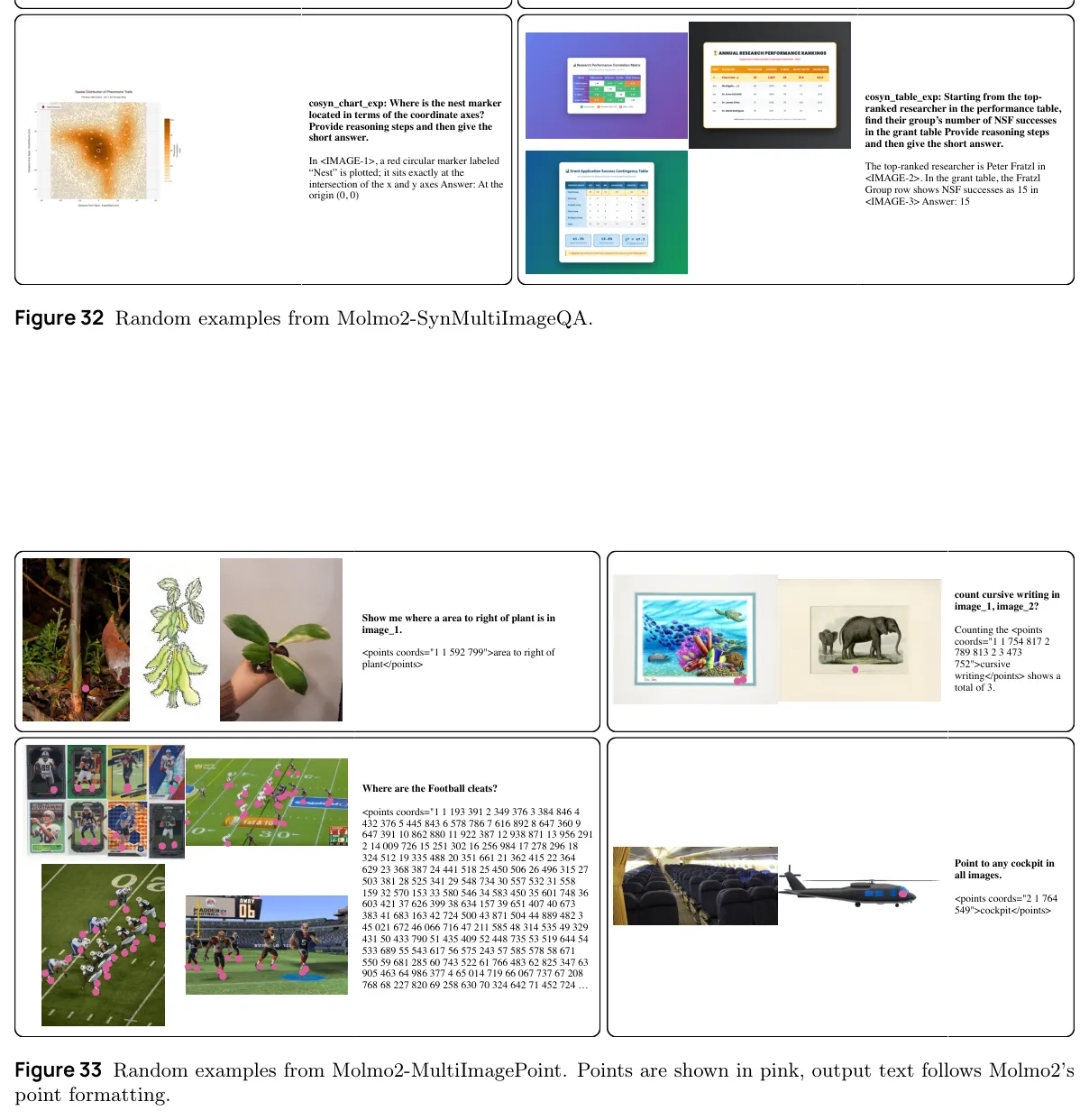
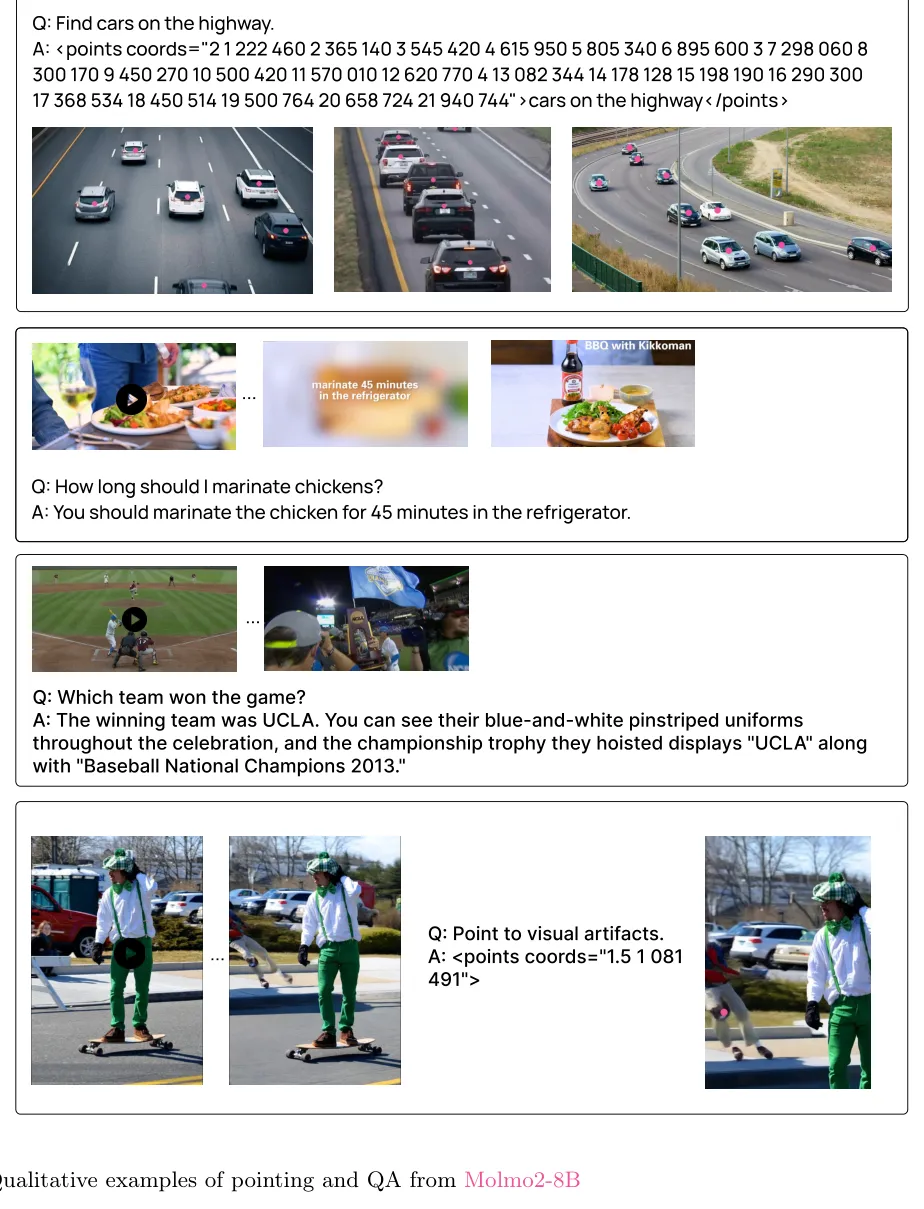
5) Molmo2-VideoPoint(人工):650k pointing query / 280k 视频,平均 6 点/视频,覆盖 8 类(objects / animals / actions-events / referring / indirect / spatial / comparative / visual artifacts),帧取 2fps。6) Molmo2-VideoTrack(人工):3.6k clips / 15k 复杂 NL query,平均 2.28 物体/query,仿 Ref-VOS 让标注者给已有 track 重写非平凡 query。7) Academic-VideoPoint/Track(curated):转 6 个数据集→49k pointing/counting;7 个 Ref-VOS + 11 个 bbox track 用 SAM-2 转 mask/点。8) Molmo2-MultiImageQA(人工):45k 图集 / 96k 图 / 72k QA(每集 2–5 图,均 2.73)。9) Molmo2-MultiImagePoint + SynMultiImageQA(合成):470k pointing/counting + 188k(CoSyn 造的 chart/table/doc 多图)。
③(续)数据 pipeline — 不蒸馏的关键工艺
dense caption(最难):two-stage——标注者先口述每个 clip(说比打字能给更多细节)→ Whisper-1 转写 → 文本 LLM 重写求连贯;再用预设问题引导描述动态变化;最后用 Molmo 出帧级 caption、LLM 把 clip+frame caption 合并成一条长 caption(“to ensure no detail is overlooked”)。long-form QA:因为现有大规模数据“largely distilled from proprietary models”,本文用 human-and-LLM 协作 from scratch;中长视频(1–3 分钟)则用自家 captioner 分 clip 总结再据 caption+transcript 出题(synthetic generator)。multi-image:按 caption 句级相似度聚成 2–5 图的集合再人工提问。
④ §3.1 架构(cropping / connector / LLM / bi-dir attention)
cropping:图像用 1 个降采样整图 + 至多 \(K\) 个重叠 crop 平铺以处理高分辨率,训练 \(K=8\)、推理 \(K=24\);视频按 \(S=2\) fps 取单 crop,最多 \(F=128\) 帧(long-context \(F=384\)),超长则均匀采样且总是包含最后一帧(播放器停在末帧、对用户重要)。connector:取 ViT 倒数第 3 与倒数第 9 层特征;图像 \(2\times2\) patch 窗口、视频 \(3\times3\)(减 token),用 multi-head attention 池化(patch 均值作 query)后共享 MLP 投影。LLM:视觉 token 与文本时间戳(视频)/图索引(多图)交错输入;多 crop 图加 column token 标长宽比;关键创新——“We allow image tokens (even if they are from different frames/images) to forward-attend to one another, which we find can increase performance.”(视觉 token 间双向/前向注意)。
⑤ §3.2 三阶段训练
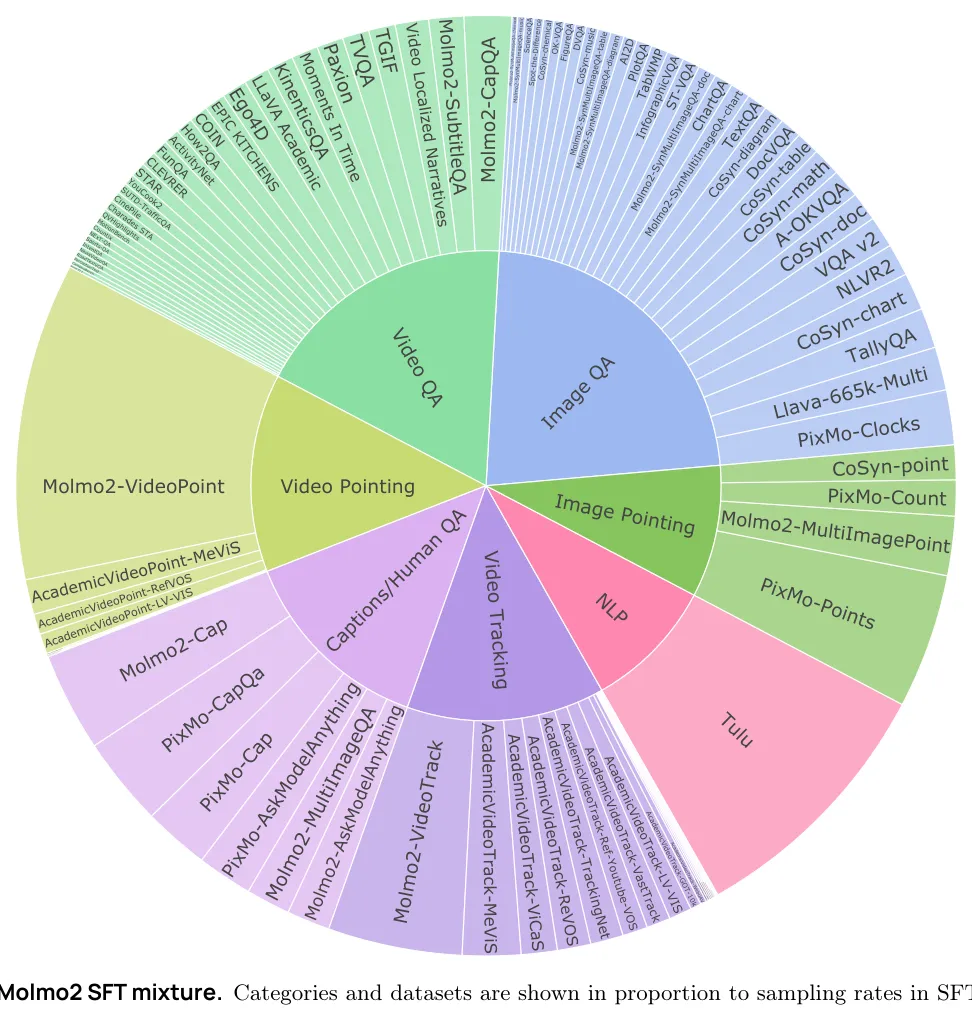
(1) 预训练(image-only):dense captioning(带长度条件)+ transcript 预测(PixMo-Cap)+ NLP(Tulu 去非英/去代码)+ pointing(PixMo-Points/Count、CoSyn-Point)——“adding pointing data during pre-training leads to better and more stable pointing performance.”。混比 60% caption / 30% image pointing / 10% NLP,32k steps、bs 128(≈4 epoch PixMo-Cap),ViT/connector/LLM 用不同学习率。(2) 联合 SFT:PixMo + Molmo2 数据 + Tulu + 开源视频/图,按 Table 1 给每类采样率、类内按 \(\sqrt{\text{size}}\) 采样并手工再平衡,30k steps、bs 128、max len 16384。(3) long-context SFT:同数据,seq len 升到 36864、\(F=384\)、2k steps、LLM 用 context parallelism(每例 8 GPU)+ Ulysses attention(其 all-gather 兼容自定义 packing/message-tree 掩码),并把视频帧编码+attentional pooling 分到 CP 组以省显存;因开销大只做短的收尾阶段。
⑥ §3.2 训练创新(token weighting / packing / message tree / 坐标格式)
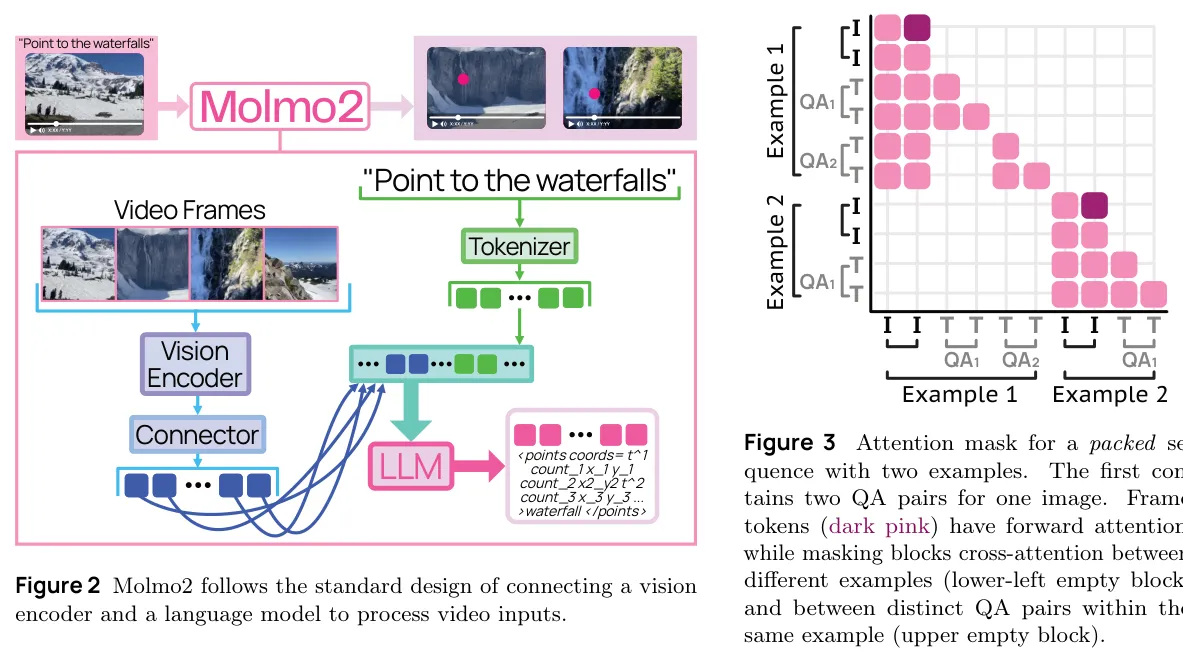
Token weighting:数据里既有单 token 的多选题、也有 4000+ token 的长 caption,长输出例即使少采也会主导 loss、拖垮短答任务。对策:video caption 固定权重 0.1、pointing 0.2,其余按 \(\sqrt[4]{n}\)(\(n\)=答案 token 数)平衡长短。Packing:on-the-fly 把多个短例拼成一条长序列避免 padding 浪费(VLM 既要 pack ViT 的 crop 又要 pack LLM 的 token),保留 \(M=48\) 的内存池构最优拼接。Message trees:视觉输入作第一条 message、每个标注是一个分支,线性化为单序列 + 自定义 attention mask 防分支互相 attend;平均 4 标注/例,packing 能把 3.8 例塞进 16348 token 序列 → 15× 训练效率。坐标格式:压缩纯文本(归一化 x,y + 时间戳/图索引 + 每物体唯一整数 ID 用于追踪/计数),按 time/index 再 x,y 排序。
⑦ §4.1 视频总表 Table 2(节选关键列:Caption F1 / Count / Short / Long / Avg / Elo)
API(闭源)
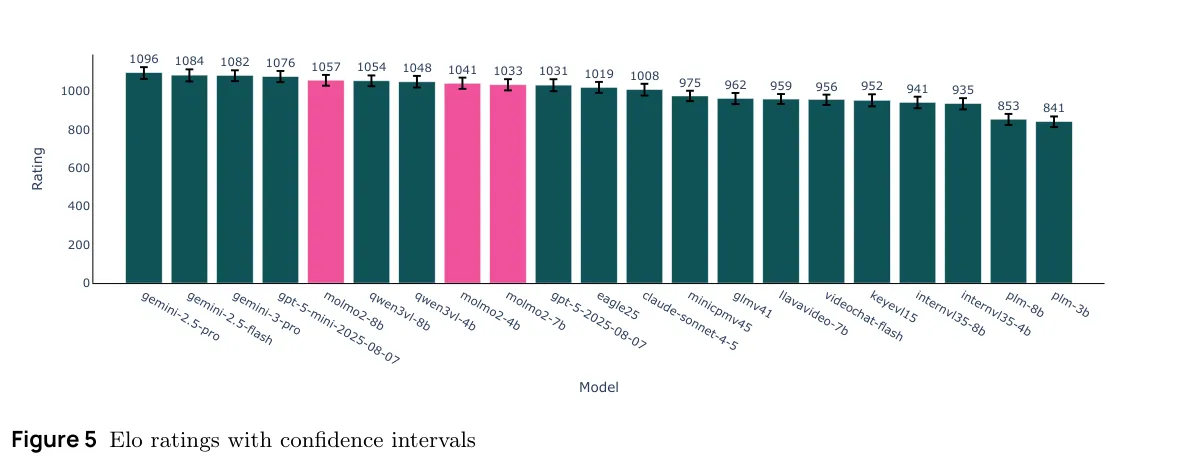
GPT-5 | CapF1 50.1 | Count 35.8 | ShortQA 73.1 | LongQA 76.3 | Avg 70.6 | Elo 1031(#10)
Gemini 2.5 Pro | 42.1 | 35.8 | 71.1 | 80.4 | 71.2 | Elo 1096(#1)
Gemini 3 Pro | 36.0 | 37.1 | 71.0 | 78.8 | 70.0 | Elo 1082(#3)
Claude Sonnet 4.5 | 26.0 | 27.2 | 62.8 | 66.4 | 59.6 | Elo 1008(#12)
Open-weight
Qwen3-VL-8B | 26.7 | 29.6 | 65.3 | 63.5 | 59.5 | Elo 1054(#6)
Eagle2.5-8B | 22.8 | 28.9 | 67.0 | 65.2 | 60.7 | Elo 1019(#11)
Open data(前作) PLM-8B | 10.9 | 26.6 | 68.5 | 56.2 | 56.2;LLaVA-Video-7B | 19.9 | 21.4 | 59.4 | 56.2 | 52.7
Molmo2(全开)
Molmo2-4B | 39.9 | 34.3 | 69.3 | 64.5 | 62.8 | Elo 1041(#8)
Molmo2-8B | 43.2 | 35.5 | 69.9 | 64.1 | 63.1 | Elo 1057(#5)
Molmo2-O-7B | 40.1 | 33.2 | 68.1 | 59.2 | 59.7 | Elo 1033(#9)
读表 why:Molmo2-8B 在开源(含 open-weight)里 short-video / caption / count 第一(CapF1 43.2、Count 35.5 都超所有非闭源,甚至 CapF1 逼近 GPT-5 的 50.1);long-video 落后(原文归因 “a lack of open-source long (10+ minutes) training data and computational limitations”)。Elo 上 Molmo2-8B 1057 反超 GPT-5(1031)与 Claude(1008),远超前作全开模型。
⑧ §4.2 grounding:Table 3 计数 & 指点(Acc / F1↑)
列:BURST-VC Acc/Close | Molmo2-VC Acc/Close | Molmo2-VP F1/Recall/Prec
GPT-5 | 43.1/73.7 | 35.8/50.3 | 4.1/4.4/4.2
Gemini 3 Pro | 44.0/71.7 | 37.1/53.1 | 20.0/27.4/19.8
Gemini 2.5 Pro | 41.6/70.0 | 35.8/56.5 | 13.0/14.5/13.6
Qwen3-VL-8B | 42.0/74.4 | 29.6/47.7 | 1.5/1.5/1.5
Molmo2-4B | 61.5/76.1 | 34.3/56.1 | 39.9/42.7/39.4
Molmo2-8B | 60.8/75.0 | 35.5/53.3 | 38.4/39.3/38.7
读表 why:BURST-VideoCount 上 Molmo2 把 acc 从对手 ~43 拉到 61;video pointing(Molmo2-VP)上 Molmo2-8B F1 38.4 vs Gemini 3 Pro 20.0、Qwen3-VL 仅 1.5、GPT-5 仅 4.1——开源/闭源都被甩开。Molmo2-VC close acc 仅次于 Gemini 2.5 Pro(56.5)。原文坦言基线模型 “we were unable to find a formulation that achieved very strong performance”(API 模型本就不会原生指点)。
⑨ §4.2 grounding:Table 4/5 追踪(J&F / F1 / HOTA↑)
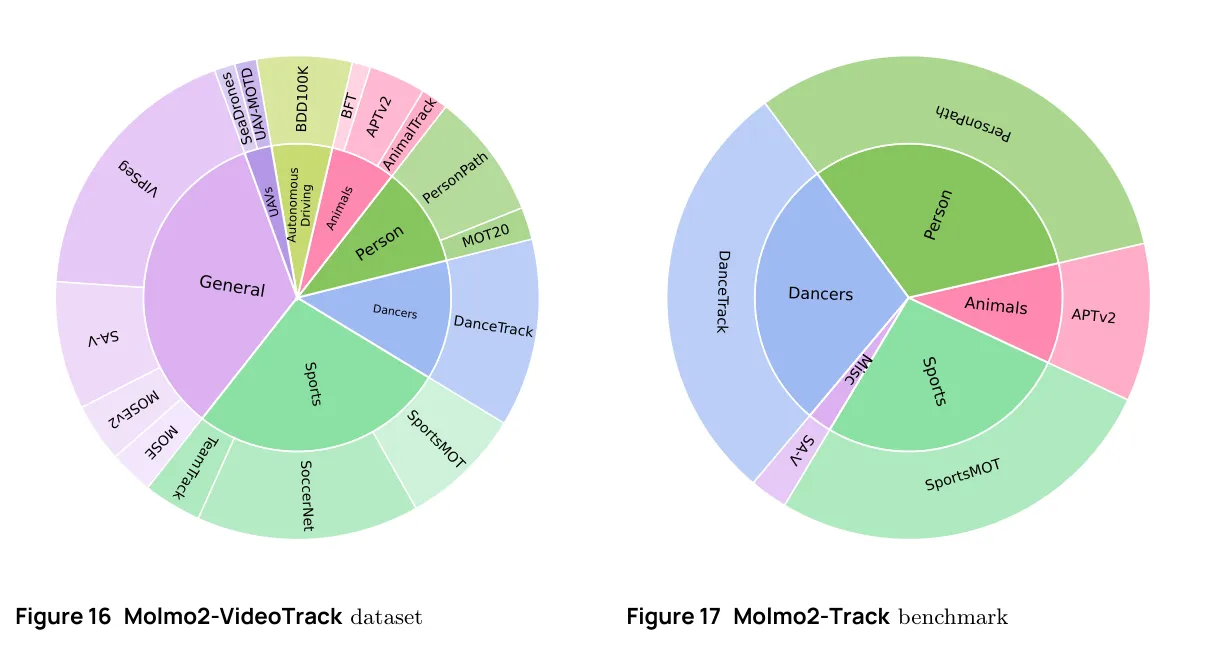
VOS benchmark 上点落在 GT mask 内算对,用 SAM-2 把点转 mask 评 J&F、1fps 点评 F1。MeViS valid J&F:Molmo2-4B 63.3 / 8B 62.3,远超 VideoMolmo-7B 53.9、Sa2VA-8B 46.9、Gemini 3 Pro 42.5、Qwen3-VL-8B 35.1。ReasonVOS(需复杂推理+遮挡)J&F:Molmo2-8B 65.8(F1 70.8 / HOTA 68.6)vs Gemini 3 Pro 52.6、Sa2VA-8B 55.5。原文结论:“Molmo2 outperforms all baselines, including specialized segmentation models, across all benchmarks, particularly excelling on ReasonVOS and Molmo2-Track”;并称 Gemini 2.5 Pro 是最强 API 但 “still struggles to generate accurate object tracks.”。Table 5(Molmo2-Track 分域 Animals/Person/Sports/Dancers/Misc)进一步显示其在复杂运动/遮挡域的优势。
⑩ §4.3 图像 Table 6 + 指点 Table 7(Point-Bench)
Table 6(图像/多图,11-benchmark 均值口径):Molmo2-8B Img QA avg 81.7 / MultiImg 56.4 / Average 76.3,稳超前作 open-data。强项:VQA v2.0 87.0、RealWorldQA 77.6、PixMo-Count 88.5(计数突出);弱项:OCR-heavy(DocVQA 93.2、InfoQA 80.1 略逊 Qwen3-VL)与 reasoning(MMMU 53.0、MathVista 58.9 落后,“possibly due to the lack of multi-modal reasoning training data”)。Table 7(Point-Bench):Molmo2-8B 均值 68.7(Affordance 84.8 / Spatial 71.3 / Reasoning 71.5 / Steerability 44.5 / Counting 71.4),超 Gemini-2.5-Pro 62.8、Qwen3VL 58.5、专用指点模型 Poivre-7B 67.5、Molmo-72B 63.8(人类上限 89.1)。原文把指点提升归因于 “improved vision encoder, pointing pre-training, and token-weighting.”。
⑪ §4.4 消融 Table 8(建模 + 视频数据)
(b) Modeling(QA avg / Cap F1):
Video-Only(全配置)| 64.8 / 39.5
No bidir | 64.4 / 38.5(双向注意↓)
No token weighting | 64.0 / 40.0(QA↓但 cap 略↑)
No time tokens | 64.5 / 37.4(时间戳很重要,尤其 caption)
pool 3×3→4×4 | 64.3 / 37.0(更大池化重伤 caption)
(c) Video SFT data:Academic 62.9/5.0 → +QA 64.5/17.2 → +Cap 65.3/38.4 → +Cap/QA 64.8/39.5
(d) Caption data:V(纯口述) F1 22.1 → VF(视频+帧合并) 35.5;再加 V/F 无提升
(a) Caption 专化:联合训 39.5 > 仅 Molmo2-Cap 35.8
读表 why:bi-directional attention + token weighting + time tokens 都对 QA 有正贡献;caption 指标对 pooling 大小/时间戳极敏感(高层 QA benchmark 看不出细节差异,所以必须额外盯 caption F1)。video QA↔caption 数据互相迁移(8a/8c),合并帧级 caption(VF)是 dense caption 质量的关键(8d)。
⑫ §4.4 消融 Table 9(计数/指点)+ Table 10(追踪)
Table 9(BVC / MVC / MVP):(a) 计数策略——直接预测 count 的 MVC 仅 28.1,“point then count” 升到 34.5(“pointing is the key ingredient in Molmo2’s counting abilities”);(b) 数据源——Molmo2-VP + Academic-VP 都要(合用 61.5/34.5/31.8;只 Academic-VP 时 MVC/MVP 暴跌到 9.0/9.0);(c) 上采样中高计数样本 → MVC 32.1→34.5、MVP 28.1→31.8。Table 10(J&F/F1/HOTA,5 追踪 benchmark 均值):(a) 加 pointing 数据:64.9/70.0/68.4 → 65.7/71.1/69.4(pointing→tracking 正迁移);(b) 数据源逐步加:Academic VOS 64.3 → +bbox → +Molmo2-VideoTrack 64.9;(c) +temporal grounding 有帮助、+single-point object tracking 反而略降。
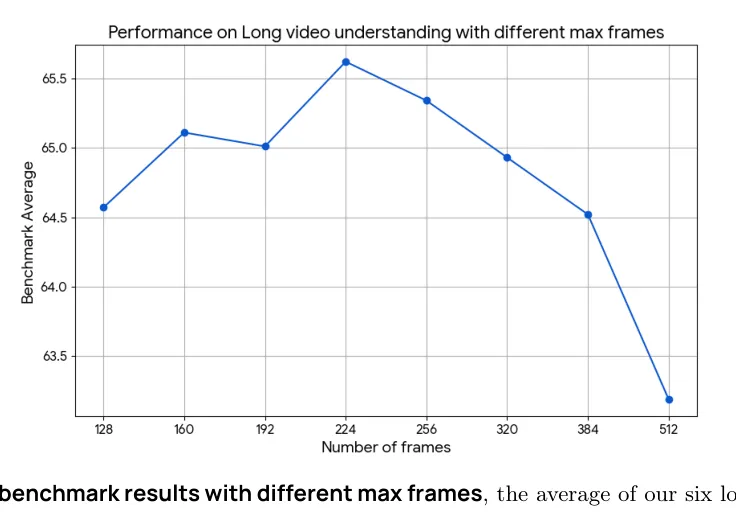
⑬ §4.4 Table 11 long-context SFT 消融
Post-training | Short QA | Long QA | Video Cap. | Image QA
With long-context SFT | 69.4 | 67.4 | 39.9 | 80.6
No long-context SFT | 69.6 | 64.4 | 42.3 | 80.5
读表 why:long-context 收尾训练显著提升 long-video QA(64.4→67.4),short QA / image QA 基本不变,但video caption 反而下降(42.3→39.9)——典型 trade-off,所以只当短的最后阶段做。
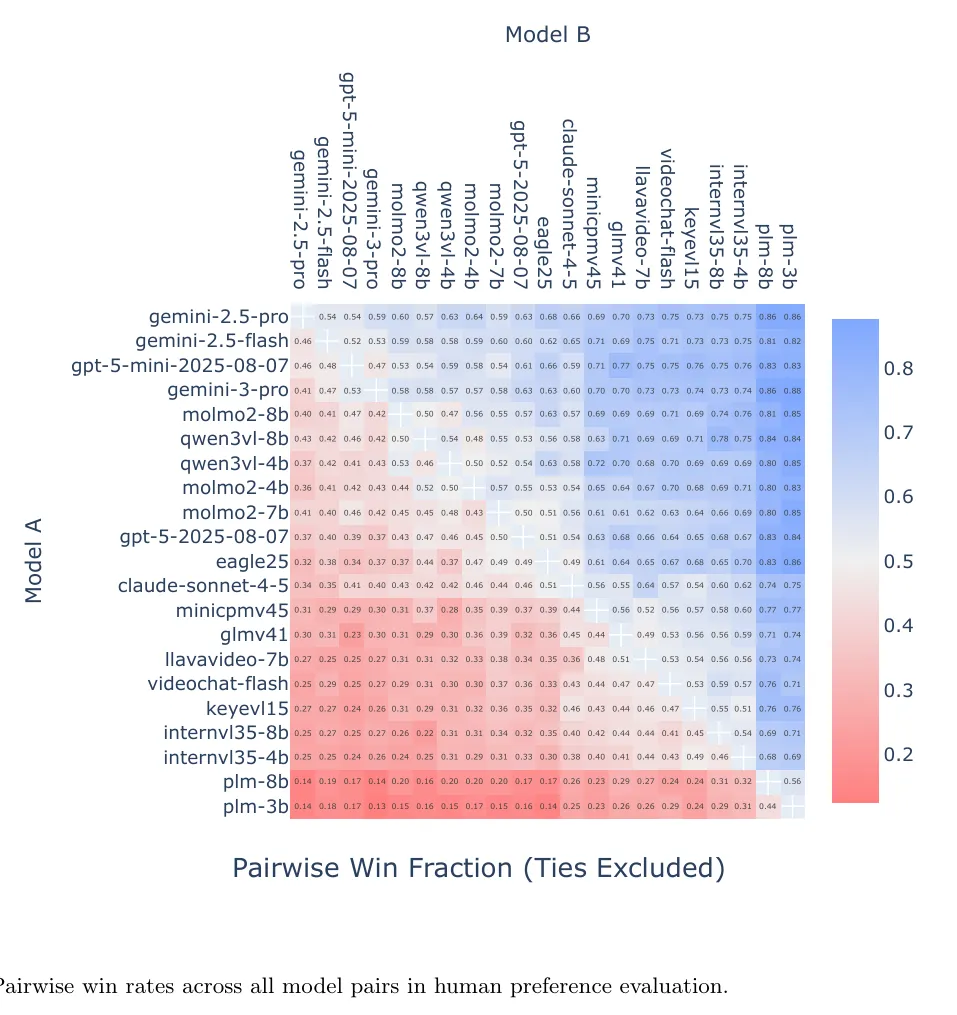
⑭ 人类偏好评测 + 局限
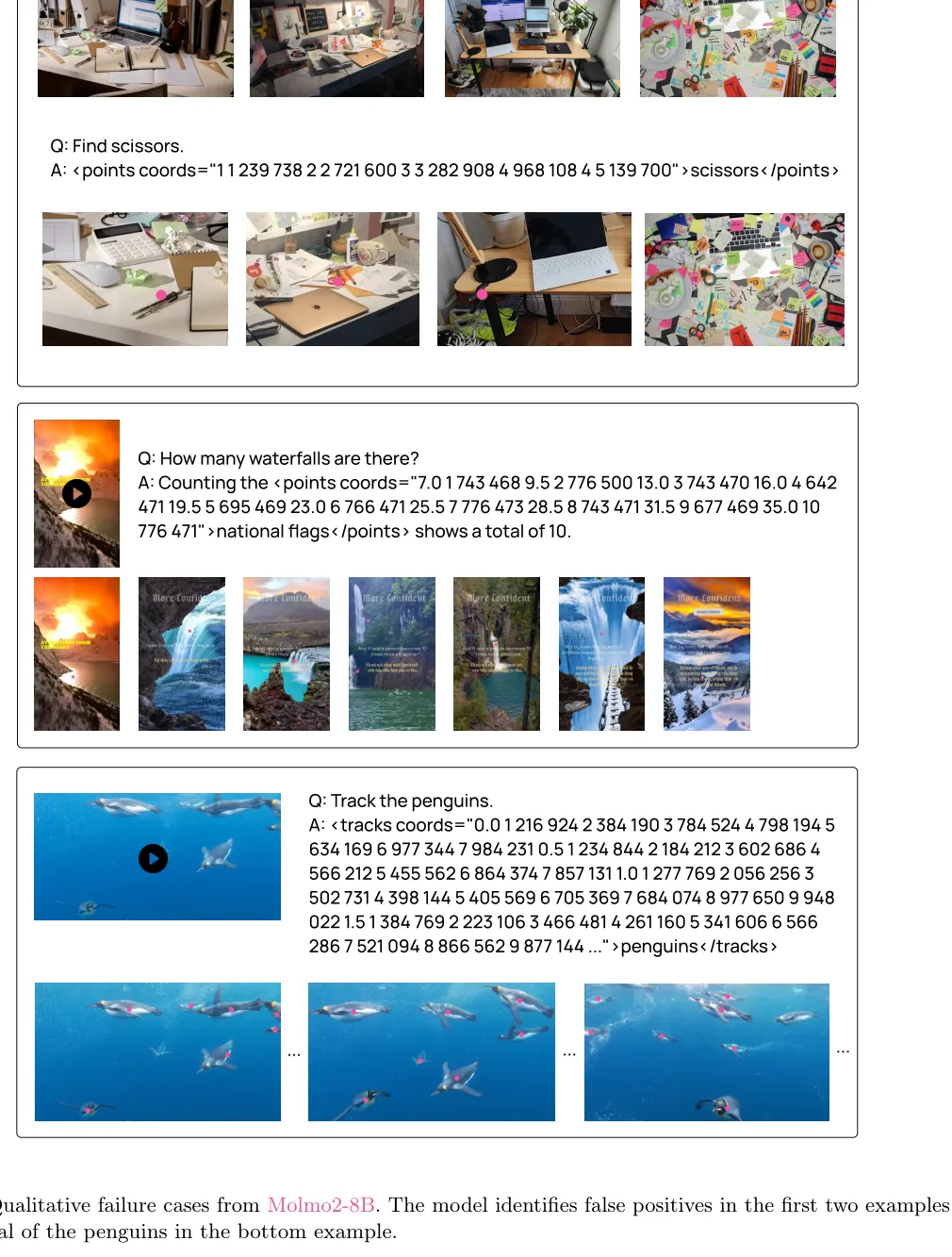
人类偏好:450 道(偏开放式)+ 51 道 caption query,两两采样模型输出收 105K ratings(每对 501 次),用 Bradley-Terry 算 Elo。Molmo2-8B Elo 1057 排第 5,领先 GPT-5(1031,#10)与 Claude Sonnet 4.5(1008,#12),远超前作全开模型,证明通用能力。局限 [原文/推测]:① long-video(10+ 分钟)落后,因缺开源超长训练数据 + 算力限制;② multimodal reasoning(MMMU/MathVista)落后,缺推理训练数据;③ OCR-heavy 任务略逊 Qwen3-VL;④ grounding 评测用 SAM-2 把点转 mask、依赖其质量;⑤ 多图仅 2–5 图、长视频 \(F\le384\) 帧,更长仍受限。
📌 全文一页总结(≥3 takeaway)
problem:最强 VLM 闭源、开源模型靠蒸馏或不公开数据/配方,且普遍缺视频 grounding(时空指点/追踪)。method:① 自建 9 个数据集(dense caption 924 词/视频、human-LLM QA、video point 650k、video track 15k query 等),全程零蒸馏;② ViT(SigLIP2)+connector+LLM,视觉 token 双向注意、视频 2fps×128/384 帧;③ 三阶段训练(image 预训练 → 联合 SFT → long-context SFT)+ 训练创新(token weighting 0.1/0.2/\(\sqrt[4]{n}\)、on-the-fly packing、message-tree 15× 效率);④ 坐标用带物体 ID 的压缩文本统一 pointing/counting/tracking。
experiment:视频总表 Avg 63.1(8B,开源第一、Elo 反超 GPT-5/Claude);grounding 上 video pointing F1 38.4 vs Gemini 3 Pro 20.0、MeViS J&F 63.3、ReasonVOS 65.8 全面领先;图像 VQA v2.0/RWQA/PixMo-Count SOTA 级、Point-Bench 68.7 超专用模型。3 个 takeaway:(1) “pointing 是计数与追踪的地基”——point-then-count 把 MVC 从 28.1 提到 34.5、pointing 数据正迁移到 tracking,是 grounding 能力的核心证据;(2) 全开 + 零蒸馏可达 SOTA:在不碰闭源 VLM 的前提下,自建数据 + bi-dir attention/token-weighting/packing 等工程把 8B 模型推到开源第一、人类偏好超 GPT-5;(3) caption F1 是隐形质量探针——pooling/时间戳/long-context 等改动在高层 QA benchmark 上看不出差别,却在 caption F1 上暴露细粒度退化,提示评测要盯 dense caption 而非只看选择题。遗留:long-video、multimodal reasoning、OCR 仍落后,受开源长视频数据与算力所限。
🖼 论文原图(本地 PDF 截图,原文 caption 未改写)