CVPR 2026 Finalist
MetaSpectra+: A Compact Broadband Metasurface Camera for Snapshot Hyperspectral+ Imaging
Yuxuan Liu ⋅ Wei Xu ⋅ Qi Guo
摘要 Abstract
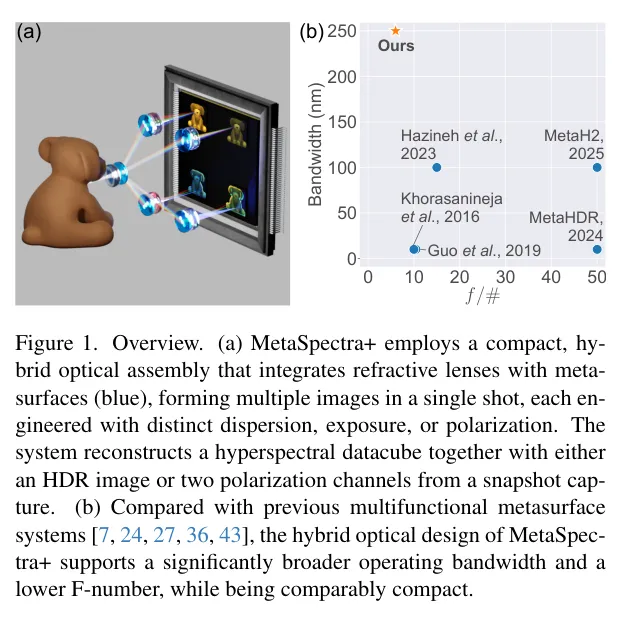
We present MetaSpectra+, a compact multifunctional camera that supports two operating modes: (1) snapshot HDR + hyperspectral or (2) snapshot polarization + hyperspectral imaging. It utilizes a novel metasurface-refractive assembly that splits the incident beam into multiple channels and independently controls each channel’s dispersion, exposure, and polarization. Unlike prior multifunctional metasurface imagers restricted to narrow (10--100 nm) bands, MetaSpectra+ operates over nearly the entire visible spectrum (250 nm). Relative to snapshot hyperspectral imagers, it achieves the shortest total track length and the highest reconstruction accuracy on benchmark datasets. The demonstrated prototype reconstructs high-quality hyperspectral datacubes and either an HDR image or two orthogonal polarization channels from a snapshot measurement.
📝 精读笔记
灵魂一句
MetaSpectra+(Purdue):一台紧凑、宽带的"超表面(metasurface)+折射镜"多功能相机,单次快照(snapshot)同时拿到高光谱数据立方 + (HDR 或偏振)。核心是两层超表面:第一层把入射光分束成多个通道,第二层独立控制每通道的色散/曝光/偏振——既能"消色散"(achromatic)又能"留可控色散"做光谱编码。靠这套色散控制,工作带宽从过去多功能超表面的窄带(10–100nm)拉到几乎整个可见光(250nm);且把"成像"(折射镜)与"分束"(超表面)解耦→更低 F 数 + 更紧凑,benchmark 上总光程(TTL)最短、重建精度最高。
问题 & 动机
多功能超表面能在紧凑单目形态里同时拿多种成像模态(深度/HDR/偏振…),且因同一视点天生配准。但超表面色散极强→achromatic 性能差,多功能超表面普遍只能工作在单波长或窄带(10–100nm),对高光谱成像尤其致命。原文指出"据我们所知,还没有多功能超表面高光谱成像跨越整个可见光谱"。所以目标=把多功能超表面成像的可用带宽做宽,实现紧凑、快照、多模态且跨模态精配准。
核心方法(关键公式)
两层超表面光学(§3.1):① 分束超表面 M0——给设计波长 λc 加线性相位把光偏到第 i 通道(式2);周期函数→傅里叶级数(式3),只 0/1 阶有效、0 阶被场阑挡掉→有效调制 ≈a1(λ)·M0,i(式4);多通道用随机交织(式5)抑制高阶衍射伪影。② 色散控制超表面 Mi——再加偏转 βi(式8),使每通道 PSF 的波长位移 Δxi(λ)=(λf/λc)(αi+βi)(式13)——联合调 αi、βi 就能调或消色散(αi+βi=0 即 achromatic)。③ 成像模型(式14):Ii=高斯噪声+G·Poisson(∫η·(H⊙h)dλ),每通道可插滤光片独立设曝光/偏振/光谱。关键解耦:折射镜负责成像、超表面负责分束(vs 前作单超表面兼做两者)→更低 F 数 + 紧凑。重建(§3.2):两套——DWDN(深维纳反卷积,非扩散)与 DDPM(扩散,从 V 个 patch 重建数据立方,加归一化因子+偏置+调度学习率)。四张图同时构成 CTIS 配置→高光谱;两张 achromatic 当曝光 bracket→HDR,或装正交偏振片→偏振。
关键结果
原型:450–700nm,V=4 通道(2×2,各偏 ~33°),M1/M2 正交色散(chromatic I1/I2)、M3/M4 消偏转(achromatic I3/I4),设计波长 {450,550,600,750}nm;SiN 纳米柱(宽 300nm/高 775nm),物镜 400mm + 4 个 12mm 目镜,DoF ~0.2–0.7m,共享 7.1×7.1mm sensor。高光谱重建(Table1,KAUST 未训练集):MetaSpectra+ TTL 仅 17mm(2-in-1 Cam 50mm、Foley 多帧 140mm)、子图最多(4),且全指标最佳——DWDN PSNR 32.92 / SSIM 0.94 / SAM 0.17、DDPM PSNR 33.31,超 2-in-1 Cam(31.14/0.86/0.24)、Array-HSI(27.44)、MST++(21.85)等。HDR:I3/I4 曝光比 ~4→额外 12.04 dB,实拍动态范围 +11 dB。偏振:I3/I4 测 0°/90°,DoLP=|I3−I4|/|I3+I4|。
亮点
① 用第二层超表面"补偿/保留"第一层偏转这一巧思,把"色散"从 bug 变成可编程旋钮(要消就消、要留做光谱编码就留)→突破窄带限制到 250nm;② 成像/分束解耦(折射+超表面各司其职)→低 F 数 + 紧凑,避开"单超表面既分束又成像"的折衷;③ 一套硬件两种模式(HS+HDR / HS+偏振)且各模态天然配准;④ 实物原型 + 真实场景验证(不止仿真),TTL 最短同时精度最高。
疑问 / 待深挖
① 随机交织分束牺牲光效率(原文承认 “at the cost of a reduction in light efficiency”),低光场景影响多大、与精度的权衡正文未量化;② 原型仅 450–700nm(摘要的"250nm 带宽"指此跨度),更宽(近红外)是否可行未验证;③ 视场 FoV 仅 ~12°、DoF 0.2–0.7m——窄视场/近景,远景/大场景适配性存疑;④ 真实实验要逐场景 fine-tune(用 front-parallel 微调),且仅 8 个实验室场景,泛化到野外复杂光照原文未充分评测。
📖 逐段精读 · 笔记
批量精读初稿(基于本地 PDF 全文提取,61K 字符)。结构:Abstract 逐句 → 背景 → Intro 闭环 → Method 公式 → 实验数值表 + 全文总结。
① Abstract(摘要)— 逐句精讲
第 1 句(系统定位):“We present MetaSpectra+, a compact multifunctional camera that supports two operating modes: (1) snapshot HDR + hyperspectral or (2) snapshot polarization + hyperspectral imaging.” —— 一台紧凑相机、单次曝光,可二选一地同时拍"高光谱 + HDR"或"高光谱 + 偏振"。
第 2 句(硬件核心):“It utilizes a novel metasurface-refractive assembly that splits the incident beam into multiple channels and independently controls each channel's dispersion, exposure, and polarization.” —— 超表面 + 折射镜混合,把入射光分成多路、每路独立控色散/曝光/偏振。
第 3 句(关键突破):“Unlike prior multifunctional metasurface imagers restricted to narrow (10–100 nm) bands, MetaSpectra+ operates over nearly the entire visible spectrum (250 nm).” 这是相对前作最大的量变——把可用带宽从几十纳米拉到整个可见光。
第 4–5 句(战绩):“Relative to snapshot hyperspectral imagers, it achieves the shortest total track length and the highest reconstruction accuracy on benchmark datasets.” 原型可从单帧重建高质量 hyperspectral datacube + 一张 HDR 或两路正交偏振。一句话抓 Abstract:用"分光 metasurface + 色散控制 metasurface"两层设计,把色散从"被动缺陷"变成"可调参数",从而在紧凑体积里把多功能成像做到全可见光带宽。
📚 背景知识(外部,非本文原创;理解全文必备)
① Metasurface(超表面):由亚波长 nanopillar 阵列构成的平面光学元件,可逐点设计相位 → 实现透镜/分束/偏振调控等。优点:极薄、可多功能复用;缺点:strong chromatic dispersion(色散强),故传统只能工作在窄带。
② Hyperspectral imaging / datacube / snapshot:高光谱成像要恢复 3D datacube(x,y + 波长 λ)。Snapshot(单次曝光)= 从一两张 2D 测量恢复整 3D cube,存在"维度缺口",靠光学编码 + 计算重建。对比 multi-shot 大幅降采集时延。
③ CTIS / PSF / dispersion / HDR / polarization:CTIS(Computed-Tomography Imaging Spectroscopy)= 用多视/多色散投影做层析式光谱重建。PSF(点扩散函数)= 点光源在传感器上的响应;波长相关的 PSF 横移即"色散"。HDR 靠 exposure bracket(不同曝光合成);polarization 用正交偏振片测 0°/90° 分量。
④ 评测指标 PSNR / SSIM / SAM:PSNR↑(峰值信噪比)、SSIM↑(结构相似度)衡量空间重建质量;SAM↓(Spectral Angle Mapper,光谱角,越小越好)衡量恢复光谱与真值的方向一致性。TTL(total track length)= 总光程长,越短越紧凑。
② §1 Introduction — problem(窄带痛点)
痛点根因:多功能 metasurface 能在紧凑单目里同时拿多模态,但 “remain fundamentally limited by severe chromatic aberrations, which confine their operational bandwidth to a single wavelength or a narrow spectral range (typically 10–100 nm).” 色散把可用带宽锁死,尤其阻碍高光谱。
作者纲领:“expanding the usable bandwidth of multifunctional metasurface imagers is crucial … enabling compact, snapshot, multi-modal imaging with accurate cross-modal registration.” 由于所有子图同一视点拍摄,多模态天然对齐(inherently registered),省掉复杂跨模态配准。
②-b §1 — solution(两层 + 解耦)+ 三大贡献
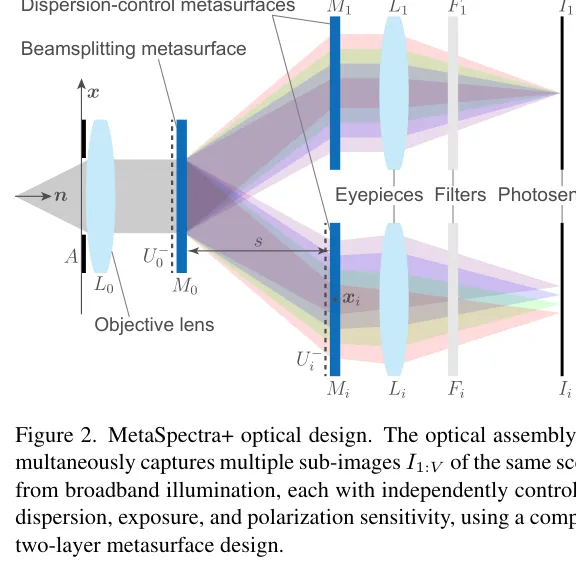
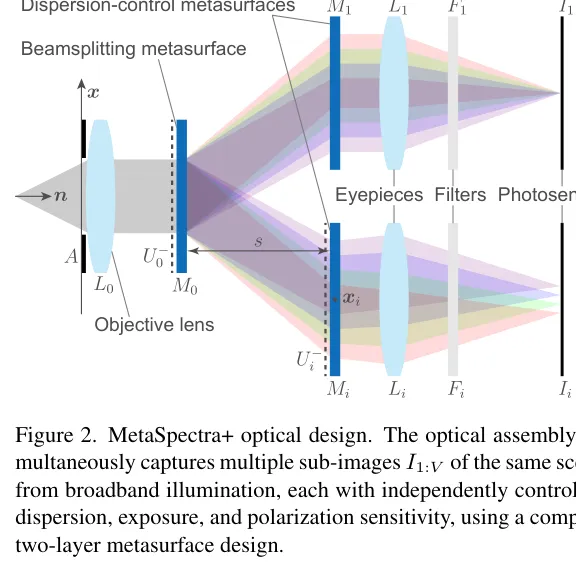
两层 metasurface assembly:“the first layer splits and deflects the incident beam into multiple optical channels, while the second layer partially or completely compensates for this deflection to either introduce a controlled amount of or eliminate dispersion.” 第一层分光、第二层补偿色散——故支持 250 nm 宽带。
关键解耦:“MetaSpectra+ decouples image formation from beam splitting, utilizing refractive optics and metasurfaces to perform each, respectively.” 折射镜负责成像、超表面负责分光 → 能在低 F-number(高进光)下保持紧凑,胜过"单 metasurface 同时分光+成像"的旧设计。三大贡献:① 新的 metasurface-refractive 宽带多功能成像范式;② 同时做高光谱重建 + HDR/偏振的原型;③ 证明 SOTA 的全面分析。数据与代码:meta-imaging.qiguo.org。
③ §2 Related Work — 快照高光谱 + 多功能成像
快照高光谱两派:Sampling-based(coded apertures / SLM / lenslet array / fiber bundle / spectral filter array)—— 稀疏采样 + 先验重建,常需 relay optics 体积大或 fabrication 贵;Encoding-based —— “embed spectral information into the spatial domain through engineered, wavelength-dependent point spread functions (PSFs)”(用 SLM / prism / diffuser / DOE / grating),更紧凑高效但需更复杂计算重建。
多功能 metasurface 的天花板:单 metasurface 可按波长/偏振/入射角分光并独立调制(focal/PSF/dynamic range/dispersion)。但 “the strong chromatic dispersion of metasurfaces fundamentally limits their achromatic performance … most multifunctional metasurfaces operate over only a narrow spectral band (10–100 nm).” 原文断言:“no hyperspectral imagers using multifunctional metasurface has demonstrated operations across the full visible spectrum.” 这正是本文要破的局。
④ §3.1 光学模型总览(式 1–2,分光)
入射波前(式 1):沿方向 \(n=(n_x,n_y,n_z)^\top\) 的宽带准直光,平面波前 \(U_0^-(x,\lambda,n)=\exp\!\big(j\tfrac{2\pi}{\lambda}\,n_\perp\cdot x\big)\),\(n_\perp=(n_x,n_y)^\top\)。物镜 + field stop \(A(x)\) 把点源准直,再由 beamsplitting metasurface \(M_0\) 分成 \(V\) 路。
分光相位(式 2):把波前导向第 \(i\) 路需在设计波长 \(\lambda_c\) 加线性相位 \[ M_{0,i}(x,\lambda_c)=\exp\!\Big(j\tfrac{2\pi}{\lambda_c}\,\alpha_i\cdot x\Big),\quad i=1,\ldots,V \] \(\alpha_i\) 是该路的偏转矢量。
⑤ 色散与随机交织(式 3–5)
衍射级展开(式 3–4):\(M_{0,i}\) 是周期函数,对其他波长 \(\lambda\) 用 Fourier 级数展开,\(a_n(\lambda)\) 是第 \(n\) 级衍射效率。经验上仅零级/一级 \((a_0,a_1)\) 显著,且后层 field stop 天然挡掉零级 \(a_0\),故有效调制近似 \[ M_{0,i}(x,\lambda)\approx a_1(\lambda)\,M_{0,i}(x,\lambda_c) \]
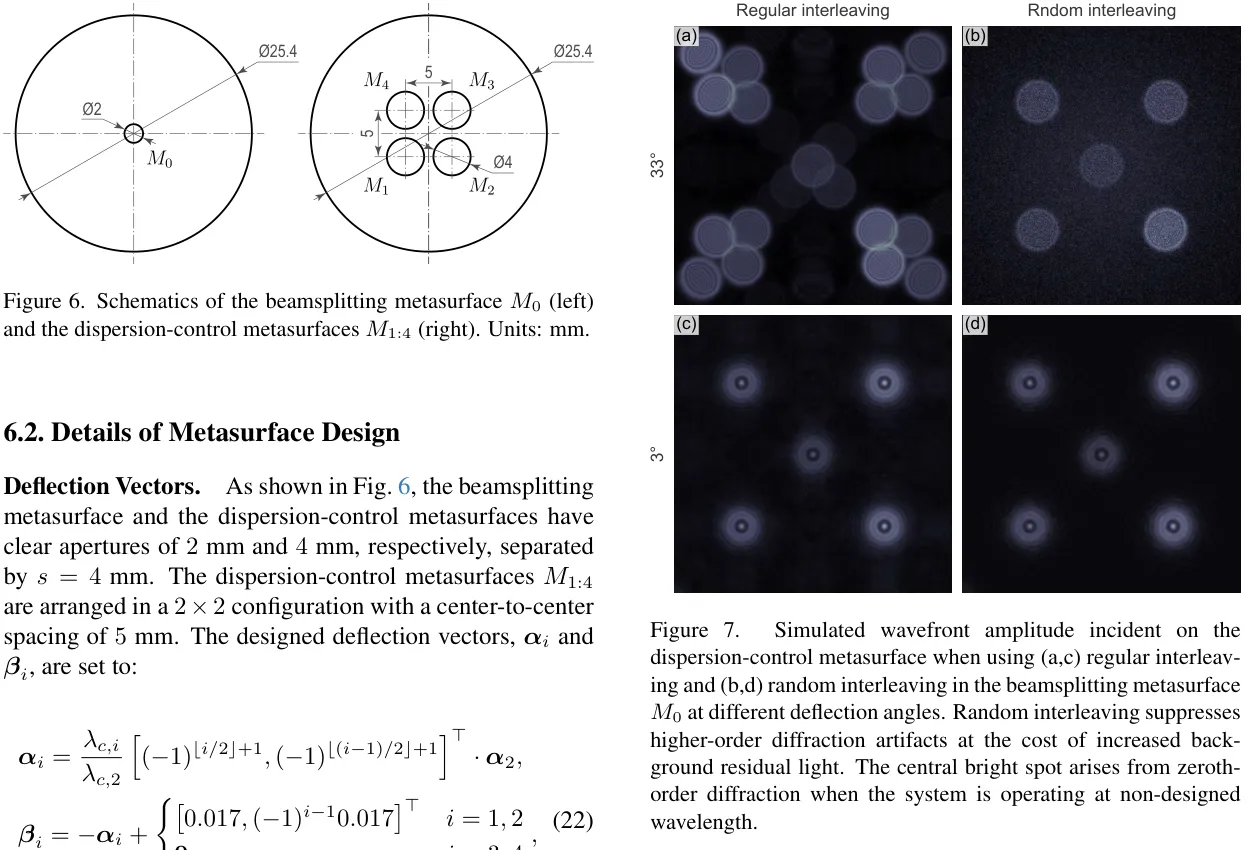
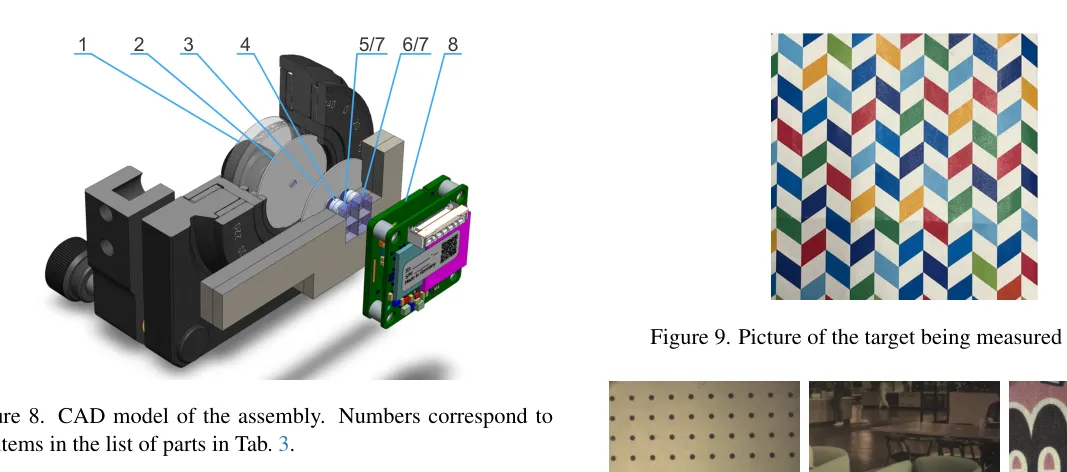
随机交织(式 5,关键工程技巧):\(M_0\) 整体相位由各子 profile 随机交织而成 \[ M_0(x,\lambda_c)=M_{0,k}(x,\lambda_c),\quad k\sim\mathrm{Multinomial}(1/V) \] 原文:random interleaving “allows \(M_0\) to simultaneously form \(V\) beams at large deflection angles while suppressing residual diffraction artifacts.” 对比规则 2×2 mosaic——大偏转角下 regular interleaving 会产生强高级衍射伪影,random 则以"降低光效"为代价压掉这些伪影。
⑥ PSF 与色散调控(式 6–13,核心式 13)
第二层偏转(式 8):色散控制 metasurface \(M_i\) 再加线性相位 \(M_i(x,\lambda)\approx b_i(\lambda)\exp(j\tfrac{2\pi}{\lambda_c}\beta_i\cdot x)\),\(\beta_i\) 为其偏转矢量、\(b_i(\lambda)\) 为透射效率。眼镜片(式 9)建模为理想薄透镜,传感器置于后焦面。
关键结论(式 13):第 \(i\) 路在波长 \(\lambda\) 的 PSF 焦点横移为 \[ \Delta x_i(\lambda)=\frac{\lambda f}{\lambda_c}\,(\alpha_i+\beta_i) \] 原文点睛:“by jointly engineering \(\alpha_i\) and \(\beta_i\), the PSF dispersion … can be precisely tuned or even eliminated (when \(\alpha_i+\beta_i=0\)).” —— 一路可做 achromatic 消色散,另一路可故意保留可控色散做光谱编码。这是整套系统"既能拍清晰像、又能拍色散像"的物理总开关。
⑦ 成像模型(式 14)+ 光效标定(式 16)
成像模型(式 14,含真实噪声):对场景高光谱辐亮度 \(H(x,\lambda)\),第 \(i\) 路子图 \[ I_i(x;j)=\mathrm{Gauss}(0,\sigma^2)+G\cdot\mathrm{Poisson}\!\Big(t\!\int \eta(\lambda;j)\,(H(x,\lambda)\odot h(x,\lambda))\,d\lambda\Big) \] \(G,t\) 为增益与曝光,\(\eta(\lambda;j)\) 是传感器对 \(j\in\{R,G,B\}\) 的光谱响应,\(\odot\) 沿波长维卷积。每路可插不同滤光片 \(F_{1:V}\) 实现独立曝光/偏振/光谱灵敏度。
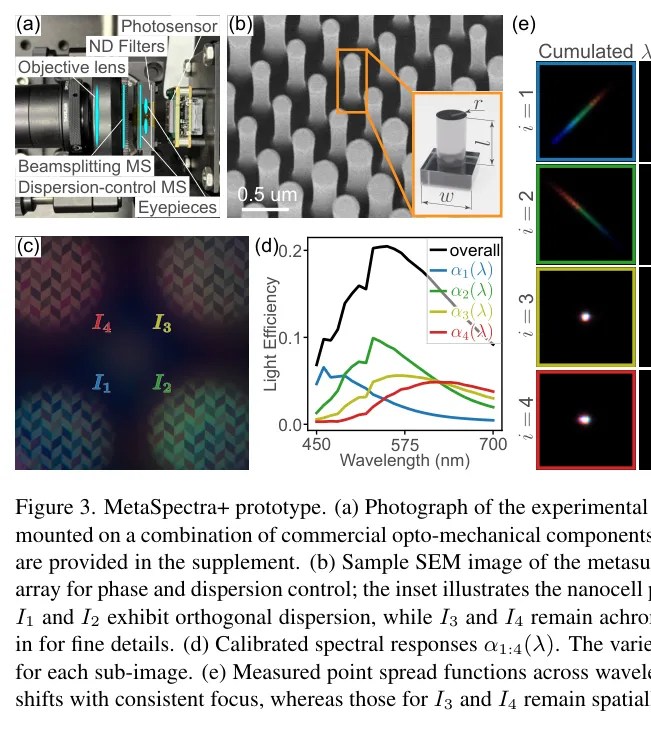
光效标定(式 16):先测无光学组件时单波长点源总能量 \(E(\lambda)=\sum_x I(x)\),再装上组件测各子图能量 \(E_i(\lambda)=\sum_x I_i(x)\),得每路光谱响应 \[ \alpha_i(\lambda)=\eta(\lambda)E_i(\lambda)/E(\lambda) \] 标定出的 \(\alpha_{1:4}(\lambda)\) 峰值大体跟随各路设计波长 \(\lambda_c\)。另需几何标定:对每个子图与参考子图求 homography 对齐。
⑧ §3.2 后处理(DWDN vs DDPM 双算法)
方法一 DWDN(非扩散):沿用 Deep Wiener Deconvolution Network——先在特征域做 Wiener 反卷积,再经多尺度前馈卷积网络细化。方法二 DDPM(扩散):建在 Hazineh et al. 之上,先训 DDPM 从 \(V\) 个对齐 patch \(P_{1:V}\) 重建完整 datacube \(H\);推理时按 patch 分块,每步预测 \(H_{k,t}\),并通过 “minimizing the discrepancy between the rendered measurements … and the measured patch” 估归一化因子 \(a_{k,t}\) 保证跨 patch 空间一致。本文改进:“we augment this normalization process with an additional bias term (\(a_{k,t}H_{k,t}+b_{k,t}\)), and apply a scheduled learning rate … both modifications improve reconstruction quality.” 附录给出 U-Net 超参(patch 128×128、batch 64、in 38/out 26 通道、1000 步、RTX 5090、采样 50 步 + 20 引导迭代)。
⑨ §4.1 原型(V=4 / 33° / 设计波长 / 几何)
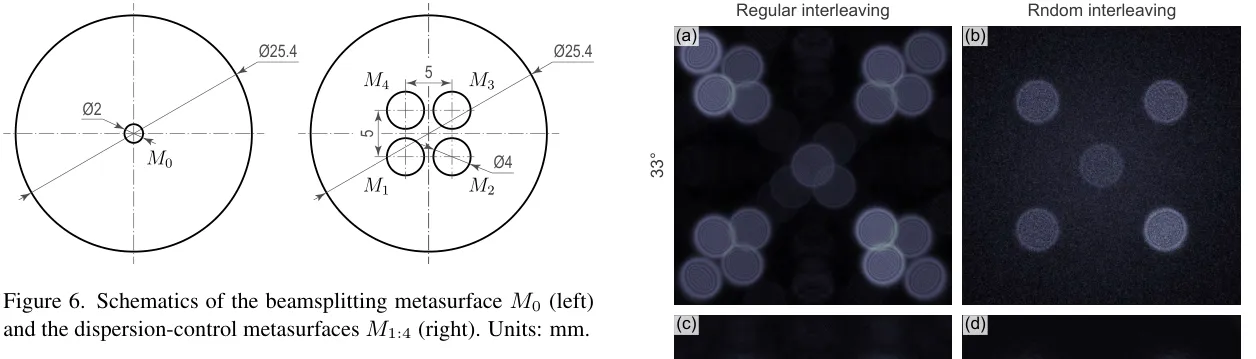
通道配置:\(M_0\) 把光分成 \(V=4\) 路、排成 2×2,每路偏转约 33°。\(M_1,M_2\) 给 \(I_1,I_2\) 引入正交色散(chromatic);\(M_3,M_4\) 抵消 \(M_0\) 的偏转 → \(I_3,I_4\) 消色散(achromatic)。为覆盖全可见光(\(a_1(\lambda)\) 偏离 \(\lambda_c\) 会下降),四路设计波长错开:\(\lambda_{c,1:4}=\{450,550,600,750\}\) nm。
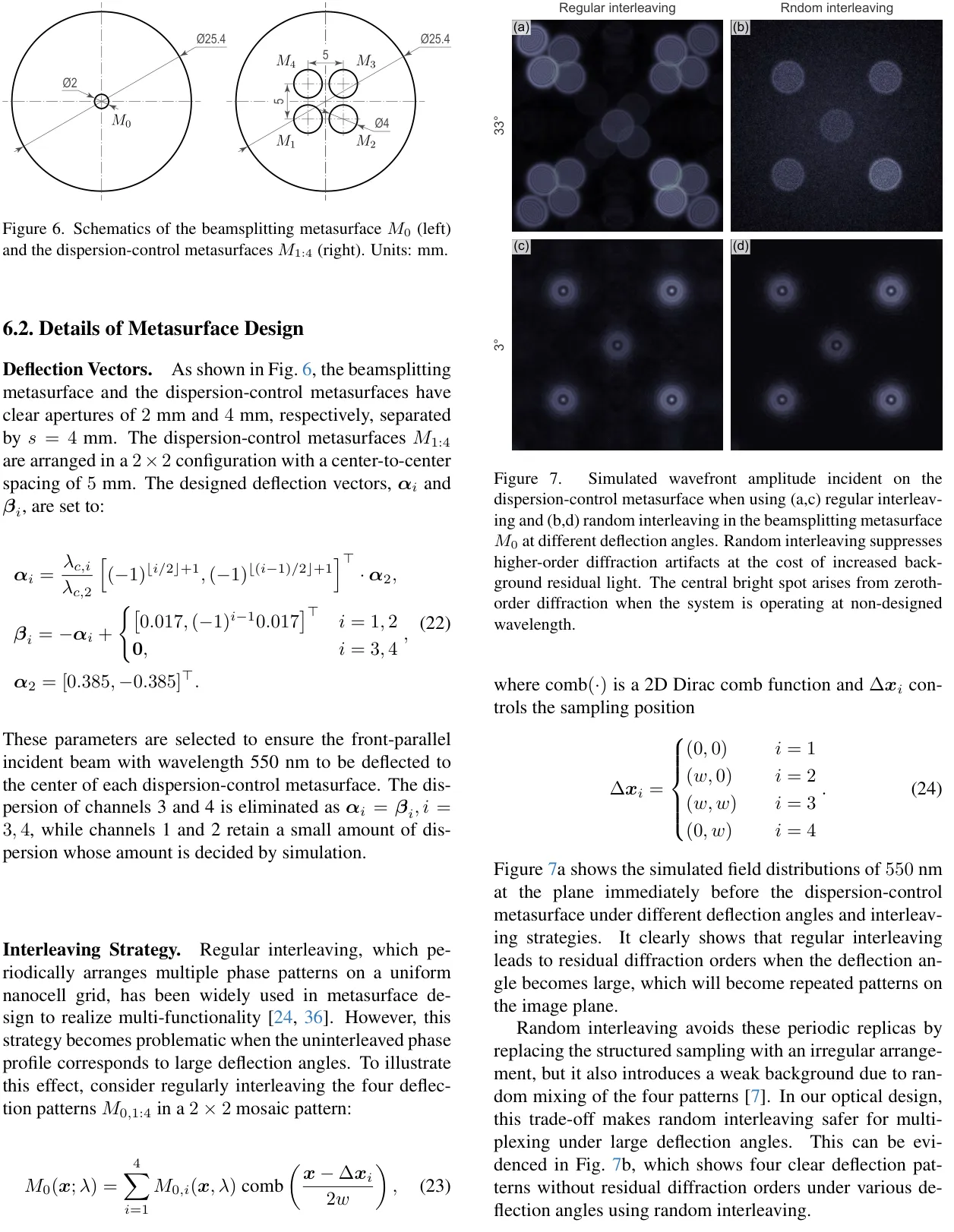
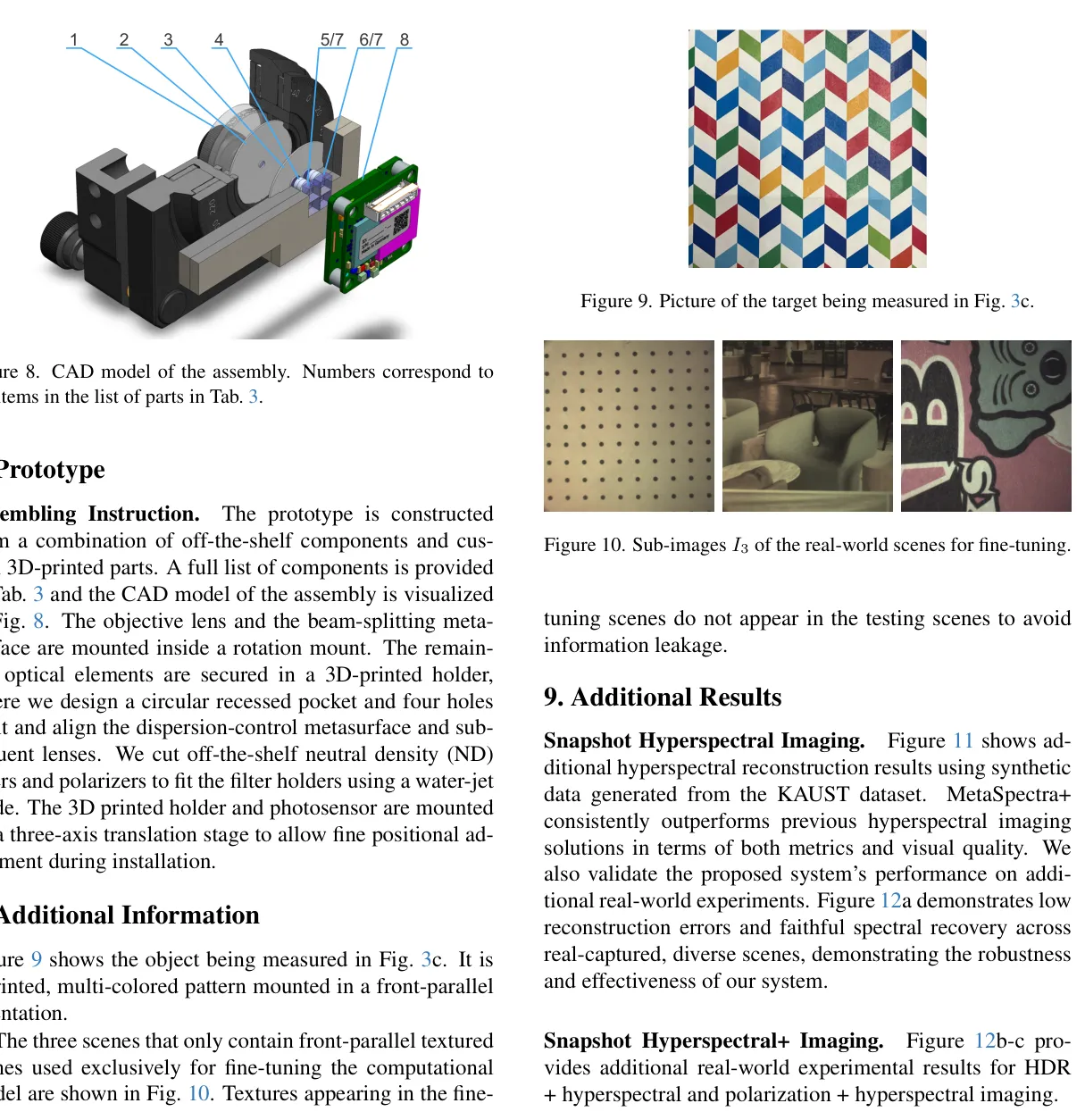
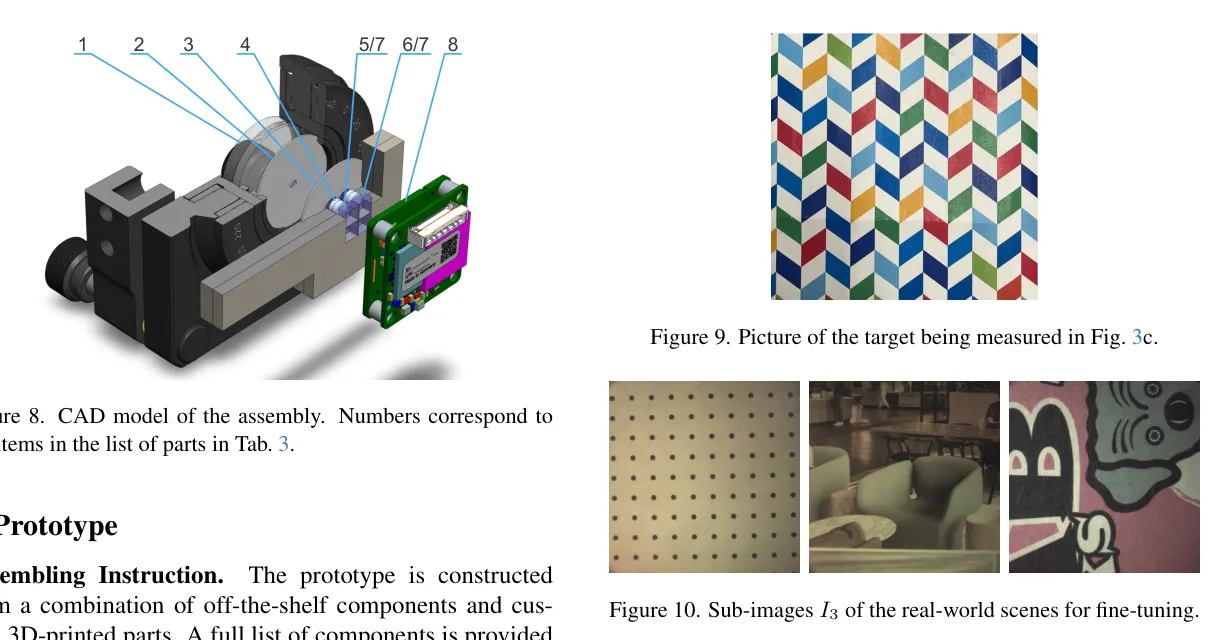
几何 / 工艺:beamsplitting metasurface 口径 2 mm(兼作入瞳)、dispersion-control 口径 4 mm、层间距 \(s=4\) mm。Metasurface = 2D nanocell 阵列,cell 宽 \(w=300\) nm,等高(\(h=775\) nm)圆柱 nanopillar,按半径 \(r\) 查预算库匹配目标相位(式 15)。系统:400 mm 物镜 achromatic doublet + 4 个 12 mm 焦距/4 mm 口径 eyepiece,DoF 约 0.2–0.7 m,共享 7.1×7.1 mm RGB 全局快门传感器。训练数据用 Harvard + ICVL,经 D-Flat 仿真器按式 14 渲染,噪声 \(\sigma\sim U(0.001,0.01)\)。
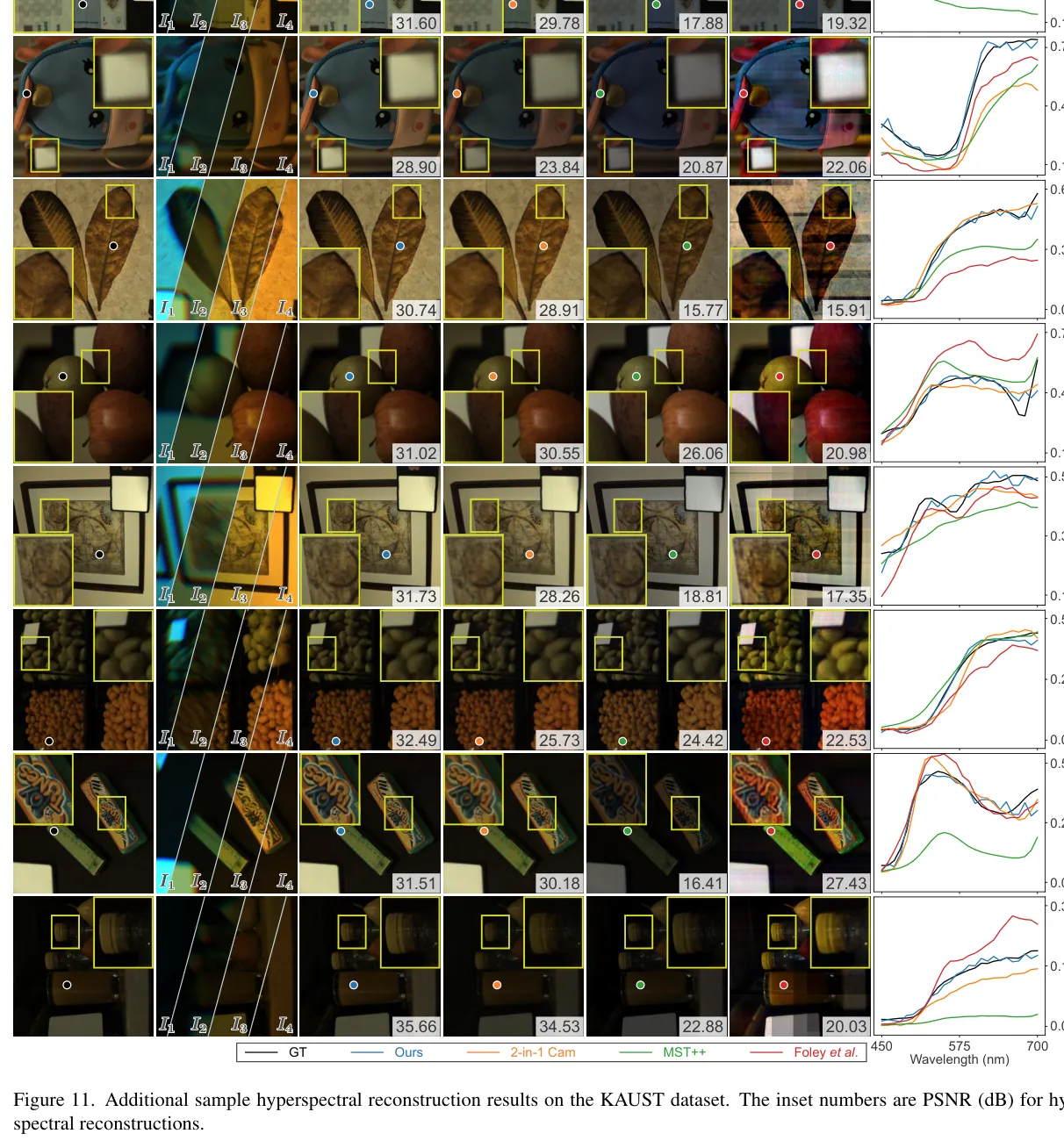
⑩ §4.2 仿真对比(Table 1 全表,KAUST,未训练集)
Method | Optics | #sub | f/# | FoV° | TTL(mm) | PSNR↑ / SSIM↑ / SAM↓
Ours (DWDN) | MS+Lens | 4* | 6 | 12 | 17 | 32.92 / 0.94 / 0.17
Ours (DDPM) | MS+Lens | 4* | 6 | 12 | 17 | 33.31 / 0.92 / 0.23
2-in-1 Cam(SIGGRAPH'24) | DOE+Lens | 2* | 5.8 | 24 | 50 | 31.14 / 0.86 / 0.24
Array-HSI(SIGGRAPH Asia'24) | DOE+CFA | 4 | 6.7 | 12 | 20 | 27.44 / 0.89 / 0.20
SCCD(Optica'21) | DOE+CCA | 1 | 16.7 | 30 | 50 | 26.78 / 0.81 / 0.36
Baek et al.(ICCV'21) | DOE | 1 | 16.7 | 46 | 50 | 26.68 / 0.74 / 0.39
MST++(CVPRW'22, RGB→spec) | Lens | 1* | – | – | – | 21.85 / 0.68 / 0.32
HRNet(CVPRW'20, RGB→spec) | Lens | 1* | – | – | – | 23.03 / 0.76 / 0.31
Foley et al.(multi-shot, ICCP'25) | Lens+CFA | 1-5 | 5.8 | 9.8 | 140 | 20.40 / 0.68 / 0.29
SfD(multi-shot, arXiv'25) | Lens | 5 | 2 | 10 | 44.5 | 27.54 / 0.82 / 0.40
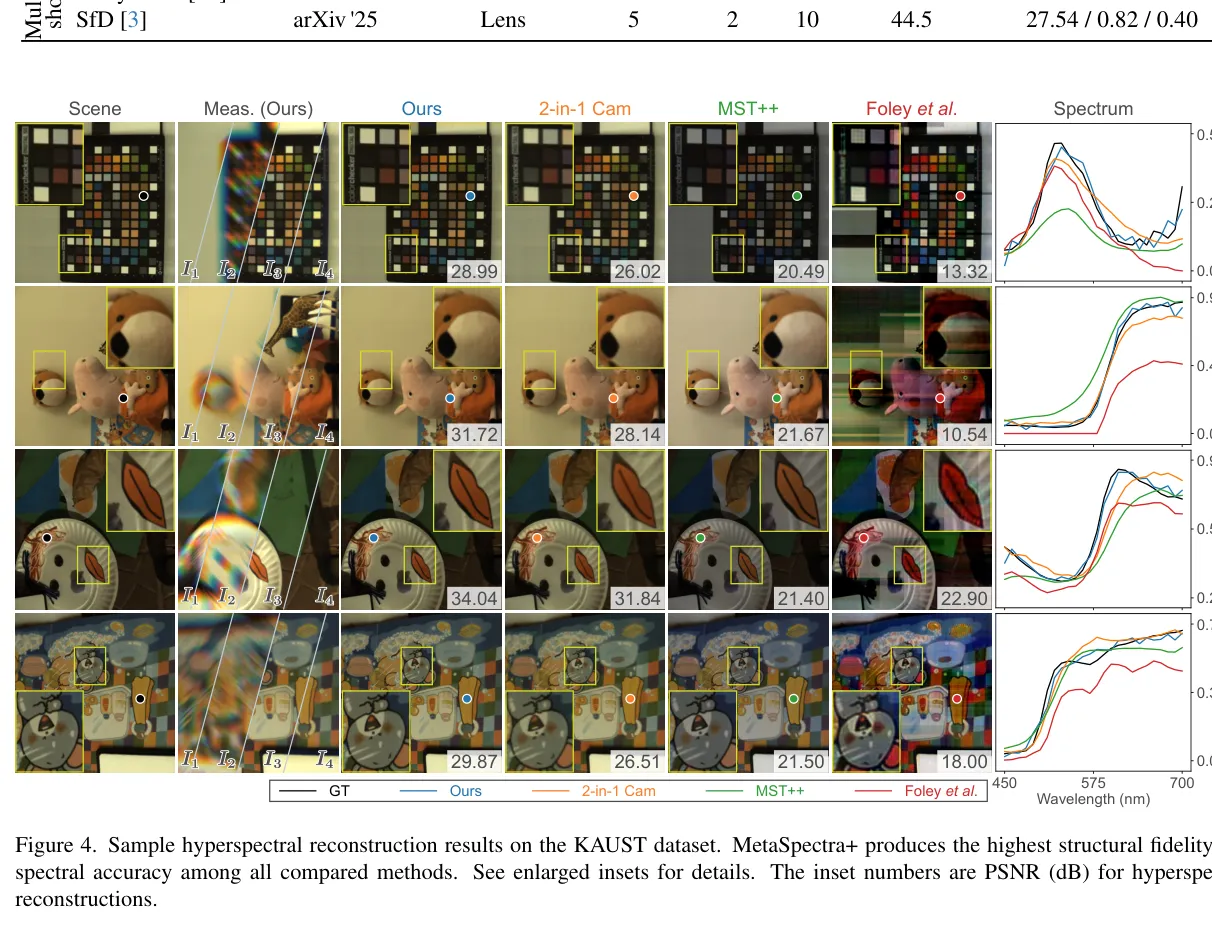
读 why:在 KAUST(所有方法都没拿来训练)上,MetaSpectra+ “provides the largest number of simultaneously measured sub-images while also achieving the smallest total track length”(TTL 仅 17 mm,远小于 2-in-1 Cam 50 / Foley 140),且 “achieves the best performance on all metrics”(PSNR DDPM 33.31 最高、SSIM DWDN 0.94 最高、SAM DWDN 0.17 最低)。* 表示能同时拍一张 achromatic RGB 做结构引导。
⑪ §4.2 真实世界高光谱重建
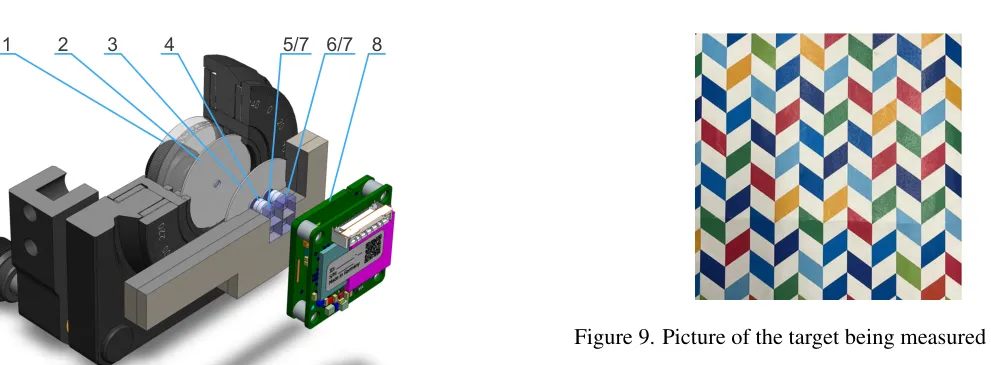
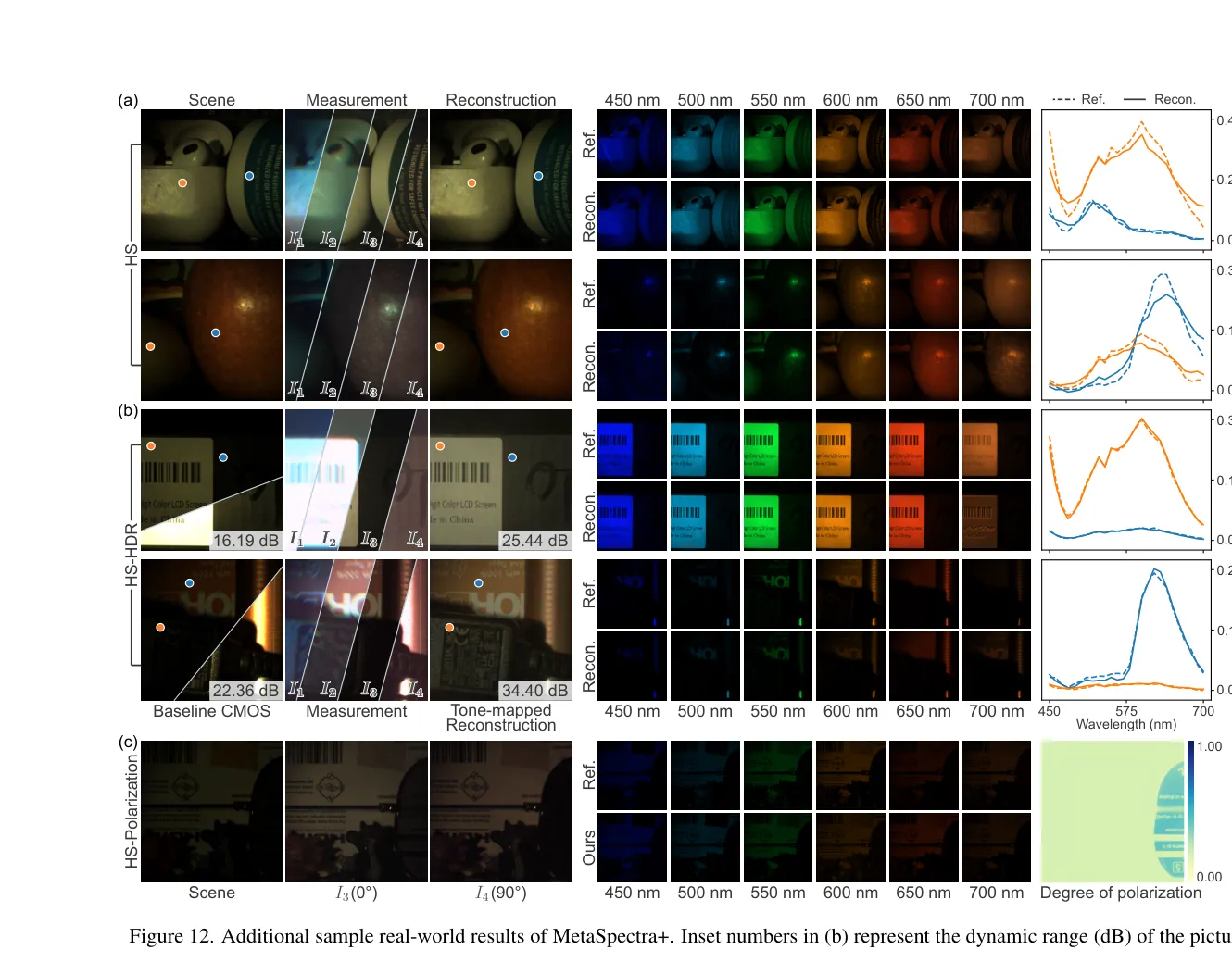
真实评测:8 个实验室场景(不同颜色/纹理/形状),3 个仅 front-parallel 纹理面用于 fine-tune,5 个含真实 3D 几何做验证集。参考 HS cube 由"一串覆盖全可见光的窄带 bandpass 滤片"逐波长拍出。原文:“To mitigate the systematic bias between the simulation and real measurements, we fine-tune the reconstruction model using only the front-parallel scenes”,验证场景纹理不出现在 fine-tune 集(避免信息泄漏)。结果:恢复 datacube “exhibit high structural fidelity and spectral accuracy.”
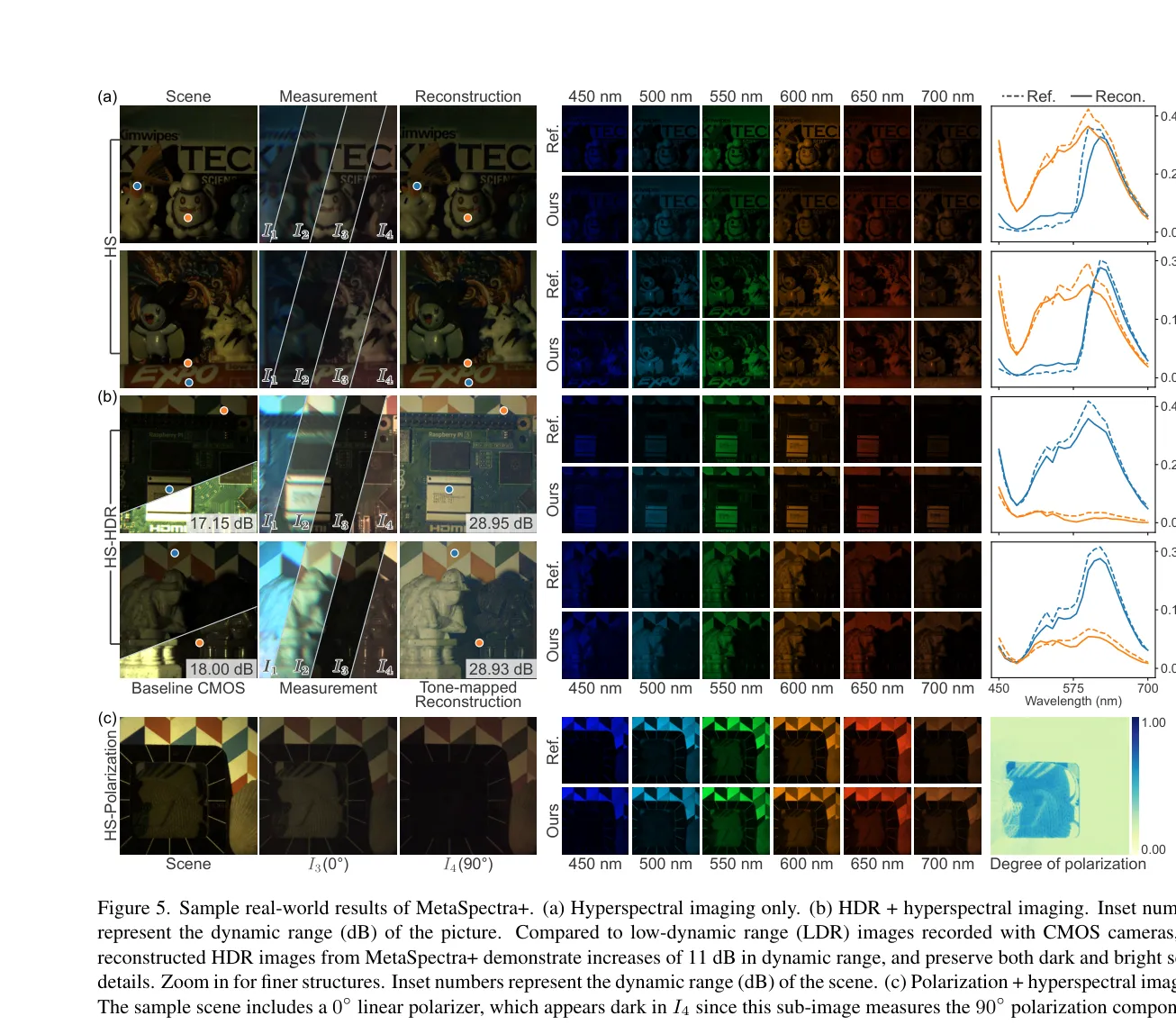
⑫ §4.3 HDR + 高光谱(11 dB 提升)
配置:给 \(I_{1:3}\) 插 0.3 OD、给 \(I_4\) 插 0.9 OD 的 ND 滤片调有效曝光。因 \(I_3,I_4\) 光谱响应相近,二者构成功率比约 4 的 exposure bracket,“enabling up to 12.04 dB additional dynamic range beyond the native sensor capability.” 用经典 Debevec & Malik 融合 \(I_3,I_4\) 得 \(I_{HDR}\),再把 \(I_{HDR},I_1,I_2\) 喂同一后处理出 datacube。实测:相对无 exposure bracketing,真实数据上 “achieving 11 dB increase in dynamic range”,重建 tonemapped RGB 在暗/亮区都保留细节、光谱仍准。
⑬ §4.3 偏振 + 高光谱(DoLP)
配置:在 \(I_3,I_4\) 前分别放 0° 与 90° 线偏振片,\(I_{1:2}\) 不加滤片。于是 achromatic 通道 \(I_3,I_4\) 测 0°/90° 偏振分量,\(I_1,I_2\) 拍与偏振无关的色散像。用 \(I_3+I_4, I_1, I_2\) 出 datacube,并算水平-垂直线偏振度 \(\mathrm{DoLP}_{HV}=|I_3-I_4|/|I_3+I_4|\)。示例场景里 0° 线偏振片在 \(I_4\)(测 90° 分量)中显暗,物理直观可解释。
📌 全文一页总结(≥3 takeaway)
① 把"色散"从缺陷变成可调参数:核心式 13 \(\Delta x_i(\lambda)=\tfrac{\lambda f}{\lambda_c}(\alpha_i+\beta_i)\)——两层 metasurface 的 \(\alpha_i,\beta_i\) 联合设计,让同一系统一路 achromatic(\(\alpha_i+\beta_i=0\))、一路保留可控色散,这是把多功能成像做到全可见光(250 nm)的物理基石。
② 解耦 + 随机交织两处工程巧思:(a) 用折射镜成像 / metasurface 分光的解耦换来低 F-number + 紧凑(TTL 仅 17 mm);(b) random interleaving(式5)在大偏转角下压住高级衍射伪影。后处理给了 DWDN 与 DDPM 两条路(并以 bias 项 + scheduled LR 改进扩散引导)。
③ SOTA + 真实多模态:KAUST 上 PSNR/SSIM/SAM 全最优且 TTL 最短;真实原型单帧同时拿"高光谱 + HDR(+11 dB)"或"高光谱 + 偏振(DoLP)",且同视点天然对齐。takeaway:计算成像里"光学编码 + 计算解码"的协同设计,能用极薄超表面在紧凑体积内突破传统窄带限制,实现可注册的多模态快照成像。
⚠️ 局限 & 待深挖(含 [推测])
① 帧率受限(作者明说):random interleaving 降低衍射效率 → 需更长积分时间 → 原型 “operates at up to 10 FPS, posing challenges for direct deployment in high-speed video applications.” 可通过减小偏转角或用更高折射率材料(GaN、TiO₂)缓解;② [推测] DoF 仅 0.2–0.7 m,且 fine-tune 依赖 front-parallel 标定,远景/复杂场景泛化待验证;③ [推测] 重建依赖精确 PSF 仿真(D-Flat)与几何/光谱标定,制造误差或 misalignment 会传导到重建;④ [推测] DDPM 路线推理需 50 扩散步 + 20 引导迭代,实时性与计算成本是落地瓶颈;⑤ 原文未给 DWDN/DDPM 在真实数据上的逐场景定量对比,二者取舍仍偏定性。
🖼 论文原图(本地 PDF 截图,原文 caption 未改写)