CVPR 2026 Finalist
Medic-AD: Towards Medical Vision-Language Model's Clinical Intelligence
Woohyeon Park ⋅ Jaeik Kim ⋅ Sunghwan Steve Cho ⋅ Pa Hong ⋅ Wookyoung Jeong ⋅ Yoojin Nam ⋅ Namjoon Kim ⋅ Ginny Y. Wong ⋅ Ka Chun Cheung ⋅ Jaeyoung Do
摘要 Abstract
Lesion detection, symptom tracking, and visual explainability are central to real-world medical image analysis, yet current medical Vision-Language Models (VLMs) still lack mechanisms that translate their broad knowledge into clinically actionable outputs. To bridge this gap, we present Medic-AD, a clinically oriented VLM that strengthens these three capabilities through a stage-wise framework. First, learnable anomaly-aware tokens (Ano) encourage the model to focus on abnormal regions and build more discriminative lesion centered representations. Second, inter-image difference tokens (Diff) explicitly encode temporal changes between studies, allowing the model to distinguish worsening, improvement, and stability in disease burden. Finally, a dedicated explainability stage trains the model to generate heatmaps that highlight lesion-related regions, offering clear visual evidence that is consistent with the model's reasoning. Through our staged design, Medic-AD steadily boosts performance across anomaly detection, symptom tracking, and anomaly segmentation, achieving state-of-the-art results compared with both closed source and medical-specialized baselines. Evaluations on real longitudinal clinical data collected from real hospital workflows further show that Medic-AD delivers stable predictions and clinically faithful explanations in practical patient-monitoring and decision-support workflows.
📝 精读笔记
灵魂一句
MEDIC-AD(首尔大 AIDAS + 三星医院 + NVIDIA):把通用医学 VLM 改造成"临床可用",按医生诊断流程 detect→compare→explain 设计三阶段课程式训练:① 注入可学的异常感知 token <Ano> 让模型聚焦病灶;② 跨图差异 token <Diff> 显式编码同一病人两次检查间的恶化/好转/不变;③ 专门的可解释阶段用 <Ano> token + ConvNeXt 头生成病灶 heatmap。在异常检测、症状追踪(MMXU)、异常分割上全面 SOTA,超过闭源(GPT-4o/Claude)和医学专用基线,并在 300 例真实随访数据上验证。
问题 & 动机
现有医学 foundation VLM 多为"广覆盖医学知识"优化(长描述 caption、OCR 指令微调、医学 CoT),擅长 disease classification / report generation / Med-VQA,却缺把知识转成临床可执行输出的机制。真实临床工作流需要三件原文点名的能力:(1) 准确病灶检测、(2) 可靠的时序症状追踪、(3) 透明的视觉可解释。原文呼吁 “a paradigm shift from generalized intelligence toward clinically grounded perception”。三个 RQ 分别对应三阶段。
核心方法(关键公式)
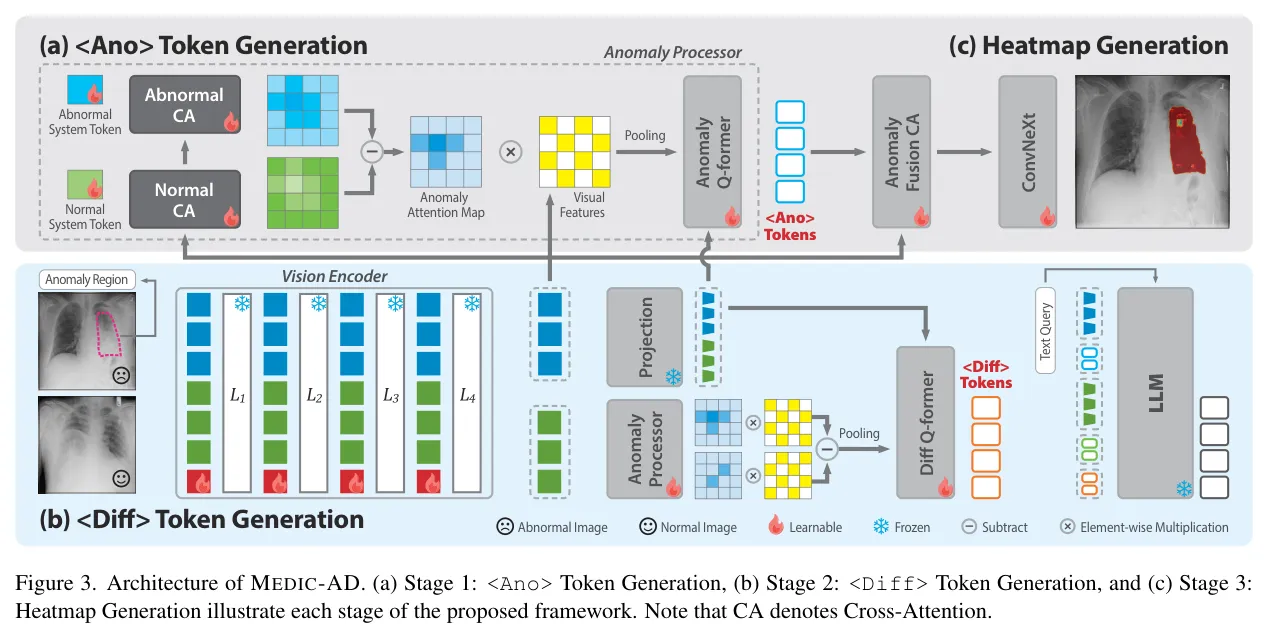
基线=Lingshu(Qwen-VL2.5 系医学 VLM)。标准 VLM:R=f_l([f_p(V);Emb(T)])(式1)。Stage1 <Ano>(式2 R=f_l([f_p(V*);<Ano>;Emb(T)])):两个可学 system token(Abnormal/Normal)与 vision encoder 4 个中间层多尺度特征做 cross-attention 得每 patch 异常/正常分数(用 Sigmoid 非 Softmax)→相减得 Anomaly Attention Map→element-wise 乘原视觉特征(按异常显著度调幅)→2D pooling→Anomaly Q-Former(LLM 投影 token 当 K/V)→2 层 MLP→<Ano>。用 visual soft prompt tuning(只调 4 层、不全更新)。Stage2 <Diff>(式3,两图各带 <Ano> + 末尾 <Diff>):两图调制后特征经 Diff Q-Former(各图投影 token 当 K/V)对比解耦→<Diff>,把"真病理进展"与"光照/体位噪声"分开。Stage3 heatmap(式4 M=f_h([f_p(V*);<Ano>])):<Ano> 与中间视觉特征 fusion→ConvNeXt 分割头出 heatmap(区别于 Citrus-V 用 SAM2 decoder)。
关键结果
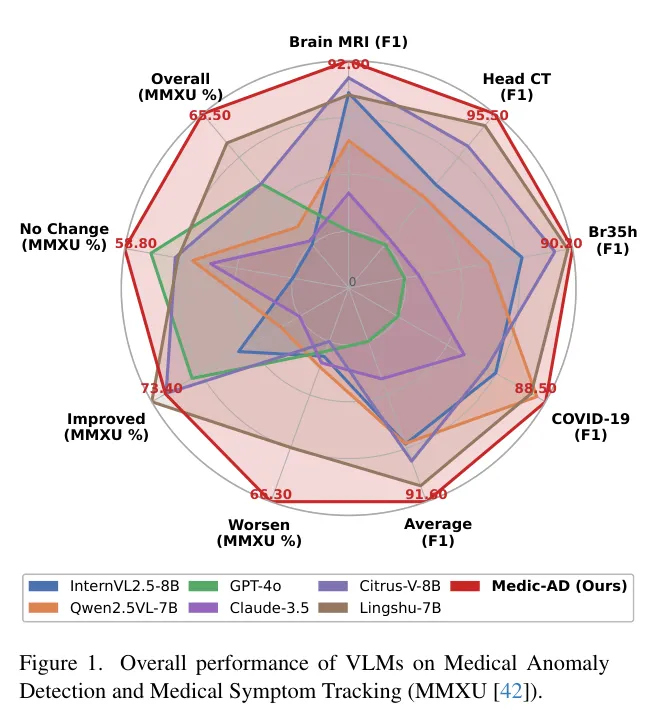
零样本异常检测(Table1,F1,全 unseen):MEDIC-AD(7B)Avg F1 91.6(Brain MRI 92.0/Head CT 95.5/Br35h 90.2/COVID-19 88.5),超 Lingshu 88.7、Citrus-V 84.2、GPT-4o 62.4、Claude-3.5 69.2、AnomalyGPT 61.4。症状追踪 MMXU(Table2):Overall 0.655(Worsen 0.663/Improved 0.714/No Change 0.588),超 Lingshu 0.620、GPT-4o 0.571。视觉 grounding(Table3,AUC/mIoU):碾压 Citrus-V——RESC 100/97.2(vs 87.6/2.1)、ChestX-Det 99.8/79.8(vs 98.0/12.4),mIoU 提升极大。真实 300 例(Table5):GREEN/RaTEScore/GPT-eval 0.020/0.430/0.291 全超 Lingshu。
亮点
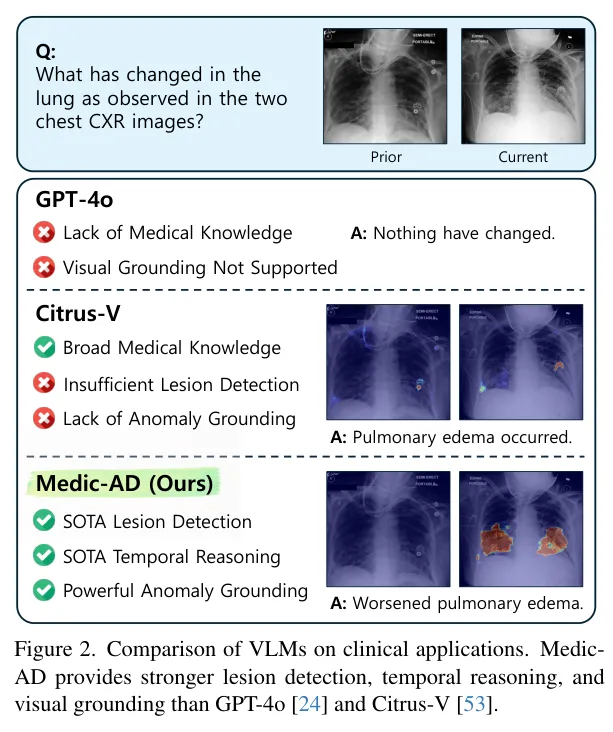
① 把临床诊断流程(检测→比较→解释)编码成训练课程,三阶段递进、各有专属 token 与任务;② <Ano> 与 <Diff> 互相增益(消融 Table4:去 <Ano> 仅用 <Diff> MMXU 0.635→加 <Ano> 0.655)——异常显著度调制让差异 token 抓真病变而非全局外观变化;③ 用异常 token 引导的 ConvNeXt 头替代 SAM2 decoder,分割 mIoU 大幅领先;④ GPT-4o 因安全对齐常拒答医学图("I'm unable to analyze..."), 本文校准更可靠。
疑问 / 待深挖
① 三阶段各自用不同数据集(Stage1 BMAD/ChestX-Det/VQA、Stage2 MIMIC-Diff-VQA、Stage3 像素 mask),阶段间是否灾难性遗忘、联合泛化如何,正文只说附录证"保留通用医学知识",需查附录 C;② MMXU Overall 0.655 看似不高(三分类),"Improved 0.714 但 No Change 仅 0.588"——"无变化"最难判,临床误报代价高;③ Stage2 仅在 chest X-ray(MMXU/MIMIC)验证,跨模态时序(MRI/CT 随访)未充分评测;④ 真实评测仅 300 例、单中心,规模与外部效度有限。
📖 逐段精读 · 笔记
批量精读初稿(基于本地 PDF 全文提取,57K 字符)。结构:Abstract 逐句 → 背景 → Intro 闭环 → Method 公式 → 实验数值表 + 全文总结。
① Abstract(摘要)— 逐句精讲
第 1 句(痛点):“Lesion detection, symptom tracking, and visual explainability are central to real-world medical image analysis, yet current medical Vision-Language Models (VLMs) still lack mechanisms that translate their broad knowledge into clinically actionable outputs.” —— 临床三件核心事(病灶检测 / 症状追踪 / 视觉可解释)才是真实影像分析的中心,但现有医学 VLM 缺把"广博知识"转成"临床可执行输出"的机制。
第 2 句(总方案):“we present MEDIC-AD, a clinically oriented VLM that strengthens these three capabilities through a stage-wise framework.” —— 用分阶段框架强化这三种能力。
第 3–5 句(三机制 verbatim):① “learnable anomaly-aware tokens (<Ano>) encourage the model to focus on abnormal regions and build more discriminative lesion centered representations.” ② “inter-image difference tokens (<Diff>) explicitly encode temporal changes between studies, allowing the model to distinguish worsening, improvement, and stability in disease burden.” ③ “a dedicated explainability stage trains the model to generate heatmaps that highlight lesion-related regions … consistent with the model's reasoning.”
第 6–7 句(战绩):“achieving state-of-the-art results compared with both closed source and medical-specialized baselines” ;并在 “real longitudinal clinical data collected from real hospital workflows” 上验证 “stable predictions and clinically faithful explanations”。一句话抓 Abstract:<Ano>(聚焦病灶)+ <Diff>(比较时序)+ heatmap(解释)三阶段,把通用医学 VLM 改造成"检测→比较→解释"的临床可用模型。
📚 背景知识(外部,非本文原创;理解全文必备)
① 医学 VLM / Med-VQA / Lingshu / Citrus-V:VLM = 视觉语言模型(图 + 文统一推理)。医学 VLM 在临床影像 + 报告上适配,做 disease classification / report generation / Med-VQA(benchmark 如 SLAKE / PathVQA / VQA-RAD / OmniMedVQA)。Lingshu 与 Citrus-V 都建在 Qwen-VL 2.5 上,用 “multi-stage training with shallow/deep alignment, medical instruction tuning, and reinforcement learning with verifiable rewards”。本文以 Lingshu-7B 为 backbone、以 Citrus-V 为主要竞品。
② Q-Former / Visual Soft Prompt Tuning:Q-Former(出自 BLIP-2 [37])= 用一组可学 query 经 cross-attention 从视觉特征里"问"出紧凑表示的桥接模块(本文有 Anomaly Q-Former、Diff Q-Former)。Visual Soft Prompt Tuning [26](VPT)= 往视觉编码器注入少量可学 prompt、冻结主干 → 低成本适配(本文只调 4 层、保留预训练稳定性)。
③ 零样本异常检测(ZSAD)/ BMAD / ChestX-Det:AD 起于工业(MVTec-AD / VisA),后借 CLIP 文图对齐做 open-vocabulary zero-shot 检测。医学侧 BMAD 把 Brain MRI / Chest X-Ray / Liver CT / Retinal OCT / Pathology 统一成一个 benchmark;ChestX-Det 提供胸部病变像素级标注(供分割)。
④ ConvNeXt / SAM2 / 评测指标:ConvNeXt [55] = 现代化纯卷积骨干(本文用作分割头)。SAM2 [48] = Segment Anything 2(Citrus-V 用它当分割 decoder,本文不用、改用 <Ano>+ConvNeXt)。指标:F1(检测)、AUC / mIoU(分割)、GREEN / RaTEScore(放射报告生成质量专用评分)。
② §1 Introduction — problem(痛点剖析)
problem 原文:“most Medical Foundation VLMs remain optimized for broad medical knowledge coverage rather than real clinical application.” 它们靠 “long-form captioning, OCR-based instruction tuning, and medical chain-of-thought reasoning” 训练,提升通用推理却 “overlook key properties required for real-world clinical workflows: (1) accurate lesion detection, (2) reliable temporal symptom tracking, and (3) transparent visual explainability of the reasoning process.”
作者的纲领句:“Addressing these limitations demands a paradigm shift from generalized intelligence toward clinically grounded perception, and understanding.” —— 从"通用智能"转向"临床落地感知"。这一句是全文价值主张的总锚点。
②-b §1 — 三个研究问题 RQ(solution,逐字)
RQ1(病灶识别 → Stage 1):“How can lesion and symptom recognition be improved in VLMs for real clinical settings?” 做法:“By injecting learnable <Ano> tokens into the transformer layers, the model highlights abnormal regions and strengthens its discriminative reasoning.”
RQ2(时序解耦 → Stage 2):“How can a VLM disentangle temporal medical images to enable more accurate symptom tracking?” 针对痛点 “Existing foundation models that support multi-image inputs typically concatenate visual features, thus failing to capture the temporal progression between scans.” 做法:引入 <Diff> tokens “compare anomaly features extracted from multiple images of the same patient … reason about whether a condition has worsened, improved, or remained unchanged.”
RQ3(可解释 → Stage 3):“How can visual explainability be integrated into medical VLM reasoning?” 做法:设计 heatmap decoder “fuses anomaly features and visual features to generate visualization maps … bridging the gap between black-box reasoning and clinical trust.”
②-c §1 — why 闭环 + 三大贡献
why 这样设计(关键直觉):“its stage-wise design encodes the clinical diagnostic workflow—detect, compare, explain—into the model's learning curriculum, transforming general-purpose vision-language understanding into clinically actionable intelligence.” 每阶段建在前一阶段表示上递进:Stage 2 的 <Diff> 建在 Stage 1 的 anomaly-aware 特征上;Stage 3 的 grounding 监督把 <Ano> 对齐到空间 heatmap。这把 grounding 从"附属可视化"升级为"把推理 ground 在异常特征上"的可核验证据。
三大贡献(contributions verbatim 精简):① “a unified, stage-wise framework (MEDIC-AD) that integrates anomaly detection, longitudinal reasoning, and visual grounding”;② “anomaly- and difference-token mechanisms that endow medical VLMs with explicit lesion sensitivity and temporal reasoning”;③ 在多任务 + 真实医院纵向数据上做 comprehensive evaluation,证明 “deployment readiness for real-world clinical practice workflows.”
③ §2 Related Work — 三条线速读
(2.1) 医学 VLM:从 contrastive alignment / report-level 表示(MedCLIP 类)→ instruction-tuned 大规模医学预训练 → Lingshu / Citrus-V 的多阶段 + RLVR。痛点:差异感知(difference captioning / 纵向推理)仍 “largely task-specific … without fully leveraging the extensive medical knowledge … of Medical Foundation VLMs.” 本文要把基础 VLM 的知识用起来。
(2.2) 零样本异常检测:工业 AD → CLIP prompt/adapter 开放词表 → Q-Former 连接 AD 与指令微调(AnomalyGPT / Anomaly-OV)。医学侧 BMAD 统一多模态 AD、ChestX-Det 给像素标注。(2.3) 可解释:cross-attention heatmap / token-conditioned activation 揭示文-图对应;本文不止做"附属可视化",而是 “grounding the reasoning process on anomalous features … ensuring clinically verifiable visual explainability.”
④ §3.1 方法总览(式 1)
标准 VLM(式 1):\[ R = f_l\big([\,f_p(V)\,;\ \mathrm{Emb}(T)\,]\big) \] 其中 \(f_p(\cdot)\) 是把 vision encoder 抽到的视觉特征 \(V\) 投影到文本嵌入空间的 visual projection;\(f_l(\cdot)\) 是 LLM;\(T\) 是文本指令。作者点破:此式 “lacks the inductive biases required for clinically meaningful perception including reliable lesion localization, temporal tracking, and visual justification.” 故分三阶段补归纳偏置。\(V^{*}\) 表示 “anomaly-augmented visual features obtained by incorporating visual soft prompts into the original visual embeddings \(V\)”。
⑤ Stage 1 — <Ano> Token 机制(式 2)
式 2:\[ R = f_l\big([\,f_p(V^{*})\,;\ \langle\mathrm{Ano}\rangle\,;\ \mathrm{Emb}(T)\,]\big) \] Anomaly Processor 全流程:两个可学 system token(Abnormal / Normal System Token)与 vision encoder 四个中间层(L1–L4)的多尺度特征做 cross-attention,产出每个 patch 的 Abnormal / Normal Attention Score。关键设计:“Unlike conventional attention head using Softmax normalization, our design applies Sigmoid activation to obtain patch-wise anomaly probabilities.”(用 Sigmoid 而非 Softmax,得 patch 级异常概率)。
调制 → 池化 → Q-Former:Abnormal 减 Normal 得 Anomaly Attention Map(“reflects the likelihood of each patch being abnormal”)→ 与原视觉特征做 element-wise multiplication(“adjusting their magnitudes according to anomaly salience”,按异常显著度调幅)→ 2D global pooling 得 Anomaly Queries → 送入 Anomaly Q-Former(“the LLM-projected visual tokens act as keys and values”)→ 2-layer MLP → 最终 <Ano>。为保稳定,只对选定 4 层做 Visual Soft Prompt Tuning(“instead of fully updating their parameters”)。训练数据:BMAD + ChestX-Det + SLAKE / PathVQA / VQA-RAD。
⑥ Stage 2 — <Diff> Token 机制(式 3)
式 3:\[ R = f_l\big([\,f_p(V^{*}_1)\,;\langle\mathrm{Ano}\rangle;\,f_p(V^{*}_2)\,;\langle\mathrm{Ano}\rangle;\ \mathrm{Emb}(T)\,;\langle\mathrm{Diff}\rangle\,]\big) \] 目标:学 difference token “that disentangle the variations in abnormal regions across time … effectively separating genuine pathological progression from visual or acquisition-related noise.”(把真病理进展从光照 / 体位 / 采集噪声中剥离)。
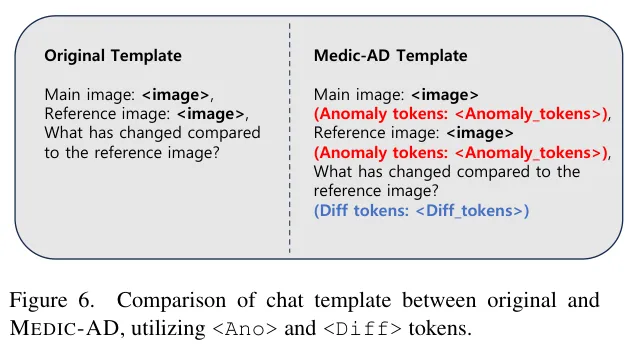
机制:两图在 Stage 1 得到的调制特征送入 Diff Q-Former,各图投影视觉 token \(f_p(V^{*}_1), f_p(V^{*}_2)\) 互为 keys/values “to encode structured inter-image relationships”,再过 2-layer MLP 得 <Diff> 附到序列尾。聊天模板(附录 A,Fig.6):原模板只问"两图有何变化";MEDIC-AD 模板给每张图挂 Anomaly tokens、给变化问题挂 Diff tokens。训练数据:MIMIC-Diff-VQA(临床随访多图)。
⑦ Stage 3 — Heatmap / 视觉可解释(式 4)
式 4:\[ M = f_h\big([\,f_p(V^{*})\,;\ \langle\mathrm{Ano}\rangle\,]\big) \] 把 <Ano> 与 vision encoder 中间特征经 fusion block(Anomaly Fusion CA)融合,再过紧凑 ConvNeXt-based segmentation head 出与输入空间对齐的 heatmap \(M\),叠回原图当区域级证据。关键区别:“While prior Medical Foundation VLMs often rely on pretrained vision decoders (e.g., SAM2 used in Citrus-V), our approach leverages the learned <Ano> tokens and ConvNeXt-based segmentation head to directly link visual reasoning with evidence.” 训练:BMAD + ChestX-Det 的像素 mask 子集,优化 DiceCE loss。
⑧ §4.1 实验 — 零样本异常检测(Table 1 全表,F1↑,全 unseen)
设置:4 个异构模态全程未见,统一 prompt “Is there any abnormality in this image?”,二分类用 F1 评。
Category | Model | BrainMRI-F1 | HeadCT-F1 | Br35h-F1 | COVID-F1 | Avg.F1
General | Qwen2.5-VL(7B) | 83.6 | 76.3 | 78.0 | 85.9 | 81.0
General | InternVL2.5(8B) | 88.6 | 79.3 | 82.8 | 73.6 | 81.1
Closed | GPT-4o | 74.1 | 65.5 | 65.6 | 44.4 | 62.4
Closed | Claude-3.5 | 78.1 | 66.7 | 67.7 | 64.2 | 69.2
Anomaly | AnomalyGPT(13B) | 74.8 | 66.7 | 61.6 | 42.5 | 61.4
Anomaly | Anomaly-OV(7B) | 61.0 | 49.6 | 53.5 | 36.3 | 50.1
Medical | LLaVA-Med(7B) | 80.1 | 63.8 | 73.4 | 60.1 | 69.4
Medical | Citrus-V(8B) | 90.2 | 88.1 | 87.6 | 70.9 | 84.2
Medical | Lingshu(7B, backbone) | 88.4 | 92.8 | 89.5 | 84.2 | 88.7
MEDIC-AD(7B) | 92.0 | 95.5 | 90.2 | 88.5 | 91.6
读 why:MEDIC-AD 四项全 SOTA,超 backbone Lingshu(+2.9 Avg) 与闭源 GPT-4o(+29.2)。原文点名闭源因安全对齐常拒答正常图(“responding with ‘I'm unable to analyze medical images …’”),而 MEDIC-AD “consistently produces well-calibrated predictions across both normal and abnormal cases”。
⑨ §4.2 实验 — 症状追踪(Table 2 全表,MMXU 准确率↑)
设置:MMXU 同病人成对胸片,三分类 worsened / improved / unchanged,题型如 “What is the condition of the left lower lung zone across the two chest CXR images? A: No significant change, B: Improved, C: Worsened.” 仅纳入支持多图推理的模型。
Model | Worsen | Improved | No Change | Overall↑
InternVL2.5(8B) | 0.486 | 0.607 | 0.402 | 0.498
Qwen2.5-VL(7B) | 0.499 | 0.545 | 0.513 | 0.519
Claude-3.5 | 0.494 | 0.518 | 0.493 | 0.502
GPT-4o | 0.480 | 0.675 | 0.559 | 0.571
Citrus-V(8B) | 0.468 | 0.713 | 0.532 | 0.571
Lingshu(7B) | 0.597 | 0.734 | 0.529 | 0.620
MEDIC-AD(7B) | 0.663 | 0.714 | 0.588 | 0.655
读 why:Overall 0.655 居首(+0.035 vs Lingshu)。原文:通用 VLM “simply concatenate multiple images”,而 MEDIC-AD “explicitly encodes inter-image relationships”,对光照 / 体位变化更鲁棒。[推测] “No Change 0.588”仍是三类最低——"无变化"最难判,临床误报代价高。
⑩ §4.3 实验 — 视觉 grounding(Table 3 全表,AUC / mIoU↑,vs Citrus-V)
Dataset | Citrus-V AUC/mIoU | MEDIC-AD AUC/mIoU
BraTS2021 | 98.8 / 32.6 | 99.8 / 87.6
RESC | 87.6 / 2.1 | 100 / 97.2
BTCV+LiTs | 82.1 / 1.7 | 97.2 / 83.6
ChestX-Det | 98.0 / 12.4 | 99.8 / 79.8
读 why:mIoU 碾压(RESC 97.2 vs 2.1,BTCV+LiTs 83.6 vs 1.7)。原文:Citrus-V 用 SAM2 decoder “tends to produce less precise masks, sometimes highlighting non-lesion areas or yielding diffuse activations in normal images”;<Ano> 引导的 ConvNeXt 头精准锁定病灶且与文本理由对齐。
⑪ §5 分析 — 消融(Table 4)+ 超参(Table 9)
Table 4(<Ano> 的作用):仅 <Diff>(无 anomaly 调制)MMXU = 0.635 → 加 <Ano> 升到 0.655。原文结论:“<Ano> and <Diff> tokens form a mutually reinforcing pair: one grounds spatial anomaly cues, while the other captures temporal evolution.” 层选择:Last layer = 90.9 F1 / 0.619 MMXU;Intermediate 4-layers = 91.6 / 0.635(中间多层聚合更优)。
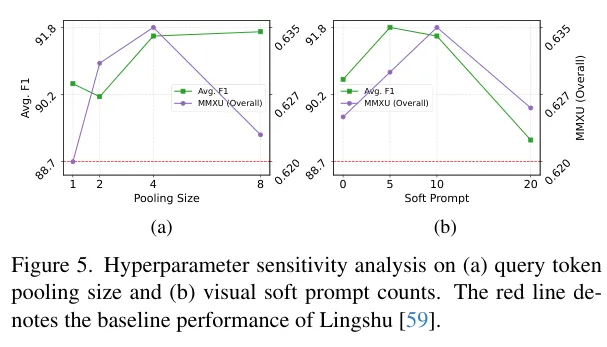
Table 9(超参全表):Pooling Size 1/2/4/8 → Avg.F1 90.5 / 90.2 / 91.6 / 91.7,MMXU 0.620 / 0.631 / 0.635 / 0.623;Soft Prompt 0/5/10/20 → F1 90.6 / 91.8 / 91.6 / 89.2,MMXU 0.625 / 0.630 / 0.635 / 0.626。默认取 pooling 4×4 + 10 soft prompts(兼顾空间抽象与异常定位)。
⑫ §5.4 真实 300 例(Table 5)+ Stage-wise vs Joint(Table 10)
Table 5(真实 300 例随访胸片,时序差异 captioning):GREEN / RaTEScore / GPT-eval —— Lingshu-7B 0.009 / 0.359 / 0.177,MEDIC-AD 0.020 / 0.430 / 0.291,三项全超。原文:模型描述 “align closely with expert assessments”,证明从公开 benchmark 到真实单中心数据都稳健。
Table 10(训练范式消融):Lingshu-7B 88.7 / 0.620 → Medic-AD(Joint) 89.7 / 0.630 → Medic-AD(Stage-wise) 91.6 / 0.655。原文:“stage-wise training consistently outperforms joint optimization … providing a more stable learning curriculum”,每个阶段目标先内化、再叠加新监督。
⑬ 灾难性遗忘 & 训练细节(附录 B/C,Table 6/7/8)
避免灾难性遗忘(Table 7/8):对照 “Lingshu (full finetuning)”(端到端全量微调 Stage1+2 数据)在通用医学 QA 上崩盘——VQA-RAD 67.9→40.8、SLAKE 83.1→38.4、PMC-VQA 56.0→6.4、MedMCQA 55.9→1.8。而 MEDIC-AD 只更新 <Ano>/<Diff> 等小模块,保住通用知识(VQA-RAD 64.3、MMMU-Med 54.2、MedMCQA 56.7)。这是"分阶段 + 小模块"设计的关键卖点。
训练配置(附录 B):全程 AdamW + cosine LR。Stage 1:3×H200,1 epoch(3h),LR 1e-4,batch 16;Stage 2:同硬件,1 epoch(6h);二者用标准 LLM cross-entropy。Stage 3:100 epochs(15h),LR 1e-3,batch 32,DiceCE loss。新增参数量(Table 6):Visual soft prompts 51K、<Ano> 40M、<Diff> 40M、Heatmap 48M —— 相对 7B backbone 极轻量。
📌 全文一页总结(≥3 takeaway)
① 把诊断流程编码成训练课程:detect→compare→explain 三阶段递进,各有专属 token(<Ano>/<Diff>)与任务,且后阶段建在前阶段表示上——这是把"通用智能"转"临床可执行智能"的核心方法论。
② 机制创新的两处巧思:(a) 异常处理用 Sigmoid 而非 Softmax 出 patch 级异常概率,相减得 Anomaly Attention Map 调制视觉特征;(b) 可解释用 <Ano>+ConvNeXt 头替代 SAM2 decoder,mIoU 碾压(RESC 97.2 vs 2.1)。<Ano> 与 <Diff> 实证互增益(MMXU 0.635→0.655)。
③ 全面 SOTA + 工程稳健:零样本异常检测 Avg F1 91.6(超 GPT-4o 62.4 / Lingshu 88.7),MMXU 0.655,grounding mIoU 大幅领先,真实 300 例随访也领先;新增参数仅百 M 量级、分阶段训练避免灾难性遗忘(对照全量微调 PMC-VQA 崩到 6.4)。takeaway:临床可用的医学 VLM 不在于"知识更多",而在于"把知识 ground 到异常区、ground 到时序变化、ground 到可视证据"。
⚠️ 局限 & 待深挖(含 [推测])
① 阶段间数据各异(Stage1 BMAD/ChestX-Det/VQA、Stage2 MIMIC-Diff-VQA、Stage3 像素 mask),正文称附录 C 证"保留通用知识",但 [推测] 跨阶段联合泛化与遗忘边界仍需更系统评测;② 时序仅胸片验证(MMXU / MIMIC 都是 chest X-ray),MRI/CT 随访的跨模态时序未充分评;③ 真实评测仅 300 例、单中心,外部效度有限;④ [推测] “No Change”类最难(0.588),临床上"误判恶化/好转"代价高,需校准;⑤ heatmap 与 LLM 文本理由的"忠实度"目前靠 mIoU/AUC 间接衡量,是否真反映模型内部推理仍是开放问题。
🖼 论文原图(本地 PDF 截图,原文 caption 未改写)