CVPR 2026 Finalist
MAMMA: Markerless Accurate Multi-person Motion Acquisition
Hanz Cuevas Velasquez ⋅ Anastasios Yiannakidis ⋅ Soyong Shin ⋅ Giorgio Becherini ⋅ Markus Höschle ⋅ Joachim Tesch ⋅ Taylor Obersat ⋅ Tsvetelina Alexiadis ⋅ Eni Halilaj ⋅ Michael J. Black
摘要 Abstract
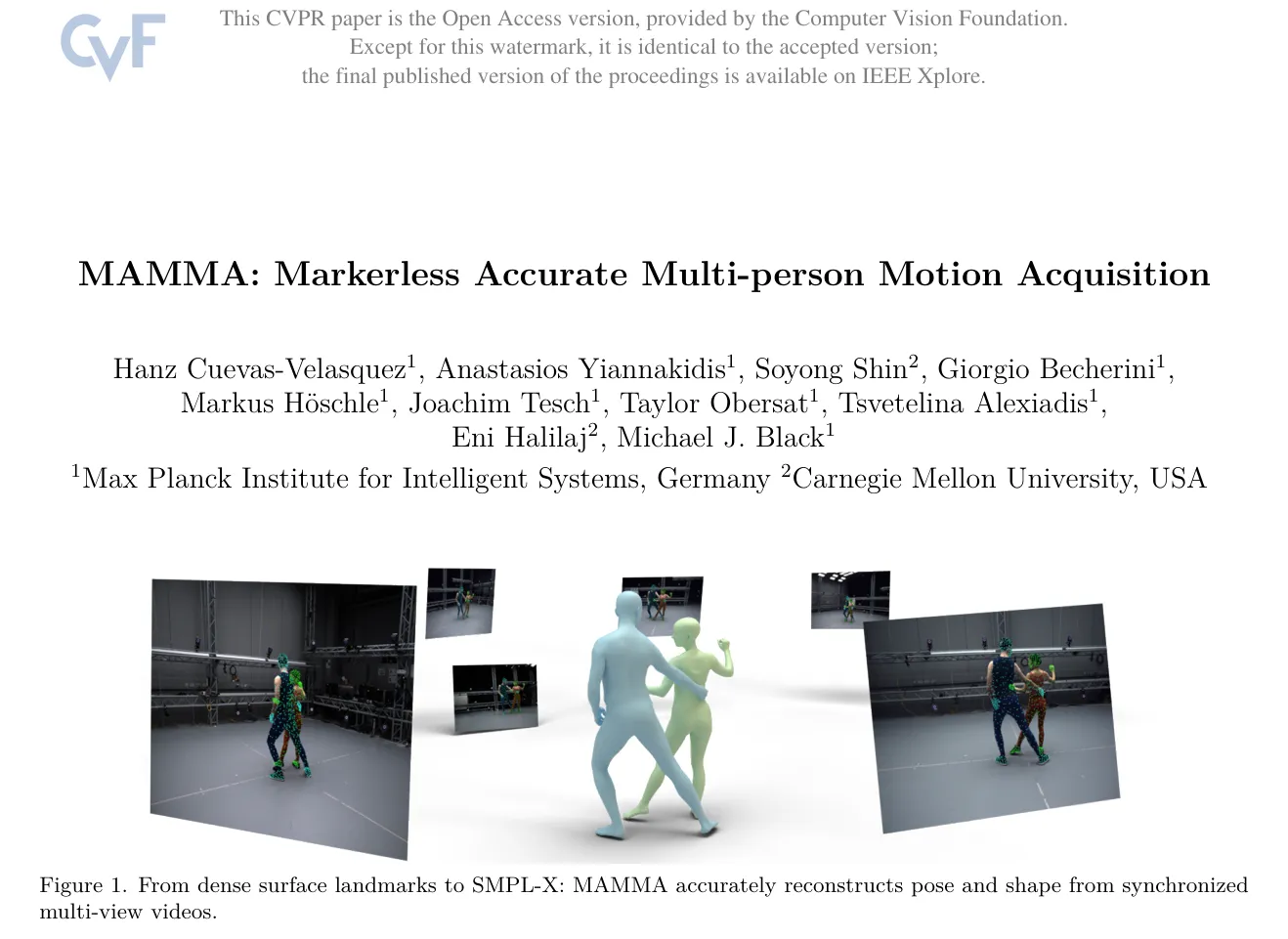
We present MAMMA, a markerless motion-capture pipeline that accurately recovers SMPL-X parameters from multi-view video.Traditional motion-capture systems rely on physical markers. Although they offer high accuracy, their requirements of specialised hardware, manual marker placement, and extensive post-processing make them costly and time-consuming. Recent learning-based methods attempt to overcome these limitations, but most are designed for single-person capture, rely on sparse keypoints, or struggle with occlusions and physical interactions. In this work, we introduce a method that predicts dense 2D surface landmarks conditioned on segmentation masks, enabling person-specific correspondence estimation even under heavy occlusion. We employ a novel architecture that exploits learnable queries for each landmark. We demonstrate that our approach can handle complex person--person interaction and offers greater accuracy than existing methods. To train our network, we construct a large, synthetic multi-view dataset combining human motions from diverse sources, including extreme poses, hand motions, and close interactions. Our dataset yields high-variability synthetic sequences with rich body contact and occlusion, and includes SMPL-X ground-truth annotations with dense 2D landmarks.The result is a system capable of accurately capturing human motion without the need for markers. Our approach offers competitive reconstruction quality compared to commercial marker-based motion-capture solutions, without the extensive manual cleanup. Finally, we address the absence of common benchmarks for dense-landmark prediction and markerless motion capture by introducing two evaluation settings built from real multi-view sequences. We will release our dataset, method, code, and model weights for research purposes.
📝 精读笔记
灵魂一句
MAMMA(Max Planck,含 Michael Black):用多视角视频做无标记点(markerless)动捕,直接吐出每人每帧的 SMPL-X 参数,专攻"两人贴身互动(拥抱/搏击/双人舞)"这种有标记点系统都头疼的场景。两段式:① MammaNet 预测 512 个稠密 2D 表面 landmark(带 uncertainty/可见性/接触),每个 landmark 一个可学 query、再用 SAM2 mask 做条件→重遮挡下也能认准是谁的身体;② 把 landmark 反投影拟合 SMPL-X。结果与商用 Vicon+MoSh++ 的 held-out marker 误差仅差 0.862mm、流水线从 ~72h 压到 26h(约 3×)。
问题 & 动机
marker-based 动捕(Vicon 等)是 “gold standard” 但贵、要贴 marker、要人工清洗(复杂姿态/贴身互动时 marker 掉落或遮挡,清数据几分钟到几小时)。已有 markerless 学习法多为单人、靠稀疏关键点、或在遮挡/物理互动下崩。原文发问:能否 “roll your own” 一个 markerless 系统,达到商用 marker-based 精度却免人工清洗,把动捕民主化给学术界。痛点核心:landmark 检测器通常在"单人孤立图"上训,贴身互动时分不清是谁、身体部位错配;真实数据又难拿 contact/visibility 这类细粒度信息。
核心方法(关键公式)
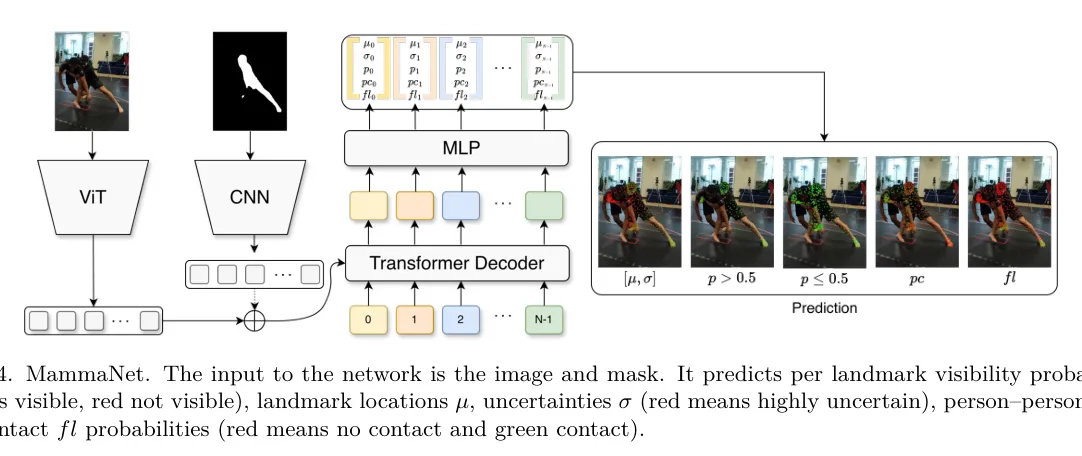
① MammaNet(§4.1):ViT-Base 提图像特征 + CNN 提 mask 特征(同空间 element-wise 相加做条件);Transformer decoder 用 N=512 个 landmark query(每 landmark 一个,区别于 CameraHMR 单 token 出全部)——cross-attn 让每 query 找最相关 patch、self-attn 学 landmark 间相关。每 landmark 出 µ_i=[x_i,y_i]、不确定度 σ_i、可见性 p_i、人-人接触 pc_i、地面接触 fl_i;loss=Gaussian NLL(landmark)+BCE(可见性)+focal(接触,正样本少)。② 拟合(§4.2,L-BFGS):不靠任何 pose/shape 回归初始化(landmark 信息够);分 4 阶段——先 min 重投影 E_ldmks=Σ ρ(‖µ−Π(V,Q)‖/σ)·p(式1,ρ=Geman-McClure 鲁棒核)定平移旋转→加 shape 先验→用重投影误差 e_i 反过来下调 σ'_i(τ=10px)+时序加速度 E_temp→最后接触优化 E_cont=E_p(SDF 排斥防穿模)+E_c(接触吸引)。总能量 E=E_ldmks+E_shape+E_temp+E_cont。③ 多视角对应(§4.3):SAM2 分割+传播跟踪每人,跨视图用对称对极距离 D_g(式2,含基础矩阵)算 affinity→Hungarian 匹配→环一致图。
关键结果
2D landmark(像素误差↓):两人互动 Harmony4D 上 +SAM2 mask 从 31.96→18.33(mask 在贴身场景作用最大);CHI3D 4.36、MammaEval-D 7.70。3D 拟合 MPJPE(mm,Table4):MAMMA 全面最优——RICH 22.20(CameraHMR 25.61)、Harmony4D 45.26(58.59)、MammaEval-D 17.71。Hi4D(Table5):MAMMA-C MPJPE 12.44mm,碾压 AvatarPose 32.10、4DAssociation 41.29(且没在 Hi4D 上训过)。穿模(Table3):MAMMA-C 穿透深度 8.46mm/378 verts,比 GT(9.84/480)还少。接触 ROC-AUC:人-人 0.91、地面 0.96。vs Vicon(§5.5):held-out marker 误差 Vicon+MoSh++ 21.619mm vs MAMMA 22.481mm,仅差 0.862mm。
亮点
① per-landmark learnable query(DETR 式)替代"单 token 出全部 landmark",对极端姿态(瑜伽 MOYO,没训过)和遮挡更鲁棒;② 用 SAM2 mask 条件把贴身两人分开——“richer pixel-based supervisory signals” 是视觉法对 marker 法的天然优势;③ 自建 MammaSyn(扩 BEDLAM 到 32 视角、2.5M crops、含 contact/visibility GT、512 点 FPS 采样偏重手脚头);④ visibility + contact 预测对贴身互动和防穿模至关重要;⑤ 落地价值:把动捕成本/工时大幅降低、还能用 4 部 iPhone 跑。
疑问 / 待深挖
① held-out marker 误差 MAMMA(22.481)其实略大于 Vicon+MoSh++(21.619),"0.862mm 差距可忽略"是作者论断,对生物力学等高精度场景是否够用需具体任务判断;② 优化地面接触 “does not improve”(landmark 已够鲁棒),说明 floor-contact 分支收益有限;③ 评测大量依赖自建数据集(MammaEval/MammaSyn),与外部公开 benchmark 的可比性有限(原文也称该领域缺统一 benchmark);④ 两人以上(≥3)互动表现原文聚焦两人、未深入。
📖 逐段精读 · 笔记
批量精读初稿(基于本地 PDF 全文提取,52K 字符)。结构:Abstract 逐句 → 背景 → Intro 闭环 → Method 公式 → 实验数值表 + 全文总结。
① Abstract(摘要)— 逐句精讲
一句话定位(原文):“We present MAMMA, a markerless motion-capture pipeline that accurately recovers SMPL-X parameters from multi-view video.”——MAMMA = Markerless Accurate Multi-person Motion Acquisition,从多视角视频无标记地恢复 SMPL-X 人体参数。
痛点:“Traditional motion-capture systems rely on physical markers. Although they offer high accuracy, their requirements of specialized hardware, manual marker placement, and extensive post-processing make them costly and time-consuming.”;而已有 learning-based 方法 “most are designed for single-person capture, rely on sparse keypoints, or struggle with occlusions and physical interactions.”。
核心做法(逐句指路):① “predicts dense 2D contact-aware and visibility-aware surface landmarks conditioned on segmentation masks, enabling person-specific correspondence estimation even under heavy occlusion.”(在分割掩码条件下预测稠密、带接触/可见性的 2D 表面 landmark,遮挡下也能做 person-specific 对应);② “a novel architecture that exploits learnable queries for each landmark.”(每个 landmark 一个可学习 query);③ 构建大规模合成多视图数据集 “including extreme poses, hand motions, and close interactions.”。
结论性卖点:“competitive reconstruction quality compared to commercial marker-based motion-capture solutions, without the extensive manual cleanup.”,并补两个评测 setting 填补 “the absence of common benchmarks for dense-landmark prediction and markerless motion capture”。一句话抓 Abstract:用 mask 条件 + per-landmark query 的 Transformer 预测 512 个稠密表面 landmark(带不确定性/可见性/接触),再优化拟合 SMPL-X,做到接近 Vicon 的精度但免去人工清洗。
📚 背景①(外部知识):SMPL / SMPL-X / marker-based vs markerless mocap
SMPL [33]=参数化人体网格模型(shape \(\beta\) + pose \(\theta\));SMPL-X [47]在 SMPL 基础上加上手(MANO)+ 脸,能表达全身+手指+表情,本文输出即 SMPL-X 的 \(\{\beta,\theta,t\}\)。Marker-based mocap(Vicon/OptiTrack/Qualisys 等)在身上贴光学 marker、用多相机三角化,精度被视为 “gold standard”,但要贴 marker、标定、清洗噪声/缺失/交换的 marker(“minutes to hours”)。Markerless=纯多相机视频 + CV 算法,便宜但通常被认为不如 marker-based 准——本文目标正是 “roll your own” markerless 追平商用 marker-based。
📚 背景②:dense surface landmarks / MoSh++ / AMASS / BEDLAM
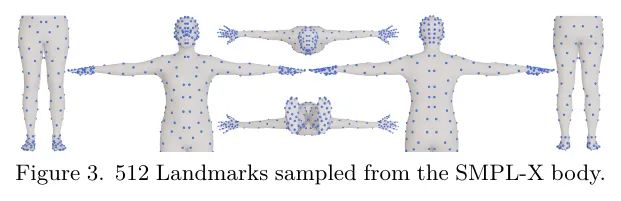
dense surface landmarks(稠密表面标记)= 在身体网格表面采样很多点(本文 512 个),比 sparse 关节点信息丰富得多,足以直接解 SMPL-X 的 body+hand pose/shape 而无需强 pose prior。MoSh++ [35]=把稀疏 Vicon marker 拟合成 SMPL-X 的经典流程,AMASS 数据集就是它造的——本文把自己当成 MoSh++ 的替代来对标。BEDLAM [3]=大规模合成人体视频数据集;本文扩展它成 32 相机多视图 + 加入近距离交互/手部,命名 MammaSyn。dependent 的 contact 标注由 SDF(符号距离函数)+ 表面法向生成。
📚 背景③:SAM2 / symmetric epipolar distance / Hungarian / 指标
SAM2 [51]=分割一切模型的视频版,能初始化一次后跨帧 propagate 出每个人的 mask 与 track ID。symmetric epipolar distance(对称对极距离,式2)=用基础矩阵 \(F_{ba}\) 衡量两视图 landmark 是否对应同一 3D 点(点到对极线距离),本文用它做跨视图人物匹配的代价。Hungarian assignment(匈牙利算法)=在代价矩阵 \(1-A_{ab}\) 上求最优一对一匹配。指标:MPJPE(Mean Per-Joint Position Error,关节位置误差 mm)、PVE(Per-Vertex Error,顶点误差 mm)、AUC(ROC 曲线下面积,0.5=随机,越高越好)。
② §1 Introduction — problem → solution → why 闭环
problem:marker-based 贵且费人工,尤其 close multi-person interaction(拥抱、武术、舞蹈)里 marker 易掉/被遮挡,而这类交互在现有 mocap 数据里 “remain underrepresented”。作者发问 “whether it is possible to ‘roll your own’ markerless system that achieves accuracy comparable to commercial marker-based systems without the tedious manual clean up.”,目标是 “democratize motion capture”。
solution(Intro 自包含):two-stage——先在所有视图估 virtual marker,再解最优人体拟合。沿 dense surface marker 路线 [16,45] 训一个稠密 2D landmark detector,但有两个难点:landmark detector 通常在单人图上训、close interaction 下难分清是哪个人/哪个部位;真实数据难拿 contact/visibility 标注。两招应对:① 扩 BEDLAM 成 close-interaction 多视图合成集 MammaSyn(带 dense landmark/visibility/contact GT);② 提出 transformer dense landmark estimator MammaNet,每个 keypoint 学一个 distinct embedding(landmark query),输出位置 + uncertainty + visibility + contact,并可用 SAM2 mask 条件化。
why(关键洞察):“We find visibility and contact estimates to be critical for dealing with close person–person interaction and to prevent interpenetration.”;且 vision-based 相对 marker-based 的优势在于 “richer pixel-based supervisory signals can be incorporated to reduce ambiguity.”。靠 landmark 精度,优化 “does not rely on pose priors or pose initialization.”,结果 “visually indistinguishable from that of a marker-based system”。
③ §2 Related Work — marker-based / markerless / 数据集
① Marker-based(Vicon/OptiTrack/Qualisys/Motion Analysis/PhaseSpace)精度高但贴标定清洗开销大,且要额外步骤把 raw 转成骨架/参数模型。② Markerless:商用方案多(Captury/Move AI/Moverse/Theia)但 “with the exception of Moverse, no such methods are capable of producing the parameters of a parametric body model”,且不开源/不报 benchmark,故本文只比学术系统。学术单目方法回归 SMPL/SMPL-X 但 “struggle with depth ambiguity and occlusion when people closely interact”;多视图方法三角化稀疏关节、停在 skeleton 级、需强 prior 再拟合。本文则直接预测稠密表面 landmark + mask 条件化分离重叠主体。③ 数据集:人-人重交互数据稀缺,多数合成集 “do not contain person–person interaction”,少数含交互的 “the range of activities and motion diversity is limited.”。
④ §3 数据集 — MammaSyn(S/I/H)+ 真实评测集
MammaSyn(合成训练,纯合成训):扩 BEDLAM 到 32 相机虚拟多视图,含 2.5M crops、955k images,目标覆盖 (i) multi-view (ii) extreme pose (iii) high-fidelity hands (iv) two-person interaction。自采两套 Vicon 数据补交互:Latin-Dance(2 人 10 序列)、Interacting Couples(2 人 48 序列)。dense-landmark GT 用 Farthest Point Sampling 采 512 个顶点,并对手/脚/头加权(更密)。三个子集:MammaSyn-S(单人:BEDLAM + MOYO)、MammaSyn-I(交互:自采 + Hi4D + Harmony4D + Inter-X)、MammaSyn-H(手:SignAvatars + InterHand2.6M,把 MANO 手拟合进 SMPL-X)。
MammaEval(真实评测,Vicon + 多视图 RGB 同步、MoSh++ 转 SMPL-X):-Singles(16 视图,3 人 22 单人序列,含物体交互);-Dance(32 视图,18 段 West Coast Swing 双人舞);-Extra(32 视图,专为对标 Vicon-MoSh:标准 marker 集 FrontWaist10Fingers + 每人额外 37 个 held-out marker(不参与 MoSh 拟合,作独立 GT),3 人各 4 序列)。另开源一套纯 MAMMA 采的舞蹈集(Bachata/WCS/Breakdance/Ballroom,9 人共约 1 小时,30 FPS)。
⑤ §4.1 MammaNet 架构 — landmark queries(核心创新)
backbone 用 ViT-Base 提图像特征 + 一个额外 CNN 处理 mask,用 Transformer decoder 解出 N=512 个表面 landmark。与 CameraHMR [45] 的关键区别:CameraHMR “uses a single learnable embedding input to estimate the entire set of landmarks”,而 MammaNet “learn N embeddings (landmark queries), with one corresponding to each landmark.”。这样 cross-attention 让每个 landmark “match … to the most relevant image patches”,self-attention 学 landmark 间 “pairwise correlations”。mask 条件化:图像与 mask 特征编码到同一空间后逐元素相加(element-wise summation [27])。原文称该设计 “enables the model to generalize to challenging poses”(如从未训过的 MOYO 瑜伽姿态)。
⑥ §4.1 网络输出 + 损失函数
对每个 landmark \(i\) 网络预测:像素坐标 \(\mu_i=[x_i,y_i]\)、不确定性 \(\sigma_i\)、可见性概率 \(p_i\)、人-人接触 \(pc_i\)、地面接触 \(fl_i\)。动机:作者观察到 “predicted uncertainties are often high on rigid regions (e.g. torso) that are not visible by the camera.”,故显式加可见性预测。损失:landmark 用 Gaussian negative log-likelihood;visibility 用 binary cross-entropy;contact 用 focal loss [30](因为 “there are more landmarks that do not have contact”,类别不均衡);所有损失带 per-landmark 权重 \(\lambda_*\)。
⑦ §4.2 模型拟合 — 能量项 + 4 阶段(公式)
拟合 SMPL-X neutral body \(M(\beta,\theta,t)\),用 L-BFGS,16 个 shape 系数 \(\beta\)。初始化在“相机心射线距离最小”的 3D 点,不用任何回归器初始化 pose/shape(landmark 信息已够)。reprojection 能量(式1):\[E_{\text{ldmks}}=\frac{1}{C}\sum_{t,c,l}\rho\!\left(\frac{\lVert\mu_{t,c,l}-\Pi(V_{t,l},Q_c)\rVert}{\sigma_{t,c,l}}\right)p_{t,c,l},\] \(\Pi\) 为投影、\(Q_c\) 相机参数、\(\rho\) 为鲁棒 Geman-McClure 函数、按可见性 \(p\) 加权。4 阶段:(1) 只求平移+旋转最小化重投影;(2) 优化 pose/shape/trans + L2 形状正则 \(E_{\text{shape}}\);(3) 同能量但更新不确定性 \(\sigma'_i=\sigma_i\cdot\min(\max(e_i/\tau,0),1),\ \tau=10\text{px}\)(用重投影误差 \(e_i\) 把“位置对但网络不自信”的 \(\sigma\) 压低),并加关节加速度惩罚 \(E_{\text{temp}}\);(4) 优化接触 \(E_{\text{cont}}=E_p+E_c\),其中斥力项 \(E_p=\frac1N\sum_i\big(\min(0,\text{SDF}_{\text{other}}(v_i)+\delta)\big)^2\)(穿模惩罚,\(\delta\) 容许软组织形变)、吸引项 \(E_c=\frac1N\sum_i p_i\big(\max(0,\text{SDF}_{\text{other}}(v_i))\big)^2\)。总能量 \(E=E_{\text{ldmks}}+E_{\text{shape}}+E_{\text{temp}}+E_{\text{cont}}\)。SDF 用自写 CUDA kernel 全 GPU 加速。
⑧ §4.3 多视图对应 — affinity / 对称对极 / Hungarian
先用 SAM2 出 mask(可自动检测或几下点击初始化),propagation 做跨帧 track;每个 track 的人在每视图每帧出 \(x_{v,p}\in\mathbb{R}^{F\times N\times2}\) 的 dense landmark(不可见帧填 dummy)。跨视图两两比对:几何亲和度 \(A_g(x_a,x_b)=\exp(-D_g/\lambda)\in[0,1]\),\(D_g\) 为对称对极距离(式2)\[D_g=\frac{1}{2FN}\sum_{i=1}^{FN}\big(d(x_b^i,F_{ba}x_a^i)+d(x_a^i,F_{ab}x_b^i)\big),\] 只在两视图都可见的 landmark 上算(避非可见点的误预测)。可见点太少或 \(D_g\) 超阈值则亲和置 0。对 \(A_{ab}\in[0,1]^{M_a\times M_b}\) 解 Hungarian(代价 \(1-A_{ab}\)),再跨所有视图对连成 cycle-consistent correspondence graph,连通分量即同一人的多视图组。
⑨ §5.1 2D landmark 网络对比(Table 1 单人 / Table 2 双人,px↓)
对比 CameraHMR[45](同 backbone、单 token)与 Look-Ma*([16] 复现、去掉 pose/shape 头只留 landmark 头)。输入分辨率 \(512\times384\)。
Table 1(单人,RICH / MOYO / MammaEval-S):
Look-Ma* | 13.26 | 22.43 | 10.25
CameraHMR | 8.84 | 12.53 | 6.32
MammaNet (ours) | 8.55 | 11.40 | 6.09
MammaNet +masks SAM2 | 8.83 | 11.04 | 6.16
Table 2(双人 IoU>0.5,Harmony4D / CHI3D / MammaEval-D):
Look-Ma* | 31.45 | 8.77 | 15.01
CameraHMR | 32.84 | 6.30 | 10.21
MammaNet (ours) | 31.96 | 6.22 | 9.87
MammaNet +masks SAM2 | 18.33 | 4.36 | 7.70
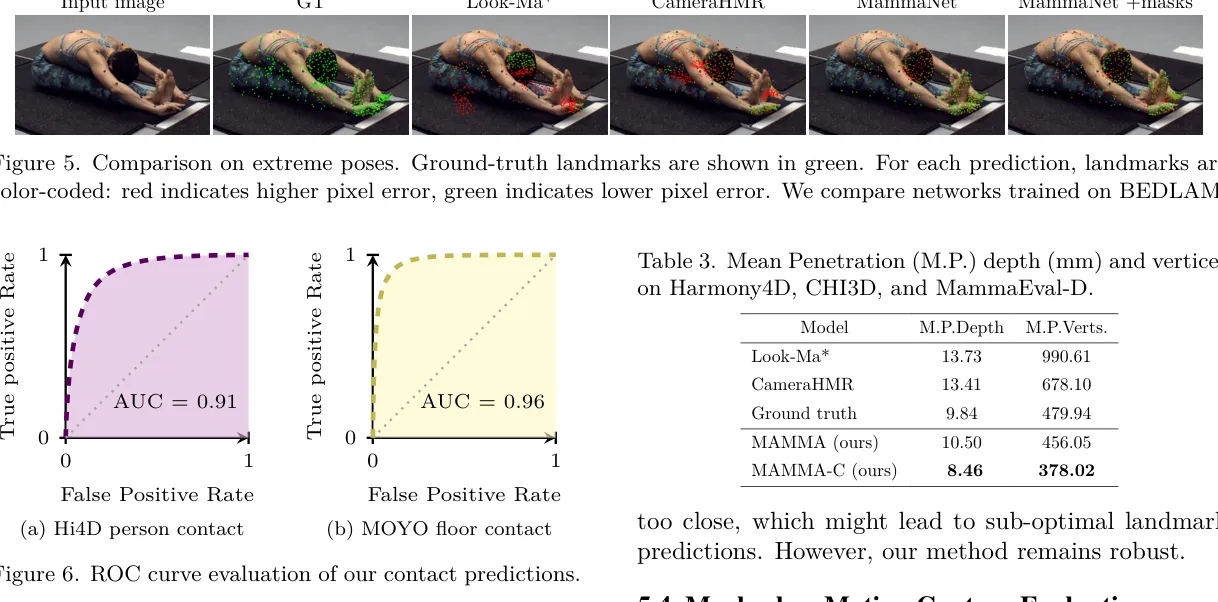
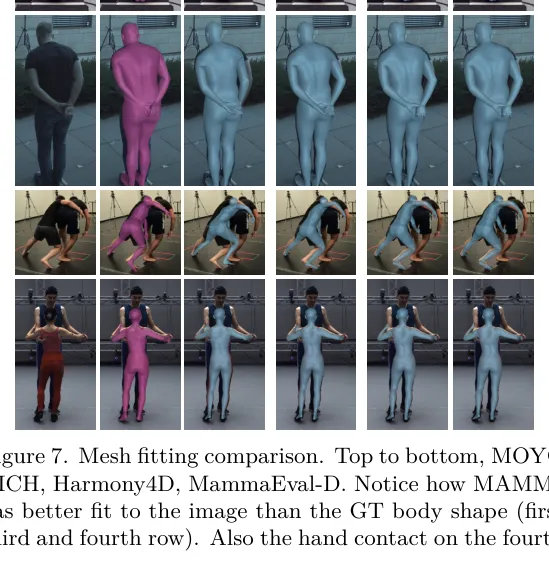
读表 why:单人时 mask “provide a marginal benefit”(8.55 vs 8.83,互有胜负);但双人重叠时 mask 作用巨大——Harmony4D 从 31.96 骤降到 18.33、CHI3D 6.22→4.36、MammaEval-D 9.87→7.70,因为 mask 帮网络 disambiguate target individual。MammaNet 还能泛化到没训过的 MOYO 瑜伽极端姿态(11.40,远好于 CameraHMR 12.53、Look-Ma* 22.43)。
⑩ §5.2 接触预测 ROC(AUC)
BEDLAM 是单人、无 contact,故用 MammaSyn 重训并加两分支(人-人接触 + 地面接触;注意是任意身体部位触地,非仅脚)。评测:floor contact 用 MOYO 测试集(瑜伽含复杂触地),person-person contact 用 Hi4D(且重训时去掉 Hi4D 序列防泄漏)。结果:Hi4D person contact AUC = 0.91,MOYO floor contact AUC = 0.96,原文 “the AUC for both predictions is more than 90% which indicates that our model correctly identifies most contact points with few false positives.”。
⑪ §5.3 对应评测 + §5.4 穿模 Table 3(mm↓)
三套交互数据上跨视图 identity 匹配 100% accuracy,证明 dense landmark 的几何信息够丰富,无需额外身份特征网络。穿模(Mean Penetration depth / vertices):
Look-Ma* | 13.73 | 990.61
CameraHMR | 13.41 | 678.10
Ground truth | 9.84 | 479.94
MAMMA (ours) | 10.50 | 456.05
MAMMA-C (ours) | 8.46 | 378.02
读表 why:加 contact 优化的 MAMMA-C 穿模最少(8.46mm / 378 顶点),甚至低于 GT(9.84mm / 480)——因为 GT 本身就有穿模,所以单看重建指标不够,穿模才显出 contact 项价值。注意 floor contact 优化对结果无明显提升,说明 landmark 已足够鲁棒。
⑫ §5.4 3D 拟合 Table 4(MPJPE/PVE mm↓)+ Hi4D Table 5
Table 4(MPJPE/PVE;列:RICH|Harmony4D|CHI3D|Eval-S|Eval-D|MOYO):
SMPLify | 96.18/71.42 | -/- | 67.68/51.79 | 47.15/35.42 | 53.92/43.08 | 62.15/44.68
LookMa* | 39.52/30.29 | 59.37/45.6 | 46.47/39.36 | 25.97/23.94 | 27.98/24.89 | 60.15/53.82
CameraHMR | 25.61/21.36 | 58.59/42.0 | 40.8/34.61 | 15.25/18.43 | 20.41/21.06 | 33.75/33.74
MAMMA | 22.20/19.76 | 45.26/34.02 | 38.01/32.84 | 12.96/17.18 | 17.71/19.80 | 22.95/25.48
MAMMA-C | 22.20/19.76 | 45.35/34.05 | 37.96/32.82 | 12.96/17.18 | 17.73/19.78 | 22.95/25.48
Table 5(Hi4D,19 SMPL 关节 MPJPE,网络未训过 Hi4D):MvP 92.77 → Graph 89.62 → Faster VoxelPose 68.40 → MVPose* 53.05 → MVPose 42.63 → 4DAssociation 41.29 → AvatarPose 32.10 → MAMMA-C 12.44。即 MAMMA 大幅领先(12.44 vs 次优 AvatarPose 32.10,约 1/2.6)。Table 4 里 MAMMA 在每个数据集都优于 SMPLify/LookMa*/CameraHMR;MAMMA 与 MAMMA-C 的 MPJPE/PVE 几乎相同(contact 主要改善穿模而非关节误差)。
⑬ §5.5 对标 Vicon — 关键 0.862mm 结论
Vicon 宣称定位 marker 亚毫米,但真正重要的是推断出的人体精度(受软组织/贴错位影响)。用 MammaEval-Extra 的 37 个 held-out marker(不参与 MoSh 拟合)作独立 GT,预测其位置算 3D 欧氏误差:Vicon+MoSh++ 21.619mm,MAMMA 22.481mm,差距仅 0.862mm,且动画 “visually indistinguishable”。结论:markerless 已足够准到能替代传统 pipeline 当 “ground truth”(如造 AMASS)。效率上把 capture-to-SMPL-X 从 “∼72 hours to 26 hours on a consumer GPU”(约快 3 倍),并能泛化到 4 部 iPhone 的消费级采集。
⑭ §6 Conclusion + 局限
结论:提出新架构做多视图 markerless SMPL-X 捕捉,靠 per-landmark learnable queries 在极端姿态/遮挡下稳健预测稠密 2D landmark,并首次给出与 gold-standard marker-based 的定量对比,“achieves competitive reconstruction quality with significantly lower cost”。局限 [推测/原文提及]:① 训练纯靠合成 MammaSyn,real-domain gap 靠 BEDLAM 真实感渲染缓解但未深究;② SAM2 mask 在两人极近时会丢部分身体 “which might lead to sub-optimal landmark predictions”(原文承认但称仍鲁棒);③ 假设相机已标定、需多视图;④ 不与纯前馈方法比(它们需对每个多视图配置重训)、不与单帧单目比(无法恢复全局平移旋转);⑤ Harmony4D 上即便加 mask 仍是最难(18.33px),人-人重交互仍是公开挑战。
📌 全文一页总结(≥3 takeaway)
problem:marker-based mocap 是精度金标准但贵、费人工、close interaction 下易失败;markerless 学术方法多停在稀疏关节/单人/遮挡脆弱。method:two-stage——① MammaNet(ViT-Base + mask-CNN + Transformer decoder,per-landmark learnable query)预测 512 个稠密表面 landmark 及其 uncertainty/visibility/person-person & floor contact;② 用 L-BFGS 多阶段优化把 SMPL-X 拟合到多视图重投影(Geman-McClure 鲁棒、按可见性加权、SDF 接触斥力/吸引、无需 pose prior/init);③ 用 SAM2 track + 对称对极距离 + Hungarian + cycle-consistent graph 做跨视图人物对应。数据靠扩 BEDLAM 的合成集 MammaSyn(2.5M crops / 955k img / 32 cam)。
experiment:2D landmark 双人场景 mask 把 Harmony4D 误差从 31.96→18.33px;3D 拟合 Table 4/5 全面领先(Hi4D MPJPE 12.44mm vs 次优 32.10mm);穿模 MAMMA-C 8.46mm 低于 GT;对标 Vicon held-out marker 仅差 0.862mm、pipeline 72h→26h。3 个 takeaway:(1) 用 per-landmark query 取代 CameraHMR 的单 token,让每个表面点各自 cross-attend 到最相关 patch,是稠密 landmark 在极端姿态/未见姿态下泛化更好的关键;(2) mask 条件化 + visibility/contact 预测是 close multi-person interaction 解遮挡、防穿模的胜负手(双人误差近乎腰斩);(3) markerless 已能做到与 Vicon-MoSh 仅差 0.862mm 的“视觉不可区分”精度,可作 GT 替代品并把流水线提速约 3 倍——但仍依赖标定多视图、合成训练域差与极近交互的 mask 丢失是遗留问题。
🖼 论文原图(本地 PDF 截图,原文 caption 未改写)