CVPR 2026 Finalist
Linear Fundamental Matrix Estimation from 7 or 5 Points
Taci Ata Kucukpinar ⋅ Juan Mogollon ⋅ Joshua Fraser ⋅ Timothy Duff ⋅ Kannappan Palaniappan
摘要 Abstract
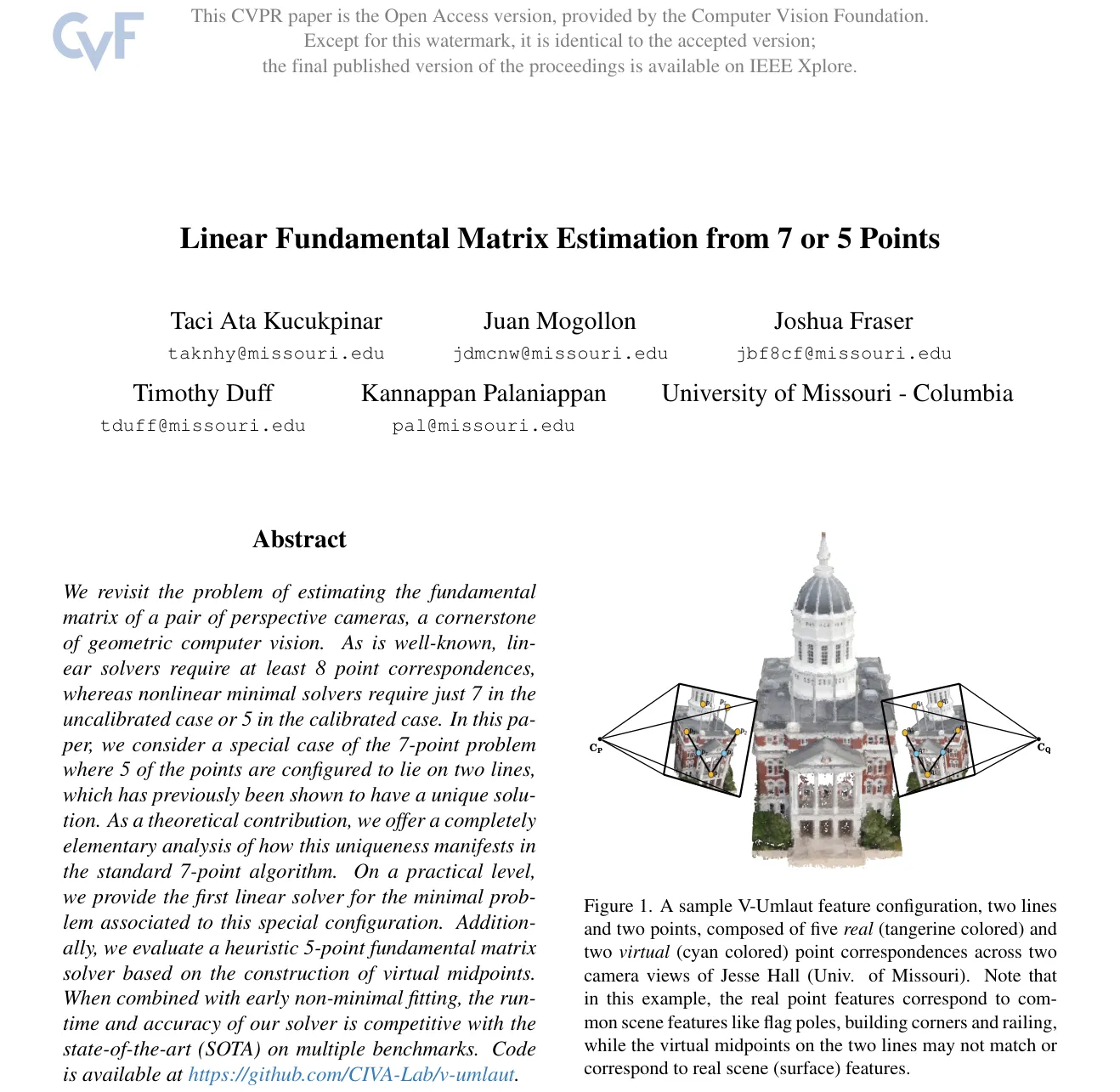
We revisit the problem of estimating the fundamental matrix of a pair of perspective cameras, a cornerstone of geometric computer vision.As is well-known, linear solvers require at least 8 point correspondences, whereas nonlinear minimal solvers require just 7 in the uncalibrated case or 5 in the calibrated case.In this paper, we consider a special case of the 7-point problem where 5 of the points are configured to lie on two lines, which has previously been shown to have a unique solution.As a theoretical contribution, we offer an analysis of how this uniqueness manifests in the standard 7-point algorithm. On a practical level, we provide the first practical linear solver for the minimal problem associated to this special configuration.Additionally, we evaluate a heuristic 5-point fundamental matrix solver based on the construction of virtual midpoints.When combined with early non-minimal fitting, the runtime and accuracy of our solver is competitive with the state-of-the-art (SoTA) on multiple benchmarks.
📝 精读笔记
灵魂一句
两视图几何的经典常识:算基础矩阵 F,线性解法要 ≥8 点,非线性最小解法要 7 点(uncalibrated)/5 点(calibrated)。本文盯住 7 点问题的一个特例——其中 5 个点落在两条线上(称 V-Umlaut 配置),已知它有唯一解。贡献:① 给出该配置第一个既线性又最小的实用 F 求解器(Solver 3.1,比 [29] 完全初等、快且稳、适配 RANSAC);② 彻底讲清标准 7 点算法在此配置下的两个伪解(spurious solution)从何而来,证明"唯一性"是真几何现象而非参数化假象;③ 把它当一个启发式 5 点解器(用 virtual midpoint 造出 2 个虚拟对应),配合 early non-minimal fitting(ENM),速度/精度在 PhotoTourism、Aachen 上追平 SOTA 5 点解器。代码开源 v-umlaut。
问题 & 动机
两视图几何是 3D 重建(incremental/global/learned SfM)的基石、研究了上百年。动机有二:① 理论——最近 [29] 在给 n-view 最小问题分类时发现,7 点 F 估计在某些特殊配置下居然只有唯一解(通常 7 点算法给 3 个解),本文取其中最一般的 V-Umlaut 配置深挖;② 实用——最小解器嵌在 RANSAC 里做 outlier-robust 估计,[47] 在三视图里用了 “virtual correspondence”(直接取两对应的 2D 中点当虚拟点,affine 近似下中点投影还是中点)。本文把 (p6,q6)、(p7,q7) 设成这种虚拟对应 → 得到一个线性 5 点 F 解器。
核心方法(关键公式)
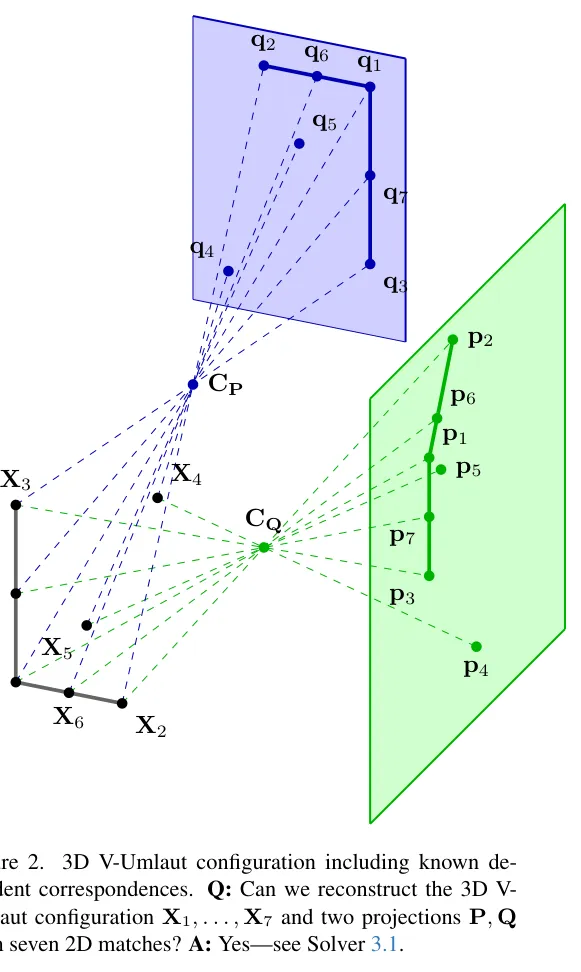
F 基础:3×3、rank(F)=2(式1)、对应点满足 qᵀFp=0(式2)、scale 意义下 F∈P⁸。V-Umlaut 约束(式3):p_(5+i)∈span(p1,p_(1+i))、q_(5+i)∈span(q1,q_(1+i)),i∈{1,2}——5 点在两条线上。① 投影归一化(§3.2):构造 per-view 单应 H1,H2 把每视图前 4 点映到标准帧(z1~e1,z2=e2,z3=e3,z4=e1+e2+e3),F=H2ᵀ·F_coords·H1(式6),其中 F_coords 对角为 0、规范 f32=1(式5)。② 伪解分析(§3.3):标准 7 点 det(F_coords)=0(式11)+w_iᵀF_coords z_i=0(i=4..7,式12)给 3 个解;其中两个退化(f12=f21=0 或 f13=f31=0)对应 affine F、反投影会逼出"CP,CQ,X1,X2 共面"——与非退化假设矛盾→真解须 f12·f13≠0。③ 非线性化线性(§3.4):用式13 把 f21 线性表为 f12、式16 把 f31 表为 f13,行列式约束化简成 f12·f13·(c1(s)f31+c2(s))=0(式18)→c1f31+c2=0(式19)。式12+式19=5 个线性方程解 5 个未知→唯一解;Cramer 法则得 F_coords=Φ(s,x,y)(式21,Φ:R¹⁰⇢R⁵ 有理映射)。
关键结果
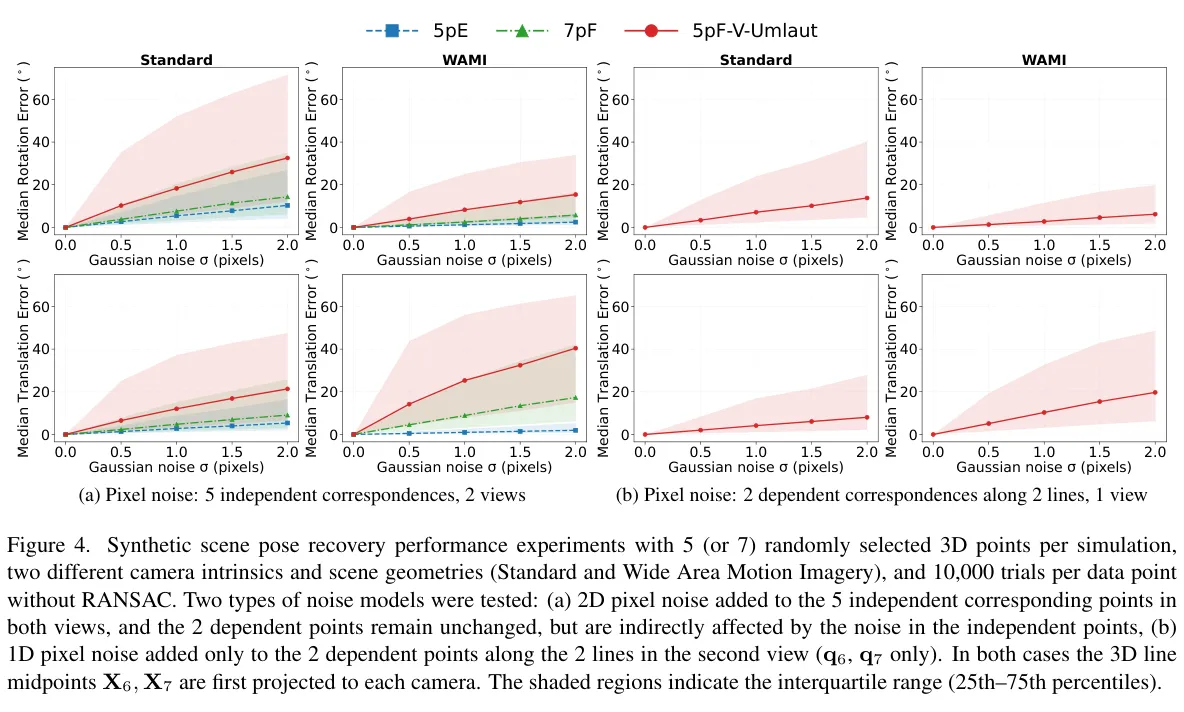
合成(10000 trials,§4):5pE 返回最多 10 解、7pF 最多 3 解、5pF-V-Umlaut 返回唯一解;本解器对噪声更敏感但 “degrades gracefully”,误差差异主要来自虚拟/dependent 点的噪声(暗示可用深度学习匹配 dependent 点改进)。真实(PhotoTourism 13 场景 + Aachen,LO-RANSAC,Table1 @1000 iters):5pF-V-Umlaut 裸跑最快(PhotoTourism 3.52ms vs 5pE 24.68ms)但精度低(mAA@10 49.79 vs 79.58);+ENM 后追平 SOTA(MED 1.25°/mAA 79.62,runtime 44.12ms,远低于 5pE+ENM 的 116.17ms)。结论:V-Umlaut+ENM 用更少运行时达到 top 精度。
亮点
① 在被研究上百年的两视图几何里挖出新结果——把 [29] 的"意外唯一性"从抽象分类落成可跑、初等、稳定的求解器;② “best of both worlds”:既线性(无需解三次方程)又最小;③ 显式刻画并主动绕开标准 7 点算法的两个伪解(对应两个 identical 的 ruled quadric),是漂亮的几何洞察;④ 5 点启发式 + virtual midpoint + ENM 让纯理论结果具备工程竞争力。
疑问 / 待深挖
① 误差主要来自 virtual/dependent 点匹配——原文建议"deep learning-based matching of dependent points",但本文未实现;② V-Umlaut 裸解精度明显逊于 5pE,强依赖 ENM 才追平,其独立价值更多在"快"而非"准";③ Φ 的显式有理公式与式18 推导都丢到 supplementary(SM Sec.9),正文未给完整公式;④ 论文受美陆军工程兵 ERDC 资助、强调 WAMI(航拍广域运动影像)场景,地面/驾驶等其他相机运动下表现原文未单独评测。
📖 逐段精读 · 笔记
批量精读初稿(基于本地 PDF 全文提取,43K 字符)。结构:Abstract 逐句 → 背景 → Intro 闭环 → Method 公式 → 实验数值表 + 全文总结。
① Abstract(摘要)— 逐句精讲
原文起手:“We revisit the problem of estimating the fundamental matrix of a pair of perspective cameras, a cornerstone of geometric computer vision.”——重访两视图几何里最经典的问题:估计一对透视相机的基础矩阵 \(F\)。
常识基线(逐句指路):“linear solvers require at least 8 point correspondences, whereas nonlinear minimal solvers require just 7 in the uncalibrated case or 5 in the calibrated case.”——线性解法要 \(\ge 8\) 对点;非线性最小解法在 uncalibrated(不知内参,解 \(F\))下要 7 点、在 calibrated(已知内参,解 \(E\))下要 5 点。
本文切口:“a special case of the 7-point problem where 5 of the points are configured to lie on two lines, which has previously been shown to have a unique solution.”——盯住 7 点问题的一个特例:其中 5 个点落在两条线上(作者命名 V-Umlaut 配置),此前 [29] 已证它有唯一解。
两层贡献:① 理论——“a completely elementary analysis of how this uniqueness manifests in the standard 7-point algorithm.”(用完全初等的方法讲清这个唯一性如何在标准 7 点算法里体现);② 实用——“the first linear solver for the minimal problem associated to this special configuration.”(该配置第一个既线性又最小的实用解器)。再加一个 “heuristic 5-point fundamental matrix solver based on the construction of virtual midpoints.”(基于虚拟中点的启发式 5 点解器)。
结论性卖点:“When combined with early non-minimal fitting, the runtime and accuracy of our solver is competitive with the state-of-the-art (SOTA) on multiple benchmarks.”——配合 early non-minimal fitting(ENM)后,速度/精度在多个 benchmark 上追平 SOTA。代码 “Code is available at https://github.com/CIVA-Lab/v-umlaut.”。一句话抓 Abstract:把"7 点中 5 点共两线 ⇒ 唯一解"这个特例做成线性最小 \(F\) 解器,再借虚拟中点变成 5 点解器,配 ENM 追平 SOTA。
📚 背景①(外部知识,非本文原创):基础矩阵 \(F\) / 本质矩阵 \(E\) / 对极几何
两台透视相机看同一 3D 点 \(X\),成像点 \(p,q\) 满足对极约束 \(q^\top F p = 0\);\(F\) 是 \(3\times3\)、\(\operatorname{rank}(F)=2\)、scale 自由度的矩阵(\(F\) 看作射影空间 \(\mathbb{P}^8\) 的一个元素),编码两视图相对几何(uncalibrated,不知内参 \(K\))。若已知 \(K\),把像点归一化后得本质矩阵 \(E\),约束更强、自由度更少 → 最小点数从 7 降到 5。给定 \(F/E\) 即可(按 Hartley-Zisserman 标准流程)恢复相机位姿 \((R,t)\) 与 3D 点。原文 “p ∼ λp for any nonzero real scalar λ, since both vectors represent the same point in the real projective plane \(\mathbb{P}^2\)”。
📚 背景②:8/7/5 点算法 & "linear vs minimal" 到底差在哪
对极约束 \(q^\top F p=0\) 对每对点给 1 个线性方程,\(F\) 有 8 个自由度 → 8 点算法纯线性(恰定/超定)。但 \(F\) 还有 \(\det(F)=0\)(即 \(\operatorname{rank}(F)=2\))这条非线性约束;只用 7 点时必须联立这个三次约束 → 7 点算法解三次方程、最多给 3 个解(非线性 minimal)。"minimal solver" = 用恰好最少点、被反复嵌进 RANSAC(所以越快越好、解越少越省心)。本文亮点正是:在 V-Umlaut 特例下做到既 minimal(5/7 点)又 linear(不解三次)且唯一解——原文称 “this solver exists in the best of both worlds, as it is both linear and minimal.”。
📚 背景③:RANSAC / LO-RANSAC / ENM / mAA / MED
真实匹配含大量错配(outlier),RANSAC = 反复随机取最小点集算模型、数 inlier、留最好者;LO-RANSAC 额外加局部优化(本文用 PoseLib 的 LO-RANSAC 实现)。ENM(Early Non-Minimal Refitting,来自 [47])= 每个 RANSAC 迭代里先跑最小解器,再 “(1) a set of n ≥ 5 inliers is determined, and then (2) a second-stage estimate is computed using an n-point essential matrix solver.”,inlier 阈值 1 像素。本文还提一个 Fast ENM:只保留与初始 V-Umlaut 估计最接近的二阶段位姿,省 scoring 开销。指标:mAA@10°(mean Average Accuracy,位姿误差在 10° 阈值内的平均准确度,越高越好)、MED(median pose error \(=\max(\theta_R,\theta_t)\),越低越好)。
📚 背景④:单应归一化 / 重心坐标 / virtual correspondence / ruled quadric
单应 \(H\)= 射影变换;本文用它把每视图前 4 点映到标准帧来化简 \(F\) 的形式。重心坐标= 用线段两端点的凸组合系数表示线上点(如 \(p_6=\tilde s_{11}p_1+(1-\tilde s_{11})p_2\))。virtual correspondence(来自 [47])= 没有第 6/7 个真匹配,就取两个真匹配的 2D 中点当虚拟点,原文给出理由 “midpoints project exactly to midpoints” under “affine approximations to the camera geometry”。ruled quadric(直纹二次曲面)= 射影重建临界配置理论里,7 点算法的 3 个解各对应 “{X1,…,X7, C_P, C_Q} lies on a unique ruled quadric”。
② §1 Introduction — problem → solution → why 闭环
problem:两视图几何虽被研究上百年,作者自嘲 “it is perhaps rather surprising that any new results in two-view geometry are left to be discovered at all!”。但 [29](PLMP,在给 n-view minimal problems 做分类时)意外发现 7 点 \(F\) 估计在特殊配置下唯一解;它在 [29, Table 1] 是倒数第三项,最后两项是 V-Umlaut 的退化、也满足该唯一性。本文取最一般的 V-Umlaut(两线两点、5 实点;见 Fig 1/2)深挖。
solution(Intro 已自包含):实用动机来自 [47] 的三视图工作——它解 calibrated three-view from four point-triplets 的流程是 “(1) estimating a fifth virtual point correspondence …, (2) estimating two-view geometry with the standard 5-point minimal solver, and then (3) registering the third view with a minimal P3P solver.”,且发现 “a naive strategy can be surprisingly effective: simply match the 2D midpoints of two given correspondences.”。本文就把 V-Umlaut 的 dependent 对应 \((p_6,q_6),(p_7,q_7)\) 设成这种虚拟中点 → 得到启发式 5 点线性 \(F\) 解器。
三条贡献(原文):1) “the first practical solver for the V-Umlaut fundamental matrix problem … both linear and minimal … completely elementary … fast, stable … suitable for RANSAC.”;2) “a detailed analysis of the spurious solutions … confirms that the unexpected uniqueness result of [29] is not merely an artifact of their chosen camera parametrization, but a meaningful geometric result.”;3) 经验证明 “the linear 5-point heuristic … outperforms the 7-point algorithm in RANSAC … combined with the early non-minimal fitting …, our V-Umlaut solver matches the performance of the standard, SOTA 5-point solver [32].”。
why 唯一性成立(关键假设):非退化假设第 4 条最关键——\(\{C_P,C_Q,X_1,X_2\}\) 与 \(\{C_P,C_Q,X_1,X_3\}\) 都不共面,原文 “the last of these assumptions certainly holds for general camera motions. This is the key assumption that we will use to establish the unexpected uniqueness”。正是它排除了两个伪解。
③ §2 Related Work — 与 [29]/[47]/[5] 的精确关系
① 历史:uncalibrated 三次 7 点算法 “originates in the 1800s [46]”,calibrated 5 点用 Nistér [32]/Stewénius [45] 的 Gröbner 方法。② 与 [29]:本文 §3.4 “derivation of the linear solver from nonlinear constraints … is naturally aligned with this theme”(把非线性约束化简成线性,呼应 [29] 减小求解难度的主旨)。③ 与 [47]:直接复用其虚拟点选择策略 + 公开代码/数据来评测。④ 与已有 5 点 uncalibrated 解器 [5] 的区别:“this work employs a planar approximation of the scene … the previous solver needs to solve a cubic equation, whereas our method is linear.”。⑤ §3.3 的伪解分析关联 critical configurations 文献 [7,8,21],但 “ours is an instance of unexpected uniqueness in the minimal case” 而非超定下的非唯一。
④ §3.1 问题形式化 + 4 条非退化假设
给定:7 对 \((p_i,q_i)\in\mathbb{P}^2\times\mathbb{P}^2\),其中第 6/7 对是 dependent,满足共线约束(式3):\(p_{5+i}\in\operatorname{span}(p_1,p_{1+i})\)、\(q_{5+i}\in\operatorname{span}(q_1,q_{1+i})\),\(i\in\{1,2\}\)。用重心坐标(式4):\(p_6=\tilde s_{11}p_1+(1-\tilde s_{11})p_2\)、\(p_7=\tilde s_{12}p_1+(1-\tilde s_{12})p_3\)(\(q\) 同理)。目标:求 \(F\in\mathbb{P}^8\),\(\operatorname{rank}F=2\),\(q_i^\top F p_i=0\ (i=1..7)\),并据此重建相机对 \((P,Q)\) 与 \(X_1..X_7\)(其中 \(X_6\in\operatorname{span}(X_1,X_2)\)、\(X_7\in\operatorname{span}(X_1,X_3)\))。4 条非退化假设:(1) \(X_1,X_2,X_3\) 不共线,任意 3 点(来自 \(\{p_1..p_4\}\) 或 \(\{q_1..q_4\}\))不共线;(2) \(\tilde s_{ij}\notin\{0,1\}\)(dependent 2D 点不与其它点重合);(3) 不落入 [20,§11.9] 的传统退化(无相对平移、点共面);(4) \(\{C_P,C_Q,X_1,X_2\}\) 与 \(\{C_P,C_Q,X_1,X_3\}\) 均不共面。
⑤ §3.2 Per-view 投影归一化(构造 \(H_1,H_2\))
目标坐标化形式 \(F_{\text{coords}}\)(式5)对角为 0、规范 \(f_{32}=1\):\[F_{\text{coords}}=\begin{pmatrix}0&f_{12}&f_{13}\\ f_{21}&0&f_{23}\\ f_{31}&1&0\end{pmatrix},\qquad F=H_2^\top F_{\text{coords}} H_1.\] 用前 4 点构造 \(A=[\,p_1\ p_2\ p_3\,]\)、\(D=\operatorname{diag}(\Delta_{423},\Delta_{143},\Delta_{124})\)(三个 \(3\times3\) 行列式),令 \(H_1=D^{-1}A^{-1}\)。归一化后 \(z_i:=H_1 p_i\) 满足 \(z_1\sim e_1,z_2=e_2,z_3=e_3,z_4=e_1+e_2+e_3\);同理 \(w_i:=H_2 q_i\)。原文关键:前 3 对 “zi ∼ wi ∼ ei, i = 1, 2, 3, automatically imply the form of \(F_{\text{coords}}\)”,而第 4 对 \(z_4\sim w_4\sim e_1+e_2+e_3\) “forces the entries of \(F_{\text{coords}}\) to sum to zero.”。新重心坐标由式10 从 \(z_6,z_7,w_6,w_7\) 算出,如 \(s_{11}=\tfrac{1}{1+z_{62}/z_{61}}\)。
⑥ §3.3 伪解分析(全文精髓,逐公式)
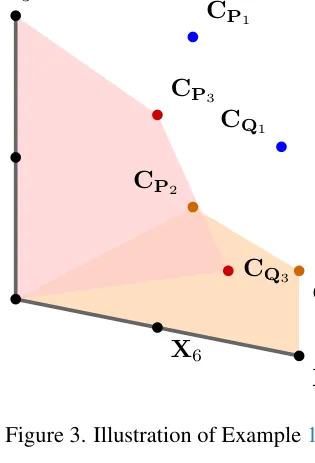
标准 7 点的方程组 \(\det(F_{\text{coords}})=0\)(式11)与 \(w_i^\top F_{\text{coords}} z_i=0,\ i=4,5,6,7\)(式12)有 3 个解,但对 V-Umlaut 其中 2 个退化。看 \(i=6\):\[w_6^\top F_{\text{coords}} z_6 = w_{62}z_{61}f_{21}+w_{61}z_{62}f_{12}=0.\] 若假设 \(f_{12}=0\),由 \(s_{ij}\notin\{0,1\}\) 推出 \(f_{21}=0\),于是 \(F_{\text{coords}}\) 退化成 affine \(F\)(式15,只剩 \(a,b,c\) 三项),其左右极点 \(e=(b,-a,0)^\top,\ e'=(1,-c,0)^\top\) 都落在 \(e_1e_2\) 上 → 反投影逼出 “the four points \(C_P,C_Q,X_1,X_2\) are coplanar”,与假设(4)矛盾。同理 \(i=7\) 下 \(f_{13}=0\Rightarrow f_{31}=0\) 逼出 \(C_P,C_Q,X_1,X_3\) 共面矛盾。故任何非退化解必满足 \(f_{12}f_{13}\neq0\),两个退化解被主动绕开(Fig 3 画了三对相机心,两对是伪解)。
⑦ §3.4 从非线性到线性(式18 → 式19 → \(\Phi\))
用式13 把 \(f_{21}\) 线性表为 \(f_{12}\)、式16 把 \(f_{31}\) 线性表为 \(f_{13}\),代入行列式约束(式11)化简得 \[f_{12}f_{13}\big(c_1(s)f_{31}+c_2(s)\big)=0,\] 其中 \(c_1,c_2\) 是输入参数 \(s\) 的 “simple rational functions”(完整推导在 SM Sec.9)。由 \(f_{12}f_{13}\neq0\) → \(c_1(s)f_{31}+c_2(s)=0\)(式19,线性!)。式12(\(i=4,5,6,7\))+ 式19 合计 5 个线性方程、5 个未知(\(F_{\text{coords}}\) 的 5 个非零项)→ generic 下唯一解。系数在 10 参数有理函数域 \(\mathbb{F}=\mathbb{Q}(s_{11},s_{12},s_{21},s_{22},x_1,x_2,x_3,y_1,y_2,y_3)\) 上,Cramer 法则给显式有理映射 \(F_{\text{coords}}=\Phi(s,x,y)\)(式21,\(\Phi:\mathbb{R}^{10}\dashrightarrow\mathbb{R}^5\))。其中 \(x,y\) 是第 5 对归一化点 \(z_5=(x_1,x_2,x_3)^\top,\ w_5=(y_1,y_2,y_3)^\top\)。
⑧ §3.5 Solver 3.1 四步 + Example 1 数值佐证
Solver 3.1(4 步):1) 用单应归一化对应使式7/8 成立;2) 由式9/20 提参 \((s,x,y)\);3) 求值 \(\Phi(s,x,y)=F_{\text{coords}}\);4) 反归一化 \(F=H_2^\top F_{\text{coords}} H_1\)。Example 1:给定一组 \(X_1..X_7\) 与相机 \((P,Q)\),Solver 3.1 恢复 GT 的 \(F^1_{\text{coords}}\approx\begin{psmall}0,-1.418,.236;\,2.291,0,-1.909;\,-.2,1,0\end{psmall}\);传统 7 点算法另返两伪解 \(F^2,F^3\),对应相机心 \(C_{Q2}\approx(.468,.884,0,0)^\top\in\operatorname{span}(X_1,X_2,C_P)\)、\(C_{Q3}\approx(.611,0,.792,0)^\top\in\operatorname{span}(X_1,X_3,C_P)\),恰好落进 §3.3 排除的两个共面退化。Remark 1:“the two ruled quadrics for the spurious cases i = 2, 3 are identical.”(两伪解的直纹二次曲面完全相同)。
⑨ §4 合成实验(两场景 / 两噪声模型 / 解的个数)
两场景:Standard(\(K_{\text{VGA}}\):\(f=800\),主点 \((320,240)\),FoV \(43.6°\times33.4°\);scene box \(x_B=y_B=2,z_B=4\),相机柱 \(r=8\))与 WAMI(航拍广域,\(K_{\text{WAMI}}\):\(f=17000\),主点 \((3300,2200)\),FoV \(22.0°\times14.7°\);box \(x_B=y_B=1000,z_B=100\),相机柱 \(z\in[1500,2000],r=1500\))。两噪声模型:(a) 高斯像素噪声加在 5 个独立对应(dependent 点不直接加噪但经 \(H_1,H_2\) 间接受影响);(b) 1D 噪声只沿两条线加在第二视图的 \(q_6,q_7\)。位姿误差用 \(\theta_R=\arccos\frac{\operatorname{tr}(R^\top R_{GT})-1}{2},\ \theta_t=\arccos(t^\top t_{GT})\)(式22),选最接近 GT 的解,10000 trials/点。解的个数(关键):“5pE returns up to 10 candidate essential matrix solutions, 7pF up to 3, whereas 5pF-V-Umlaut returns a unique solution.”。结论:本解器 “more sensitive, yet still degrades gracefully”,且 Fig4(b) 表明误差差异主要来自 dependent 点噪声 → “can be improved through more careful deep learning-based matching of dependent points [28]”。
⑩ §5 真实数据实验 — setup
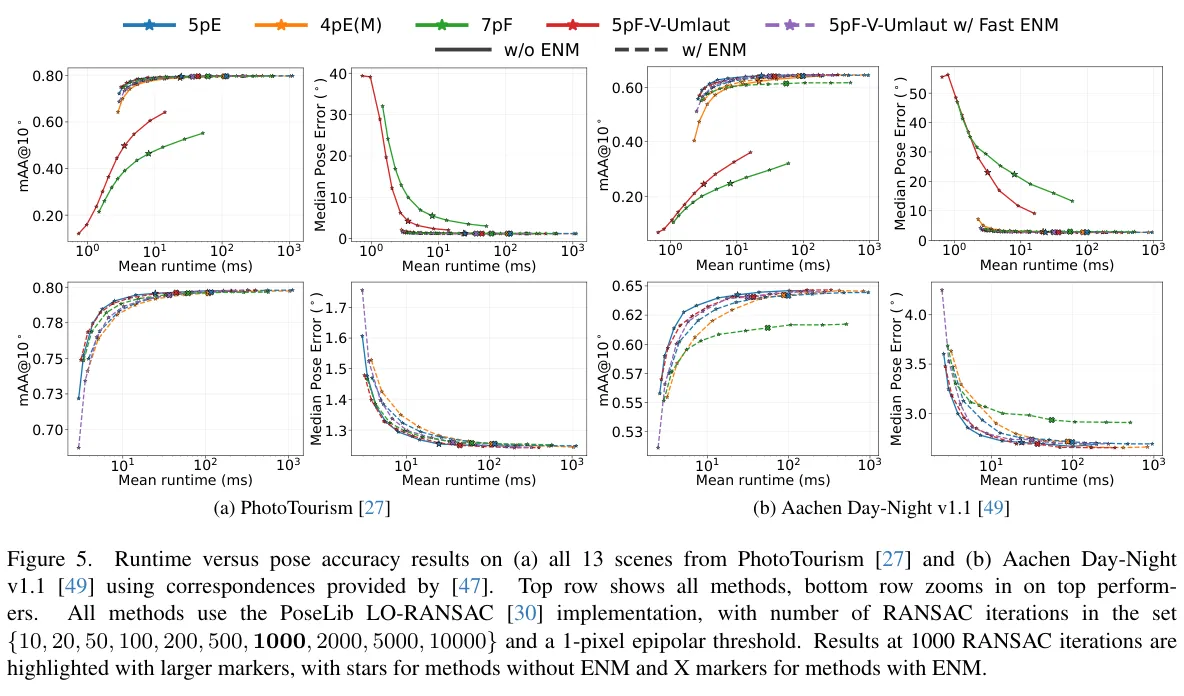
把 V-Umlaut 当通用 5 点解器:给 5 个独立对应,取线段 2D 中点造出虚拟 \((p_6,q_6),(p_7,q_7)\)。在 PoseLib LO-RANSAC 框架里对比 5pE、4pE(M)[47]、7pF,并各自加 ENM / Fast ENM 变体。数据:PhotoTourism(13 场景)+ Aachen Day-Night v1.1,每场景 5000 对(用 SuperPoint[12]/SuperGlue[42] 匹配、\(\ge10\) 匹配且 \(\ge10\%\) co-visibility),1 像素 epipolar 阈值,RANSAC 迭代取 \(\{10,20,50,100,200,500,1000,2000,5000,10000\}\)。
⑪ Table 1 完整数值(RANSAC 固定 1000 iters;MED°↓ / mAA@10°↑ / Runtime ms↓ / Med. Inliers)
[PhotoTourism 13 Scenes]
5pE | 1.26 | 79.58 | 24.68 | 0.70
4pE(M) | 1.31 | 78.95 | 23.66 | 0.70
7pF | 5.53 | 46.44 | 8.07 | 0.55
5pF-V-Umlaut | 4.26 | 49.79 | 3.52(最快裸解)| 0.49
5pE + ENM | 1.26 | 79.65 | 116.17 | 0.70
4pE(M) + ENM | 1.26 | 79.58 | 108.11 | 0.70
7pF + ENM | 1.26 | 79.58 | 61.44 | 0.70
5pF-V-Umlaut + ENM | 1.25 | 79.62 | 44.12 | 0.70
5pF-V-Umlaut + Fast ENM | 1.26 | 79.44 | 36.37 | 0.70
[Aachen Day-Night v1.1]
5pE | 2.71 | 64.24 | 23.47 | 0.58
4pE(M) | 2.93 | 62.20 | 21.66 | 0.57
7pF | 22.37 | 24.69 | 7.99 | 0.24
5pF-V-Umlaut | 23.05 | 24.43 | 3.16 | 0.22
5pE + ENM | 2.71 | 64.16 | 98.99 | 0.58
4pE(M) + ENM | 2.71 | 64.21 | 86.89 | 0.58
7pF + ENM | 2.93 | 61.41 | 55.21 | 0.56
5pF-V-Umlaut + ENM | 2.69 | 64.07 | 36.93 | 0.58
5pF-V-Umlaut + Fast ENM | 2.73 | 64.05 | 31.28 | 0.58
⑫ 读表 why + 结论
裸解:5pF-V-Umlaut 最快(PhotoTourism 3.52ms ≈ 5pE 24.68ms 的 1/7;Aachen 3.16ms vs 23.47ms)但精度差(mAA 仅 49.79 / 24.43)。+ENM:一举追平甚至略超 SOTA——PhotoTourism MED 1.25°(全表最低)/ mAA 79.62,Runtime 仅 44.12ms,远低于 5pE+ENM 的 116.17ms、4pE(M)+ENM 108.11ms;Aachen 同样 MED 2.69(最低)/ mAA 64.07 / 36.93ms。Fast ENM:更省时(36.37 / 31.28ms)但精度略降(mAA 79.44 / 64.05),“less consistent, but balances accuracy and runtime better.”。原文坦承的局限:“V-Umlaut + ENM does not offer any improvement in accuracy over the somewhat faster non-ENM methods with 1000 samples”——@1000 iters 时它相对非 ENM 的 5pE 精度只是持平,独立价值在运行时而非更准;并猜测把 ENM 里 Nistér 解器换成 V-Umlaut 初始化的迭代过程或可再提升。
⑬ §6 Conclusion + 适用边界 / 资助背景
结论原文:“our work provides a complete understanding of an unexpected solution uniqueness phenomenon in the seven-point F-matrix estimation problem … We describe and implement a very simple, stable, and very fast solution, which shows promise as a minimal solver and is competitive with the state-of-the-art on real data.”。适用边界 [推测/原文未单独评测]:论文受美陆军工程兵 ERDC-ITL 资助、合成实验专设 WAMI(航拍广域运动影像)场景,对地面/驾驶等相机运动下的表现未单列;裸解精度逊于 5pE,强依赖 ENM 补精度;\(\Phi\) 的显式有理公式与式18 完整推导丢在 SM Sec.9,正文未给。
📌 全文一页总结(≥3 takeaway)
problem:\(F\) 估计常识是线性 8 点 / 最小 7 点(\(F\))、5 点(\(E\));[29] 发现 7 点在"5 点共两线"(V-Umlaut) 时唯一解,但缺实用解器。method:① 投影归一化把 \(F\) 化成对角 0、\(f_{32}=1\) 的 \(F_{\text{coords}}\)(式5/6);② 证明标准 7 点的两个退化解会逼出相机心与点共面、与"general motion 不共面"假设矛盾 → 真解必 \(f_{12}f_{13}\neq0\)(§3.3);③ 把非线性行列式约束线性化为 \(c_1 f_{31}+c_2=0\)(式19),得 5 线性方程唯一解、Cramer 给有理映射 \(\Phi\)(式21);④ 用虚拟中点把它当 5 点解器,配 ENM。
experiment:合成上唯一解、优雅退化;真实 PhotoTourism/Aachen 上裸解最快(3.5/3.2ms),+ENM 追平 SOTA(MED 1.25°/2.69°、mAA 79.62/64.07)且运行时仅同类 ENM 方法的约 1/3。3 个 takeaway:(1) 在被研究上百年的两视图几何里仍能挖出"线性 ∧ 最小 ∧ 唯一"的新 \(F\) 解器,主卖点是极快 + RANSAC 友好;(2) 用初等几何(共面矛盾)显式刻画并主动绕开标准 7 点算法的两个伪解,把 [29] 的"意外唯一性"坐实为真几何结果而非参数化假象;(3) 工程上"靠 V-Umlaut 的快保运行时、靠 ENM 补精度"是该方案的正确用法,误差瓶颈在 dependent/虚拟点匹配,未来可用深度学习匹配改进。
🖼 论文原图(本地 PDF 截图,原文 caption 未改写)