CVPR 2026 Finalist
LDP-Slicing: Local Differential Privacy for Images via Randomized Bit-Plane Slicing
Yuanming Cao ⋅ Chengqi Li ⋅ Wenbo He
摘要 Abstract
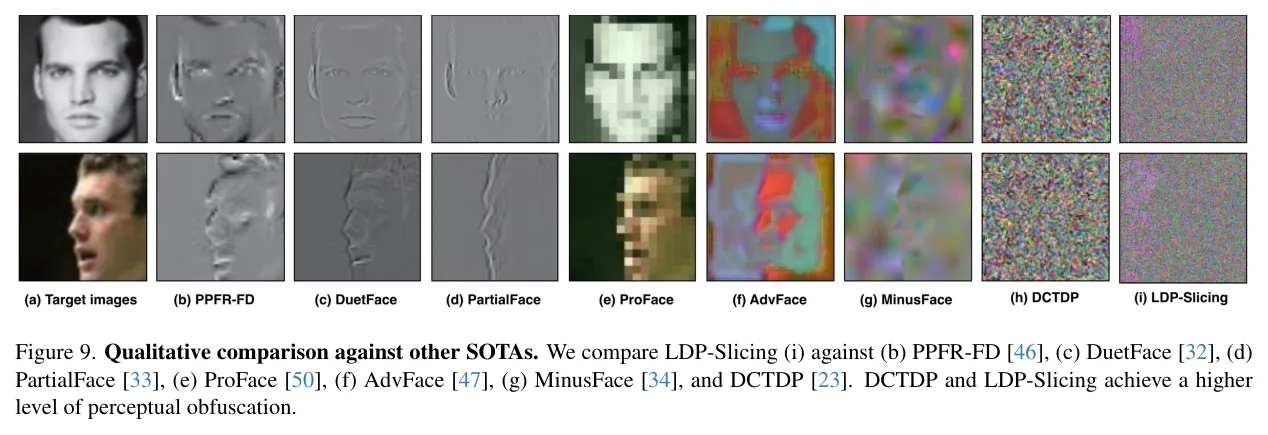
Local Differential Privacy (LDP) is the gold standard trust model for privacy-preserving machine learning by guaranteeing privacy at the data source. However, its application to image data has long been considered impractical due to the high dimensionality of pixel space. Canonical LDP mechanisms are designed for low-dimensional data, resulting in severe utility degradation when applied to high-dimensional pixel spaces. This paper demonstrates that this utility loss is not inherent to LDP, but from its application to an inappropriate data representation. We introduce LDP-Slicing, a lightweight, training-free framework that resolves this domain mismatch. Our key insight is to decompose pixel values into a sequence of binary bit-planes. This transformation allows us to apply the LDP mechanism directly to the bit-level representation. To further strengthen privacy and preserve utility, we integrate a perceptual obfuscation module that mitigates human-perceivable leakage and an optimization-based privacy budget allocation strategy. This pipeline satisfies rigorous pixel-level $\varepsilon$-LDP while producing images that retain high utility for downstream tasks. Extensive experiments on face recognition and image classification demonstrate that LDP-Slicing outperforms existing DP/LDP baselines under comparable privacy budgets, with negligible computational overhead.
📝 精读笔记
灵魂一句
让“本地差分隐私(LDP)直接保护整张图像”第一次变实用——核心洞见:LDP 在图像上“没用”不是 LDP 的锅,而是用错了表示;把每个 8-bit 像素拆成 8 个二值 bit-plane(YCbCr 共 24 个),在二值域(k=2)上做 randomized response(翻转每个 bit),配合“小波 LL 剪枝防人眼”+“按 bit/通道重要性最优分配隐私预算”,既满足严格的逐像素 ε-LDP,又让隐私化后的图能直接喂标准识别/分类模型,零额外存储/传输开销、5.5ms/张。
问题 & 动机
LDP 是隐私金标准(在数据源头加噪、不需可信 curator),但用于图像被认为不实用:8-bit 像素有 256 个值,k-ary randomized response 报真值概率 p=e^ε/(e^ε+k−1),k=256 时 p 极小→输出几乎纯噪、信息全毁(“curse of dimensionality”)。前作只好退而求其次:要么用中心化 DP(需可信 curator、被攻破则全泄),要么把 LDP 用在低维表示(latent/feature/eigenvector)而非原始像素。
核心方法(三模块 + 关键公式)
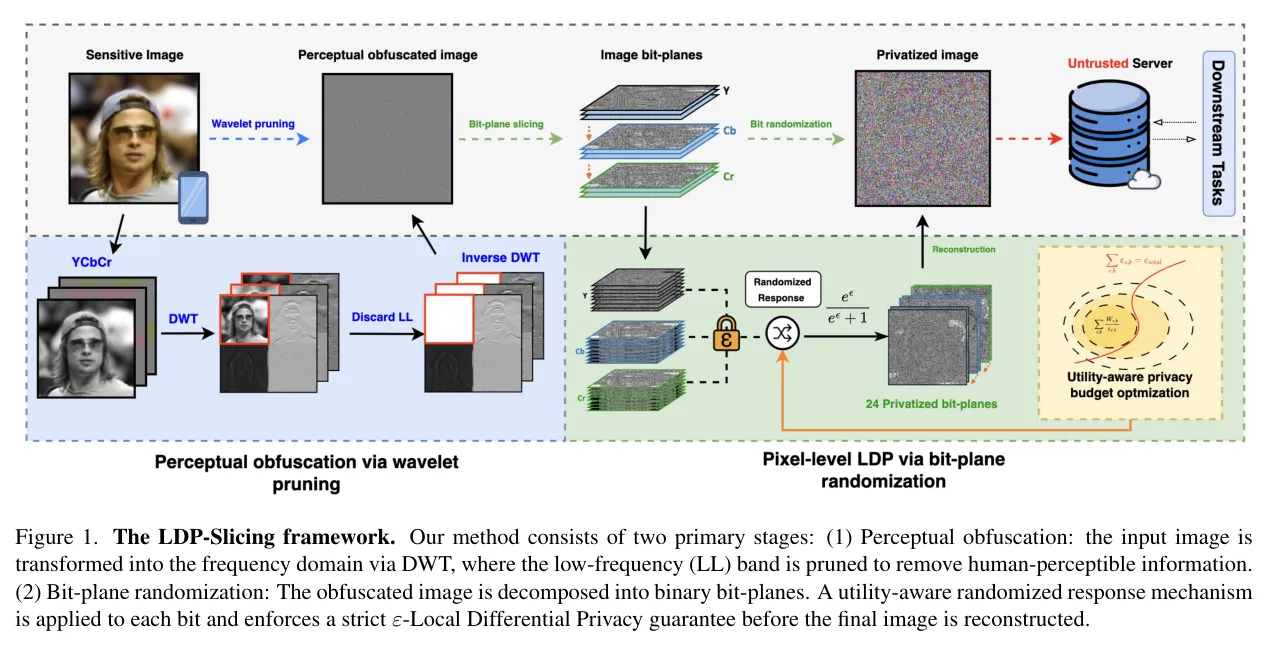
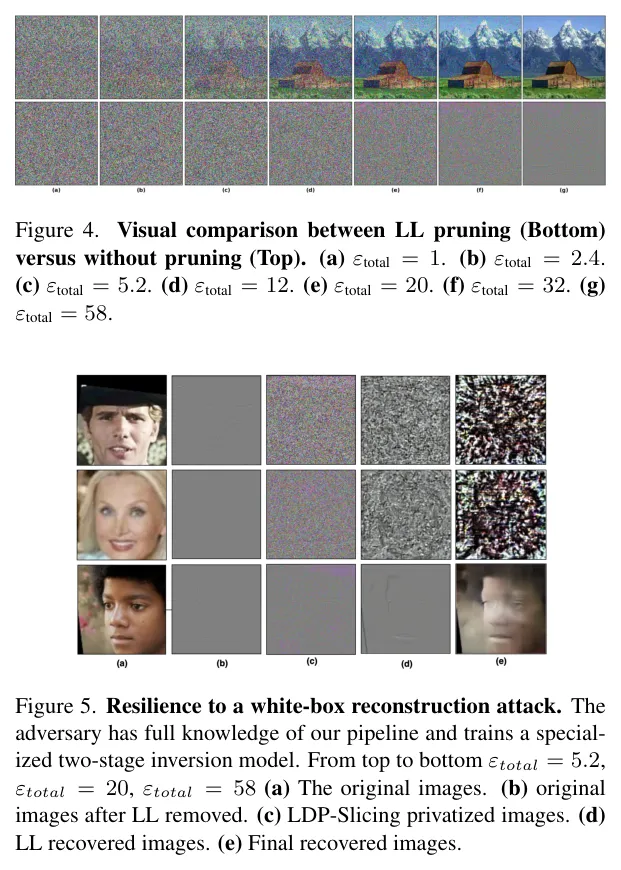
① 感知遮蔽(§4.1):1 级 Haar DWT 分 LL/LH/HL/HH,把低频 LL 置零再 IDWT 重建(LL-Pruning)。利用“人眼靠低频、CNN 靠高频”的不对称;DWT 多分辨率、避免 DCT 块伪影。是公开确定性预处理、不耗隐私预算。② bit-plane 随机化(§4.2):每像素拆 bit x_ℓ=⌊x/2^{d−ℓ}⌋ mod 2(式1,YCbCr 共 24 plane),二值域上独立做 randomized response,报真概率 e^{ε_ℓ}/(e^{ε_ℓ}+1)(式2)。③ 效用感知预算分配(§4.3):MSB/Y 通道含主结构、LSB/色度次要。约束优化 min Σ W_{c,b}/ε_{c,b} s.t. Σε_{c,b}=ε_total(式3);权重 W_{c,b}=w_c·w_b(w_Y=4, w_Cb=w_Cr=1;w_b=2^{b−1});Lagrange 闭式解 ε_{c,b}=ε_total·√W_{c,b}/Σ√W_{i,j}(式4),重建 x̃=Σ 2^{8−ℓ}·x̃_ℓ(式5)。隐私证明:逐像素 ε_total-LDP(定理3=24 bit 独立 RR 的 sequential composition + 重建属 post-processing 不削隐私);TV(P,Q)≤tanh(ε/2)(推论4),身份辨别 advantage≤½·tanh(ε/2)。
关键结果
人脸识别(Table 1):LDP-Slicing(pixel-level) AgeDB 96.68/LFW 99.75/CPLFW 91.08/CALFW 96.02,DP/LDP 类最佳、逼近非隐私 ArcFace(97.88/99.77/92.77/96.05),远超 PEEP(87.47)/DCTDP(94.37)。身份辨别攻击 advantage(Table 2,越低越好):CIFAR10 0.25/CIFAR100 0.1/LFW 4.5,远低于 DCTDP(4.97/5.98/12.58)。开销(Table 5):×1(零额外) vs DCTDP ×63、DuetFace ×54;速度 5.5ms/张(232 img/s) vs MinusFace 68ms;隐私严格度比 DCTDP 严 ~4.7×。
亮点
① 第一个在原始像素上做严格 pixel-level ε-LDP(不靠手工/学习特征);② 关键洞见“utility loss 是表示问题、非 LDP 固有”——bit-plane 把 k=256 降到 k=2;③ 按 bit/通道重要性最优分配预算(Lagrange 闭式解);④ 输出标准图、零存储/传输开销、即插即用、Θ(N) 线性、可端侧部署;⑤ 抗白盒/黑盒重建 + StyleGAN(Map2V) 攻击。
疑问 / 边界
① pixel-level ε-LDP 是逐像素保证,整图组合是 “loose worst-case”(作者承认),靠“独立扰动破坏空间相关性”间接实现 image-level 保护、非严格 image-level;② LL-Pruning 是启发式(无形式保证)、靠它防人眼;③ ε=20 这种“实用预算”偏大(强隐私 ε≤5.2 时 AgeDB 掉到 68.89);④ 与 DCTDP 的预算换算是“理论上界”假设、非严格等价对比;⑤ 双刃剑(可被滥用逃避合法系统,作者有伦理声明)。
📖 逐段精读 · 笔记
批量精读初稿(基于本地 PDF 全文,含 Supplementary):① Abstract 逐句 ② Intro 闭环 ③ Method 机制+公式 ④ 实验/消融数值表 + 全文一页总结。最后更新 2026-06-21。
① Abstract 逐句精讲(verbatim 引用 + 中文指路)
原文①:“Local Differential Privacy (LDP) is the gold standard trust model for privacy-preserving machine learning by guaranteeing privacy at the data source. However, its application to image data has long been considered impractical due to the high dimensionality of pixel space.”
在说什么:LDP=金标准(源头加噪、零信任);但用于图像因像素空间高维一直被认为不实用。
为什么:这句立"靶"——LDP 好但图像用不了,全文要翻这个案。
原文②:“This paper demonstrates that this utility loss is not inherent to LDP, but from its application to an inappropriate data representation … Our key insight is to decompose pixel values into a sequence of binary bit-planes. This transformation allows us to apply the LDP mechanism directly to the bit-level representation.”
在说什么:翻案——效用损失不是 LDP 固有缺陷、是表示用错了;核心 insight=把像素拆成二值 bit-plane(于是 LDP 在二值域 \(k=2\) 天然好用)。
原文③:“we integrate a perceptual obfuscation module that mitigates human-perceivable leakage and an optimization-based privacy budget allocation strategy. This pipeline satisfies rigorous pixel-level ε-LDP while producing images that retain high utility for downstream tasks.”
三件套:bit-plane 随机化(核心) + 感知遮蔽(防人眼) + 预算最优分配;产出满足严格 pixel-level ε-LDP 且高可用的图。
一句话抓 Abstract:bit-plane 把图变成 LDP-friendly 表示 + 小波防人眼 + 预算优化 = 实用的逐像素 ε-LDP。
📚 背景知识(外部,非本文原创,理解本文必备)
① 中心化 DP vs 本地 DP(LDP):中心化 DP 需可信 curator 先收集原始数据再加噪(如 DP-SGD),curator 被攻破则全泄;LDP 在用户端/源头就加噪,服务器永不见原始数据 → 零信任、更强,但加噪也更猛。
② ε-LDP 定义 + randomized response:机制 \(\mathcal{M}\) 是 ε-LDP 当对任意两输入 \(x,x'\)、任意输出集 \(S\):\[ \Pr[\mathcal{M}(x)\in S]\le e^{\varepsilon}\,\Pr[\mathcal{M}(x')\in S] \](输出分布近乎不可区分)。ε 越小越隐私。randomized response(Warner 1965)=二值数据经典 LDP 机制:以概率 \(p\) 报真、\(1-p\) 报假。
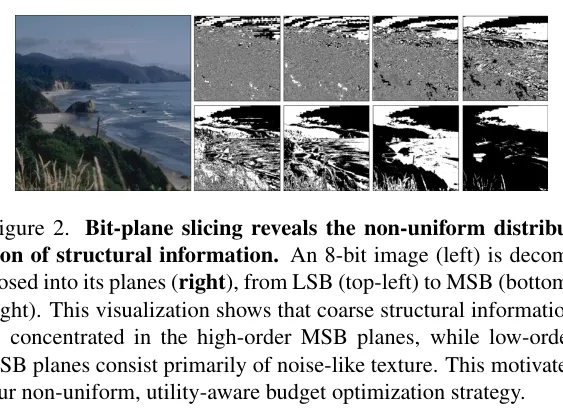
③ bit-plane slicing(MSB/LSB):把 8-bit 像素的 8 个二进制位各抽成一"层"。MSB(高位)=粗结构信息集中处;LSB(低位)=噪声状纹理。第 \(b\) 位对像素值贡献 \(2^{b-1}\)。这是本文"非均匀分配预算"的依据(Fig 2 “coarse structural information is concentrated in the high-order MSB planes, while low-order LSB planes consist primarily of noise-like texture”)。
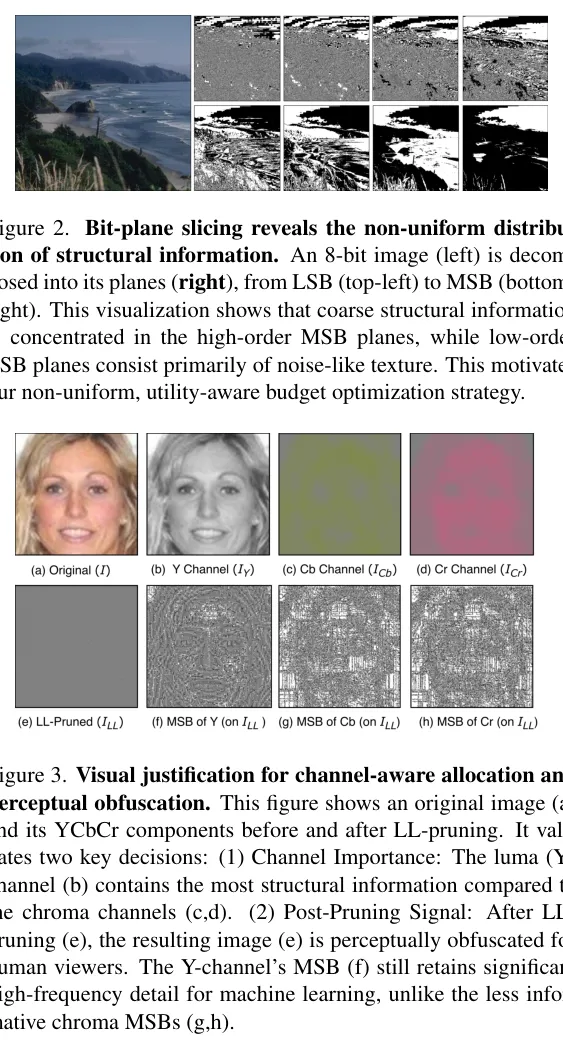
④ DWT vs DCT / YCbCr:DWT(小波,本文用 1 级 Haar) 把图分成多分辨率子带 LL/LH/HL/HH;DCT(余弦变换)是分块的。LL=低频近似(人眼看内容靠它)。YCbCr=亮度 Y + 两色度 Cb/Cr;CNN 对色度退化鲁棒(JPEG chroma subsampling 也降色度),故给 Y 更高权重。
⑤ 两条 LDP 性质(证明基石):sequential composition(\(\varepsilon_1\)-LDP + \(\varepsilon_2\)-LDP 串联 = \((\varepsilon_1+\varepsilon_2)\)-LDP)→ 24 bit 各自 \(\varepsilon_\ell\) 加起来=\(\varepsilon_{total}\);post-processing immunity(对 LDP 输出再做任意映射不削隐私)→ bit 重建回像素不泄露。TV 距离=两分布最大可区分度。
② Introduction · problem → 现有不足 → solution → why 闭环
problem:视觉系统要用云端服务就得上交可识别图像 → 中心化风险(原文举 Facebook 未经同意存人脸模板 [38])。早期模糊/像素化 “offer no formal privacy guarantees and have been shown to be reversible by modern deep learning attacks”;加密防访问但挡不住推理攻击、训练大模型不实用。
现有不足:中心化 DP 需可信 curator(“If the curator is breached, the privacy of all raw data is irreversibly lost”);LDP 无 curator 但 “confronts an insurmountable barrier with high-dimensional data”——单个 8-bit 像素 256 个取值,RR 注入 “overwhelming noise that destroys nearly all task-relevant information”(维度诅咒)。故前作只能退到中心化 DP 或对 latent/feature/eigenvector 等低维表示做 LDP。
solution + why:原文 “an image can be transformed into an LDP-friendly representation without collapsing its dimensionality.” → bit-plane 切分(\(k{=}256\to k{=}2\))+ 小波感知遮蔽 + 效用感知预算分配。why bit-plane 对:k-ary RR 噪声随 \(k\) 暴涨,而二进制是像素的"天然分解",每 bit 仅 \(\{0,1\}\) 二选一、报真概率合理;且 MSB≫LSB 的语义差异正好让"按重要性分配预算"有的放矢——把同样的 ε 花在刀刃(Y 通道 MSB)上。
③ §2 Related Work · 谱系(为何前作都不够)
纯遮蔽(脆):模糊/像素化/噪声 “no formal guarantees … repeatedly shown to be vulnerable to reconstruction”;InstaHide 这类 learnable instance encoding 也被 Carlini et al. [6] “decisively broken” + fusion-denoising 攻击。原文总结 “visual obscurity is a fragile defense against increasingly powerful learning-based attacks”。频域启发式:DCT 扰动/丢系数虽降视觉信息,但 “this frequency removal method is also reversible”。DP 类:中心化 DP(DP-SGD/DP-GAN/DP-Diffusion)需可信 curator;LDP 前作 “avoids applying LDP to raw pixels, instead applying LDP to lower dimensional intermediate representations”。本文 gap:“source-level privacy guarantees directly on high-dimensional pixel data without collapsing it”。
④ §3.1 Threat Model · 两类攻击(含 Def 1)
对手:控制服务器、完全知晓本文机制,但拿不到原始数据。两类攻击:① reconstruction attack(从隐私图 \(\tilde I\) 恢复感知相似的 \(I^*\),定义沿用 Carlini [6]);② identity distinguishing attack(Def 1)——给隐私图 \(\tilde x=\mathcal{M}(x)\) 与一张公开图 \(y\),判断是否同一人 \(b=\mathbb{1}[i=j]\),对手优势 \( \mathrm{Adv}^{link}_{\mathcal{M}}(\mathcal{A})=\big|\Pr[b'=b]-\tfrac12\big| \)。这模拟"跨匿名服务追踪用户"。
⑤ §3.2 LDP 定义 + Randomized Response + 两定理
ε-LDP(Def 2):见背景②的式子——不需定义"邻接数据集"(区别于中心化 DP),直接保证任意两本地输入的输出分布近乎一致,是更强的保证。RR(Def 3):二值 \(v\in\{0,1\}\),\( \Pr[\mathcal{M}_{RR}(v)=v']=p \)(\(v=v'\))否则 \(1-p\)。两性质:Thm 1 sequential composition(\(\varepsilon_1+\varepsilon_2\))、Thm 2 closedness to post-processing。这两条是后面"24 bit 求和 = \(\varepsilon_{total}\) + 重建不泄露"的证明地基。
⑥ §4 核心洞见 · 为何高基数 RR 崩、二值不崩
维度诅咒的数学根:k-ary RR 报真概率 \[ p=\frac{e^{\varepsilon}}{e^{\varepsilon}+k-1} \] 对 8-bit 像素 \(k=256\),即便中等 ε,\(p\) 也"vanishingly small"→ 输出几乎纯噪。洞见:“A pixel with 256 discrete states is a binary encoding of eight bits, and the significance of each bit corresponds to the semantic structure of the pixel.” 拆成二值后每 bit \(k=2\),\(p=\frac{e^{\varepsilon_\ell}}{e^{\varepsilon_\ell}+1}\) 合理,且可按 bit 重要性分预算。三模块=感知遮蔽 + bit-plane 随机化 + 效用感知优化。
⑦ §4.1 Method · 感知遮蔽(wavelet pruning)
动机(感知不对称):核心 LDP 防算法攻击,但大 ε 下残留结构仍可能被人眼看出。原文 “human vision primarily uses low-frequency image cues … whereas modern CNNs often exploit fine, high-frequency details”。做法:1 级 Haar DWT 分 LL + LH/HL/HH → LL-Pruning(把低频 LL 系数全置零)→ IDWT 重建。DWT 多分辨率、避免 DCT 激进剪频的块伪影,更保有用高频(消融 Table 3 证 DWT > DCT)。关键:这步是公开确定性预处理、不消耗 ε(证明里用到)。
⑧ §4.2 Method · bit-plane randomization(式1–2)
bit 分解(式1):\[ x_\ell=\Big\lfloor \frac{x}{2^{d-\ell}}\Big\rfloor \bmod 2,\quad \ell\in\{1,\dots,d\} \] \(d=8\),YCbCr 三通道共 24 个 bit-plane。逐 bit 二值 RR(式2):\[ \Pr[\mathcal{M}_{RR}(x_\ell)=\tilde x_\ell]=\begin{cases}\dfrac{e^{\varepsilon_\ell}}{e^{\varepsilon_\ell}+1} & \tilde x_\ell=x_\ell\\[4pt]\dfrac{1}{e^{\varepsilon_\ell}+1} & \text{otherwise}\end{cases} \] \(\varepsilon_\ell\)=该 plane 分到的预算。剩下的问题:\(\varepsilon_{total}\) 如何分到各 \(\varepsilon_\ell\)?
⑨ §4.3 Method · 效用感知预算优化(式3–5)
为何不均匀分:均匀 \(\varepsilon_\ell=\varepsilon_{total}/24\) 次优——MSB/Y 含主结构、LSB/色度次要,“Wasting privacy budget on noisy, low-impact LSBs … degrades utility for no meaningful privacy gain”。约束优化(式3):\[ \min_{\{\varepsilon_{c,b}\}}\sum_{c,b}\frac{W_{c,b}}{\varepsilon_{c,b}}\quad \text{s.t.}\ \sum_{c,b}\varepsilon_{c,b}=\varepsilon_{total},\ \varepsilon_{c,b}\ge0 \](失真 \(\propto 1/\varepsilon\))。权重 \(W_{c,b}=w_c\cdot w_b\):色度 \(w_Y=4,\ w_{Cb}=w_{Cr}=1\)(CNN 抗色度退化 + JPEG chroma subsampling 启发)、bit \(w_b=2^{b-1}\)(对像素值贡献)。Lagrange 闭式解(式4):\[ \varepsilon_{c,b}=\varepsilon_{total}\cdot\frac{\sqrt{W_{c,b}}}{\sum_{i\in\{Y,Cb,Cr\}}\sum_{j=1}^{8}\sqrt{W_{i,j}}} \] → 重要信息分到最多预算(最少噪)。重建(式5):\( \tilde x=\sum_{\ell=1}^{8}2^{8-\ell}\,\tilde x_\ell \)。
⑩ §4.4 Method · 隐私证明(Thm 3 + TV bound 式6–7)
定理3:LDP-Slicing 满足 pixel-level \(\varepsilon_{total}\)-LDP。证明=① per-pixel composition(24 bit 独立 RR,单 bit 似然比 \(\le e^{\varepsilon_\ell}\),连乘 \(\le e^{\sum\varepsilon_\ell}=e^{\varepsilon_{total}}\));② post-processing immunity(重建是数据无关函数,按 Thm 2 不削隐私);小波剪枝是公开确定性预处理、不耗 ε。推论4(TV bound,式6–7):\[ TV(P,Q)\le\frac{e^{\varepsilon}-1}{e^{\varepsilon}+1}=\tanh(\varepsilon/2),\qquad \mathrm{Adv}^{link}_{\mathcal{M}}\le\tfrac12\tanh(\varepsilon/2) \] 给对手区分能力一个硬上界。
Q&A · 为什么 bit-plane 能解决"维度诅咒"?
维度诅咒来自 k-ary RR 的报真概率 \(p=\frac{e^\varepsilon}{e^\varepsilon+k-1}\) 随 \(k\) 增大而趋 0:\(k=256\) 时几乎全噪。bit-plane 把"在 256 个值里选真值"换成"8 个独立的二选一",每个子问题 \(k=2\)、\(p=\frac{e^{\varepsilon_\ell}}{e^{\varepsilon_\ell}+1}\),加噪可控;总预算靠 composition 守恒(\(\sum\varepsilon_\ell=\varepsilon_{total}\))。本质:没改变 LDP 也没降维(仍是逐像素保证),只是换了一个让 RR"吃得下"的等价表示——这正是 Abstract 说的 “not inherent to LDP, but … an inappropriate data representation”。
Q&A · 逐像素 ε-LDP 真能保护整张脸吗?(诚实)
作者自己点破局限:“composing the privacy bounds across all pixels implies a loose worst-case theoretical guarantee for the full image”——把每像素 ε 组合到整图是很松的 worst-case。但实际有效,原因是 “semantic identity inherently relies on spatial correlation (e.g., contours and textures)”:对每像素 bit 独立扰动会 “severely disrupts structural dependencies and erodes global semantic information”。即理论整图界松,但独立扰动破坏了身份所依赖的空间相关性 → 实测攻击 advantage 很低(Table 2)。这是诚实的"理论-实证 gap"标注。
⑪ §5.1 主结果 · 人脸识别精度(Table 1,%,默认 \(\varepsilon_{total}=20\))
MS1MV2 训 ResNet-50+ArcFace;Bold 为 DP/LDP 类最佳。
验证了什么:在 DP/LDP 类里全面最佳,LFW/CALFW 几乎追平非隐私 ArcFace。原文还指出 DCTDP 是 block-level,换算到 per-pixel 后本文隐私 “5 times stricter”(附录给 \(\varepsilon_{pixel}\le(64-1)\times3\times0.5=94.5\) vs 本文 20,约 4.7×)。分类上 LDP-Slicing 在 CIFAR-10 \(\varepsilon\le12\)、CIFAR-100 全预算下击败中心化 DP-SGD。
| 方法 (保证) | AgeDB-30 | LFW | CPLFW | CALFW |
| ArcFace (无隐私上界) | 97.88 | 99.77 | 92.77 | 96.05 |
| PEEP (feature-level) | 87.47 | 98.41 | 79.58 | 90.06 |
| DCTDP (block-level) | 94.37 | 99.48 | 90.60 | 93.47 |
| LDP-Slicing (pixel) | 96.68 | 99.75 | 91.08 | 96.02 |
⑫ §5.2 攻击防御(Table 2 identity dist. + 重建攻击)
身份辨别 advantage(%,越低越好):
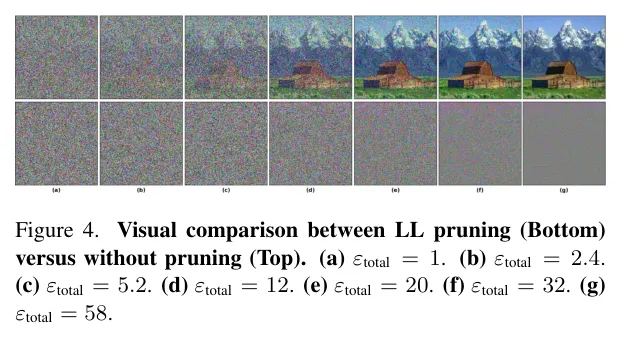
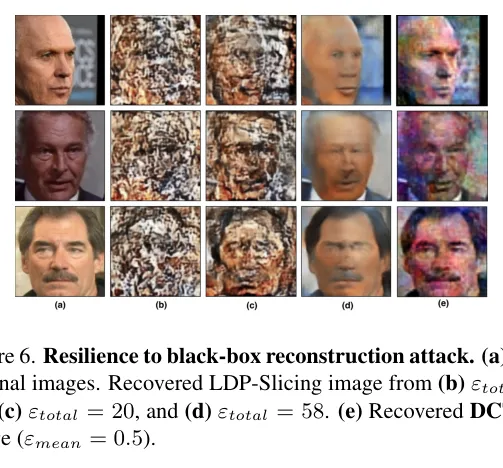
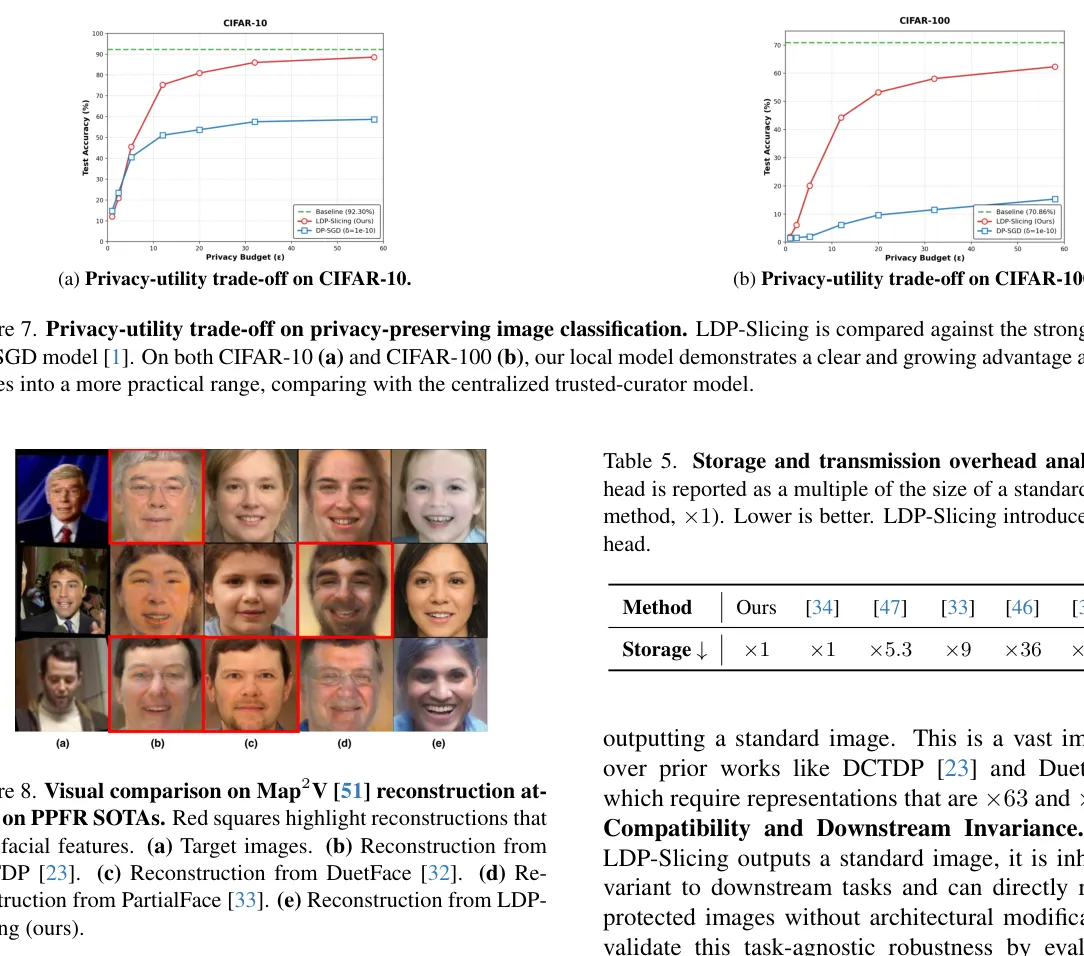
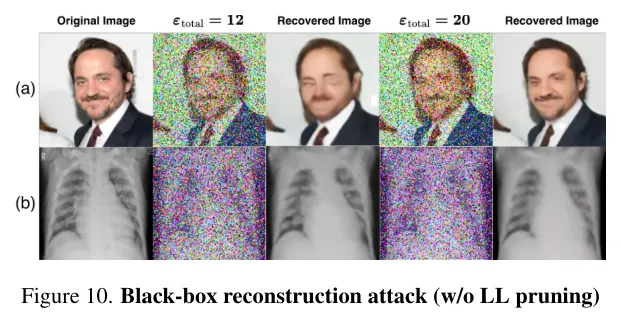
重建攻击:白盒(对手知全流程、训 denoiser + LL recovery 两阶段逆模型)下 “under medium to low privacy budget, the adversary fails to reconstruct a recognizable face”;黑盒(U-Net)下 DCTDP 被重建出近可辨人脸,而本文即便松到 \(\varepsilon_{total}=58\) 仍 “highly distorted”;连 StyleGAN 先验的 Map2V SOTA 攻击也 “fails to break LDP-Slicing”。
| 方法 | CIFAR10 | CIFAR100 | AgeDB | LFW | CALFW | CPLFW |
| DuetFace | 5.07 | 7.14 | 6.97 | 19.75 | 12.98 | 8.89 |
| DCTDP | 4.97 | 5.98 | 5.65 | 12.58 | 10.92 | 10.36 |
| LDP-Slicing | 0.25 | 0.1 | 0.42 | 4.5 | 3.87 | 1.62 |
⑬ §5.3 消融(Table 3,acc %,\(\varepsilon_{total}=20\))
| 配置 | AgeDB-30 | LFW | CPLFW | CALFW |
| (A) w/o LL Pruning | 96.90 | 99.77 | 91.67 | 96.05 |
| (B) LL + Uniform Budget | 89.82 | 99.35 | 86.73 | 94.13 |
| (C) DC Pruning + Util-aware | 95.58 | 99.53 | 89.53 | 95.77 |
| (D) LL + Util-aware (Ours) | 96.68 | 99.75 | 91.08 | 96.02 |
⑭ §5.x 隐私-效用权衡 + 复杂度/开销(Table 4–5)
权衡(Table 4,AgeDB-30 acc / PSNR):\(\varepsilon=1\) 50.95/6.90dB → \(\varepsilon=5.2\) 68.89/6.94 → \(\varepsilon=12\) 93.70/7.30 → \(\varepsilon=20\) 96.68/7.62 → \(\varepsilon=58\) 97.45/9.94——“as the privacy guarantee becomes stronger (lower ε), utility declines”,平滑可预测、PSNR 同步。开销(Table 5,×标准图,越低越好):Ours ×1(零开销)、MinusFace ×1、PartialFace ×9、DuetFace ×54、DCTDP ×63。速度:Apple M4 上 112×112 图 5.5 ms/张(232 img/s) vs MinusFace 68 ms,复杂度 \(\Theta(N)\) 线性于像素数。兼容性:输出标准图、对下游任务不变,可零样本跨域(VGGFace2/CelebA/Chest X-Ray),且由 post-processing 性质,任何在隐私图上训练的模型自动继承隐私保证。
⑮ §5 图像分类 vs 中心化 DP-SGD + 跨域泛化(含 Table 6/7)
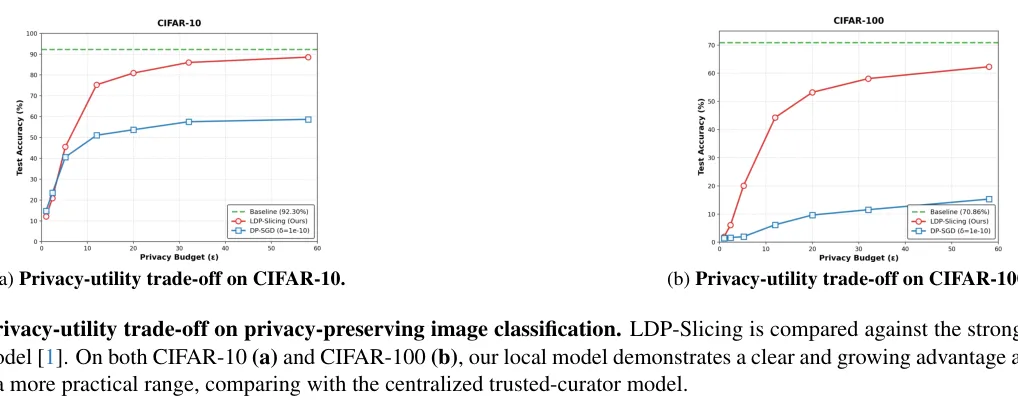
分类(CIFAR-10/100,ResNet-56 from scratch):原文 “LDP-Slicing decisively outperforms DP-SGD at all privacy budgets ε ≤ 12 on CIFAR-10 and all budgets on CIFAR-100”——一个本地(零信任)模型在实用预算区间击败中心化(需可信 curator、δ 设 1e-10 逼近 pure-DP)的 DP-SGD,是很强的结果(Fig 7:优势随 ε 进入实用区间而扩大)。跨域零样本(Table 6):MS1MV2 训练的模型直接测——Chest X-Ray \(\varepsilon=5.2\) 已 90.54%、\(\varepsilon=20\) 92.15%;VGGFace2 \(\varepsilon=20\) 67.15%、CelebA \(\varepsilon=20\) 80.44%,证 “task-agnostic robustness”。色度权重消融(Table 7):\(4{:}1{:}1\)(本文) 全面最佳(CIFAR10 80.36 / AgeDB 96.68),\(2{:}1{:}1\)、\(1{:}1{:}1\) 依次下降 → 印证"给 Y 通道更多预算"的设计。
实现细节(附录 D):PPFR 用 ResNet-50(IR)+ArcFace(\(s=64,\ m=0.4\)),SGD(mom 0.9, wd 5e-4),24 epochs,lr 0.1 在 10/18/22 epoch 降 10×,从 IR-50 预训练初始化 + 5-epoch warmup;小 ε(如 2.4) 用 gradient clipping(max norm 1) 防梯度消失。分类 ResNet-56、250 epochs、batch 128。全部实验在 NVIDIA H100 + PyTorch。
📌 全文一页总结(problem → method → experiment → takeaway)
problem:LDP 是零信任金标准但用于图像因 \(k=256\) 像素空间噪声爆炸而"不实用",前作只能退到中心化 DP 或低维表示。
method:① 洞见"是表示问题非 LDP 固有"→ bit-plane 把像素拆成 24 个二值平面(\(k=2\)) 做 randomized response(式1–2);② 小波 LL-Pruning 防人眼(不耗预算);③ 按 \(W_{c,b}=w_c\cdot w_b\) 的 Lagrange 闭式解最优分配预算(式4);④ 证明逐像素 \(\varepsilon_{total}\)-LDP(composition + post-processing)+ TV/advantage 上界。
experiment:人脸识别 DP/LDP 类最佳、逼近非隐私(LFW 99.75/CALFW 96.02);身份辨别 advantage 最低(CIFAR10 0.25 vs DCTDP 4.97);抗白/黑盒 + StyleGAN 重建(\(\varepsilon=58\) 仍失真);零存储开销、5.5 ms/张、比 DCTDP 严 ~4.7×;分类击败中心化 DP-SGD。
Takeaway:① 把"换对表示"作为让 LDP 在像素上实用的钥匙(不改 LDP、不降维);② 输出标准图即插即用、可端侧零信任部署;③ 按 bit/channel 重要性分预算是效用关键(均匀分会崩)。诚实边界:逐像素保证整图是 loose worst-case(靠破坏空间相关性间接保护语义);LL 剪枝是启发式(且去掉精度几乎不降,主要换感知隐私);实用 \(\varepsilon\) 偏大(默认 20);作者承认可被滥用规避合法系统(双刃剑,伦理章节自述)。
🖼 论文原图(本地 PDF 截图,原文 caption 未改写)