CVPR 2026 Finalist
ImmerIris: A Large-Scale Dataset and Benchmark for Off-Axis and Unconstrained Iris Recognition in Immersive Applications
Yuxi Mi ⋅ Qiuyang Yuan ⋅ Zhizhou Zhong ⋅ Xuan Zhao ⋅ Jiaogen Zhou ⋅ Fubao Zhu ⋅ Jihong Guan ⋅ Shuigeng Zhou
摘要 Abstract
Recently, iris recognition is regaining prominence in immersive applications such as extended reality as a means of seamless user identification. This application scenario introduces unique challenges compared to traditional iris recognition under controlled setups, as the ocular images are primarily captured off-axis and less constrained, causing perspective distortion, intra-subject variation, and quality degradation in iris textures. Datasets capturing these challenges remain limited. This paper fills this gap by presenting a large-scale iris dataset collected via head-mounted displays, termed ImmerIris. It contains 499,791 ocular images from 564 subjects, and is, to our knowledge, the largest public iris dataset to date and among the first dedicated to immersive applications. It is accompanied by a comprehensive set of evaluation protocols that benchmark recognition systems under various challenging conditions. This paper also draws attention to a shared obstacle of current recognition methods, the reliance on a pre-processing, normalization stage, which is fallible in off-axis and unconstrained setups. To this end, this paper further proposes a normalization-free paradigm that directly learns from minimally adjusted ocular images. Despite its simplicity, it outperforms normalization-based prior arts, indicating a promising direction for robust iris recognition.
📝 精读笔记
灵魂一句
为“VR/XR 头显里用虹膜识别登录”这一新场景,做了第一个大规模专门数据集 ImmerIris(VR 头显侧置相机拍的 off-axis、无约束眼图,499,791 张 / 546 人,目前最大公开虹膜库)+ 8 个难度递增评测协议;并发现现有 SOTA 普遍卡在“归一化(normalization)”这步在斜视+退化下不可靠,于是提出极简的“去归一化(NormFree)”范式——直接裁剪虹膜区域、套人脸识别那套(ResNet+ArcFace),反而比依赖归一化的 SOTA 更稳。
问题 & 动机
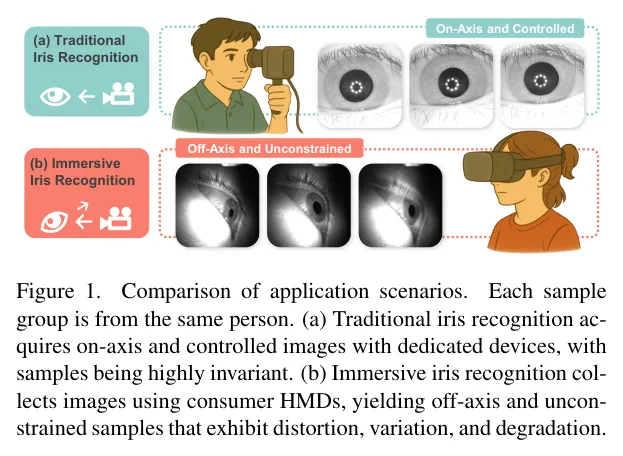
传统虹膜识别在受控(on-axis、正视专用相机)下很成熟;但 XR/VR 头显里相机侧置、用户不正视、环境不约束 → 三大新挑战:① perspective distortion(斜视几何→虹膜变椭圆、纹理不均匀拉伸);② intra-subject variation(同一只眼因光照/注视方向变化而变);③ quality degradation(不配合→闭眼遮挡等低质)。这类数据集稀缺,挡住该方向研究。
核心方法(数据集 + NormFree)
数据集:Skyworth Pancake XR 头显侧置相机拍 NIR 眼图;3×3 注视点(1-9) × 11 级亮度(暗→亮) × 每眼每级 5 张 = 每人 990 张;546 人初采 540,540 张,剔检测失败 36,697 + 缺陷 4,052 → 499,791 张;标 6 类退化(眼睑/睫毛遮挡、瞳孔扩张、极端斜视、镜面反射、运动模糊),~42% 至少一项退化;7:3 划分(训练 347,927/380 人、测试 151,864/166 人、主体不重叠=开集,两眼算两类)。协议:4 isolated(Occlusion/Dilation/Light/Gaze)+ 4 combined 难度递增(Control→Fix→Select→Any);verification(1:1) + identification(1:N)、单眼/双眼。NormFree:抛弃归一化,预训练检测器裁虹膜方框(×1.2 含上下文)→直接喂人脸识别架构 ResNet(IR-50)+ArcFace 角度间隔损失。消融对照 NormKeep(同模型但保留归一化)。
关键结果
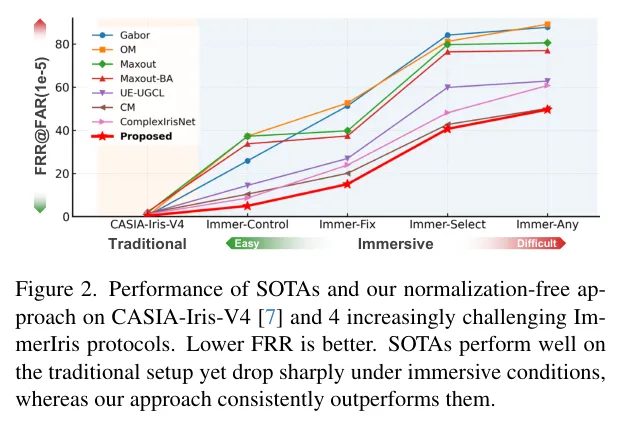
跨域(Table 3):CASIA-T 训的 SOTA 在 CASIA-T 上 FRR@FAR(1e-5)~5%,搬到 Immer-Any 暴涨到 85-94%(几乎不可用)→证明 immersive 是独特域。ImmerIris 训(Table 4-6):NormFree 几乎都排第一/第二;isolated 退化上对 NormKeep 优势更大(4.12-16.82%);gaze variation 最难(平均退化 36.99%),dilation 反而影响小。消融(Table 7):换 normalization 实现只让 NormKeep 微涨→归一化缺陷是普遍性的、非实现特定。
亮点
① 目前最大公开虹膜数据集(499,791/546)、首批专为 immersive;② 系统化 8 协议(隔离+组合、单/双眼、verify+identify);③ 点破“normalization 是技术债”并给出极简反例 NormFree(借 FR 经验:成功靠强特征器+判别目标而非精细预处理);④ NormFree 简单却普遍超 SOTA,尤其抗退化。
疑问 / 边界
① 摘要笔误:abstract 写 “564 subjects”,但正文/Table 1 都是 546;② NormFree 在最难的 gaze/Select/Any 上并非总第一(如 Left Immer-Any 1e-5 CM 49.93 略优于 NormFree 52.04、gaze 上 CM 38.92<NormFree 45.04),gaze 仍是开放难题(作者列为 future work);③ 人群仅亚洲成人 20-40、单一头显、仅 NIR,泛化未验证;④ 虹膜=敏感生物特征,隐私风险(论文称 IRB 批准、无个人信息记录)。
📖 逐段精读 · 笔记
批量精读初稿(基于本地 PDF 全文):① Abstract 逐句 ② Intro 闭环 ③ 数据集+方法机制 ④ 实验/消融数值表 + 全文一页总结。最后更新 2026-06-21。
① Abstract 逐句精讲(verbatim 引用 + 中文指路)
原文①:“Recently, iris recognition is regaining prominence in immersive applications such as extended reality … the ocular images are primarily captured off-axis and less constrained, causing perspective distortion, intra-subject variation, and quality degradation in iris textures.”
在说什么:XR 让虹膜识别重新热门,但 immersive 采集=off-axis + 少约束 → 三类问题(透视畸变 / 类内变化 / 质量退化)。这三点是全文主轴。
原文②(PDF 原句,verbatim):“This paper fills this gap by presenting a large-scale iris dataset collected via head-mounted displays, termed ImmerIris. It contains 499,791 ocular images from 546 subjects, and is, to our knowledge, the largest public iris dataset to date and among the first dedicated to immersive applications.”
在说什么:贡献一=ImmerIris 数据集(HMD 采集、最大公开虹膜库)。诚实标注:本页摘要框 / arXiv 显示 “564 subjects”,但本地 PDF 的摘要、§1、Table 1 三处一致写 546——以 PDF 的 546 为准(这是 arXiv 元数据与 PDF 的不一致,非笔误三处)。
原文③:“This paper also draws attention to a shared obstacle of current recognition methods, the reliance on a pre-processing, normalization stage, which is fallible in off-axis and unconstrained setups. To this end, this paper further proposes a normalization-free paradigm that directly learns from minimally adjusted ocular images.”
在说什么:关键诊断=归一化(normalization)是共同短板;解法=去归一化范式直接学最小调整的眼图。
一句话抓 Abstract:建大数据集 + 揭归一化短板 + 提 NormFree 反例,三连推动 immersive 虹膜识别。
📚 背景知识(外部,非本文原创,理解本文必备)
① 虹膜识别 / Daugman 两阶段范式:虹膜=眼睛里调光的环状结构、纹理因人而异。经典流程(Daugman [9]):① normalization(分割虹膜环、参数化内外边界、用极坐标"橡皮膜"变换把环状虹膜展开成矩形条纹理)→ ② feature extraction(纹理映射成身份模板)。本文炮轰的就是第①步。
② iriscode / Hamming 距离:经典法用 Gabor / log-Gabor / ordinal measure 等滤波器把归一化纹理编成二值 iriscode,两条用 Hamming 距离比对。本文 baseline 里 Gabor[9] / OM[38] 即此类(training-free)。
③ on-axis vs off-axis / NIR:on-axis=相机正对注视轴(传统专用设备);off-axis=相机与眼成角(HMD 侧置,本文场景)→ 虹膜成椭圆。NIR=近红外(虹膜成像常用波段,不受可见光色彩干扰)。
④ 借自人脸识别(FR)的经验 + ArcFace:原文 FR 多年成功 “not in elaborate pre-processing but rather in robust feature extractors and discriminative objectives”。ArcFace [11]=加性角度间隔损失(外部知识):\[ \mathcal{L}=-\frac{1}{N}\sum_{i=1}^{N}\log\frac{e^{s\cos(\theta_{y_i}+m)}}{e^{s\cos(\theta_{y_i}+m)}+\sum_{j\neq y_i}e^{s\cos\theta_j}} \] 在特征角度空间加间隔 \(m\) 拉大类间。NormFree 直接搬 FR 的 ResNet + ArcFace。
⑤ 评测指标:verification(1:1,判断 probe 与某存档是否同人)、identification(1:N,在 gallery 找身份)。FRR@FAR=给定误受率(FAR,如 1e-5)下的误拒率(FRR),越低越好;rank-1 accuracy=识别 top-1 命中率;open-set=测试主体训练时没见过。
② Introduction · problem → 现有不足 → solution → why 闭环
problem:原文 “HMD cameras are usually placed at an angle to eyes … producing off-axis images. The images are also captured in unconstrained environments.” 三挑战逐条:perspective distortion(椭圆 + 局部不均拉伸)、intra-subject variation(光照 / 注视变)、quality degradation(闭眼遮挡等)。
现有不足:数据稀缺(“most existing datasets are either proprietary or small in scale”),且 SOTA 泛化差——Fig 2:在受控 CASIA 上 FRR 极低,搬到 ImmerIris 协议 FRR 陡升。架构上 SOTA 共享两阶段范式,而 “the normalization stage imposes a major bottleneck, as current techniques often yield ill-unwrapped textures under immersive distortion and degradation, and fail to handle intra-subject variations”。
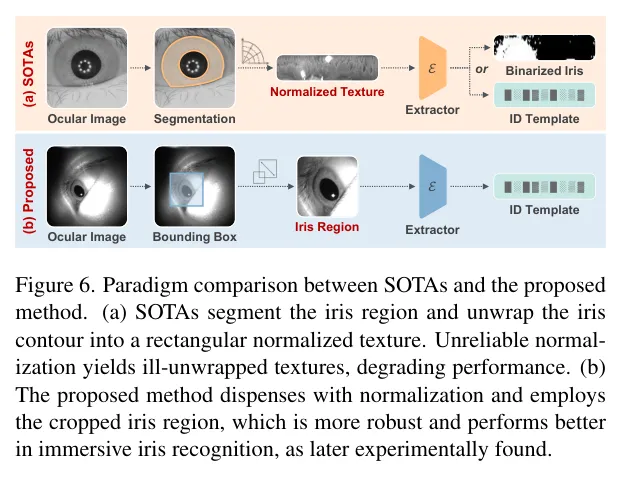
solution + why:① 出数据集 + 8 协议;② 诊断归一化瓶颈;③ 提 NormFree(“dispenses with the fallible normalization and directly learns from minimally adjusted ocular images”)。why 去归一化:极坐标展开预设虹膜是规整圆环,但 off-axis 下虹膜是椭圆 / 被遮挡 → "ill-unwrapped"、且无法吸收类内变化;而现代 DNN 特征器已强到能接管归一化原本的"预对齐"作用——原文 “normalization may be becoming a technical debt”。
③ §2.1 Related Work · 数据集谱系(Table 1)
既有库几乎全 on-axis / 受控或半受控;最接近的 PolyU Iris DB [42] 虽用 VR 但仍 semi-controlled。ImmerIris 是唯一 Off-axis + Unconstrained 且规模最大者。
原文 “ImmerIris further investigates real-world challenges such as pronounced off-axis distortions and illumination changes.”
| Dataset | Axis | Conditions | # Img (Subj) |
| CASIA-IrisV4 [7] | On | Controlled | 20,000 (1000) |
| ND-CrossSensor [46] | On | Controlled | 117,503 (676) |
| VISOB [35] | On | Semi-Ctrl | 95,107 (550) |
| PolyU Iris DB [42] | Off | Semi-Ctrl | 142,005 (384) |
| ImmerIris (ours) | Off | Unconstrained | 499,791 (546) |
④ §2.2 Related Work · 方法谱系(为何前作不够)
两阶段范式:normalization(分割 → 参数化轮廓 → 极坐标展开)+ feature extraction。早期用手工滤波器(Gabor [9] / log-Gabor / ordinal measure [38] / sparse / phase correlation)出二值 iriscode、Hamming 比对;近期用 DNN(CNN / FCN / Mask R-CNN / DenseNet / ResNet / 含 periocular 线索的 backbone)。关键:原文指出已有 normalization-free 前作 [1,4,14] “still rely on iris segmentation, a fallible part of the normalization pipeline”——它们仍依赖分割这一易错环节,本文则彻底只裁框。总评 “they are not designed for off-axis and unconstrained immersive iris recognition and perform unsatisfactorily”。
⑤ §3.1 数据采集(真实数字)
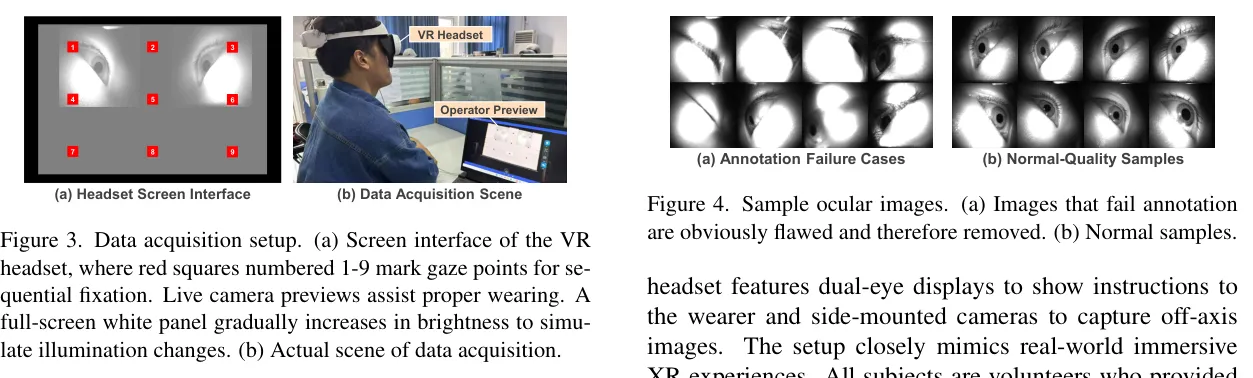
设备 + 流程:Skyworth Pancake XR 头显侧置相机拍 NIR 眼图(640×640);被试看屏上 3×3 红方块(注视点 1-9) 依次注视,每点屏幕亮度自动扫 11 级(暗→亮,模拟光照变化 + 诱导自然瞳孔大小变),每级每眼拍 5 张 → 每人 990 张(双眼合计);546 人 → 初采 540,540 张。伦理:被试=亚洲成人 20–40、性别近均衡、知情同意无报酬、不记录个人信息、IRB 批准。
⑥ §3.2 数据清洗 + 质量标注(6 维退化)
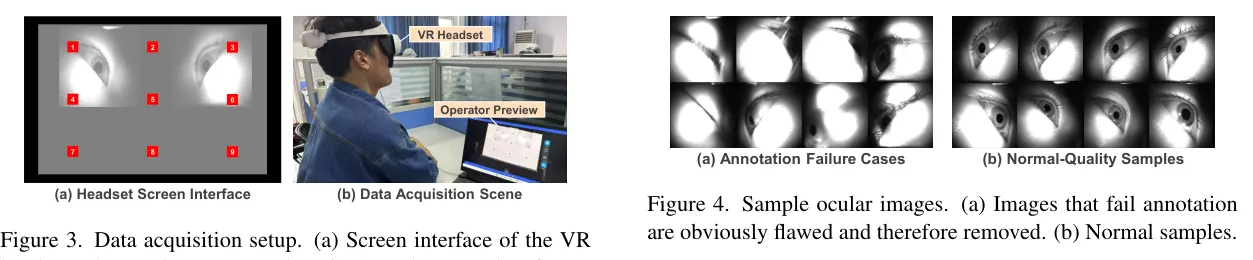
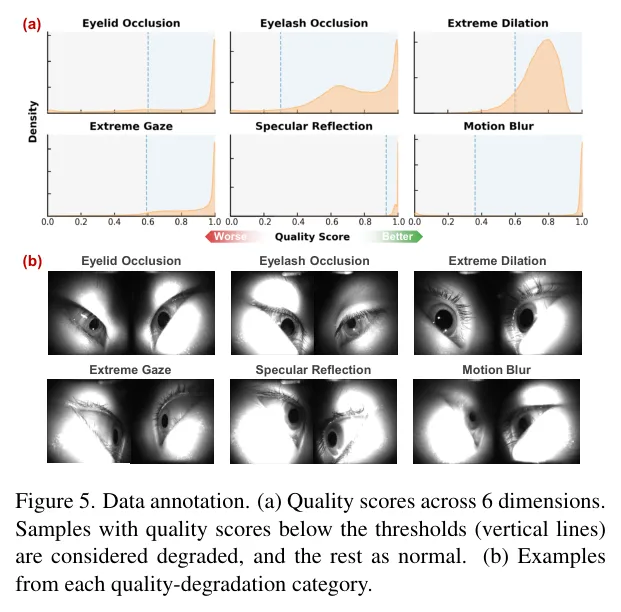
清洗:预训练 ocular 检测器拿虹膜框,丢检测失败 36,697(出框 / 闭眼 / 运动模糊)+ 人工剔缺陷 4,052 → 余 499,791 张。标注:对 6 类常见退化打质量分——eyelid occlusion / eyelash occlusion / extensively dilated pupil / extreme off-axis gaze / specular reflection / motion blur,各维阈值分 normal/degraded。原文 “approximately 42% of images are degraded in at least one quality dimension”——印证质量退化是真实挑战。
Fig 4 / 5 直观:Fig 4(a) 标注失败例=ocular 区域出框、闭眼、眨眼/扫视致严重运动模糊(“obviously flawed and therefore removed”);Fig 4(b) 为正常样本对照。Fig 5(a) 给出 6 维质量分的分布与阈值竖线(低于阈值判 degraded),Fig 5(b) 展示每类退化的样例。采集设计的巧思:用屏幕 “a full-screen white panel gradually increases in brightness” 在每个注视点扫 11 级亮度,一举同时制造光照变化与瞳孔大小(dilation)变化两种类内变化,这样一次采集就覆盖了 Light 与 Dilation 两个协议所需的可控变量。
⑦ §3.3–3.4 划分 + 8 协议设计
划分(7:3,open-set):训练 347,927 张 / 380 人、测试 151,864 张 / 166 人,主体不重叠(系统须 enroll/识别没见过的人),两眼当两类。off-axis 畸变贯穿全数据集故不单列。
4 isolated 协议:Immer-Occlusion(含眼睑+睫毛遮挡,后者仅 3,664 张较稀)/ -Dilation(两图都低虹膜-眼比)/ -Light(暗 3 级配亮 3 级)/ -Gaze(不同注视点配对)。4 combined(难度递增、代表不同操作模式):Immer-Control(固定注视+全配合,仅多 off-axis)→ -Fix(固定注视但其他可变)→ -Select(避开极端注视区 right 3/6/9、left 1/4/7)→ -Any(完全无约束、最贴近真实开放场景)。
⑧ §3.5 评测设置(配对与单/双眼)
verification(1:1):每协议采 up to 1.5M genuine + up to 3M impostor 对,确保 FAR 估到 1e-5 可靠。identification(1:N):每类放 1 张高质量样本入共享 gallery(Immer-Dilation 因两图都退化故识别任务略过),每条配 up to 100 probe。单眼 vs 双眼:单眼=便捷,仅同侧配对;双眼=更安全,左右同时拍的图配对、须两眼都匹配才接受。Immer-Select 双眼测因两侧极端注视点都要删、只剩 2/5/8 过简,故略过。
⑨ §4 The Proposed Method · NormFree(机制)
流程(Fig 6b):预训练检测器检出虹膜区(同 §3.2 清洗用的检测器)→ 方形 bbox 裁剪、bbox 按 ×1.2 扩张纳入眼周上下文 → resize → 直接喂特征器。不分割、不极坐标展开,“far more robust than normalization and can be performed efficiently on the fly”。特征器=人脸识别用的 ResNet(IR-50)、损失=角度间隔的 ArcFace。命名 NormFree;对照 NormKeep=同架构但保留归一化(隔离"去归一化"单独贡献)。核心论点:“DNN-based feature extractors … largely taking over the role that normalization once played. In this sense, normalization may be becoming a technical debt.”
为何直接搬 FR 架构就够:原文 “For decades, FR has demonstrated remarkable success in open scenes, owing not to elaborate pre-processing, but rather to robust feature extractors and discriminative training objectives.” 虹膜识别与开放场景人脸识别同属"开集、判别"的度量学习问题——人脸早已证明强 backbone + 角度间隔损失能直接吃原始裁剪图、自己学到不变性,无需为每种畸变手工设计预处理。因此作者 “employ a ResNet of comparable size to SOTAs and train it using an angular-margin-based loss, wlog., ArcFace”,让 NormFree 与 SOTA 模型规模可比、把增益干净地归因到"去归一化 + 判别目标"而非"堆参数"。
Q&A · 为什么归一化在 immersive 下失败?
归一化的极坐标"橡皮膜"展开建立在"虹膜=正圆环、可被规整分割"的假设上。off-axis 使虹膜成椭圆且局部不均拉伸、遮挡/反射/模糊又破坏分割与轮廓参数化 → 展开出来的纹理条 “ill-unwrapped”,同一只眼在不同光照/注视下展开结果还不一致(吸收不了类内变化)。原文 §5.6 证其缺陷"general rather than specific to a particular implementation"——换更自适应的归一化实现也只微涨。
Q&A · NormFree 与此前的 normalization-free 方法区别?
此前 [1,4,14] 号称 normalization-free,但原文点明它们 “still rely on iris segmentation, a fallible part of the normalization pipeline”——仍要先分割虹膜(易错)。NormFree 更彻底:只用一个检测 bbox(比分割鲁棒得多)裁方框、连分割都不做,把活全交给强特征器 + 判别损失。这正是借鉴 FR"少预处理、强特征器"的哲学。
⑩ §5.2 跨域崩塌(Table 3,FRR@FAR 1e-5)
CASIA-T 训练 → 测自身 vs 测 Immer-Any:
归一化对 on/off-axis 都"适用"故输入名义对齐 → 崩塌主要来自域间差距。原文 “all SOTAs suffer a drastic performance degradation, becoming barely usable”——证明 immersive 是真·新挑战。
| 方法 | 测 CASIA-T | 测 Immer-Any |
| Gabor [9] | 5.24 | 85.47 |
| OM [38] | 5.14 | 88.48 |
| Maxout [48] | 47.26 | 94.09 |
| ComplexIrisNet [27] | 35.79 | 93.14 |
⑪ §5.3 组合协议主结果(Table 4,Left FRR@FAR 1e-5)
| 方法 | Control | Fix | Select | Any |
| CM [45] | 7.18 | 18.35 | 45.03 | 49.93 |
| ComplexIrisNet [27] | 7.32 | 19.73 | 49.13 | 57.62 |
| NormKeep(消融) | 6.41 | 19.77 | 49.20 | 56.63 |
| NormFree (ours) | 5.50 | 15.22 | 47.96 | 52.04 |
⑫ §5.4 隔离挑战(Table 5,Left FRR@FAR 1e-5)+ 发现
| 方法 | Occlusion | Dilation | Light | Gaze |
| CM [45] | 16.59 | 12.10 | 16.62 | 38.92 |
| ComplexIrisNet [27] | 29.58 | 8.22 | 21.62 | 40.31 |
| NormKeep(消融) | 12.35 | 13.66 | 20.82 | 46.63 |
| NormFree (ours) | 8.23 | 4.53 | 9.79 | 45.04 |
⑬ §5.5 识别(Table 6)+ §5.6 消融(Table 7)
识别 rank-1(Left,↑):NormFree Immer-Any 94.39(CM 92.65 / NormKeep 91.99)、Occlusion 98.23(CM 95.41)、Light 98.36、Control 99.52(NormKeep 99.76 略高)、Gaze 95.49(CM 96.14 略高)——多数第一/第二,与 verification 趋势一致。消融(Table 7,Immer-Any avg L/R,FRR@FAR 1e-5):NormKeep Default 55.23 / Alt Model(IR-18) 55.41 / Alt Normalization 52.77;NormFree Default 50.80 / Alt Model(IR-18) 51.99。→ ① 换更小 IR-18,NormFree 仍超 NormKeep 且超 SOTA(“performance gain is less variant to model scale”);② 换"更自适应的归一化实现" NormKeep 仅微涨 → “the drawback of normalization is general rather than specific to a particular implementation”。
⑭ §5 Benchmark 三句话总览(原文 verbatim 三结论)
原文开篇即给三条核心结论,逐条对应全文证据链:① “ImmerIris effectively captures the unique challenges of immersive recognition”(数据集真能反映 immersive 难点——Fig 2 + Table 3 跨域崩塌为证);② “SOTA methods generalize poorly to immersive protocols, indicating the need for methodological advances”(SOTA 泛化差、需方法革新——Table 4 最难两档连最强 SOTA 都 unsatisfactory);③ “Being normalization-free delivers robust performance and suggests a promising future direction”(去归一化稳健、指明方向——NormFree 全表对 NormKeep 稳定领先)。读法:这是典型"数据集 + benchmark + 方法启示"三件套论文,三条结论各由一组实验支撑,互不掺水。
跨域实验的关键控制变量(为何崩塌可归因于域差):原文 “the normalization is applicable by design to both on-axis and off-axis images, so the inputs are nominally aligned. Thus, the observed performance differences can be primarily attributed to the domain gap between datasets.” —— 因为归一化对 on/off-axis 都能跑、输入名义上对齐,所以 CASIA→Immer 的暴跌不是"输入格式不兼容"造成的,而是数据分布本身的 domain gap,这才使 Table 3 成为"immersive 是新难题"的有力证据。
数据量红利的实证:原文 “DNN-based SOTAs trained on ImmerIris perform much better on Immer-Control than on CASIA-T in Tab. 3(a) (their setup differ only by off-axis distortion), showing that performance can benefit from increased data volume.” —— Immer-Control 与 CASIA-T 仅差一个 off-axis 畸变,但 SOTA 在前者反而更好,正是因为 ImmerIris 训练集是 CASIA-T 的 25×;这一对照说明大数据本身就能抵消部分畸变损失,也佐证了"建大数据集"这件事的价值。Gabor/OM 这类 training-free 法则在所有协议都差,原文归因 “their effectiveness primarily depends on normalization”——再次把矛头指向归一化。
📌 全文一页总结(problem → method → experiment → takeaway)
problem:XR/VR 头显里的虹膜识别是 off-axis + 无约束,带来透视畸变 / 类内变化 / 质量退化,且专门数据集稀缺、SOTA 泛化崩。
method:① 出 ImmerIris(499,791 张 / 546 人,HMD NIR、3×3 注视 × 11 亮度采集)+ 8 难度协议(4 isolated + 4 combined);② 诊断归一化是瓶颈;③ NormFree=检测器裁虹膜方框(×1.2 含上下文)直接套 ResNet(IR-50)+ArcFace(对照 NormKeep)。
experiment:跨域 SOTA 从 ~5% FRR 崩到 85–94%(barely usable);ImmerIris 上 NormFree 多数协议第一/第二、抗退化最明显(Dilation 4.53 / Light 9.79)、对 NormKeep 稳定领先;换模型/换归一化实现均证归一化缺陷普遍。
Takeaway:① 用大数据集证明 “immersive 虹膜是独立难题”(不是 controlled 的简单延伸);② 用极简 NormFree 指出 “去归一化"是有前景方向、normalization 正成"技术债”;③ 方法论启示=照搬 FR 的"强特征器 + 判别目标 > 精细预处理"。诚实边界:页面摘要框/arXiv 显示 564 而 PDF 三处为 546(以 546 为准);gaze/Select/Any 上 NormFree 并非总第一(CM 在 Select/Any/Gaze 局部更优);人群仅亚洲成人 20–40、单一头显、仅 NIR;虹膜=敏感生物特征有隐私风险(论文称 IRB 批准、无个人信息)。
🖼 论文原图(本地 PDF 截图,原文 caption 未改写)