CVPR 2026 Finalist
FUSER: Feed-Forward Multiview 3D Registration Transformer and SE(3)^N Diffusion Refinement
Haobo Jiang ⋅ Jin Xie ⋅ Jian Yang ⋅ Liang Yu ⋅ Jianmin Zheng
摘要 Abstract
Registration of multiview point clouds typically depends on extensive pairwise matching to build a pose graph for global synchronization, which is computationally expensive and ill-posed without holistic geometric constraints. In this paper, we propose FUSER, the first feed-forward multi-view registration transformer that processes all scans jointly in a unified, compact latent space to directly predict global poses without any pairwise estimation. To maintain tractability, FUSER employs a sparse 3D CNN to encode each scan into low-resolution superpoint features preserving absolute translation cues, followed by a Geometric Alternating Attention module for efficient intra- and inter-scan reasoning. Particularly, we transfer 2D attention priors from off-the-shelf foundation models (i.e., $\pi^3$) to enhance 3D feature attention. Building upon FUSER and its estimates, we further introduce FUSER-DF, an SE(3) diffusion refinement framework to correct FUSER's estimates through a denoising process over the joint SE(3)$^N$ space. Here, FUSER serves as a surrogate multiview register to model the denoiser, and a prior-conditioned SE(3)$^N$ variational lower bound is derived for denoising supervision. Extensive experiments on 3DMatch and ScanNet confirm the superior registration accuracy and efficiency of our method.
📝 精读笔记
灵魂一句
多视角点云配准长期是"两段式":先做大量两两配准建 pose graph,再做 pose synchronization 求全局位姿——又慢又怕 outlier 误差累积。FUSER 是首个 feed-forward 多视角配准 Transformer:把所有 scan 一次塞进统一 latent 空间、直接回归每个 scan 的全局 SE(3) 位姿、零两两匹配。三招——sparse 3D CNN 保绝对平移线索 + intra/cross-scan 交替注意力 + 把 2D 基础模型(π³)的注意力先验迁到 3D。再加 FUSER-DF(在 SE(3)ᴺ 联合空间做扩散精修、FUSER 自己当 surrogate denoiser)。把 minutes→seconds(3DMatch Full 384s→0.31s)、精度还大涨(ScanNet mean TE 0.37→0.15m)。NTU/Alibaba/南大。
问题 & 动机
任务:给 N 个无序、部分重叠的 scan,估每个的全局刚体位姿 T_i=(R_i,t_i)∈SE(3) 对齐到统一坐标系。主流两段式(pairwise-then-global)四大硬伤(原文):(i) 缺全局上下文——"Each pairwise alignment is performed independently, ignoring geometric constraints from other scans",低重叠/对称场景歧义;(ii) outlier 敏感——"Inaccurate pairwise estimates contaminate pose synchronization, causing global error propagation";(iii) 算力开销大——重复两两配准慢(特征提取+剔 outlier);(iv) 强归纳偏置——"numerous hand-crafted designs, e.g. graph sparsification, robust losses, and synchronization schedules" 限制灵活性。即便最先进方法仍困在此范式。
核心方法(含关键公式)
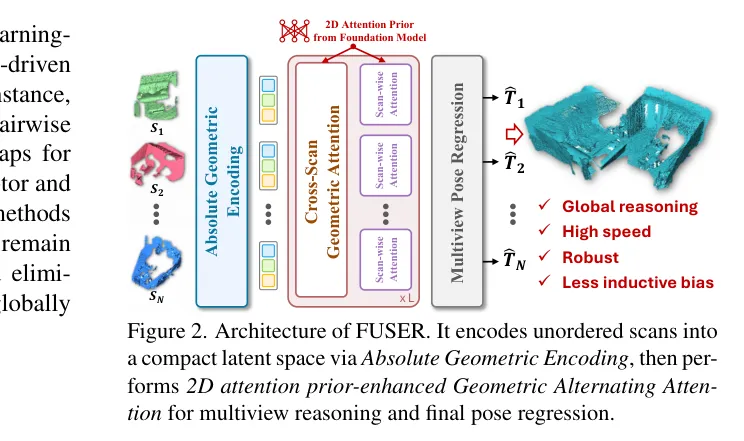
FUSER 三件套(Fig.2):
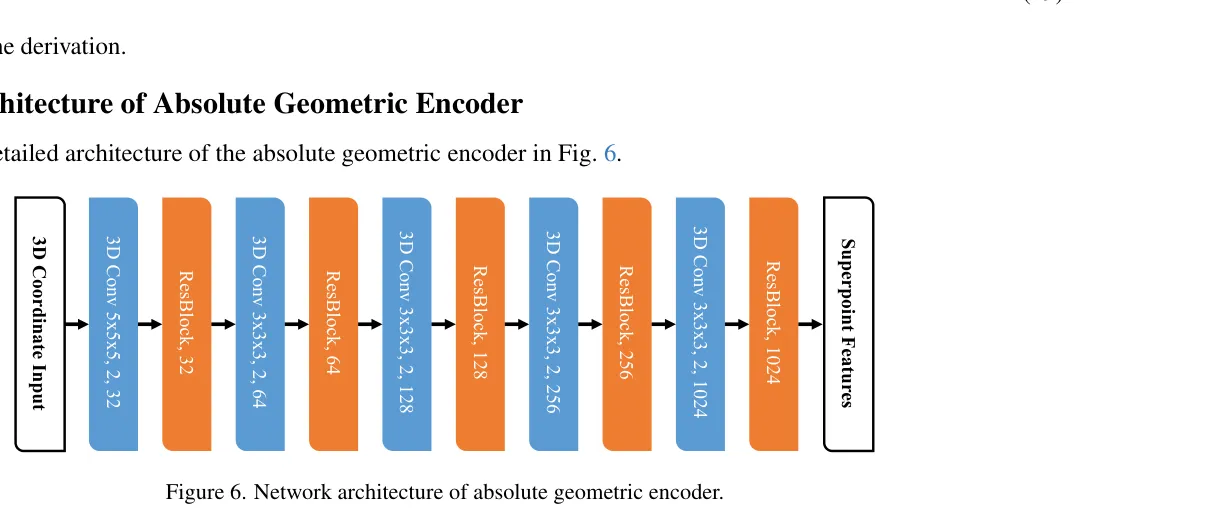
① Absolute Geometric Encoding:用 MinkowskiEngine 的 sparse 3D CNN(5 层、kernel 3 stride 2)把每个 scan 编成低分辨率 superpoint 特征(M'_i≪M_i)。关键:放弃平移不变的相对编码(KPConv)——因 FUSER 直接回归绝对位姿(尤其 translation),"position-agnostic encodings become inadequate"。
② Geometric Alternating Attention:仿 VGGT 的交替注意力,L=32 层(16 intra-scan + 16 cross-scan) 交替做局部/全局推理。为 permutation equivariance 去掉 VGGT 的 learnable reference token(式3);用 superpoint 坐标的 sinusoidal PE(3D RoPE 实测反而掉点,因 cross-scan 时相对位置跨坐标系会误导)。2D→3D 注意力先验迁移:直接用 π³(VGGT 变体,2D 图像重建预训练)权重初始化交替注意力层,无需改架构→显著涨点(Table 4)。
③ Global Pose Regression:self-attn 精修 + global avg pool 得 scan 级描述子 → 两个 MLP 头回归 t̂_i∈ℝ³ 与 9D 旋转 proxy → SVD 正交化成 R̂_i∈SO(3)。
reference-free 监督(绝对世界系 ill-posed 且破坏置换等变):监督相对位姿 T̂_i←j=T̂_i⁻¹T̂_j——geodesic 旋转 loss L_r + Huber 平移 L_t(式4)+ 点级一致性 L_p(式5),总 L=(1/N(N−1))Σ_{i≠j}(L_r+γ_t·L_t+γ_p·L_p)(式6)。
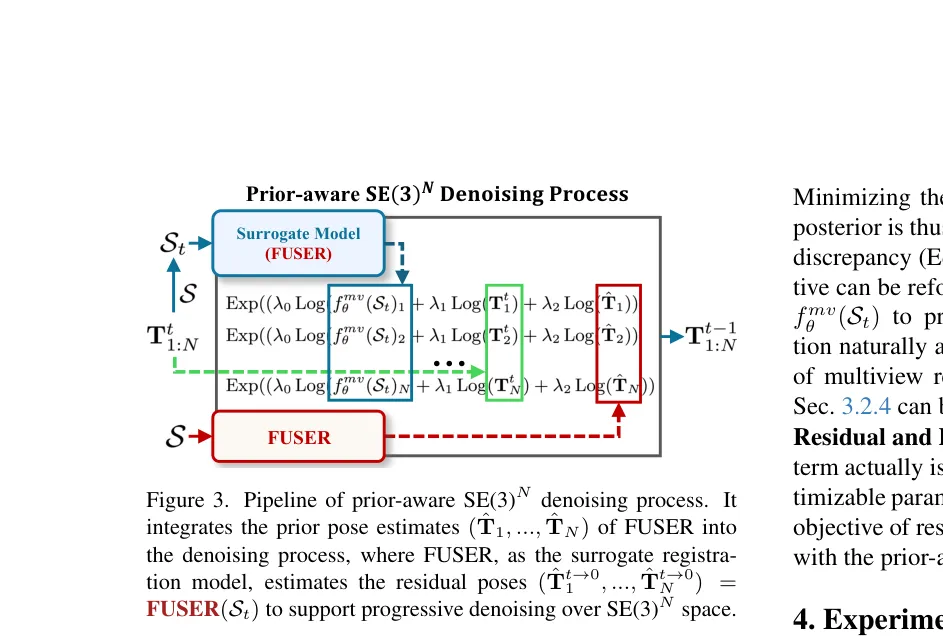
FUSER-DF:在 SE(3)ᴺ 联合流形把多视角精修建成 denoising diffusion;三创新(vs SE(3) diffusion[40])=pairwise→multiview、estimation→refinement(从 FUSER 估计起步小步修,非从 identity)、pairwise→multiview surrogate(用 FUSER 当去噪器 f^mv_θ(S^t)=FUSER(S^t) 预测残差位姿,式13)。prior-aware 扩散从最优位姿扩散向 FUSER 先验(式7),并推导 prior-conditioned 变分下界(式9)做监督。
关键结果
ScanNet(30 scans, Table 1):FUSER(#Pair=0) Rot@3°/5°/10°=69.4/86.9/94.7、mean RE/TE 6.7°/0.15m;FUSER-DF Rot@3° 提到 72.0、mean TE 0.15m。对比最强 prior MDGD(17.4°/0.37m)——mean RE 17.4°→6.7°、TE 0.37→0.15m。3DMatch(60 scans, 单帧难设, Table 2):RR 最强 prior PARENet 61.9 → FUSER 90.3 / FUSER-DF 92.0(RE 3.1°,TE 0.14m)。ArkitScenes(200 scans, Table 3):RR 最强 prior 26.7 → FUSER 92.1 / FUSER-DF 95.0。速度(Table 5):3DMatch Full 两两法 384–763s → FUSER 0.31s/FUSER-DF 2.91s;ArkitScenes 1831–2455s → 0.61s/6.50s。显存仅 2.83G/5.09G(200 scans)。
亮点
① 范式转变:首个把多视角配准做成单次 feed-forward 全局回归、彻底去掉两两匹配 + synchronization(#Pair=0),一举解掉两段式四大硬伤;② 跨模态迁移惊喜——2D 重建基础模型 π³ 的注意力先验(view grouping/alignment/sparsity)直接迁到 3D 点云就大涨(Table 4),且无需改架构;③ FUSER 一鱼两吃:既是配准器又当 SE(3)ᴺ 扩散的 surrogate denoiser;④ 绝对几何编码 + reference-free 相对监督巧解"既要绝对位姿又要置换等变";⑤ minutes→seconds 量级 + 数据可扩展(Table 4 越多数据越准),指向 3D 配准基础模型。
疑问 / 待核
① 3D RoPE 反而掉点——原文归因"cross-scan 时相对位置跨坐标系误导",但只给定性解释、未深入(是否换设计可救?原文未写)。② FUSER ~0.6B 参数 + 训练吃 4 大数据集 + 8×L20 GPU,是"大模型+大数据"路线,小数据/小算力下能否复现优势原文未探。③ FUSER-DF 相比 FUSER 增益不均衡:严格阈值(Rot@3° 69.4→72.0、ArkitScenes RR 92.1→95.0)有提升,但宽松阈值/部分指标几乎持平甚至略降(如 ScanNet Rot@10° 94.7→94.5),扩散精修的性价比(+10 步去噪、2.91s)边界原文未量化讨论。④ 仅室内 RGB-D(3DMatch/ScanNet/ArkitScenes),室外/LiDAR 大场景泛化未测(原文未写)。
📖 逐段精读 · 笔记
本地 PDF 全文精读(PyMuPDF 提取,约 6 万字符,正文+附录变分下界推导)。原文英文原句直引 + 中文指路,配准/扩散概念开背景块。最后更新 2026-06-21。
① Abstract(摘要)— 逐句精讲
第 1 句(旧范式痛点):"Registration of multiview point clouds conventionally relies on extensive pairwise matching to build a pose graph for global synchronization, which is computationally expensive and inherently ill-posed without holistic geometric constraints." —— 在说什么:传统多视角点云配准是两段式——先把所有 scan 两两匹配建出"位姿图"(pose graph),再做全局同步(synchronization)恢复绝对位姿;为什么有问题——既贵(两两组合是 \(O(N^2)\)),又本质病态(没有整体几何约束,单对匹配信息不足)。
第 2 句(核心贡献):"This paper proposes FUSER, the first feed-forward multiview registration transformer that jointly processes all scans in a unified, compact latent space to directly predict global poses without any pairwise estimation." —— FUSER 是第一个前馈(feed-forward)多视角配准 Transformer:把所有 scan 一起塞进一个统一紧凑的隐空间联合处理,直接预测全局位姿、完全不做两两估计。这是范式级改动(two-stage → one-shot)。
第 3-4 句(两个关键机制):"FUSER encodes each scan into low-resolution superpoint features via a sparse 3D CNN that preserves absolute translation cues, and performs efficient intra- and inter-scan reasoning through a Geometric Alternating Attention module. Particularly, we transfer 2D attention priors from off-the-shelf foundation models to enhance 3D feature interaction and geometric consistency." —— 两招:① sparse 3D CNN 把每个 scan 编成低分辨率 superpoint 特征、且保留绝对平移线索(这点对"直接回归平移"至关重要);② Geometric Alternating Attention(帧内/跨帧交替)做高效多视角推理;并且把现成 2D 基础模型的注意力先验迁移到 3D。
第 5-6 句(精修 + 战果):"we further introduce FUSER-DF, an SE(3)N diffusion refinement framework to correct FUSER's estimates via denoising in the joint SE(3)N space ... a prior-conditioned SE(3)N variational lower bound is derived for denoising supervision." —— FUSER-DF 在 \(SE(3)^N\)(N 个位姿的联合流形)上把"精修"建成去噪扩散,并推导出先验条件变分下界做监督。实验在 3DMatch/ScanNet/ArkitScenes 上精度与效率双 SOTA。
一句话抓 Abstract:把多视角配准从"两两匹配 + 全局同步"的两段式,改成"一次前馈直接出全局位姿",再加一个 \(SE(3)^N\) 扩散精修头,又快(分钟→秒)又准。
📚 背景知识(外部,非本文原文,理解本文必备)
① 点云配准:对齐两个(pairwise)或多个(multiview)点云到同一坐标系。SE(3) = 刚体变换群(旋转 \(SO(3)\) + 平移 \(\mathbb{R}^3\)),位姿 \(T=(R,t)\)。② pose graph / synchronization:把各 scan 当节点、两两相对位姿 \(T_{i\leftarrow j}=T_i^{-1}T_j\) 当边,从一堆带噪相对位姿恢复全局一致的绝对位姿 = transformation synchronization(常用 IRLS / rotation averaging)。③ sparse 3D CNN / MinkowskiEngine / superpoint:点云稀疏体素化后只在占用体素上卷积(省算力);superpoint = 下采样后的代表点(数量 \(M'\ll M\))。④ VGGT / π³ / alternating attention:VGGT 是 2D 多视图几何 Transformer,用"帧内 + 跨帧"交替注意力做多图推理;π³ 是其置换等变变体。本文把这套 2D 预训练注意力迁到 3D。⑤ permutation equivariance(置换等变):打乱 scan 输入顺序,输出位姿应随之同样打乱而不变质——无序多视角输入必须的性质。⑥ RoPE vs 正弦 PE:位置编码两种;RoPE 编相对位置,本文发现 3D 跨 scan 下相对位置跨坐标系会误导,改用绝对正弦 PE。⑦ SE(3) diffusion(扩散配准):把位姿估计建成"加噪 → 去噪"过程:前向把最优位姿扰向 identity,反向学去噪器逐步恢复;本文改成在 \(SE(3)^N\) 联合空间、扰向 FUSER 先验。⑧ 变分下界(VLB):扩散训练目标的可优化下界,分解成 residual / prior-matching / denoising-matching 项。⑨ 指标:RR(Registration Recall,把对齐误差落在阈值内的序列比例,↑好,具体阈值见原文 Appendix A)、RE/TE(旋转/平移误差,↓好);#Pair = 实际执行的两两匹配次数(FUSER 为 0)。⑩ 数据集:3DMatch / ScanNet / ScanNet++ / ArkitScenes 均为室内 RGB-D。
② §1 Introduction — problem → 现有不足 → solution → why 闭环
problem(要解决什么):多视角配准远不如 pairwise 受关注,主流都走 pairwise-then-global(两两配准建 pose graph + synchronization),隐含假设"提升 pairwise 精度自然带来多视角一致"。
现有不足(为什么不够):原文直指 "optimizing scan pairs in isolation fails to exploit global multi-scan geometric constraints, often producing ambiguous or unstable relative poses whose errors further accumulate during synchronization"——孤立优化 scan 对,既用不上全局约束,误差又会在同步阶段累积;加上冗余两两配准的算力开销。即便近期工作(overlap 预测、triplet 一致性、学习式同步)也 "remain bound to the pairwise-then-global paradigm and thus cannot fully overcome its inherent limitations"。
solution(Intro 自包含):FUSER = "the first feed-forward multiview registration transformer that jointly encodes all scans in a compact latent space to directly predict global poses without any pairwise estimation",好处是 "enables holistic geometric reasoning across scans, avoids error propagation and redundant computation, and removes handcrafted priors"。三个工程难点 + 对策:(a) 直接回归绝对平移 → 需绝对几何线索 → sparse 3D CNN 绝对编码(不是相对的 KPConv);(b) all-scan 注意力代价高 → Geometric Alternating Attention(intra/cross 交替)保 tractable;(c) 从头训难 → 迁移 π³ 的 2D 注意力先验(尽管模态 gap 仍大涨)。why work:联合推理给全局约束、单次前向无冗余两两、纯数据驱动注意力——逐条对消下面四个缺陷。
Q&A · §3.2.1 两段式(pairwise-then-global)到底差在哪四点?
原文列了四个根本缺陷(FUSER 逐条对消):(i) "Missing global context"——每对独立对齐、忽略其它 scan 的几何约束,低重叠/对称场景会歧义;(ii) "Outlier sensitivity"——不准的两两估计会污染同步、造成全局误差传播;(iii) "Computational overhead"——重复两两配准(含特征抽取 + outlier 剔除)很慢;(iv) "Strong inductive bias: It necessitates numerous hand-crafted designs, e.g. graph sparsification, robust losses, and synchronization schedules"——大量手工设计限制灵活性、阻碍全局最优。[点评] 把对手的弱点拆成四条、再用"单次前馈联合推理"一一对应,是非常清晰的 motivation 结构——和它致敬的 VGGT/π³ 一脉相承(用一个统一模型替掉拼接式流水线)。
③ §3.1 Background — 问题定义 & 借来的 SE(3) 扩散(公式 1)
问题定义:给一组部分重叠点云 \(\mathcal{S}=\{S_i\in\mathbb{R}^{M_i\times3}\mid 1\le i\le N\}\),每个 scan 从不同相机位姿拍摄,目标是估计每个 scan 的刚体全局位姿 \(T_i=(R_i,t_i)\in SE(3)\)(\(R_i\in SO(3),\ t_i\in\mathbb{R}^3\)),把它们对齐到同一全局坐标系。传统把它建成图 \(G=(\mathcal{S},E)\),边 \((i,j)\) 编码相对位姿 \(T_{i\leftarrow j}=T_i^{-1}T_j\)。
借来的 pairwise SE(3) 扩散(为 FUSER-DF 铺垫):已有工作把 pairwise 配准建成 SE(3) 上的扩散——前向把最优变换 \(H_0\) 逐步扰成噪声位姿(式 1):\[ H_t=\mathrm{Exp}\!\big(\gamma\sqrt{1-\bar\alpha_t}\,\varepsilon\big)\,F(\sqrt{\bar\alpha_t};H_0,H),\quad \bar\alpha_t=\textstyle\prod_{s=0}^{t}(1-\beta_s) \]其中 \(\varepsilon\sim\mathcal{N}(0,I)\),\(H\) 是 identity,\(\beta_t\) 走 cosine schedule,\(F\) 是"最优位姿 ↔ identity"的插值。反向过程用一个 surrogate 配准模型 \(f_\theta\) 学去噪。本文把这套从"pairwise / 扰向 identity"升级为"multiview / 扰向 FUSER 先验"(见 §3.3)。
④ §3.2.2 Absolute Geometric Encoding(核心机制一:为何要"绝对")
关键洞察:主流深度描述子(GeoTransformer/RoITr)偏好平移不变的相对坐标归一化(如 KPConv),以稳住 pairwise 匹配;但 FUSER 要直接回归绝对位姿(尤其平移),相对编码就不够了——原文 "removing global location cues obscures where each scan lies in the camera frame, making translation regression inherently ambiguous"(抹掉全局位置线索 → 不知道 scan 在相机系里的绝对位置 → 平移回归本质歧义)。
怎么做:用 MinkowskiEngine 搭绝对坐标感知的 sparse 3D CNN,对每个 scan 做层级体素化 + 稀疏卷积,得到紧凑 superpoint 特征 \(F_i\in\mathbb{R}^{M_i'\times d}\)(\(M_i'\ll M_i\))。为让后续 all-scan 注意力可承受,用更深的 5 层卷积层级(kernel 3、stride 2)把 superpoint 数压得很低。原文强调:尽管 superpoint 分辨率低,"the resulting compact superpoint features still retain sufficient geometric information for accurate pose regression"——压缩没伤精度,反而换来"all-scan 注意力可行"。
⑤ §3.2.3 Geometric Alternating Attention(核心机制二:置换等变,公式 3)
结构:原文 "Inspired by VGGT's alternating attention mechanism for cross-image reasoning, we extend this paradigm to 3D matching field. Our transformer contains L = 32 alternating layers, including 16 intra-scan and 16 cross-scan blocks"——32 层交替:16 个帧内(intra-scan)抓局部几何 + 16 个跨帧(cross-scan)抓全局关系,顺序交替。
两处关键改造(vs VGGT):① 去掉 reference token 保置换等变:VGGT 用可学 reference token 标记参考视图,"this design causes instability under varying scan orders";FUSER 去掉它,使(式 3)\[ \mathrm{AA}\big(P_\pi(\mathcal{S}'),P_\pi(F)\big)=P_\pi\big(\mathrm{AA}(\mathcal{S}',F)\big) \]即"打乱输入顺序 = 打乱输出"(无序输入必须)。② 用正弦 PE 而非 3D RoPE:在 superpoint 绝对坐标上加正弦位置编码;作者坦言也试过相对位置的 3D RoPE,但 "our experiments shows it may bring degraded performance, possibly caused by the relative position information would be misleading during cross-scan attention (as each scan belongs to different coordinate system)"——跨 scan 时各自坐标系不同,相对位置反而误导。[诚实] 这条是"负结果如实写出",但深层机理只给了一句"possibly"。
Q&A · 为什么把 2D 基础模型的注意力先验迁到 3D 会有效?(Table 4)
做法:不从头训交替注意力,而是 "we initialize our alternating attention layers with pretrained weights from π3, a VGGT variant trained on large-scale 2D image reconstruction tasks",并且 "we make no architectural modifications"(除 2D/3D 位置编码与特征编码差异外结构天然兼容)。为何有效:原文归因 "transferable 2D attention priors, such as view grouping, alignment consistency, and attention sparsity, which generalize surprisingly well to unstructured 3D point clouds"——多视图推理的"哪些视图该归到一起、对齐一致性、注意力稀疏"这些先验是跨模态通用的。实证:Table 4 上 FUSER(ScaN) 去掉 π³ 先验 Rot@3° = 12.9、mean RE = 34.8°;加上 = 36.6 / 22.6°——巨大增益。[点评] 这是全文最有"foundation model 时代味道"的发现:2D 几何基础模型的权重可直接当 3D 配准的良好初始化。
⑥ §3.2.4 全局位姿回归 & reference-free 监督(公式 4/5/6)
回归头:先用若干 self-attention 精修每个 scan 的 superpoint token → global average pooling 得 scan 级描述子 → 两个轻量 MLP 分别回归平移 \(\hat t_i\in\mathbb{R}^3\) 和一个 9D 旋转 proxy → 经 SVD 正交化投到合法旋转 \(\hat R_i\in SO(3)\)。
为何 reference-free:原文 "Directly supervising global poses in a fixed world frame is inherently ill-posed"——世界坐标系随数据集/序列变、且"选某个 scan 当参考"会破坏置换等变。故改成监督相对位姿 \(\hat T_{i\leftarrow j}=\hat T_i^{-1}\hat T_j\)。三项损失:① 测地旋转损失 + Huber 鲁棒平移(式 4):\[ L_r(i,j)=\arccos\!\Big(\tfrac{\mathrm{Tr}(R_{i\leftarrow j}^{\top}\hat R_{i\leftarrow j})-1}{2}\Big),\quad L_t(i,j)=\ell_\beta\big(\hat t_{i\leftarrow j}-t_{i\leftarrow j}\big) \]② 点级几何一致损失(式 5):\[ L_p(i,j)=\tfrac{1}{N_j}\textstyle\sum_{l=1}^{N_j}\big\|(\hat R_{i\leftarrow j}p_l+\hat t_{i\leftarrow j})-(R_{i\leftarrow j}p_l+t_{i\leftarrow j})\big\|_1 \]③ 总损失(式 6,对所有有序对求平均):\[ L=\tfrac{1}{N(N-1)}\textstyle\sum_{i\ne j}\big[L_r(i,j)+\gamma_t L_t(i,j)+\gamma_p L_p(i,j)\big],\quad \gamma_t=\gamma_p=0.1 \]
⑦ §3.3 FUSER-DF — SE(3)ᴺ 扩散精修的三个创新
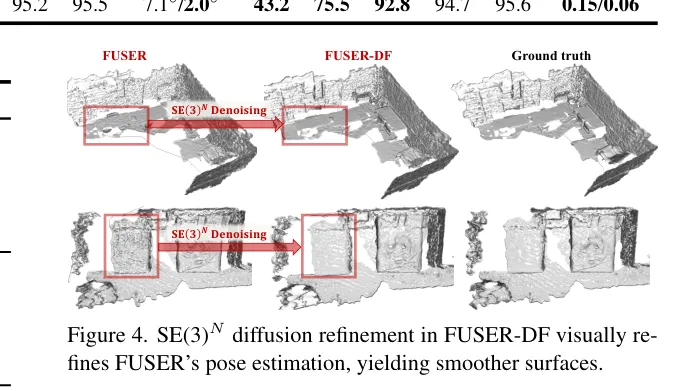
动机:FUSER 已给出 \(\hat T_{1:N}\),FUSER-DF 在其上追求更高精度,把多视角位姿修正建成 \(SE(3)^N\) 联合流形上的去噪扩散。相对已有 pairwise SE(3) 扩散,原文给三创新:(i) "From pairwise to multiview"——在联合空间 \(SE(3)^N\) 上扩散整组位姿、全程保留 cross-scan 依赖;(ii) "From estimation to refinement"——反向链从 FUSER 估计起步、只做小步修正,而非从无信息的 identity 起估;(iii) "Pairwise to multi-view surrogate"——直接拿 FUSER 当 multiview surrogate denoiser(pairwise 模型做不到多视角)。
⑧ §3.3.2 prior-aware 前向扩散(公式 7/8:扰向"先验"而非 identity)
关键差异:常规 SE(3) 扩散把最优位姿扰向 identity;FUSER-DF "diffuses from the optimal poses toward the prior \(\hat T_{1:N}\) predicted by FUSER"——扰向 FUSER 的先验估计。前向(式 7-8):\[ T_i^{t}=\mathrm{Exp}\!\big(\gamma\sqrt{1-\bar\alpha_t}\,\varepsilon\big)\,F(\sqrt{\bar\alpha_t};T_i^{0},\hat T_i) \]\[ F(\sqrt{\bar\alpha_t};T_i^{0},\hat T_i)=\mathrm{Exp}\!\big((1-\sqrt{\bar\alpha_t})\cdot\mathrm{Log}(\hat T_i(T_i^{0})^{-1})\big)\,T_i^{0} \]即 \(\sqrt{\bar\alpha_t}\) 作为"最优 \(T_i^0\) ↔ 先验 \(\hat T_i\)"的插值权重,外层 \(\mathrm{Exp}(\gamma\sqrt{1-\bar\alpha_t}\varepsilon)\) 再加随机扰动。原文:这种扰动 "introduces stochastic noise to the interpolated pose, enriching the diversity of diffusion trajectories",从而增强去噪器的泛化。直觉:因为推理时起点就是"FUSER 先验附近",所以训练就该围着"最优 ↔ 先验"这段去造噪声轨迹,分布匹配、只需小步修。
⑨ §3.3.3 反向过程 + 变分下界 + FUSER 当 surrogate(公式 9/13)
反向:学一个 \(SE(3)^N\) 去噪器 \(p_\theta\),把位姿从 FUSER 先验修向最优。变分下界(式 9,附录 B 推导)分解为三项:Residual term(重建项)+ Prior matching term(先验匹配,是常数、无可优化参数、可略)+ Prior-aware Denoising matching term(核心 loss,最小化"后验 \(q\) 与去噪器 \(p_\theta\)"的 KL 散度)。
巧点——把去噪还原成"再跑一次 FUSER":后验/先验的期望(式 11/12)经一个 multiview surrogate \(f_\theta^{mv}\) 参数化,而本文直接令(式 13):\[ (\hat T_1^{t\to0},\dots,\hat T_N^{t\to0})=f_\theta^{mv}(S^t)\triangleq \mathrm{FUSER}(S^t) \]其中 \(S^t\) 是按噪声位姿 \(T_{1:N}^t\) 变换后的 scans,\(T_i^{t\to0}=T_i^0(T_i^t)^{-1}\) 是"从噪声位姿到最优"的残差变换。于是最小化 KL 等价于让 FUSER 预测残差位姿——可直接复用 §3.2.4 的配准损失训练去噪器,无需另设目标。系数上 \(\lambda_2\)(先验权重)早期主导、随去噪渐衰,反向逐步退回常规 SE(3) 形式。[点评] "用同一个 FUSER 既做估计又做去噪 surrogate"是很省的设计——精修阶段几乎零额外网络。
⑩ §4.2 主结果 — Table 1/2/3(真实数值,#Pair 一栏看点)
ScanNet(30 scans,Table 1):
┃ 方法 ┃ #Pair ┃ Rot@3° ┃ mean RE / TE ┃
┃ SGHR ┃ 13920 ┃ 57.2 ┃ 26.4° / 0.70m ┃
┃ MDGD(最强 prior, Sparse) ┃ 6004 ┃ 56.1 ┃ 17.4° / 0.37m ┃
┃ FUSER ┃ 0 ┃ 69.4 ┃ 6.7° / 0.15m ┃
┃ FUSER-DF ┃ 0 ┃ 72.0 ┃ 7.1° / 0.15m ┃
原文 "FUSER significantly reduces mean translation and rotation errors (0.37m→0.15m, 17.4°→6.7°)";FUSER-DF 在严阈值下再涨 "Rot@3°: 69.4 →72.0"。注意 #Pair = 0:FUSER 完全不做两两匹配。
3DMatch(60 scans,单帧难设,Table 2):RR——Full+PARENet 61.9 / SGHR+PARENet 55.3 → FUSER 90.3 / FUSER-DF 92.0(RE 3.1°、TE 0.14m)。ArkitScenes(200 scans,Table 3):RR——最强 baseline 仅约 24-27 → FUSER 92.1 / FUSER-DF 95.0(TE 0.12-0.13m)。三个数据集、不同 scan 数都是大幅领先,且 scan 越多(200)优势越夸张。
⑪ §4.3 消融 — Table 4(2D 先验 + 数据规模,各验证什么)
① 2D 注意力先验(验证"迁移有效性"):FUSER(ScaN) w/o π³ 先验 Rot@3° = 12.9、mean RE = 34.8°、TE 0.74m;w/ = 36.6 / 22.6° / 0.45m。原文 "integrating this prior significantly enhances both rotation and translation precision"——一个初始化就把 Rot@3° 翻了近 3 倍。② 数据可扩展(验证"foundation 潜力"):训练集逐步加(ScaN → +ArkitS → +ScaNP → +3DM),Rot@3° = 36.6 → 35.8 → 56.9 → 69.4,mean TE = 0.45 → 0.26 → 0.20 → 0.15,单调变好。原文 "with increasing training data, our model yields consistent accuracy gains, indicating a favorable scaling trend and strong potential for large-scale 3D foundation training"。
⑫ §4.3 速度 / 显存 — Table 5(feed-forward 的核心卖点)
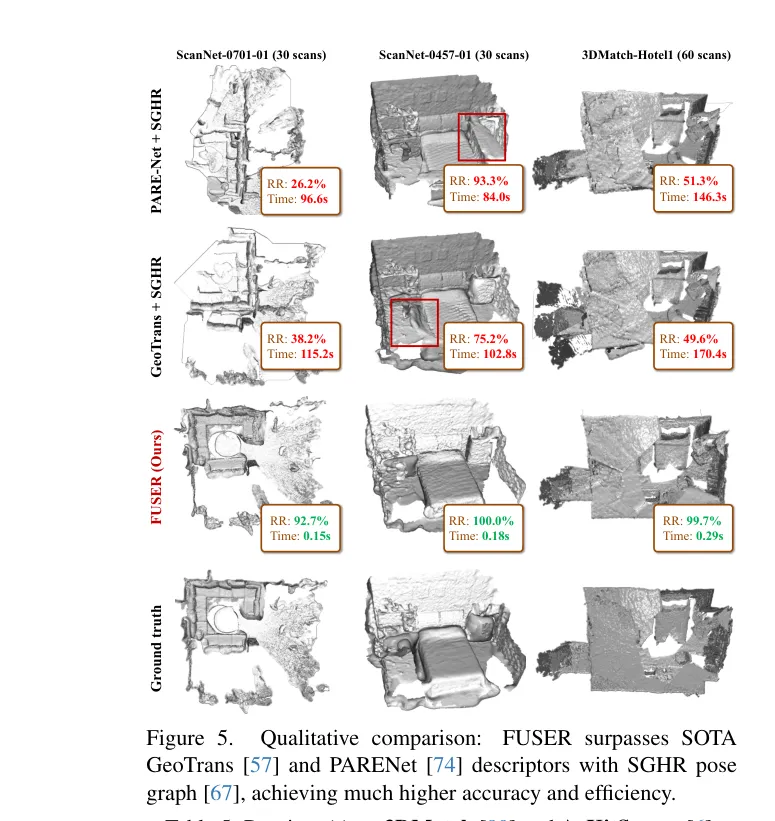
运行时(每序列):3DMatch Full 两两法需 384-763s(FCGF 517s、PARENet 384s)→ FUSER 0.31s / FUSER-DF 2.91s;ArkitScenes(200 scans)Full 需 1831-2455s → FUSER 0.61s / FUSER-DF 6.50s。原文 "remove the redundant pairwise optimization, enabling efficient second-scale inference",即分钟级 → 秒级。显存:得益于紧凑 superpoint + FlashAttention,200 scans 最长序列仅 2.83G(FUSER)/ 5.09G(FUSER-DF)。定性(Fig.5):FUSER 在 3DMatch-Hotel1 达 RR 100% / 0.18s,而 GeoTrans+SGHR 仅 75.2% / 102.8s。
📌 全文一页总结(problem → method → experiment → takeaway)
① problem:多视角点云配准的传统"两段式(两两匹配 + 全局同步)"有四个根本缺陷——缺全局上下文、怕 outlier 误差传播、重复两两很慢、强手工归纳偏置。
② method:(a) FUSER——首个前馈多视角配准 Transformer:sparse 3D CNN 绝对几何编码(保平移线索)+ 32 层 intra/cross 交替注意力(去 reference token 保置换等变 式3、正弦 PE、用 π³ 的 2D 注意力先验初始化)+ 直接回归全局位姿(reference-free 相对位姿监督 式4-6);(b) FUSER-DF——把精修建成 \(SE(3)^N\) 扩散、扰向 FUSER 先验(式7-8)、用 FUSER 自身当 multiview surrogate denoiser 预测残差位姿(式13)、prior-conditioned VLB(式9)监督。
③ experiment:在 #Pair = 0 下——3DMatch RR 61.9 → 92.0、ArkitScenes RR ~27 → 95.0、ScanNet mean RE/TE 17.4°/0.37m → 6.7°/0.15m;速度 384-2455s → 0.31-0.61s(分钟→秒)、显存仅 2.83-5.09G;消融证明 2D 先验(12.9 → 36.6 Rot@3°)与数据规模(36.6 → 69.4)均显著贡献。
④ takeaway(≥3 条 + 适用边界):
• Takeaway 1:多视角配准可以彻底抛弃"两两匹配 + 同步",用"统一紧凑 latent + 一次前馈联合推理"直接出全局位姿,精度反而更高(全局约束 + 无误差传播)。
• Takeaway 2:2D 几何基础模型(π³/VGGT)的注意力权重可跨模态迁到 3D 作良好初始化(view grouping / alignment / sparsity 通用),且性能随数据规模单调上涨——指向"3D 配准基础模型"。
• Takeaway 3:把"位姿精修"建成扰向先验的 \(SE(3)^N\) 扩散、并复用配准模型自身当去噪 surrogate,可在几乎零额外网络下再榨严阈值精度(Rot@3° 69.4 → 72.0)。
• 适用边界 / 诚实点:① 绝对编码要求 superpoint 保留绝对坐标,3D RoPE 反而掉点的机理论文只给"possibly",未深究 [推测:跨坐标系相对位置无意义];② 路线是 0.6B 参 + 4 大数据集 + 8×L20 的"大模型 + 大数据",小算力可复现性未讨论;③ FUSER-DF 增益不均衡——主要在严阈值(@3°)涨,宽阈值几乎持平;④ 实验全为室内 RGB-D,室外/LiDAR/跨域泛化未验证。
🖼 论文原图(本地 PDF 截图,原文 caption 未改写)