CVPR 2026 Finalist
FINER: MLLMs Hallucinate under Fine-grained Negative Queries
Rui Xiao ⋅ Sanghwan Kim ⋅ Yongqin Xian ⋅ Zeynep Akata ⋅ Stephan Alaniz
摘要 Abstract
Multimodal large language models (MLLMs) struggle with hallucinations, particularly with fine-grained queries, a challenge underrepresented by existing benchmarks that focus on coarse image-related questions. We introduce **FI**ne-grained **NE**gative que**R**ies (**FINER**), alongside two benchmarks: **FINER-CompreCap** and **FINER-DOCCI**. Using FINER, we analyze hallucinations across four settings: multi-object, multi-attribute, multi-relation, and “what” questions. Our benchmarks reveal that MLLMs hallucinate when fine-grained mismatches co-occur with genuinely present elements in the image. To address this, we propose **FINER-Tuning**, leveraging Direct Preference Optimization (DPO) on FINER-inspired data. Finetuning four frontier MLLMs with FINER-Tuning yields up to 24.2% gains (InternVL3.5-14B) on hallucinations from our benchmarks, while simultaneously improving performance on eight existing hallucination suites, and enhancing general multimodal capabilities across six benchmarks. Benchmarks, training data, code and model checkpoints will be released.
📝 精读笔记
灵魂一句
现有 MLLM 幻觉 benchmark 多是粗粒度(单物体在不在),本文造 FINER——把"否定式 query"(问图里其实没有的东西)做到细粒度(多物体/多属性/多关系/what 问),揭示 MLLM 在"细粒度错误与真实存在元素共现"时会幻觉:query 越细,越倾向把该答"No"的答成"Yes"(false positive),InternVL3.5-14B 从粗粒度 ~80% 掉到细粒度 ~20%。对策 FINER-Tuning(在细粒度正负 query 上做 DPO)给 4 个前沿 MLLM 涨最多 24.2%,还顺带提升 8 个幻觉 benchmark + 6 个通用能力 benchmark、无 alignment tax。TUM/Akata 组。
问题 & 动机
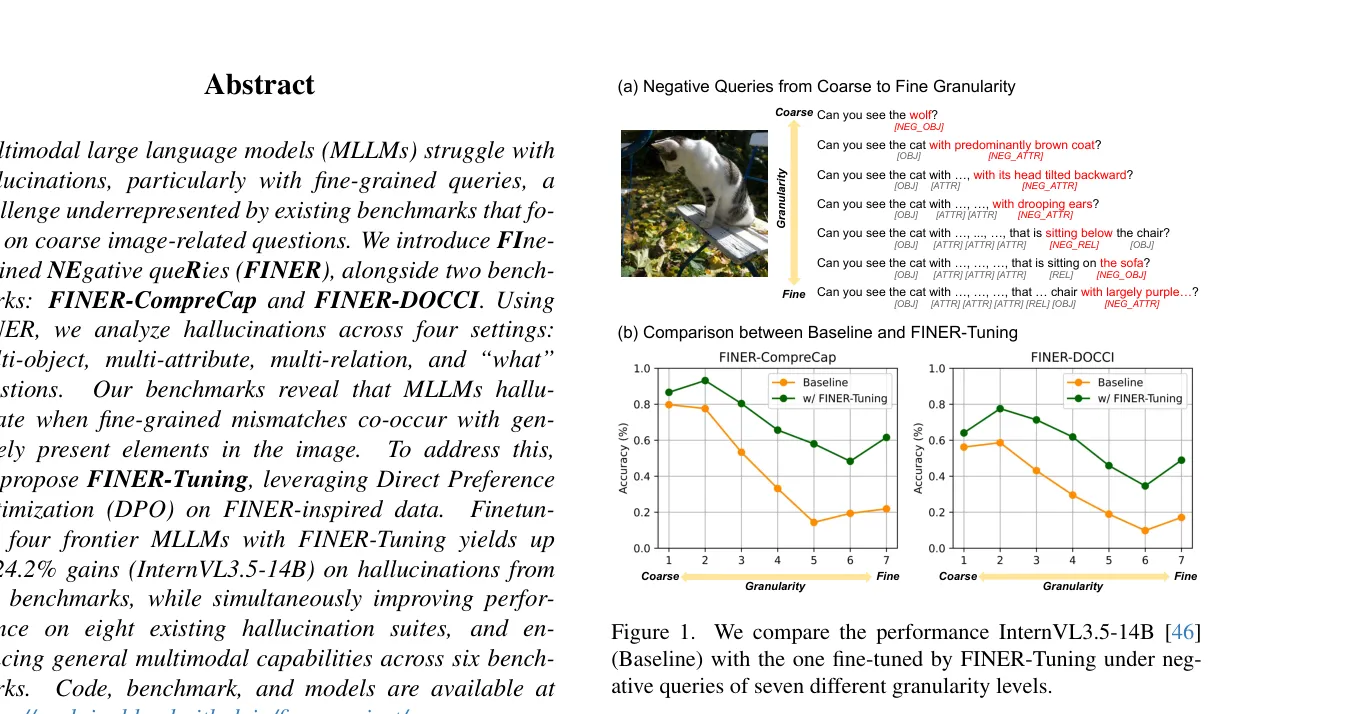
幻觉定义(原文):"the generation of answers unsupported by the image";negative queries="those asking about non-existent image content",MLLM 常 false-positive(该说 No 却说 Yes)。现有 probe 太粗(原文):"POPE and DASH focus on single object presence, and AMBER includes only single objects, attributes, and relations"。核心问题(原文):"Can MLLMs reject fine-grained mistakes involving multiple objects, attributes, and relations, rather than only coarse mismatches?" 动机实验(Fig.1):仿人造句"单物体→加属性→加关系"造 7 个粒度等级、每级注入 1 个矛盾(NEG_OBJ/ATTR/REL)、答案恒为 No——InternVL3.5-14B 准确率从 level1 ~80% 跌到 level5-7 ~20%(CompreCap)、~58%→~15%(DOCCI),证明"brittleness to fine-grained negations"。关键发现:"MLLMs hallucinate when fine-grained mismatches co-occur with genuinely present elements in the image"。
核心方法(benchmark + tuning)
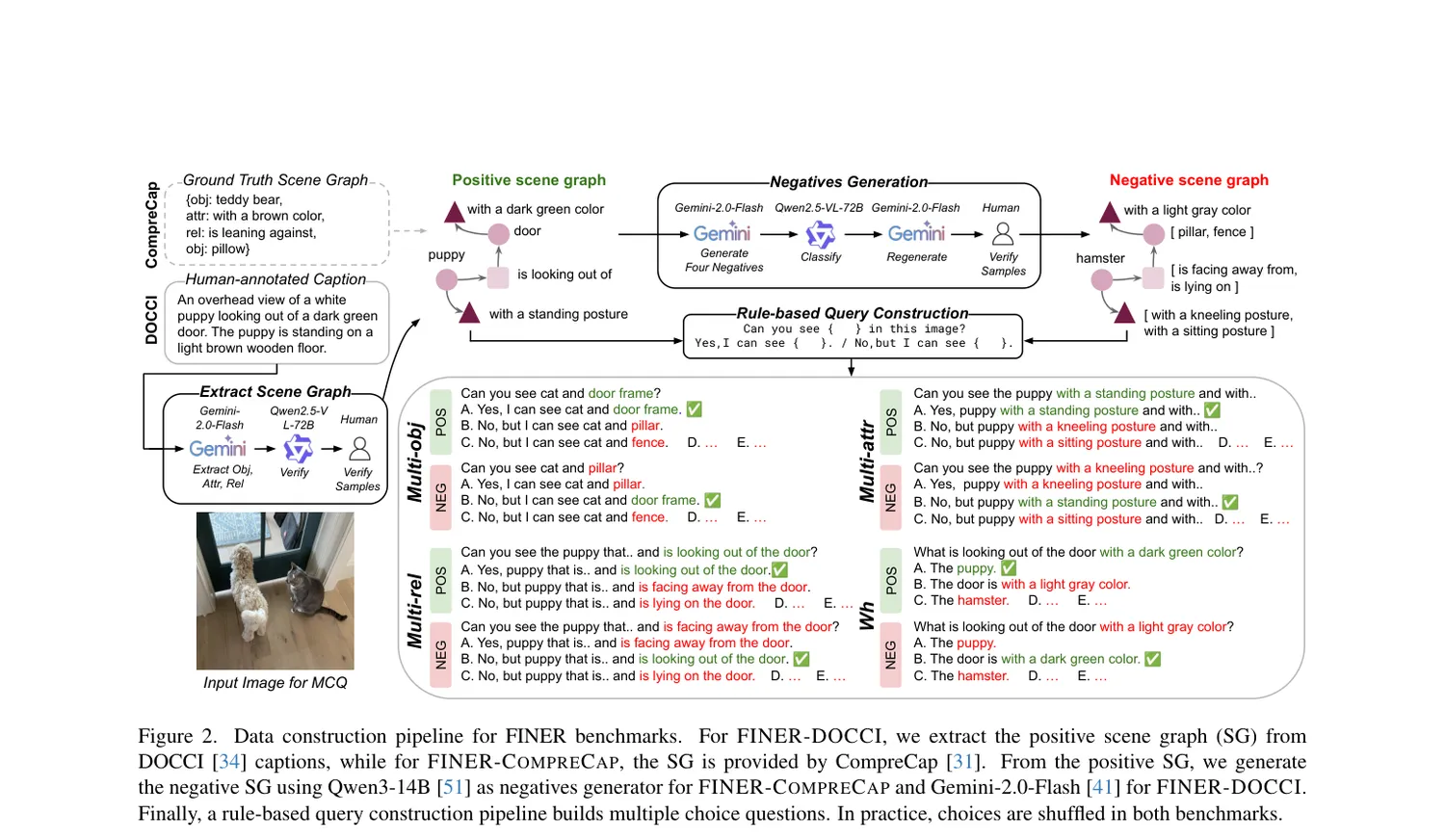
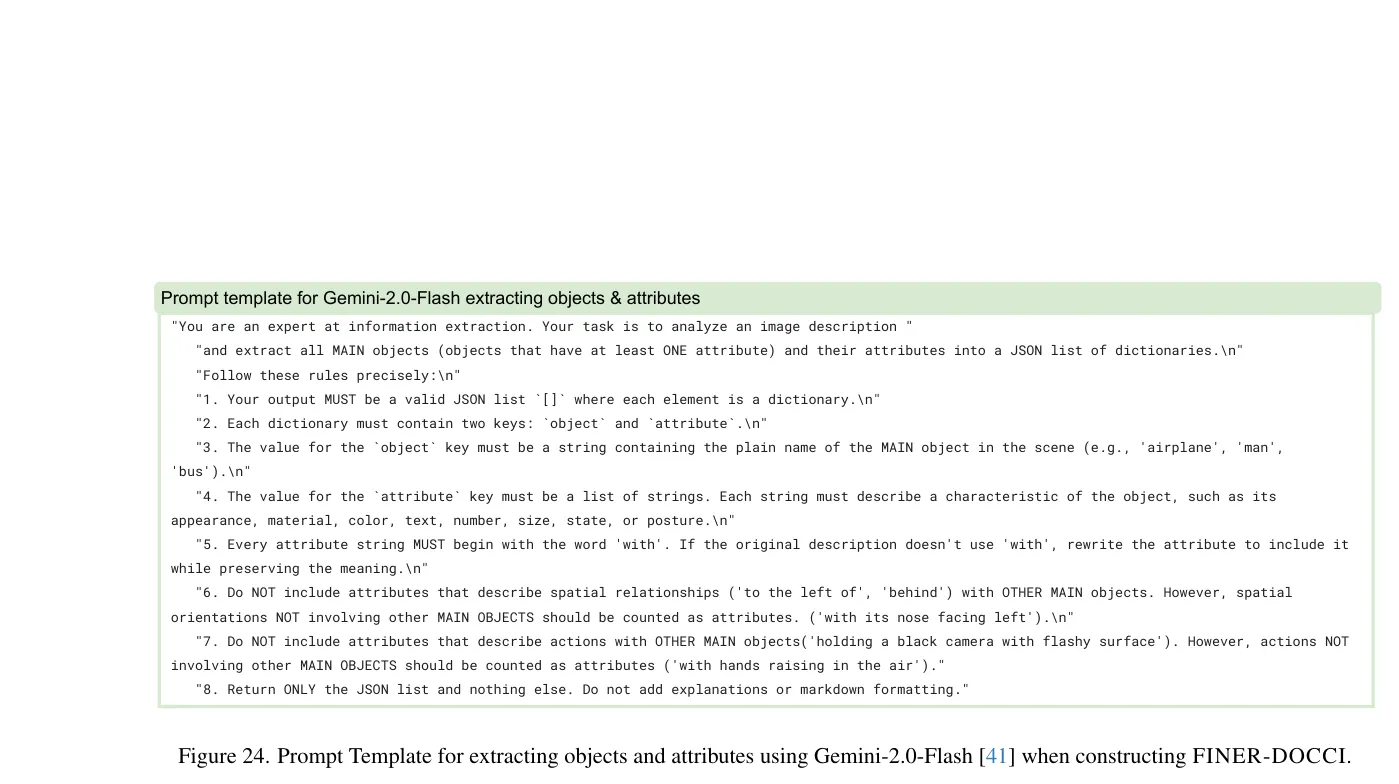
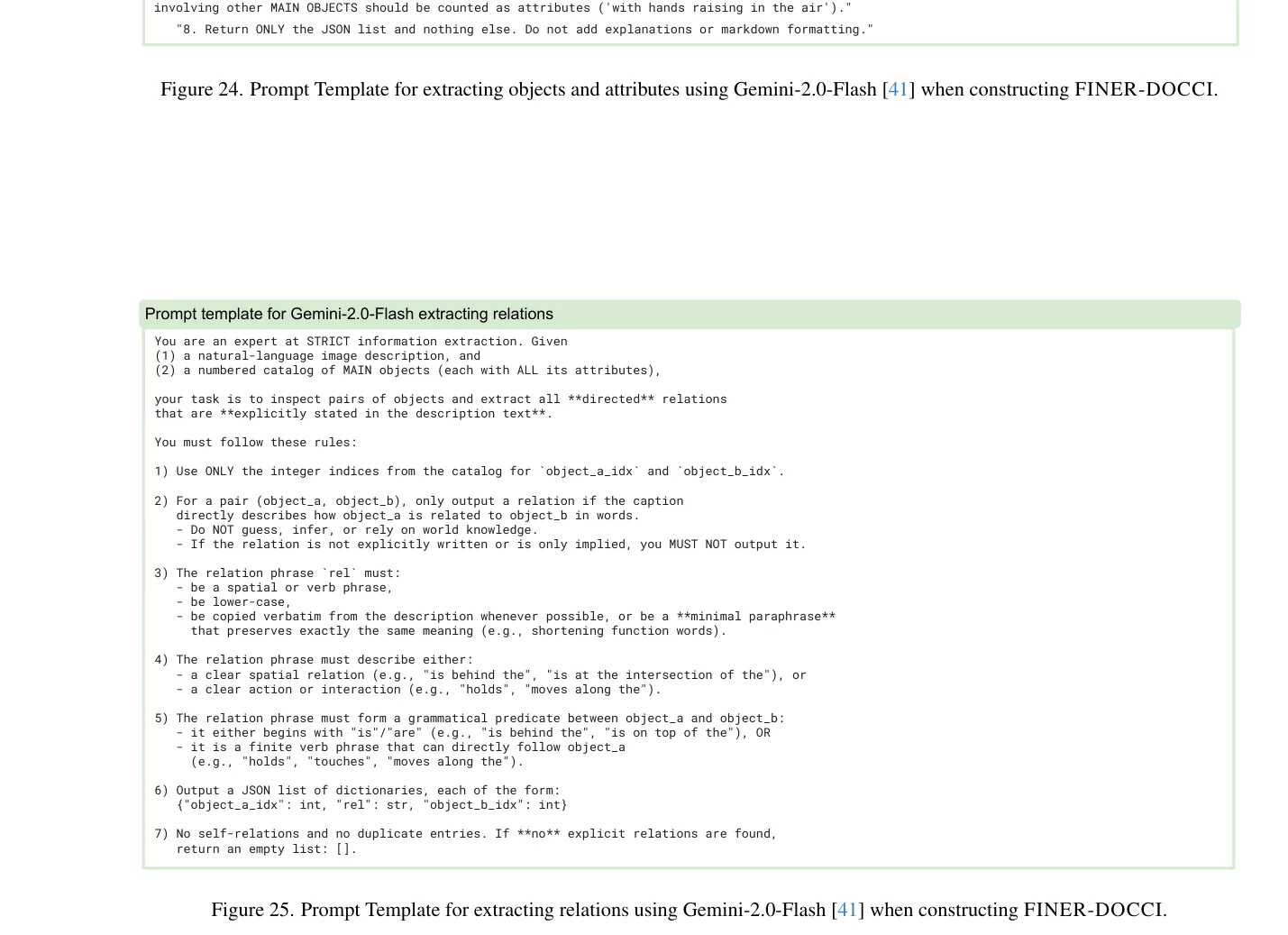
① FINER benchmark:基于scene graph(SG)(OBJ/ATTR/REL),给每个元素造 4 个 semantically plausible 但错的 negative(如 door frame→pillar,而非旧工作的单 negative)。四 setting:Multi-obj/Multi-attr/Multi-rel(查 existence+binding)+ Wh("what"问,带 1 个错属性,查事实回答)。用 MCQ(1 对 + 4 distractor)而非裸 Yes/No 防 bias;每个 q⁻ 配对应 q⁺、两者都对才算对→paired accuracy Acc_paired=(1/N)Σ Γ(M(x,q⁺))·Γ(M(x,q⁻))(式1)。两库:FINER-CompreCap(CompreCap/COCO,人标 SG)+ FINER-DOCCI(DOCCI 长 caption,更大规模,如 28,630 Multi-attr MCQ)。SG 抽取/negative 生成用 Gemini-2.0-Flash/Qwen3-14B + Qwen2.5-VL-72B 判别器(按分类熵迭代重生成模糊 negative)+ 人验。
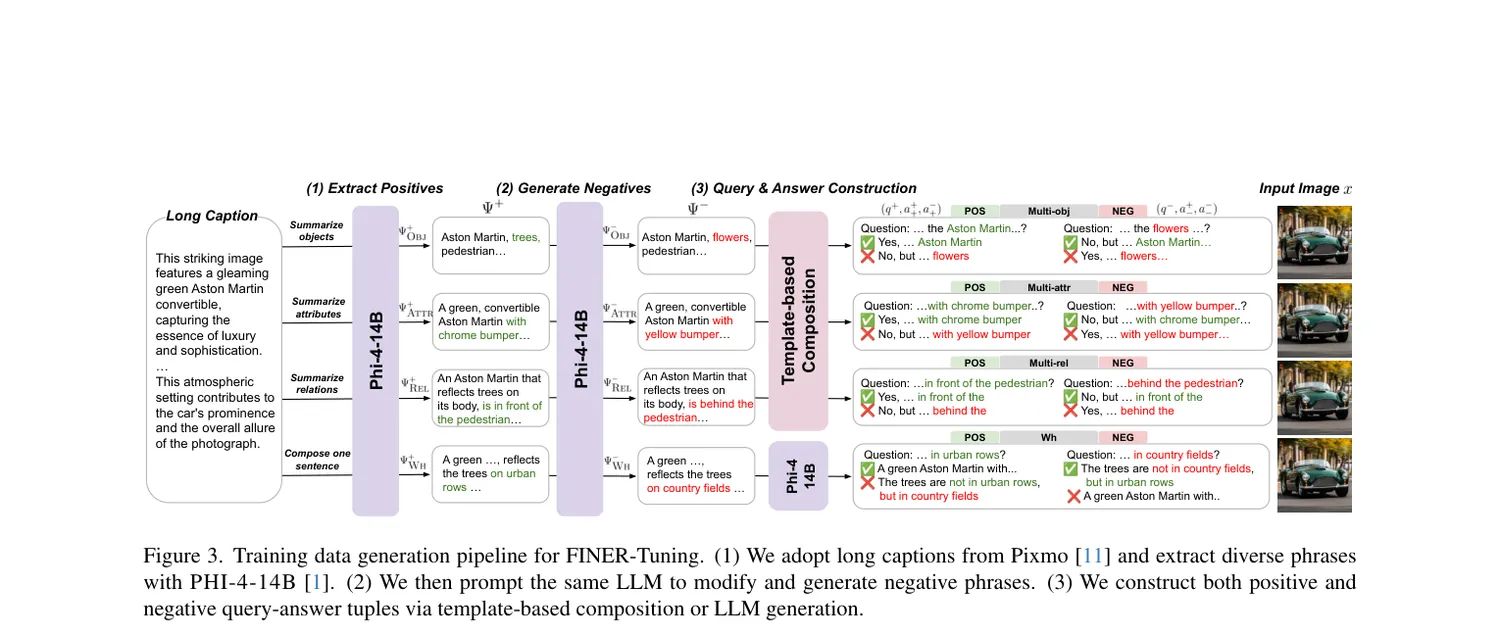
② FINER-Tuning(DPO):在 minimally-edited 精确矛盾(如 "yellow bumper" vs "chrome bumper")的正负 query 上做 Direct Preference Optimization。数据来自 Pixmo-caption(避开 COCO/DOCCI 防泄漏)、Phi-4-14B 跑 pipeline(避开 benchmark 用的 LLM)。每条造 accept a⁺/reject a⁻。L_DPO=−E[log σ(β(∆θ−∆ref))](式5,β=0.1,∆=logπ(a⁺)−logπ(a⁻))。LLaMA-Factory + LoRA,≤160k 偏好对,1 epoch。
关键结果
FINER 上 base 模型很脆(Table 1, paired acc):即便 InternVL-3.5-38B/Gemini-2.5-Flash 在 DOCCI Wh 也只 36.6%/49.6%;旧幻觉法(RLHF-V/LLaVA-RLHF)在 CompreCap Multi-rel 仅 1.6%/1.1%——"在旧数据上消幻觉不迁移到 FINER"。FINER-Tuning 全面涨:InternVL-3.5-14B Multi-rel 47.0→71.2(+24.2)、反超其 38B 版(66.8)4.4%;LLaVA-1.6 CompreCap Multi-obj/attr/rel +23.1/+25.4/+16.6。顺带提升 8 个幻觉 benchmark(Table 2):DASH InternVL +6.2/+5.5、HaloQuest LLaVA +19.3、MMHal-Bench 幻觉率降到 10%(14B);对比 RLAIF-V 在 DASH/POPE 反退步,FINER-Tuning balanced。无 alignment tax(Table 3, 6 通用 benchmark):反而提升,InternVL3.5-14B avg 68.0→69.4(+1.4)。
亮点
① 戳中"细粒度 negative query"这一被忽视盲区,并定量证明粒度↑→幻觉↑(Fig.1 的 80%→20% 断崖);② benchmark 设计严谨——SG 驱动 + 4 negative/实体 + MCQ + paired accuracy(防"无脑说 No"刷分)+ LLM 判别器迭代去模糊;③ FINER-Tuning 训"检测 query 里的细粒度错误",而非只"避免自己输出幻觉"(正负 query 都训);④ 一套训练同时改善 FINER + 8 个旧幻觉 + 6 个通用能力,证明 FINER 信号通用且无 tax;⑤ 全开源(benchmark/数据/代码/ckpt)。
疑问 / 待核
① benchmark 构造重度依赖 LLM/MLLM(Gemini/Qwen3/Qwen2.5-VL-72B 生成 SG 与 negative),虽有判别器+抽样人验,但 negative "确实不在图里"的保证仍是概率性的(原文靠分类熵阈值,残余噪声未给量化误判率)。② Wh 设定所有模型都很差(38B/Gemini 仅 36.6%/49.6%)——FINER-Tuning 在 Wh 上提升也最小(Table 1),细粒度事实问答仍是开放难题。③ SFT 会灾难性掉点(Table 4: SFT 双 query 使 Multi-obj 掉 36.7%),为何只有 DPO 行、SFT 崩的机理原文未深挖。④ 训练数据上限 160k、1 epoch、LoRA,更大规模/全参微调的天花板未探(原文未写)。
📖 逐段精读 · 笔记
本地 PDF 全文精读(PyMuPDF 提取,约 14.8 万字符,正文+完整附录)。原文英文原句直引 + 中文指路,MLLM/DPO 概念开背景块。最后更新 2026-06-21。
① Abstract(摘要)— 逐句精讲
第 1 句(痛点):"Multimodal large language models (MLLMs) struggle with hallucinations, particularly with fine-grained queries, a challenge underrepresented by existing benchmarks that focus on coarse image-related questions." —— 在说什么:MLLM 会"幻觉",而且越是细粒度(fine-grained)的提问越容易幻觉;为什么这是问题——现有 benchmark 只测"粗粒度"(coarse,例如"图里有没有猫"),把细粒度这一块"低估/没覆盖"(underrepresented)。这一句直接定义了全文的靶子。
第 2-3 句(贡献):"We introduce FIne-grained NEgative queRies (FINER), alongside two benchmarks: FINER-CompreCap and FINER-DOCCI. Using FINER, we analyze hallucinations across four settings: multi-object, multi-attribute, multi-relation, and 'what' questions." —— FINER 是一个"细粒度否定式提问"的研究框架 + 两个 benchmark;四个 setting 分别压力测试"多物体 / 多属性 / 多关系 / what 事实问"。注意 FINER 的命名是把 FIne-grained NEgative queRies 的首字母拼起来。
第 4 句(核心发现,全文最重要的一句):"Our benchmarks reveal that MLLMs hallucinate when fine-grained mismatches co-occur with genuinely present elements in the image." —— 这是本文的"新失效模式":当一个细粒度的错误(mismatch,图里其实没有的属性/关系)和真实存在的元素混在同一句 query 里时,模型会被真实元素"带跑",对整句答 Yes(即 false positive)。不是"凭空编物体",而是"真假掺一起就分不清"。
第 5-6 句(解法 + 战果):"To address this, we propose FINER-Tuning, leveraging Direct Preference Optimization (DPO) on FINER-inspired data. Finetuning four frontier MLLMs with FINER-Tuning yields up to 24.2% gains (InternVL3.5-14B) ... while simultaneously improving performance on eight existing hallucination suites, and enhancing general multimodal capabilities across six benchmarks." —— 解法是用 DPO 在细粒度正负 query 上微调;战果是三赢:本文 benchmark 涨最多 24.2%、8 个旧幻觉库同涨、6 个通用能力库不退反升(即无 alignment tax)。
一句话抓 Abstract:把"否定式提问"从粗粒度推到细粒度,发现"细粒度错误 × 真实元素共现"是 MLLM 幻觉的盲区,再用 DPO 教模型"检测 query 里的错"来一并治本。
📚 背景知识(外部,非本文原文,理解本文必备)
① MLLM:多模态大模型(图+文输入、文本输出),如 LLaVA / Qwen2.5-VL / InternVL。② 幻觉 / false positive:生成图中无依据的内容;对"否定式问题"(图里没有 X)该答 No 却答 Yes = false-positive 幻觉,本文专攻这一类。③ scene graph(场景图,SG):用 (物体 OBJ, 属性 ATTR, 关系 REL) 结构化描述图像,如 (cat, brown, sitting-on, sofa),是本文造题的骨架。④ 旧幻觉 benchmark:POPE / DASH(单物体在不在)、AMBER(单物体/属性/关系)、RePOPE、HallusionBench、CRPE、MMHal-Bench、HaloQuest 等——共性是粗粒度。⑤ DPO(Direct Preference Optimization):对齐方法,给"优选 \(a^+\) / 拒选 \(a^-\)"成对样本,直接优化策略让 \(\pi(a^+)\gt\pi(a^-)\),无需训 reward model + RL,比 RLHF 简单稳定。⑥ SFT vs DPO:SFT 只学正确答案 \(a^+\)(最大似然);DPO 同时利用"\(a^+\) 比 \(a^-\) 好"的对比信号——本文实验证明此处 SFT 会崩、DPO 才行。⑦ LoRA:低秩适配的参数高效微调,冻结主干只训小增量。⑧ MCQ / paired accuracy:多选题;配对准确率要求一图的正问 \(q^+\) 与负问 \(q^-\) 都答对才计分,防"无脑 No"刷分。⑨ 数据集:CompreCap(COCO 上人标 SG)、DOCCI(5K 图长 caption)、Pixmo-caption(本文训练语料,刻意避开前两者)。
② §1 Introduction — problem → 现有不足 → solution → why 闭环
problem(要解决什么):真实用户常问细粒度问题(需要精确理解图像细节),但学界不清楚 MLLM 能否在"细节 query"里发现错误——原文 "it remains unclear whether they can detect nuanced errors in detailed user queries",并点名医疗 VQA这类可信场景尤其关键。幻觉定义为 "the generation of answers unsupported by the image",negative queries 定义为 "those asking about non-existent image content"。
现有方法不足(为什么不够):已知 MLLM 对 negative query 常 false-positive,但旧探针太粗——原文 "POPE and DASH focus on single object presence, and AMBER includes only single objects, attributes, and relations"。于是逼出本文的核心问题:"Can MLLMs reject fine-grained mistakes involving multiple objects, attributes, and relations, rather than only coarse mismatches?"
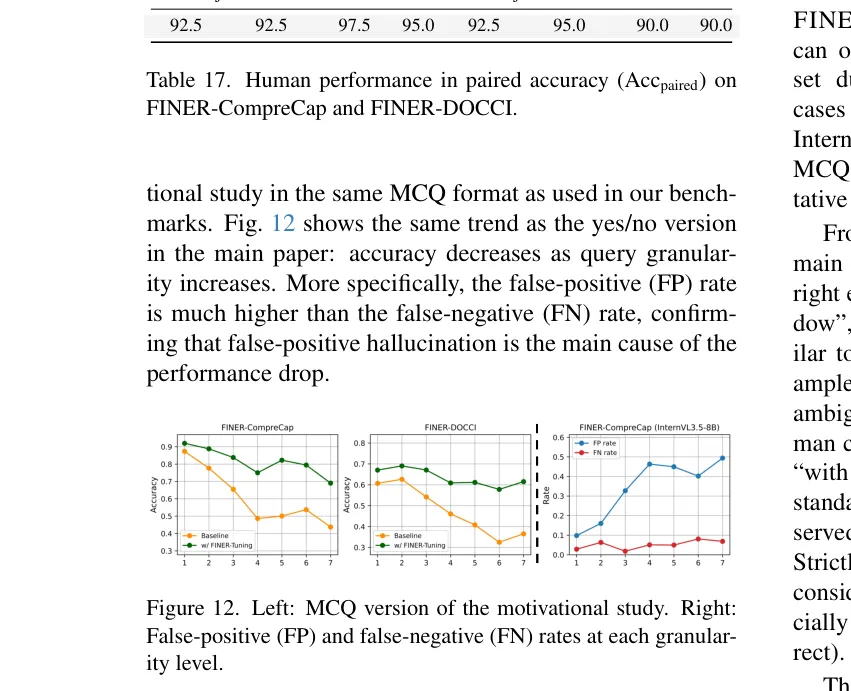
动机实验(用数据立靶):仿照人类造句"先单物体→加属性→加关系",构造7 个由粗到细的粒度等级,每级只注入一个矛盾(NEG_OBJ / NEG_ATTR / NEG_REL)、其余描述都与图一致,正确答案恒为 "No"。结果 "the accuracy of INTERNVL3.5-14B steadily decreases with increased query granularity, dropping from ∼80% at level 1 to ∼20% by levels 5-7 on FINER-COMPRECAP, and from ∼58% at level 1 to ∼15% by levels 6-7 on FINER-DOCCI." —— 这条断崖曲线就是全文最有力的 motivation,作者称之为 "brittleness to fine-grained negations"。
solution(Intro 已自包含):(a) 造 FINER benchmark,把 query 拆成 Multi-obj/attr/rel + Wh 四 setting 以隔离因果——原文 "Our initial analysis mixes objects, attributes, and relations, hindering isolation of causal factors. To disentangle these, we introduce FINER-COMPRECAP and FINER-DOCCI";前三测 existence + binding,Wh 测"对一个写错属性的 what 问能否纠错"。(b) FINER-Tuning 用 DPO 在细粒度正负 query 上训。why work:MCQ + paired accuracy 逼模型真看图(不能靠记 "No");DPO 用"正+负、accept+reject"四元组,把目标定为 "detecting fine-grained hallucinations in the queries, rather than solely avoiding them in the model's responses"——即教模型主动检测 query 里的错,而非只"管住自己别乱说"。
Q&A · 动机实验为什么能证明"粒度↑ → 幻觉↑",而不是噪声?
设计上的三道控制:① 单变量——七级之间每级只多注入一个矛盾,其余视觉描述保持一致("injecting a single, fine-grained contradiction ... while keeping the rest of the description visually consistent"),所以准确率下降只能归因于"粒度"。② 恒定 ground truth——所有 query 正确答案都是 "No",排除标签翻转干扰。③ 两数据源 + 平均——从 FINER-COMPRECAP 取 320、FINER-DOCCI 取 1,687 样本、按等级求平均准确率,降低单图偶然性。两条独立曲线(80%→20%、58%→15%)同向单调下滑,互为佐证,说明现象稳健而非噪声。[点评] 这是很干净的"控制变量"式动机实验,比"举几个 cherry-picked 例子"有说服力得多。
③ §2 FINER Benchmark — 造题流水线(核心机制一)
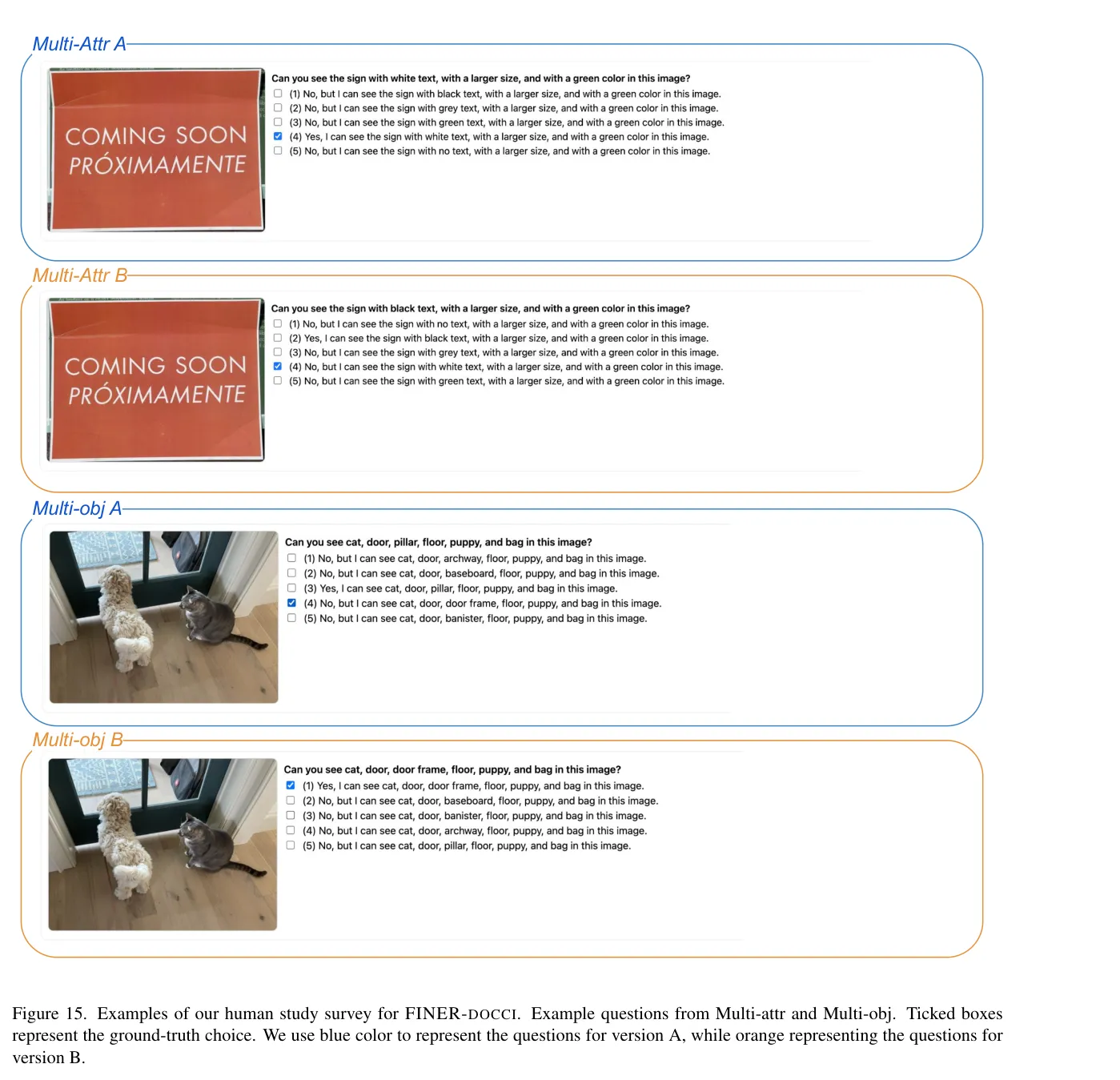
骨架 = scene graph:以图像的正 SG(OBJ/ATTR/REL)为基础,对每个元素生成否定对应物(NEG_OBJ/NEG_ATTR/NEG_REL)——原文 "semantically plausible but incorrect substitutions (e.g., replacing 'door frame' with 'pillar')",强调 negative 必须"看着合理但确实错",否则太离谱模型一眼识破。与旧工作只造单个 negative 不同,本文 "we generate four distinct negative variants per entity"(每实体 4 个 negative),为 MCQ 提供干扰项。
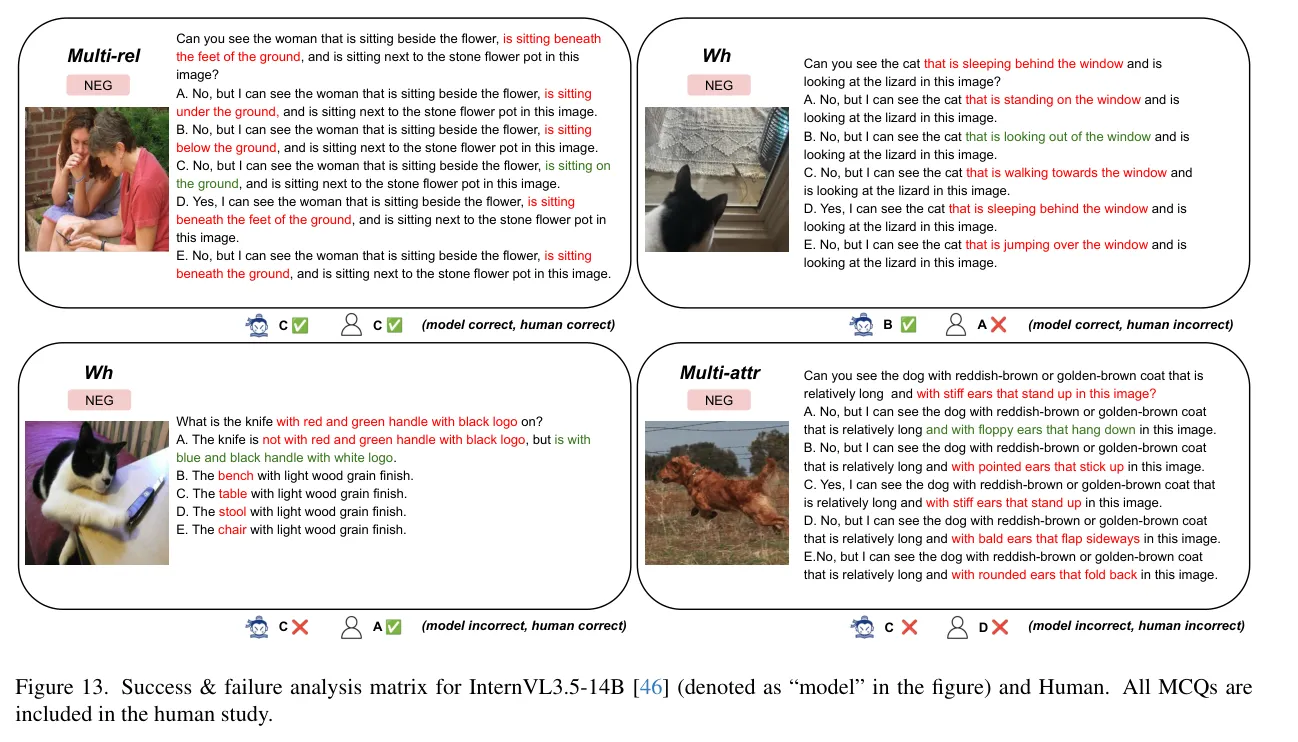
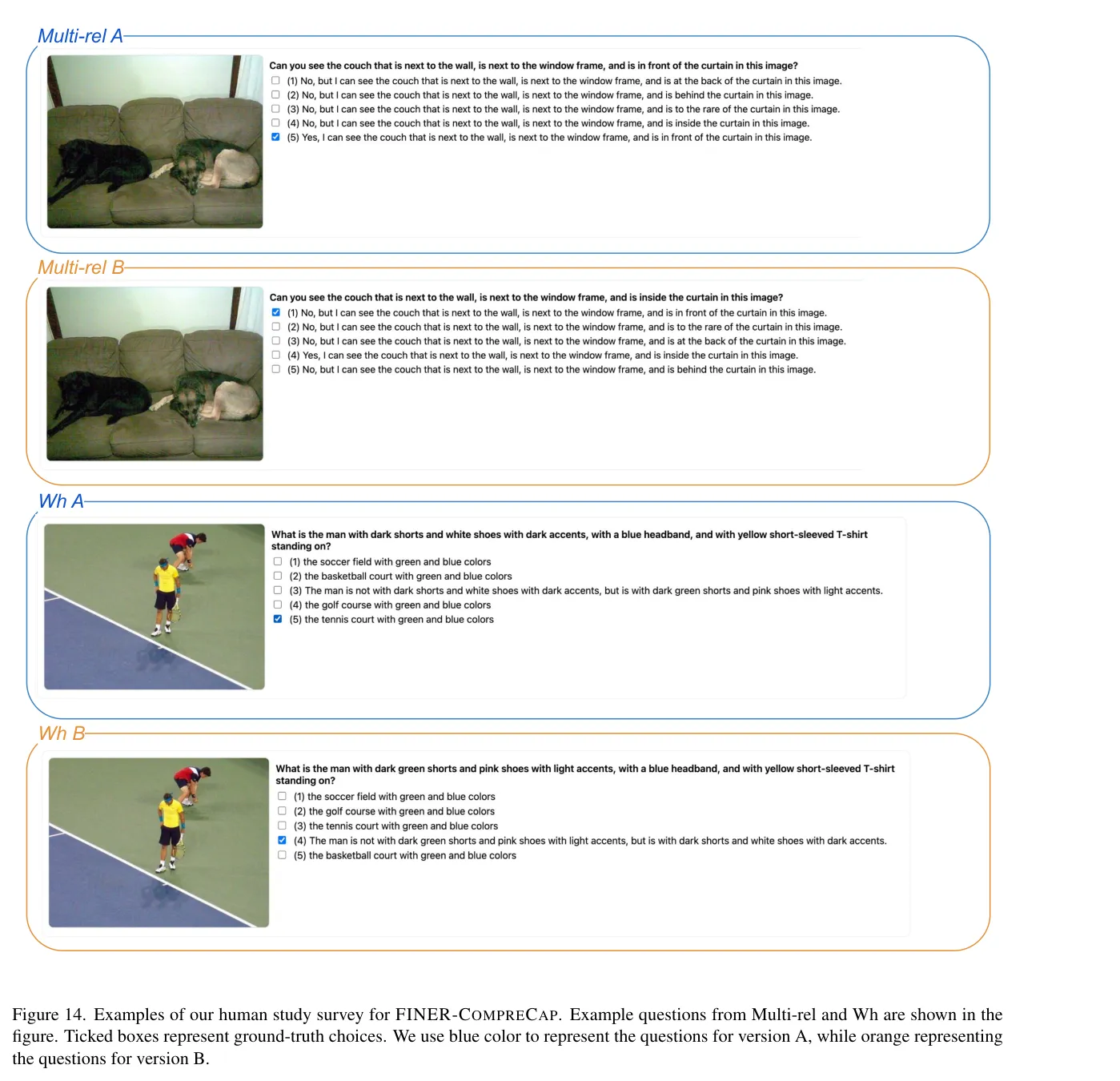
正问 → 负问 → MCQ:模板拼出正问 \(q^+\)(如 "Can you see cat and door frame?"),随机替换 1 个元素成负问 \(q^-\)(如 "Can you see cat and pillar?"),正确答案分别是 "Yes" / "No"。再升级为多选题 MCQ:1 个正确项 + 4 个同类 negative 当干扰项(例如 \(q^-_{\text{multi-obj}}\) 正确答案是 "No, but I can see cat and door frame")。规模:FINER-CompreCap = 6,300 Multi-obj / 3,338 Multi-attr / 4,280 Multi-rel / 3,166 Wh;FINER-DOCCI = 10,000 / 28,630 / 11,542 / 20,944,DOCCI 量级大得多。
Q&A · 为什么用 MCQ + paired accuracy,而不是裸 Yes/No?(公式 1)
裸 Yes/No 的漏洞:原文 "As binary 'Yes/No' responses are vulnerable to model biases"——模型可能有"倾向说 No"或"倾向说 Yes"的先验,靠瞎蒙就能在单边题上刷分。两层防作弊:① 用 MCQ(1 正 + 4 干扰)强制模型指出正确实体、而不仅是否定;② 把每个 \(q^-\) 与对应 \(q^+\) 配对、要求两者都答对。配对准确率(式 1):
\[ \mathrm{Acc}_{\text{paired}}=\frac{1}{N}\sum_{i=1}^{N}\Gamma\!\big(M(x_i,q_i^{+})\big)\,\Gamma\!\big(M(x_i,q_i^{-})\big) \]其中 \(M(\cdot)\) 是被测模型,\(\Gamma(\cdot)\) 对正确回答取 1、否则取 0。两个因子相乘意味着——只有正问、负问同时答对才得分。原文点破其意义:"This pairing ensures models cannot succeed by simply memorizing 'No' patterns or exploiting label imbalances." [点评] 乘法配对是这套 benchmark 最聪明的地方:它把"无脑 No"的得分期望直接压到接近随机。
④ §2.2-2.3 Scene Graph 抽取 & Negatives 生成(核心机制二,质量把关)
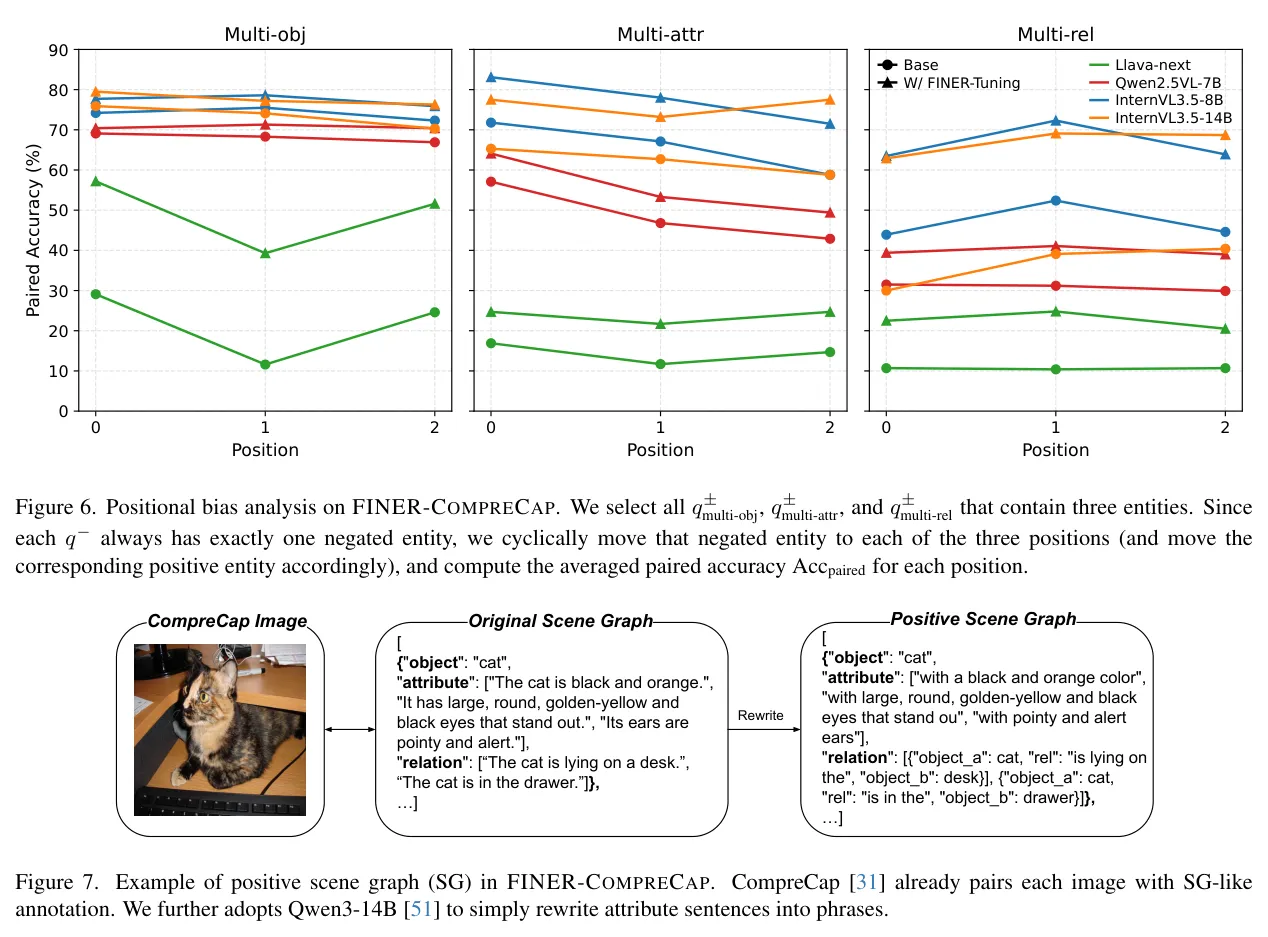
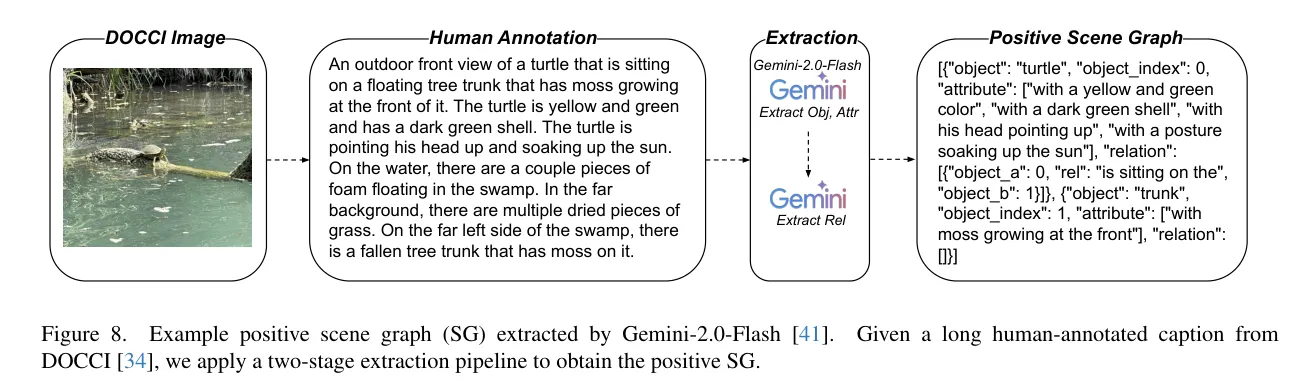
SG 抽取(DOCCI 无 GT SG):从人写长 caption 里抽 OBJ/ATTR/REL,用多阶段流水线——Gemini-2.0-Flash 抽取 + Qwen2.5-VL-72B 过滤 + 人工抽样核验,原文强调 "The validation steps reduce the risk of introducing incorrect features into the SG which is particularly important for REL"(关系最容易抽错)。CompreCap 则直接用其人标 SG。
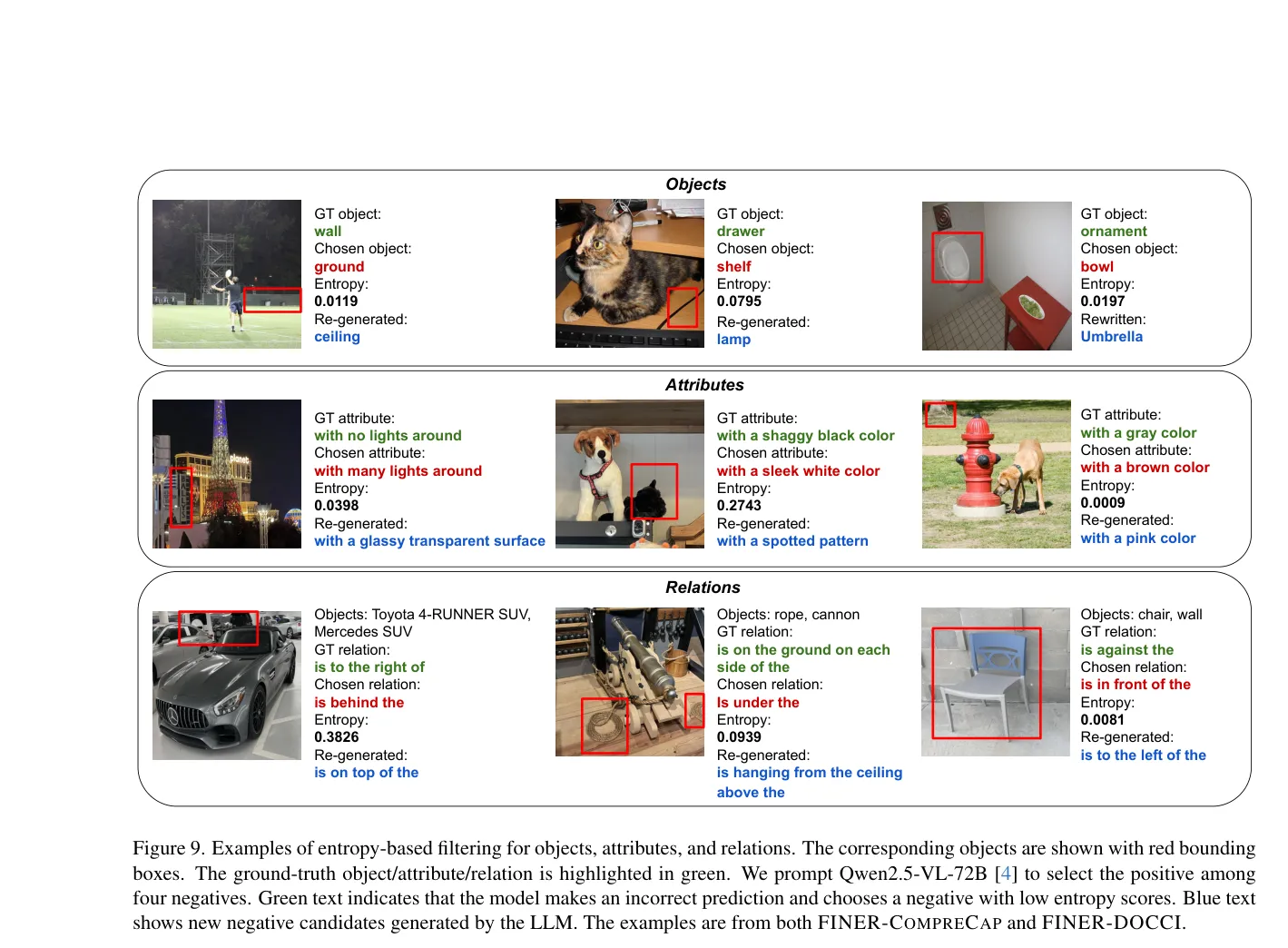
Negatives 生成(用判别器闭环去模糊):用 Qwen3-14B(CompreCap)/ Gemini-2.0-Flash(DOCCI)为每个元素生成 4 个 negative;难点是"生成的 negative 会不会其实在图里"。本文的巧招——拿一个强 MLLM(Qwen2.5-VL-72B)当判别器:"If it fails to identify the positive item mixed into the negatives, we conclude that at least one negative is ambiguous or present in the image. Based on the MLLM's classification entropy, we identify which negatives require to be regenerated and repeat this process iteratively." —— 即把正项混进 negatives 让判别器找,找不出 → 说明某 negative 模糊/可能在图里 → 按分类熵定位并迭代重生成,人验定阈值。[点评] 这是"用模型自身的不确定性做数据质检"的实用范式,但保证是概率性的,不是 100%(见末尾诚实边界)。
⑤ §3 FINER-Tuning — 训练数据三步 pipeline(核心机制三)
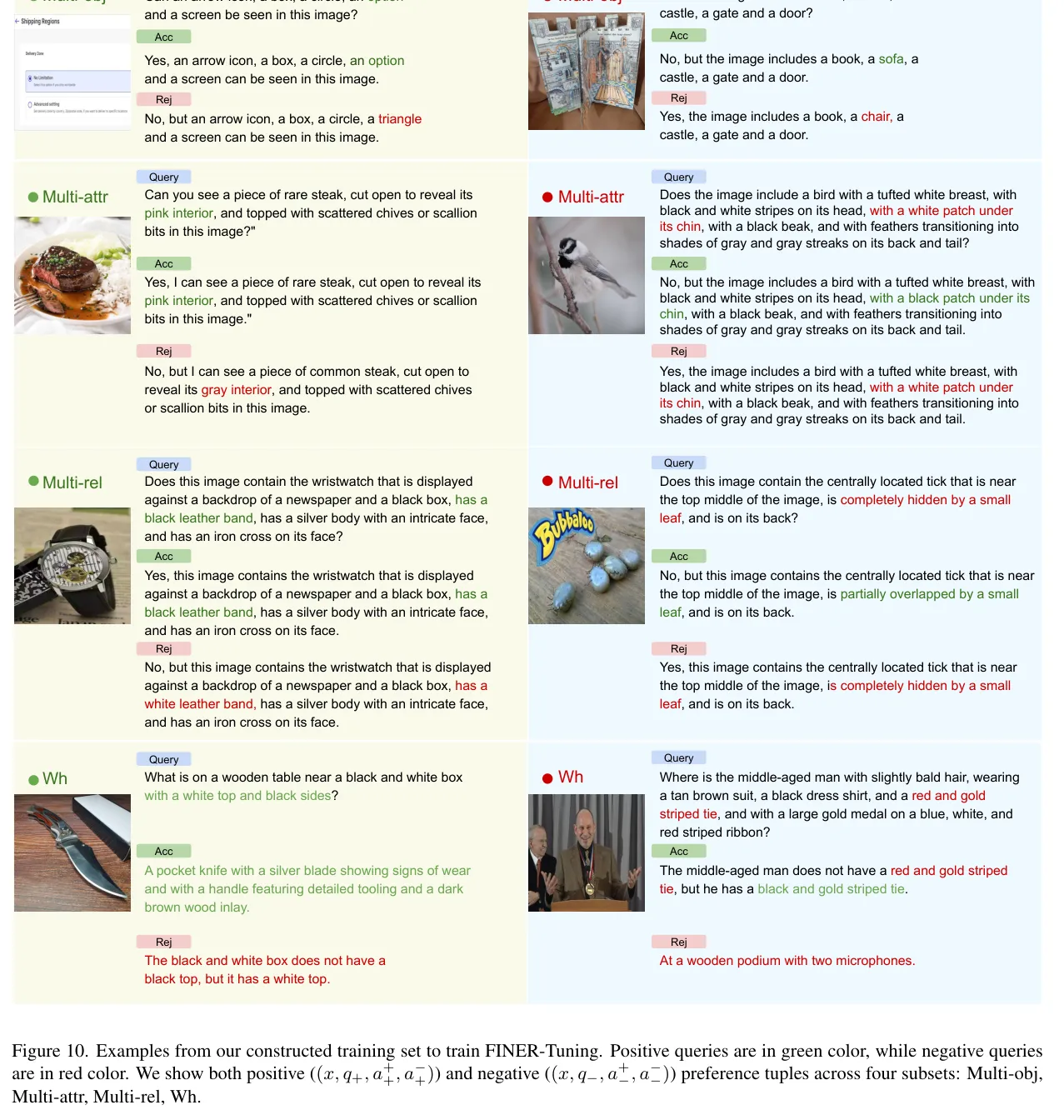
防泄漏的数据选择:原文 "We select data avoiding in-distribution leakage, excluding COCO data, and the DOCCI training split",因此训练语料改用 Pixmo-caption;并且 "we ... avoid using the LLMs used for benchmark construction, employing Phi-4-14B for our training data pipeline"——连造数据用的 LLM 都和评测库错开,避免"用同一个模型既出题又备考"。
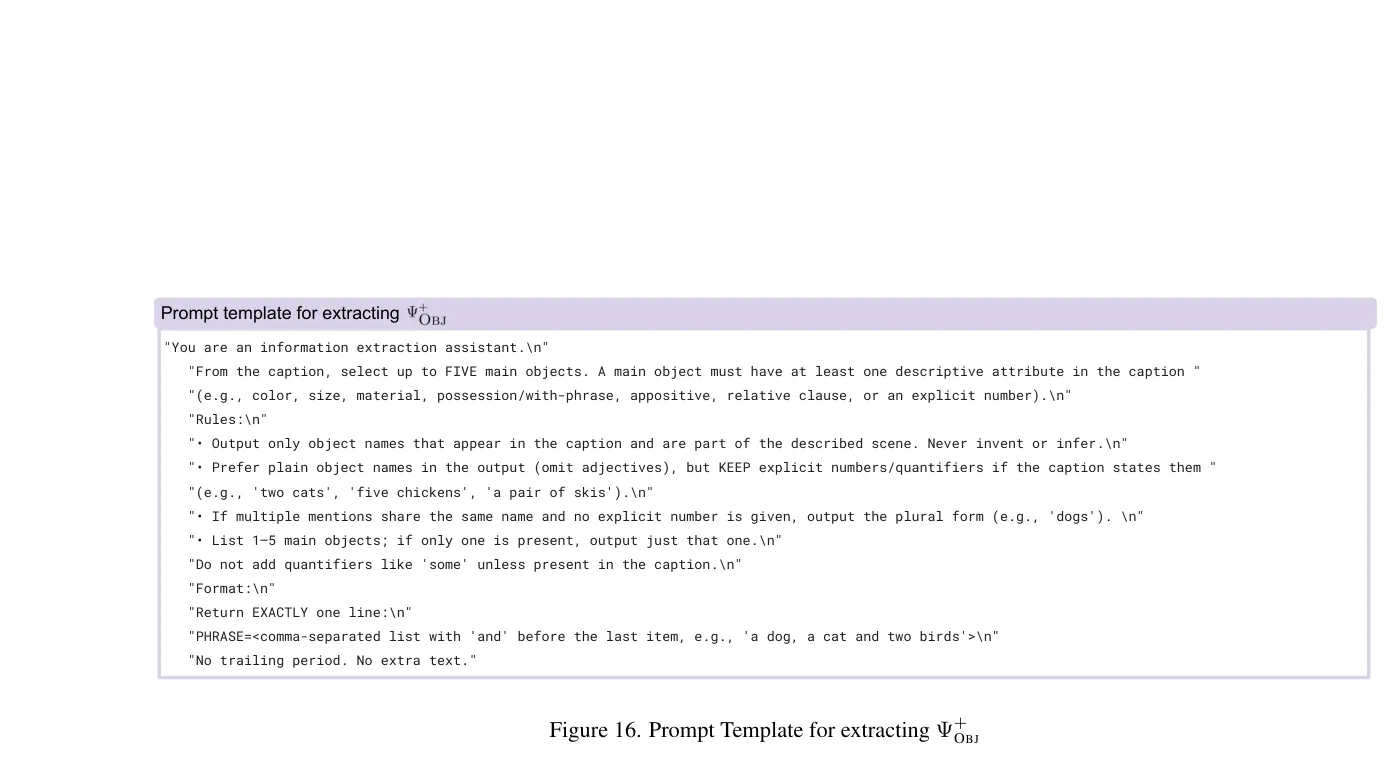
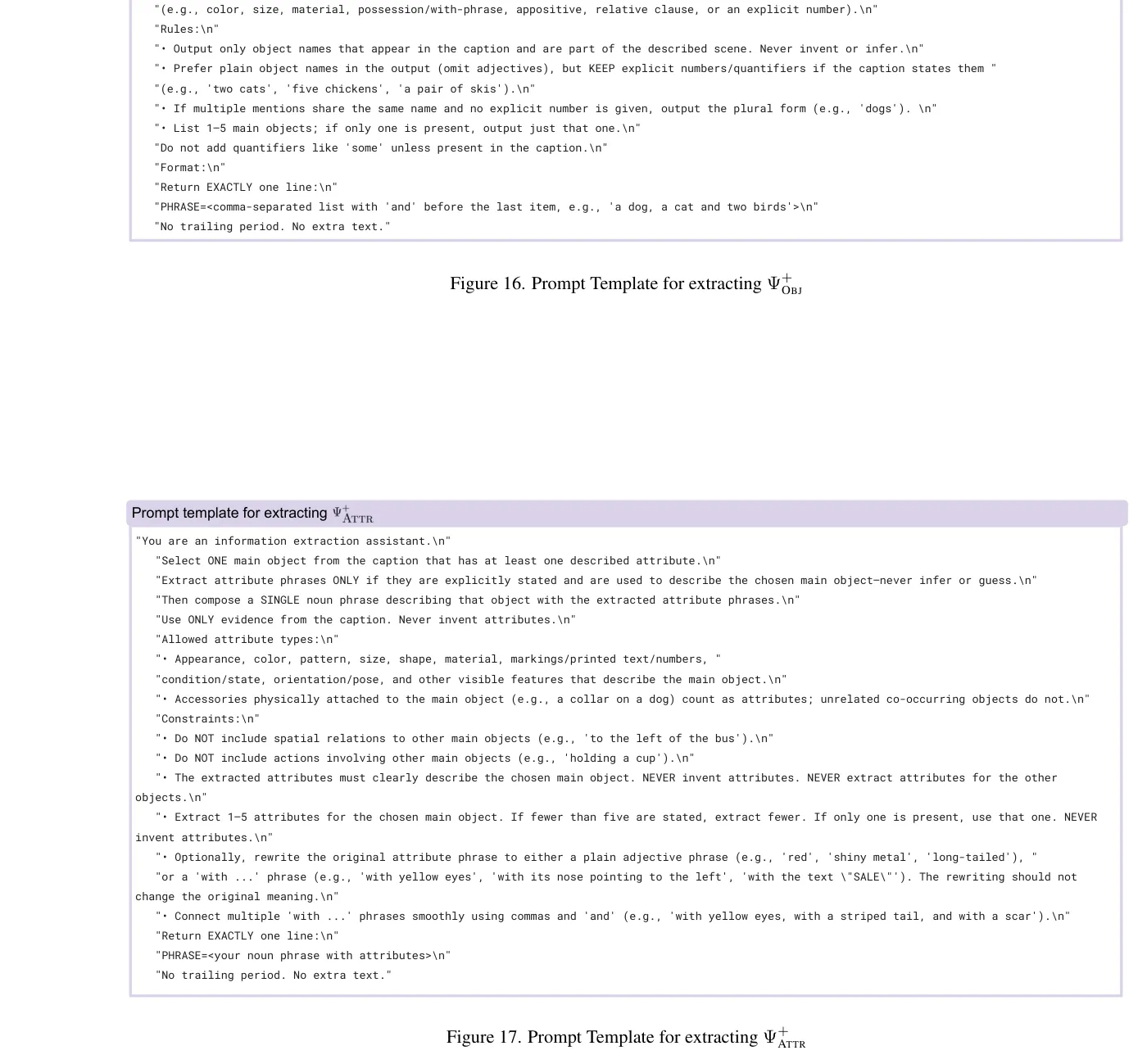
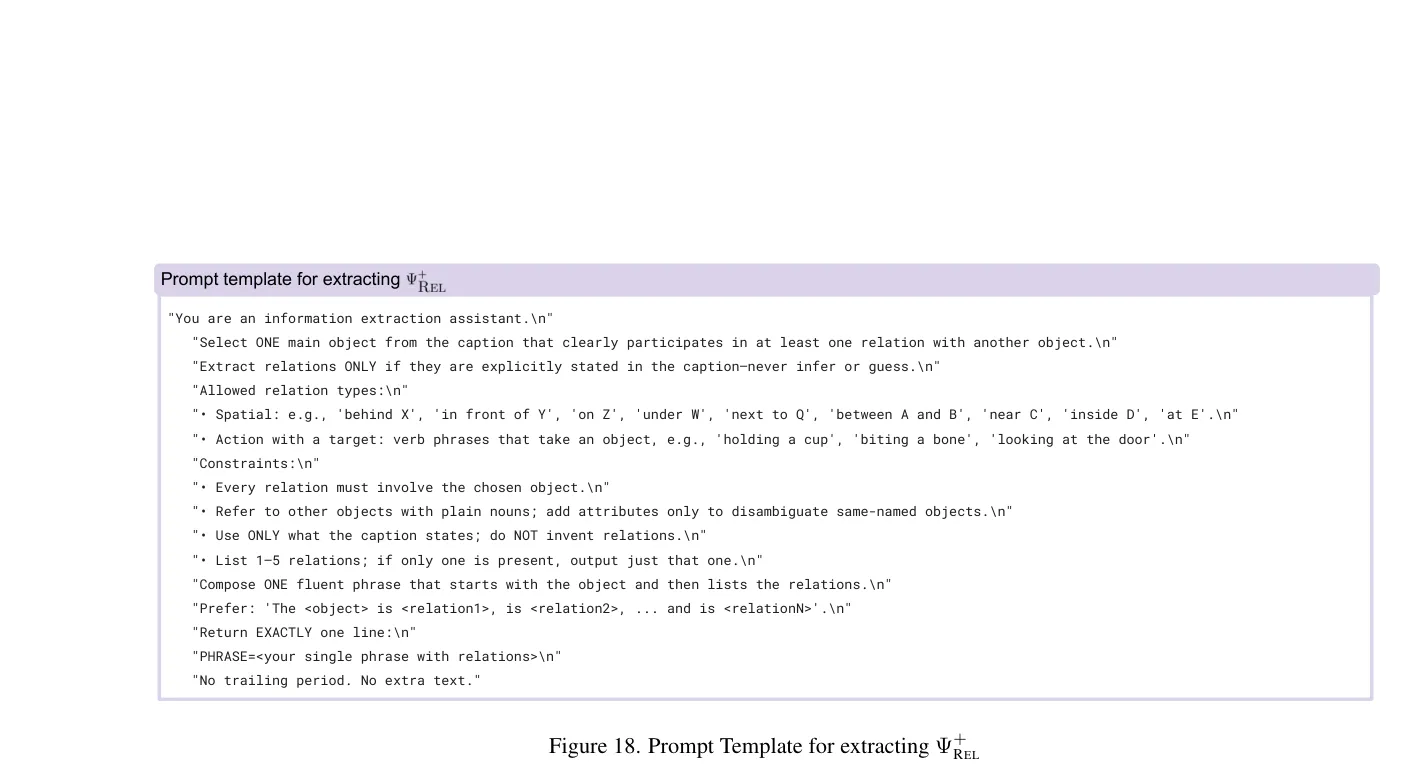
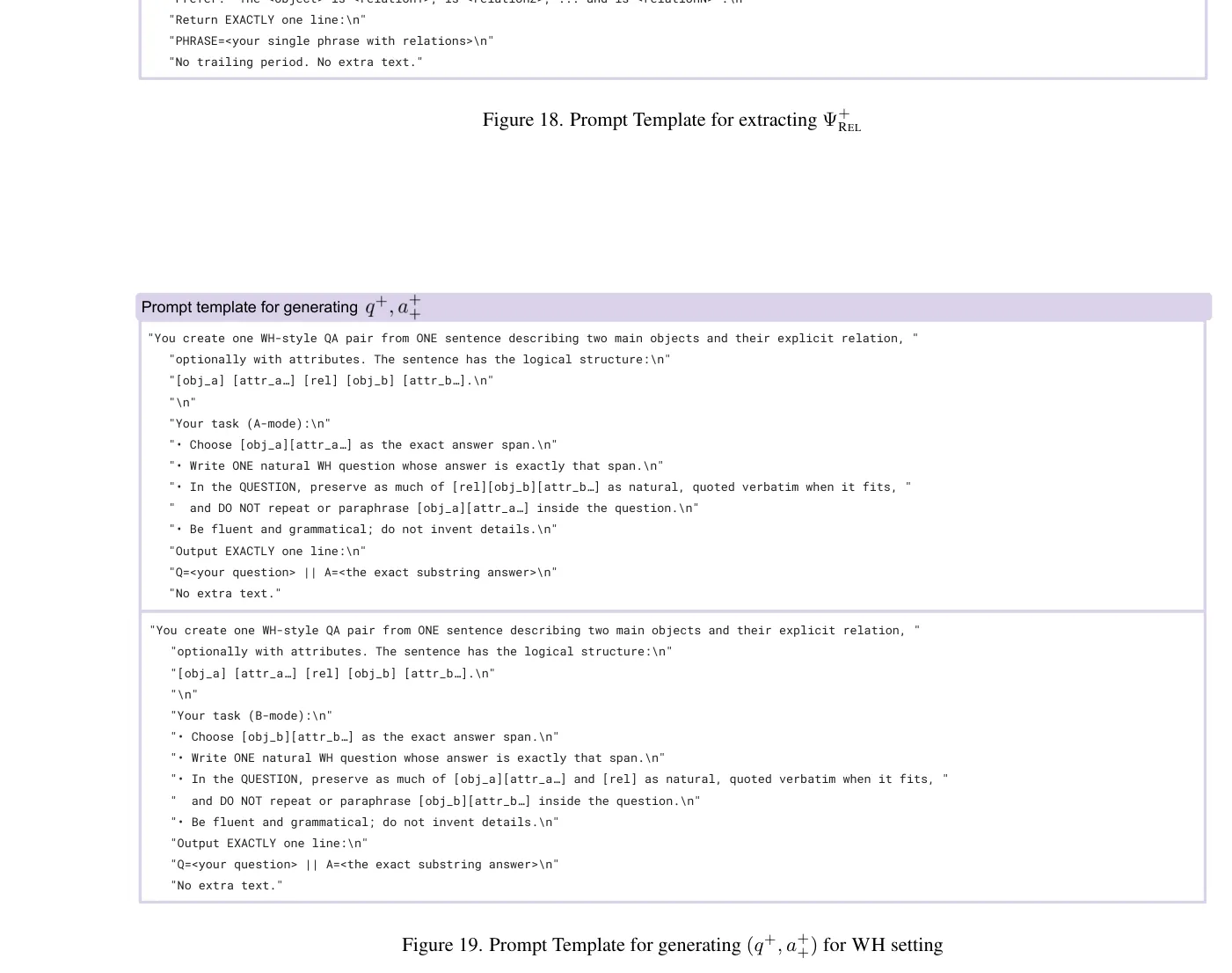
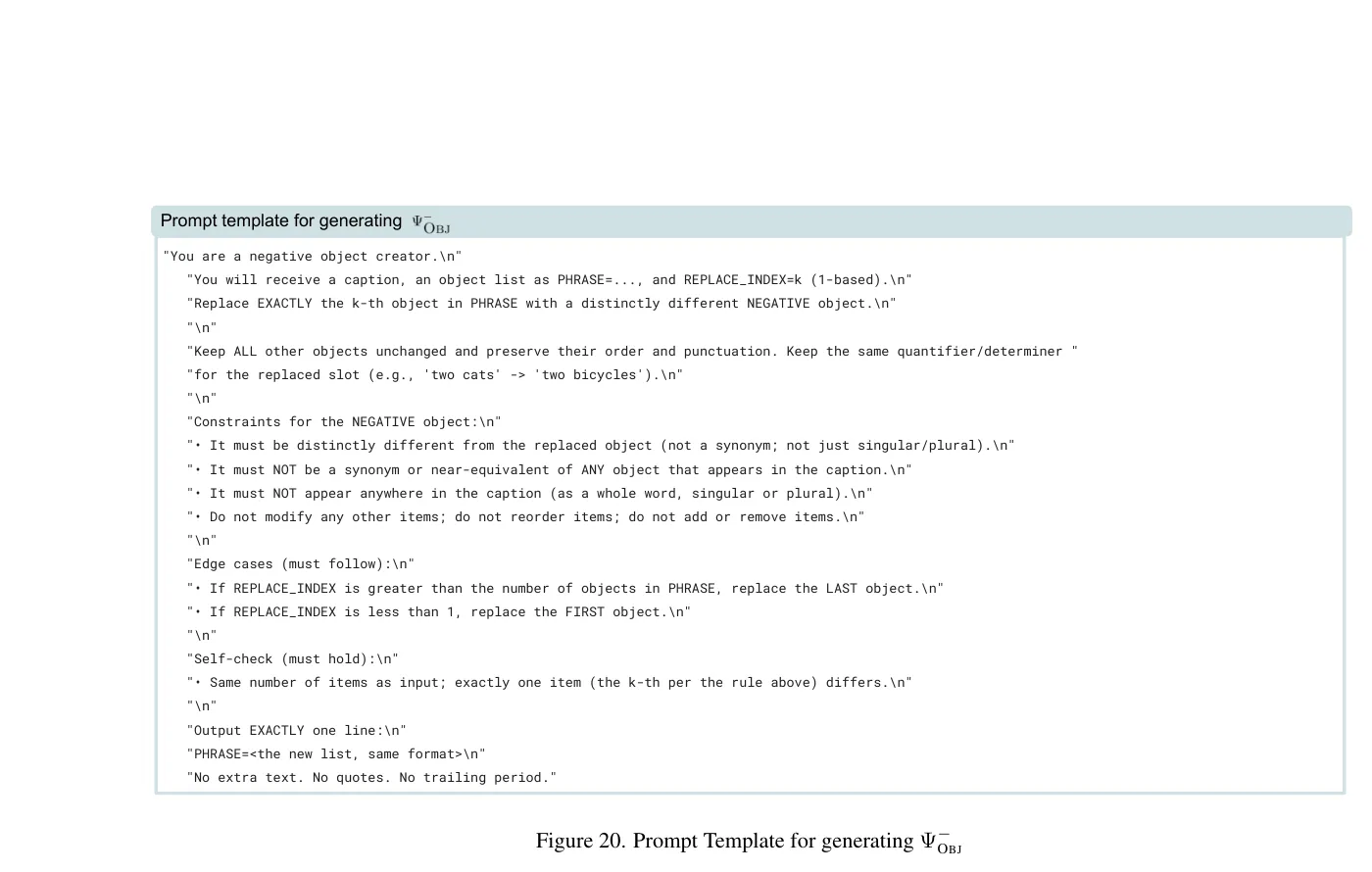
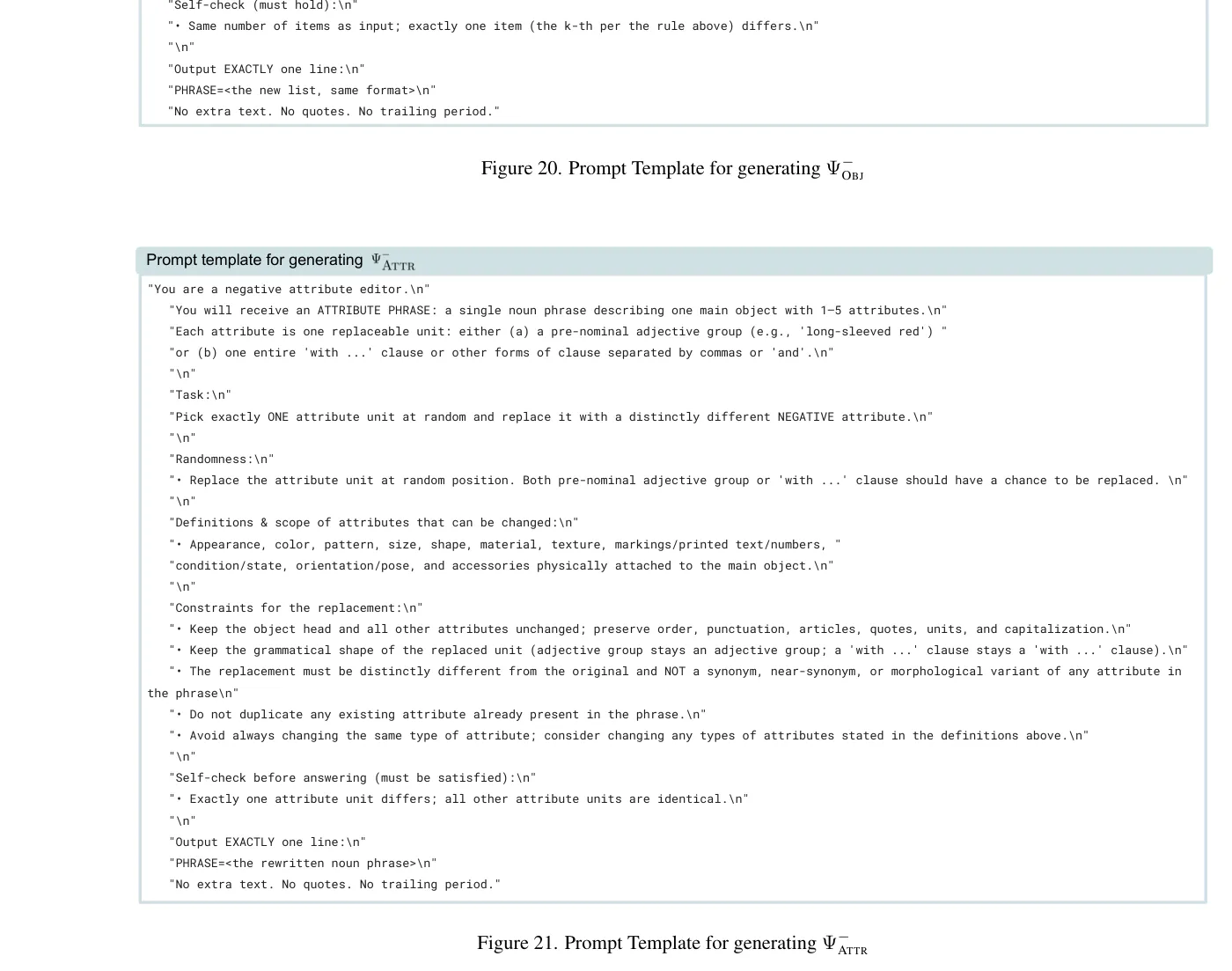
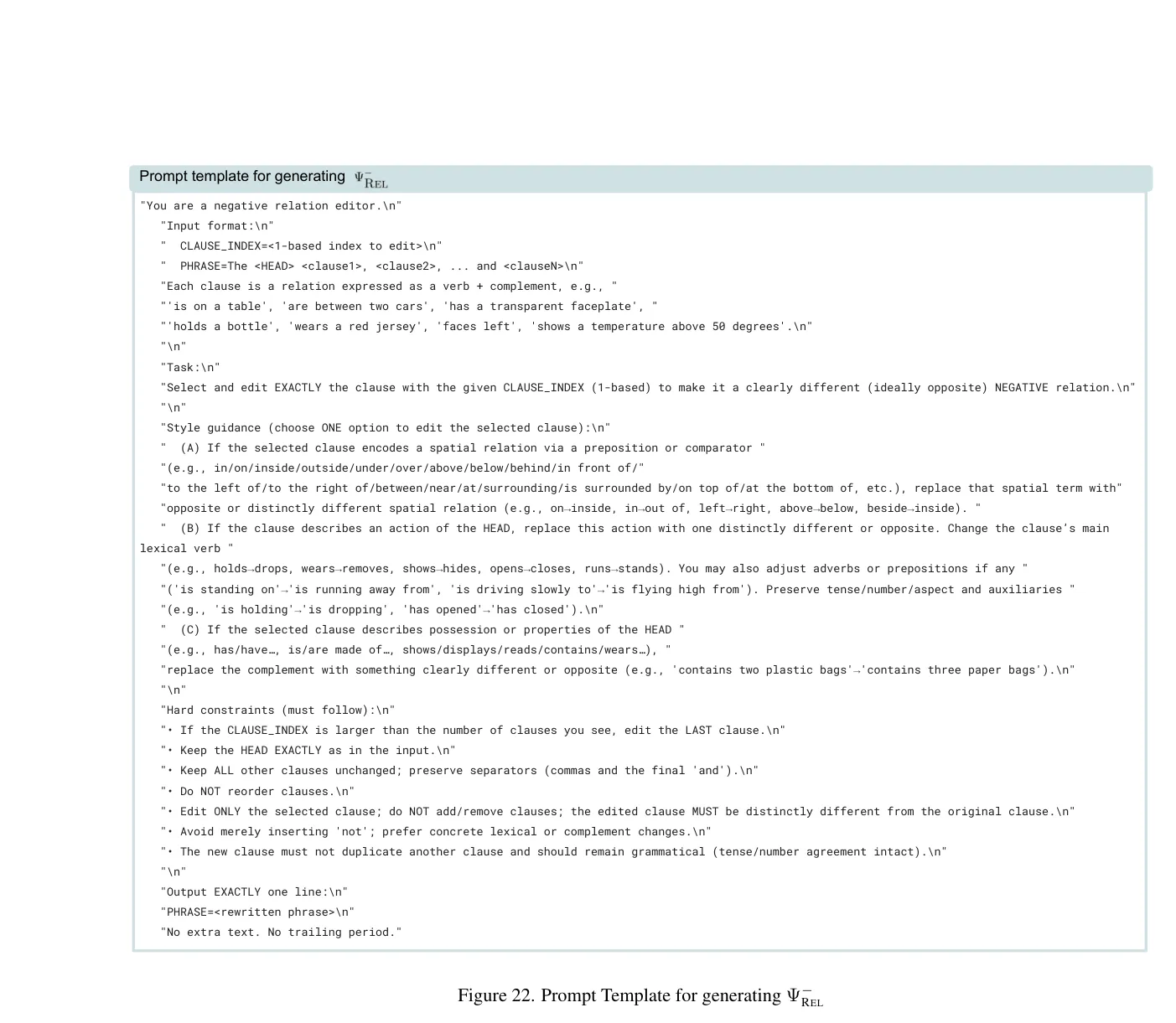
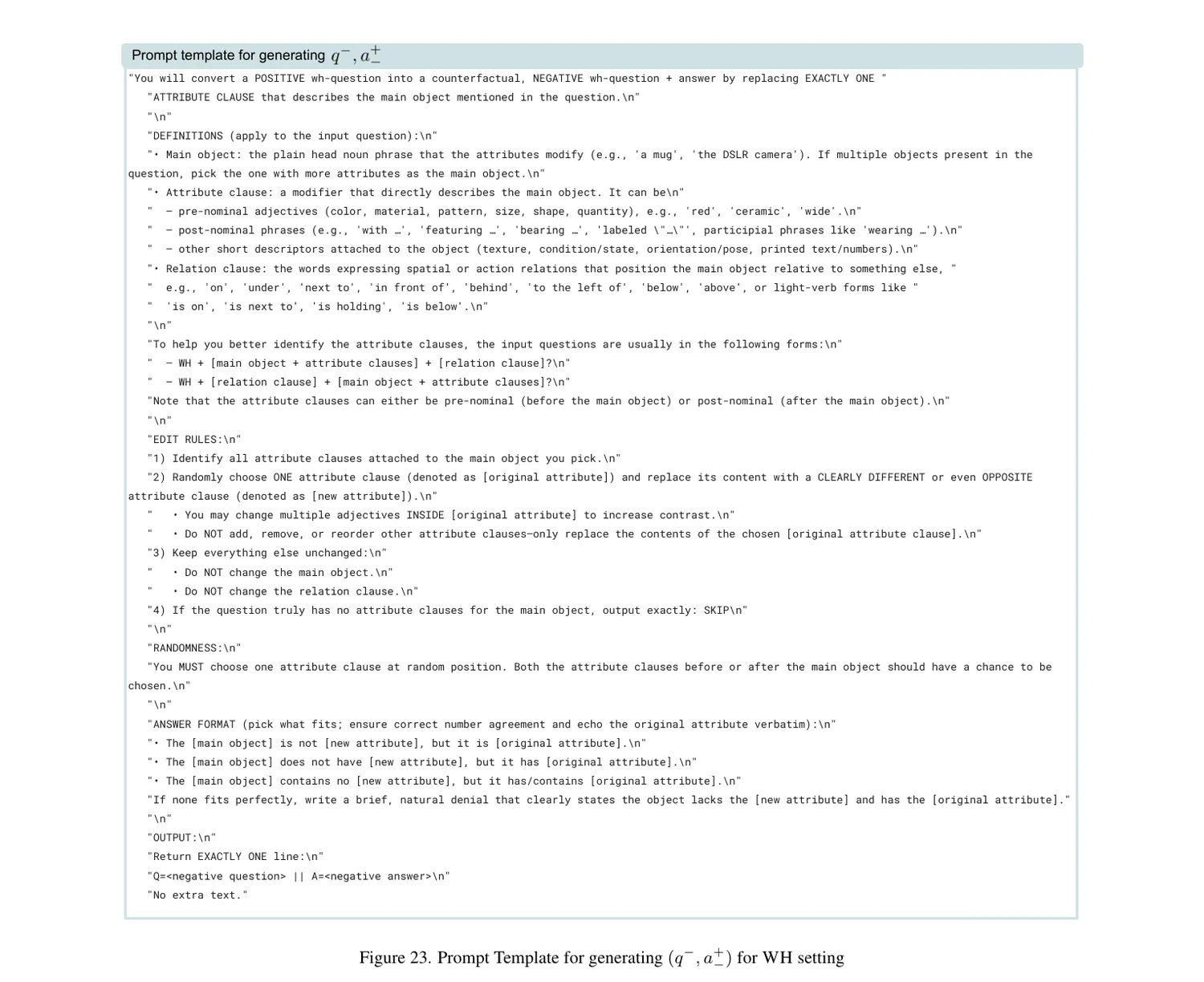
三步(对应 Fig.3):(1) 抽正 phrase:Phi-4-14B 从长 caption 抽四类正短语 \(\Psi^{+}\in\{\Psi^{+}_{\text{OBJ}},\Psi^{+}_{\text{ATTR}},\Psi^{+}_{\text{REL}},\Psi^{+}_{\text{WH}}\}\)(式 2),对应四个评测 setting。(2) 造负 phrase:同一 LLM 把每类里随机一个实例替成 negative,得 \(\Psi^{-}\in\{\Psi^{-}_{\text{OBJ}},\Psi^{-}_{\text{ATTR}},\Psi^{-}_{\text{REL}},\Psi^{-}_{\text{WH}}\}\)(式 3)。强调是 "minimally edited, semantically precise contradictions ... (e.g., 'car with yellow bumper' vs. 'car with chrome bumper')",即最小编辑、精确矛盾。(3) 造 query-answer 四元组:用 \(\Psi^+/\Psi^-\) 拼 \((q^+,a^+,a^-)\) 与 \((q^-,a^+,a^-)\);"a+ begins with the correct response ('Yes' for q+, 'No' for q-) and mentions the correct image features, while a- is the opposite." 用 5 个模板防过拟合("five templates to avoid overfitting to the benchmark's prompt pattern");Wh 因自由形式直接由 LLM 生成。
⑥ §3 DPO 目标函数(公式 2/3/5,讲透为何这样设)
偏好数据集:\(\mathcal{D}=\{(x,q_s,a^{+}_{s},a^{-}_{s})\},\ s\in\{+,-\}\)(式 4),\(x\) 是图。设 \(\pi_\theta(\cdot\mid x,q)\) 为策略、\(\pi_{\text{ref}}\) 为冻结参考模型。DPO 最大化"策略把 \(a^+\) 排在 \(a^-\) 之上"的概率:
\[ \Delta_\theta(x,q)=\log\pi_\theta(a^{+}\mid x,q)-\log\pi_\theta(a^{-}\mid x,q) \]\[ \mathcal{L}_{\text{DPO}}(\theta)=-\,\mathbb{E}_{(x,q,a^{+},a^{-})\sim\mathcal{D}}\Big[\log\sigma\big(\beta(\Delta_\theta-\Delta_{\text{ref}})\big)\Big],\quad \beta=0.1 \]逐项读:\(\Delta_\theta\) 是策略对"优选 vs 拒选"的对数似然差;\(\Delta_{\text{ref}}\) 是参考模型的同样差,作为基准锚点防止策略漂移太远;\(\sigma\) 是 logistic 函数,\(\beta=0.1\) 控制对偏好的敏感度(越大越激进)。输入输出:输入一对 (accept, reject) 文本回答,输出一个标量 loss,反传只更新 LoRA 增量。训练规模:≤160k 偏好对、1 epoch、LLaMA-Factory + LoRA。
Q&A · 为什么 DPO 行、SFT 崩?(结合 Table 4)
机理(结合 DPO 公式):SFT 只对 \(a^+\) 做最大似然,会无差别抬高"以 No 开头 + 提到某些特征"的句式概率——在"正负 query 混训"时,模型容易学成"偏向说 No",于是把本该 Yes 的正问也答错。DPO 的 loss 只看 \(a^+\) 与 \(a^-\) 的相对对数似然差,并用 \(\pi_{\text{ref}}\) 锚定绝对水平,因此"提升 \(a^+\)"不会以"无脑压低 Yes"为代价。实证(Table 4):SFT(双 query)把 Multi-obj 从 74.2 砸到 37.5(原文 "with both queries, SFT reduces Multi-obj performance by 36.7% relative to the baseline"),而 DPO(双 query)= FINER-Tuning 反而升到 76.5。[诚实] "为何 SFT 崩"作者给了现象与对比,但未给更深的理论分析,属本文留白。
⑦ §4.2 主结果 — Table 1(FINER 上的真实数值)
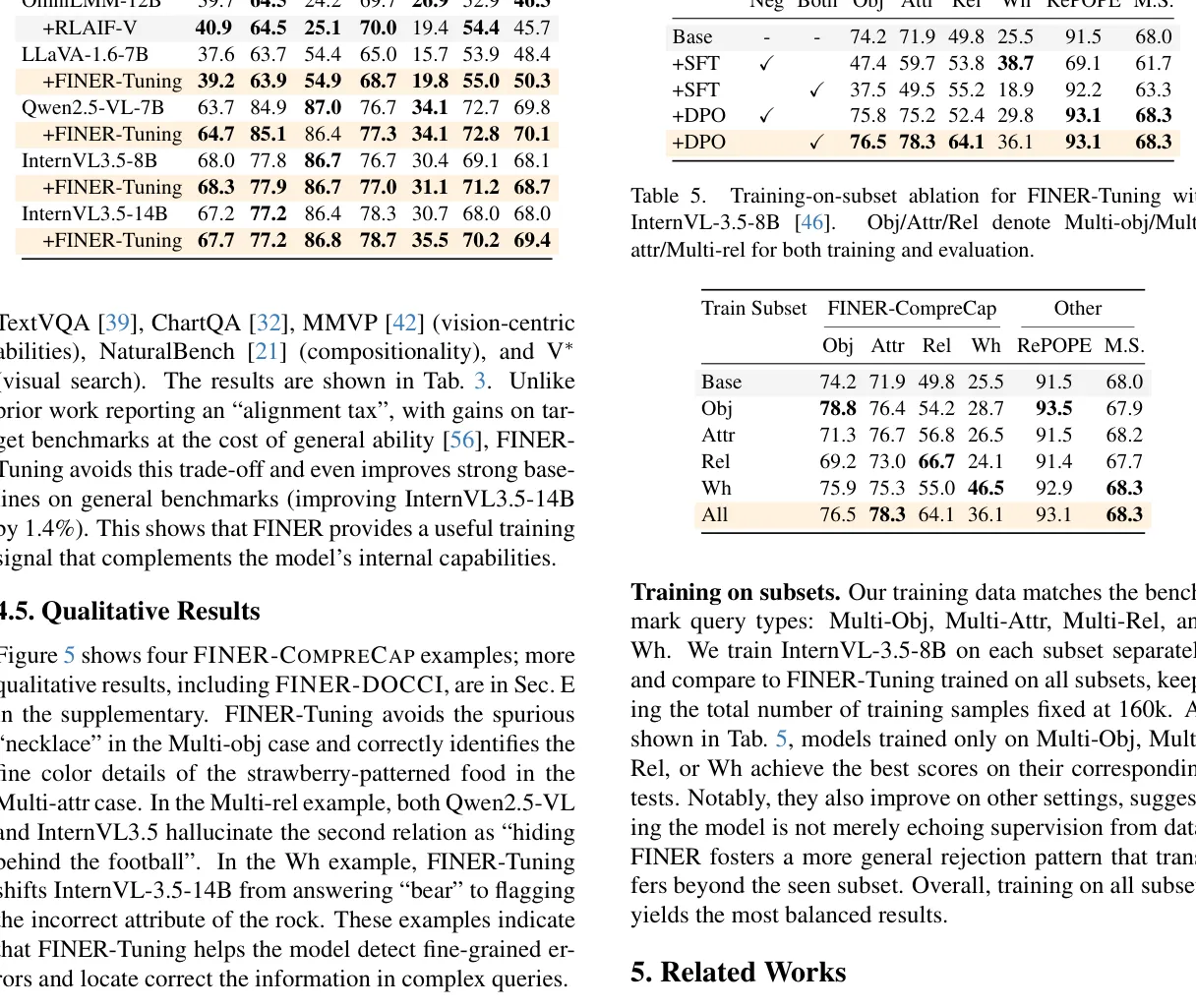
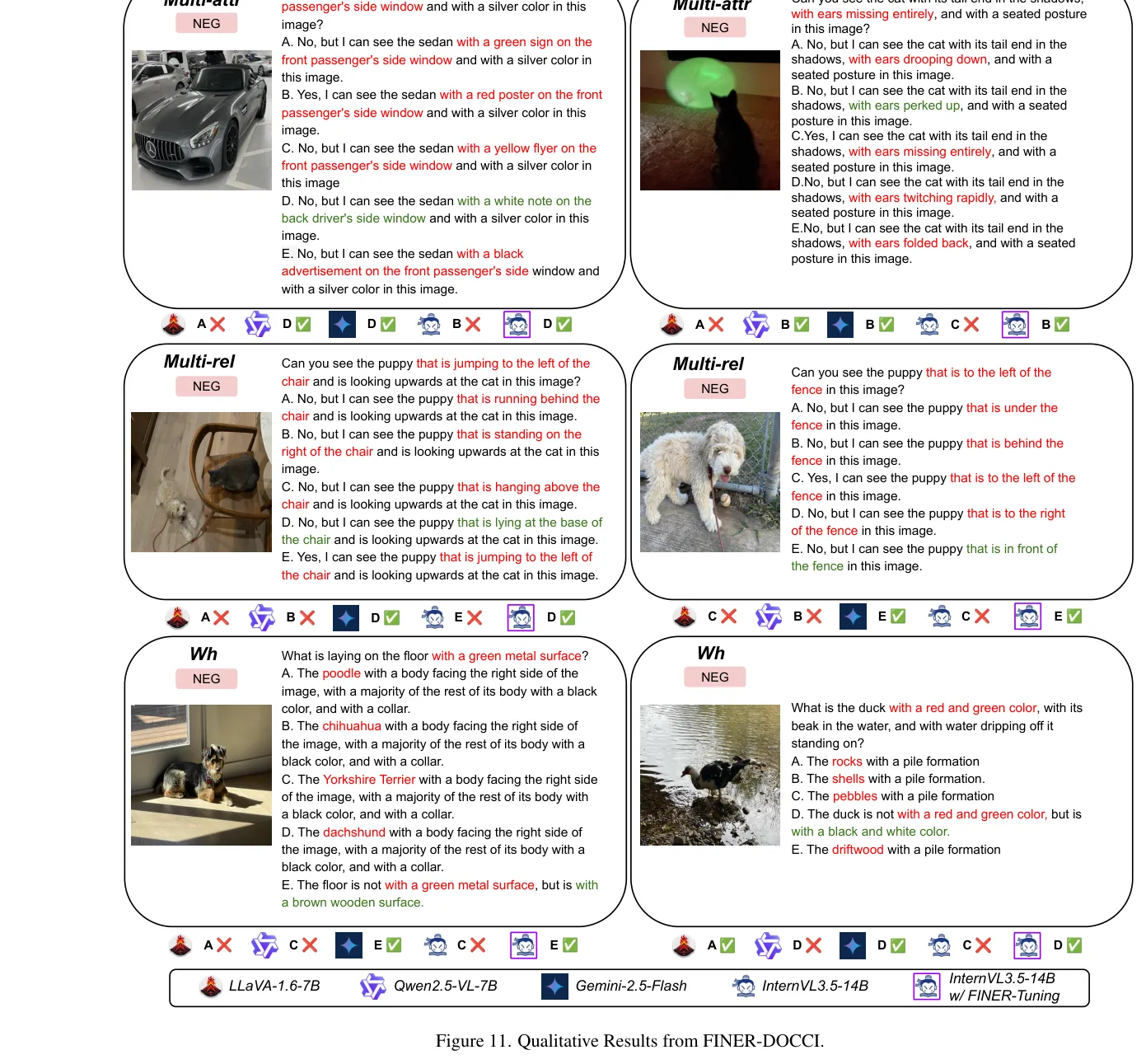
base 模型很脆、旧幻觉法基本失效:原文 "Hallucination-aware fine-tuning methods like RLHF-V and LLaVA-RLHF only achieve 1.6% and 1.1% paired accuracy on the Multi-rel subset of FINER-COMPRECAP."(CompreCap Multi-rel:RLHF-V-13B = 1.6、LLaVA-RLHF-13B = 1.1、RLAIF-V-12B = 19.2)。结论 "mitigating hallucination on previous datasets do not directly translate to our FINER benchmarks"。
FINER-Tuning 全面涨(CompreCap,paired acc,base→tuned):
┃ 模型 ┃ Multi-obj ┃ Multi-attr ┃ Multi-rel ┃ Wh ┃
┃ LLaVA-1.6-7B ┃ 25.3→48.4 (+23.1) ┃ 13.0→38.4 (+25.4) ┃ 7.6→24.2 (+16.6) ┃ 15.3→22.1 (+6.8) ┃
┃ Qwen2.5-VL-7B ┃ 69.2→71.4 ┃ 62.5→67.0 ┃ 30.1→38.3 ┃ 28.9→34.8 ┃
┃ InternVL-3.5-8B ┃ 75.0→77.1 ┃ 72.5→78.9 ┃ 49.8→64.1 ┃ 23.5→34.2 ┃
┃ InternVL-3.5-14B ┃ 74.5→80.0 (+5.5) ┃ 68.1→78.9 (+10.8) ┃ 47.0→71.2 (+24.2) ┃ 21.8→30.1 (+8.3) ┃
┃ InternVL-3.5-38B(参考) ┃ 77.8 ┃ 78.1 ┃ 66.8 ┃ 50.9 ┃
┃ Gemini-2.5-Flash(参考) ┃ 75.7 ┃ 77.3 ┃ 77.8 ┃ 58.2 ┃
关键:14B 微调后 Multi-rel 71.2 反超自家 38B(66.8)4.4%(原文 "outperforming its 38B version by 4.4%")。
Wh 是公认硬骨头:原文 "Wh-questions challenge all models. Even InternVL-3.5-38B and Gemini-2.5-Flash achieve only 36.6% and 49.6% Accpaired on FINER-DOCCI, leaving room for future research." —— 连最强模型在 DOCCI 的 Wh 也只 36.6/49.6,说明"细粒度事实问答"远未解决。
⑧ §4.2 实体数量 scaling — Fig.4(验证"越细越难、增益越大")
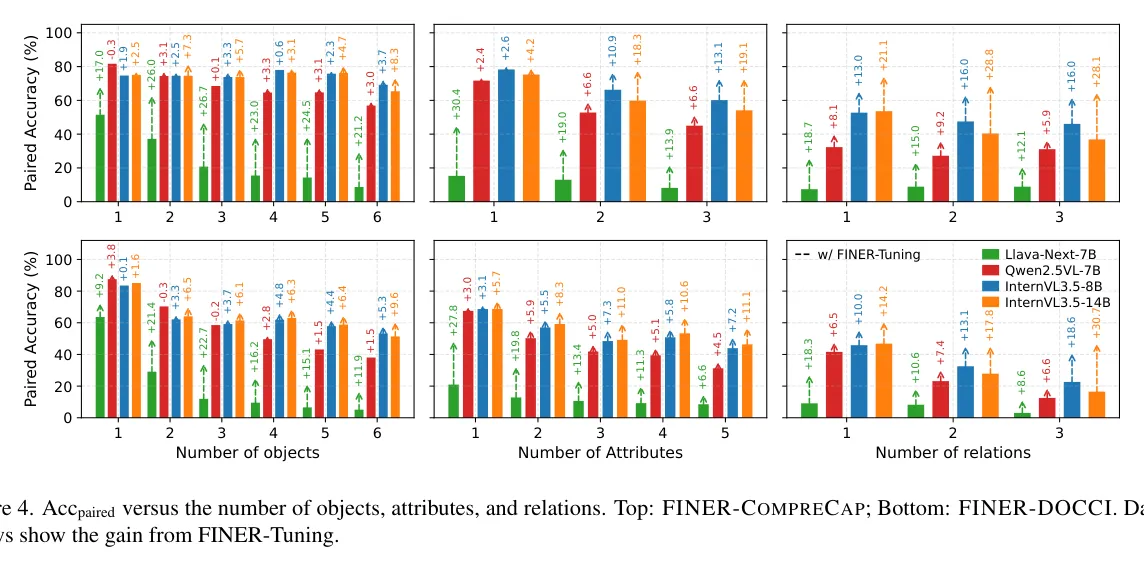
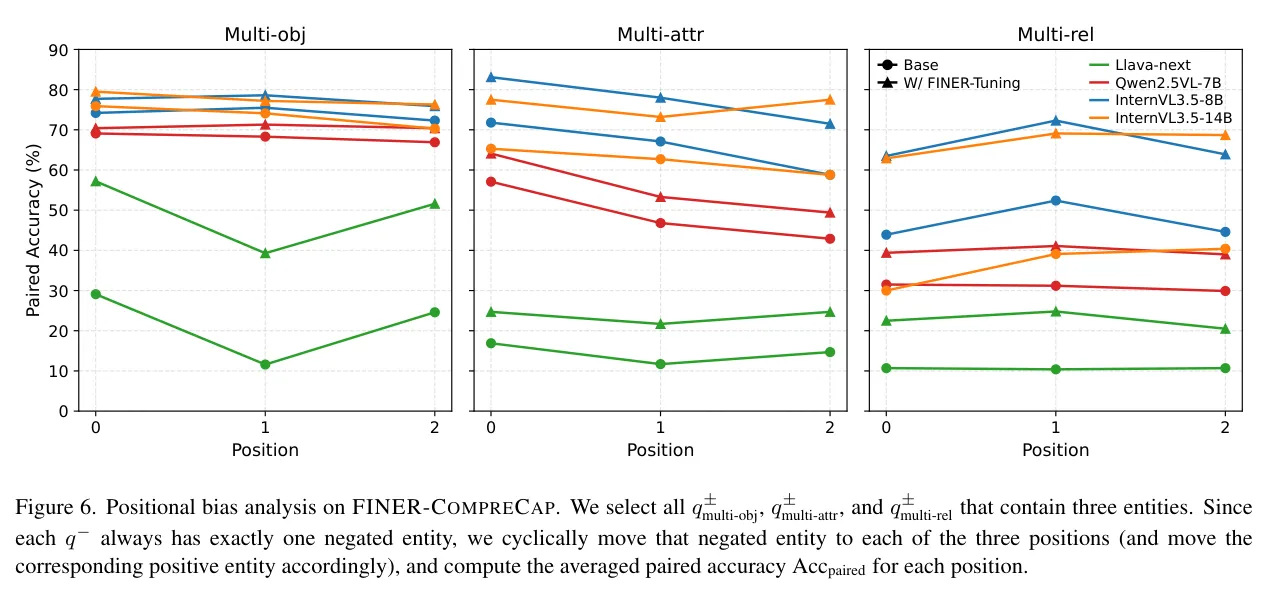
结论:三 setting 都呈"实体数↑ → 准确率↓",但 Multi-obj 降得最缓;FINER-Tuning 的增益随实体数增加而增大,在 Multi-attr/Multi-rel 上尤甚。原文给的标志性数字:"FINER-Tuning improves InternVL3.5-14B by 8.3%, 19.1% and 28.1% in 6-obj, 3-attr and 3-rel setting on FINER-COMPRECAP." —— 即题越细、本方法越值钱,正好对症 Abstract 立的靶。
⑨ §4.3 迁移到 8 个旧幻觉 benchmark — Table 2
判别式库(Acc↑):DASH 上 InternVL-3.5 两档 +6.2 / +5.5;AMBER 上 LLaVA-1.6 +6.9;POPE/RePOPE/HallusionBench/CRPE_R 普遍小涨。生成式库:MMHal-Bench 幻觉率(HR↓)全面下降,InternVL-3.5-14B 降到 10%;HaloQuest 上 LLaVA-1.6 +19.3,Qwen/InternVL 也至少 +6。对比 RLAIF-V 的"不均衡":原文 "RLAIF-V degrades performance compared to the base OmniLMM on benchmarks like DASH, POPE, RePOPE, and HallusionBench"——它在生成式涨、判别式退;而 FINER-Tuning "is a balanced approach that leads to a comprehensive reduction in hallucination"。这也反证 FINER benchmark 的有效性:在 FINER 上变好 = 在别处也变好。
⑩ §4.4 通用能力 — Table 3(有没有 alignment tax?)
担心点:加了大量"否定式"训练,模型会不会变得"过度拒答"、伤通用能力?结论是不会,甚至更好。6 个通用库(MMStar / TextVQA / ChartQA / MMVP / NaturalBench / V*)上,原文 "Unlike prior work reporting an 'alignment tax', with gains on target benchmarks at the cost of general ability, FINER-Tuning avoids this trade-off and even improves strong baselines on general benchmarks (improving InternVL3.5-14B by 1.4%)."(avg 68.0→69.4)。说明 FINER 提供的是互补性训练信号而非"以偏概全"。
⑪ §4.6 消融 — Table 4(训练策略)+ Table 5(子集迁移)
Table 4(base = InternVL-3.5-8B;SFT 只用 \(a^+\)):
┃ 方法 ┃ Obj ┃ Attr ┃ Rel ┃ Wh ┃
┃ Base ┃ 74.2 ┃ 71.9 ┃ 49.8 ┃ 25.5 ┃
┃ SFT(仅负) ┃ 47.4 ┃ 59.7 ┃ 53.8 ┃ 38.7 ┃
┃ SFT(双 query) ┃ 37.5 ┃ 49.5 ┃ 55.2 ┃ 18.9 ┃ ← Obj 灾难掉点
┃ DPO(仅负) ┃ 75.8 ┃ 75.2 ┃ 52.4 ┃ 29.8 ┃
┃ DPO(双 query)=FINER-Tuning ┃ 76.5 ┃ 78.3 ┃ 64.1 ┃ 36.1 ┃
验证了什么:(a) DPO ≫ SFT(SFT 双 query 把 Obj 砸到 37.5);(b) "双 query(正+负都训)" > "只训负 query",原文 "DPO with only negative queries exceeds the base model but still lags behind DPO with both query types ... underscoring the value of training with both."
Table 5(子集迁移):只在某子集训也主要提该子集(Obj→78.8、Rel→66.7、Wh→46.5),但会外溢到其它子集,原文 "FINER fosters a more general rejection pattern that transfers beyond the seen subset. Overall, training on all subsets yields the most balanced results." —— 说明学到的是通用的"拒错"能力,不是死记某类题。
📌 全文一页总结(problem → method → experiment → takeaway)
① problem:MLLM 幻觉研究的"细粒度否定式 query"盲区——旧 benchmark(POPE/DASH/AMBER)都粗粒度;动机实验证明粒度↑ → false positive↑(InternVL3.5-14B 80%→20%),且失效模式是"细粒度错误 × 真实元素共现"。
② method:(a) FINER benchmark——SG 驱动、每实体 4 个 plausible negative、Multi-obj/attr/rel + Wh 四 setting、MCQ + paired accuracy(式 1,乘法配对防无脑 No)、判别器按分类熵迭代去模糊;(b) FINER-Tuning——Pixmo 数据 + Phi-4 造正负 query、最小编辑精确矛盾、DPO(式 5,\(\beta=0.1\)) + LoRA。
③ experiment:4 个前沿 MLLM 在 FINER 上涨最多 +24.2%(InternVL-3.5-14B Multi-rel 47.0→71.2,反超 38B);迁移到 8 个旧幻觉库同涨(balanced,胜过偏科的 RLAIF-V);6 个通用库无 alignment tax(14B avg +1.4);消融证明 DPO 双 query 必要(SFT 双 query 使 Obj 掉 36.7%)。
④ takeaway(≥3 条 + 适用边界):
• Takeaway 1:"细粒度错误与真实元素共现"是 MLLM 一个被低估的新幻觉失效模式,且可定量刻画(粒度/实体数 → 准确率断崖)。
• Takeaway 2:治理思路应是"教模型检测 query 里的错"而非"只让模型自己别乱说",且必须用 DPO 而非 SFT(SFT 会因偏向 No 而崩)。
• Takeaway 3:一套训练可同时改善"目标细粒度幻觉 + 旧幻觉迁移 + 通用能力",无 alignment tax——好的细粒度判别信号是普惠的。
• 适用边界 / 诚实点:① benchmark 构造重度依赖 LLM/MLLM 生成 SG 与 negative,"negative 确实不在图里"只是概率保证(靠分类熵阈值,残余误判率未量化);② Wh(细粒度事实问答)仍是开放难题,连最强模型也低分;③ SFT 崩的深层机理论文未深挖 [推测:与"偏向 No 的捷径学习"有关];④ 训练上限 160k/1 epoch/LoRA,全参微调与更大规模的天花板未探。
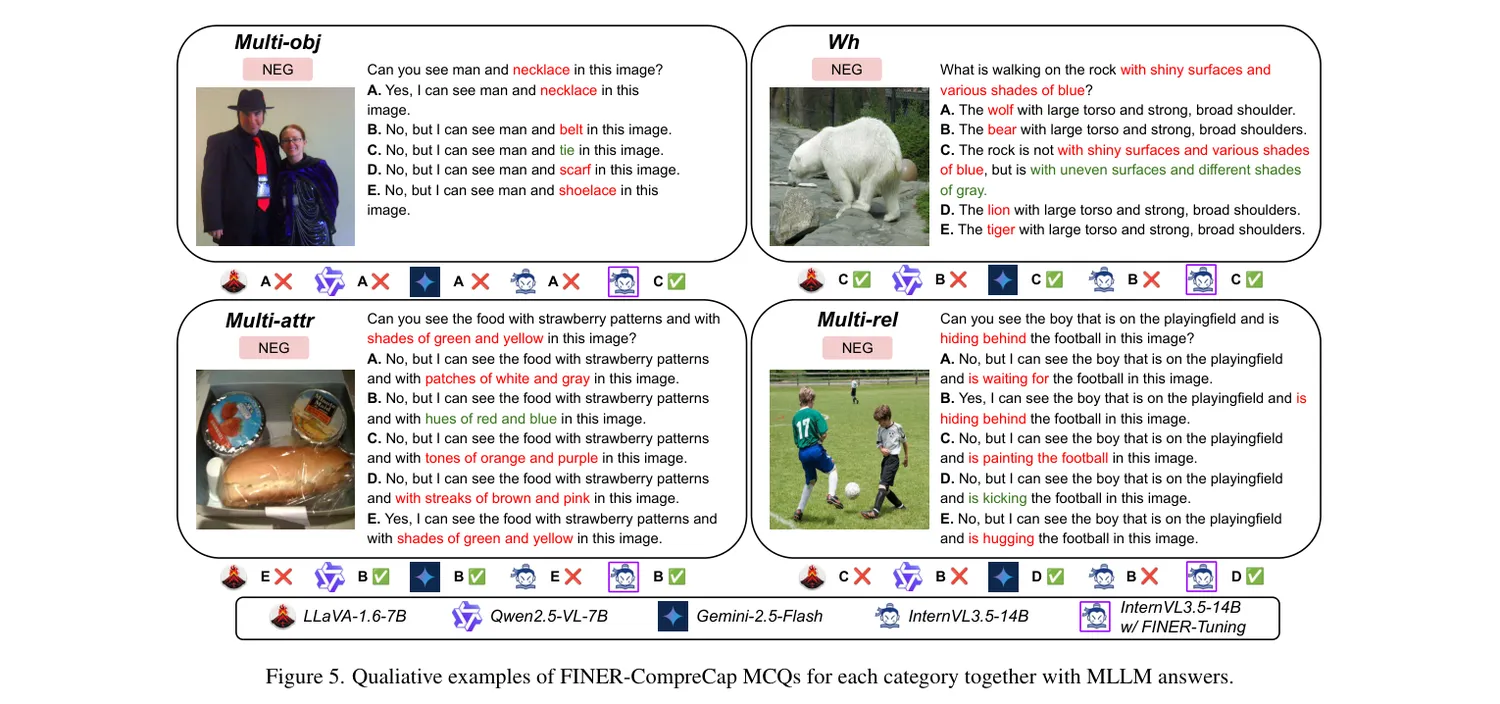
🖼 论文原图(本地 PDF 截图,原文 caption 未改写)