CVPR 2026 Finalist
A Style is Worth One Code: Unlocking Code-to-Style Image Generation with Discrete Style Space
Huijie Liu ⋅ Shuhao Cui ⋅ Haoxiang Cao ⋅ Shuai Ma ⋅ Kai Wu ⋅ Guoliang Kang
摘要 Abstract
Innovative visual stylization is a cornerstone of artistic creation, yet generating novel and consistent visual styles remains a significant challenge. Existing generative approaches typically rely on lengthy textual prompts, reference images, or parameter-efficient fine-tuning to guide style-aware image generation, but often struggle with style consistency, limited creativity, and complex style representations. In this paper, we consider the code-to-style image generation task, which aims to produce images with novel and consistent visual styles specified by only a numerical code. To date, this field has only been primarily explored by the industry (e.g., Midjourney), with no open-source research from the academic community. To fill this gap, we propose CoTyle, the first open-source method for this task. Specifically, we first train a discrete style codebook from a collection of images to extract style embeddings. These embeddings serve as conditions for a text-to-image diffusion model (T2I-DM) to generate stylistic images. Subsequently, we train an autoregressive style generator on the discrete style embeddings to model their distribution, allowing the synthesis of novel style embeddings. During inference, a numerical style code is mapped to a unique style embedding by the style generator, and this embedding guides the T2I-DM to generate images in the corresponding style. Extensive experiments validate that CoTyle effectively converts a numerical code into a style controller, demonstrating a style is worth one code. Compared to existing methods, the stylized images generated by our method are more diverse and consistent, unlocking a vast space of reproducible styles from minimal input.
📝 精读笔记
灵魂一句
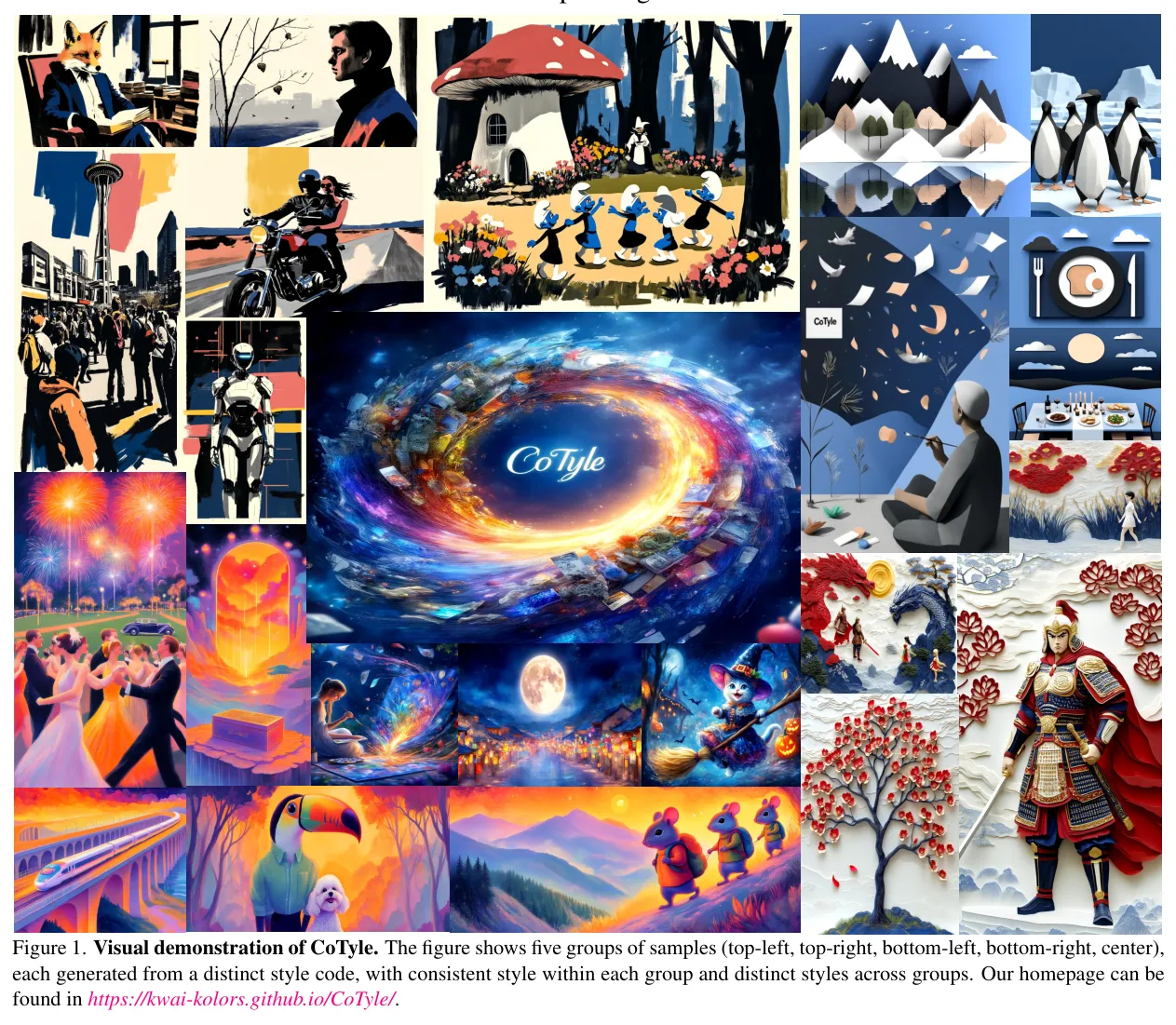
"一个风格 = 一串数字码"。提出 code-to-style 新任务:只给一个数字 code(如 3909769406)就生成全新且一致的视觉风格图——不要长 prompt、不要参考图、不要 LoRA。这能力此前只有 Midjourney(闭源、无技术报告)有,本文 CoTyle 是首个开源方案。三件套:① 用对比学习训一个离散风格 codebook(把同风格不同内容的图映到同一分布);② 把风格 embedding 当"文本"注入 T2I 扩散模型;③ 训一个自回归风格生成器(next-token)来"凭空造"新风格码序列。北航 + 快手可灵 Kolors,CVPR 2026 Finalist。
问题 & 动机
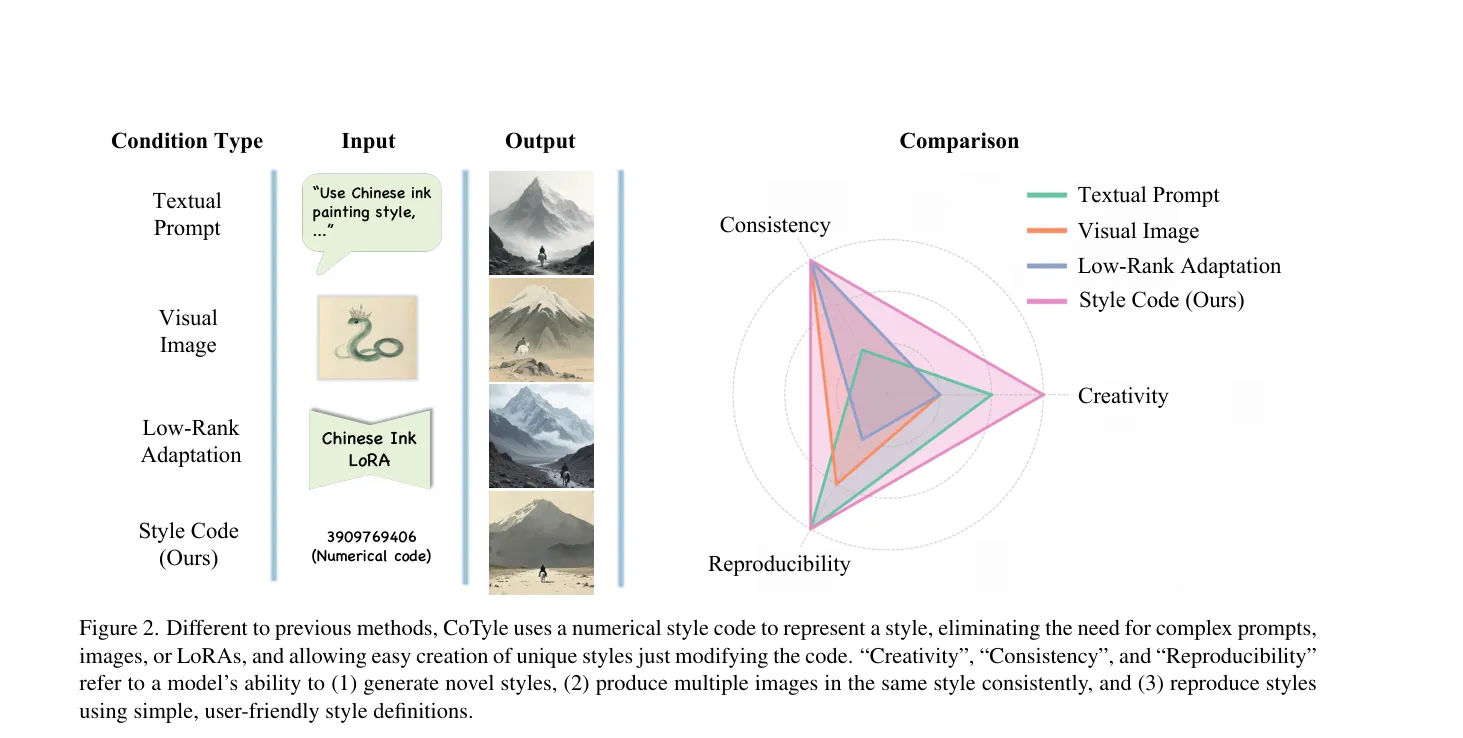
现有风格化生成三条路各有短板(雷达图三维:一致性/创造力/可复现):文本 prompt → 同描述出图差异大(一致性差);参考图 / LoRA → 只能复刻已有风格、造不出新风格(创造力差),且要传像素图或 LoRA 权重(可复现差)。原文:"existing methods cannot simultaneously achieve high consistency, creativity and reproducibility." 一个数字码恰好同时满足:唯一标识(可复现)+ 可凭空生成(创造力)+ 固定码出图一致(一致性)。
核心方法(三组件 + 关键公式)
① 离散风格 codebook(§3.1):不像传统 VQ 为重建图,而是用对比损失(式1-2)把同风格图拉近、异风格推远;加重建损失(式3)防 codebook collapse、让风格 embedding 贴近 VLM 图像编码分布;总 Lstyle=Lcontrast+α·Lrecon+β·Lvq(式4)。② 风格条件 T2I-DM(§3.2):把风格 embedding 当文本输入从文本分支注入 DiT(用 VLM 当 text encoder、风格 embedding 替换图像特征)——比从视觉分支注入更能保语义;用 rectified flow matching 训。③ 自回归风格生成器(§3.3):在 codebook 索引上用 next-token 训 AR(Qwen2-0.5B 从零训),学风格分布、能造新索引序列。推理(Alg 1):数字 code→定随机种子→采首 token→自回归出 N=196 个索引→查码本得 embedding→引导 T2I 出图。④ 高频抑制(式5):高频索引≈"无意义占位/无风格",按频率 e−k(f−τ) 降权 → 提升多样性。
关键结果(数值)
code-to-style(Table 1,vs 闭源 Midjourney):CoTyle 一致性 0.6007 vs MJ 0.4734、美学 0.7173 vs 0.5948,仅多样性略低(0.7764 vs 0.8088,原文归因训练数据广度不足)。图像条件模式 CoTyle* 一致性 0.5791,超 InstantStyleXL 0.5753、USO 0.4395 等。消融:文本分支注入一致性 0.5791 > 视觉分支 0.5306;去掉重建损失一致性崩到 0.4102;去掉高频抑制多样性 0.7764→0.7488、一致性 0.6007→0.5301。
亮点
首个开源 code-to-style;离散码天然契合自回归 next-token + 抑制内容只留风格;风格 embedding 走文本分支注入更保语义(区别于"风格=颜色"的窄定义);支持风格插值(按比例混合两组索引,证明风格特征可组合);一个数字码就是可分享、可复现的"风格指纹"。
疑问 / 边界
① 多样性输给 Midjourney(0.7764 vs 0.8088),原文自承训练数据广度不够;② 数字码到风格是"黑箱映射"——码本身无语义、无法预测"3909769406 长啥样",只能试(与 Midjourney 同病);③ 依赖预训练 Qwen-Image + VLM,整条链重;④ 评测主要用 CSD/CLIP-T/QualityCLIP 自动指标 + 与单一闭源对手(MJ)比,缺人评/缺更多 code-to-style 对手(因为这任务几乎没人做);⑤ 与自动驾驶无直接关系(纯创意图像生成),但"离散 codebook + 自回归生成器"作为紧凑可控的离散 latent 思路,与 world model/感知里的 tokenized 表示同源,可作方法论参考(不强行类比性能)。
📖 逐段精读 · 笔记
批量精读初稿,基于本地 PDF 全文(51k 字符 / 17 页)。最后更新 2026-06-21。
① Abstract(摘要)— 逐句精讲
原文(任务定义句):"we consider the code-to-style image generation task, which aims to produce images with novel and consistent visual styles specified by only a numerical code. To date, this field has only been primarily explored by the industry (e.g., Midjourney), with no open-source research from the academic community."
在说什么:提出"code-to-style"新任务——只给一个数字码就生成具有"新颖且一致"风格的图;此前只有 Midjourney(闭源)做过,学术界空白。点评:"only a numerical code" 是全题眼——把"风格"压缩成一个可复现、可分享的数字。
原文(方法三步句):"we first train a discrete style codebook from a collection of images to extract style embeddings. These embeddings serve as conditions for a text-to-image diffusion model (T2I-DM)… Subsequently, we train an autoregressive style generator on the discrete style embeddings to model their distribution, allowing the synthesis of novel style embeddings."
在说什么:三步——① 训离散风格码本抽风格 embedding;② 用它当条件训 T2I 扩散模型出风格图;③ 训自回归(AR)风格生成器建模 embedding 分布、合成新风格。点评:"离散码本 + AR 生成"是把"造新风格"变成"像语言模型一样采样 token 序列"。
原文(结论句):"a numerical style code is mapped to a unique style embedding by the style generator, and this embedding guides the T2I-DM… demonstrating a style is worth one code."
一句话抓 Abstract:CoTyle=离散风格码本(抽风格)+ T2I-DM(按风格生成)+ AR 风格生成器(造新风格),让"一个数字码 = 一种可复现的独特风格",是首个开源的 code-to-style 框架。
📚 背景知识(外部补充):T2I-DM / VQ 码本 / LoRA / AR / CSD
T2I-DM:文生图扩散模型(本文用 Qwen-Image 的 DiT)。DiT:用 Transformer 做骨干的扩散模型。VQ 码本(vector-quantized codebook):把连续特征量化到一个有限"词表"里的离散 token(如 VQ-VAE/VQGAN),本文借它把"风格"离散化。LoRA:低秩微调,现有风格法常训一个 style LoRA 注入模型。AR next-token:自回归逐 token 预测(像 GPT),本文用它建模"风格索引序列"的分布。CSD:衡量扩散模型风格相似度的指标,本文用它算 Consistency(同码图间相似度)和 Diversity(=1−不同码图间 CSD)。rectified flow matching:一种比 DDPM 更直的生成路径训练目标。
② Introduction — problem → 三性质缺口 → solution → why
problem(三类现有法各缺一项):原文按 consistency/creativity/reproducibility 三维评判(Fig 2 雷达图)——文本提示:"images generated from identical textual style descriptions often exhibit substantial variations"(一致性差);参考图 / 风格 LoRA:"rely on existing style images… incapable of creating novel, unseen artistic styles"(创造性差),且要分享像素级参考图或复杂 LoRA 权重("poor reproducibility")。结论 "existing methods cannot simultaneously achieve high consistency, creativity and reproducibility."
solution:code-to-style——"uses a numerical style code to create novel styles. This code also functions as both a unique identifier for style creation and consistent style reproduction." CoTyle 是首个开源实现。why it works(机理):① 离散码本把风格变成有限 token,天然契合 AR 的 next-token 采样 → 能"造"出训练集没见过的新风格组合(creativity);② 同一个 code 固定随机种子 → 同一串索引 → 同一风格(consistency + reproducibility);③ code 只是个数字 → 极易分享复现(reproducibility)。一个数字码同时拿下三性质,正是对 problem 的精准反击。
Q&A · 为什么一个"数字码"能同时满足三性质?
核心拆解:reproducibility(复现)——code 是纯数字,分享一个整数即可(对比分享图片/LoRA 权重),且它固定 AR 生成器的随机种子,相同 code → 相同索引序列 → 相同风格,确定可复现;consistency(一致)——同一 code 解出同一组风格 embedding 去条件化 T2I-DM,不同内容图共享同一风格表示,Table 1 实测 Consistency 0.6007 > Midjourney 0.4734;creativity(创造)——AR 风格生成器是无条件建模风格索引分布,能采样出训练集没出现过的新索引组合,而非像参考图/LoRA 那样复刻已有风格。关键设计支撑:把风格做成"离散 token 序列"——既可像语言模型那样"生成新句子(新风格)",又能用一个 seed 整数完全决定这串 token。
③ §3.1 离散风格码本(对比损失 Eq1/2 + 重建 Eq3 + 总损失 Eq4)
为何要离散码本(两点):原文 "(1) the discrete indices align naturally with the next-token prediction objective of autoregressive modeling, and (2) the quantization process inherently suppresses irrelevant content information, which facilitates more effective pooling of style features." 与传统码本不同:不为重建图像,而是 "encode images with identical styles but different content into the same distribution, while encoding images with divergent styles into different distributions." 故用对比损失。
对比损失(Eq1/2):\[ \mathcal{L}_{contrast}=\frac{1}{B}\sum_{i=1}^{B}\Big[y_i(1-s_i)^2+(1-y_i)\,\mathrm{ReLU}(s_i-m)^2\Big] \] 相似度 \(s_i=\dfrac{F(v_{1,i})\cdot v_{2,i}}{\|F(v_{1,i})\|\,\|v_{2,i}\|}\),其中 \(y_i\in\{0,1\}\)(1=同风格、0=异风格),\(m\)=margin,\(v\)=ViT 特征,\(F\)=码本。同风格拉近、异风格推开(超过 margin 才罚)。重建损失(Eq3,防码本坍塌):让风格 embedding 贴近 VLM 图像编码器的特征分布,原文 "adding a reconstruction loss is essential to avoid codebook collapse." 总损失:\(\mathcal{L}_{style}=\mathcal{L}_{contrast}+\alpha\mathcal{L}_{recon}+\beta\mathcal{L}_{vq}\)(\(\mathcal{L}_{vq}\)=commit+codebook 量化损失)。
④ §3.2 T2I-DM 按风格码本条件化(从"文本支路"注入)
核心主张:原文 "we argue that style information should not be narrowly defined as color, but encompasses rich semantic features. Thus, we treat style embeddings as a form of textual input and injecting them into the Diffusion Transformer (DiT) through textual branch." 即风格不是"颜色"而是"语义",所以把风格 embedding 当文本注入——用 VLM 当 text encoder,风格 embedding 替换原图像特征,让 T2I-DM 学到更贴近人类感知的风格。训练:对同风格图对 \((x_1,x_2)\),抽 \(v_1\) 量化成 \(F(v_1)\),以 \(F(v_1)\)+\(x_2\) 的文本提示 \(y_2\) 为条件、用 rectified flow matching 生成 \(x_2\)。附带能力:天然支持 image-conditioned 生成且优于现有法。
⑤ §3.3 AR 风格生成器 + 推理(Alg 1)+ 高频抑制(Eq5)
为何还要 AR 生成器:码本 embedding 都来自已有图,无法造新风格;故训一个无条件 AR 模型,对图像的风格索引做 next-token 预测,学习风格分布 → 能采新风格。推理链路(Alg 1):数字码 \(n\) → 固定随机种子 → 采初始 token \(I_0\) → AR 自回归生成其余 \(N-1\) 个索引 → 查码本得向量 → 解成风格 embedding → 连同 prompt 用 rectified flow 出图。
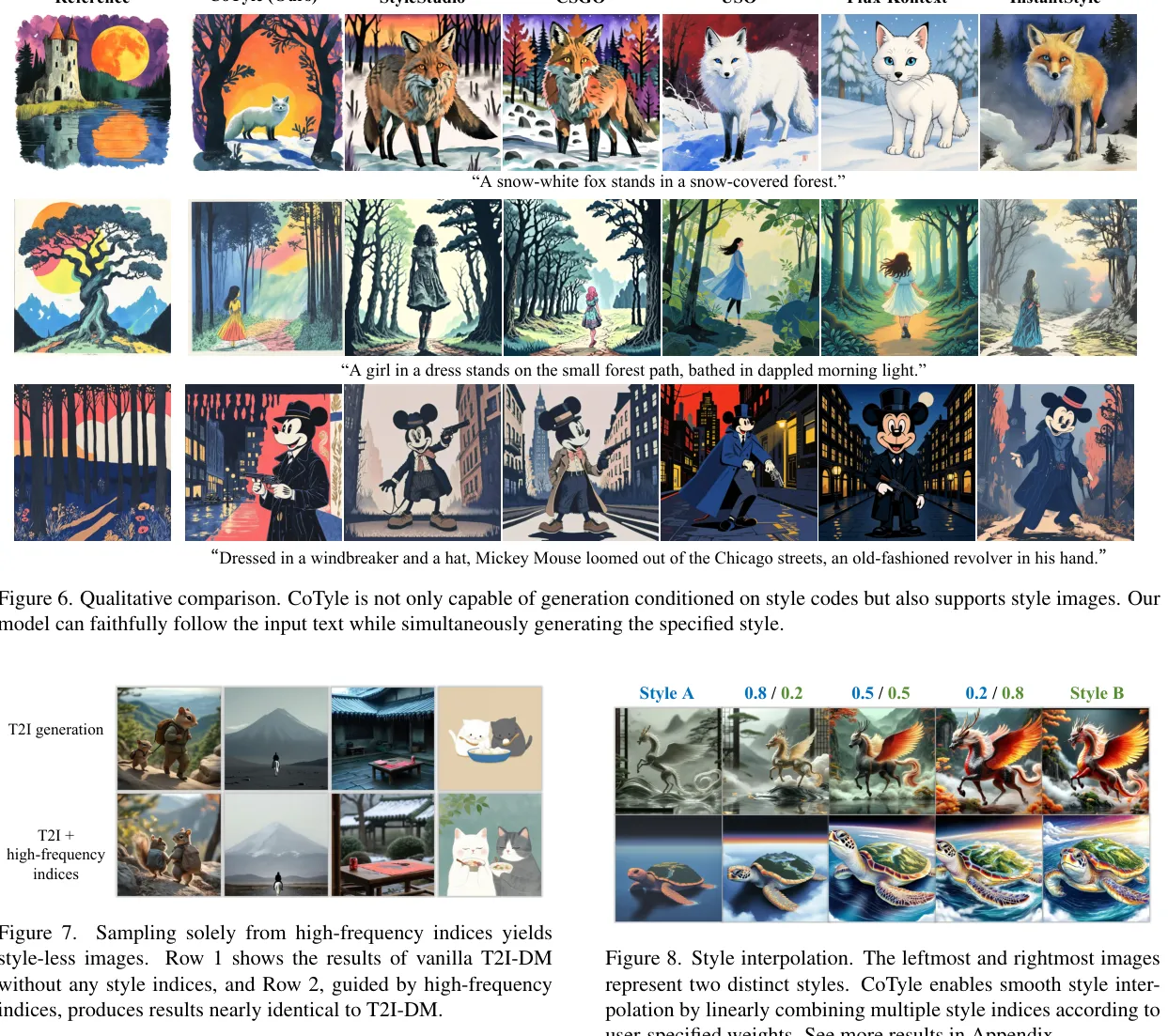
高频索引抑制(Eq5,关键 trick):作者发现少数索引被超高频选中,原文 "high-frequency indices represent a form of 'arbitrary' style information, just like meaningless placeholders. Sampling exclusively from high-frequency indices yields images with no specific style." 故对高频 logits 乘抑制系数 \(s(i)\):当 \(f(i)\lt\tau\) 时 \(s(i)=1\)(不抑制),当 \(f(i)\ge\tau\) 时 \(s(i)=e^{-k\,(f(i)-\tau)}\)(频率越高、抑制越狠);其中 \(f(\cdot)\) 把索引映到频率、\(\tau\) 为阈值、\(k\) 为超参。附录进一步发现这些高频 token 像语言模型里的"filler token",替换成随机值几乎不掉质量——揭示码本表达力的局限。
⑥ §4.1 实现细节(三段式训练的真实配置)
码本阶段:词表 \(K=1024\)、embedding 维 64、20,000 步、batch 128、lr 1e-5。DiT 阶段:从预训练 Qwen-Image 初始化、60,000 步、batch 64、lr 4e-6。风格生成器:用 Qwen2-0.5B 架构但从零训(不load 预训练权重)、100,000 步、batch 64、lr 1e-5。风格参考图 resize 到 392×392(原文 "stylistic features are robust to geometric transformations"),每图编码成 196 个风格 token(N=196)。点评:码本只有 1024 词、风格生成器仅 0.5B——整套"风格大脑"其实很轻量,重活在 Qwen-Image DiT。
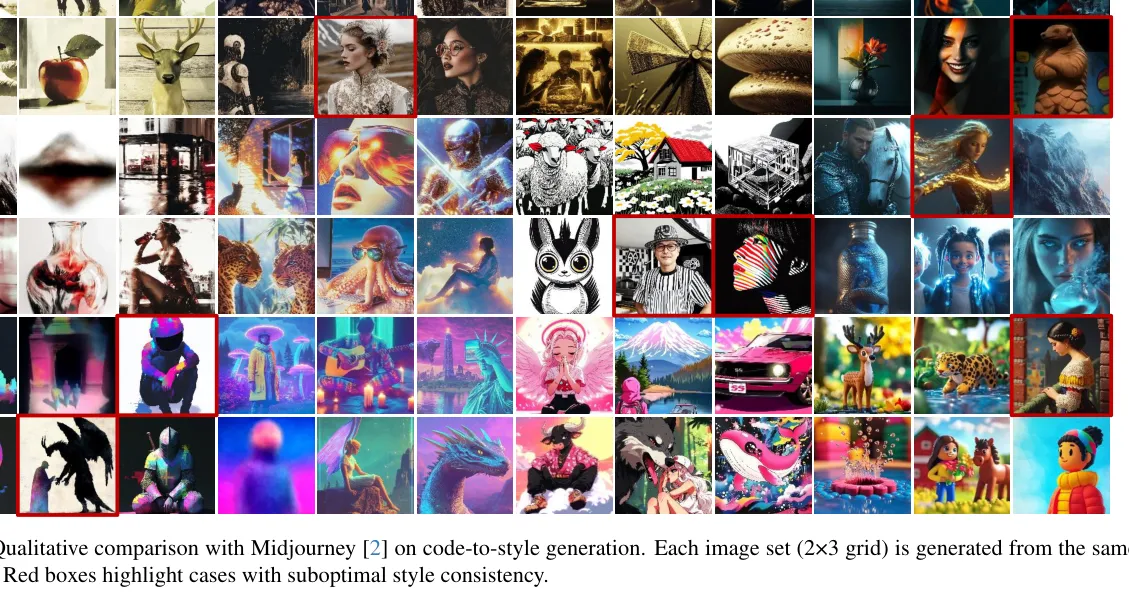
⑦ §4.4 主结果(Table 1 真实数值,vs Midjourney)
设置:code-to-style 采 500 码 ×4 图=2000 图;指标 Diversity↑/Aesthetics↑/CLIP-T↑/Consistency↑(CSD 系)。
方法(条件) Diversity↑ | Aesthetics↑ | CLIP-T↑ | Consistency↑
Midjourney(Code,闭源) 0.8088 | 0.5948 | 0.3090 | 0.4734
CoTyle(Code,开源) 0.7764 | 0.7173 | 0.3119 | 0.6007
—— 图条件对照 ——
InstantStyleXL(Image) — | 0.7135 | 0.3134 | 0.5753
CoTyle*(Image) — | 0.7178 | 0.3230 | 0.5791
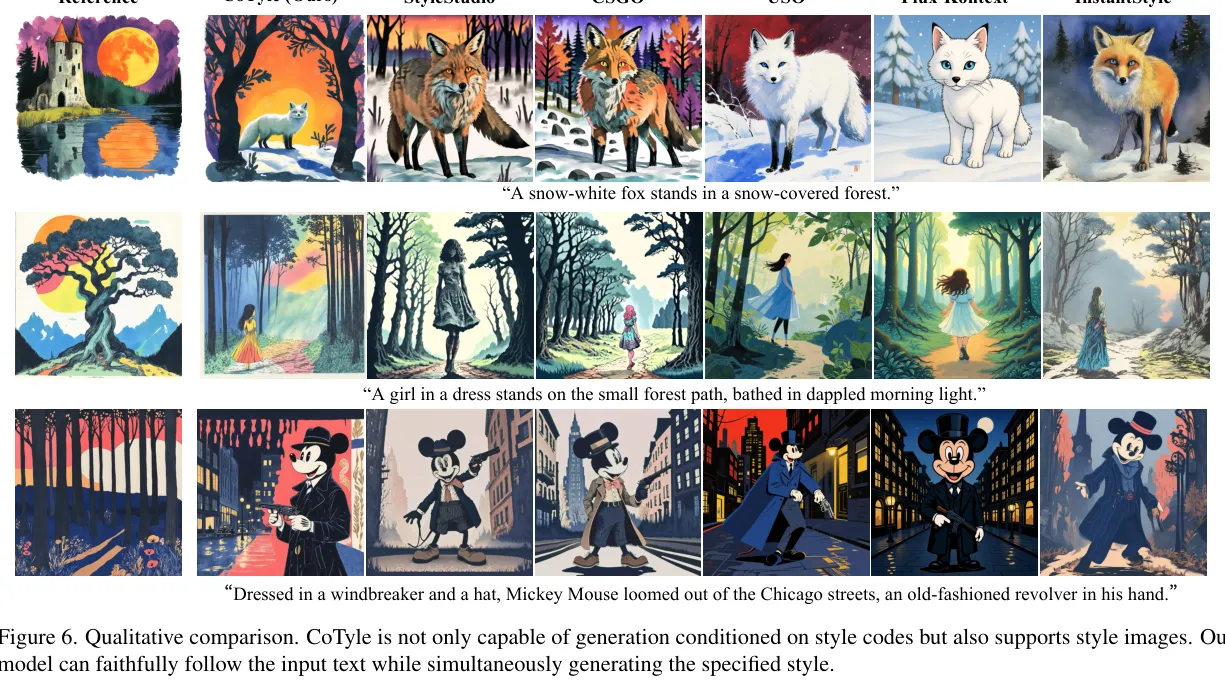
读表:对 Midjourney,CoTyle 在一致性(0.6007 vs 0.4734)和美学(0.7173 vs 0.5948)大幅领先,仅 Diversity 略低(0.7764 vs 0.8088)——原文坦承 "slightly inferior diversity, which may be attributed to the insufficient breadth of the training dataset"(诚实)。图条件下 CoTyle* 一致性 0.5791 也居首(超 InstantStyleXL 0.5753)。
⑧ §4.5 消融(Table 2/3/4,每个验证一个设计)
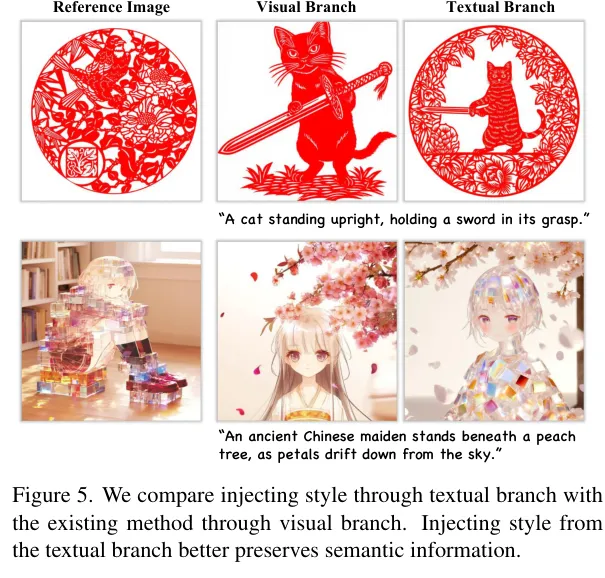
Table 2 · 注入支路:Visual Branch 一致性 0.5306 vs Textual Branch 0.5791。文本支路更优——原文 Fig 5 显示视觉支路只抓到"红色调"却丢了语义(如纸剪风的圆形轮廓),文本支路能正确生成"由水晶块组成的人形"。验证了"风格=语义,应从文本注入"。
Table 3 · 风格损失:完整 \(\mathcal{L}_{style}\) 一致性 0.5791;去掉负样本(全用同风格对)降到 0.4890;去掉 \(\mathcal{L}_{recon}\) 暴跌到 0.4102(且美学 0.7001)。验证了对比的负样本与重建损失都不可或缺(重建防码本坍塌)。Table 4 · 高频抑制 \(s(i)\):有 \(s(i)\):Diversity 0.7764 / Consistency 0.6007;无 \(s(i)\):0.7488 / 0.5301。抑制同时提升多样性与一致性(不抑制时大多数码塌成写实风、风格性丢失)。
⑨ §4.6 风格插值 + 高频索引的深层洞见
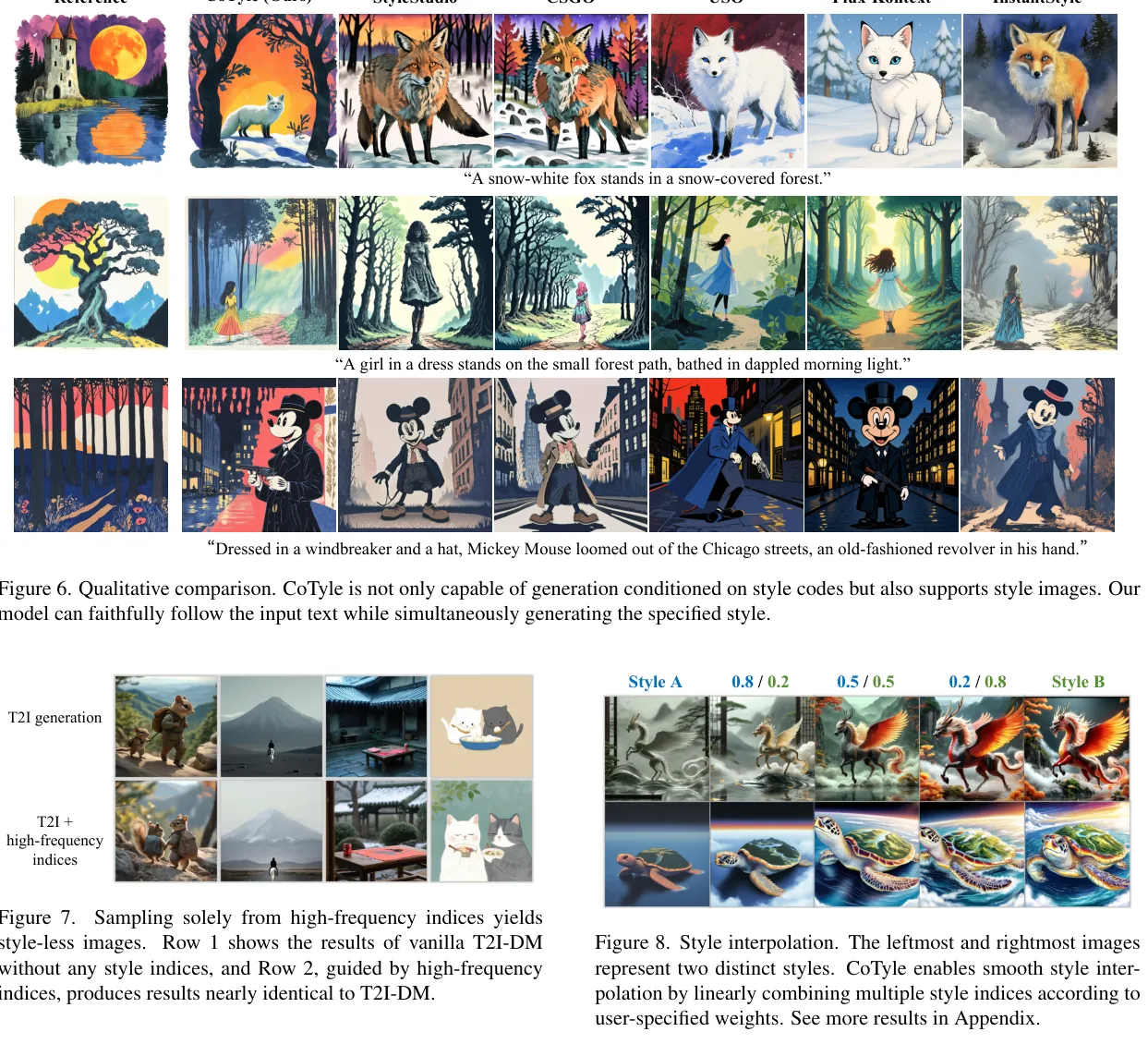
风格插值:每个风格=N 个索引,按比例混合两组索引即可插值(Fig 8:0.8/0.2、0.5/0.5、0.2/0.8)。附录关键洞见:原文 "the specific token selection strategy during interpolation has minimal impact… the stylistic information is invariant to the order of its tokens. This property aligns naturally with human intuition about style, which is typically perceived as a holistic attribute rather than a sequence-dependent structure." 即风格在该离散空间里是"整体、与 token 顺序无关"的——这与文本(顺序敏感)截然不同,是一个很漂亮的表征性质,也提示该离散空间可能支撑更多风格编辑能力,甚至迁移到音频等模态。
Q&A · 这套"离散风格空间"给我们什么启发?
方法论启发:① 把难控的连续属性离散化成 token 序列,就能借语言模型那套"采样生成新组合"的能力来"造"新东西(这里是风格,原理可推广到其他可枚举属性);② 用一个种子/码完全决定一串 token,是"可复现生成"的极简实现——比分享权重/参考图轻太多;③ 对比损失 + 量化天然做"内容-风格解耦"(量化抑制内容、对比聚风格),比硬拆 color/texture 更贴近"风格是语义整体"的人类直觉。边界(诚实,原文 Limitations):多样性受限于"风格配对训练数据"的广度(不如 Midjourney);量化必然丢失细微风格;以及"找到好看风格"目前仍是在巨大码空间里随机搜,缺乏可解释的导航——这三点是后续可改方向。
📚 三维度对比:consistency / creativity / reproducibility(Fig 2)
Fig 2 雷达图按三轴评判四类风格指定方式,正是 CoTyle 立论的坐标系——原文定义 "'Creativity', 'Consistency', and 'Reproducibility' refer to a model's ability to (1) generate novel styles, (2) produce multiple images in the same style consistently, and (3) reproduce styles using simple, user-friendly style definitions."
指定方式 一致性 | 创造性 | 复现性 短板
文本提示 低 | 高 | 高 同描述出图差异大
参考图 高 | 低 | 低 只能复刻已有、要传像素图
风格 LoRA 高 | 低 | 低 只能复刻已有、要传权重
风格码(本文)高 | 高 | 高 一个数字同时拿下三项
洞察:文本提示输在一致性、参考图/LoRA 输在创造性与复现性——没有一种现有方式三项全占。CoTyle 的数字码因"离散可采样(造新)+ 种子可复现 + 数字易分享"恰好补齐三角,这就是它把一个看似简单的"数字码"做成新范式的根本原因。
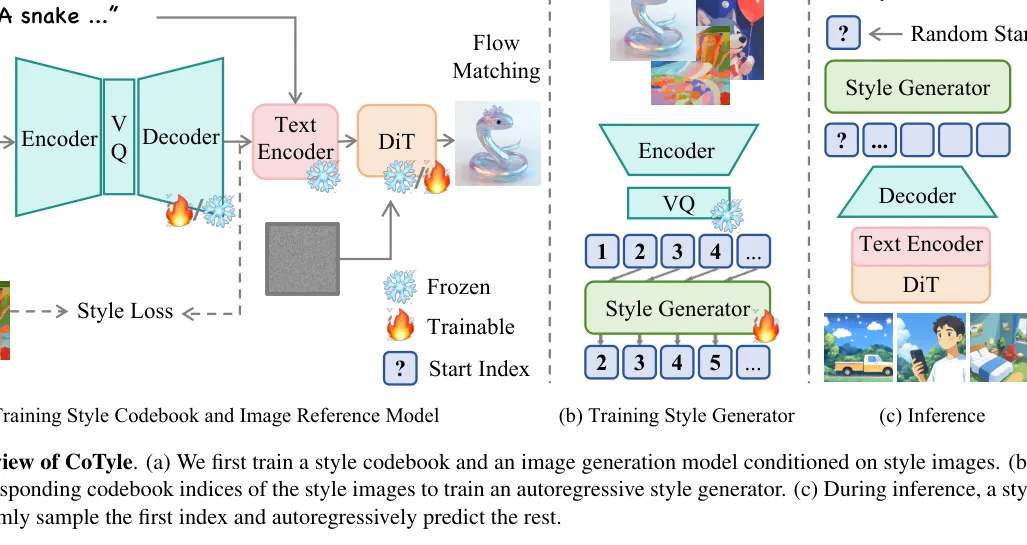
📚 三段式训练/推理流程串讲(Fig 3 a/b/c)
(a) 训码本 + 图参考模型:同风格图对 → ViT 抽特征 → VQ 量化进风格码本(对比损失聚风格)→ 风格 embedding 当文本条件喂 DiT,用 flow matching 学"按风格图生成"。此阶段产物=能按参考图风格出图的 T2I-DM + 一个会抽风格的码本。(b) 训风格生成器:把训练图过码本得到离散索引序列,用这些序列训一个自回归模型(next-token)学风格分布。(c) 推理:数字码 → 定随机种子 → 采首个索引 → AR 补全 N 个索引 → 查码本 → 风格 embedding → 条件化 DiT 出图。串起来一句话:码本负责"把风格变成离散词",AR 负责"用词造新风格句子",DiT 负责"把风格句子画出来",数字码则是"决定造哪句的随机种子"。
Q&A · 为什么码本"不为重建"、必须用对比损失?
核心区别:传统 VQ 码本(VQ-VAE/VQGAN)目标是高保真重建原图,会把内容细节也编进 token;而 CoTyle 的码本目标相反——只要风格、丢掉内容。原文 "its purpose is to encode images with identical styles but different content into the same distribution, while encoding images with divergent styles into different distributions." 为何非对比损失不可:原文 "Without the contrastive loss, the model would simply learn to map diverse styles to an identical embedding"——没有"推开异风格"的负样本压力,模型会偷懒把所有风格塌成同一个 embedding(Table 3 去负样本一致性 0.5791→0.4890 实证)。为何还要重建损失:防止码本坍塌、让风格 embedding 贴近 VLM 图像编码器的特征分布,否则后续"当文本注入 DiT"对不上(Table 3 去 \(\mathcal{L}_{recon}\) 暴跌到 0.4102)。量化的副作用恰是优点:原文 "the quantization process inherently suppresses irrelevant content information"——离散化天然滤掉内容噪声,正好服务"抽纯风格"。
⑩ Supplementary 洞见:高频索引 = "filler token"
现象(附录 Fig A1):码本索引呈长尾分布——约 5–10% 的索引被超高频选中。本质判断:原文 "we replace these dominant indices with random or shuffled values and observe minimal degradation in reconstruction quality or perceptual style fidelity",并断言 "the high-frequency indices do not encode specific, semantically meaningful stylistic features. Instead, they function as placeholder tokens… This behavior mirrors the phenomenon observed in language models, where certain 'filler' tokens dominate usage." 意义:① 解释了为什么要做高频抑制 \(s(i)\)——这些 token 是"无风格占位符",全采它们就退化成普通写实图(Fig 7);② 暴露码本表达力的局限(容量不足/过拟合导致 filler 主导),作者据此呼吁 "more balanced, semantically disentangled discrete representations"。诚实点评:这是论文难得的自我批判——把"trick(高频抑制)"背后的"病因(码本不够均衡)"也讲透了。
Q&A · 开源价值与实用定位(vs Midjourney)
定位:code-to-style 此前只有 Midjourney 闭源在做,原文指出 "the absence of technical reports has hindered its adoption and development within the open-source community." CoTyle 是首个开源框架并公开模型权重与源码(原文 "we present the first comprehensive framework… and publicly release both the model weights and source code"),把这一能力"民主化"给学术界。实用价值:① 品牌/IP 风格统一——一个数字码即可在海量出图里保持同一视觉风格(一致性 0.6007 远超 Midjourney 0.4734),适合系列插画、电商素材、游戏美术的风格统一;② 风格资产可分享可版本化——分享一个整数即可让他人复现同款风格,无需传图或权重,天然适合协作与"风格商店";③ 风格插值提供连续的风格调参旋钮。诚实边界:多样性略逊 Midjourney(训练数据广度受限)、量化丢细节、"找到好看风格"目前还得在巨大码空间里碰运气(缺可解释导航)——这些都是作者在 Limitations 里点名的后续方向。方法层面的可迁移性:"把属性离散成 token + 用一个种子码确定序列 + AR 采样造新组合"这套范式,原则上可推广到风格之外的其它可枚举生成属性,甚至音频等模态(作者亦如此展望)。
📌 全文一页总结(problem → method → experiment → takeaway)
problem:风格化生成的三类现有法(文本提示 / 参考图 / 风格 LoRA)无法同时做到 consistency + creativity + reproducibility;code-to-style(一个数字码定风格)此前仅 Midjourney 闭源探索。method(CoTyle 三件套):① 离散风格码本——对比损失 \(\mathcal{L}_{contrast}\)(同风格拉近、异风格推开)+ 重建损失防坍塌,\(\mathcal{L}_{style}=\mathcal{L}_{contrast}+\alpha\mathcal{L}_{recon}+\beta\mathcal{L}_{vq}\);② T2I-DM(Qwen-Image DiT)把风格 embedding 当文本注入、rectified flow 训练;③ AR 风格生成器(Qwen2-0.5B 从零训)next-token 建模风格索引分布,推理时数字码定种子 → 生成 N=196 索引 → 查码本 → 条件化出图,并用高频抑制 \(s(i)\) 防"无风格塌缩"。
experiment:vs Midjourney 一致性 0.6007 vs 0.4734、美学 0.7173 vs 0.5948(仅多样性略低 0.7764 vs 0.8088);图条件一致性 0.5791 居首;消融证文本支路 > 视觉支路、重建+负样本损失必要、高频抑制同时提升多样性与一致性;支持风格插值。
Takeaway(≥3 条):① 把"风格"离散成 token 序列是核心创举——既契合 AR 的 next-token "造新风格"(creativity),又能用一个种子整数完全复现一串索引(reproducibility + consistency),一举破解三性质不可兼得;② 风格应从"文本/语义支路"而非"视觉/颜色支路"注入(Table 2 实证),契合"风格是语义整体"的直觉;③ 离散风格空间具有"顺序无关、可线性混合"的优良性质,支撑插值且可能推广到更多编辑/模态;④ 首个开源 code-to-style 框架,填补 Midjourney 闭源的学术空白;诚实边界=多样性受训练数据广度限制、量化丢细节、好风格仍需在码空间盲搜。
🖼 论文原图(本地 PDF 截图,原文 caption 未改写)