CVPR 2026 Finalist
3DReflecNet: A Large-Scale Dataset for 3D Reconstruction of Reflective, Transparent, and Low-Texture Objects
Zhicheng Liang ⋅ Haoyi Yu ⋅ Boyan Li ⋅ Dayou Zhang ⋅ Zijian Cao ⋅ Tianyi Gong ⋅ Junhua Liu ⋅ Shuguang Cui ⋅ Fangxin Wang
摘要 Abstract
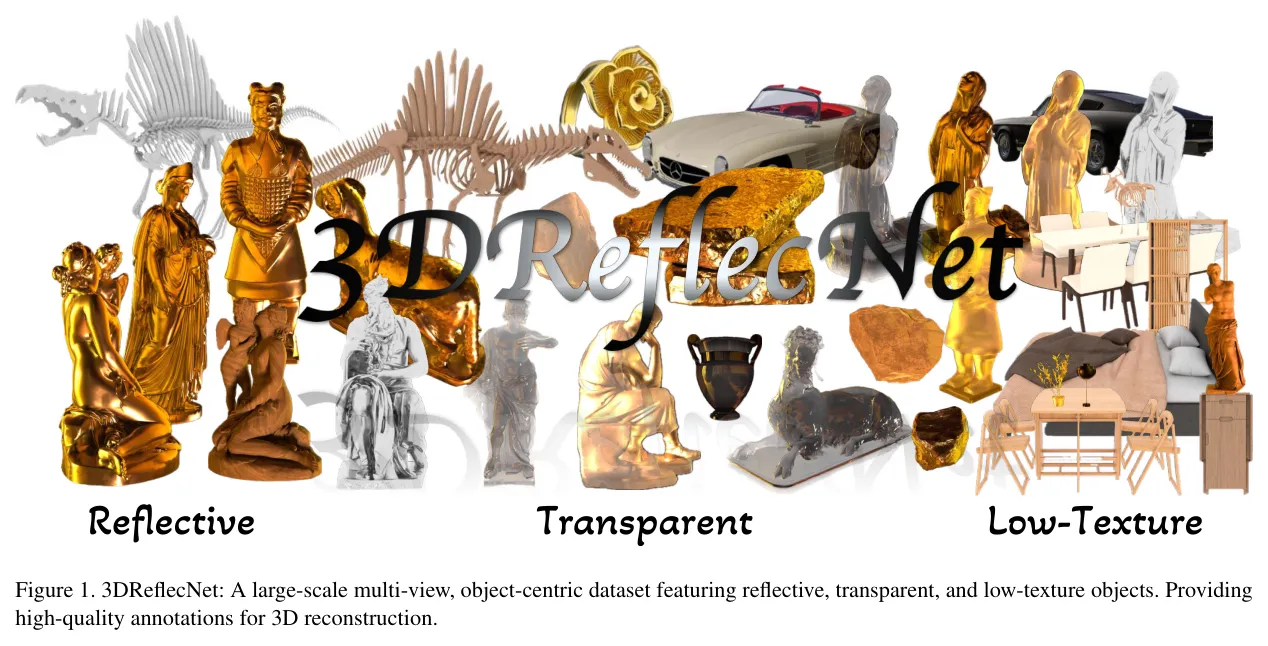
Accurate 3D reconstruction of objects with reflective, transparent, or low-texture surfaces remains a significant challenge. Such materials often violate key assumptions in multi-view reconstruction pipelines, such as photometric consistency and the reliance on distinct geometric texture cues. Existing datasets primarily focus on diffuse, textured objects, thereby offering limited insight into performance under real-world material complexities. In this paper, we introduce 3DReflecNet, a large-scale hybrid dataset exceeding 22 TB that is specifically designed to benchmark and advance 3D vision methods for these challenging materials. 3DReflecNet combines two types of data: over 100,000 synthetic instances generated via physically-based rendering of more than 10,000 shapes, and over 1,000 real-world objects scanned using consumer RGB-D devices. Together, these data consist of more than 7 million multi-view frames. It encompasses diverse materials, complex lighting conditions, and a wide range of geometric forms—including shapes generated from both real and LLM-synthesized 2D images using diffusion-based methods. To support robust evaluation, we design benchmarks for four core tasks: image matching, reflection removal, structure-from-motion, and novel view synthesis. Through extensive experiments, we show that state-of-the-art methods struggle to maintain accuracy across these settings, highlighting the need for more resilient 3D vision models. We release the dataset, baselines, and evaluation suite to facilitate progress in this direction, which can be accessed at supplementary materials.
📝 精读笔记
灵魂一句
一个专门针对反光 / 透明 / 弱纹理三类"硬骨头"物体的大规模 3D 重建数据集(>22 TB)。这类材质违反多视图重建的两大根基假设——光度一致性(photometric consistency)和"有显著纹理特征",于是 SfM/MVS/NeRF/3DGS 全失灵。现有数据集(DTU/CO3D/MVImgNet)只覆盖漫反射有纹理物体。3DReflecNet 用 12K+ 形状 × PBR 渲染出 120K+ 合成实例 + 1000+ 真实扫描 = 7M+ 多视图帧,配 5 个任务基准(图像匹配 / SfM / 新视角合成 / 去反射 / 重打光),系统性暴露 SOTA 的失败模式。CUHK 深圳,CVPR 2026 Finalist。
问题 & 动机
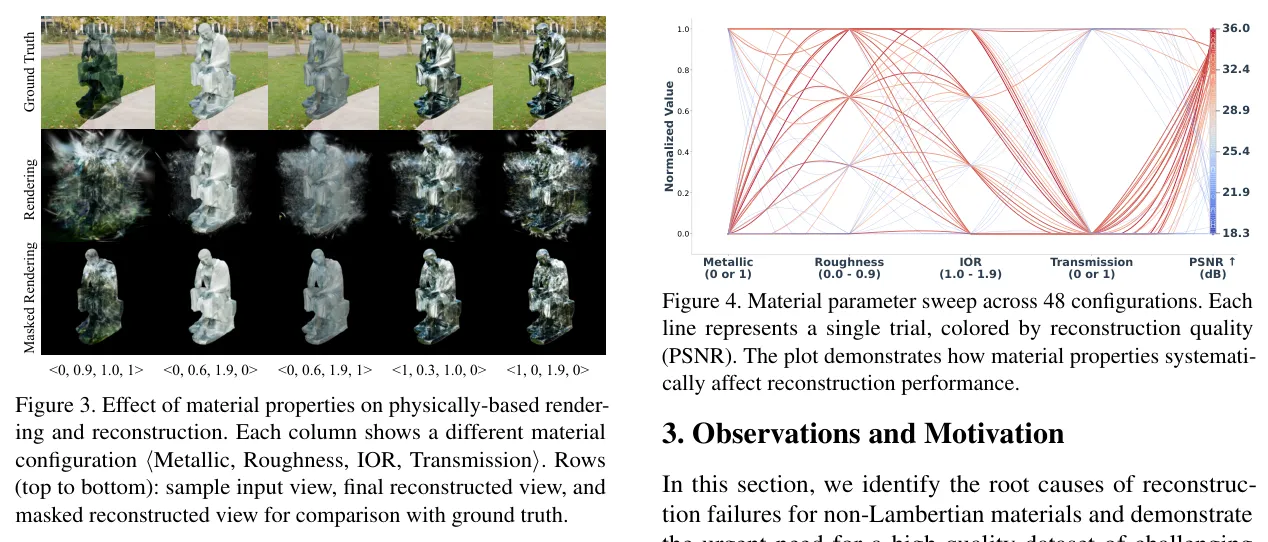
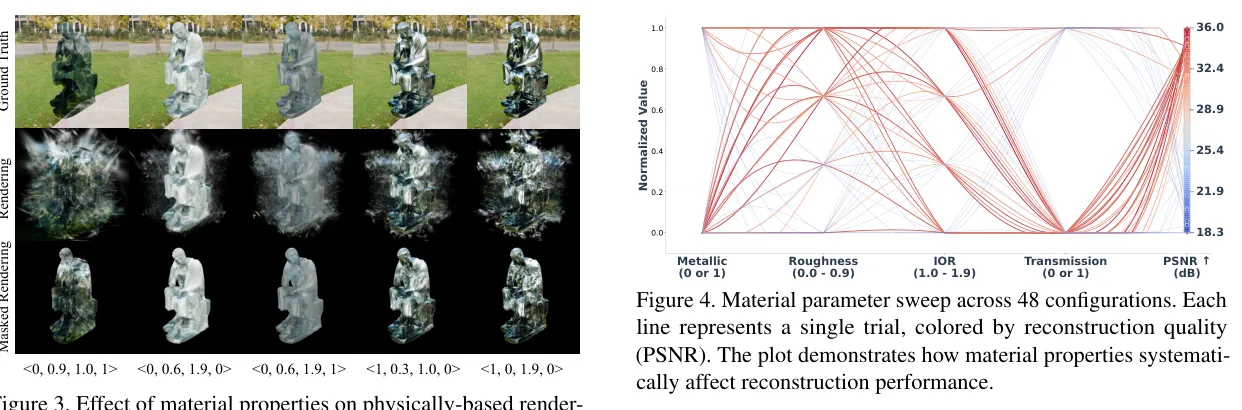
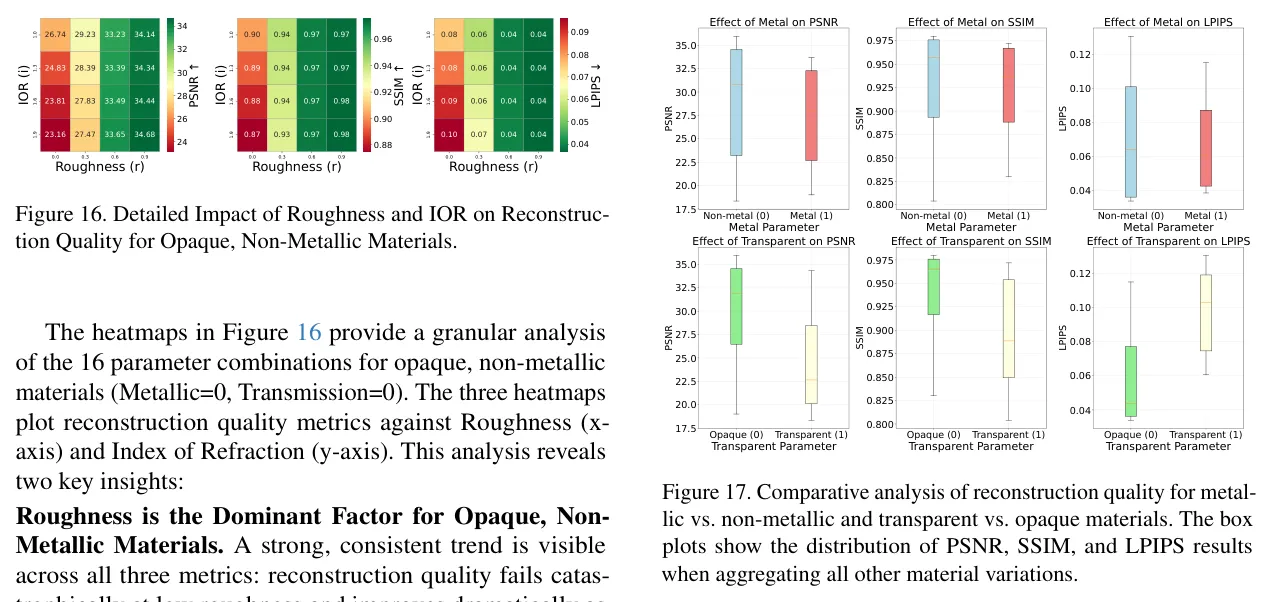
反光/透明/弱纹理物体的 3D 重建"notoriously challenging"。根因(§3.2):① 反光=view-dependent BRDF → 算法把高光误当几何特征;② 弱纹理=缺高频特征 → 对应匹配歧义;③ 透明最毒——同时破坏光度一致性和"光沿直线传播"假设(折射使对极几何 epipolar 失效)→ 重建彻底崩。原文实测(§3.1,48 组材质 sweep):光滑金属仅 19 dB PSNR vs 高粗糙非金属 35 dB(差 45%);透明材质一致 掉 5.82 dB(19.3%)。
核心内容(数据集 + 构造管线 + 基准)
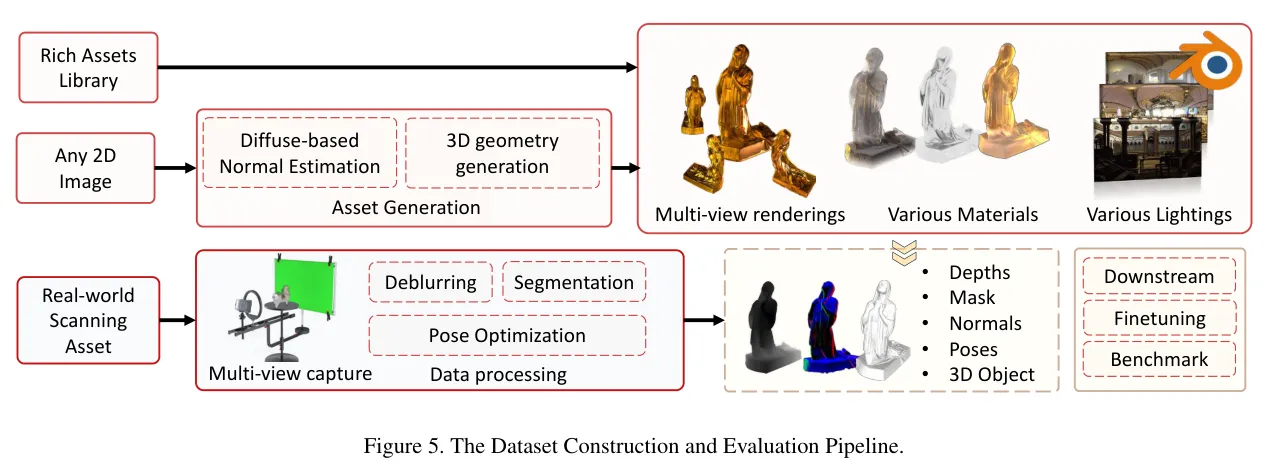
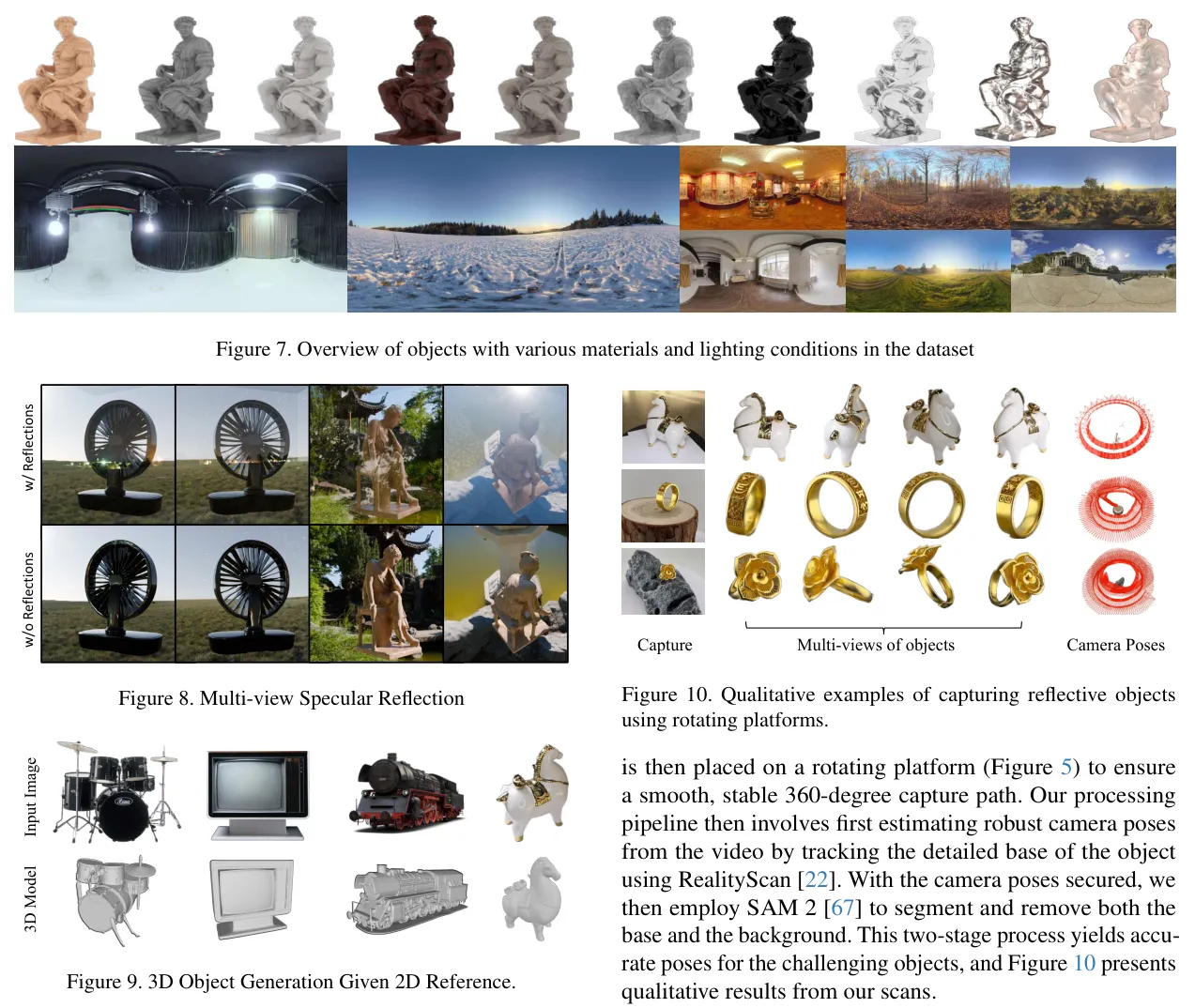
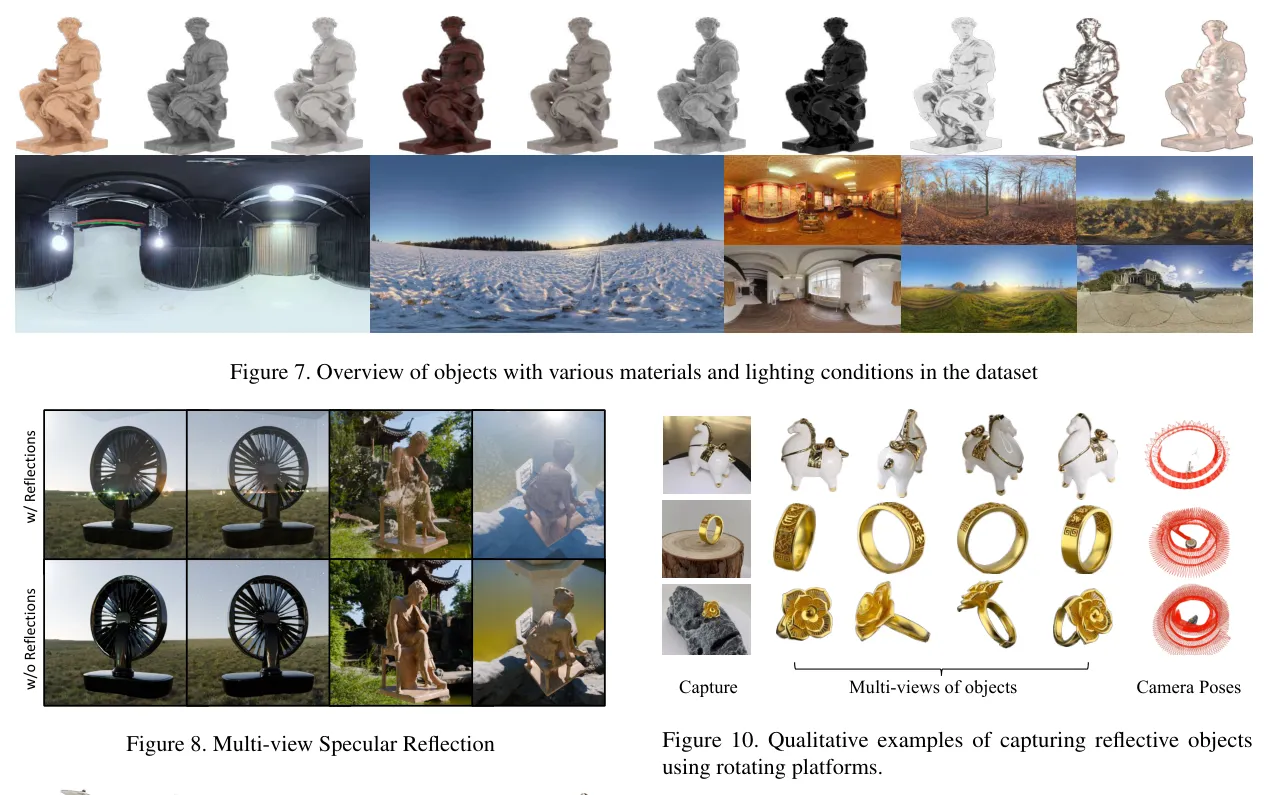
① 统计(Table 2):合成 12K+ 形状 / 22 材质 / 2700+ HDRI 光照 / 120K+ 实例 / 每实例 60 视角 / 7M+ 帧;真实 300+ 形状 / >50 材质 / 1000+ 实例 / 100+ 视角。9 大类、22 材质分 5 组(Diffuse / Transparent / Metallic / Glossy-Textured / Glossy-Low-Texture)。② 构造管线(Fig 5):合成走 Blender PBR(含"相机-玻璃片"装置模拟 view-dependent 镜面反射,60 角度×上百光照)+ 2D→3D diffusion 生成(用真实图 + GPT-4o 生成图当参考,估法线/深度→建 mesh→规范位姿);真实走 iPhone 16 Pro 拍,把物体放在高纹理底座 + 转台上(用底座当 tracking marker 解决反光物体位姿估计失败),RealityScan 出位姿、SAM2 抠分割。③ 5 任务基准 + 标准评测 + baseline。
关键结果(数值)
图像匹配(Table 3,AUC@5°):最好的 ROMA 在本数据集仅 32.1 vs 在 MegaDepth 62.6(腰斩,显示难度)。新视角合成(Table 4,PSNR):所有方法 Diffuse 都 >36 dB,但 Transparent 暴跌到 17–21 dB(2DGS 17.12 最惨),Metallic 25–29、Glossy-Low-Texture 26–28。表面重建(Table 5,Chamfer↓):Diffuse 0.06、Transparent 高到 0.142–0.502(PGSR 在透明上崩)。结论:SOTA 在漫反射很好、遇复杂光学全面退化。
亮点
首个同时覆盖透明+反光+弱纹理+可重打光、且合成(PBR)+真实双子集的对象级数据集(Table 1 里独一份全 ✓);"相机-玻璃片"多角度反射模拟 + diffusion 2D→3D 扩形状库;真实采集用"底座当锚点"巧解反光物体位姿;带 Qwen3-VL-30B 文本标注、可支撑 text/image-to-3D 生成任务。
疑问 / 边界
① 纯 benchmark/数据集,不提新模型——只暴露问题、不解问题(价值在"立标尺");② §3.1 写"高 IOR 越差",但给的数值是 IOR1.0→19.9dB、IOR1.9→27.9dB(方向看着相反),原文表述前后矛盾、需查原文/勘误(不替它脑补);③ 去反射/重打光/真实数据的定量结果全塞进补充材料,正文只给定性结论;④ 对象级(object-centric)、转台采集,非驾驶街景——对自驾的"反光车漆/玻璃幕墙/湿地面"是相关启发但非同分布(推断,原文未做车载)。④ 子页面顶部摘要是早期版(100K/10K、4 任务),PDF 终版已扩到 120K+/12K+、5 任务,以 PDF 为准。
📖 逐段精读 · 笔记
批量精读初稿,基于本地 PDF 全文(99k 字符 / 30 页含补充,精读聚焦正文)。最后更新 2026-06-21。
① Abstract(摘要)— 逐句精讲
原文(痛点句):"Accurate 3D reconstruction of objects with reflective, transparent, or low-texture surfaces still remains notoriously challenging. Such materials often violate key assumptions in multi-view reconstruction pipelines, such as photometric consistency and the availability on distinct geometric texture cues."
在说什么:反射/透明/低纹理三类材料的 3D 重建出了名地难,因为它们违背多视图重建的两条核心假设——光度一致性(同一点在不同视角颜色一致)和有可区分的几何纹理线索。点评:开篇即把"难"归因到具体假设的失效,而非泛泛而谈,奠定了后文"根因分析 + 造数据集"的逻辑。
原文(数据集句):"We introduce 3DReflecNet, a large-scale hybrid dataset exceeding 22 TB… over 120,000 synthetic instances generated via physically-based rendering of more than 12,000 shapes, and over 1,000 real-world objects captured using consumer devices. Together, these data consist of more than 7 million multi-view frames."
在说什么:一个 >22TB 的合成+真实混合数据集:12,000+ 形状 PBR 渲染出 120,000+ 合成实例 + 1,000+ 真实物体扫描,共 >700 万多视图帧。点评:"hybrid(合成+真实)"是它区别于 OpenMaterial(纯合成)的关键卖点。
原文(基准句):"we design benchmarks for five core tasks: image matching, structure-from-motion, novel view synthesis, reflection removal, and relighting. Extensive experiments demonstrate that state-of-the-art methods struggle to maintain accuracy across these settings."
一句话抓 Abstract:针对"反射/透明/低纹理"造一个合成+真实的大规模数据集,配 5 个任务基准,系统性地揭示 SOTA 在这些材料上集体翻车,呼唤"物理感知"的 3D 模型。
📚 背景知识(外部补充):为什么这三类材料致命
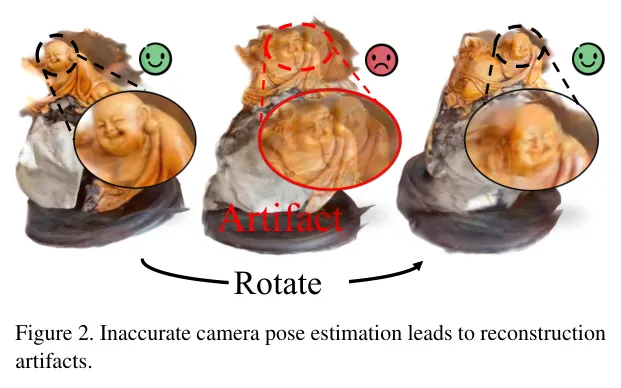
光度一致性(photometric consistency):多视图三角化/MVS 默认"同一 3D 点从不同视角看颜色一致"(朗伯/漫反射假设)。反射(镜面/金属)由 BRDF 决定外观随视角变,高光会被误当成几何特征。低纹理缺高频特征,对应匹配歧义。透明最狠:光线折射,违背"光直线传播",使对极几何(epipolar geometry)失效——这是三角化的根基。SfM / MVS / NeRF / 3DGS 全建立在这些假设上,故对非朗伯材料系统性失败(Fig 2:轻微位姿误差就导致重建错位与伪影)。
② Introduction — problem → 数据集缺口 → solution → 贡献
problem:原文 "these methods struggle when confronted with complex optical phenomena—notably specular reflection, transparency, and low texture. Such conditions induce appearance inconsistency across views, undermining the assumptions behind Structure-from-Motion (SfM) and Multi-View Stereo (MVS) pipelines." 根因 "Most state-of-the-art algorithms rely on (i) photometric consistency and (ii) distinctive appearance features across views. Both assumptions break down under view-dependent effects, light transmission, or low-texture surfaces."
数据集缺口:原文 "Datasets such as DTU, CO3D, and MVImgNet largely focus on textured, diffuse objects." 而 OpenMaterial 虽用实测折射率渲染,但 "remains confined to purely synthetic data, lacks real-world noise and motion, and primarily supports novel view synthesis." 即"要么只有漫反射、要么只有合成"。
solution + 三贡献:① 大规模混合数据集(120,000+ 合成 + 1,000+ 真实,>7M 帧,9 大类);② 统一资产生产流水线(PBR + camera-through-glass 模拟视角相关光学 + diffusion 2D→3D 生成);③ 五任务基准 + 标准评测 + baseline,揭示 SOTA 系统性失败模式。why(机理):同时覆盖"合成的精确标注"与"真实的噪声/运动",并用玻璃片真实模拟镜面反射、用扩散模型扩展稀有几何——补齐既有数据集的物理真实性短板。
③ §3.1 材料消融实验(48 配置,真实数值揭示失败)
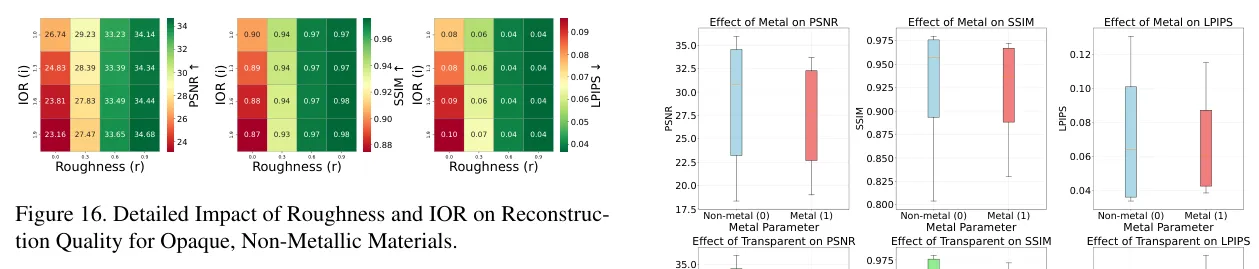
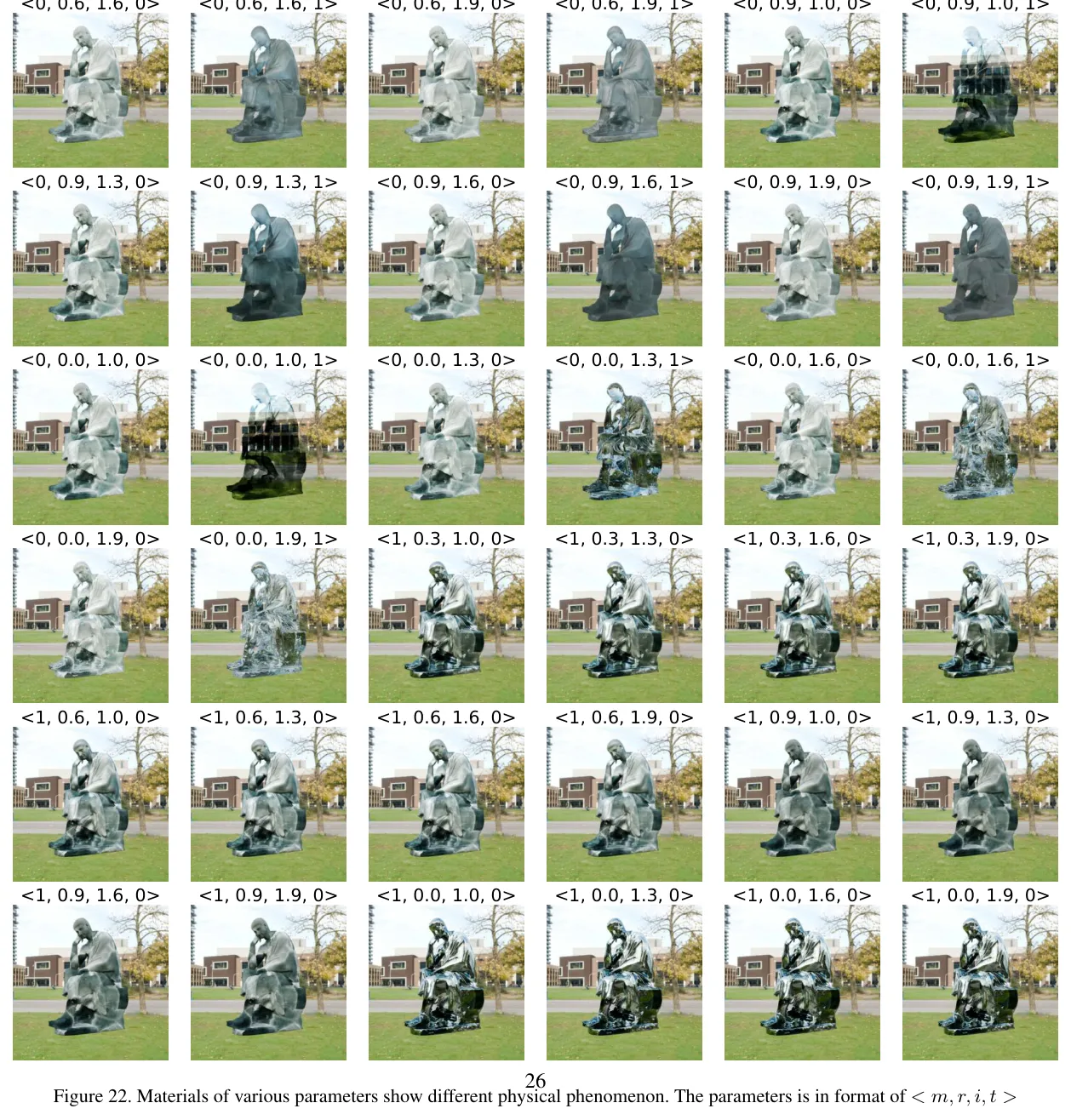
实验设计:用 3DGS 在同一模型上系统扫四个材料参数——\(\text{metallic}\in\{0,1\}\)、\(\text{roughness}\in[0,0.9]\)、\(\text{IOR}\in[1.0,1.9]\)、\(\text{transmission}\in\{0,1\}\),共 48 种配置;每种用 50 张带掩码多视图训练、10 张留出视图测 PSNR(Fig 4)。三种失败模式:① 光滑反射(roughness=0)灾难性失败——金属仅 19 dB PSNR vs 高粗糙度非金属 35 dB,原文 "a 45% degradation";② 低粗糙度饿死匹配——非金属 roughness 0→0.9,PSNR 涨 5 dB(纹理线索变多);③ 透明最致命——原文 "causing a consistent 5.82 dB PSNR drop (19.3% quality loss) across all configurations"。
透明 + 折射率:原文 "higher refractive indices progressively worsen performance: transparent materials exhibit PSNR values ranging from 19.9 dB (IOR=1.0) to 27.9 dB (IOR=1.9)",并归纳 "confirming that stronger refraction increasingly violates epipolar geometry." [注:原文"worsen"的定性结论与所列 19.9→27.9 的数值方向看似相反,此处忠实照抄论文原话与数字,具体口径以原文 Suppl. I/J 为准,不臆测。]
④ §3.2 根因:算法假设 vs 物理现实
核心论断:原文 "These failures stem from a fundamental mismatch between algorithmic assumptions and physical light transport." 逐类拆:反射——"violate photometric consistency through view-dependent appearance governed by their BRDF, causing algorithms to misinterpret specular highlights as geometric features";低纹理——"lack the high-frequency features needed for robust correspondence matching";透明(最严重)——"breaking both photometric consistency and the geometric assumption of linear light propagation: refraction invalidates the epipolar constraints underpinning multi-view triangulation, causing complete reconstruction breakdown." 作者强调 "These are not edge cases but systematic failures."
Q&A · 为什么透明材料是"最致命"的一类?
核心:反射/低纹理只破坏"光度一致性"这一条假设(外观线索不可靠),而透明同时破坏两条:① 光度一致性(透过去看到的是背景,不是表面);② 更要命的几何假设——光直线传播。多视图三角化靠对极几何(一条光线在另一视图对应一条极线),而折射让光线拐弯,对极约束彻底失效 → 三角化从根上崩。这就是为什么消融里透明的 PSNR 掉得最稳(5.82 dB / 19.3%),且 SfM/MVS/NVS 全线对透明束手无策。启示:要做透明重建,必须显式建模折射/光传输,而非在 RGB 一致性上打补丁。
⑤ §4 数据集对比(Table 1)+ 规模统计(Table 2)
Table 1(与现有数据集对比,✓=支持):3DReflecNet 是唯一四项全 ✓(Transparent / Reflection / Low-Texture / Relighting)且 PBR ✓ + w/Real ✓、实例 120K+ 的数据集。对照:OpenMaterials(Transparent ✗、纯合成无 Real、1001 实例)、Objaverse(800K+ 但无 PBR、无透明)、DTU/Tanks&Temples(漫反射为主)、NeRO(仅 8 个物体)。
Table 2 规模: #Shapes | #Materials | #Lighting | #Instances | #Views | #Frames
Synthetic(合成) 12K+ | 22 | 2700+ | 120K+ | 60 | 7M+
Real(真实) 300+ | >50 | 5 | 1000+ | 100+ | 120K+
⑥ §4.2 合成数据生成(材料/光照/玻璃模拟反射/渲染输出)
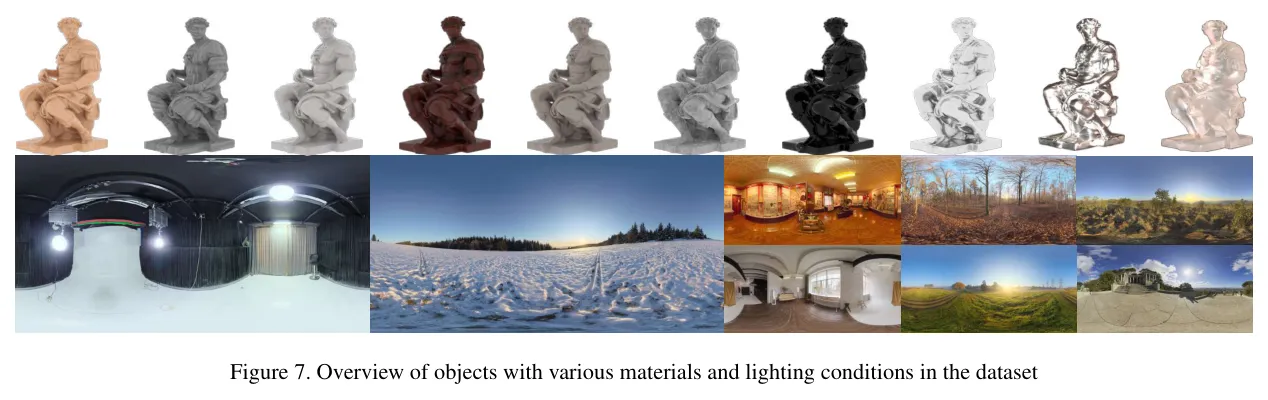
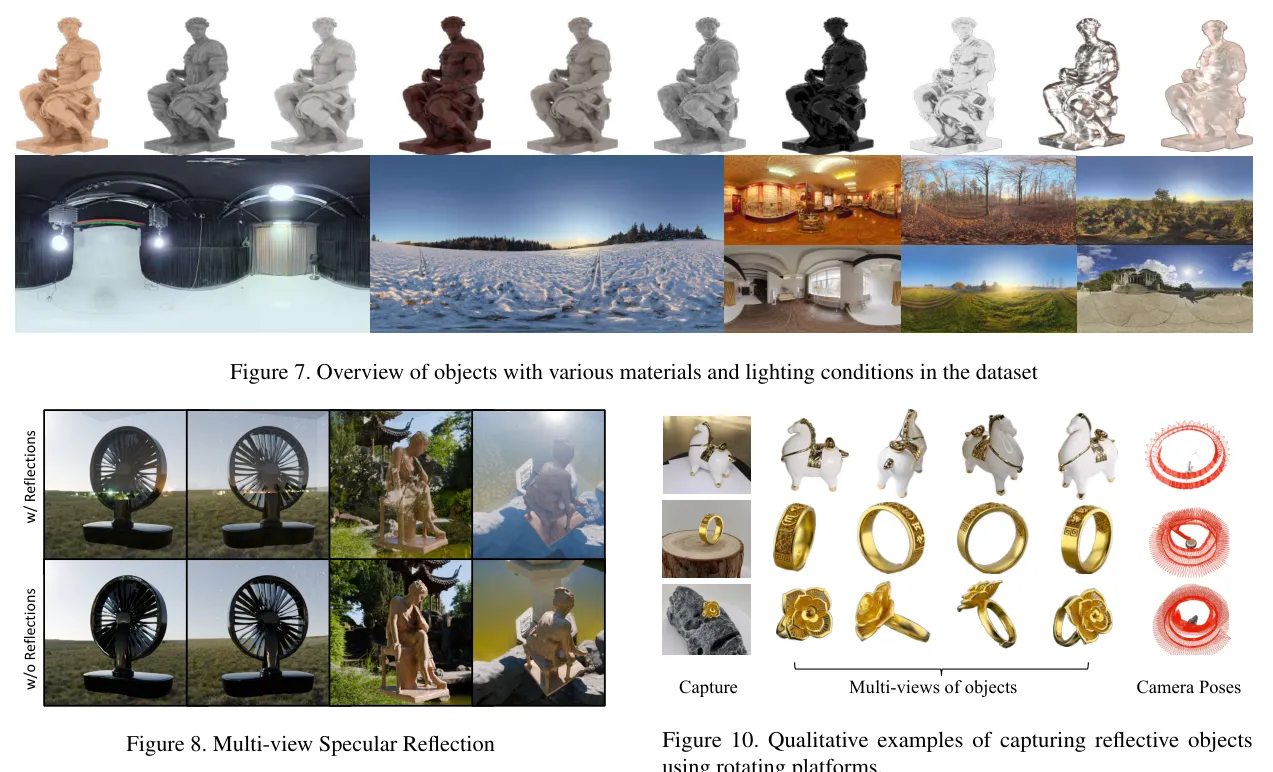
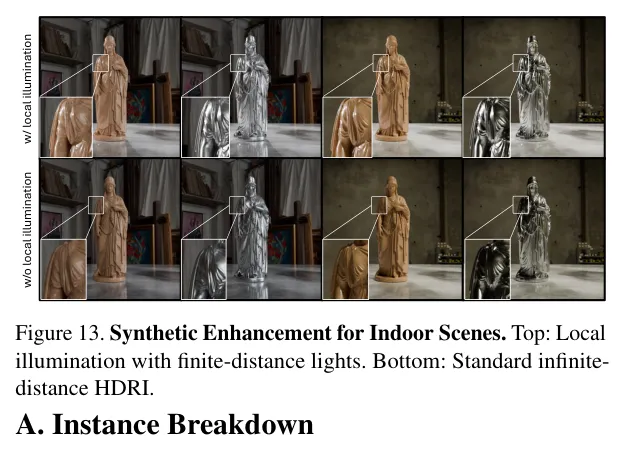
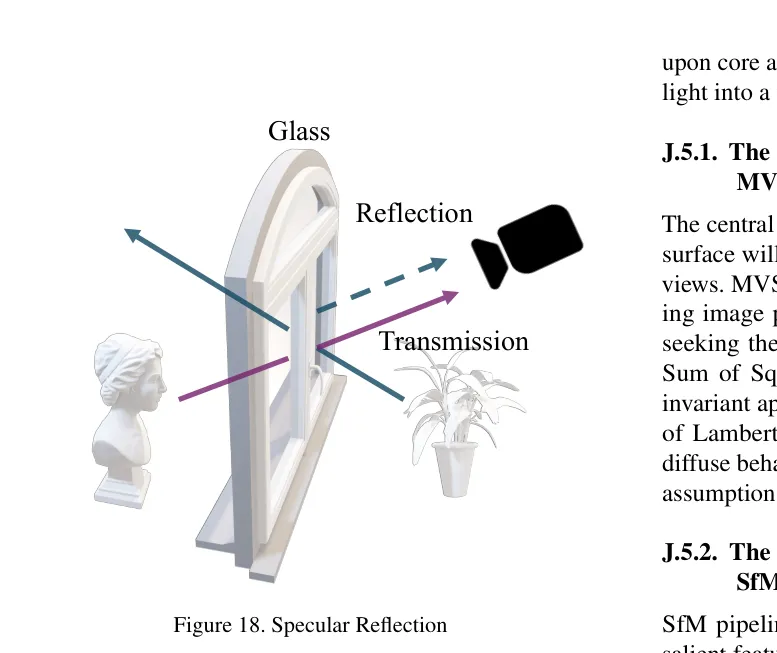
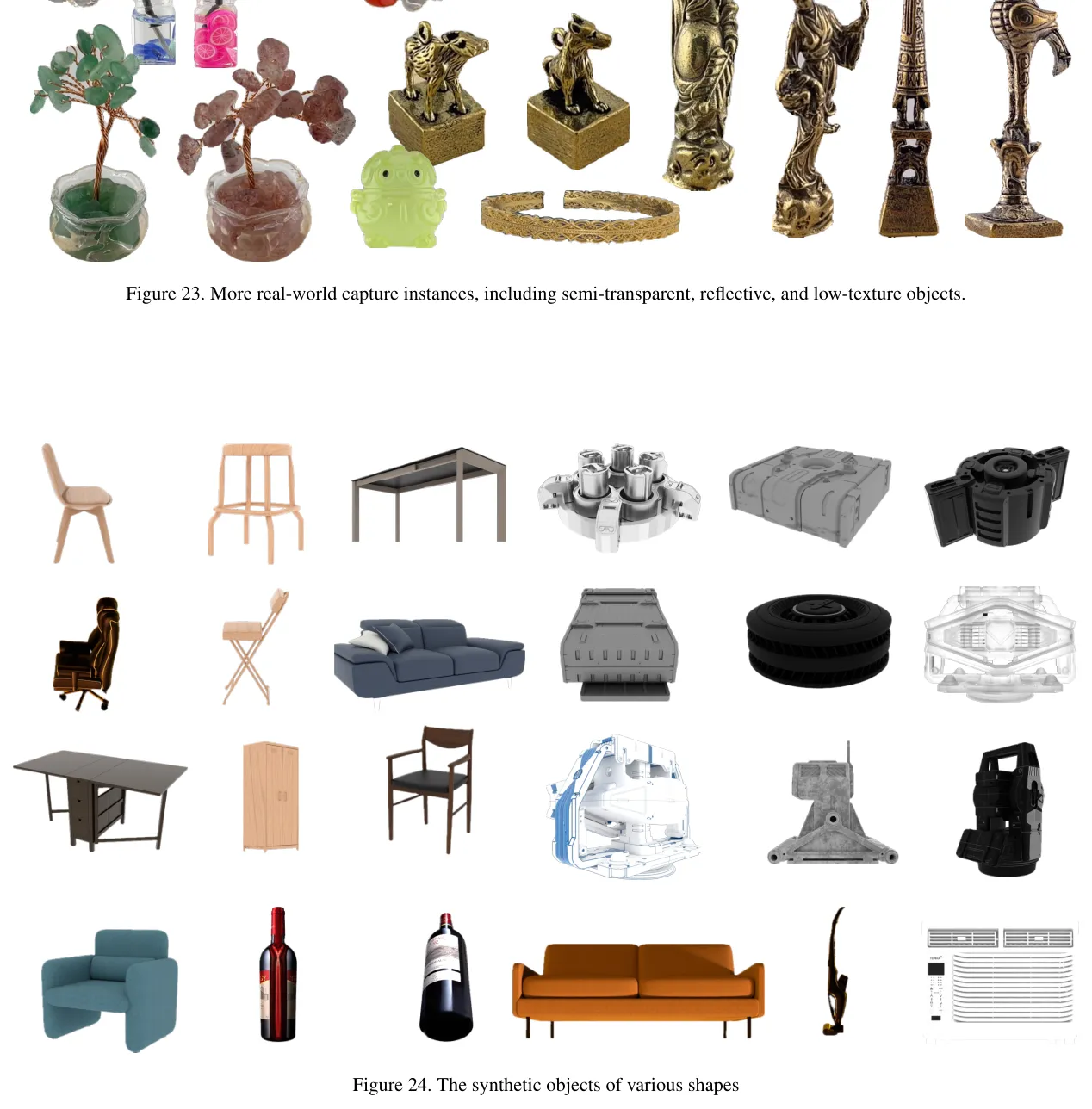
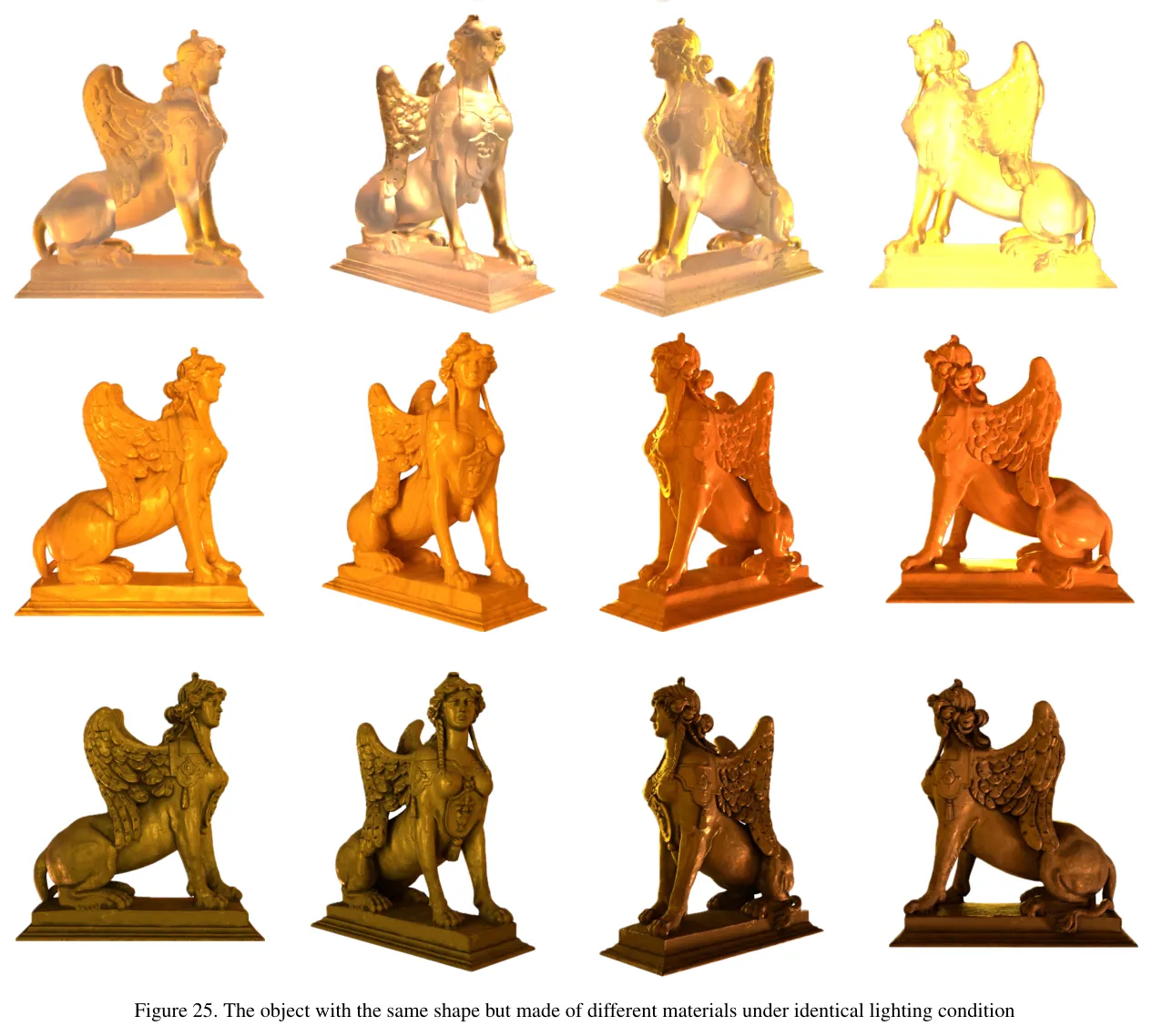
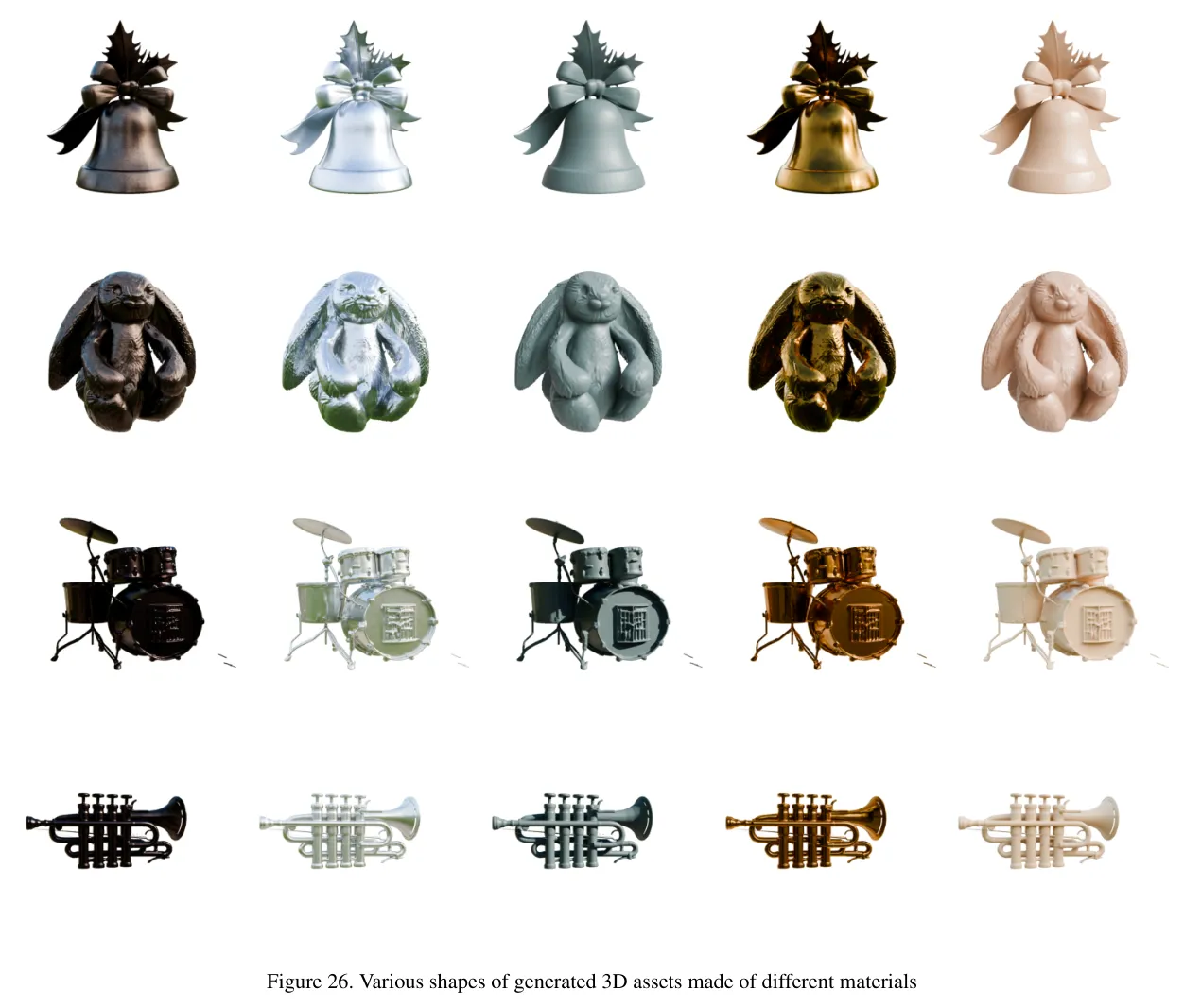
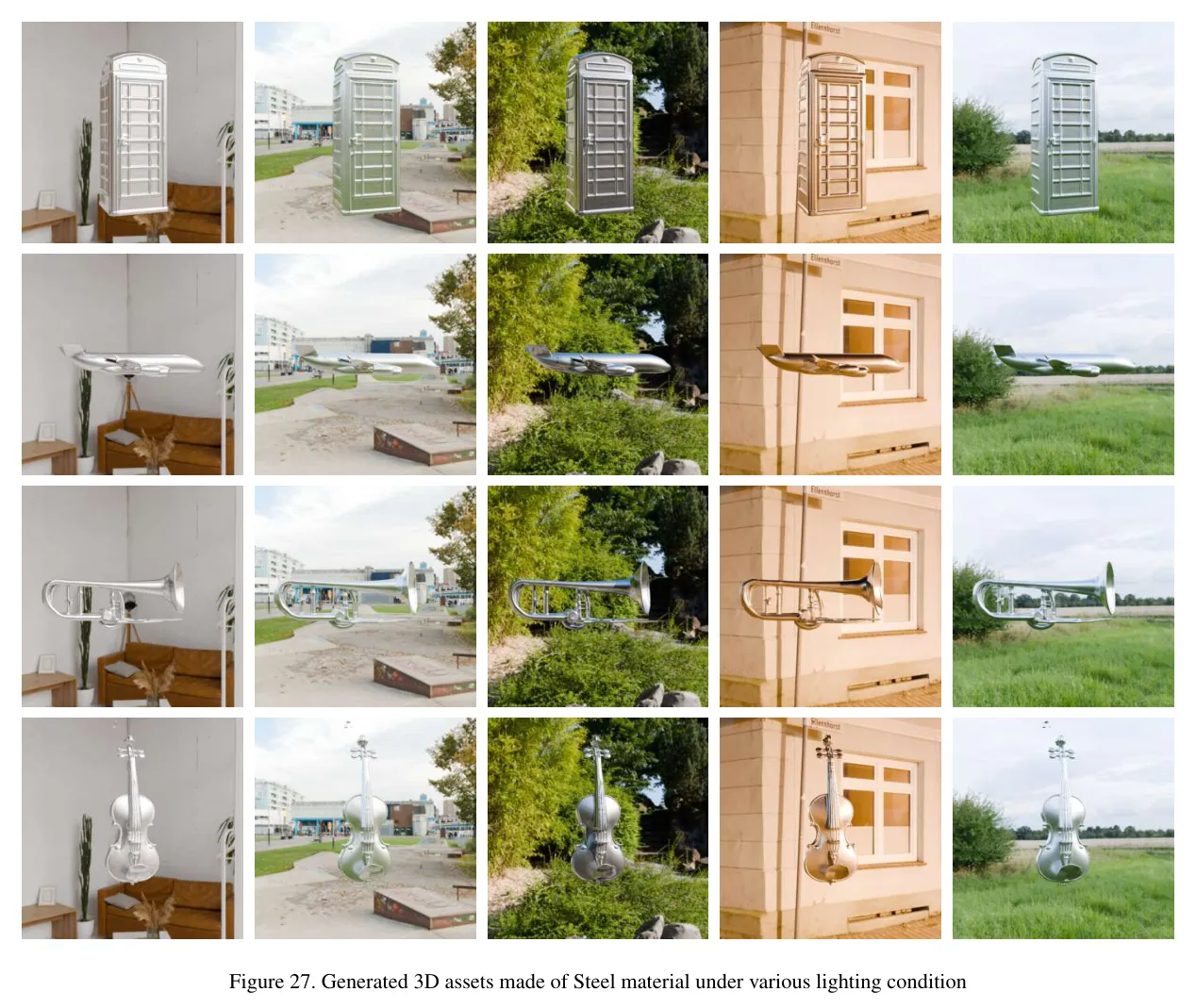
形状:从扫描库+3D 资产库收集 10K+ 高质量形状(艺术/工业/自然),再生成 2K+ 日常物体。材料:22 种,分五组——Diffuse(混凝土/哑光)、Transparent(玻璃/亚克力)、Metallic(钢/铬)、Glossy-Textured(带纹理抛光木)、Glossy-Low-Texture(陶瓷釉)。光照:2700+ HDRI 环境贴图 + 1–2 个上半球点光源。镜面反射模拟(巧思):原文 "we position a glass sheet between the object and the camera",且 "we provide data from 60 different angles under hundreds of lighting conditions"(不像前作只单角度)。渲染输出:每实例 60 视图、1000×1000 分辨率 RGB + 点云/网格 + 分割掩码 + 稠密深度 + 表面法向。
⑦ §4.3 用 2D 参考图做 diffusion 2D→3D 生成
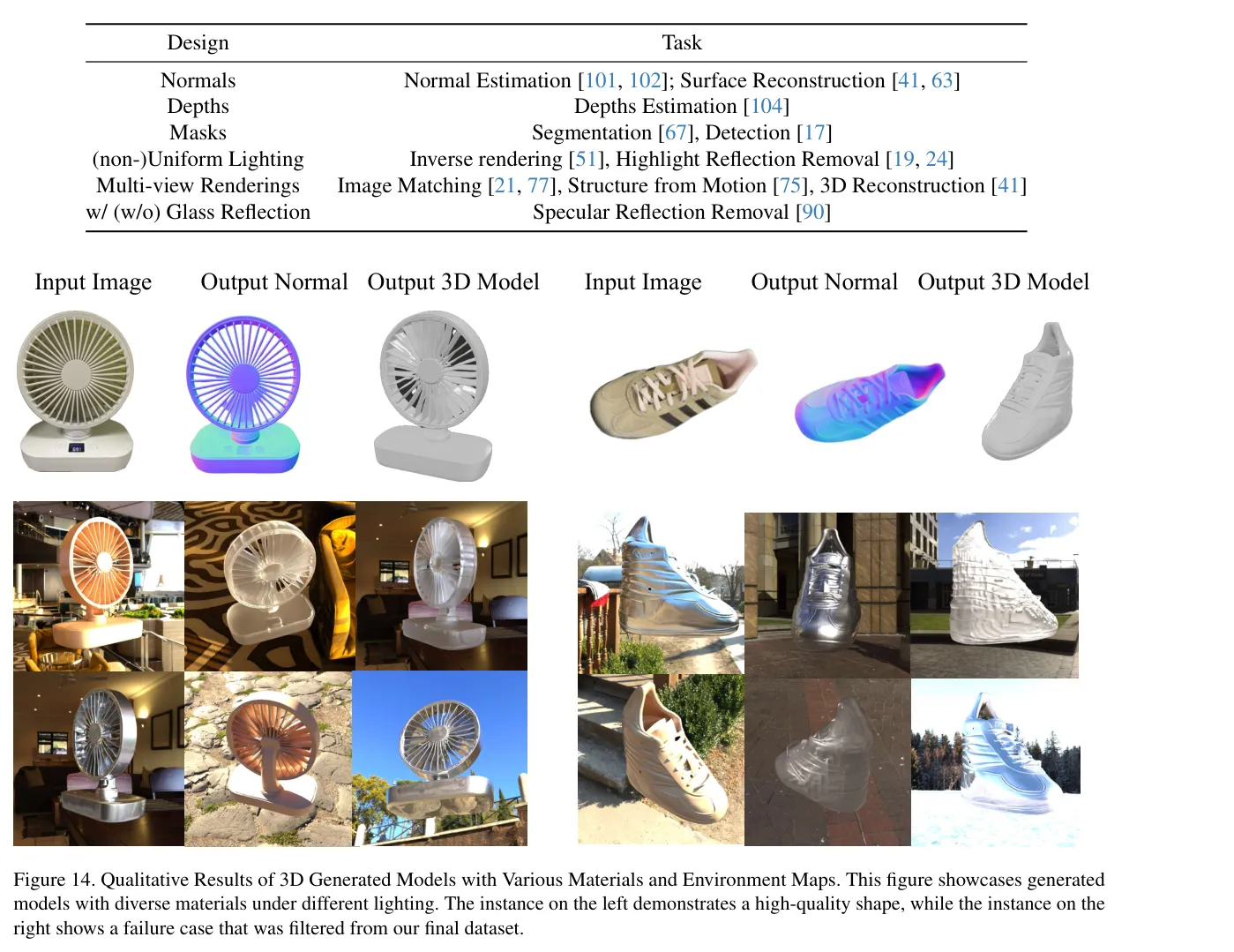
动机:突破"预定义库"的几何多样性上限。流程:原文 "We use real-world and LLM-generated 2D images as references to synthesize 3D models via diffusion-based methods. This process involves estimating normals and depth, reconstructing a mesh, and refining it to a canonical pose." 2D 参考含三列 GPT-4o 生成图 + 一列真实拍摄,生成的 3D 模型再在 Blender 用多样 PBR 材料 + HDR 光照渲染。点评:"LLM 想象稀有外形 → diffusion 提 3D → PBR 渲染"是一条低成本扩容路径,把生成式管线接进数据集构建。
⑧ §4.4 真实采集(旋转平台 + 标记底座 + RealityScan + SAM2)
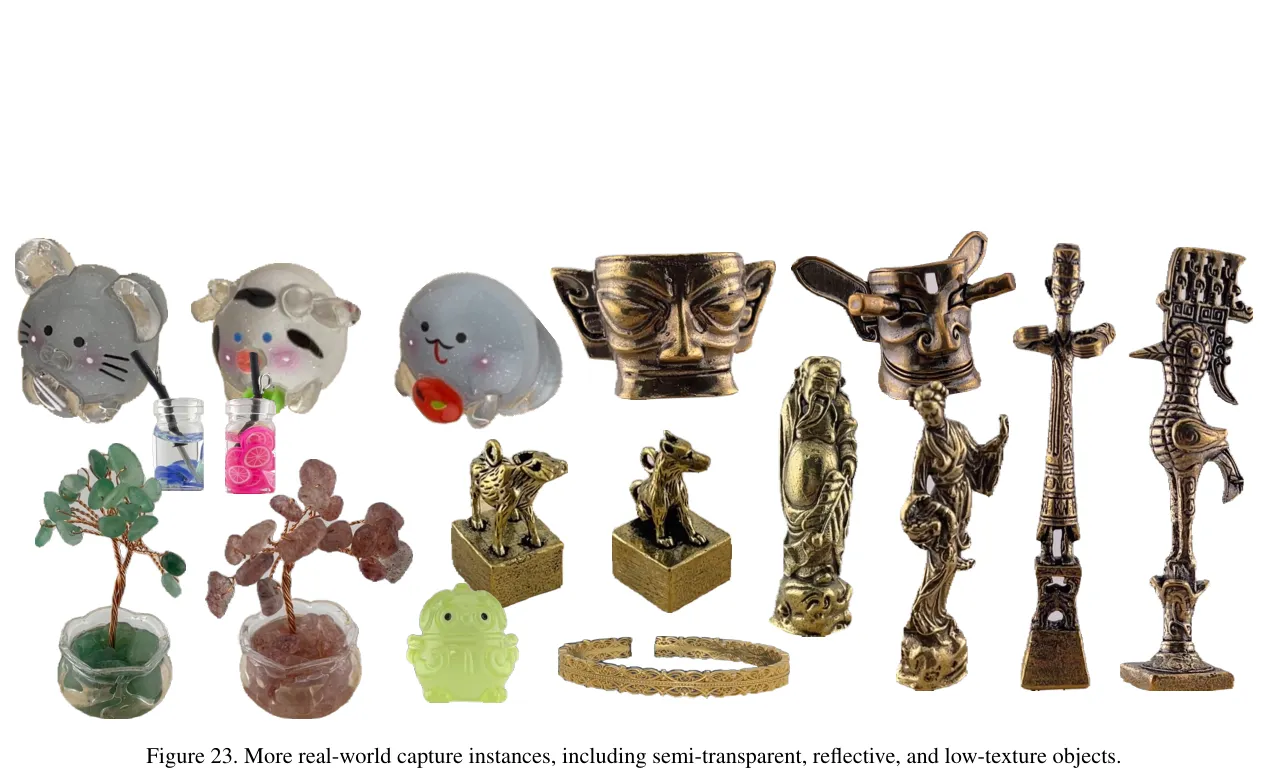
核心难点:原文 "standard camera pose estimation algorithms fail when objects have challenging materials… that lack stable, view-invariant features." 即反射/低纹理物体本身估不出位姿。巧解(把位姿任务与物体解耦):把目标物放在高细节底座(当作稳定跟踪标记)上,整体置于旋转平台做平滑 360° 采集;先用 RealityScan 跟踪底座恢复鲁棒相机位姿,再用 SAM 2 分割去掉底座与背景。设备=iPhone 16 Pro,1080×1920 @30FPS。点评:"用一个好跟踪的代理物体替难跟踪的目标定位姿",是务实又聪明的数据采集工程。
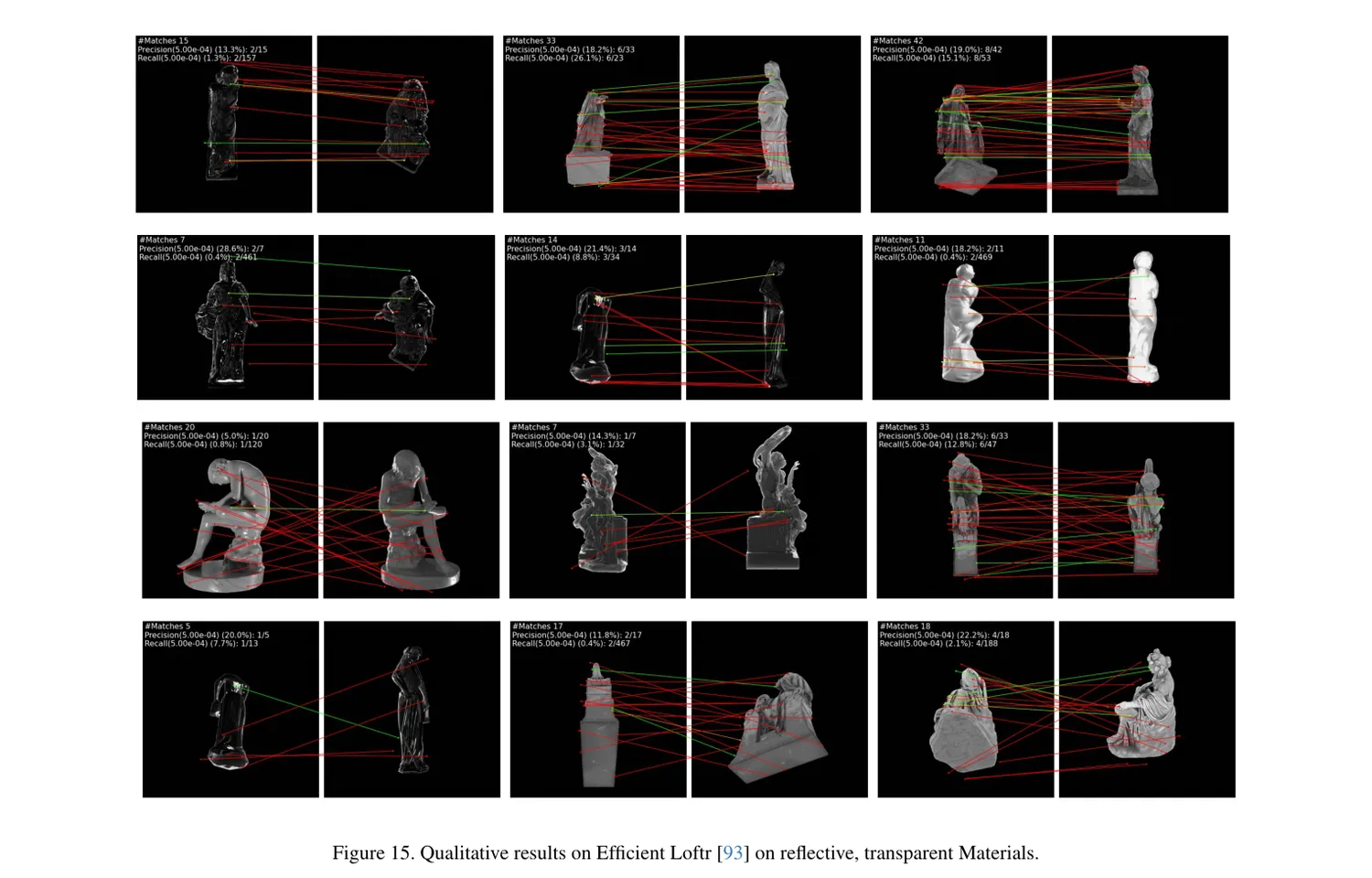
⑨ §5.2 图像匹配基准(Table 3,真实数值)
设置:1000 个罗马雕像实例,指标 AUC@5°/10°/20°(位姿精度曲线下面积);括号内斜体=同方法在 MegaDepth 上的成绩(对照"简单数据")。
方法 AUC@5°↑ | @10° | @20° (括号=MegaDepth)
SuperPoint+NN 11.2 (31.7) | 20.8 (46.8) | 27.7 (60.1)
LoFTR 19.8 (52.8) | 35.6 (69.2) | 39.2 (81.2)
ELoftr 21.3 (56.4) | 36.2 (72.2) | 41.9 (83.5)
ROMA(最佳) 32.1 (62.6) | 47.5 (76.7) | 59.1 (86.3)
读表:即便最强的 ROMA,AUC@5° 也从 MegaDepth 的 62.6 暴跌到 3DReflecNet 的 32.1(近乎腰斩)。原文 "existing methods often struggle to establish accurate correspondences… due to inconsistent appearance, lack of distinctive texture, and view-dependent distortions." 巨大 gap 本身就是数据集价值的证明。
⑩ §5.3 SfM + §5.4 新视角合成(Table 4 NVS PSNR)
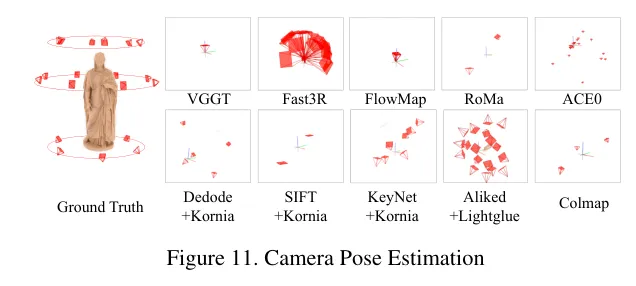
SfM:评 10 种方法;为聚焦物体本身,去掉背景但保留表面光照(防止背景提供"作弊"特征),Fig 11 显示多数方法都恢复不出准确相机参数。NVS(Table 4,PSNR↑,五材料类):
方法 Diffuse | Transparent | Metallic | Glossy-Tex | Glossy-LowTex
Instant-NGP 36.12 | 19.20 | 25.59 | 34.01 | 26.52
3DGS 36.99 | 20.20 | 27.02 | 34.10 | 27.62
Splatfacto 37.32 | 21.31 | 28.61 | 34.21 | 28.01
2DGS 36.77 | 17.12 | 28.46 | 34.42 | 27.97
规律:Diffuse 全 >36 dB(漫反射满足一致性);Transparent 全线崩到 ~17–21 dB(最难);Metallic / Glossy-Low-Texture 因镜面反射退化;Glossy-Textured ~34 dB(有漫反射纹理兜底但镜面区仍有伪影)。
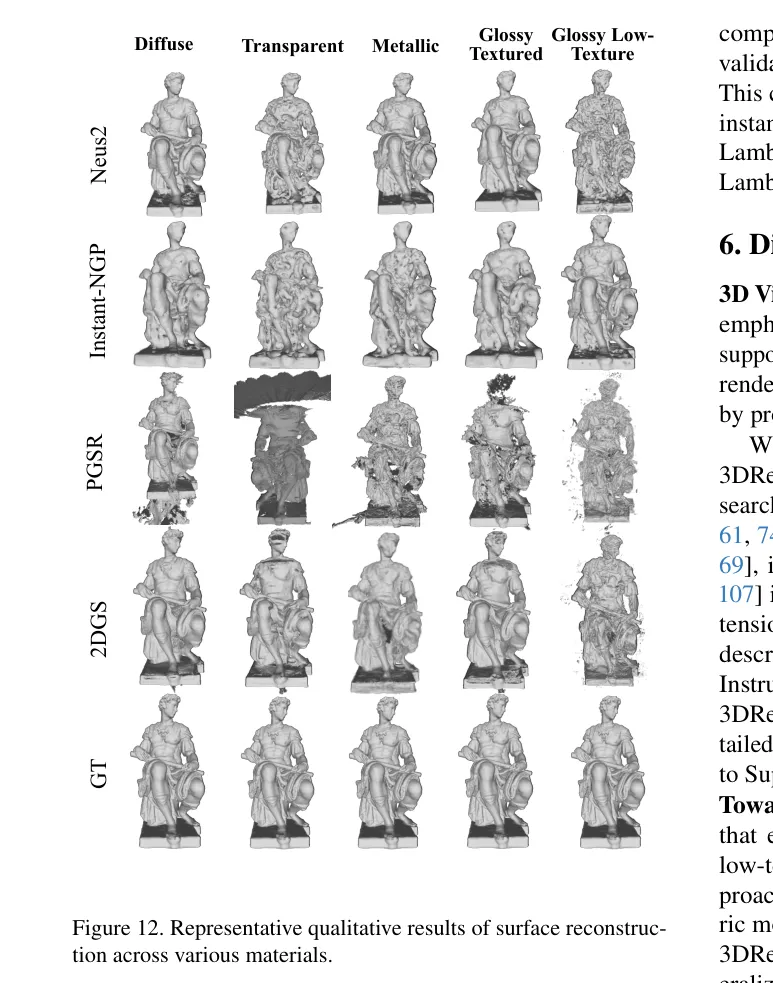
⑪ §5.4 表面重建(Table 5 Chamfer Distance↓)+ 其他任务
Table 5(Chamfer 距离↓,越小越好):2DGS 综合最好(Diffuse 0.060 / Transparent 0.142 / Metallic 0.121 / Glossy-Tex 0.086 / Glossy-LowTex 0.098);Neus2 次之;PGSR 在透明/金属上崩坏(Transparent 0.502、Metallic 0.412,远差于其 Diffuse 0.062)。所有方法都"漫反射好、非朗伯差"。反射去除/重打光/真实数据(§5.5)因篇幅放附录,结论一致:原文 "SOTA methods… perform poorly on 3DReflecNet","This consistent failure on both our synthetic and real-world instances confirms that SOTA methods, designed for simple Lambertian surfaces, are not robust."
Q&A · 对自动驾驶 / 工业感知有何意义?
强相关:路面积水、车漆高光、玻璃幕墙、金属护栏、夜间低纹理——都是"反射/透明/低纹理"的现实化身,正是纯视觉/多视图重建最容易出鬼影、估错位姿的地方。3DReflecNet 的价值:① 提供带精确 GT(深度/法向/位姿/网格)的非朗伯材料训练/评测数据,可用于压测 BEV/occupancy 重建在反光透明物上的鲁棒性;② 其"标记底座 + 旋转平台 + RealityScan + SAM2"采集协议,给"难跟踪物体如何拿到可靠位姿真值"提供了可复制范式;③ 五任务基准提示量产系统:在镜面/透明场景需引入物理/材料感知而非纯 RGB 一致性。边界(诚实):本数据集是object-centric(单物体、转台/合成),与车载大场景、动态、远距离仍有域差;且反射/重打光实验在附录、正文未给全表,落地前需自行复核。
📚 PBR 四参数解读(消融为何扫这四个)
§3.1 扫的四个参数正是 Cook-Torrance/disney BRDF 里决定外观的关键量,也是"非朗伯难度"的旋钮:① metallic(金属度 0/1)——0=电介质(漫反射为主),1=金属(几乎全镜面、带颜色反射);② roughness(粗糙度 0–0.9)——0=镜面光滑(高光极尖、最难匹配),0.9=磨砂(高光散开、接近漫反射、最好重建);③ IOR(折射率 1.0–1.9)——决定透明体折射弯折强度,越高越破坏对极几何;④ transmission(透射 0/1)——0=不透光,1=透明(光穿过物体看到背景)。消融结论的物理对应:"roughness 0→0.9 PSNR 涨 5 dB"="高光散开→纹理线索回归";"transparent −5.82 dB"="透射+折射双杀光度一致性与几何"。把抽象的"难"翻译成可调的物理参数,是本节最大价值。
Q&A · 为什么必须"合成 + 真实"混合,纯合成不够?
核心:纯合成(如 OpenMaterial)能给精确 GT,但缺三样东西——真实传感器噪声、真实运动模糊、真实采集分布。原文批评 OpenMaterial "remains confined to purely synthetic data, lacks real-world noise and motion." 而纯真实又难拿到精确 GT(尤其反射/透明物体连位姿都估不准)。3DReflecNet 的取舍:合成端用 PBR 拿"完美标注 + 海量多样性(材料/光照/几何任意组合出 120K 实例)",真实端用"标记底座 + 转台 + RealityScan"拿"真实噪声下仍可靠的位姿真值",两端互补。原文定位 "By bridging synthetic and real domains… 3DReflecNet provides a new foundation to evaluate 3D vision models under realistic and challenging conditions." 这就是它在 Table 1 同时打 ✓ PBR 与 ✓ w/Real 的意义。
📚 九大类目 + 文本标注(§4.1, Fig 6)
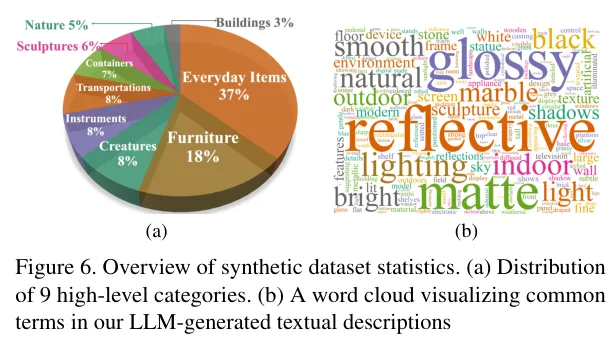
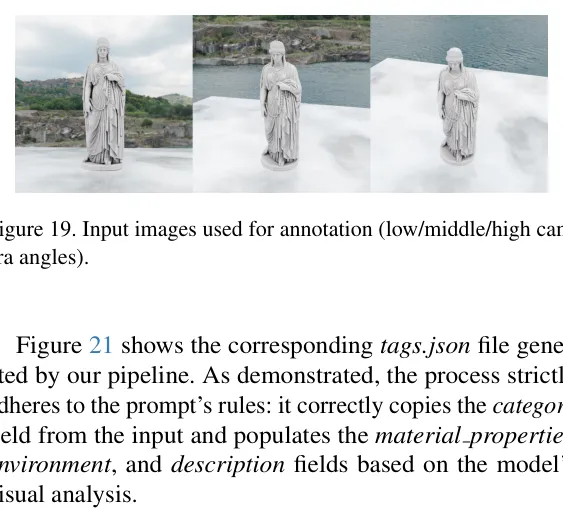
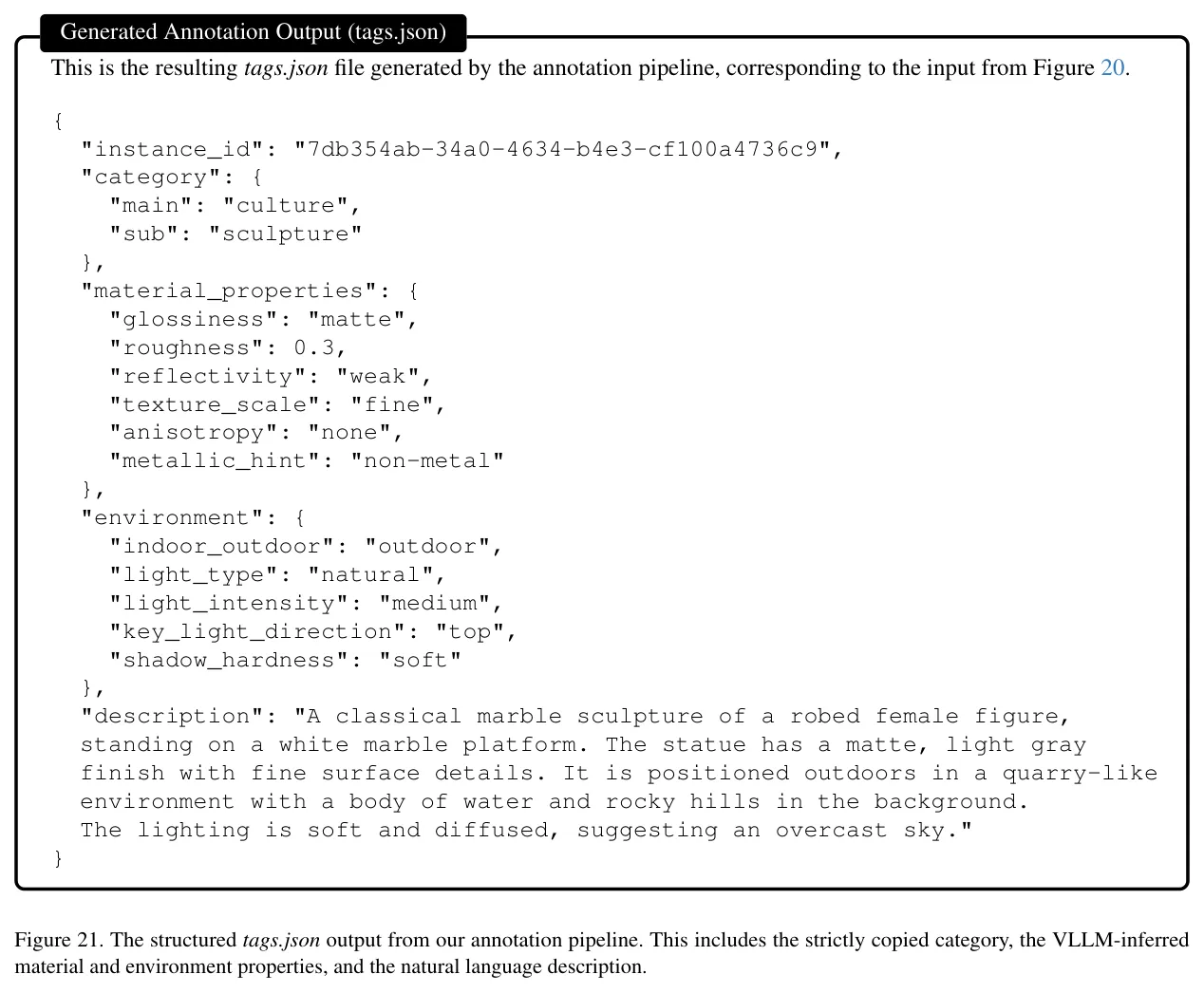
类目分布:合成集分 9 个高层类目,原文 "While Everyday Items is the largest category, the dataset maintains a balanced distribution across other diverse classes." 涵盖家居、车辆、雕像、电子产品、配饰、矿物等(含对称几何/低纹理外观以贴近工业场景)。文本标注:Fig 6b 词云里 "terms like reflective, lighting, and glossy confirm our core focus on complex materials and illumination." 每个实例还用 Qwen3-VL-30B 生成详细文字描述与标签,原文称其 "designed to support generation-related tasks, such as text-to-3D asset creation." 点评:不止做感知数据集,还为 text-to-3D / image-to-3D / 材质生成等生成式任务预埋了语言标注,扩展性强。
Q&A · 数据集怎么用?划分、任务、可扩展性
基准划分(§5.1):原文 "80% of the data is allocated for training, 10% for validation, and remaining 10% for testing",覆盖合成 + 真实的 object-centric 场景,支持五任务(匹配/SfM/NVS/反射去除/重打光),每个任务给标准评测 + baseline。可扩展(§6 Discussion):因提供深度/法向/掩码/网格等全套 GT,还可支持 "highlight removal, inverse rendering, depth estimation, and surface normal prediction",以及生成式方向 image-editing / text-to-3D / image-to-3D / image-to-texture。使用建议:想压测自家重建在反光透明物上的鲁棒性,可直接取对应材料类(如 Transparent / Metallic)做 zero-shot 评测——因为消融已证明这些类是 SOTA 的盲区。
Q&A · 与 VGGT/前馈重建大模型的关系 + 22TB 规模意味着什么
与前馈重建大模型(如 VGGT/DUSt3R)的关系:那些方法主张"标准大 Transformer + 大数据"就能学会多视图几何、绕开几何后优化——但它们的训练数据仍以漫反射/有纹理为主,隐含吃了"光度一致性"红利。3DReflecNet 恰恰是给这类"数据驱动几何大模型"准备的压力测试集与训练补给:Table 3 里 VGGT/Fast3R/FlowMap 等也被纳入相机位姿评测(Fig 11 显示它们在反射/透明物上同样吃瘪)。换言之,本文回答了"大数据路线的 data 该长什么样才能 cover 非朗伯世界"。22TB / 7M 帧的规模意义:足够大才能既做训练(数据驱动模型需要量)又做细粒度评测(按材料类/光照/几何分桶分析失败模式);而 60 视图 ×1000² + 全套 GT(深度/法向/掩码/网格/位姿)保证每个实例都能支撑匹配→SfM→NVS→重建→重打光的全链路评测,这是 OpenMaterial(1001 实例、纯合成、窄任务)做不到的。诚实边界:22TB 对下载/存储/训练算力是真实门槛,且 object-centric 与车载大场景仍有域差,迁移到量产感知前需做域适配验证。
📌 全文一页总结(problem → dataset → benchmark → takeaway)
problem:反射/透明/低纹理材料违背多视图重建的"光度一致性"与"对极几何"假设,SfM/MVS/NeRF/3DGS 系统性失败;而现有数据集(DTU/CO3D/Objaverse/OpenMaterial)要么只有漫反射、要么纯合成。dataset(即本文"方法"):3DReflecNet=合成(12K+ 形状 ×22 材料 ×2700+ HDRI → 120K+ 实例、60 视图、7M+ 帧、1000²、含玻璃片模拟 60 角度镜面反射)+ 真实(iPhone 转台 + 标记底座 + RealityScan 位姿 + SAM2 分割,1000+ 物体),并用 diffusion 把 GPT-4o/真实 2D 图升成 3D 扩容;GT 含深度/法向/掩码/点云/网格。
benchmark:五任务(匹配/SfM/NVS/反射去除/重打光,80/10/10 划分)。匹配:ROMA AUC@5° 从 MegaDepth 62.6 跌到 32.1;NVS:Diffuse >36 dB 但 Transparent 仅 ~17–21 dB;表面重建:PGSR 透明 Chamfer 0.502 崩坏;材料消融:金属光滑面仅 19 dB(−45%)、透明 −5.82 dB(−19.3%)。
Takeaway(≥3 条):① 失败有根因、可量化——不是个例而是假设失效:反射破坏光度一致性、透明额外破坏对极几何(折射使光线拐弯),消融用 PSNR 把"难度"钉成数字;② 合成+真实混合 + 物理玻璃模拟 + 生成式扩容是补齐既有数据集短板的组合拳,且首个四类材料全覆盖 + 含真实数据;③ 采集工程范式——"难跟踪物体放标记底座上转台采集"解决了非朗伯物体位姿真值难题;④ 呼唤物理感知模型——所有 SOTA 在非朗伯材料上集体退化,证明纯 RGB 一致性范式见顶,需引入 BRDF/光传输建模。适用边界:object-centric、反射/重打光全表在附录。
🖼 论文原图(本地 PDF 截图,原文 caption 未改写)