CVPR 2025 🥈 Best Paper 提名
Navigation World Models
Amir Bar · Gaoyue Zhou · Danny Tran · Trevor Darrell · Yann LeCun
摘要 Abstract
见上方 arXiv / CVF 链接。
📝 精读笔记
灵魂一句
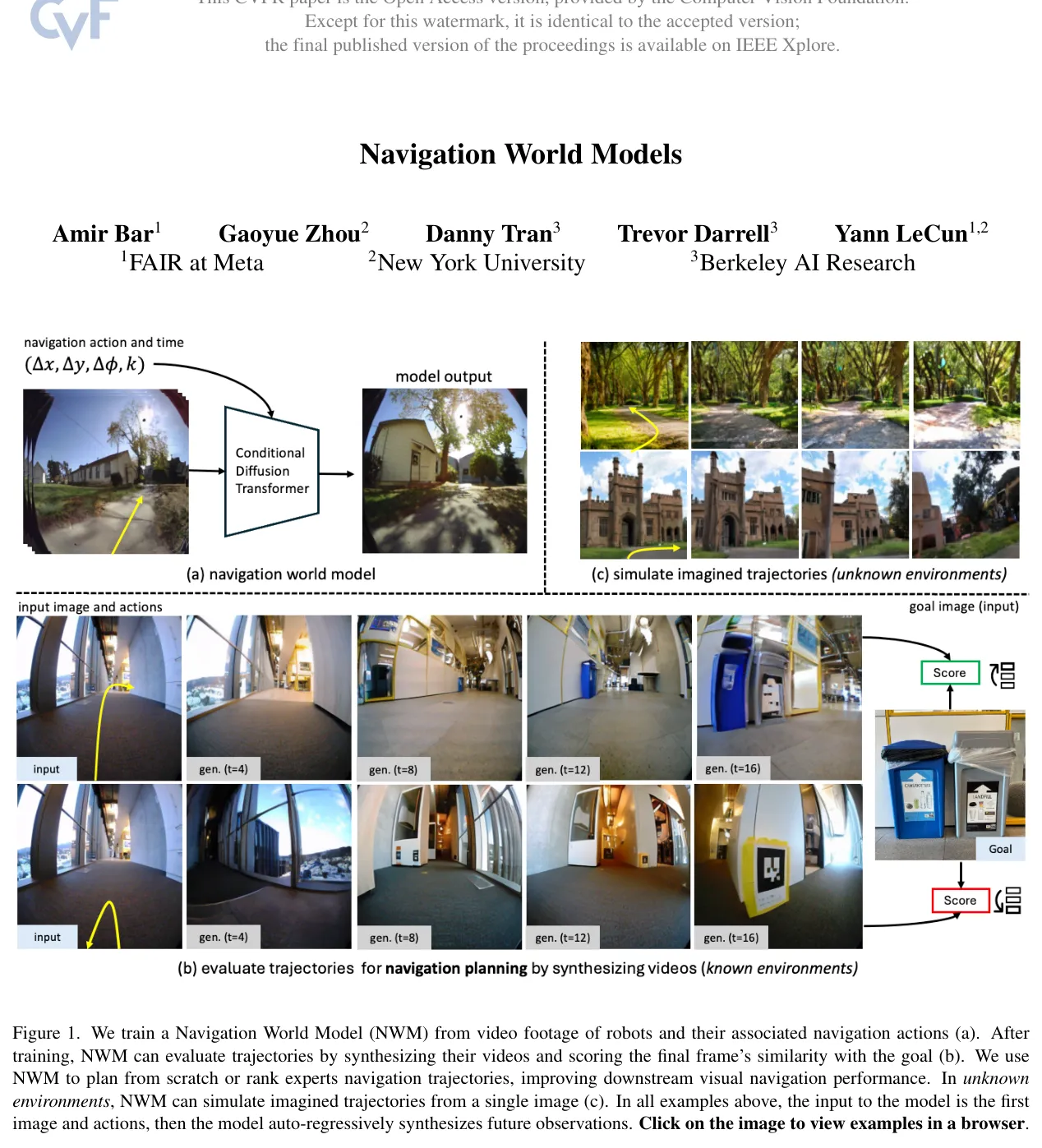
把"导航"重写成"可控视频生成":给当前帧 + 导航动作(平移 u + 转向 φ + 时间偏移 k),用 Conditional Diffusion Transformer (CDiT) 自回归预测未来帧。训练后一鱼三吃——① 当 planner(模拟一堆轨迹、选能到目标的);② 给现成策略 NoMaD 的轨迹打分排序;③ 从单张图"想象"陌生环境。Yann LeCun 组(FAIR/Meta + NYU + Berkeley),scaled 到 1B 参数。
问题 & 动机
现有 SOTA 机器人导航策略(GNM/NoMaD)是"硬编码"的——原文 "current state-of-the-art robotics navigation policies are 'hard-coded', and after training, new constraints cannot be easily introduced (e.g. 'no left turns')";且不能对难题动态多分配算力。NWM 用 world model 破局:把环境 dynamics 学进生成模型,规划时动态加约束 + 用相似度评分挑轨迹,无需重训策略。
核心方法(CDiT + 能量规划)
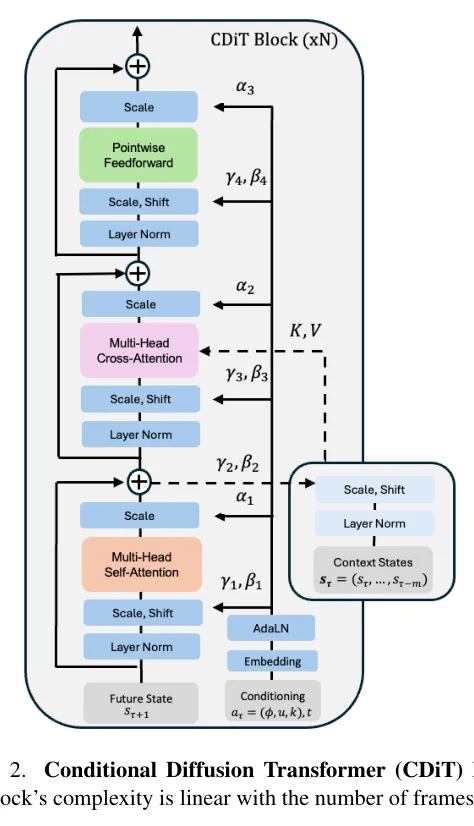
① 公式化:随机映射 st+1 ~ Fθ(st+1 | sτ, aτ),状态用预训练 SD VAE 编码成 latent;动作 a=(u, φ, k),u∈R² 平移、φ∈R yaw、k 时间偏移(±16s,把"时间"也当可控动作)。② CDiT block:不像 DiT 对全部 context 做 self-attention,只对"正在去噪的目标帧"做 self-attn,对过去帧用 cross-attention(query=当前帧 / KV=过去帧)+skip → 复杂度从 DiT 的 O(m²n²d) 降到 O(mn²d),对 context 线性。③ 动作/时间/diffusion-timestep 各自 sine-cosine + MLP 编码求和 ε=ψa+ψk+ψt(式3)经 AdaLN 调制。④ 规划=能量函数(式4)E = −相似度 S(sT, s*) + 约束惩罚,用 MPC + Cross-Entropy Method 优化动作序列。
关键结果(数值)
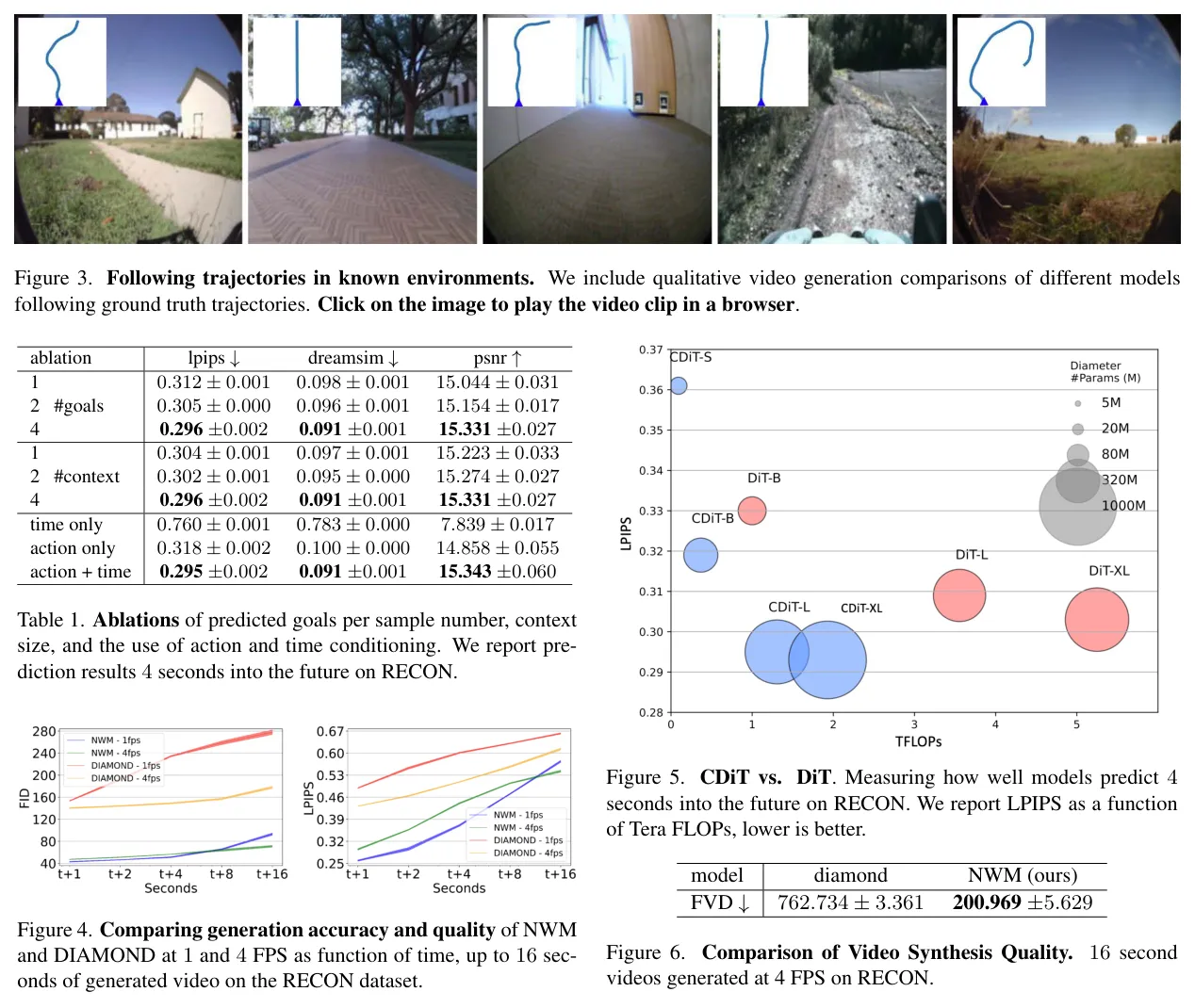
RECON 导航(Table 2,2 秒轨迹):NWM planning ATE 1.13 / RPE 0.35,碾压 NoMaD(1.93 / 0.52)和 GNM(1.87 / 0.73)。视频质量 FVD:NWM 200.97 vs DIAMOND 762.73(低 3.8×)。效率:CDiT-L 与 DiT-XL 同参数下 快 4× 还更准。
亮点
CDiT 线性复杂度(比 DiT 省 4× FLOPs);单模型跨多环境/多 embodiment;约束感知规划(Table 3 三种约束全满足、性能仅微降);加 Ego4D 无标注视频(只有 time-shift 动作)能提升陌生环境想象。
疑问 / 边界
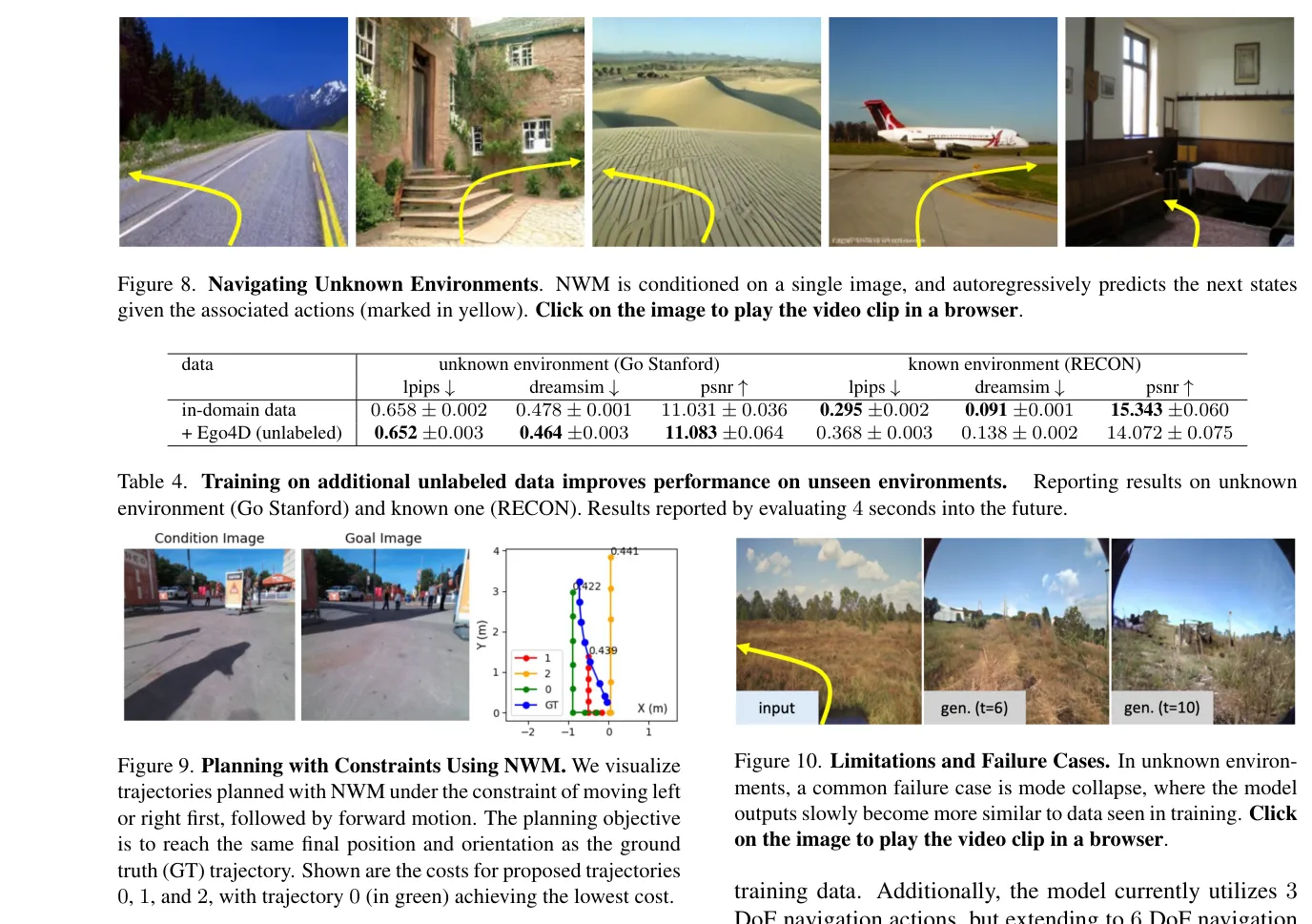
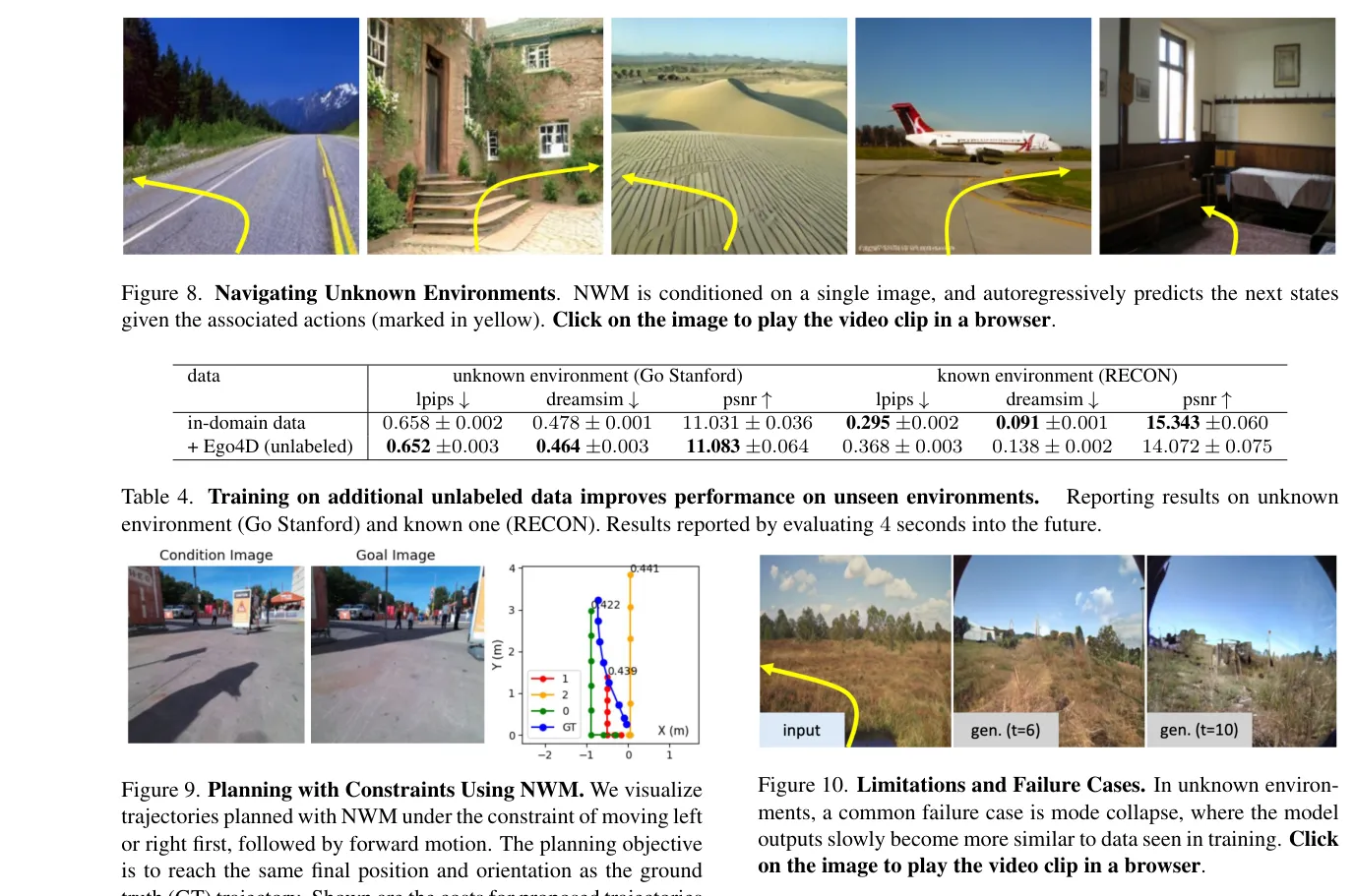
① 加 Ego4D 在陌生环境(Go Stanford)涨、但在已知环境(RECON)反而掉(lpips 0.295→0.368)——in-domain 保真 vs 泛化的 trade-off,原文表述偏正面、淡化了这点;② OOD 长程预测会 mode collapse(输出越跑越像训练数据);③ 目前仅 3-DoF 动作;④ 难模拟行人等场景动态(原文承认 "struggles with simulating temporal dynamics like pedestrian motion")。
📖 逐段精读 · 笔记
批量精读初稿,基于本地 PDF 全文(51k 字符 / 11 页)。最后更新 2026-06-21。
① Abstract(摘要)— 逐句精讲
原文(定义):"We introduce a Navigation World Model (NWM), a controllable video generation model that predicts future visual observations based on past observations and navigation actions." → NWM 本质是可控视频生成模型:输入"过去观测 + 导航动作",输出"未来视觉观测"。把"导航"重写成"给定动作预测未来帧"。
原文(骨架):"To capture complex environment dynamics, NWM employs a Conditional Diffusion Transformer (CDiT), trained on a diverse collection of egocentric videos of both human and robotic agents, and scaled up to 1 billion parameters." → 用 CDiT 抓环境动态;训练数据=人 + 机器人的第一视角视频;规模 1B 参数。
原文(能力 1·规划):"In familiar environments, NWM can plan navigation trajectories by simulating them and evaluating whether they achieve the desired goal." → 熟悉环境:模拟轨迹 + 评估是否到目标 = 规划。
原文(能力 2·加约束,核心卖点):"Unlike supervised navigation policies with fixed behavior, NWM can dynamically incorporate constraints during planning." → 监督策略行为固定,NWM 能在规划时动态加约束(如"不准先左后右"),无需重训。
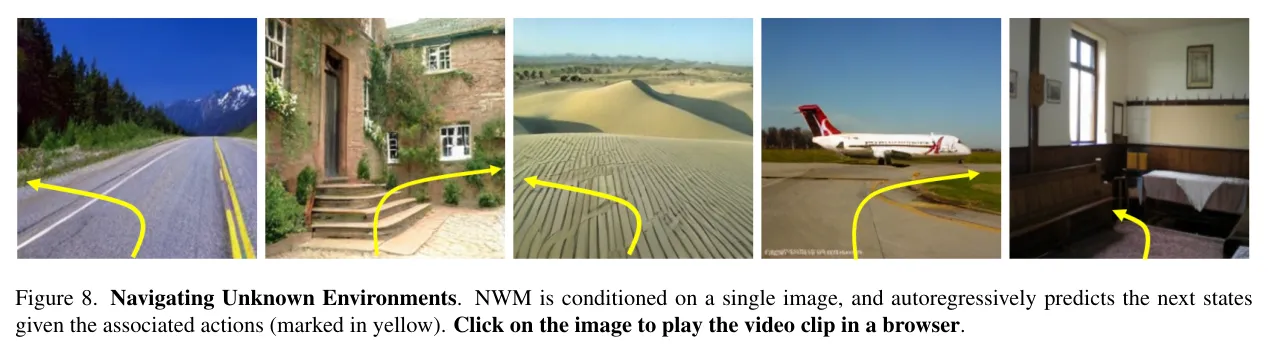
原文(能力 3·想象):"NWM leverages its learned visual priors to imagine trajectories in unfamiliar environments from a single input image." → 用学到的视觉先验,从单张图想象陌生环境的轨迹。一句话抓 Abstract:CDiT 驱动的 1B 导航 world model,熟悉环境能规划+加约束、陌生环境能从单图想象。
📚 背景知识(外部,非本文原文,理解 NWM 必备)
① World Model(Ha & Schmidhuber 2018):学一个"环境模拟器"——给当前 state + action,预测 next state(和 reward)。与 policy 的区别:policy 直接输出动作,world model 输出"世界会怎么变",可用于脑内 rollout + 规划。NWM = 导航版 world model。
② DiT(Peebles & Xie 2023):Diffusion Transformer——把 latent 当 token 序列、用纯 Transformer(self-attn + FFN)做扩散去噪 backbone 替代 U-Net,条件/timestep 经 AdaLN 注入。CDiT 是 DiT 的"省算力变体"。
③ AdaLN(Adaptive LayerNorm):普通 LayerNorm 的 scale \(\gamma\) / shift \(\beta\) 是固定学习参数;AdaLN 让 \(\gamma,\beta\) 由条件向量经小 MLP 动态算出,把条件信息"调制"进每层归一化与注意力输出。
④ Diffusion / DDPM(Ho 2020):前向逐步加高斯噪声把数据→纯噪声;反向训一个网络从噪声里"去噪"还原数据。本文前向 \(s^{(t)}_{\tau+1}=\sqrt{\bar\alpha_t}\,s_{\tau+1}+\sqrt{1-\bar\alpha_t}\,\epsilon\),反向网络 \(F_\theta\) 在 \(s_\tau,a_\tau,t\) 条件下还原 \(s_{\tau+1}\)。
⑤ MPC + Cross-Entropy Method(CEM):MPC=模型预测控制,用模型 rollout 一段未来、优化这段动作序列、只执行第一步、再滚动重做。CEM=无梯度采样优化:采一批动作序列→评分→留 top-k elite→用 elite 拟合新分布→重采,迭代收敛。NWM 用 CEM 求最小能量动作序列。
⑥ 评测指标:ATE(Absolute Trajectory Error,轨迹绝对误差)/ RPE(Relative Pose Error,相对位姿误差)测导航精度;LPIPS / DreamSim 测感知相似度(深度特征距离);PSNR 测像素质量;FID / FVD 测生成图像/视频的分布质量。
② §1 Introduction — problem → solution → why 闭环
problem(动机递进):人规划时会"想象未来轨迹 + 考虑约束和反事实";而现有 SOTA 机器人导航策略 "are 'hard-coded', and after training, new constraints cannot be easily introduced (e.g. 'no left turns')",且 "cannot dynamically allocate more computational resources to address hard problems"。两大痛点:不可加约束 + 不能为难题多花算力。
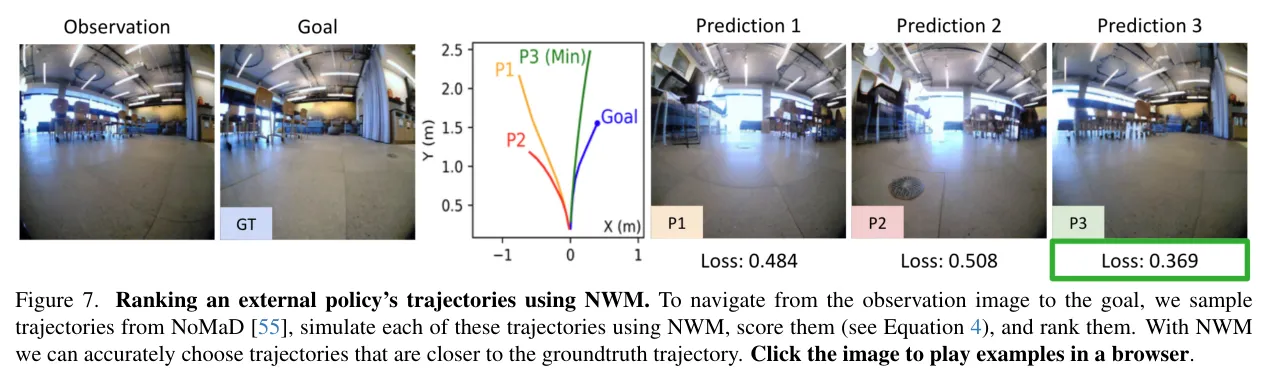
solution(Intro 即给):提 NWM,"trained to predict the future representation of a video frame based on past frame representation(s) and action(s)"。两套用法:① planning——放进 MPC,优化动作序列让 NWM 到达目标;② ranking——用现成策略 NoMaD 采样轨迹、NWM 模拟+选最优。
why CDiT(核心创新动机):"Unlike a DiT, CDiT's computational complexity is linear with respect to the number of context frames ... requiring 4× fewer FLOPs compared to a standard DiT while achieving better future prediction results." → DiT 对 context 帧数二次方太贵,CDiT 线性 → 能用更长 context、更省算力。
why 无标注数据 + 与相关工作的区别:"NWM benefits from training on unlabeled, action- and reward-free video data from Ego4D"——即使只有视频、无动作/奖励(仅用 time-shift)也能涨。与 DIAMOND/GameNGen(单一游戏环境)不同,NWM "trained across a wide range of environments and embodiments";与 NVS(NeRF/Zero-1-2-3)不同,NWM "model temporal dynamics from natural videos, without relying on 3D priors"。
③ §3.1 公式化 — 状态、动作与时间
数据与动作:给定第一视角视频数据集 \(D=\{(x_0,a_0,\dots,x_T,a_T)\}\),图像 \(x_i\in\mathbb{R}^{H\times W\times 3}\),导航命令 \(a_i=(u,\phi)\):平移 \(u\in\mathbb{R}^2\)(控制前后/左右),偏航 \(\phi\in\mathbb{R}^1\)(控制 yaw 旋转角)。标注维度:3-DoF(平面导航,固定 pitch/roll;原文注脚说可扩展到 \(u\in\mathbb{R}^3,\phi\in\mathbb{R}^3\) 的 6-DoF)。
world model 映射(式1):先用预训练 VAE 编码 \(s_i=\mathrm{enc}_\eta(x_i)\),再做随机映射 \(s_{\tau+1}\sim F_\theta(s_{\tau+1}\mid s_\tau,a_\tau)\),其中 \(s_\tau=(s_\tau,\dots,s_{\tau-m})\) 是过去 \(m\) 帧的 latent。用 VAE 的好处:在压缩 latent 空间预测,又能 decode 回像素可视化。设计成随机映射是为模拟随机环境。
把时间也当动作(式2):式1 只建模动作、不控时间。引入 time shift \(k\in[T_{\min},T_{\max}]\),令 \(a_\tau=(u,\phi,k)\),\(k\) 决定"往未来/过去走几步"。多步动作=区间内累加:\[ u_{\tau\to m}=\sum_{t=\tau}^{m}u_t,\qquad \phi_{\tau\to m}=\Big(\sum_{t=\tau}^{m}\phi_t\Big)\bmod 2\pi \]why:同时学"动作响应"与"环境时间动态";实践允许 \(\pm 16\) 秒时移。
④ §3.1 动作-时间纠缠问题 — multi-goal 解法
问题(原文亲述):"if reaching a specific location always occurs at a particular time, the model may learn to rely solely on time and ignore the subsequent actions, or vice versa." → 若"到某地"总在"某时刻"发生,模型会偷懒只用时间忽略动作(或反之),即动作与时间纠缠。
解法:训练时每个 state 采多个 goal(\(\pm 16\)s 窗口内随机),制造"同地点不同时间到达"的自然反事实(natural counterfactuals),逼模型不偷懒。原文:"we sample multiple goals for each state during training." Table 1 证实 4 goals 显著优于 1 goal。
⑤ §3.2 CDiT block — 省算力的核心架构
结构:时序自回归 Transformer,CDiT block 在 latent 序列上重复 \(N\) 次、带动作条件。关键设计:"constraining the attention in the first attention block only to tokens from the target frame which is being denoised"——self-attention 只作用于"正在去噪的目标帧"。
对过去帧用 cross-attention:"every query token from the current target attends to tokens from past frames, which are used as keys and values. The cross-attention then contextualizes the representations using a skip connection layer." → query=当前目标帧 token,KV=过去帧 token,再加 skip connection。原文总结:"CDiT resembles the original Transformer Block, without applying expensive self-attention over the context tokens."
⑥ §3.2 条件注入 — sine-cosine + MLP + AdaLN(式3)
编码:动作 \(a\in\mathbb{R}^3\) 的每个标量 → sine-cosine 特征 → 2-layer MLP → 映到 \(\mathbb{R}^{d/3}\),拼成 \(\psi_a\in\mathbb{R}^d\);time shift \(k\)、diffusion timestep \(t\) 同理得 \(\psi_k,\psi_t\)。三者求和:\[ \varepsilon=\psi_a+\psi_k+\psi_t \]
注入 + 兼容无标注:\(\varepsilon\) 喂 AdaLN,生成 scale/shift 系数去调制 LayerNorm 与注意力层的输出。训练无标注数据时,"we simply omit explicit navigation actions when computing" \(\varepsilon\)——即把动作项从求和里去掉,优雅兼容"只有视频、没有动作"的 Ego4D 数据。
⑦ §3.2 复杂度对比 — CDiT 为何省 4× FLOPs
记号:\(n\)=每帧 token 数,\(m\)=帧数,\(d\)=token 维。标准 DiT 把全部 context token 一起做 self-attention,主导项 \[ O(m^2 n^2 d)\quad(\text{对 context 长度二次方}) \] CDiT 的主导项是 cross-attention:\[ O(m n^2 d)\quad(\text{对 context 线性}) \] 故 CDiT "is linear with respect to the context, allowing us to use longer context size." 实测 §4:CDiT 在 ≤1B 参数下更准且 \(<2\times\) FLOPs;"even with equal amount of parameters (e.g, CDiT-L compared to DiT-XL), CDiT is 4× faster and performs better."
⑧ §3.2 扩散训练目标
前向:对目标 \(s_{\tau+1}\) 按随机 timestep \(t\) 加噪 \(s^{(t)}_{\tau+1}=\sqrt{\bar\alpha_t}\,s_{\tau+1}+\sqrt{1-\bar\alpha_t}\,\epsilon,\ \epsilon\sim\mathcal{N}(0,I)\);\(t\) 越大越接近纯噪声。反向:网络 \(F_\theta(s_{\tau+1}\mid s_\tau,a_\tau,t)\) 在 context + 动作 + timestep 条件下去噪还原。
损失:\[ L_{\text{simple}}=\mathbb{E}_{s_{\tau+1},a_\tau,s_\tau,\epsilon,t}\big\|\,s_{\tau+1}-F_\theta(s^{(t)}_{\tau+1}\mid s_\tau,a_\tau,t)\,\big\|_2^2 \] 即去噪 MSE;并随机采 \(t\) 覆盖各噪声水平。另跟 DiT 一致地预测噪声协方差并用变分下界 \(L_{\text{vlb}}\) 监督。
⑨ §3.3 用 world model 规划 — 能量函数(式4-5)
目标:给定初始 latent \(s_0\) 与导航目标 \(s^*\),找动作序列 \((a_0,\dots,a_{T-1})\) 最大化"到达 \(s^*\) 的似然"。定义能量函数:\[ E(s_0,a_{0:T-1},s_T)=-S(s_T,s^*)+\sum_{\tau=0}^{T-1}\mathbb{I}(a_\tau\notin A_{\text{valid}})+\sum_{\tau=0}^{T-1}\mathbb{I}(s_\tau\notin S_{\text{safe}}) \]
各项含义:\(S(s_T,s^*)\)=把 \(s_T,s^*\) 用 VAE decoder 解回像素后测的感知相似度(LPIPS/DreamSim);\(\mathbb{I}(\cdot)\)=指示函数,对非法动作("不准先左后右"→\(A_{\text{valid}}\))或不安全状态("别靠悬崖"→\(S_{\text{safe}}\))加大惩罚。求解(式5):\(\arg\min_{a_0,\dots,a_{T-1}}\mathbb{E}_s[E(\cdot)]\),重写成 MPC 问题,用 Cross-Entropy Method(无梯度、population-based)优化。
⑩ §3.3 Ranking — 给现成策略的轨迹打分
做法:假设已有导航策略 \(\pi(a\mid s_0,s^*)\)(本文用 SOTA 的 NoMaD),从 \(\pi\) 采样多条轨迹,用 NWM 自回归模拟每条,按式4 能量(末帧与目标的 LPIPS 相似度)选最低能量的那条。原文:"we draw multiple samples ... and choose the one with the lowest energy." 这让 NWM 不必从零规划,也能即插即用地增强现成策略。
⑪ §4.1 实验设置 — 数据/指标/基线/实现
数据:有位姿的机器人集 SCAND(社交合规导航)、TartanDrive(越野)、RECON(开放世界)、HuRoN(社交交互)→ 可推相对动作;外加无标注 Ego4D(仅 time-shift 动作);GO Stanford 当陌生环境测试。基线:DIAMOND(U-Net 扩散 world model)、GNM(goal-conditioned 导航策略)、NoMaD(GNM 的扩散策略扩展)。
实现:默认 CDiT-XL 1B 参数 / context 4 帧 / batch 1024 × 4 goals = 4096 / Stable Diffusion VAE tokenizer / AdamW lr \(8\mathrm{e}{-5}\) / 训练于 8×8 H100;推理时每模型采样 5 次报均值±std。消融统一在 RECON 上做"单步 4 秒未来预测"。
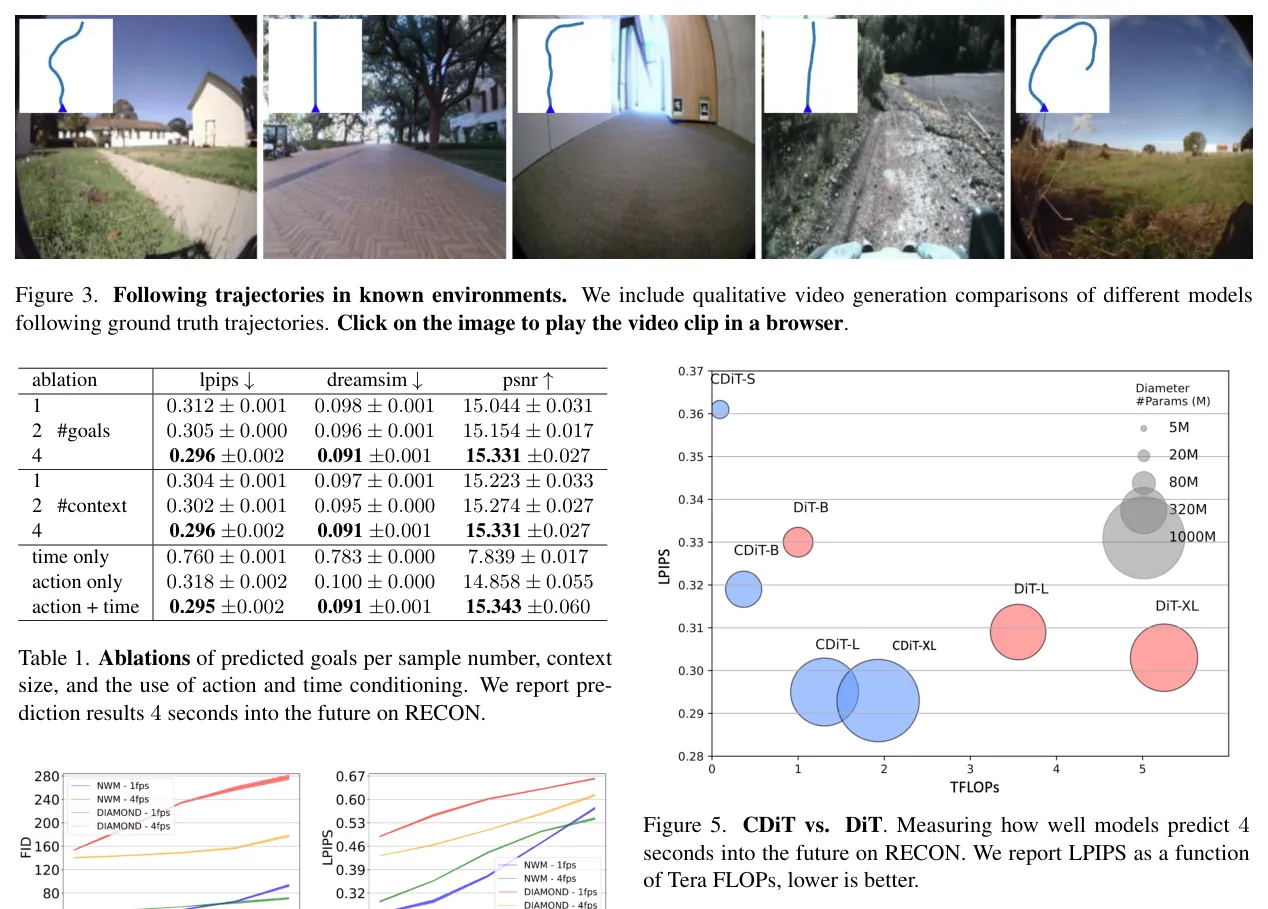
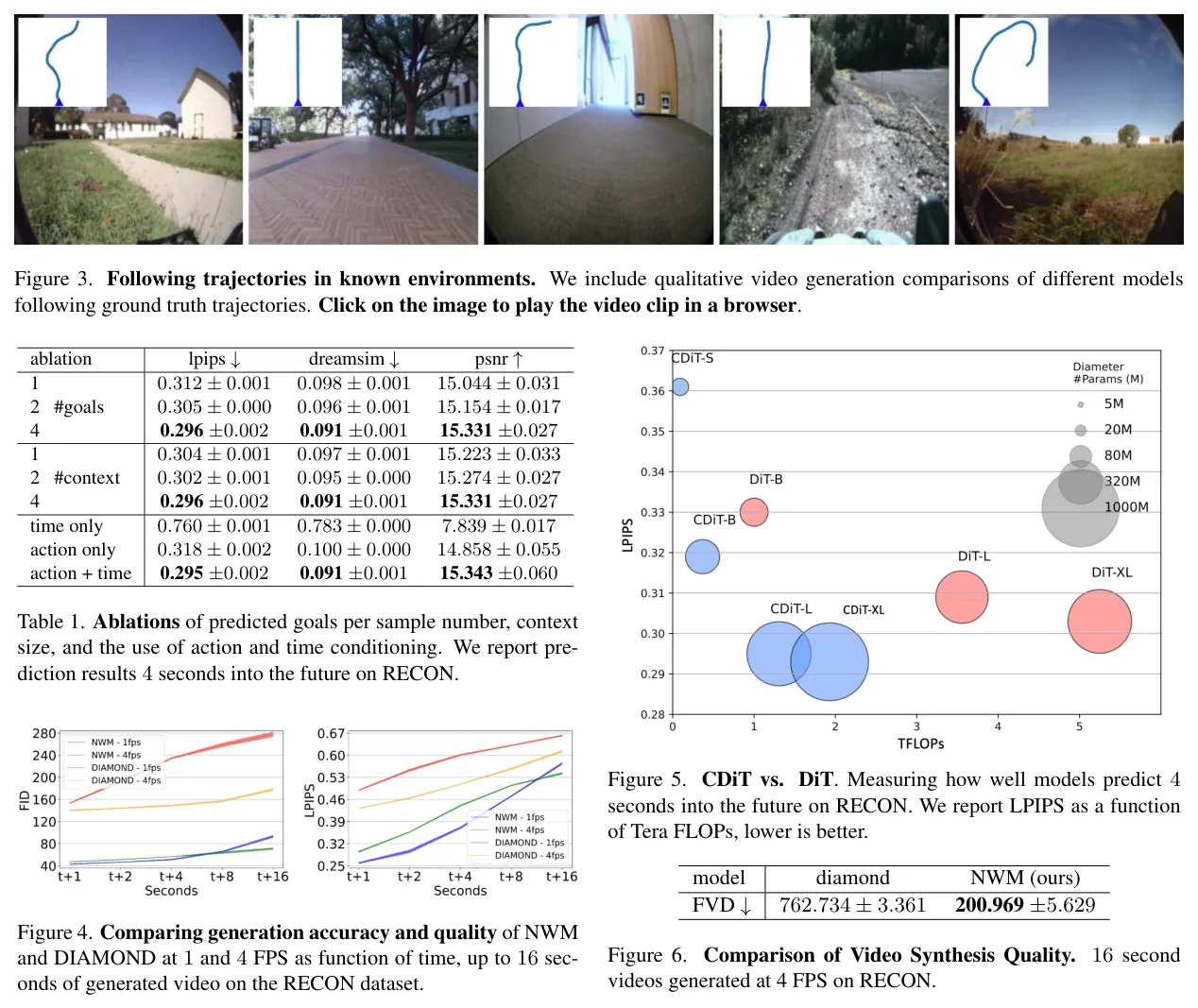
⑫ §4.2 消融 — Table 1(RECON 4 秒预测,lpips↓/dreamsim↓/psnr↑)
| 设置 | lpips↓ | dreamsim↓ | psnr↑ |
| #goals 1 | 0.312 | 0.098 | 15.044 |
| #goals 2 | 0.305 | 0.096 | 15.154 |
| #goals 4 | 0.296 | 0.091 | 15.331 |
| #context 1 | 0.304 | 0.097 | 15.223 |
| #context 2 | 0.302 | 0.095 | 15.274 |
| #context 4 | 0.296 | 0.091 | 15.331 |
| time only | 0.760 | 0.783 | 7.839 |
| action only | 0.318 | 0.100 | 14.858 |
| action + time | 0.295 | 0.091 | 15.343 |
读表:① goals 1→4 单调变好(lpips 0.312→0.296);② context 1→4 同样变好(短 context 会"lose track");③ time only 几乎崩(lpips 0.760、psnr 仅 7.839),action only 也劣于二者兼用 → "both inputs are beneficial."
⑬ §4.3 CDiT vs DiT + 视频质量
CDiT vs DiT(Figure 5,LPIPS vs TeraFLOPs):CDiT 在 ≤1B 参数全程更准且 \(<2\times\) FLOPs;同参数下 CDiT-L 比 DiT-XL 快 4× 还更好。视频质量(Figure 6,FVD↓):16 秒 @4FPS 视频,DIAMOND 762.734 vs NWM 200.969——低 3.8×,质量显著更高。Figure 4 还显示长程时 4FPS 优于 1FPS(1FPS 8 秒后误差累积退化)。
⑭ §4.4 导航 — Table 2 + 约束 Table 3
导航(Table 2,RECON 2 秒轨迹,ATE↓/RPE↓):GNM 1.87/0.73;NoMaD 1.93/0.52;NWM+NoMaD(16) 1.83/0.50;NWM+NoMaD(32) 1.78/0.48;NWM (planning) 1.13/0.35——standalone 规划碾压所有,ranking 也单调随采样数变好。
约束规划(Table 3,相对无约束基线的末位姿差 Δu/Δφ):forward-first +0.36/+0.61、left-right-first −0.03/+0.20、straight-then-forward +0.08/+0.22——三种约束全满足、性能仅微降。约束通过"把特定步的动作置零 + Standalone Planning 优化其余"实现,证明 world model 的"动态加约束"卖点真能落地。
⑮ §4.5 泛化 — Table 4(诚实指出 trade-off)
加 Ego4D 无标注数据(4 秒预测,lpips↓/dreamsim↓/psnr↑):陌生环境 Go Stanford:in-domain 0.658/0.478/11.031 → +Ego4D 0.652/0.464/11.083(变好);但已知环境 RECON:0.295/0.091/15.343 → +Ego4D 0.368/0.138/14.072(变差)。
[诚实指出] 原文标题写 "improves performance on unseen environments" 是对的,但同一张表显示已知环境保真度同时下降——这是"泛化 vs in-domain 拟合"的经典 trade-off,正文未展开讨论,读者需自行注意。
⑯ §6 讨论 — 为什么 work / 更大图景
表征之谜:NWM 不用显式地图却能规划,作者坦诚 "we are not exactly sure yet what representations enable this, as our NWM does not explicitly utilize a structured map of the environment." 一个猜想:"next frame prediction from an egocentric point of view can drive the emergence of allocentric representations"——第一视角的逐帧预测,可能自发催生"上帝视角"(allocentric)的空间表征。
方法论意义:原文把贡献定位为 "a scalable, data-driven approach to learning world models for visual navigation",并认为它 "bridges learning from video, visual navigation, and model-based planning",可能打开"不仅会感知、还能规划以指导行动"的自监督系统大门。这正是把视频生成、视觉导航、基于模型的规划三条线拧成一股的尝试,也解释了为何它拿到 CVPR Best Paper 提名。
📌 全文总结(≥3 takeaway)
problem:监督导航策略硬编码、不可加约束、不能为难题多花算力。method:把导航当可控视频生成——CDiT(self-attn 只给目标帧、过去帧走 cross-attn → context 线性 \(O(mn^2d)\))做扩散 world model,动作+时间+timestep 经 AdaLN 注入;规划=能量函数(−感知相似度 + 约束惩罚)+ MPC/CEM。experiment:RECON planning ATE 1.13 碾压 NoMaD 1.93;FVD 200.97 vs DIAMOND 762.73;CDiT 同参比 DiT 快 4×。
takeaway 1:"导航=可控视频生成 + 能量规划"这一范式可行——单个 world model 即可 standalone 规划、给现成策略 rerank、从单图想象陌生环境,且规划时能动态加约束(监督策略做不到)。
takeaway 2:CDiT 的 context 线性技巧是工程关键——self-attn 只留给目标帧、过去帧走 cross-attn,把 \(O(m^2n^2d)\) 降到 \(O(mn^2d)\),同参比 DiT 快 4×,使 1B 规模 + 长 context 可行。
takeaway 3:world model 能白嫖无标注视频——只用 time-shift 动作的 Ego4D 即可提升陌生环境想象(代价是 in-domain 保真略降),这是 world model 相对 RL policy 的数据优势。
Q&A · 疑问 / 边界(原文 §5 限制)
① mode collapse:OOD 长程预测会慢慢"塌"回训练数据样貌("outputs slowly become more similar to data seen in training",Figure 10)。② 难模拟场景动态:原文承认 "struggles with simulating temporal dynamics like pedestrian motion"(行人运动等)。③ 仅 3-DoF:当前平面导航 3 自由度,6-DoF / 机械臂关节控制留作 future work。④ 表征不明:Discussion 坦言 "we are not exactly sure yet what representations enable this",无显式地图,猜测第一视角 next-frame 预测可能催生 allocentric 表征。
Q&A · 与自动驾驶的关系(相关领域,标 [推测])
genuinely 相关(非硬比):NWM 与自驾的 e2e planning / 仿真 world model 同源——都想"给当前观测 + 候选动作,预测未来、再挑最优轨迹"。可迁移点:① CDiT 的 context 线性技巧对自驾多帧时序 BEV 序列同样省算力 [推测,原文只做机器人导航];② 能量函数加 \(A_{\text{valid}}/S_{\text{safe}}\) 约束 ≈ 自驾里加"不压实线/保持安全距"硬约束的规划范式;③ ranking 现成策略对自驾"用 world model 给 planner 候选轨迹打分"直接可借鉴。边界:NWM 在 VAE-latent / 像素空间预测、3-DoF、单 agent,自驾需多 agent 交互 + BEV/3D + 更强安全保证,原文均未涉及。小结:真正可迁移的不是模型权重,而是"把规划重写成『在学到的环境模拟器里 rollout + 用能量函数挑轨迹』"这套思路,以及让长 context 时序预测变便宜的 CDiT 注意力结构——这两点对自驾的预测式规划与仿真都有参考价值 [推测]。
🖼 论文原图(本地 PDF 截图,原文 caption 未改写)