CVPR 2025 🥈 Best Paper 提名
Molmo and PixMo: Open Weights and Open Data for State-of-the-Art Vision-Language Models
Matt Deitke · Christopher Clark · Sangho Lee · Rohun Tripathi · Yue Yang · Jae Sung Park · Mohammadreza Salehi · Niklas Muennighoff · Kyle Lo · Luca Soldaini · Jiasen Lu · Taira Anderson · Erin Bransom · Kiana Ehsani · Huong Ngo · YenSung Chen · Ajay Patel · Mark Yatskar · Chris Callison-Burch · Andrew Head · Rose Hendrix · Favyen Bastani · Eli VanderBilt · Nathan Lambert · Yvonne Chou · Arnavi Chheda · Jenna Sparks · Sam Skjonsberg · Michael Schmitz · Aaron Sarnat · Byron Bischoff · Pete Walsh · Chris Newell · Piper Wolters · Tanmay Gupta · Kuo-Hao Zeng · Jon Borchardt · Dirk Groeneveld · Crystal Nam · Sophie Lebrecht · Caitlin Wittlif · Carissa Schoenick · Oscar Michel · Ranjay Krishna · Luca Weihs · Noah A. Smith · Hannaneh Hajishirzi · Ross Girshick · Ali Farhadi · Aniruddha Kembhavi
摘要 Abstract
见上方 arXiv / CVF 链接。
📝 精读笔记
灵魂一句
证明不靠蒸馏闭源 VLM(不拿 GPT-4V 等生成的合成数据)也能从头训出 SOTA 开源 VLM:关键不在模型而在数据 PixMo——用"让标注员对着图说 60-90 秒"采到 712k 超详细 caption(带录音回执证明没用 VLM)、用2D 指点(pointing)采到 2.3M grounding 标注(又快又能 grounding/计数/解释/未来给 agent 指路)。最强 Molmo-72B 学术分第一、人类偏好 Elo 第二(仅次 GPT-4o),超 Gemini 1.5 Pro 与 Claude 3.5 Sonnet。权重+数据+代码全开。Allen AI。
问题 & 动机
最强 VLM 都是闭源(GPT-4o/Gemini/Claude,权重/数据/代码都不放)。而最强的"开源权重"模型大多重度依赖闭源 VLM 生成的合成数据(如 ShareGPT4V 用 GPT-4V 生成 caption)→ 本质是"把闭源 VLM 蒸馏成开源"。原文:“the scientific community is missing foundational knowledge about how to build performant VLMs from scratch.” 本文要补这块——不蒸馏、纯自采数据地训出强 VLM。
核心方法 + 关键创新
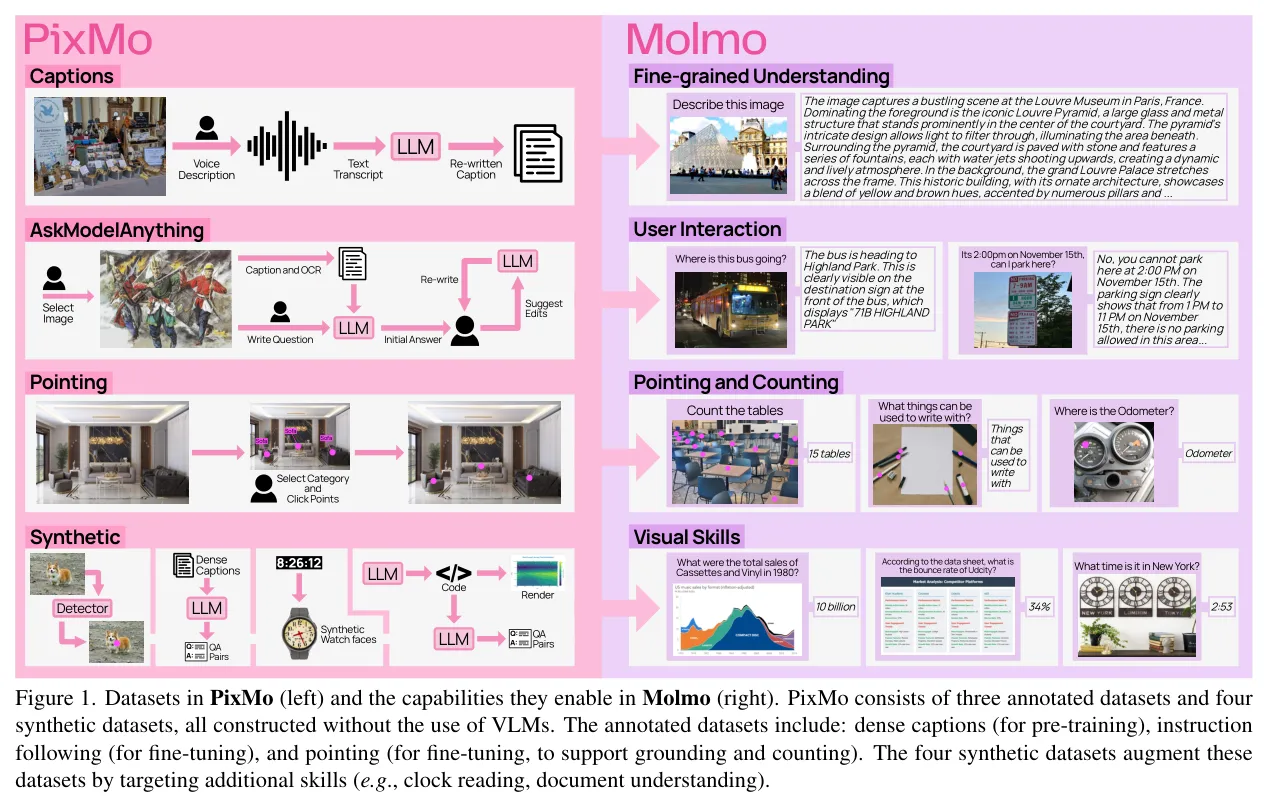
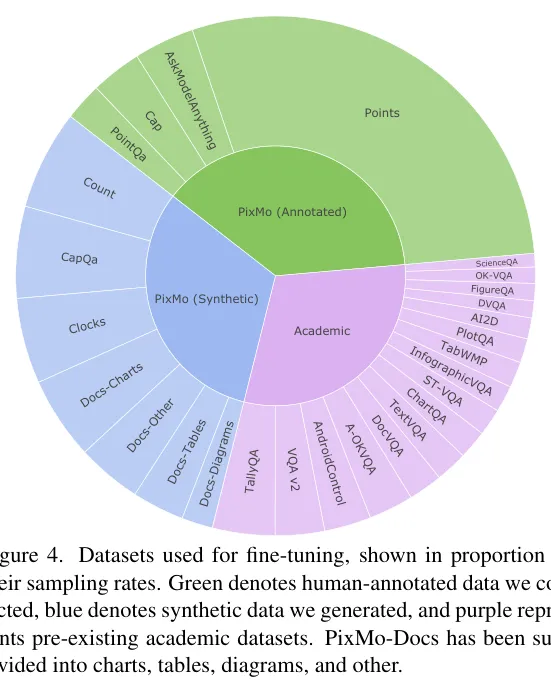
① PixMo 数据集(7 个,全程不用 VLM):PixMo-Cap(712k 图、平均 196 词的稠密 caption,对比 COCO 11 词;采集诀窍=让标注员对着图"说话"60-90 秒,比打字更详细更快,且录音=没用 VLM 的回执,再用纯文本 LLM 把转录整理成 caption);PixMo-AskModelAnything(162k QA/73k 图:标注员出题 → 把 OCR+caption 喂纯文本 LLM 作答 → 标注员接受/打回重写);PixMo-Points(2.3M 指点标注/223k 图:点比框/掩码快得多,含"not present"负例,支持 point-to/计数/point-as-explanation);合成类 PixMo-CapQA / Docs(代码渲染图表)/ Clocks / Count(均无 VLM)。② 架构(标准 LLaVA 式,§2):preprocessor 多尺度多 crop → ViT encoder(CLIP-L/14 336px,SigLIP/MetaCLIP 亦可)→ connector(拼第 3 与第 10 倒数层特征、每 2×2 patch 用 mean-query 注意力池化 + MLP)→ decoder-only LLM(OLMo-7B / OLMoE-1B-7B / Qwen2 7B / Qwen2 72B)。新点:overlapping multi-crop(重叠裁剪让边界 patch 有邻域上下文)、attention pooling(优于 stacking)、text-only dropout(预训练只对文本 token dropout,逼模型靠图像而非语言先验)、多标注图共享图像编码(省 2/3 图像、训练时间减半)。③ 训练(§4):预训练全参在 PixMo-Cap 上学 caption/transcript(90% 带长度提示,不要单独的 connector-only 阶段,改用 connector 高 LR 短 warmup);微调混 PixMo + 学术集,按 √size 采样、上调 pointing 权重、用 style tag(如 "vqa2:")隔离 benchmark 答案风格;点输出为 0-100 归一化纯文本坐标、上→下左→右排序。④ 指点驱动的链式计数:先逐个点出再数(point-then-count),是 Molmo 计数强的关键。
关键结果
11 学术 benchmark + 人类 Elo(870 标注员、32.5 万次成对偏好):Molmo-72B 学术均分 81.2 全场最高、Elo 1077 排第二(仅次 GPT-4o 1079),超 Gemini 1.5 Pro(1074)/Claude 3.5 Sonnet(1069)/Gemini Flash。MolmoE-1B(MoE,最省)≈ GPT-4V;Molmo-7B 系列介于 GPT-4V 与 GPT-4o 之间。强项:自然图(RealWorldQA、VQA v2.0 SOTA)、计数(CountBench/PixMo-Count 领先全部,靠 pointing CoT);OCR(Chart/Doc/Info/TextVQA)超开源+部分闭源、略逊 Qwen2-VL。关键消融(Table 3b):同一批图上,PixMo-Cap 人工数据 cap-F1 54.1 vs ShareGPT4V 36.3(蒸馏数据反而差很多),且与"用 GPT-4o 给同批图生成 caption"基本打平(52.9)——证明自采数据不输蒸馏。
亮点
① 第一个系统性展示"不蒸馏闭源 VLM 也能训出 SOTA 开源 VLM",并把权重/数据/代码/评测全开;② 语音采 caption(模态切换→更详细+反蒸馏回执)与 2D pointing 数据(快、且通向 grounding/计数/解释/agent 指点行动)两个数据创新;③ point-then-count 链式计数;④ overlapping crop / attention pooling / text-only dropout / 去掉 connector 单独阶段 等一串建模 insight 都给了消融;⑤ Molmo-72B 超 Gemini 1.5 Pro/Claude 3.5 Sonnet。
疑问 / 边界(原文标注)
① 推理弱:MMMU/MathVista 落后(Molmo-72B MMMU 54.1 vs GPT-4o 69.1),自认训练 mix 缺高级推理数据。② OCR 略逊 Qwen2-VL。③ pointing 对测试 crop 数敏感:计数/captioning 需训练-测试 crop 数一致,否则退化(小量高分辨率后训练可缓解)。④ Chatbot Arena 上超所有开源但低于若干闭源(题型不同)。⑤ 时钟读取超所有 VLM 但仍逊于专用非-VLM 模型。⑥ 人类评测与学术分大体一致,唯 Qwen2-VL 学术高但人类偏好相对低。
📖 逐段精读 · 笔记
批量精读初稿(基于本地 PDF 全文,PyMuPDF 提取)。原文英文原句引用 + 中文指路 + 追问 why。最后更新 2026-06-21。
① Abstract(摘要)— 逐句精讲
原文(开篇定位):"Today's most advanced vision-language models (VLMs) remain proprietary. The strongest open-weight models rely heavily on synthetic data from proprietary VLMs to achieve good performance, effectively distilling these closed VLMs into open ones." → 拆两层:① 最强 VLM 全是闭源;② 即便"开权重"的强模型,也是靠闭源 VLM 生成的合成数据训练,本质是蒸馏(distillation)。
原文(断诊问题):"As a result, the community has been missing foundational knowledge about how to build performant VLMs from scratch." → 真正缺的不是一个模型,而是"从零造强 VLM 的基础知识"——这是本文的靶心。
原文(核心贡献):"Our key contribution is a collection of new datasets called PixMo, including a dataset of highly detailed image captions for pre-training, a free-form image Q&A dataset for fine-tuning, and an innovative 2D pointing dataset, all collected without the use of external VLMs." → 贡献=PixMo 三类自采数据(稠密 caption + 自由问答 + 2D 指点),且 "all collected without the use of external VLMs"(全程不碰外部 VLM)。
原文(成功三要素):"The success of our approach relies on careful modeling choices, a well-tuned training pipeline, and, most critically, the quality of our newly collected datasets." → 作者把"数据质量"列为 most critically 的因素,建模与训练只是配角。
原文(结果):"Our best-in-class 72B model not only outperforms others in the class of open weight and data models, but also outperforms larger proprietary models including Claude 3.5 Sonnet, and Gemini 1.5 Pro and Flash, second only to GPT-4o based on both academic benchmarks and on a large human evaluation." → Molmo-72B 学术分 + 人类评测双口径仅次 GPT-4o,超 Claude 3.5 Sonnet / Gemini 1.5 Pro&Flash。一句话抓 Abstract:不蒸馏、纯自采的开放数据 PixMo 训出 SOTA 开源 VLM Molmo,72B 仅次 GPT-4o,权重/数据/代码全开。
📚 背景知识(外部,非本文原文,理解 Molmo 必备)
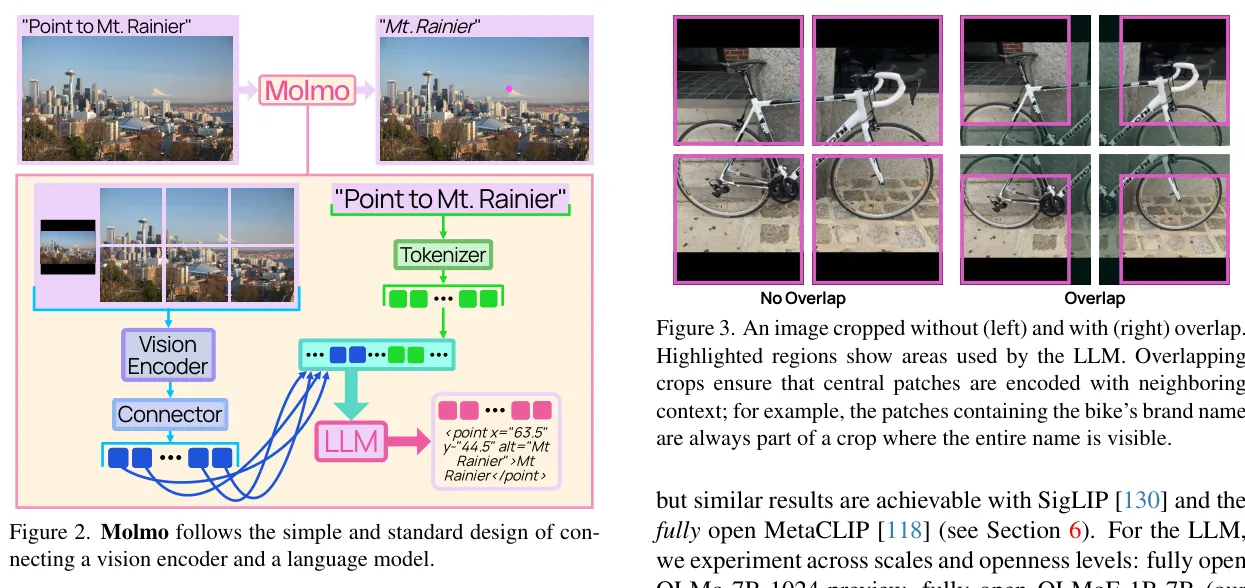
① VLM 标准架构(LLaVA 范式):视觉编码器(ViT,如 CLIP)把图编码成 patch 特征 → connector(投影/池化)映到 LLM 词嵌入空间 → decoder-only LLM 把"图像 token + 文本 token"拼一条序列做 next-token 预测。Molmo 完全沿用这套 "simple and standard design",把创新全压在数据与若干建模细节上。
② 蒸馏(distillation)vs 自采:ShareGPT4V 等用 GPT-4V 生成 caption 来训开源模型 = 把闭源能力"蒸馏"过来;省事,但① 开源社区学不到"从头怎么造";② 受闭源条款/能力上限约束;③ 永远追在闭源后面。本文刻意全程避开 external VLM,就是要补"from scratch"这块知识。
③ pointing / grounding vs bbox / 掩码:grounding=把语言落到图像具体位置。传统用框(bounding box)或分割掩码,标注慢且贵;本文改用2D 点(直接点中心),"much easier to annotate",故能上到 2.3M 量级。点还能干三件事:用点的序列做计数 CoT、做答案的视觉解释(point-as-explanation)、未来给机器人/web agent 指"去哪个 waypoint / 拿哪个物体 / 点哪个按钮"。
④ Elo / Bradley-Terry:把模型两两对比的人类偏好胜负,用 Bradley-Terry 模型拟合成一个 Elo 分(像棋手等级分)。本文收集 "over 325k ratings"、约 870 名标注员、每对模型约 450 次成对偏好,算出 Elo 排名,补充纯学术 benchmark 的不足。
⑤ MoE(Mixture-of-Experts):MolmoE-1B 基于 OLMoE-1B-7B——总参 7B、激活 1B 的稀疏专家模型,每 token 只路由到少数专家,故"1B 激活算力"能逼近稠密大模型效果,是 Molmo 家族里"最省"的一档。
② §1 Introduction — problem → solution → why 闭环
problem(递进):最强 VLM(GPT-4o / Gemini-1.5 Pro / Claude 3.5 Sonnet)"remain proprietary with neither model weights, data, nor code being publicly released";早期全开模型(LLaVA)"now lag significantly behind the state-of-the-art";近期强开源模型则"trended towards less open data",要么数据闭源、要么重度依赖闭源 VLM 合成数据。综合 → 社区缺 from-scratch 知识。
solution(Intro 即交底牌):提 Molmo + PixMo(Pixels for Molmo)。caption 采集的关键诀窍——"we ask annotators to describe images in speech for 60 to 90 seconds",并 "collect an audio receipt (i.e., the annotator's recording) proving that a VLM was not used"。一招解三难:直接打字会"只描述显著物 + 打字慢 + 可能复制 VLM",改成"对图说话 60-90 秒"既更详细更快,录音又是没用 VLM 的物证。
why(自采为何能赢蒸馏):① 语音模态切换让人天然提供更长更细描述;② 点标注快 → grounding 数据能上 2.3M 量级;③ 这些高质多样数据 + 一串建模改进,使 Molmo 不靠蒸馏也达 SOTA。作者明言 pointing 的远景:"VLMs enable agents (e.g., robots, web agents) to act by pointing in their environments"——这是把 grounding 从"看"推向"做"的伏笔。
③ §2 架构 — 四大组件总览
原文:架构 "has four components: (1) a pre-processor that converts the input image into multiscale, multi-crop images, (2) a ViT image encoder that computes per-patch features for each image independently, (3) a connector that pools and projects patch features into the LLM's embedding space, and (4) a decoder-only LLM."
四件套:① 预处理器→多尺度多裁剪;② ViT 逐 crop 独立编码出 per-patch 特征(主用 OpenAI ViT-L/14 336px CLIP,SigLIP/MetaCLIP 亦可);③ connector 池化+投影进 LLM 词嵌入空间;④ decoder-only LLM。同一套数据与配方换不同视觉编码器与 LLM(OLMo-7B / OLMoE-1B-7B / Qwen2 7B / Qwen2 72B)即得一个模型家族,"keeping the training data and recipe consistent across choices (except for learning rates)"。
④ §2 裁剪 — overlapping multi-crop(重叠多裁剪)
动机:"Most ViTs only support square images at a fixed resolution that is generally too low for fine-grained tasks such as OCR or detailed captioning." → 故把图切成多个方 crop 平铺,外加"全图缩到 ViT 分辨率"当低分辨率概览,每个 crop 由 ViT 独立编码。
关键创新(重叠):普通裁剪让边界 patch 缺邻域上下文——"border patches lack context from adjacent patches"。解法是让 crop 互相重叠,"Patch features from the overlap are not passed to the connector or LLM so that the passed patch features exactly tile the high-resolution image." 即重叠只为给边界 patch 补上下文,重叠区特征本身丢弃,保证传给 LLM 的特征恰好无缝平铺高分辨率图。消融 Table 2d:single crop 仅 46.7 / 62.8(cap-F1 / 11-avg),multi+no-overlap 53.4 / 75.7,multi+overlap 54.1 / 76.9。
⑤ §2 connector — 池化与视觉 token 排布
特征构造:拼接 ViT "the third-to-last and tenth-from-last ViT layers"(倒数第 3 与倒数第 10 层)的特征,略优于单层。
注意力池化:每个 \(2{\times}2\) patch 窗口(共 4 个 patch,各维 \(d\))用多头注意力池化成 1 个向量,其中 "the mean of the patches serves as the query"(4 个 patch 的均值当 query,patch 当 key/value)。这套 attention pooling 优于直接把 4 个特征 stacking——消融 Table 2f:stacking 53.7 / 76.1 vs attention 54.1 / 76.9。池化后经 MLP 映到 LLM 空间。
token 排序:视觉 token 按"left-to-right, top-to-bottom"排,先低分辨率全图、再高分辨率 crop(行优先 row-major);插入特殊 token 标记低/高分辨率序列的起止,行间加 row-end token 标换行——让 1D 序列保留 2D 空间结构。
⑥ §2 高效训练两招 — text-only dropout & 多标注图
text-only dropout:"During pre-training, dropout is applied only to text tokens to encourage reliance on the image rather than language priors." 预训练只对文本 token 做残差 dropout → 逼模型靠图像而非语言先验编故事;微调时不用(目标响应短,dropout 太少)。消融 Table 2c:off/off 53.1/74.6 → on(text only)/on 54.1/76.9。
多标注图共享编码:一张图常有多条标注(如 VQA v2.0 多个 QA)。把该图所有标注文本拼成一条长序列,用注意力 mask 让"每条标注只看图像 token + 自身 token,看不到别的标注"。原文:"reducing the number of processed images by two-thirds and shortening training time by over half, with only a 25% increase in sequence length"——等价于逐对训练,却省 2/3 图像编码、训练时间减半。
⑦ §3 数据 — PixMo 三个人工标注集
PixMo-Cap(预训练,稠密 caption):web 图跨 70+ 主题;早期每图 3 名标注员各说 ≥60 秒、后期 1 人 ≥90 秒;语音转录后用纯文本 LLM 汇总/润色成 caption。"we collected 712k distinct images with 1.3M transcripts and captions. Our captions average 196 words, compared to 11 words in COCO captions and 37 words in localized narratives." → 712k 图、平均 196 词(COCO 才 11 词),细节量级碾压。
PixMo-AskModelAnything(微调,自由问答):标注员选图出题 → 跑非-VLM 的 OCR + 一个 PixMo-Cap 训练过的模型给 caption → 把 OCR+caption 喂纯文本 LLM 作答 → 标注员接受或打回让其修订。"We collected 162k question-answer pairs in 73k images."
PixMo-Points(微调,2D 指点):标注员点出某物、描述它、再穷尽点出每个实例(带"not present"负例,学会"图里没有")。"This resulted in 2.3M question-points pairs from 223k images." 另采 79k point-explanation(14k 图)让模型"用点解释答案"。三大用途:point-to / count-by-pointing / point-as-explanation。
⑧ §3 数据 — PixMo 四个合成集(仍不用 VLM)
PixMo-CapQA:只给 LLM ground-truth caption(不给图),让它自问自答 → 214k QA / 165k 图。PixMo-Docs:提示 LLM 生成图表/文档/表格/图示的渲染代码,再据"对代码的特权访问"出题 → 255k 图、2.3M QA。PixMo-Clocks:渲染合成钟表(~50 种表体、~160k 种表盘、随机时间)→ 826k 读时间样本。PixMo-Count:用非-VLM 检测器在 web 图上数最多的那类物体,按计数生成 QA,并人工核验构成更难的 PixMo-Count 测试集。共同点:"all constructed without the use of VLMs"。
⑨ §4 训练 — 预训练 + 微调
预训练:全参在 PixMo-Cap 上学"生成 caption 或某条 transcript","90% of the time, includes a length hint to guide the model's output length"(长度提示)。关键简化:去掉传统"先只训 connector"的独立阶段——"We find this step unnecessary when pre-training on PixMo-Cap",改为给 connector 更高 LR + 更短 warmup,4 epoch AdamW。这砍掉了对 noisy web-scale 数据的依赖。
微调:混 PixMo + 学术集(VQA v2.0 / TextVQA / ChartQA / DocVQA / AI2D / A-OKVQA / ...)。采样率 "proportional to the square root of their size",即 \(p_i \propto \sqrt{N_i}\),并手动下调超大合成集(PlotQA/FigureQA/DVQA/Clocks)、上调 pointing(学得慢)。用 style tag(如给 VQA v2.0 题加前缀 "vqa2:")隔离 benchmark 的怪异答案风格,避免污染面向用户的回答。点输出为 0-100 归一化纯文本坐标,多点按 top-down/left-right 编号。
⑩ §5 评测方法 — 学术 benchmark + 人类 Elo
学术:10 个常用集 + 自建 PixMo-Count,优先用作者发布值、缺则取技术报告/OpenVLM Leaderboard 最优、再缺自测。作者强调可复现之难:"performance can vary significantly (e.g., by 10%) based on evaluation details",故主张评测开放。Molmo 学术评测用 36 crops(训练时 12),计数任务除外(pointing 对 crop 数不泛化)。
人类:15k 图-文 prompt 对喂各模型 → 约 870 标注员成对偏好 → "over 325k ratings" → Bradley-Terry 拟合 Elo。人类评测与学术分大体一致,唯一例外是 Qwen2-VL(学术高但人类偏好相对低)。
⑪ §5 主结果 — Table 1(学术均分 + 人类 Elo)
节选(越高越好;11-avg=11 benchmark 均分):
| 模型 | 11-avg | Elo | Elo rank | 开放度 |
| GPT-4o-0513 | 78.5 | 1079 | 1 | 闭源 |
| Gemini 1.5 Pro | 78.3 | 1074 | 3 | 闭源 |
| Claude 3.5 Sonnet | 76.7 | 1069 | 4 | 闭源 |
| GPT-4V | 71.1 | 1041 | 10 | 闭源 |
| Qwen2-VL-72B | 79.4 | 1037 | 12 | 权重 |
| Llama-3.2V-90B | 74.5 | 1063 | 5 | 权重 |
| Molmo-72B | 81.2 | 1077 | 2 | 全开 |
| Molmo-7B-D | 77.3 | 1056 | 6 | 全开 |
| Molmo-7B-O | 74.6 | 1051 | 9 | 全开 |
| MolmoE-1B | 68.6 | 1032 | 13 | 全开 |
读表:① Molmo-72B 学术均分 81.2 全场最高(超 Qwen2-VL-72B 79.4、GPT-4o 78.5),Elo 1077 仅次 GPT-4o;② Qwen2-VL-72B 学术 79.4 但 Elo 仅排 12——学术分与人类偏好背离的典型;③ MolmoE-1B 用 MoE 极小激活算力 ≈ GPT-4V(Elo 1032 vs 1041)。强项:自然图(RealWorldQA、VQA v2.0 SOTA)、计数;OCR(Chart/Doc/Info/TextVQA)超开源+部分闭源、略逊 Qwen2-VL;弱项:推理(MMMU 54.1 vs GPT-4o 69.1、MathVista)。
⑫ §6 模型消融 — Table 2(cap-F1↑ / 11-avg↑)
(a) 视觉编码器:OpenAI CLIP 54.1/76.9、MetaCLIP 54.1/77.2、SigLIP 54.4/77.1 三者近似;DINOv2(纯图像、无文本/标签监督)53.2/75.6 竟也有竞争力——"Surprisingly, DINOv2 ... is competitive on these tasks." (b) 分辨率:crops 越多越好,4/4 仅 71.0、36/36 达 77.2,但 caption/计数需训练-测试 crop 数一致。(d) 裁剪:single 46.7/62.8 → multi+overlap 54.1/76.9(见 ④)。(c) dropout、(e) 长度条件、(f) 池化均如前述:去掉任一都掉点,证明每个设计都有正贡献。
⑬ §6 数据消融 — Table 3(自采 vs 蒸馏的关键证据)
(a) PixMo-Cap 规模:0→89k→178k→356k→712k,cap-F1 从 -(无)→49.6→51.6→52.6→54.1,单调涨——"Scaling PixMo-Cap from 0 to 712k images significantly improves ... metrics."
(b) 预训练数据来源(同批图、cap-F1/11-avg):ShareGPT4V+o(158k) 36.3/74.9;我们仅原始转录 45.2/76.4、仅清洗后 53.0/76.5、原始+清洗 54.1/76.9;用 GPT-4o 给同批图 caption 52.9/77.5。结论原文:"Our human annotated data performs on par with distilling GPT-4o ... demonstrating the effectiveness of our data." → 自采 ≈ 蒸馏 GPT-4o,且远胜 ShareGPT4V(54.1 vs 36.3)——这是"数据采集方法本身有效"的最硬证据。(c) 微调数据:academic only 72.5 → 加 PixMo 全套 76.9;去掉 pointing 掉到 76.2。
⑭ §6 计数消融 — Table 4(point-then-count 为何关键)
(a) 计数策略(CBQA=CountBenchQA / PCQA=PixMo-Count):count only 87.9/80.2;point-then-count 89.4/86.3;count-then-point 81.5/77.6;pointing+regex 88.4/85.4。→ "先逐个点出、再数"的链式思维显著最好(尤其 PCQA 这种难集,86.3 vs 80.2)。(b) 点顺序:有序(top-down/left-right) 89.4/86.3 vs 无序 85.4/74.1。(d) 坐标编码:纯文本 89.4/86.3 > 特殊 token 85.8/80.9——坐标当普通文本反而最好。原文:"Pointing is the key ingredient in Molmo's counting abilities."
📌 全文总结(≥3 takeaway)
problem:最强 VLM 闭源;开源强模型靠蒸馏闭源合成数据,社区缺"从头训 VLM"的基础知识。method:不蒸馏地自采 PixMo——语音描述 60-90s 采 712k 超详细 caption(录音防 VLM)+ 与纯文本 LLM 交互采 162k instruction + 2.3M 2D pointing + 合成 CapQA/Docs/Clocks/Count;标准 LLaVA 架构 + overlapping multi-crop + attention pooling + text-only dropout + 去 connector 单独阶段 + 多标注共享编码;point-then-count 链式计数。experiment:Molmo-72B 学术 81.2 第一、Elo 第二仅次 GPT-4o,超 Gemini 1.5 Pro/Claude 3.5 Sonnet;计数领先全部;消融证明自采≈蒸馏 GPT-4o 且远胜 ShareGPT4V(54.1 vs 36.3)。
takeaway 1:"造好数据" > "蒸馏闭源"——同批图上自采 caption(54.1)打平 GPT-4o 蒸馏(52.9)、碾压 ShareGPT4V(36.3),首次系统性证明开源 VLM 可不依赖闭源 from scratch 追到前沿。
takeaway 2:两个可复制的数据范式——① 语音采 caption(模态切换 → 更详细 + 录音防蒸馏);② 2D pointing(标注极快 → 上 2.3M 量级,且通向 grounding/计数 CoT/视觉解释/具身 agent 指点行动)。
takeaway 3:建模细节也有真金——overlapping crop(46.7→54.1)、attention pooling、text-only dropout、length-conditioned caption、去掉 connector 独立阶段、多标注共享编码(省 2/3 图像、训练减半)逐一被消融验证;point-then-count 是计数 SOTA 的钥匙。
takeaway 4(方法论层面):本文最值得学的是"把创新压在数据、把架构保持标准"的取舍——作者明说成功 "relies on careful modeling choices, a well-tuned training pipeline, and, most critically, the quality of our newly collected datasets",并刻意用 "the simple and standard design" 的 LLaVA 架构,证明在 VLM 这个阶段,数据质量与采集方法的回报率高于架构花活;同时把 weights / data / training code / evaluations 四样全开,让结论可被社区复现与审计——这本身就是对"开源 VLM 如何 from scratch"这一基础问题的直接回答。
Q&A · 疑问 / 边界(原文标注)
① 推理弱:MMMU/MathVista 落后(Molmo-72B MMMU 54.1 vs GPT-4o 69.1),作者自认 "its training mix lacks data focused on advanced reasoning"。② OCR 略逊 Qwen2-VL(Chart/Doc/Info/TextVQA)。③ pointing 对测试 crop 数敏感:计数/captioning 需训练-测试 crop 数一致,否则退化(小量高分辨率后训练可缓解)。④ Chatbot Arena 上超所有开源但低于若干闭源(题型不同、且不公开无法细究)。⑤ 时钟读取超所有 VLM(含闭源)但仍逊于专用非-VLM 模型。
Q&A · 与具身 / 自动驾驶的关系(相关领域,标 [推测])
genuinely 相关:pointing 数据范式与自动驾驶/具身的"把语言指令落到像素/空间位置"高度同源。可迁移点:① 2D 点标注比 3D 框/掩码便宜得多、能上量,对自驾的弱监督 grounding("指出那个行人/那个红灯")有借鉴 [推测,原文只做通用 VLM];② point-then-count 的"先定位再聚合"链式思维,对"数车道线/数障碍物"类任务有启发;③ 语音采 caption 的"模态切换降标注成本"思路,对自驾长尾场景的稠密描述标注同样适用 [推测]。边界:Molmo 在 2D 图像 + 纯文本坐标空间工作,无 3D/BEV、无时序、无多 agent 交互与安全约束,自驾落地需另解这些,原文均未涉及。
🖼 论文原图(本地 PDF 截图,原文 caption 未改写)