CVPR 2025 🥈 Best Paper 提名
MegaSaM: Accurate, Fast and Robust Structure and Motion from Casual Dynamic Videos
Zhengqi Li · Richard Tucker · Forrester Cole · Qianqian Wang · Linyi Jin · Vickie Ye · Angjoo Kanazawa · Aleksander Holynski · Noah Snavely
摘要 Abstract
见上方 arXiv / CVF 链接。
📝 精读笔记
灵魂一句
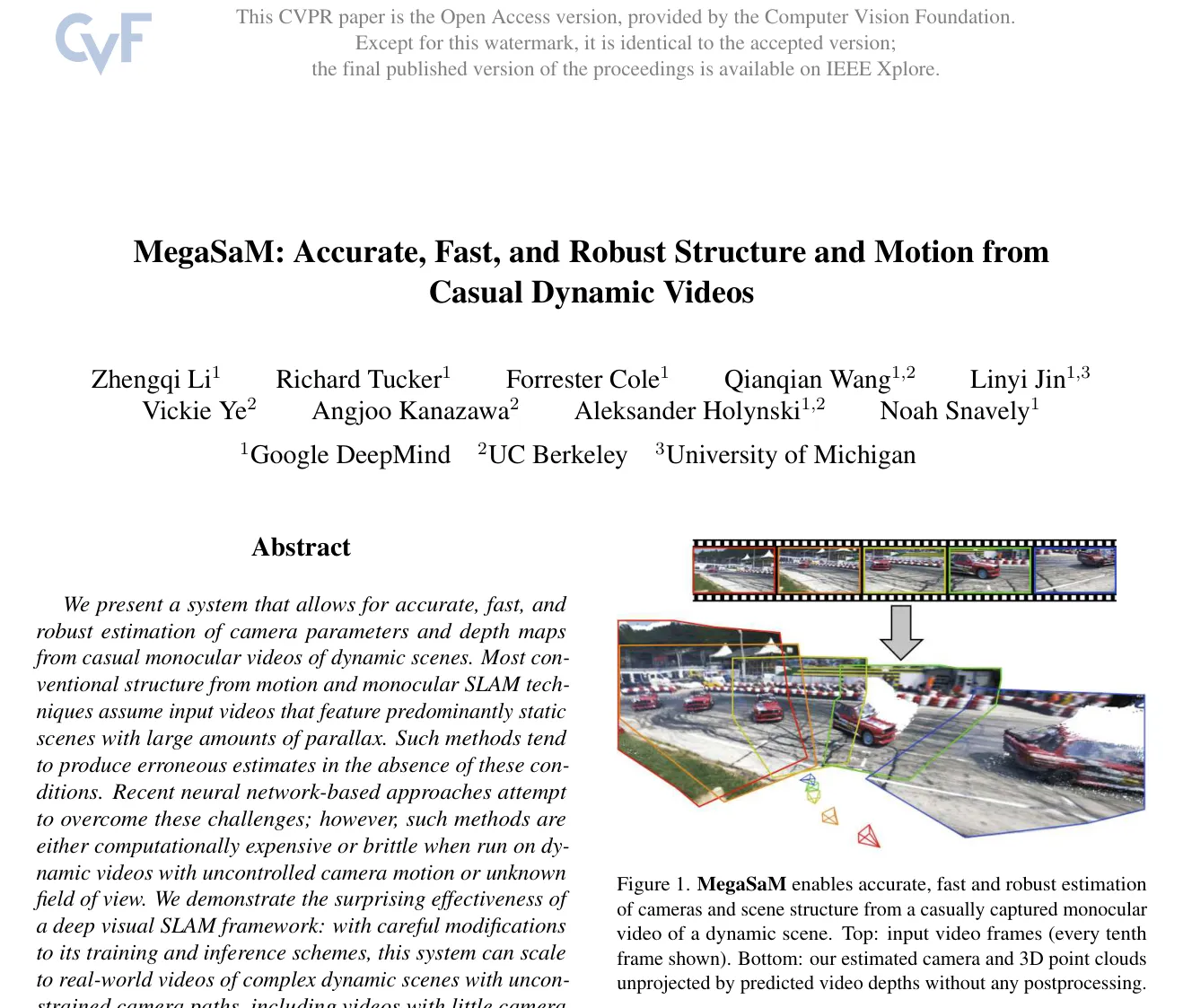
把深度可微 SLAM(DROID-SLAM)"魔改"到能处理随手拍的动态视频(有运动物体、相机几乎不动/纯旋转、焦距未知、时长长):在可微 bundle adjustment 里 ① 用运动概率图降权动态像素、② 注入单目深度先验做初始化/正则、③ 用 Hessian 不确定性判断几何何时"不可观测"从而自适应开关单目正则与焦距优化。结果:相机位姿 + 视频深度精度大幅超 CasualSAM/MonST3R 等,且快到 ~1s/帧(对手要几分钟)。Google DeepMind。
问题 & 动机
从随手拍的单目动态视频估相机参数 + 稠密深度。传统 SfM/SLAM 假设静态场景 + 大基线视差,casual 视频偏偏相反:原文 “limited camera motion parallax (e.g., nearly stationary or rotational cameras) and a broad range of focal lengths, and often include moving objects”。近期两条路——微调单目深度网/重建辐射场,或把深度/光流/轨迹/运动分割塞进全局优化——都 “computationally expensive or brittle when applied to unconstrained videos”。本文要的是同时 accurate + fast + robust。
核心方法 + 关键公式
① DROID-SLAM 底座(§3.1):可微 BA 层迭代更新 per-frame 视差 d̂ 与相机位姿 Ĝ;ConvGRU 预测 2D 对应场 û_ij + 置信 ŵ_ij,刚体流由 ego-motion+视差经多视约束导出(式1);BA 最小化加权重投影代价 C=Σ‖û_ij−u_ij‖²_Σij(式2),用 Levenberg–Marquardt(式3)+ Schur 补(式4-6)高效可微求解;MegaSaM 额外把焦距也设为可优化变量。② 运动概率图:额外网络 Fm 由 I_i + 邻居关键帧预测 movement map m_i,与流置信相乘 w̃_ij=ŵ_ij·m_i 在 BA 里降权动态像素。③ 两阶段训练:S1 仅静态合成(TartanAir + static Kubric)学 ego-motion 流+置信;S2 冻结 F、在动态合成(Kubric)上只训 Fm(相机损失 + 交叉熵,式8)——把"学动态"与"学对应"解耦,使可微 BA 训练稳定(消融证明关键)。④ 单目深度先验初始化:不再像 DROID 把视差初始化成常数 1,而用 metric 对齐的单目视差 D_align=α̂·D_rel+β̂(D_rel 来自 DepthAnything 仿射不变深度,α̂/β̂ 用 UniDepth 的 metric 深度中值对齐;UniDepth 还给焦距初值)。⑤ 不确定性感知全局 BA(§3.2.2):用 Laplace 近似 Σ_θ≈diag(−H(θ*))⁻¹(式10)估 epistemic 不确定性——当扰动参数几乎不改重投影误差时不确定性大=该量不可观测(如纯旋转/静止相机→视差不可观测);据此设单目正则权重 w_d=γ_d·exp(−β_d·med(diag(H_d))),poses 不可观测才开单目正则,焦距 Hessian H_f<τ_f 时关掉焦距优化。⑥ 一致视频深度(§3.3):仿 CasualSAM 但 (i) 优化视差+不确定性变量而非微调单目网络、(ii) 固定相机、(iii) 用法向一致 + 多尺度深度梯度匹配损失(式11 C_cvd=w_flow·C_flow+w_temp·C_temp+w_prior·C_prior)→ 更快更准。
关键结果
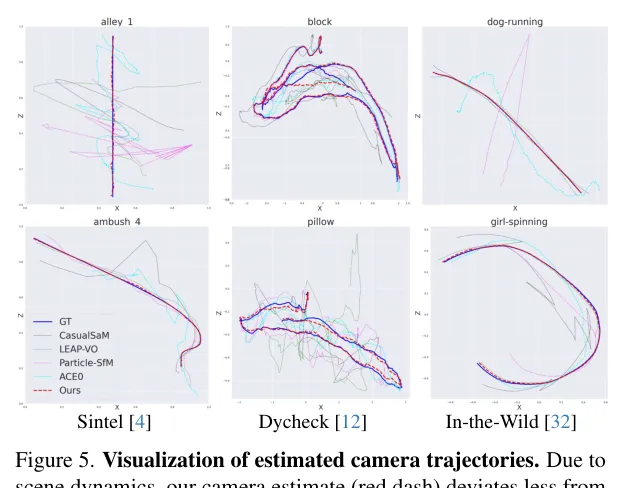
相机位姿(ATE/RTE/RRE 越低越好)三个 benchmark 全面第一且快:Sintel ATE 0.018(calib)/0.023(uncalib) vs CasualSAM 0.036/0.067、MonST3R 0.078,~1.0s/帧;DyCheck ATE 0.020 vs CasualSAM 0.185、ACE-Zero 0.062;In-the-Wild ATE 0.004 vs LEAP-VO 0.016。对比 CasualSAM(1.6m)/RoDynRF(15m) 的分钟级优化,MegaSaM 是秒级。视频深度(Table 4):Sintel abs-rel 0.21(DA-v2 0.37 / CasualSAM 0.31 / MonST3R 0.31),DyCheck abs-rel 0.11/δ1.25 94.1 全面领先。消融(Table 5):去掉运动图 m̂_i → RTE 从 0.008 飙到 0.127;去掉两阶段训练 → RTE 0.136;去单目初始化 ATE 0.038——每个组件都关键。
亮点
① 证明"深度可微 BA 层"是动态视频相机跟踪的关键、并成功扩到低视差/动态场景;② 运动概率图 + 两阶段解耦训练让动态像素降权且训练稳;③ 双单目模型(DepthAnything 给一致深度 + UniDepth 给尺度/焦距)做先验;④ 用 Hessian 不确定性量化"几何可观测性",自适应决定何时加单目正则/关焦距优化——优雅解决低视差退化;⑤ 视频深度无需 per-video 微调网络 → 秒级。
疑问 / 边界(原文标注)
① 失败场景:运动物体占满整幅、或没有可靠可跟踪内容时会挂(与 CasualSAM 同病)。② 不能处理视频内焦距变化或强径向畸变(Limitation 自认)。③ 纯合成训练(TartanAir+Kubric)但泛化到真实——好,但依赖外部 DepthAnything/UniDepth/RAFT 多个现成模块,是个系统集成而非单一模型。④ "快"是相对分钟级优化法;~1s/帧 + 深度优化 1.3 FPS,仍非实时。⑤ 训练相机模块需 8×A100 约 4 天。
📖 逐段精读 · 笔记
批量精读初稿(基于本地 PDF 全文,PyMuPDF 提取)。原文英文原句引用 + 中文指路 + 追问 why。最后更新 2026-06-21。
① Abstract(摘要)— 逐句精讲
原文(旧假设的失效):“Most conventional structure from motion and monocular SLAM techniques assume input videos that feature predominantly static scenes with large amounts of parallax. Such methods tend to produce erroneous estimates in the absence of these conditions.” → 传统 SfM/SLAM 假设静态 + 大视差,casual 视频不满足时就出错。
原文(近期神经法仍不行):“Recent neural network-based approaches attempt to overcome these challenges; however, such methods are either computationally expensive or brittle when run on dynamic videos with uncontrolled camera motion or unknown field of view.” → 近期神经法要么贵、要么在不受控相机运动/未知 FoV 下脆。
原文(核心发现):“We demonstrate the surprising effectiveness of a deep visual SLAM framework: with careful modifications to its training and inference schemes, this system can scale to real-world videos of complex dynamic scenes with unconstrained camera paths, including videos with little camera parallax.” → 核心发现:深度可微 SLAM(DROID 式)经"精心改造其训练/推理"就能扩到复杂动态 + 不受控相机路径 + 低视差。
原文(结论):“significantly more accurate and robust at camera pose and depth estimation when compared with prior and concurrent work, with faster or comparable running times.” 逐句抓 Abstract:改造 DROID 式可微 SLAM → 扛动态/低视差/未知焦距 → 相机+深度双 SOTA 且更快或相当。
📚 背景知识(外部,非本文原文,理解 MegaSaM 必备)
① SfM / SLAM / Bundle Adjustment:从多帧估相机位姿+3D 结构。经典做法=找 2D 对应 → 用 BA 最小化重投影误差(3D 点投回各帧与观测的差)联合优化点和相机。视差(parallax)=相机平移带来的视点差,没有视差就无法三角化深度(纯旋转看不出远近)。
② DROID-SLAM(本文底座):深度可微 SLAM——把 BA 做成可微层,ConvGRU 反复预测帧间光流+置信,用 BA 联合更新视差与位姿,整个端到端从大量数据学。优点=学出来的流/置信比手工特征稳。
③ 单目深度:仿射不变 vs metric。DepthAnything 给"相对深度"(仿射不变、有未知尺度+偏移,但时序一致细节好);UniDepth 给"绝对/metric 深度"+焦距(有真实尺度)。两者互补:用 UniDepth 的 metric 把 DepthAnything 的相对深度对齐成 D_align=α̂·D_rel+β̂。
④ epistemic 不确定性 / Hessian / 可观测性:对优化问题,Hessian H 描述代价对参数的曲率;Laplace 近似下参数协方差 Σ≈−H⁻¹(引 Goli 等 Bayes' Rays [14]、Kendall&Gal [23])。某参数的 Hessian 小(曲率平)= 改它几乎不影响代价 = 它"不可观测"、不确定性大。本文据此判断"低视差时视差/焦距不可观测",从而决定是否引入单目先验兜底——这是全文最优雅的一招。
②′ §2 Related Work — 三条相关路线 & 本文站位
① 传统/深度 SfM-SLAM:特征匹配或光度对齐求 2D 对应 → BA 最小化重投影/光度误差(ORB-SLAM/COLMAP 等);深度版(DROID-SLAM/DUSt3R/MASt3R 等)用网络估对应或全局点云。共性短板(原文):“assume predominantly static scenes and sufficient camera baselines between frames. Therefore, their performance can degrade significantly or fail entirely in the presence of scene dynamics or limited camera parallax.” ② 动态视频专门法:Robust-CVD[26]/CasualSAM[77] 联合优化相机 + 稠密深度(spline 或微调单目网);Particle-SfM[78]/LEAP-VO[6] 先从长程轨迹推运动 mask 再在 BA 里降权动态特征;并发 MonST3R[75] 用 DUSt3R 点云 + 额外对齐优化定位。③ 本文站位:原文 “we show that performance can be significantly improved by coupling the differentiable SLAM system with the intermediate predictions of underlying dynamic scenes.” —— 把可微 SLAM 与"单目深度/运动概率"中间预测深度耦合,而非松散级联。
② §1 Introduction — problem → solution → why 闭环
problem:casual 动态视频违反"静态+大视差"假设——原文 “limited camera motion parallax (e.g., nearly stationary or rotational cameras) and a broad range of focal lengths, and often include moving objects and scene dynamics.” 两条近期路线(微调单目深度网/重建辐射场;或把深度/光流/轨迹/运动分割塞进全局优化)都 “computationally expensive or brittle when applied to unconstrained videos that feature long time duration, unconstrained camera paths, or complex scene dynamics.”
solution(Intro 即给 method):“reexamine and extend prior deep visual SLAM framework”(DROID 的可微 BA 层是关键,原文 “such a learned layer is critical for achieving accurate and efficient camera pose estimation for the more challenging case of dynamic video”);“integrate monocular depth priors and motion probability maps into a differentiable SLAM paradigm”;再加 “uncertainty-aware global BA scheme, which improves system robustness when camera parameters are poorly constrained by the input video”;并 “consistent video depths ... without the need for test-time network fine-tuning”。
why(为什么这些改造有效):运动图降权动态像素 → BA 不被运动物体带偏;单目先验补"低视差时不可观测的深度" → 不退化;不确定性自适应 → 大视差时不被单目误差拖累、小视差时才靠先验兜底;固定相机优化深度 → 快。★ Intro 已自包含闭环。
四点贡献(原文凝练):(i) 证明深度可微 SLAM 的 learned BA 层对动态视频相机跟踪 critical;(ii) 把单目深度先验 + 运动概率图整合进可微 SLAM;(iii) 提出不确定性感知全局 BA,在相机参数被输入弱约束时提升鲁棒;(iv) 无需 test-time 网络微调即得一致视频深度。
③ §3.1 Deep Visual SLAM 底座(DROID-SLAM 的可微 BA,式1-6)
目标与状态:给定视频 V={I_i},估相机位姿 Ĝ_i∈SE(3)、焦距 f̂(若未知)、稠密视频深度 D̂_i。沿用 DROID-SLAM:维护两组状态——每帧 1/8 分辨率视差 d̂_i∈R^(H/8×W/8) 与位姿 Ĝ_i∈SE(3),在 frame-graph 的图像对 (I_i,I_j)∈P 上用可微 BA 迭代更新。
对应与刚体流(式1):ConvGRU 迭代预测 2D 对应场 û_ij 与置信 ŵ_ij:(û^{k+1},ŵ^{k+1})=F(I_i,I_j,û^k,ŵ^k)。另一路"刚体流"由 ego-motion + 视差经多视约束导出:u_ij = π( Ĝ_ij ∘ π⁻¹(p_i, d̂_i, K⁻¹), K )(式1),其中 Ĝ_ij=Ĝ_j∘Ĝ_i⁻¹ 是相对位姿、K 是内参矩阵。
可微 BA(式2-6):最小化加权重投影代价 C(Ĝ,d̂,f̂)=Σ_{(i,j)∈P} ‖û_ij − u_ij‖²_Σij,权重 Σ_ij=diag(ŵ_ij)⁻¹(式2);用 Levenberg–Marquardt:(JᵀWJ + λ·diag(JᵀWJ)) Δξ = JᵀWr(式3),λ 由网络每轮预测。把近似 Hessian 按"相机+焦距 / 视差"分块(式4),因每个重投影项只含一个视差变量 → H_d 是对角阵,可用 Schur 补高效求更新(式5-6),整层端到端可微。MegaSaM 关键扩展:把焦距 f̂ 也设为可优化变量(DROID 假设焦距已知)。静态训练损失 L_static=L_cam + w_flow·L_flow(式7)。
frame-graph(帧图)与迭代本质:BA 不是对所有帧两两做,而是在动态构建的 frame-graph 上做——原文 “a set of image pairs from a frame-graph (Ii, Ij) ∈ P, built dynamically to connect frames with overlapping field of view.” 即只连"视野有重叠"的帧对,既省算力又保证约束有效;状态变量 d̂/Ĝ 在训练与推理阶段都通过这个可微 BA 层反复迭代更新(ConvGRU 每轮出新的流/置信、BA 每轮解一次 LM 线性系统)。这正是"deep visual SLAM"区别于经典手工 BA 的地方:流、置信、阻尼 λ 全是学出来的。
③′ §3.2.1 运动概率图 + 两阶段解耦训练(消融最关键)
为何要单独的运动网络:最朴素的想法是"直接在动态视频上训,指望 pairwise 置信 ŵ 自动吸收物体运动信息",但原文发现 “this simple training strategy tends to produce suboptimal results due to unstable training behaviour from differentiable BA layers.” 故另设网络 F_m 预测物体运动概率图 m_i=F_m({I_i}∪N(i))(条件于 I_i 及其邻居关键帧),专门监督它标出动态像素;BA 里把流置信与运动图相乘成最终权重 w̃_ij=ŵ_ij·m_i → 动态像素在 BA 中被降权。
两阶段训练(decouple):S1 ego-motion 预训练——只在静态合成数据上训原 SLAM 网络 F(式7 监督流 + 置信),让它学"纯 ego-motion 诱导的对应"。S2 动态微调——冻结 F、只 finetune F_m(条件于 F 的特征),监督 L_dynamic=L_cam + w_motion·L_CE(式8,含相机损失 + 交叉熵)。原文:“This stage decorrelates learning scene dynamics from learning 2D correspondences, and thus leads to more stable and effective training behavior.” 消融证明这是动态相机精度的命门。
③″ §3.2.1 视差/相机初始化(注入单目深度先验)
问题:DROID 把视差 d̂ 初始化成常数 1,原文发现"在低基线 + 复杂动态视频上这样初始化跟不准"。解法(训练时):用 DepthAnything 的视差初始化 d̂(用每个训练序列 GT 深度估的全局 scale/shift 对齐);把前两帧位姿设为 GT 以消除 gauge ambiguity(尺度/参考系不定性);焦距初值用 GT 随机扰动 25%。这给可微 BA 一个靠谱起点,避免陷入低视差退化解。
③‴ §3.2.2 推理 frontend:metric 对齐的单目视差 D_align
推理两段:frontend(关键帧选择 + 滑窗 BA)+ backend(全帧全局 BA)。单目视差对齐:每帧初始化为 metric 对齐视差 D_align = α̂·D_rel + β̂,其中 D_rel 是 DepthAnything 的仿射不变视差、(α̂,β̂) 通过把 D_rel 与 UniDepth 的 metric 深度 D_abs 做中值对齐求得;UniDepth 还预测每帧焦距,取全视频中值作初始 f̂(frontend 内固定)。初始化:累积到 Ninit=8 个关键帧 → 先做"仅相机运动"BA(视差固定为 D_align)→ 再增量滑窗 local BA。frontend 代价=重投影 + 单目正则 w_d·Σ‖d̂_i − D_align_i‖²(式9)。
④ §3.2.2 不确定性感知全局 BA(全文最优雅一招,式10)
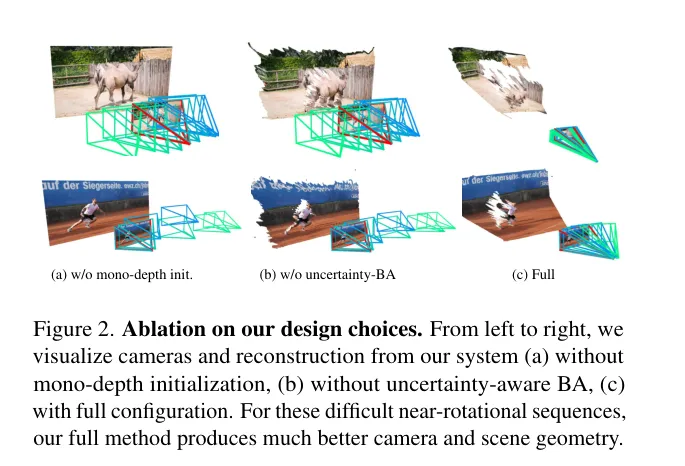
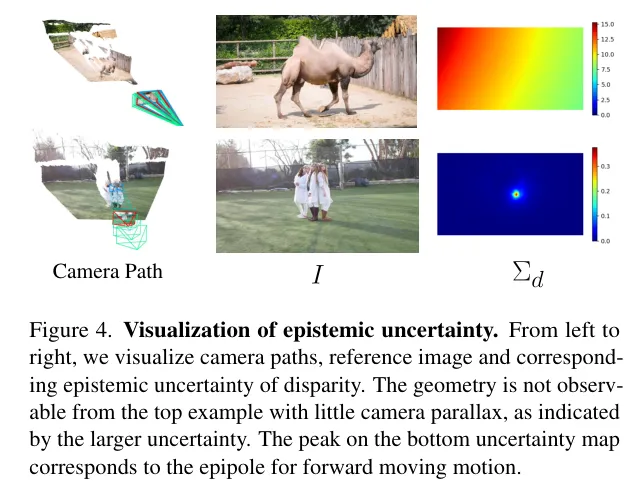
两难:该不该在全局 BA 里加单目正则?原文:若视差足够(well-constrained)则不需要、甚至 “the error from mono-depth can diminish camera tracking accuracy”;若纯旋转/低基线则纯重投影 BA 会退化(Fig.2 第二列)。判据=可观测性:由 Laplace 近似 Σ_θ=−H(θ*)⁻¹(Bayes' Rays [14]),并按 Ritter 等用对角近似 Σ_θ≈diag(−H(θ*))⁻¹(式10)。直觉:当扰动某参数几乎不改重投影误差时,其 Hessian 小、不确定性大 = 不可观测(极端例:静止相机 → 视差完全不可观测)。自适应规则:取视差 Hessian 对角中值 med(diag(H_d)),设单目正则权重 w_d=γ_d·exp(−β_d·med(diag(H_d)))(poses 越不可观测 → 正则越强);若焦距 Hessian H_f<τ_f 则关闭焦距优化(焦距不可观测时别瞎优化)。Fig.4 可视化:旋转主导序列的视差不确定性显著更大。
④′ §3.3 一致视频深度优化(仿 CasualSAM 但更快更准,式11)
给定相机参数后,可选地优化更高分辨率的一致视频深度。仿 CasualSAM 做一阶优化(深度 + 每帧 aleatoric 不确定性),目标 C_cvd=w_flow·C_flow + w_temp·C_temp + w_prior·C_prior(式11:2D 流重投影 + 时序深度一致 + 尺度不变单目先验)。与 CasualSAM 的三点不同(原文):(i) 不微调单目网络,而是直接优化一组视差 + 不确定性变量(省时);(ii) 固定相机参数(不联合优化相机+深度);(iii) 用表面法向一致 + 多尺度深度梯度匹配损失替代 CasualSAM 的深度先验损失。原文:这些改动 “lead to much faster optimization times as well as more accurate video depth estimates.”
④″ 具体化:一段"纯旋转/低视差"视频里发生了什么
场景:手持相机几乎原地转(典型 casual 拍摄)。① 退化风险:纯旋转下相机平移≈0 → 无视差 → 三角化不出深度,纯重投影 BA 的视差变量"怎么取都几乎不改重投影误差" → 解不唯一(Fig.2(b):几何崩坏)。② 不确定性诊断:此时视差 Hessian 对角 diag(H_d) 很小 → Σ_d≈diag(−H)⁻¹ 很大 → 系统"知道自己不知道"深度(Fig.4 顶行旋转主导序列的不确定性显著高于底行前向运动序列)。③ 自动兜底:med(diag(H_d)) 小 → w_d=γ_d·exp(−β_d·med(·)) 自动变大 → 单目正则 ‖d̂−D_align‖² 主导,用 DepthAnything/UniDepth 的单目深度把不可观测的几何"撑住";若焦距也不可观测(H_f<τ_f)则索性关掉焦距优化、改用 UniDepth 的中值焦距。④ 反向情形:若前向/侧移有充分视差,diag(H_d) 大 → w_d→0 → 几乎不加单目正则,避免单目误差拖累已被良好约束的几何。⑤ 几何直觉印证:原文指出前向运动时不确定性图的峰值恰在 epipole(极点)处——沿视线方向的点天然难定深度,与几何完全吻合。这套"先诊断可观测性、再决定是否兜底"的机制,正是 MegaSaM 同时做到 robust(低视差不崩)与 accurate(高视差不被先验拖累)的根。
Q&A · 几个 why 追问
1 为什么"可微 BA 层"对动态视频至关重要?BA 把几何约束(重投影一致)硬编码进网络,相比纯回归位姿,它在动态/低视差等困难情形下更稳;且置信 ŵ + 运动图 m 让 BA 能"主动忽略"不可靠像素。原文称 learned BA layer “is critical for achieving accurate and efficient camera pose estimation for the more challenging case of dynamic video”。
2 为什么把"学动态"和"学对应"解耦成两阶段?若一锅端训,运动信息会和 ego-motion 对应纠缠、又叠加可微 BA 的不稳定性 → 训练发散/次优。先用静态数据把 F 的"纯 ego-motion 对应"练扎实再冻住,单独训运动网 F_m,等于把两个难题拆开 → 稳定(消融:去两阶段 RTE 0.008→0.136,崩)。
3 为什么不确定性能决定"何时加单目正则"?低视差时几何"不可观测"——纯重投影 BA 有无穷多近似解(退化),此时必须靠单目先验兜底;但高视差时几何已被良好约束,单目先验反而引入误差。Hessian 对角恰好量化了"每个变量被数据约束的程度",于是用它自动在两种 regime 间切换,而非手调。
4 MegaSaM 是"一个模型"还是"一套系统"?是系统集成:可微 SLAM(F + F_m)+ 外部 DepthAnything(一致相对深度)+ UniDepth(metric 尺度 + 焦距)+ RAFT(深度优化用的光流)+ 不确定性 BA + 一致深度优化。优势是各取所长,代价是依赖多个现成模块(诚实边界)。
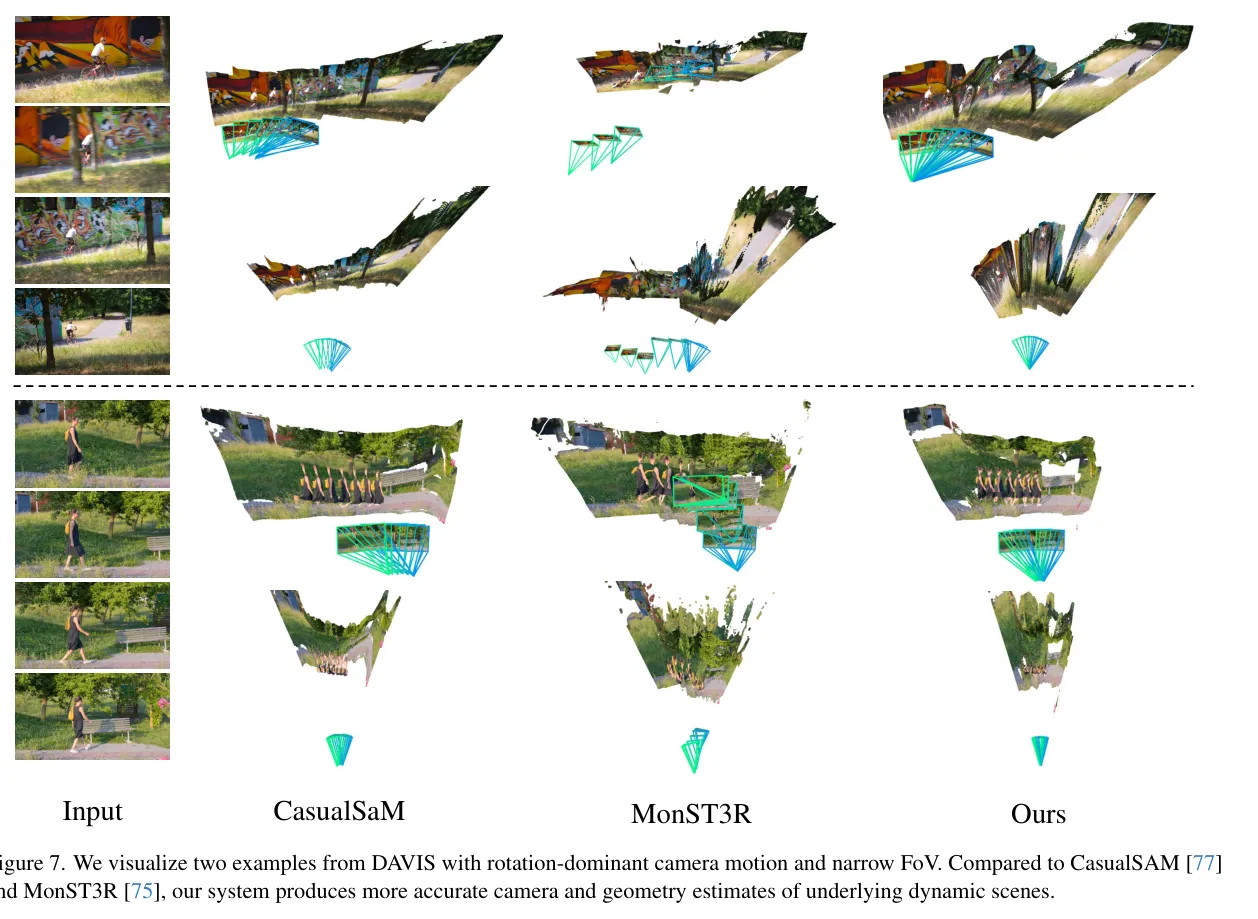
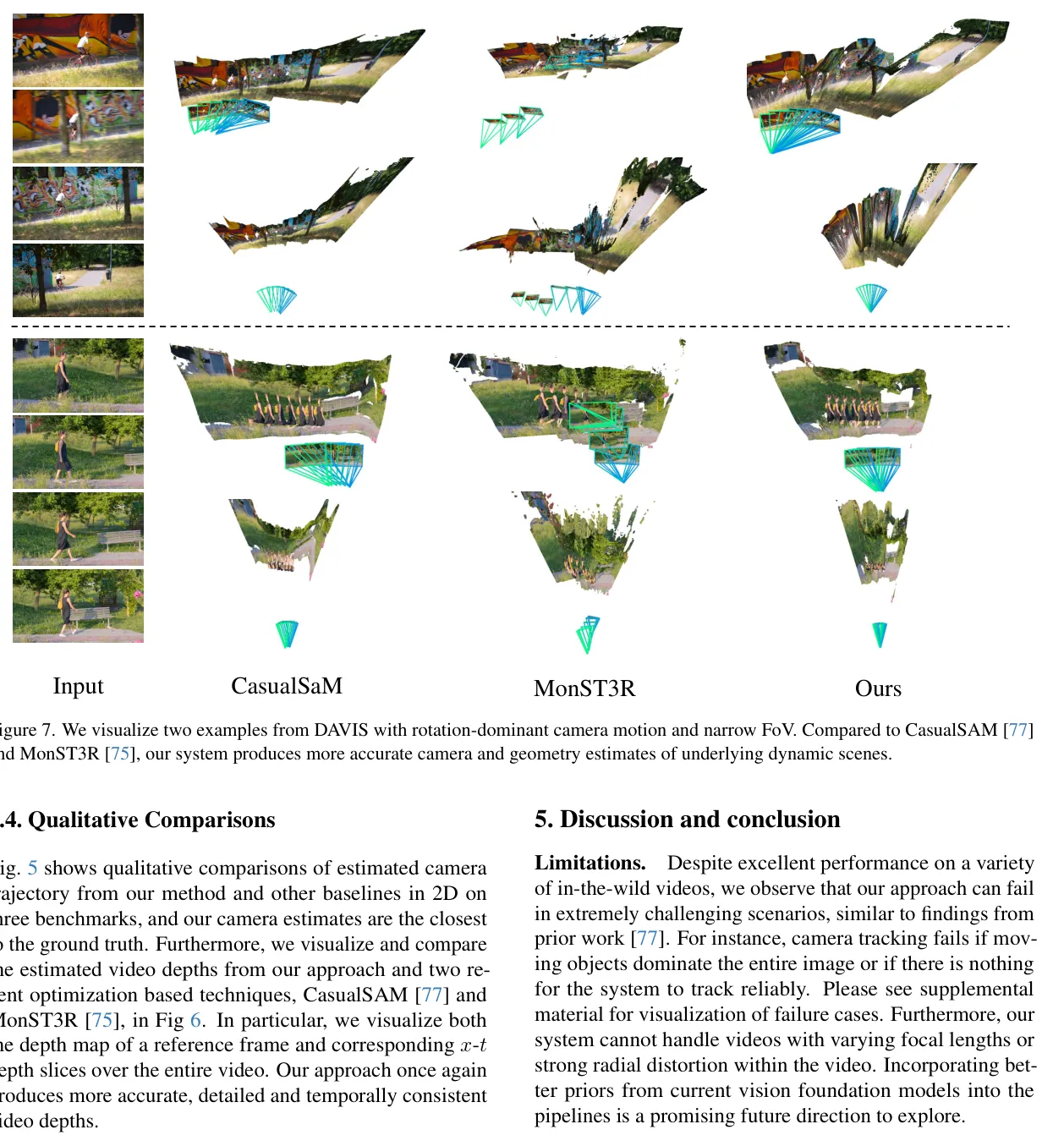
5 为什么不微调单目网络也能得到好深度(且更快)?CasualSAM 为每段视频做 test-time 微调整个单目深度网络(慢)。MegaSaM 改为:固定已估好的相机参数,只优化一组视差 + aleatoric 不确定性变量,并用表面法向一致 + 多尺度深度梯度匹配约束(式11)。因为相机已准、且只优化少量变量而非网络权重,收敛快得多;原文证实这同时带来 “much faster optimization times as well as more accurate video depth estimates”。本质:把"重新训网络"换成"在固定相机下做一个轻量几何优化"。
⑤ §4 实验 — 相机位姿(Table 1-3,ATE/RTE/RRE 越低越好)
设置:三个 benchmark(Sintel 18 seq / DyCheck 真实 180-500 帧 / In-the-Wild 12 段 DynIBaR 视频 100-600 帧);calibrated(已知焦距)/uncalibrated(未知)两档;位姿经 Sim(3) Umeyama 对齐后算 ATE/RTE/RRE,GT 轨迹归一化为单位长度;Time=总时间/帧数。下表节选 calibrated ATE:
| 方法 | Sintel ATE | DyCheck ATE | In-Wild ATE | Time/帧 |
| CasualSAM | 0.036 | 0.185 | 0.031 | 1.1–2.8m |
| Particle-SfM | 0.062 | 0.081 | 0.051 | 21–49s |
| MonST3R(uncalib) | 0.078 | 0.690 | 0.073 | 1.0–1.7s |
| MegaSaM | 0.018 | 0.020 | 0.004 | 0.7–1.0s |
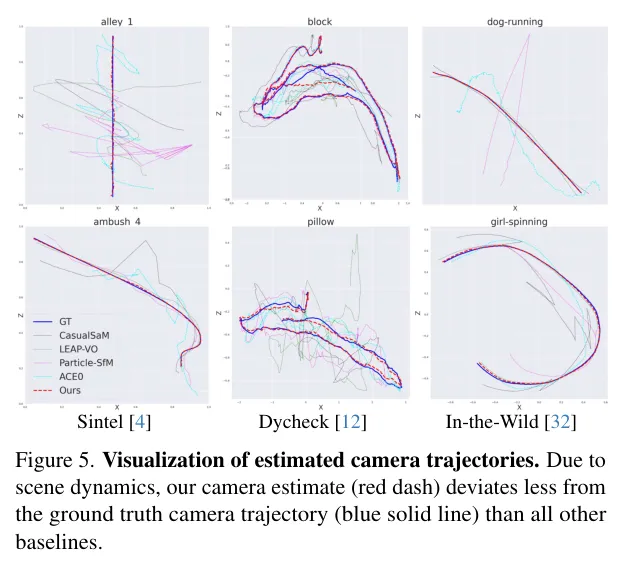
读表(Table 1-3):三数据集 ATE 全面最低且秒级(CasualSAM 1.1-2.8m、RoDynRF 6.6-15m 是分钟级)。Sintel:Ours calib ATE 0.018(CasualSAM 0.036 / MonST3R uncalib 0.078);DyCheck:Ours 0.020 vs MonST3R uncalib 0.690(几乎崩)、CasualSAM 0.185;In-the-Wild:Ours 0.004 vs LEAP-VO 0.016、MonST3R 0.073。uncalibrated 档同样领先(Sintel 0.023、DyCheck 0.020、In-Wild 0.004)。动态 + 低视差正是 MegaSaM 的主场,原文 “outperforms the concurrent work MonST3R in terms of both robustness and accuracy even though MonST3R adopts a more recent global 3D point cloud representation.”
视频深度 abs-rel↓ / δ1.25↑(Table 4):Sintel:DA-v2 0.37/58.6、DepthCrafter 0.27/68.2、CasualSAM 0.31/64.2、MonST3R 0.31/62.5、Ours 0.21/73.1;DyCheck:DA-v2 0.20/84.7、Ours 0.11/94.1。深度也全面领先——且不需要 per-video 微调单目网络。
消融(Table 5,Sintel;ATE/RTE/RRE):vanilla Droid-SLAM 0.030/0.022/0.50 → Full 0.019/0.008/0.04。逐项去除:去运动图 m̂_i → RTE 0.008→0.127(暴涨,动态像素污染 BA);去两阶段训练 → RTE 0.136(最崩);去单目初始化 → ATE 0.019→0.038;去不确定性 BA(u-BA) → ATE 0.033 / RRE 0.11。深度侧:联合优化相机(w/ ft-pose) abs-rel 0.21→0.23 变差(故固定相机更好);用 CasualSAM 旧 C_prior → abs-rel 0.36。每个设计都不可省。
⑥ §4 实现细节 + benchmarks + 局限
实现(可复现):S1 静态预训练 = 163 个 TartanAir 场景 + 5K static Kubric 视频;S2 动态微调 = 11K dynamic Kubric 视频;每样本 7 帧序列;w_flow=0.02、w_motion=0.1;Adam、~4 天、8× A100 80G。frontend w_d=0.05;backend γ_d=1e-4、β_d=0.05、τ_f=50;深度优化 w_flow=w_prior=1.0、w_temp=0.2,速度 1.3 FPS @336×144(评测在 672×288)。GT:DyCheck 用 Shape-of-Motion 提供的相机/传感器深度;In-the-Wild 用实例分割 mask 掉动态物后跑 COLMAP 得 GT。
局限(原文自陈 + 推断):① 失败场景:原文 “camera tracking fails if moving objects dominate the entire image or if there is nothing for the system to track reliably.” ② 不支持视频内焦距变化或强径向畸变(Limitation 自认)。③ 是个系统集成(依赖 DepthAnything/UniDepth/RAFT 多个外部模块),非单一端到端模型。④ "快"是相对分钟级优化法;~1s/帧相机 + 深度优化 1.3 FPS,仍非实时。⑤ 纯合成训练(TartanAir+Kubric)泛化到真实——效果好,但训练相机模块需 8×A100 约 4 天。
📌 全文一页总结(问题→方法→实验→takeaway)
问题(§1):随手拍动态视频违反 SfM/SLAM 的"静态 + 大视差"假设(动态物体、纯旋转/低视差、未知/变焦距、时长长),现有法要么贵要么脆。
方法(§3):以 DROID-SLAM 可微 BA 为底座(式1-6,额外把焦距设为可优化变量),加五件套:① 运动概率图 w̃=ŵ·m 在 BA 里降权动态像素;② 两阶段解耦训练(S1 静态学 ego-motion 流、S2 冻 F 只训运动网 F_m);③ 双单目深度先验做初始化/正则(DepthAnything 给一致相对深度 + UniDepth 给 metric 尺度与焦距,对齐成 D_align);④ Hessian epistemic 不确定性自适应开关单目正则与焦距优化(式10,低视差/不可观测才兜底);⑤ 固定相机优化一致视频深度(式11,不微调网络)。
实验(§4):相机位姿 Sintel/DyCheck/In-Wild 的 ATE/RTE/RRE 全面第一且秒级(对手分钟级;DyCheck 上 MonST3R 0.690 崩、Ours 0.020),视频深度 abs-rel/δ1.25 也全面领先(Sintel 0.21、DyCheck 0.11/94.1);消融证明运动图 / 两阶段 / 单目初始化 / 不确定性 BA 缺一不可。
Takeaway:① "深度可微 SLAM + 单目先验 + 不确定性感知"是把相机&深度估计稳健扩到 in-the-wild 动态视频的有效配方,输出可直接喂给动态重建/4D 系统;② 用 Hessian 量化可观测性、自适应决定何时靠先验兜底是优雅解决低视差退化的关键;③ 两阶段解耦 + 运动图是动态相机精度的命门(消融最敏感);④ 边界=运动物体占满/无可跟踪内容会挂、不支持视频内变焦/强畸变、是系统集成依赖多外部模块、非实时。
🖼 论文原图(本地 PDF 截图,原文 caption 未改写)