CVPR 2025 Finalist
DIFIX3D+: Improving 3D Reconstructions with Single-Step Diffusion Models
Jay Zhangjie Wu · Yuxuan Zhang · Haithem Turki · Xuanchi Ren · Jun Gao · Mike Zheng Shou · Sanja Fidler · Zan Gojcic · Huan Ling
摘要 Abstract
见上方 arXiv / CVF 链接。
📝 精读笔记
灵魂一句
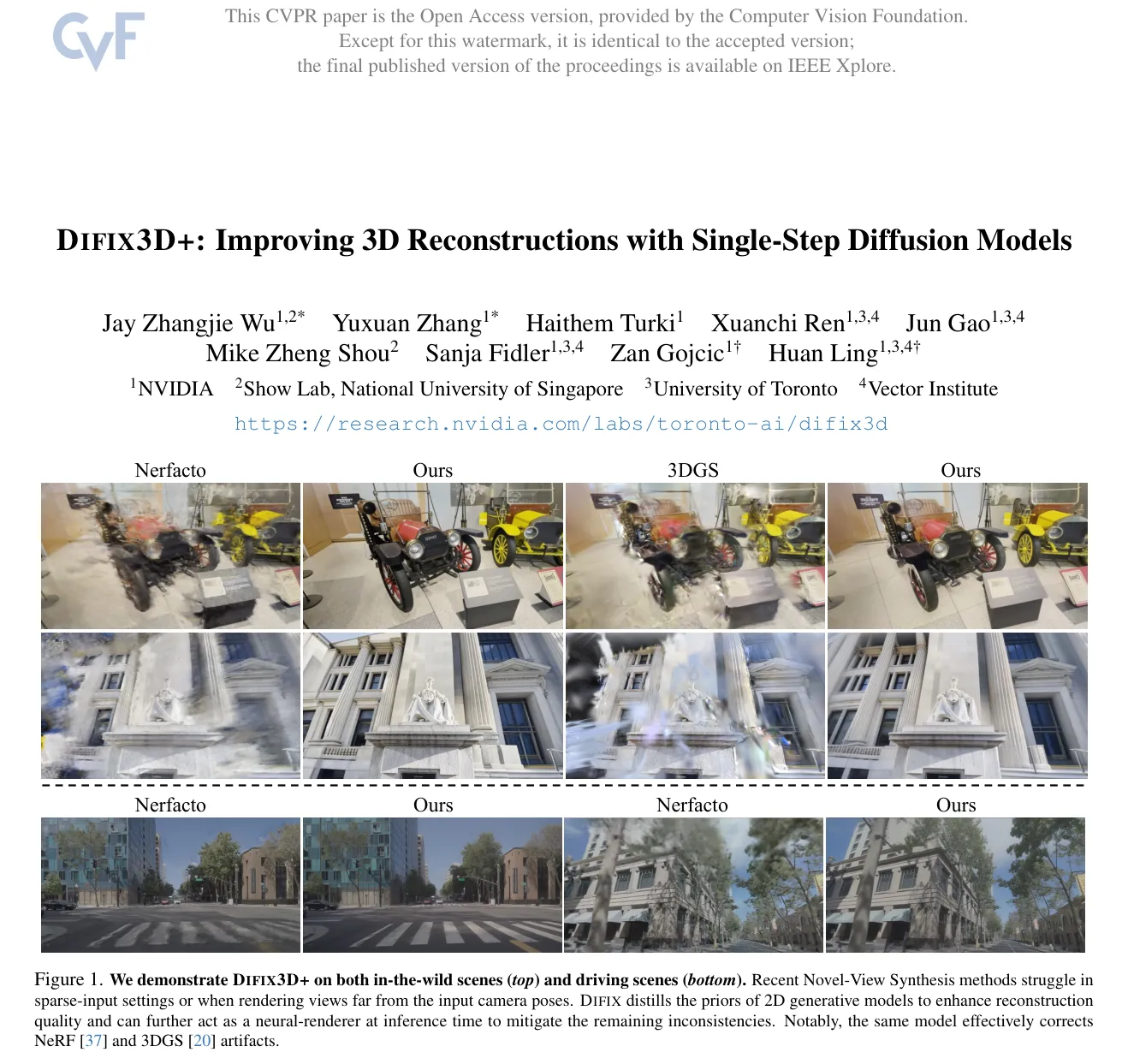
用一个 单步扩散模型 DIFIX(基于 SD-Turbo 微调)去"修"NeRF/3DGS 在极端新视角下的伪影:既在重建阶段把渲染出的 pseudo-view 清洗干净再 distill 回 3D(DIFIX3D 渐进更新),又在推理阶段当实时神经增强器(DIFIX3D+,A100 上仅 +76ms)。同一个模型通吃 NeRF 与 3DGS,FID 平均提升 ~2×、PSNR >1dB,且保持 3D 一致性。
问题 & 动机
NeRF/3DGS 在训练视角附近很好,但远离输入相机的欠约束区/极端新视角持续出现伪影(spurious geometry、缺失区域)。根因(原文):① per-scene 优化需要精挑的 view-consistent 数据,易陷 shape-radiance ambiguity(训练图能被一个"几何错误但能重现训练图"的 3D 表示完美还原);② 无数据先验 ⇒ 欠约束区只能靠表示自身的 smoothness、无法 hallucinate 合理几何/外观。2D 扩散模型有互联网级先验、泛化好,但"how to lift 2D priors to 3D remains unclear"——已有法每个训练步都 query 扩散模型,偏 object-centric、对大场景 scale 差、慢。
核心方法 + 关键公式
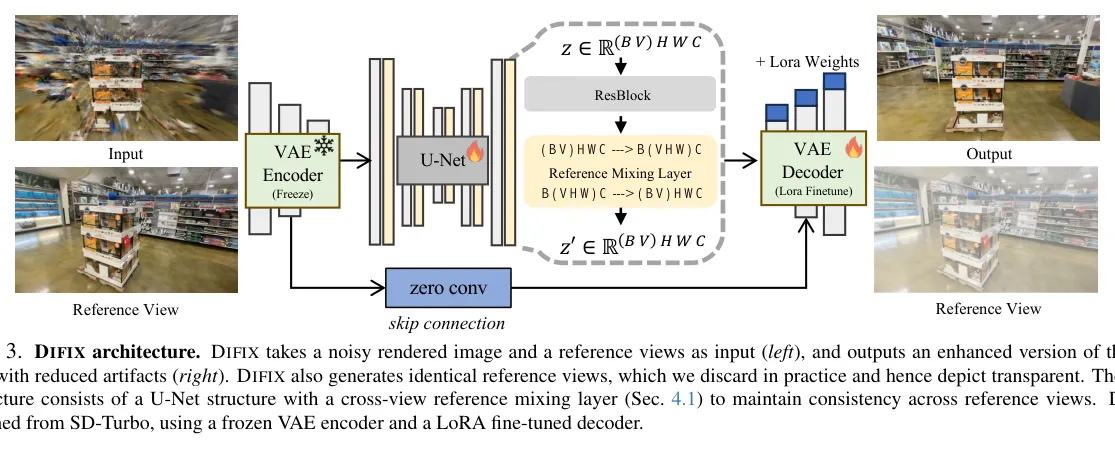
① DIFIX = 单步扩散 artifact fixer(§4.1):基于 SD-Turbo(单步、可实时)做 image-to-image,冻结 VAE encoder + LoRA 微调 decoder(仿 Pix2pix-Turbo)。关键 insight:NeRF/3DGS 伪影图的分布 ≈ 扩散训练时某噪声级 τ 的 xτ 分布 ⇒ 直接把退化渲染图当输入、只在 τ=200 做单步"去噪"(非 1000,Fig.4 验证 τ=200 最佳:太高改变内容、太低修不掉)。② Reference mixing layer:把最近训练视角当 clean 参考,concat 到 view 维 z∈R^{V×C×H×W},把 view 轴并进空间轴做 self-attention(rearrange b c v (hw)→b c (vhw)→attn→还原)捕跨视一致,复用原 2D self-attention 权重。③ 损失:L=L_Recon(L2)+L_LPIPS+0.5·L_Gram;Gram loss(式4-5)=VGG-16 特征自相关 Gˡ(I)=ϕˡ(I)ᵀϕˡ(I) 的 L2 → 更锐细节。④ DIFIX3D 渐进 3D 更新(§4.2,仿 Instruct-NeRF2NeRF):每 1.5k 迭代把 GT 位姿向目标轻微扰动→渲染→DIFIX 修→加入训练集,逐步"长大"参考与目标间的 3D 线索重叠,使条件信号始终够强、少 hallucinate。⑤ DIFIX3D+ 实时后处理:渲染末端再过一遍 DIFIX 去残余伪影,单步仅 76ms(比多步扩散快 >10×)。⑥ 配对数据 curation(Table 1):sparse reconstruction / cycle reconstruction(驾驶近直线轨迹,横移 1-6m 训第二个 NeRF 造退化)/ model underfitting(只训 25%-75% epoch 造显著伪影)/ cross reference(多相机互渲)。
关键结果
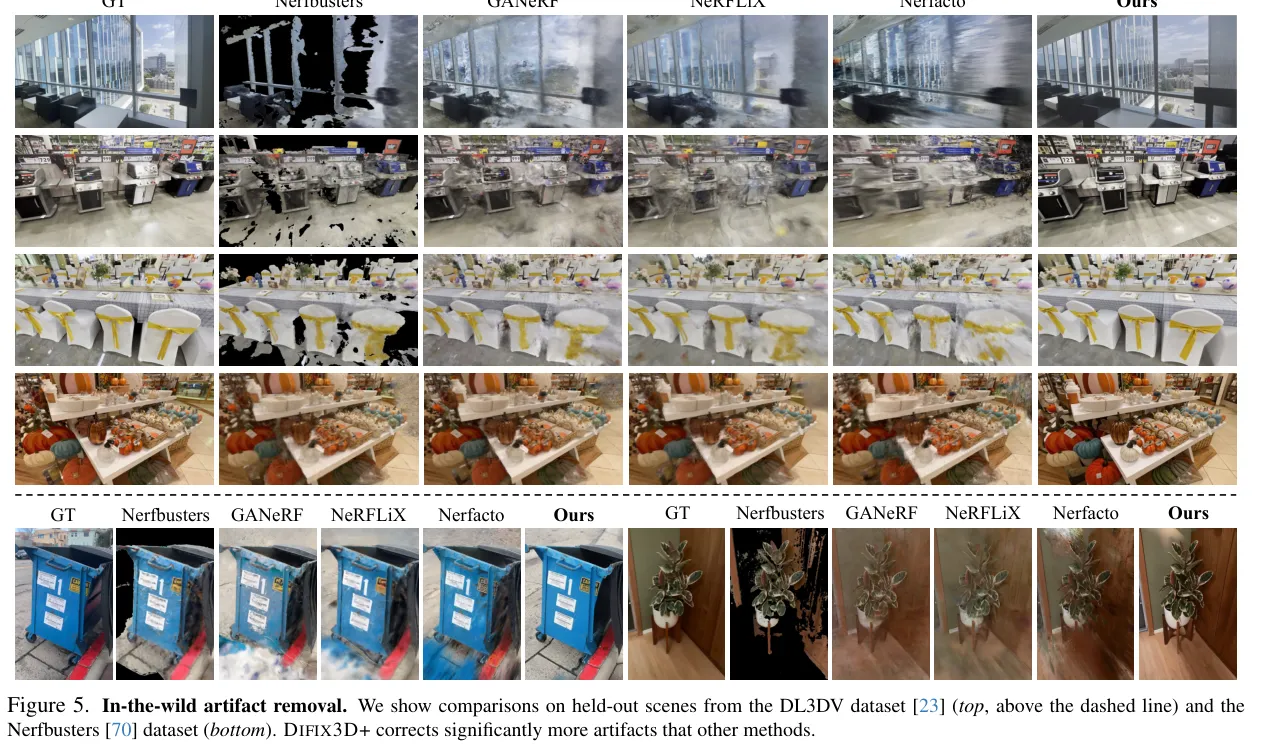
In-the-wild(Nerfbusters+DL3DV):两个变体相对各自 NeRF/3DGS backbone LPIPS 降 ~0.1、FID 降近 3×、PSNR 升 ~1dB。Nerfbusters 上 Nerfacto 17.29/0.62/0.40/134.65(PSNR/SSIM/LPIPS/FID)→ DIFIX3D+ 18.32/0.66/0.279/49.44;3DGS 17.66/0.68/0.33/113.84 → DIFIX3D+ 18.51/0.69/0.264/41.77。驾驶 RDS(自建):Nerfacto 19.95/.49/.53/91.38 → +DIFIX3D+ 21.75/.58/.402/73.08,全面超 NeRFLiX。消融关键:噪声级 1000→200 单这一项就把 LPIPS 0.381→0.319、FID 108.86→61.80;再加 Gram、Reference 进一步到 0.2996/47.87。
亮点
① 一个单步模型身兼两职——训练期 distill 清洗 + 推理期实时增强;② "伪影分布≈扩散噪声分布@τ=200"的洞察,把"修伪影"变成"轻量单步去噪";③ 渐进 3D 更新让极端新视角也能保持长程一致(比直接 query 扩散快 >10×);④ NeRF/3DGS 同一模型通吃;⑤ 微调只需单张消费级显卡几小时。
疑问 / 边界(原文标注 / 推断)
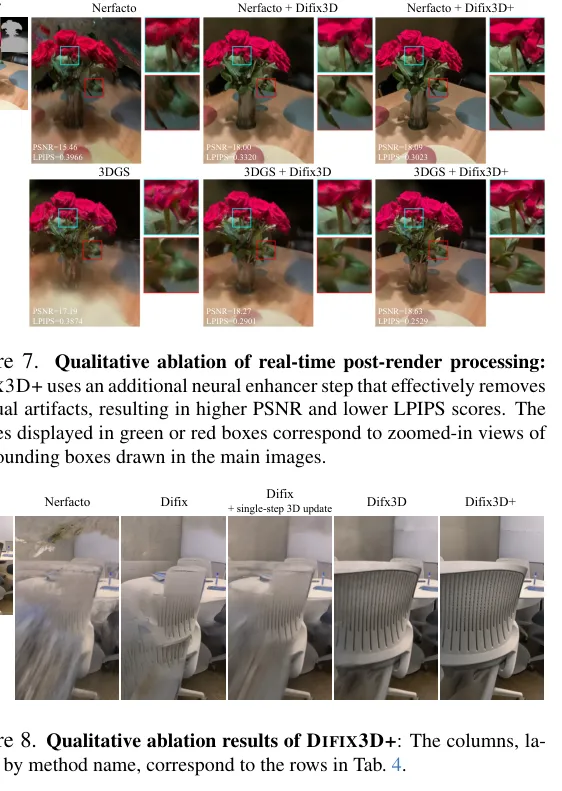
① "实时 76ms"是指推理后处理那一步(A100);DIFIX3D 渐进更新本身是训练期流程、非实时。② 生成模型天然多视不一致:目标轨迹太远时条件变弱仍会 hallucinate,post-render 是"兜底"而非根治(原文 Fig.8 显示直接用 DIFIX 会 flickering,必须 distill 回 3D)。③ RDS 驾驶数据集自建非公开 → 该结果外部不可复现。④ PSNR 增益温和(~1dB,DL3DV 仅 17.16→17.82),真正大赢在感知指标 FID/LPIPS(PSNR 对色偏敏感、说明保真未退)。⑤ 增量更新是必需:一次性灌入全部 pseudo-view 会使 LPIPS/FID 退化(Table 4 自证)。
📖 逐段精读 · 笔记
批量精读初稿(基于本地 PDF 全文,PyMuPDF 提取)。原文英文原句引用 + 中文指路 + 追问 why。最后更新 2026-06-21。
① Abstract(摘要)— 逐句拆解
原文:“achieving photorealistic rendering from extreme novel viewpoints remains challenging, as artifacts persist across representations.” → 痛点:极端新视角伪影,且 NeRF/3DGS 跨表示都有。
原文:“DIFIX, a single-step image diffusion model trained to enhance and remove artifacts in rendered novel views caused by underconstrained regions of the 3D representation.” → 主角 DIFIX:单步扩散,专修"欠约束区"造成的伪影。
原文:“First, it is used during the reconstruction phase to clean up pseudo-training views ... distilled back into 3D ... More importantly, DIFIX also acts as a neural enhancer during inference.” → 同一模型身兼两职:① 重建期清洗 pseudo-view 再 distill 回 3D;② 推理期当实时神经增强器。原文进一步点明推理期增强修的是什么:“effectively removing residual artifacts arising from imperfect 3D supervision and the limited capacity of current reconstruction models.” → 即"不完美 3D 监督"+"重建模型容量有限"两类残余伪影。
原文:“a single model compatible with both NeRF and 3DGS ... achieves an average 2× improvement in FID score over baselines while maintaining 3D consistency.” → 通用(NeRF+3DGS 通吃)+ FID 2× + 保 3D 一致。逐句抓 Abstract:单步扩散修伪影 → 训练 distill + 推理增强 → NeRF/3DGS 通吃 → FID 2×、PSNR >1dB、保一致。
📚 背景知识(外部,非本文原文,理解 DIFIX3D+ 必备)
① NeRF / 3DGS 体渲染(式1-2):NeRF 用坐标 MLP 编码场景,沿光线积分颜色 C(p)=Σαᵢcᵢ∏(1−αⱼ)(式1,αᵢ=1−exp(−σᵢδᵢ));3DGS 用高斯粒子(位置µ/旋转 r/尺度 s/不透明度 η/颜色 c),同一体渲染式但 αᵢ=ηᵢexp(−½(p−µᵢ)ᵀΣ⁻¹(p−µᵢ))(式2,Σ=RSSᵀRᵀ)。共性:都是 per-scene 优化、无跨场景数据先验。
② shape-radiance ambiguity(NeRF++ [86] 提出,本文病根之一):训练图能被一个"几何并不正确、但靠 view-dependent 颜色硬记训练图"的 3D 表示完美重现 → 训练视角看着好、一换新视角就崩。原文:“training images can be perfectly regenerated from a 3D representation that does not necessarily respect the underlying geometry.” 无数据先验时这是 per-scene 优化的根本缺陷——欠约束区只能靠表示自身的 smoothness,无法 hallucinate 合理几何/外观。
③ 扩散模型 + 去噪分数匹配(式3):对数据加噪 xτ=ατx+στϵ(ϵ~N(0,I)),训练 denoiser Fθ 最小化 ‖y−Fθ(xτ;c,τ)‖²(式3,y 通常=噪声 ϵ),τ~U(0,1000),τ=1000≈纯高斯噪声。SD-Turbo([49],adversarial diffusion distillation)=对抗蒸馏出的单步扩散(一步出图,原本擅长 inpaint/outpaint)。Pix2pix-Turbo([40])=用 SD-Turbo 做单步 image-to-image(冻 VAE encoder + LoRA 微调 decoder)。DIFIX 即此范式 + reference mixing + 低噪声 τ=200。
④ 两条"2D 先验 lift 到 3D"路线(§2 Related Work):(A) 每步 query 扩散(DreamFusion[41]/Zero-1-to-3[25]/ReconFusion[72]/SparseFusion[89])——把扩散当 scorer 在每个优化步打分指导 3D,慢、偏 object-centric、对大场景 scale 差;(B) distill pseudo-view(Deceptive-NeRF[27]/3DGS-Enhancer[28])——只渲一批伪观测、用扩散清洗后增广训练集,不必每步 query、省。本文属 (B),但加两点:① 渐进 3D 更新保长程一致;② 同模型在训练期+推理期都用。
②″ §2 Related Work — 确定性方法为何在"模糊区"失败 & 本文与 distill 路线的两点分野
① 训练期"修输入不一致" ≠ 根治:原文 “Most 3D reconstruction methods assume perfect input data, yet real-world captures often include slight inconsistencies that lead to artifacts and blurriness when distilled into a 3D representation.” 一类工作优化相机位姿/光照/瞬态遮挡补偿,但 “While these methods compensate for input data inconsistencies during training, they do not entirely eliminate them.” → 这正是本文在 render time 也加 fixer 的动机。② 确定性 feed-forward 为何糊:NeRFLiX[88] 等聚合邻近参考视的确定性方法,原文 “While these deterministic methods perform well near reference views, they often produce blurry results in ambiguous regions where the distribution of possible renderings is inherently multimodal.” —— 欠观测区"可能的渲染"本是多峰分布,确定性回归只能取均值 → 糊;生成式(扩散)才能采到清晰的某一峰,这是本文用扩散而非回归的根本理由。
本文 vs Deceptive-NeRF[27]/3DGS-Enhancer[28](同属 distill pseudo-view 路线):原文 “we diverge in two key aspects: (i) we introduce a progressive 3D update pipeline that effectively corrects artifacts even in extreme novel views while preserving long-range consistency and (ii) we use our model both during optimization and at render-time, leading to improved visual quality.” → 两点分野 = 渐进 3D 更新(保极端视角长程一致) + 训练期与渲染期同模型双用。对照 GANeRF[46] = per-scene GAN(每场景重训),泛化不如互联网级扩散先验。
② §1 Introduction — problem → solution → why 闭环(Intro 已自包含)
problem:NeRF/3DGS 训练视角附近好,但欠观测/极端视角持续伪影(spurious geometry、missing regions);根因=per-scene 优化 + shape-radiance ambiguity + 无先验难 hallucinate。2D 扩散有互联网级先验、泛化好,但 “the best way to lift these 2D priors to 3D remains unclear”——已有"每步 query"法慢且 scale 差。
solution(Intro 即给 method):“build upon recent advances in single-step diffusion ... with minimal fine-tuning, be adapted to 'fix' artifacts present in NeRF/3DGS renderings”;训练期用 DIFIX 造 pseudo-view distill 回 3D 改善欠约束区;因单步够快,推理期再对改进后重建的输出过一遍 DIFIX 做实时后处理(DIFIX3D+)。
why(为什么能又快又好,四连环):① 单步 ⇒ 76ms 可实时(比多步快 >10×);② "伪影≈τ=200 噪声" ⇒ 轻量修不乱改内容;③ 渐进更新 ⇒ 条件信号随 3D 线索重叠增长而变强、极端视角也一致;④ distill 回 3D ⇒ 多视一致(直接逐帧 DIFIX 会 flicker)。★ Intro 已闭环。
四点贡献(原文):(i) 极小代价把 2D 扩散适配成"修 3D 渲染伪影",单消费级显卡几小时、同模型通吃 NeRF/3DGS;(ii) 渐进 distill 回 3D 保多视一致,比"每步 query"快 >10×;(iii) 单步扩散使近实时后处理成为可能;(iv) PSNR +>1dB、FID +>2×。
③ §4.1 DIFIX 架构(SD-Turbo + 冻 VAE + LoRA + reference mixing)
整体(Fig.3):输入=退化渲染图 Ĩ(可能含伪影)+ 一组 clean 参考视 I_ref(取最近训练视),输出精修 Î。基座=SD-Turbo(单步、可实时),冻 VAE encoder + LoRA 微调 decoder(仿 Pix2pix-Turbo)。why 这样微调:保留预训练的互联网级视觉知识(encoder 冻),只在输出端轻量适配(LoRA)→ 防过拟合 + 省算力。注:DIFIX 也会输出和参考视相同的图,实际丢弃(Fig.3 画透明)。
Reference mixing layer(把 2D self-attn 改成跨视):concat 新视 Ĩ 与参考视 I_ref 到新增的 view 维,frame-wise 编码 z=E((Ĩ,I_ref))∈R^{V×C×H×W}。然后(einops)rearrange(z, b c v (hw) → b c (vhw)) → self-attn → rearrange 回——即把 view 轴并进空间轴,让 self-attention 一次看到所有视角的所有空间位置 → 捕跨视依赖。关键巧处:这样能原样继承 2D self-attention 的权重(“inherit all module weights from the original 2D self-attention”)。why 有用:参考视是 clean 的,注意它 → 把正确的物体/颜色/纹理"抄"进退化区,尤其当新视严重退化时。
③′ Reference mixing 维度走一遍(为何能"白嫖"原 2D self-attention 权重)
输入张量:把目标新视 Ĩ 和参考视沿新增 view 维拼起来,frame-wise 过 VAE encoder → z∈R^{V×C×H×W}(C=latent 通道数、V=参考视+目标视总数、H/W=latent 空间尺寸)。einops 三步(原文逐字):“z′ ← rearrange(z, b c v (hw) → b c (vhw)); z′ ← lϕⁱ(z′, z′); z′ ← rearrange(z′, b c (vhw) → b c v (hw))”,其中 lϕⁱ 是作用在 vhw 维上的 self-attention。即把 view 轴 v 并进空间轴 (hw) 得到长度 v·h·w 的序列,对它做普通 self-attention,再拆回 v 与 (hw)。why 能继承权重:attention 仍是在"一个一维序列"上做(只是序列里混进了别视角的 token),算子签名与原 2D self-attention 完全一致 → “This design allows us to inherit all module weights from the original 2D self-attention.” 效果:退化新视的 token 能直接 attend 到 clean 参考视的 token,把正确物体/颜色/纹理"抄"过来——原文 “effective for capturing key information (e.g., objects, color, texture) from reference views, especially when the quality of the original novel view is severely degraded.”
④ §4.1 噪声级洞察(全文最核心 insight:伪影 ≈ τ=200 的 xτ)
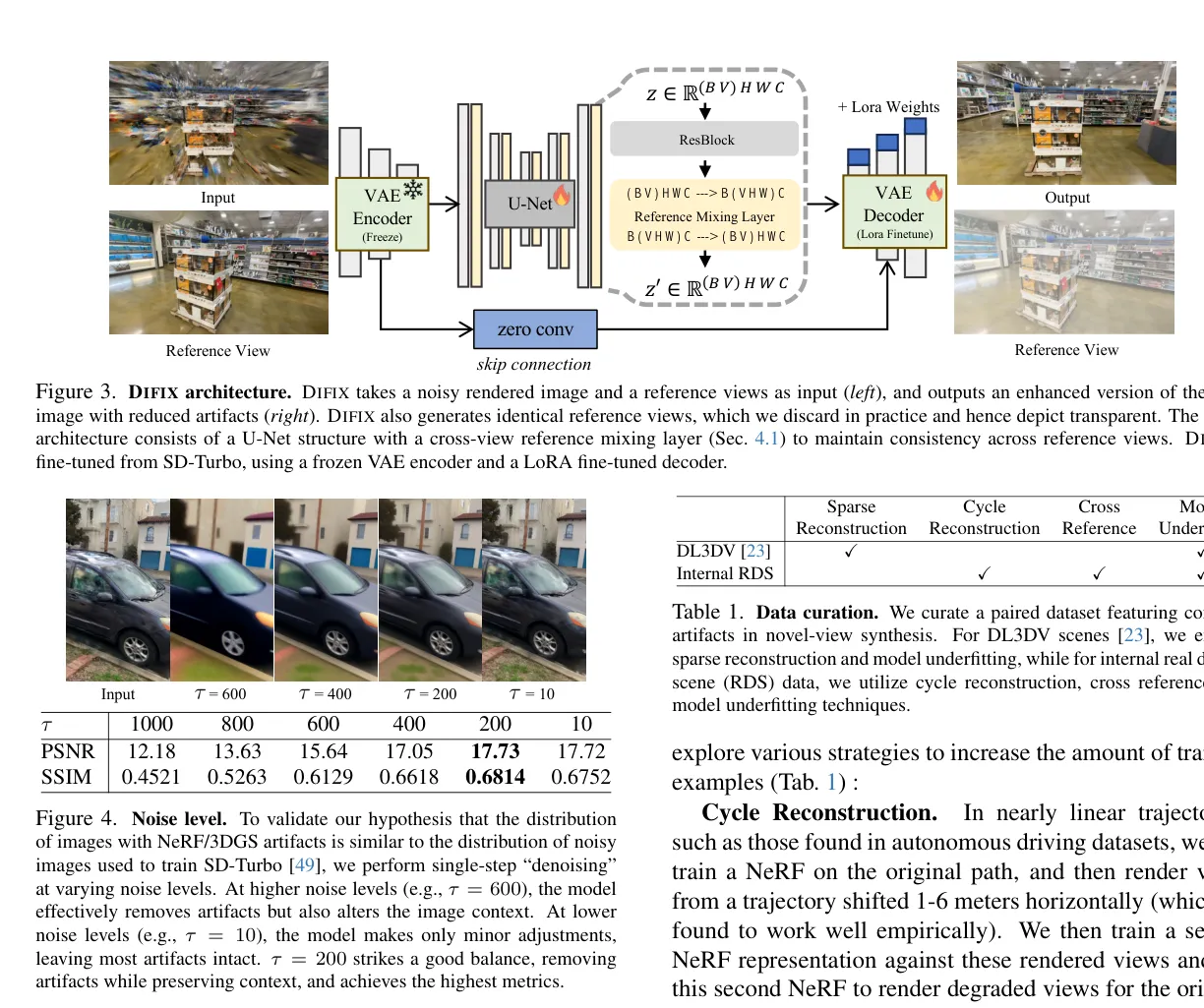
insight 原文:“the distribution of images degraded by neural rendering artifacts Ĩ resembles the distribution of images xτ originally used to train the diffusion model at a specific noise level τ.” —— NeRF/3DGS 伪影图(模糊/floaters/缺失)统计上像扩散训练时某噪声级 τ 的半噪声图 xτ。所以:直接把退化渲染图当作 x_{τ=200} 喂进去、做单步去噪,就能修掉伪影(而非从纯噪声 τ=1000 生成)。
Fig.4 实证(预训练 SD-Turbo 单步去噪扫 τ,越高/越低都差):
| τ | 1000 | 800 | 600 | 400 | 200 | 10 |
| PSNR↑ | 12.18 | 13.63 | 15.64 | 17.05 | 17.73 | 17.72 |
| SSIM↑ | 0.4521 | 0.5263 | 0.6129 | 0.6618 | 0.6814 | 0.6752 |
读表 + why:τ=600 能去伪影但 “alters the image context”(噪声当太多 → 模型自由 hallucinate → 改了内容、与 GT 矛盾,PSNR 仅 15.64);τ=10 “makes only minor adjustments, leaving most artifacts intact”(几乎没去伪影,PSNR 17.72 高是因为没动原图,但 SSIM 0.6752 略低、伪影还在);τ=200 兼顾(去伪影 + 保内容,PSNR/SSIM 均最高)。故 DIFIX 固定 τ=200。
损失:L=L_Recon(L2 to GT)+L_LPIPS+0.5·L_Gram。Gram loss(式4-5)=Σˡ βˡ‖Gˡ(Î)−Gˡ(I)‖²,Gˡ(I)=ϕˡ(I)ᵀϕˡ(I)(VGG-16 第 l 层特征的自相关矩阵)。why Gram:Gram 矩阵编码"纹理统计"(特征通道间相关),匹配它 → 鼓励锐利细节/纹理,弥补 L2/LPIPS 偏糊的倾向。
⑤ §4.1.1 配对数据 curation(4 策略造"伪影↔clean"对,Table 1)
为什么需要多策略:训练 DIFIX 需大量 (含伪影图, clean GT) 配对。最直接的 sparse reconstruction(每 n 帧训一个 3D,其余帧当 novel)只在 DL3DV(轨迹偏离大)好用;多数 NVS 数据集 held-out 视角仍看同一区域 → 退化不显著。故补三招:
① Sparse Reconstruction:每 n 帧训 3D、剩余 GT 配渲染 novel(DL3DV)。② Cycle Reconstruction(驾驶近直线轨迹):先在原轨迹训 NeRF → 渲染横移 1-6m 的轨迹 → 用这些图训第二个 NeRF → 再用它渲原轨迹(有 GT)的退化图。③ Model Underfitting:只训 25%-75% epoch 造比 hold-out 更显著的伪影,配对应 GT。④ Cross Reference(多相机):只用一个相机训、渲其余 held-out 相机(选 ISP 相近的保视觉一致)。配置(Table 1):DL3DV 用 ①③;驾驶 RDS 用 ②③④。
⑥ §4.2 DIFIX3D 渐进更新 + DIFIX3D+ 实时后处理
为什么不能只逐帧 DIFIX?原文:生成模型天然 “inconsistencies across different poses/frames”——逐帧独立修 → 每帧修法不同 → 跨帧 flickering(Fig.8 第一列直接 DIFIX)。解法=把 DIFIX 输出 distill 回 3D 表示,让 3D 表示充当"多视一致性的强制器"。
DIFIX3D 渐进更新(仿 Instruct-NeRF2NeRF [14]):“当目标轨迹离输入太远,conditioning 变弱、模型被迫 hallucinate 更多”。故渐进:先用参考视优化 3D → 每 1.5k iter 把 GT 位姿轻微向目标扰动 → 渲染 novel → DIFIX 精修(此时步子小、conditioning 强、少 hallucinate)→ 加入训练集 → 再 1.5k iter。逐步"长大"参考↔目标的 3D 线索重叠 ⇒ conditioning 始终够强 ⇒ 一致且无伪影。
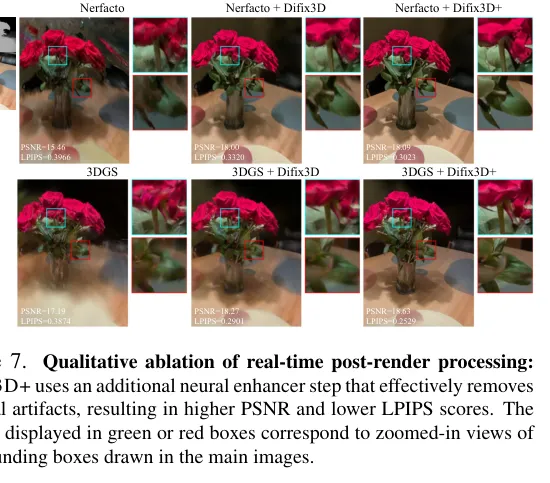
DIFIX3D+ 实时后处理:即便 distill 后,因生成轻微多视不一致 + 重建表示容量有限,仍有残余模糊 → 渲染末端再过一遍 DIFIX 去残余伪影。单步仅 76ms(A100),比多步扩散快 >10×,且保持一致。
⑥′ 具体化:渐进更新 + 三步流水线走一遍(Fig.2)
给定蓝相机=训练视、红相机=目标视(远)、橙相机=沿渐进轨迹的中间 novel 视。Step 1:用预训练 3D 渲染一个橙视(位姿=训练视向目标插值一小步)→ 喂 DIFIX(+最近训练视当参考)→ 去伪影得 clean 橙视。Step 2:把这张 clean 橙视 distill 回 3D(加入训练集再训 1.5k iter)→ 3D 表示在该方向"长"出可靠几何。重复 Step 1-2:橙相机一步步逼近红相机,每步条件都强(因为只比上一步远一点点)→ 参考↔目标 3D 线索重叠持续扩大。Step 3:最终在红目标视渲染后,再过一遍 DIFIX 做 76ms 后处理去残余模糊。关键:若跳过中间橙视、直接在远红视 query DIFIX,条件太弱 → 大面积 hallucinate → 不一致(这正是 Table 4(b) 一次性 distill 退化的原因)。
Q&A · 几个 why 追问
0 为什么"distill 回 3D"就能强制多视一致?3D 表示(NeRF MLP / 3DGS 高斯集)是单一的、几何自洽的场景——从它渲染任意视角都来自同一套底层几何/颜色,天然多视一致。把 DIFIX 的(各帧略不一致的)输出当监督去优化这一个 3D 表示,相当于让 3D 表示对多帧做"一致性平均/调和" → 再从它渲染就不 flicker 了。逐帧独立 DIFIX 没有这个共享几何,故会闪。
1 为什么用单步而非多步扩散?多步去噪慢,无法实时后处理;SD-Turbo 已用对抗蒸馏把扩散压成单步 → 一步出图 76ms。这是"推理期也能用同一模型当增强器"的前提。
2 同一个 DIFIX 为何能通吃 NeRF 和 3DGS?训练数据1:1 混合两种伪影;且 NeRF/3DGS 伪影本质都是欠约束区的 floaters/blur/missing,统计上都落在 τ=200 噪声分布附近 → 同一去噪映射可修。
3 为什么 PSNR 只 +1dB 而 FID 2-3×?PSNR 是逐像素、对色偏敏感;DIFIX 的提升主要在感知(锐度、合理纹理、去 floaters)→ 体现在 LPIPS/FID。PSNR 升而非降 恰好排除"瞎编内容"(若 hallucinate 错内容 PSNR 会掉)→ 证明保真未退、是真改善。
4 reference view 怎么选、为何只取最近训练视?取最近训练视——它最 clean、与目标视空间重叠最多 → 给跨视 attention 提供最可靠的"正确答案"参照。
⑦ §5 实验 — 关键数值表(In-the-wild,PSNR↑/SSIM↑/LPIPS↓/FID↓)
设置:在 DL3DV 80% 场景(112/140)造 8 万对 noisy-clean(NeRF:3DGS=1:1)训 DIFIX;在 DL3DV 28 held-out + Nerfbusters 12 capture 上评测,参考/目标视按相机位置分两簇保证大偏离。Table 2(粗体=最佳):
| 方法 | Nerfbusters | DL3DV | ||||||
| PSNR | SSIM | LPIPS | FID | PSNR | SSIM | LPIPS | FID | |
| NeRFLiX | 17.91 | 0.656 | 0.346 | 113.6 | 17.56 | 0.610 | 0.359 | 80.7 |
| Nerfacto | 17.29 | 0.621 | 0.402 | 134.7 | 17.16 | 0.581 | 0.430 | 112.3 |
| DIFIX3D (Nerfacto) | 18.08 | 0.653 | 0.328 | 63.8 | 17.80 | 0.596 | 0.327 | 50.8 |
| DIFIX3D+ (Nerfacto) | 18.32 | 0.662 | 0.279 | 49.4 | 17.82 | 0.613 | 0.283 | 41.8 |
| 3DGS | 17.66 | 0.678 | 0.327 | 113.8 | 17.18 | 0.588 | 0.384 | 107.2 |
| DIFIX3D+ (3DGS) | 18.51 | 0.686 | 0.264 | 41.8 | 17.99 | 0.602 | 0.293 | 40.9 |
读表:FID 是头条——Nerfacto 134.7→49.4、3DGS 113.8→41.8(近 3×);LPIPS 各降 ~0.1;PSNR 升 ~1dB。且全面超 Nerfbusters/GANeRF/NeRFLiX 等所有 NVS 增强 baseline。DIFIX3D → DIFIX3D+ 的差(如 Nerfacto FID 63.8→49.4、LPIPS 0.328→0.279)= 推理期后处理那一步的净增益。
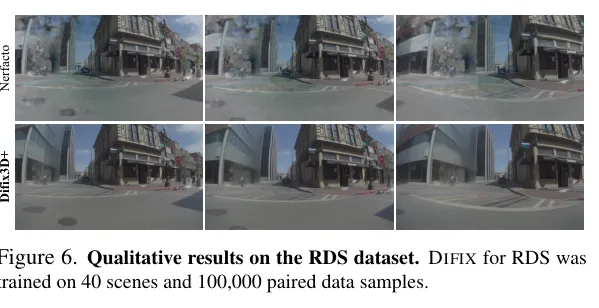
驾驶 RDS(自建,Table 3,Nerfacto backbone):Nerfacto 19.95/0.493/0.530/91.38 → +NeRFLiX 20.44/0.567/0.469/116.3(FID 反升=变差) → +DIFIX3D 21.52/0.570/0.427/77.83 → +DIFIX3D+ 21.75/0.583/0.402/73.08,全面超 NeRFLiX。⚠️ RDS 数据集自建非公开 → 该结果外部不可复现(诚实边界)。
⑧ §5.3 消融(两张关键表,证明每个设计都不可省)
Table 5 · DIFIX 组件(Nerfbusters,LPIPS↓/FID↓):pix2pix-Turbo(τ=1000) 0.381/108.9 → DIFIX(τ=200) 0.319/61.8 → +Gram 0.306/55.5 → +Reference 0.2996/47.9。单是把噪声 1000→200 就贡献最大跳变(FID 108.9→61.8)——原文:高噪声 “causes the model to generate more hallucinated pixels that contradict the ground truth, resulting in poorer generalization”。Gram/Reference 再锦上添花。
Table 4 · 流水线(Nerfacto baseline 起,逐步加 a/b/c/d):
| 配置 | PSNR | SSIM | LPIPS | FID |
| Nerfacto | 17.29 | 0.621 | 0.402 | 134.65 |
| +(a) 仅逐帧 DIFIX(无 3D 更新) | 17.40 | 0.628 | 0.2996 | 49.87 |
| +(a)+(b) 一次性 distill(非增量) | 17.97 | 0.656 | 0.3424 | 75.94 |
| +(a)+(b)+(c) 增量 distill = DIFIX3D | 18.08 | 0.653 | 0.328 | 63.77 |
| +(a)+(b)+(c)+(d) = DIFIX3D+ | 18.32 | 0.662 | 0.279 | 49.44 |
读表(关键洞察):(a) 仅逐帧 DIFIX 的 LPIPS/FID 看着已很好(0.2996/49.87)但跨帧 flicker、欠观测区差(单帧指标掩盖了不一致);(b) 一次性灌全部 pseudo-view 反而退化(LPIPS 0.2996→0.3424、FID 49.87→75.94)——因为远/弱条件视角被 hallucinate 污染;(c) 改增量 distill 才稳(DIFIX3D);(d) 再加推理后处理(DIFIX3D+)所有感知指标再升。结论:增量更新 + 后处理缺一不可。
📌 全文一页总结(问题→方法→实验→takeaway)
问题(§1):NeRF/3DGS per-scene 优化无数据先验 + shape-radiance ambiguity,极端/欠约束新视角伪影严重;2D 扩散先验强但 lift 到 3D 慢(每步 query)且多视不一致。
方法(§4):DIFIX=SD-Turbo 微调的单步 image-to-image artifact fixer(冻 VAE enc + LoRA dec + reference mixing 跨视 attention + τ=200 低噪声 + Gram 损失),核心洞察"伪影分布≈τ=200 噪声分布"故修伪影=单步去噪;DIFIX3D 用它造 pseudo-view 渐进 distill 回 3D(每 1.5k iter 向目标小步扰动位姿,保 conditioning 强、多视一致);DIFIX3D+ 再在推理末端做 76ms 实时增强;4 种数据 curation 策略造伪影配对。
实验(§5):NeRF/3DGS 通吃,Nerfbusters/DL3DV 上 FID 近 3×、LPIPS −0.1、PSNR +1dB,超 Nerfbusters/GANeRF/NeRFLiX;驾驶 RDS 同样全面超 NeRFLiX;消融证明低噪声 τ=200、增量更新、推理后处理三者缺一不可。
Takeaway:① 把"修 3D 渲染伪影"重述成"在恰当噪声级(τ=200)做单步扩散去噪 + distill 回 3D 保一致",是高效、可实时、跨表示 lift 2D 先验到 3D 的实用范式;② 单步是"训练 distill + 推理增强同模型双用"的前提;③ 渐进/增量更新是保长程一致的关键(一次性灌入反而退化);④ 边界=生成天然多视不一致需 distill 兜底(直接逐帧会 flicker)、RDS 非公开不可复现、增益主要在感知指标(PSNR 仅温和 +1dB 但恰证未瞎编)。
🖼 论文原图(本地 PDF 截图,原文 caption 未改写)