GenCeption:视频生成模型是通用视觉学习器
核心一句:类比 NLP 里 next-token prediction 把上千个语言任务收敛成一个通才大模型,本文主张 大规模 text-to-video 生成 就是计算机视觉那个"缺失的通用预训练目标"——它天然提供 时空先验 + 视觉语言对齐 + 可扩展性。把一个预训练视频扩散模型(WAN 2.1)单步前馈化、用文本指令驱动,就得到一个统一架构做深度/法向/相机位姿/指代分割/3D 关键点的通才感知模型 GenCeption,多任务匹配甚至超过各自的专用 SOTA,且数据效率高出 7–500×。
1 · Abstract 逐句精读
🔍 指路:开门见山用 NLP 类比抛问题——语言靠 next-token prediction 从"一任务一模型"走到"一个通才大模型",那 计算机视觉的等价催化剂 是什么?全文就是回答这一问。
🔍 指路:核心论点——大规模 text-to-video 生成 = CV 的强预训练范式。理由三件套:(1) 时空先验(生成逼真视频必须懂 3D 几何、物体恒存、物理);(2) 视觉语言对齐(模型本就以文本为条件);(3) 可扩展性(视频生成已被大规模数据+算力 scale 过)。这正好对应通用视觉智能所需。
🔍 指路:方法命名 + 一句话定义——拿预训练视频生成扩散 backbone,定义一个 前馈(feed-forward)感知模型,用 文本指令 驱动做各种视觉任务。关键词 feed-forward:把扩散那套"多步迭代采样"改成一次前向(§3.2 详解)。
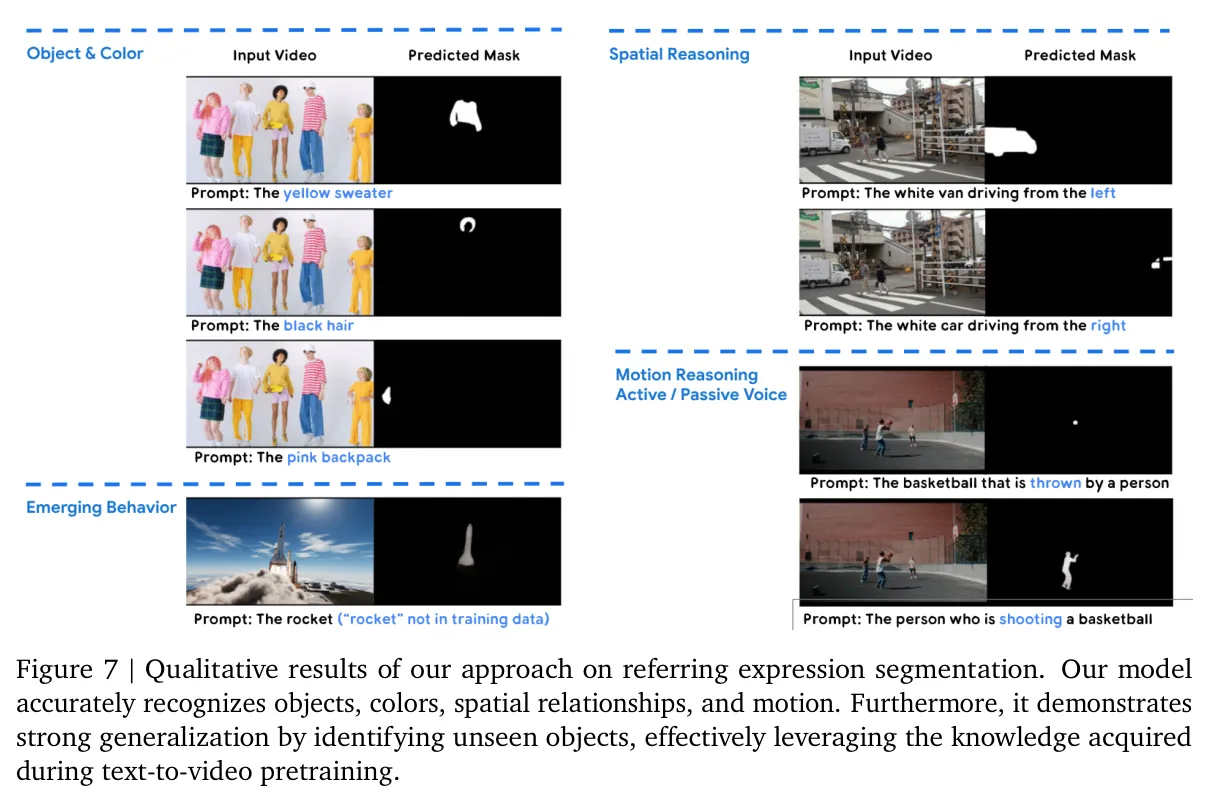
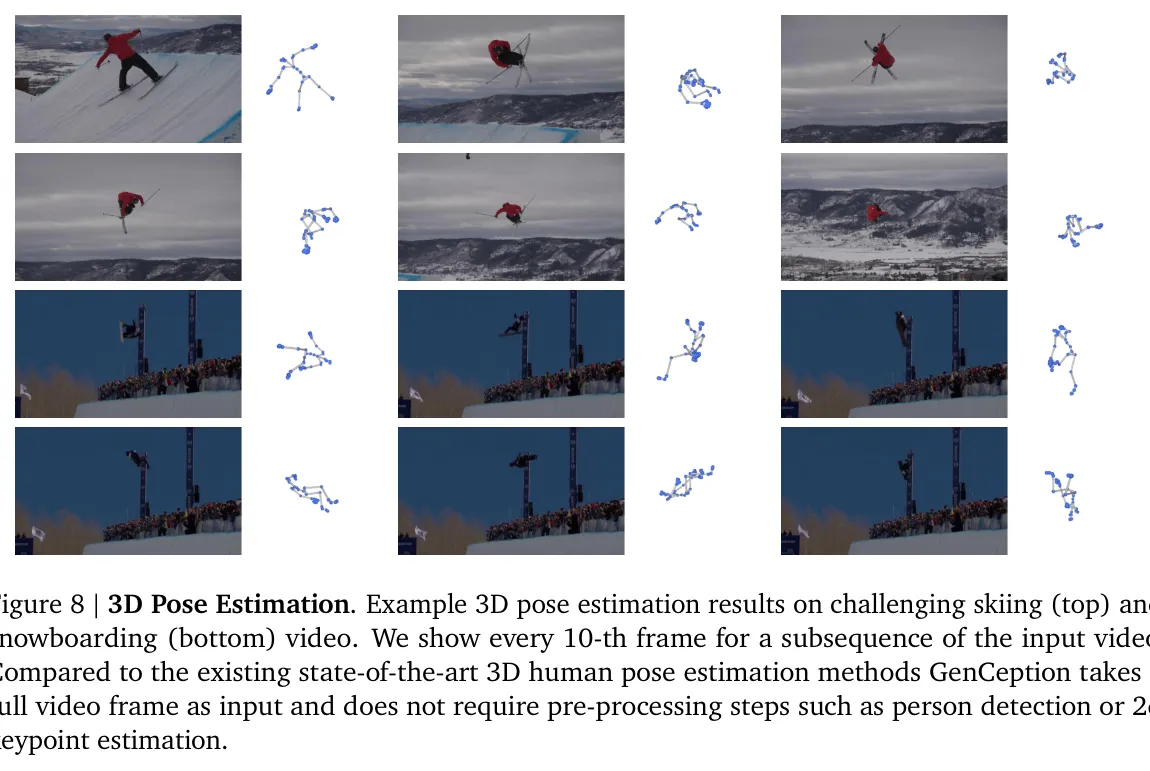
🔍 指路:结果——覆盖 深度 / 表面法向 / 相机位姿 / 指代分割 / 3D 关键点 一大票任务,匹配甚至超过各自的专用模型。注意点名的对手 D4RT(CVPR2026 Best Paper)、VGGT-Ω 都是重量级几何模型。
🔍 指路:三个补充卖点:(1) 同等条件下 视频生成预训练 > V-JEPA / VideoMAE(后面消融证明是"生成目标本身"起作用,不只是数据/规模);(2) 初步 scaling(越大越好);(3) 数据效率 7–500×(用极少训练数据追平顶尖模型)。
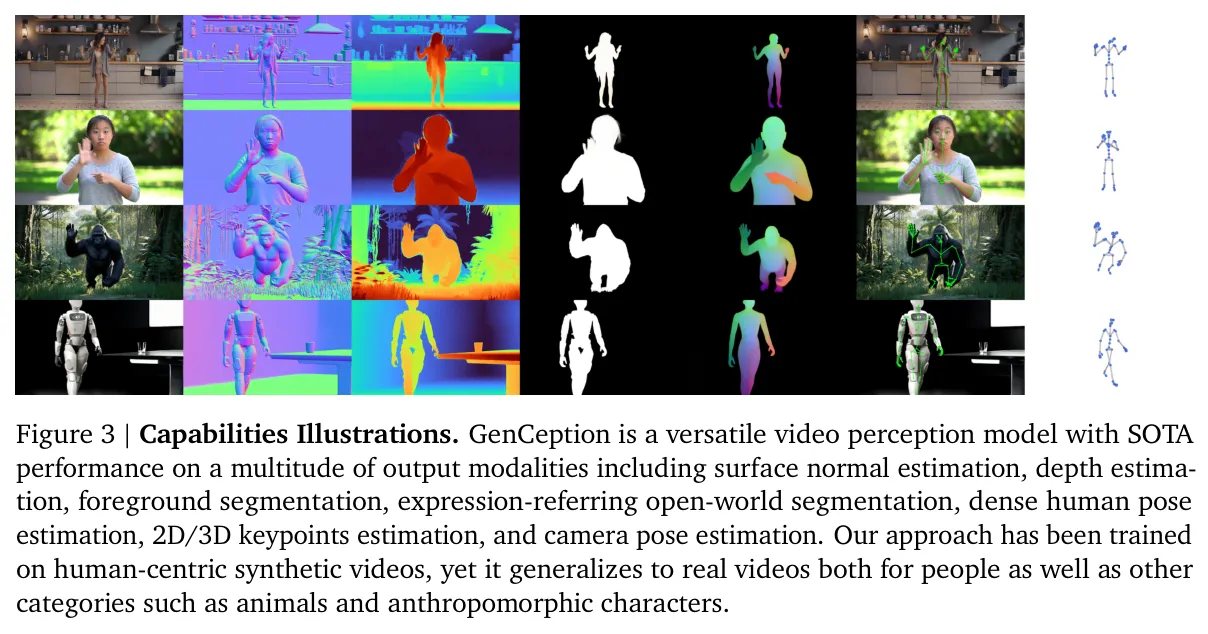
🔍 指路:涌现行为 + 立意拔高——只用 合成人类视频 训练,却能泛化到 真实画面 + OOD 类别(动物、机器人)。结论上升到:视频生成不只是"合成工具",而是通往物理世界通用视觉智能的 基础路径。
2 · Introduction:problem → 三大要求 → 范式转变
SAM、Depth Anything 再强,也还是 一任务一套定制架构;CV 还没有一个像 LLM 那样"从通用预训练到万能涌现"的 统一视觉基础模型。作者把"找通用视觉模型"重述为"找一个通用预训练目标——视觉版 next-token prediction"。
"The world is a 4D continuum. The pre-training objective should force the model to internalize the 4D temporal causality and physics of a world in motion." —— 逼模型内化 4D 时序因果与物理。
"visual features should be natively aligned with linguistic semantics" —— 视觉特征与语言语义原生对齐,才能继承指令跟随 + 常识。
"scaled in both data and compute, ultimately enabling the emergence of vision intelligence." —— 数据/算力可 scale,最终涌现视觉智能。
🔍 为什么是 text-to-video generation:作者论证它 唯一同时满足三条(对比对比学习、MAE):生成高保真视频→逼出时空先验(①);原生以文本为条件→自带视觉语言对齐(②);标注成本低+商业价值高已被大规模 scale(③)。
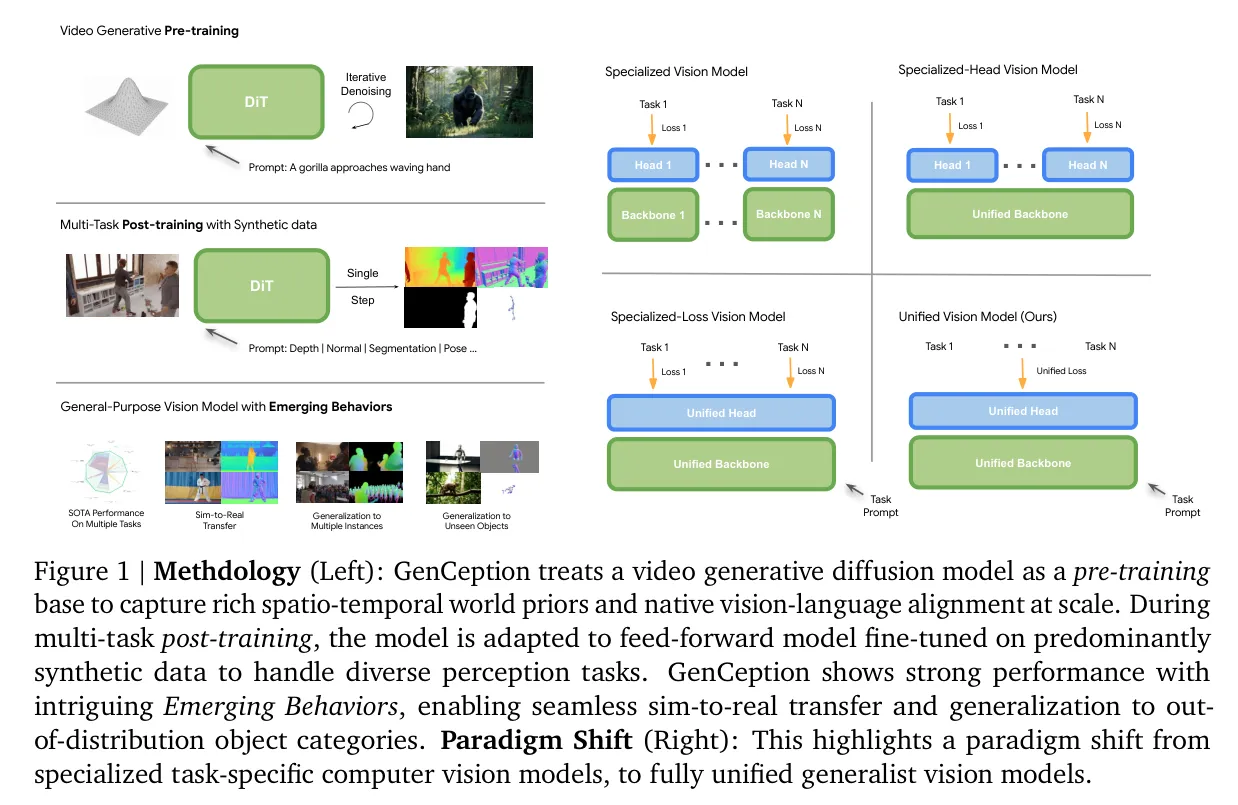
从"专用"到"统一"的四象限演进:Specialized(每任务独立 backbone+head+loss)→ Specialized-Head(统一 backbone、各任务 head/loss)→ Specialized-Loss(统一 backbone+head、各任务 loss)→ Unified(Ours):统一 backbone + 统一 head + 统一 loss,任务只由 text prompt 指定。
🔍 关键思想(贯穿全文):加一个新视觉任务,不再改架构/改 recipe,只改数据格式——就像 LLM 把各种任务都转成"文本进文本出"。这才让"无限扩任务谱系"成为可能。
3 · 📚 背景块(外部知识,非本文原文,读懂 method 必需)
text-to-video 扩散模型三件套:VAE 编解码器(视频↔latent)+ text encoder + DiT(latent 上的 Transformer 扩散器)。训练时从噪声出发多步去噪成视频。Rectified Flow 变体让模型预测 velocity
v = ε − x0(噪声与干净数据之差),推理时沿这个速度场积分。GenCeption 正是利用这个 v 的定义做"单步前馈"(§4)。前作把预训练图像扩散改成感知器:Marigold(SD → 单目深度)、GenPercept(系统研究 feature injection / decoding / 目标)、Diception(文本指令驱动多任务)。视频侧:DepthCrafter/NormalCrafter/Geo4D/DiffusionRenderer/ReferEverything 等,但多聚焦单一 dense 任务。GenCeption 的差异:统一 dense+sparse、单步前馈、跨广谱任务定量 SOTA。
MAE / VideoMAE:遮挡重建(masked modeling),纯视觉、无语言对齐。DINO:特征级自蒸馏。V-JEPA:latent 空间特征预测(LeCun 线)。CLIP / SigLIP:图文对比学习,有语言对齐但视频级 scaling 受限。GenCeption 的消融正是拿 WAN 对打 V-JEPA / VideoMAE V2。
把相机外参(旋转+平移,传统写成矩阵)表示成每像素一条光线的 map(ray origin + ray direction),与视频生成的"像素/RGB"格式天然对齐。GenCeption 用它把 6 通道相机信息塞进 3 通道 RGB("Rothko" raymap,§4.3)。
[69] 提出"视频生成模型学到强视觉先验"的假说但走 training-free 多步生成 + 定性;Vision Banana [18]("Image generators are generalist vision learners")在 2D 图像空间。GenCeption 的定位:原生 video 域(抓时序一致)+ 高效 feed-forward + 更广任务的严格定量评测。它也是作者前作 human-centric 模型 THFM 的通用化升级。
4 · Method:把视频扩散模型改造成前馈感知器
3.1 三大方法论原则
用预训练 text-to-video 扩散模型作 universal backbone。核心守则:最大程度遵守原预训练 regime、最小改动,以完整保留其时空/几何/物理/语言对齐先验。
把各视觉任务当成统一 seq-to-seq 映射,不做任务专属 encoder/decoder/loss。把各目标模态格式化进 共享表征空间(dense→RGB)。
感知要"准且快",所以把多步生成 backbone 变成 单步前馈 感知模型。
3.2 从扩散预训练到感知微调(单步前馈的关键技巧)
预备:原 DiT 在 Rectified Flow 下预测 velocity v = ε − x0(x0=干净视频 latent,ε=噪声),去噪步 index 作额外输入调制。
🔍 指路(三个动作,全为"最小改动榨取特征"):
# 单步前馈感知的三步改造(相对原扩散推理)
1) 输入: 喂 干净 input-video latent(不是噪声)→ 只跑 一次 forward(丢弃 50 步迭代采样)
2) 条件时间步: 固定 t = 0(Rectified Flow 生成过程的终点 = 无噪声)
3) 输出取负: DiT 出的是 v = ε − x0 → 取负 −v = x0 − ε 更贴目标 latent,收敛更快、性能更好
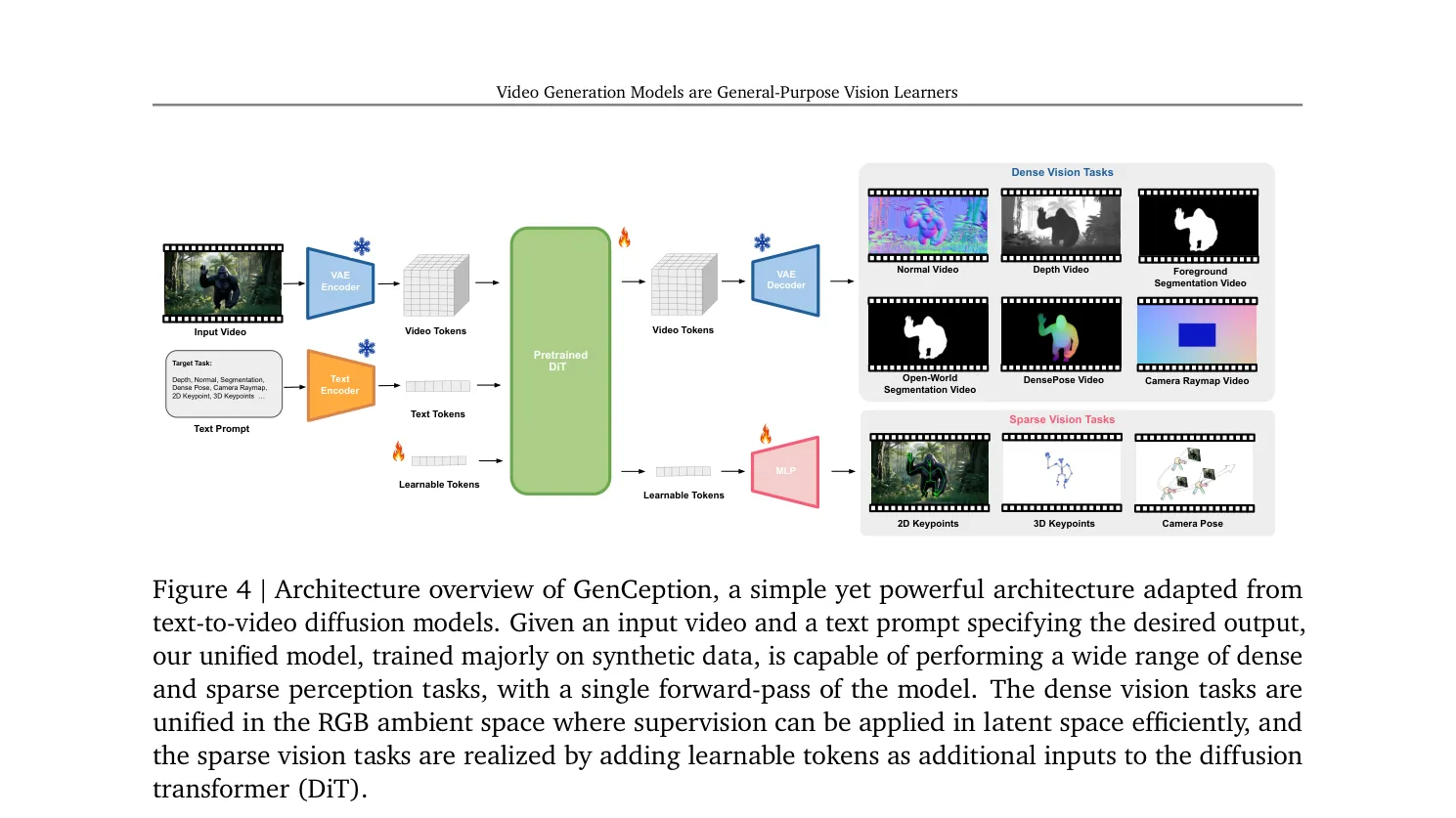
本质:把 DiT 当强 feature extractor。"we harvest features directly from the final layer rather than intermediate ones; this ensures they natively align with the subsequent decoder, without any architectural modifications to the base model." —— 取 最后一层 特征(不是中间层),天然对齐原 VAE decoder,backbone 零架构改动。
3.3 统一任务表示:dense 压进 RGB,sparse 用 learnable token
Dense 任务 → 统一 3 通道 RGB [0,1] 空间(backbone+decoder 全共享权重,任务只由 text prompt 切换):
| 模态 | 怎么塞进 3 通道 RGB |
|---|---|
| 深度 / 分割(单维) | 复制到 3 通道 |
| 表面法向 / DensePose(三维) | 3 通道各表一维 |
| 相机位姿(6 通道) | 用像素级 "Rothko" raymap:ray origin 放中心区、ray direction 放周边,拼进 3 通道(Figure 5) |
🔍 指路:把视觉任务投进 连续像素空间(视觉先验最强的原生域),就像 LLM 把万物转成文本串。Rothko raymap = 把相机 6 通道光线数据压成一张三通道色块图(形似 Rothko 抽象画:中心 origin、四周 direction),既保单-decoder 框架、又充分借用预训练视觉先验。
Sparse 任务(2D/3D 关键点等结构化坐标)→ learnable tokens:
🔍 指路:给 video latent 追加 T 个可学习 token(每帧一个)→ 过模型 → MLP 解出每帧 K 维目标。为守"最小改动":沿用 DiT 原生 3D RoPE;空间位置未知故设为 learnable;时间位置用 position interpolation 把 T 帧缩到 latent 长度 T′ 的范围内。这种"加 query"方式优于"加额外 attention 层"。
3.4 可扩展合成数据(human-centric)
多数真实数据集只含部分模态标注 → 用合成数据解稀缺:800 个 RenderPeople 资产 × 200 个 CMU mocap 动作 + 3D 场景/HDRI 背景 + 变焦距/相机位姿轨迹 → 共 7,500 段视频。Blender 分 render pass 出 normal/depth/segmentation GT;从 rigged 资产恢复关节位置作 2D/3D keypoint GT。离线预计算并 cache 成 video latents + text embeddings。
3.5 训练 recipe:一个 L2 loss 打天下,任务差异全甩给数据
🔍 指路:不给每个任务配专属 loss(那样要手调 loss 权重、扩任务就爆炸),而是 只用一个标准 L2(dense 在 latent 空间、sparse 在输出空间)。任务专属的处理 下沉到数据表示。以单目深度的 scale 歧义为例(通常要 scale-invariant loss)——这里在数据层解决:
# 深度:数据层消除 scale 歧义(无需 scale-invariant loss)
1) 用场景 median depth 归一化每段视频的深度图  # 消 scale 歧义
2) 非线性映射进 [0,1] RGB:  d' = clip( α · log(d + 1), 0, 1 )
   # α 动态调节"近景细节 ↔ 远景结构"的关注
于是任务间平衡只靠调数据混合比(data mixture ratio),完全类比 LLM 的做法。作者称之为 data-centric harmonization,认为能自然 scale 到更广的视觉任务谱系。
5 · 实验:多任务匹配/超越专用 SOTA + 数据效率 7–500×
5.1 实现要点
backbone = 开源开权重 WAN 2.1;480×832、81 帧 @24fps;VAE 时间 4× / 空间 8× 下采样。batch 64 on 256 v6e TPU,Adam lr 5e-5,15000 步,warmup 250。训练稳定性靠 gradient clipping + gradient dropping(梯度范数超高阈值就丢整个 batch)。深度补 TartanAir / Virtual KITTI / MVS Synth(+相机轨迹);指代分割用真实数据 MeViS / Ref-COCO / YouTube-VOS(其余任务纯合成)。
5.2 推理成本(单步前馈的收益)
| 模型 | 单 v6e TPU (81帧 480×832) | 吞吐 | 其中 DiT | VRAM |
|---|---|---|---|---|
| GenCeption 1.3B | 5.92 s | 13.6 FPS | 0.96 s | 15.3 GB |
| GenCeption 14B | 10.03 s | 8.0 FPS | 5.11 s | 42.8 GB |
共享 10GB text encoder + 0.25GB VAE(可 offload 到系统内存换 VRAM)。相比原扩散的 50 步迭代,单步前馈是数量级加速。
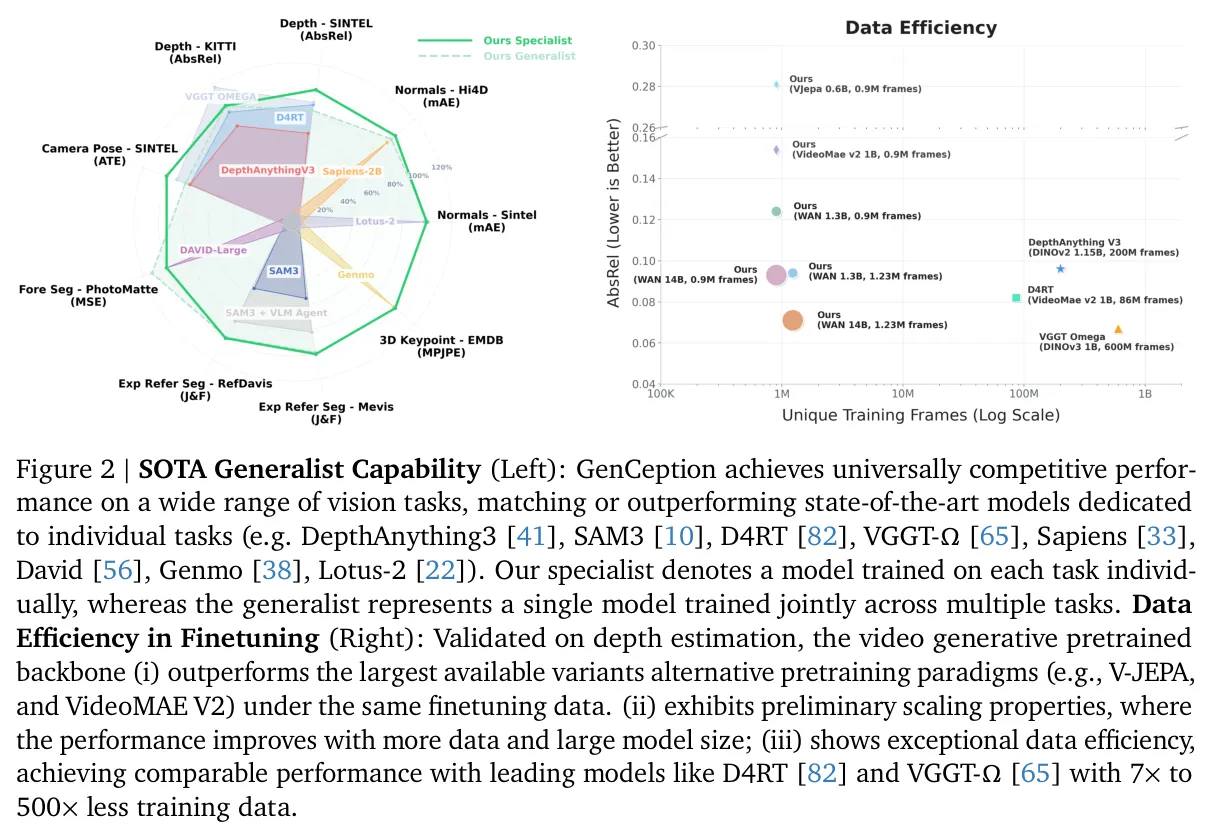
5.3 对比 SOTA 专用模型(Table 1 摘录)
| 任务 / benchmark | 代表专用模型 | GenCeption |
|---|---|---|
| Normal · Sintel (mAE↓) | NormalCrafter 30.7 · Lotus-2 30.3 | Specialist-L 29.7 · Generalist-L 29.3 |
| Camera Pose · Sintel (ATE↓) | DepthAnything3 0.201 · D4RT 0.148 · VGGT-Ω 0.145 | Specialist-L 0.130 |
| Depth · 见 5.4 数据效率表 | — | Avg AbsRel 0.093 |
| vs 统一生成基线 Diception (SD3 2B) | Normal 37.9 · CamPose ATE 0.500 | 29.3 · 0.130(全面更优) |
5.4 预训练范式对比 + 数据效率(Table 2,深度验证)— 全文最硬的实证
| 预训练 backbone | 规模 | 训练帧数 | Avg AbsRel↓ | Avg δ1↑ |
|---|---|---|---|---|
| Ours-V-JEPA-H | 0.6B | 0.9M | 0.281 | 52.2 |
| Ours-VideoMAE V2-H | 0.6B | 0.9M | 0.175 | 62.0 |
| Ours-VideoMAE V2-G | 1B | 0.9M | 0.154 | 66.9 |
| Ours-WAN 2.1-S(视频生成预训练) | 1.3B | 0.9M | 0.122 | 85.8 |
| Ours-WAN 2.1-L | 14B | 0.9M | 0.093 | 90.7 |
| DepthAnything V3-G | 1.15B | ~200M | 0.096 | 89.1 |
| D4RT | 1B | ~86M | 0.082 | 91.7 |
| VGGT-Ω | 1B | ~600M | 0.067 | 95.2 |
🔍 两个结论:(1) 同 fine-tune 数据下,WAN(视频生成预训练) 完胜 VideoMAE V2 / V-JEPA(0.9M 帧:WAN-S 0.122/85.8 vs VideoMAE-G 0.154/66.9 vs V-JEPA 0.281/52.2)——是"生成式扩散目标本身"在起作用,不只是数据/规模;(2) 数据效率:WAN-L 仅用 0.9M 帧 就达 Avg 0.093/90.7,追平 DepthAnything3 的 ~200M 帧(约 222× more)、逼近 D4RT 的 ~86M 帧——这就是 abstract 说的 7–500× less data。
6 · 消融 + 涌现行为(最关键的 insight 在这)
6.1 联合(generalist) vs 单任务(specialist):sparse 任务是软肋
🔍 指路:foreground 分割在联合训练下一致受益;但 3D 关键点(sparse)严重退化。根因两点:① token 式坐标回归 偏离了 backbone 的"连续像素空间"预训练;② 从头训的 learnable token 扰乱了预训练 DiT 的原生 attention、损坏其优化好的特征。核心 insight(呼应 §3.1 原则①):后训练要尽量少改 backbone 架构——凡是偏离预训练形态的改动(如加 token)都要付代价。
6.2 预训练的重要性:是"生成目标"本身,不只是数据/规模
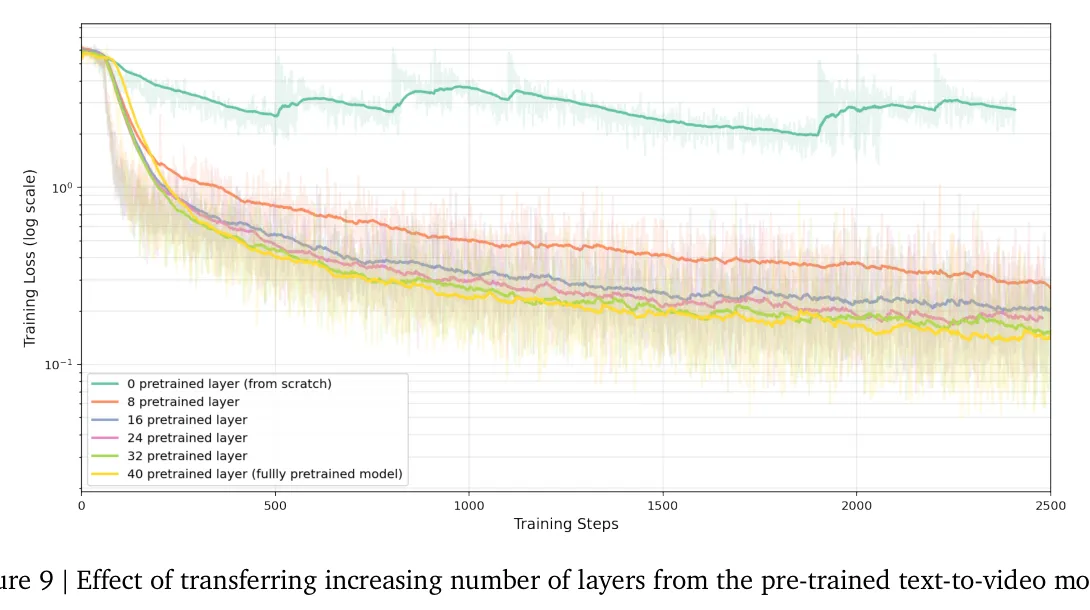
🔍 指路:两条证据钉死"预训练是关键":① 同数据下 WAN 完胜 V-JEPA/VideoMAE(§5.4);② 从头训随机 DiT → 学习曲线几乎是平的;迁移越多预训练层、性能越好(Figure 9)。所以性能来自"视频生成预训练",不是架构或 fine-tune 数据本身。
6.3 涌现行为(emergent behaviors)
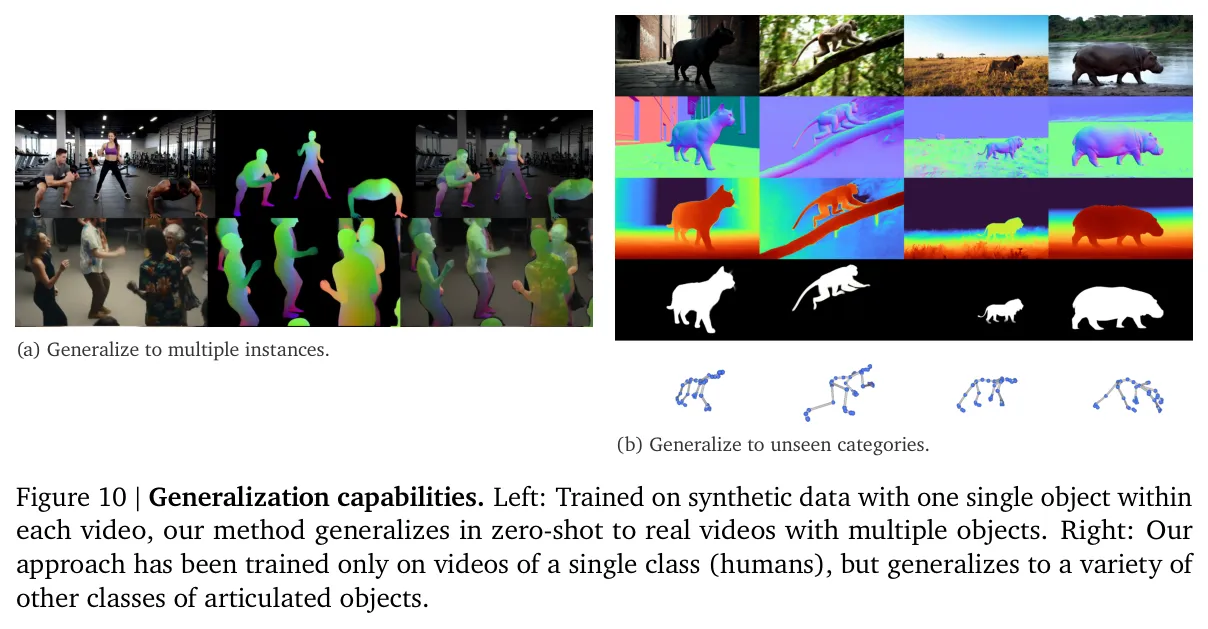
纯合成视频训练,却在真实视频上刷新 SOTA;输出细节(猫的胡须、头发软分割)甚至超过 Blender 训练数据本身的质量。
每段合成视频只有一个物体,却 zero-shot 泛化到多物体真实场景。
只训人类,却泛化到动物、拟人角色等 out-of-distribution 关节物体。
🔍 指路:作者把这些归因于"大规模 text-to-video 生成学到的丰富表征",并据此论证生成式视频 backbone 内部存在一个通用 "world model"。
7 · 逐机制追问 Q&A
作者的论证是"唯一同时满足三要求":① 时空先验——要生成高保真、时间一致的视频,模型被逼着内化 3D 几何、物体恒存、物理交互(MAE/对比学习没有这种"预测未来"的压力);② 视觉语言对齐——text-to-video 本就以文本为条件,天生带对齐(MAE/DINO 是纯视觉、无语言);③ 可 scale——视频生成因标注成本低、商业价值高已被大规模 scale(视频表征学习器普遍还小几个数量级)。消融进一步证明:同数据下 WAN 完胜 V-JEPA/VideoMAE,说明是生成目标本身在贡献。
原扩散要跑 50 步迭代采样,太慢且是"生成"不是"预测"。GenCeption 把它当特征提取器:直接喂干净 input latent、只跑一次、conditioning 时间步固定 t=0(= Rectified Flow 生成过程的终点、无噪声)。因为 DiT 学的是 velocity v = ε − x0,直接拿 v 当输出方向是反的;取负 −v = x0 − ε 才指向"干净目标"方向,和目标 video latent 对齐更好 → 实测收敛更快、性能更高。再从最后一层取特征,天然对齐原 VAE decoder,backbone 零改动。
这是全文的方法论支点——任务差异不进架构、只进数据表示。只要所有任务的输入输出都长得像"视频/RGB",就能共享同一个 backbone + decoder + loss,加新任务不改代码、只加数据。相机位姿本是矩阵、和"像素"格格不入,于是用 "Rothko" raymap 把 6 通道光线(origin+direction)拼进 3 通道色块图,让它也变成"视频"。类比:LLM 把翻译、摘要、问答全转成"文本进文本出",视觉这里就是"像素进像素出"。
作者把"任务专属定制"从 loss 下沉到数据表示。经典例子是单目深度的 scale 歧义(通常要 scale-invariant loss)——这里改成数据层:用场景 median depth 归一化 + 非线性映射 d' = clip(α·log(d+1), 0, 1) 直接消歧义并落进 [0,1]。于是 loss 永远是标准 L2,任务间平衡只靠调数据混合比,跟 LLM 一模一样。好处是扩任务时没有"手调 N 个 loss 权重"的工程爆炸。
正因为它破坏了"统一":sparse 任务要加从头训的 learnable token 做显式坐标回归,这①偏离了 backbone"连续像素空间"的预训练形态,②新 token 扰乱了预训练 DiT 已优化好的 native attention。所以它成了体系里的"异类",拖累整体。作者由此给出核心 insight:后训练要最小化对预训练 backbone 的架构改动;要支持高度异构任务,可能得从预训练范式层面重新设计。
两点降低这个疑虑:① 没用任何评测集的训练集,且除指代分割外纯合成训练——真实评测集对它是"域外",反而更难;② Table 2 是控制变量对比(同一 fine-tune 数据、只换预训练 backbone),WAN-L 用 0.9M 帧达 Avg AbsRel 0.093、追平 DepthAnything3 的 ~200M 帧。加上 emergent(合成→真实、人类→动物)说明它学的是可迁移的通用视觉先验而非死记评测分布。当然作者也诚实标注是"preliminary"scaling,规模仍有限。
三者都在"把视频世界模型的先验拿去干别的"这条主线上,但落点不同:Cosmos 造世界基础模型本身(tokenizer + 生成/预测未来);WVM 把 world model 先验 repurpose 成机器人价值模型(判断任务进度);GenCeption 把视频生成模型 repurpose 成通用感知模型(深度/法向/分割/位姿)。可以说 Cosmos 论证"世界模型能生成/模拟",WVM 和 GenCeption 分别论证"这套先验还能评估价值 / 做感知"——都是"video generative prior 是通用底座"的不同侧写。
8 · 全文一页总结
Problem:CV 还没有 LLM 那样"通用预训练→万能涌现"的统一基础模型;缺的是一个"视觉版 next-token prediction"的通用预训练目标。
Method:主张 大规模 text-to-video 生成就是这个目标(满足时空先验/视觉语言对齐/可扩展三要求)。GenCeption 拿预训练视频扩散 backbone(WAN 2.1),① 单步前馈化(喂干净 latent、t=0、negate velocity、取末层特征、backbone 零改动);② 统一任务表示(dense 压 RGB、相机用 Rothko raymap、sparse 用 learnable token);③ 统一 L2 loss,任务差异全甩给数据表示与配比;④ 主要用合成人类视频训练。
Experiment:depth/normal/camera pose/referring seg/3D keypoint 多任务匹配或超过 DepthAnything3 / SAM3 / D4RT / VGGT-Ω / Genmo 等专用 SOTA;同 fine-tune 数据下视频生成预训练完胜 V-JEPA/VideoMAE V2;数据效率 7–500×;单步前馈相比 50 步扩散数量级提速。
Takeaway:视频生成不只是合成工具,其内部存在可迁移的通用"world model",是通往物理世界通用视觉智能的基础路径。范式从"任务专属工程"转向"可扩展生成式预训练 + 数据格式设计"。
消融 highlight(去掉/改动某设计的代价)
| 改动 | 现象 | 说明 |
|---|---|---|
| generalist 联合训 vs specialist | 3D keypoint 严重退化、部分 dense 受损 | sparse 的 learnable token 偏离连续像素预训练、扰乱 attention → 最小改动 backbone |
| WAN 预训练 → V-JEPA / VideoMAE V2 | depth Avg AbsRel 0.093→0.28/0.15(同数据) | 是生成式扩散目标本身在贡献,非数据/规模 |
| 预训练层 → 从头训随机 DiT | 学习曲线几乎平的 | 预训练对下游收敛/性能必不可少(Fig 9) |
| 训练数据 0.9M 帧 vs 专用模型 ~200M | 仍追平 DepthAnything3 | 数据效率极高(7–500×) |
🖼 论文原图(本地 PDF 截图,原文 caption 未改写)